The best AI writing tool for SEO is Writesonic if you want one platform to research, draft, cite, optimize, and publish content for both Google and AI search. KoalaWriter is the better value for affiliate publishers, Surfer is stronger when optimization control matters more than one-click volume, and AirOps is the best fit for an enterprise team building custom content operations.
That does not mean one product should own every step. Most SEO teams save more money by choosing one primary writing engine, then adding a specialist only when it closes a measurable gap. Buying three tools that all research a SERP, generate an outline, and rewrite paragraphs usually adds cost rather than capability.
This guide compares 12 products that can generate or materially transform publishable text inside an SEO workflow. It focuses on the workflow behind the words: data inputs, output, automation depth, human review, publishing, scaling cost, and functional overlap. For broader research, technical, local, link, and measurement platforms, see our guide to the best AI SEO tools.
Research note: Product and pricing facts were checked against public official pages on August 5, 2026. This is an evidence-based editorial comparison, not a claim that every product was tested in a paid workspace. Vendor performance claims are not treated as independent proof of rankings, accuracy, or return on investment.
Quick picks
- Best overall: Writesonic, for a connected SEO and AI-search content pipeline.
- Best for affiliate publishers: KoalaWriter, for fast articles and product roundups at a low entry price.
- Best for optimization-led teams: Surfer, for SERP guidance, content scoring, and refresh decisions.
- Best brief-to-publish workflow: Frase, for research, drafting, audits, and CMS delivery.
- Best for brand governance: Jasper, for teams managing multiple voices, audiences, and campaign formats.
- Best enterprise automation: AirOps, for custom workflows, knowledge sources, approval gates, and large content operations.
AI writing tools for SEO compared
Pricing is a dated snapshot, not a permanent quote. Check the linked official pricing page before buying, especially where a vendor displays annual billing, promotional rates, credits, model multipliers, or usage-based overages.
| Tool | Best for | SEO data input | Automation | Human review | Entry pricing shown at cutoff |
|---|---|---|---|---|---|
| Writesonic | SEO and AI-search content pipeline | Keywords, live research, site and visibility data | High | Required | $79/month billed annually |
| KoalaWriter | Affiliate and lean publishing | SERP/web data and optional Amazon data | High | Heavy fact review | $9/month |
| Surfer | Optimization-led content teams | SERP competitors and page data | Medium to high | Required | $49 platform entry; full AI SEO from $99 |
| Frase | Brief-to-publish operations | Search results, brand voice, existing pages | High | Approval gates recommended | $39/month billed yearly |
| Scalenut | Value all-in-one SEO/GEO workflow | SERP/NLP data, clusters and site pages | High | Required | $59 monthly list; annual offer displayed |
| Jasper | Multi-brand governance | Brand Voice, knowledge and audiences | Medium to high | Brand approval | $59/seat/month billed yearly |
| AirOps | Enterprise content operations | Knowledge bases, models, data and integrations | Very high | Workflow owner required | Free Insights entry; production scales by tasks |
| ContentPen | End-to-end publishing automation | Website context, SERP data and GSC | Very high | Pre-publish QA required | $27/month billed annually |
| Byword | Programmatic SEO | Keywords, templates, CSV/API and brand knowledge | Very high | Sampling and data QA | From $99/month |
| Agility Writer | Mode-based long-form and bulk work | Live SERP, GSC and topical maps | High | Required | $28/month list; $1 trial displayed |
| SEOWriting.ai | Bulk WordPress publishing | Keywords, product URLs and NLP settings | Very high | Every batch needs review | $14/month billed annually; three free articles |
| NEURONwriter | Budget optimization plus drafting | SERP competitors, NLP terms and GSC | Medium | Editor-led | $23/month or $19 yearly equivalent |
What qualifies as an AI writing tool for SEO?
A product qualifies for this list when it can generate or materially transform publication-ready text and provide repeatable controls for an SEO content workflow. Native keyword data, SERP research, content scoring, brand governance, internal linking, and CMS publishing improve its fit, but a tool does not need every capability to qualify.
That boundary excludes three adjacent categories from the ranked list:
- General chat assistants. ChatGPT and Claude can brainstorm, draft, and edit, but they are not ranked here as complete SEO writing platforms because this comparison scores workflow controls around search evidence, optimization, governance, and publishing.
- Editorial QA utilities. Grammar, plagiarism, and AI-detection tools can review text, but reviewing text is not the same as producing an SEO content deliverable.
- Research-only SEO tools. A keyword database, crawler, or rank tracker may inform writing without generating or transforming the final article.
The important distinction is not “uses AI” versus “does not use AI.” It is the job the product owns. A writing engine owns drafting. An optimizer owns recommendations and scoring. An orchestration platform connects data, generation, review, and publishing. Buying across those layers can create a strong stack. Buying multiple products inside the same layer often creates overlap.
How to choose before you buy
Start with your bottleneck, not the longest feature list.
Choose by workflow owner
- A solo publisher usually needs a fast writing engine with controllable outlines and direct WordPress delivery.
- An SEO specialist often needs stronger competitor evidence, content scoring, refresh analysis, and editorial control.
- A content team needs brand knowledge, roles, approvals, and predictable handoffs.
- An agency needs workspaces, client separation, bulk production, export, reporting, and cost visibility.
- An enterprise content operation needs APIs, governed knowledge, approval gates, security controls, and an accountable workflow owner.
Compare the real scaling unit
“Unlimited words” rarely explains the final cost. Look for the unit that actually constrains production:
- articles or documents per month;
- generated words or model multipliers;
- credits consumed by different writing modes;
- audit pages and tracked prompts;
- projects, domains, workspaces, and seats;
- API calls, tasks, or overages;
- editorial hours required after generation.
The hidden cost is often human review. A cheap generator that creates ten hours of fact checking can cost more than a higher-priced system that preserves sources and approval steps.
Decide how much automation you can govern
Use four levels:
- Assist: AI rewrites, expands, or suggests inside an editor.
- Generate: AI creates a draft from a brief or keyword.
- Orchestrate: AI moves through research, outline, draft, optimization, and handoff.
- Publish and refresh: AI can schedule, update, or republish content with limited intervention.
Higher automation is not automatically better. The potential blast radius grows when a weak source, wrong template, or bad strategy is repeated across 100 pages.
1. Writesonic: Best overall for SEO and AI-search content workflows
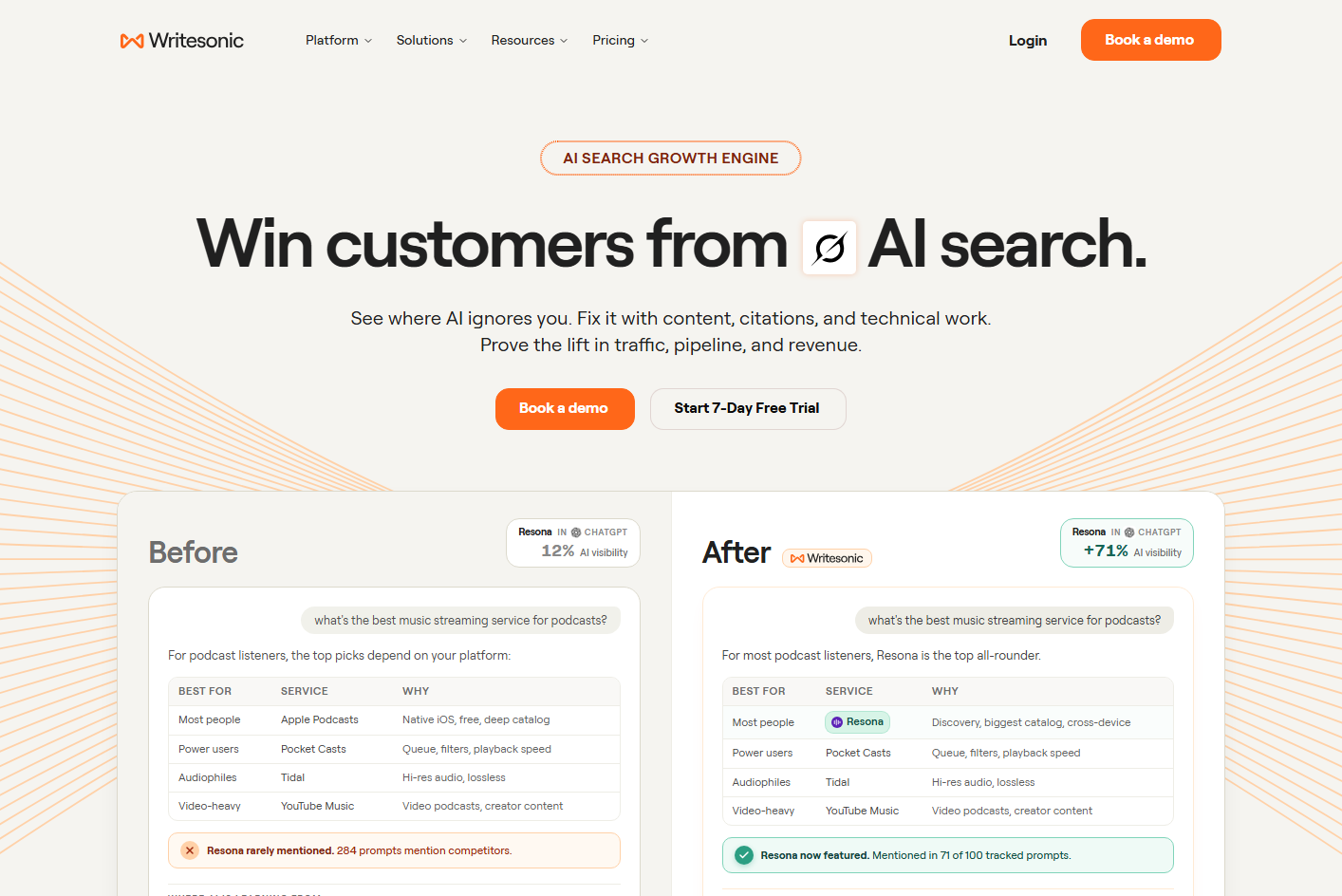
Best for: SEO teams and agencies that want research, writing, citations, optimization, AI visibility, and publishing in one platform.
Workflow snapshot:
- Product type: SEO and GEO content platform.
- Input: Keyword, live web and first-party sources, brand voice, site audits, and visibility data.
- Output: Researched article, citations, FAQs, schema, internal links, and CMS-ready content.
- Automation: High.
- Human review: Required for factual claims, original insight, legal risk, and final brand approval.
- Replaces or complements: Can replace a basic AI writer and some content-operations tooling; may complement a dedicated technical SEO or enterprise analytics stack.
Writesonic ranks first because its AI Article Writer covers more of the production chain than a prompt-based writer. Its public workflow describes research, outlining, section drafting, citation checks, brand voice, SEO structure, FAQs, schema, internal links, and publishing. The advantage is continuity: the evidence collected during research can follow the article into drafting instead of being lost between separate tools.
The platform is also broader than writing. The Writesonic pricing page packages article limits with site audits, AI-search tracking, projects, and agentic workflows. At the research cutoff, Starter displayed $79 per month billed annually with 15 AI articles per month. That price only makes sense if your team will use several parts of the platform.
Main limitation: Writesonic is easy to overbuy. A publisher who only needs five drafts a month may pay for visibility tracking, audits, and workflow features that already exist elsewhere in the stack. Before switching, compare the full platform with your present optimizer using our NEURONwriter vs Writesonic comparison.
Verdict: Choose Writesonic when consolidating research, creation, and AI-search work has more value than using best-of-breed specialists.
2. KoalaWriter: Best for affiliate publishers and lean SEO sites
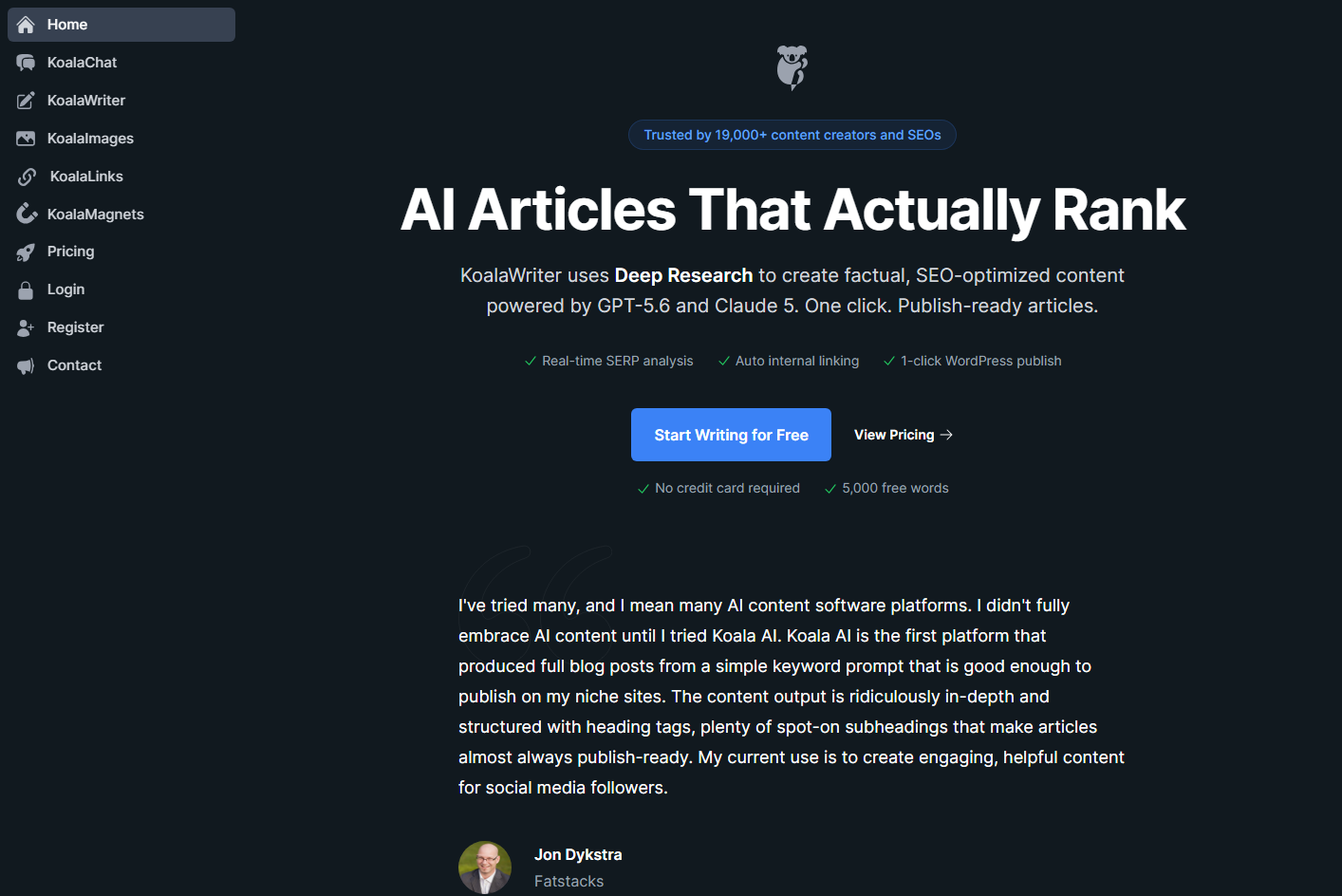
Best for: Affiliate publishers, niche-site operators, and small teams that want controllable long-form drafts without an enterprise platform price.
Workflow snapshot:
- Product type: One-click SEO article writer.
- Input: Keyword, real-time SERP and web data, outline controls, and optional Amazon product data.
- Output: Long-form article, product roundup, automatic links, and CMS-ready post.
- Automation: High.
- Human review: Heavy fact, product, intent, and disclosure review.
- Replaces or complements: Replaces a generic drafting tool for repeatable article formats; complements a stronger optimizer or editorial QA process.
KoalaWriter is the most practical low-cost pick for publishers whose main output is a blog article or product roundup. It provides outline control, bulk creation, automatic internal linking, and direct publishing to WordPress, Shopify, Webflow, or Ghost. The Amazon workflow is particularly relevant for affiliate content because product inputs are part of the article setup rather than an afterthought.
The Koala pricing page displayed an entry plan of $9 per month for 15,000 KoalaWriter words at the cutoff. Higher-end models can consume words at a multiplier, so the headline word allowance is not the only capacity number to watch.
Main limitation: Speed can hide a large verification burden. Real-time search data does not guarantee that a draft contains original experience, correct product specifications, or enough information gain to deserve a ranking. Product availability, prices, use cases, and recommendation language still need human checking.
Read our full KoalaWriter review for a deeper look at accuracy and editorial workload.
Verdict: Choose KoalaWriter when you need affordable, repeatable SEO drafts and accept that a capable editor still owns the final recommendation.
3. Surfer: Best for optimization-led drafting and refreshes

Best for: SEO specialists and editorial teams that want competitor-derived guidance, content scoring, refresh opportunities, and controlled AI assistance.
Workflow snapshot:
- Product type: Content intelligence and AI SEO platform.
- Input: SERP competitors, page content, brand knowledge, and performance signals.
- Output: Optimized draft, guidelines, audit, content ideas, and internal-link recommendations.
- Automation: Medium to high.
- Human review: Required to prevent score chasing, irrelevant term insertion, and homogenized coverage.
- Replaces or complements: Replaces a separate content scoring tool; complements a specialized high-volume writer when teams want stronger optimization control.
Surfer, whose current public brand is presented as Positive Surfer, is the best choice when the team trusts an editor to shape the article but wants the editor to work from consistent search evidence. Its pricing and plan page includes document creation or optimization, AI SEO guidelines, audit functions, brand workspaces, internal linking, and AI-search tracking depending on tier.
At the cutoff, Discovery displayed $49 per month billed yearly as the broader platform entry, while the full AI SEO workflow started with Standard at $99 per month billed yearly. Pro displayed $182. The $49 platform price should not be read as the entry price for the complete AI article workflow.
The key discipline is to treat Content Score as a diagnostic, not a writing target. A competitor-derived term can be relevant without belonging in every article. A high score cannot prove accuracy, originality, intent satisfaction, or conversions.
Main limitation: Surfer’s optimization depth can be unnecessary for a team that already owns a trusted brief and scoring system. It also overlaps heavily with Frase, Scalenut, NEURONwriter, and other content optimizers.
Verdict: Choose Surfer when editorial control and optimization consistency matter more than maximum one-click output.
4. Frase: Best for brief-to-publish content operations
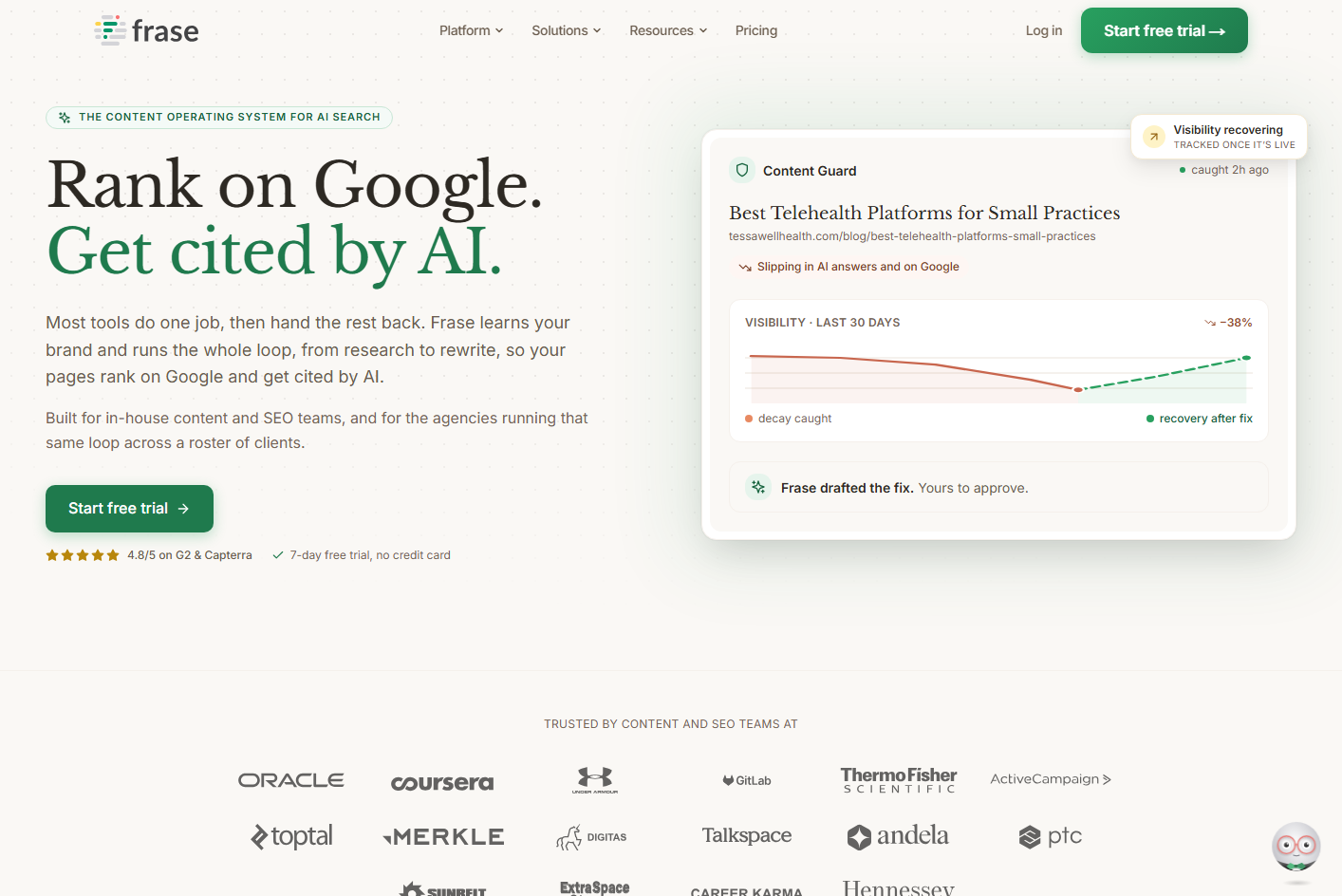
Best for: In-house content teams and agencies that want a structured loop from research and writing to audits, approval, publishing, and refreshes.
Workflow snapshot:
- Product type: SEO and GEO research, writing, audit, and publishing platform.
- Input: Search results, brand voice, existing pages, traffic changes, and CMS data.
- Output: Brief, article, optimized refresh, and published CMS page.
- Automation: High with approval controls.
- Human review: Recommended before automatic publication or a live-page update.
- Replaces or complements: Can replace separate brief, writer, content audit, and lightweight CMS workflow tools.
Frase is strongest when content work does not end with a draft. Its pricing page describes article creation, audit pages, Content Guard, AI visibility, CMS publishing, and agentic content types under one allowance structure. Starter displayed $39 per month billed yearly or $49 month to month, with 10 articles and 50 audit pages per month.
This makes Frase easier to budget than a purely usage-based orchestrator, but the allowances matter. An agency can hit article, audit-page, domain, or seat limits before it hits an AI word limit. Professional and Scale raise those caps and add more automated content types.
The most valuable control is not “auto-publish.” It is the ability to define which content types earn the right to publish automatically and which require approval. A glossary page has a different risk profile from a medical recommendation, financial comparison, or product review.
Main limitation: Frase overlaps with both optimizers and content-operations platforms. If your team already has a mature brief process and CMS automation, the incremental value may be smaller than the feature list suggests.
Verdict: Choose Frase when the bottleneck is moving content through a repeatable research, draft, audit, approval, and publishing loop.
5. Scalenut: Best value all-in-one SEO and GEO writing suite

Best for: Small teams that want keyword clustering, long-form writing, optimization, content audits, AI visibility, and publishing in one lower-cost suite.
Workflow snapshot:
- Product type: AI visibility, planning, writing, and optimization suite.
- Input: SERP and NLP data, keyword clusters, prompts, and existing site pages.
- Output: SEO/GEO article, optimized refresh, cluster, audit, and WordPress or Shopify publication.
- Automation: High.
- Human review: Required for evidence quality, differentiation, and search-intent decisions.
- Replaces or complements: Can replace a basic writer, keyword clustering tool, and content optimizer for a small team.
Scalenut offers the widest entry-level bundle in this comparison. Its AI writer page connects long-form generation with intent, terms, competitor structure, readability, and content guidance. The pricing page adds keyword clusters, AI-search visibility, GEO content audits, and publishing limits.
The page displayed a $59 monthly list price for Starter and a limited annual-equivalent offer from $24 per month at the cutoff. Because the page mixed list prices, limited offers, and different monthly allowances, compare the checkout period and exact limits instead of treating the promotional number as permanent.
Our Clearscope vs Scalenut comparison shows the underlying trade-off: focused editorial simplicity versus a broader automation suite.
Main limitation: Breadth creates complexity. Teams need to map which module owns discovery, writing, optimization, and tracking, or Scalenut becomes another overlapping dashboard.
Verdict: Choose Scalenut when you want broad SEO and GEO capability at a lower entry cost and are willing to manage a denser interface and changing plan allowances.
6. Jasper: Best for multi-brand marketing governance

Best for: Marketing teams that need consistent brand voice, shared knowledge, audiences, permissions, and reusable workflows across more than SEO articles.
Workflow snapshot:
- Product type: Enterprise marketing AI workspace.
- Input: Brand Voice, knowledge assets, audiences, style rules, and campaign briefs.
- Output: On-brand SEO, campaign, email, social, and product content.
- Automation: Medium to high.
- Human review: Brand and subject-matter approval remain necessary.
- Replaces or complements: Replaces several generic writing and campaign-template tools; complements specialist SEO research and optimization.
Jasper’s value is governance rather than the cheapest draft. The Jasper pricing page lists Brand Voice, Knowledge, Audiences, agents, workflows, integrations, and API access across its plans. Pro displayed $59 per seat per month billed yearly or $69 month to month. Business pricing is customized.
A multi-brand agency can justify that premium when every article must use the right voice, audience, product facts, and style rules. A solo SEO writer who mainly needs SERP research may not. Jasper can generate SEO content, but native competitive content intelligence is not the main reason to buy it.
For a direct category contrast, read our NEURONwriter vs Jasper comparison. It separates optimization-first software from marketing-governance software.
Main limitation: Jasper can be expensive when the team does not need shared brand context, permissions, and multi-format campaigns.
Verdict: Choose Jasper when brand consistency across people, markets, and channels is the real bottleneck. Choose an SEO-first writer when search evidence is the bottleneck.
7. AirOps: Best for enterprise content operations and custom workflows
Best for: Enterprise SEO and content teams that need custom data flows, knowledge bases, multiple models, approval gates, and repeatable large-scale operations.
Workflow snapshot:
- Product type: AI-search growth and workflow orchestration platform.
- Input: Brand kits, knowledge bases, models, data providers, CMS and SEO integrations, and workflow rules.
- Output: Creation, refresh, offsite, and measurement workflows with governed handoffs.
- Automation: Very high and configurable.
- Human review: A named workflow owner and approval policy are essential.
- Replaces or complements: Replaces glue code and disconnected automation steps; complements specialist SEO data and enterprise systems.
AirOps is different from a one-click writer. It is closer to a content operations layer in which a team defines the data, steps, tools, quality gates, and outputs. That makes it the most flexible product here and the easiest to misuse without process maturity.
The AirOps pricing page displayed a free Insights entry and production tiers tied to tasks, tracked prompts and pages, integrations, users, and sales configuration. It also explains that successful workflow actions can consume tasks and that overage behavior depends on plan. Model calls are only one part of the total usage cost.
The buying question is not “Can AirOps write an article?” It can support content creation. The question is whether your team has enough repeatable volume and operational clarity to justify building a system rather than using a configured article generator.
Main limitation: Setup burden. A solo publisher can spend more time designing workflows than creating content. Enterprise buyers must also define ownership, access, error handling, and rollback behavior.
Verdict: Choose AirOps when content production is an operational system with multiple data sources and reviewers. Skip it when your requirement is simply a good first draft.
8. ContentPen: Best for end-to-end SEO and AEO publishing automation
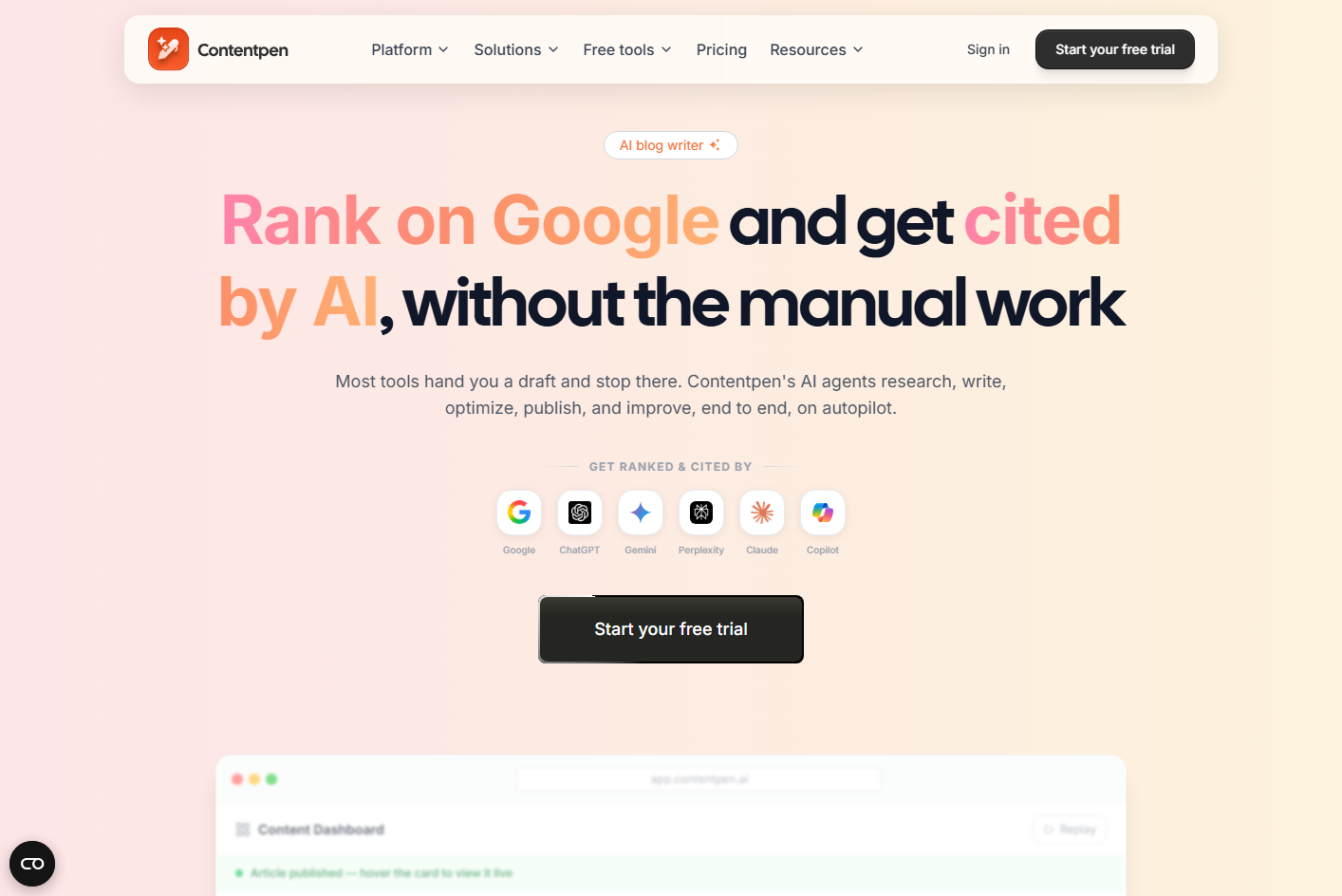
Best for: Agencies and businesses that want one system to research, write, score, link, schedule, publish, monitor, and refresh blog content.
Workflow snapshot:
- Product type: AI blog production and content intelligence platform.
- Input: Website context, keyword and SERP data, presets, and Google Search Console data.
- Output: Scored article, links, images, scheduled CMS post, and refreshed content.
- Automation: Very high.
- Human review: Check claims, citations, links, images, and scheduling before enabling autopilot.
- Replaces or complements: Can replace several lightweight writing, linking, calendar, and publishing tools.
ContentPen has one of the clearest end-to-end propositions: research, write, optimize, publish, measure, and improve inside one platform. It adds SEO and AEO scoring, automatic links, a content calendar, CMS integrations, Search Console data, and content-decay opportunities.
The ContentPen pricing page displayed Starter at $27 per month billed annually for 10 articles, Premium at $55 for 30, and Agency at $139 for 100. Extra article credits are also sold separately. That makes the article credit, not the theoretical word count, the main planning unit.
Automation is both the reason to buy and the reason to be cautious. A wrong target country, weak preset, unsupported claim, or poor internal-link rule can propagate through an entire calendar.
Main limitation: The blast radius of autopilot. Establish an editorial sample, rejection rule, and rollback process before allowing scheduled content or automated refreshes to go live.
Verdict: Choose ContentPen when publishing operations are the bottleneck and your team can maintain a reliable approval policy.
9. Byword: Best for programmatic SEO and large page sets
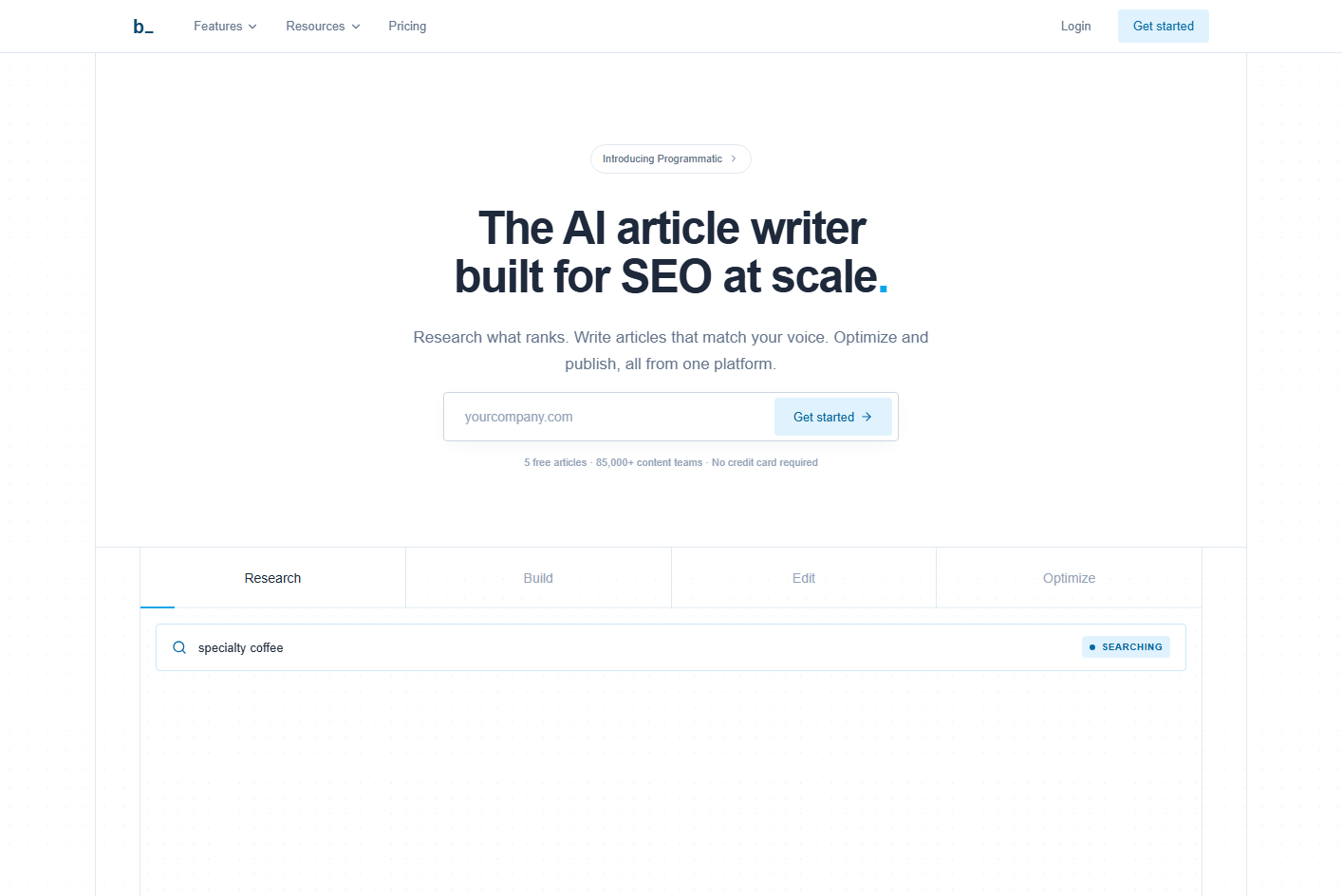
Best for: Programmatic SEO teams, agencies, and publishers producing large, structured page sets from templates and datasets.
Workflow snapshot:
- Product type: AI article and programmatic page platform.
- Input: Keyword intelligence, competitor evidence, templates, CSV or API data, and brand knowledge.
- Output: Articles or templated landing-page sets with CMS and API delivery.
- Automation: Very high.
- Human review: Validate datasets, templates, page samples, duplication, and indexation before scale.
- Replaces or complements: Replaces a basic bulk writer and some programmatic glue; complements data validation, technical SEO, and monitoring.
Byword is built around producing SEO content at scale rather than drafting one page in a chat window. Its public product architecture includes research, generation, optimization, integrations, and programmatic workflows. The programmatic layer can combine a template with structured data for location, comparison, integration, or catalog pages.
The official pricing page identifies plans starting at $99 per month. Capacity should be evaluated through credits, domains, seats, API access, overages, and the proportion of generated pages that survive editorial and indexing review.
Programmatic production has the highest upside and the highest failure blast radius in this list. A valid dataset does not guarantee that each page has unique demand, useful information, or enough differentiation. A template error can affect thousands of URLs.
Main limitation: Quality assurance and indexation risk. Begin with a small cluster, validate representative page types, and expand only after search behavior and editorial acceptance are understood.
Verdict: Choose Byword when the input is structured data and the deliverable is a governed page set, not merely a queue of blog posts.
10. Agility Writer: Best for configurable long-form modes and bulk agencies
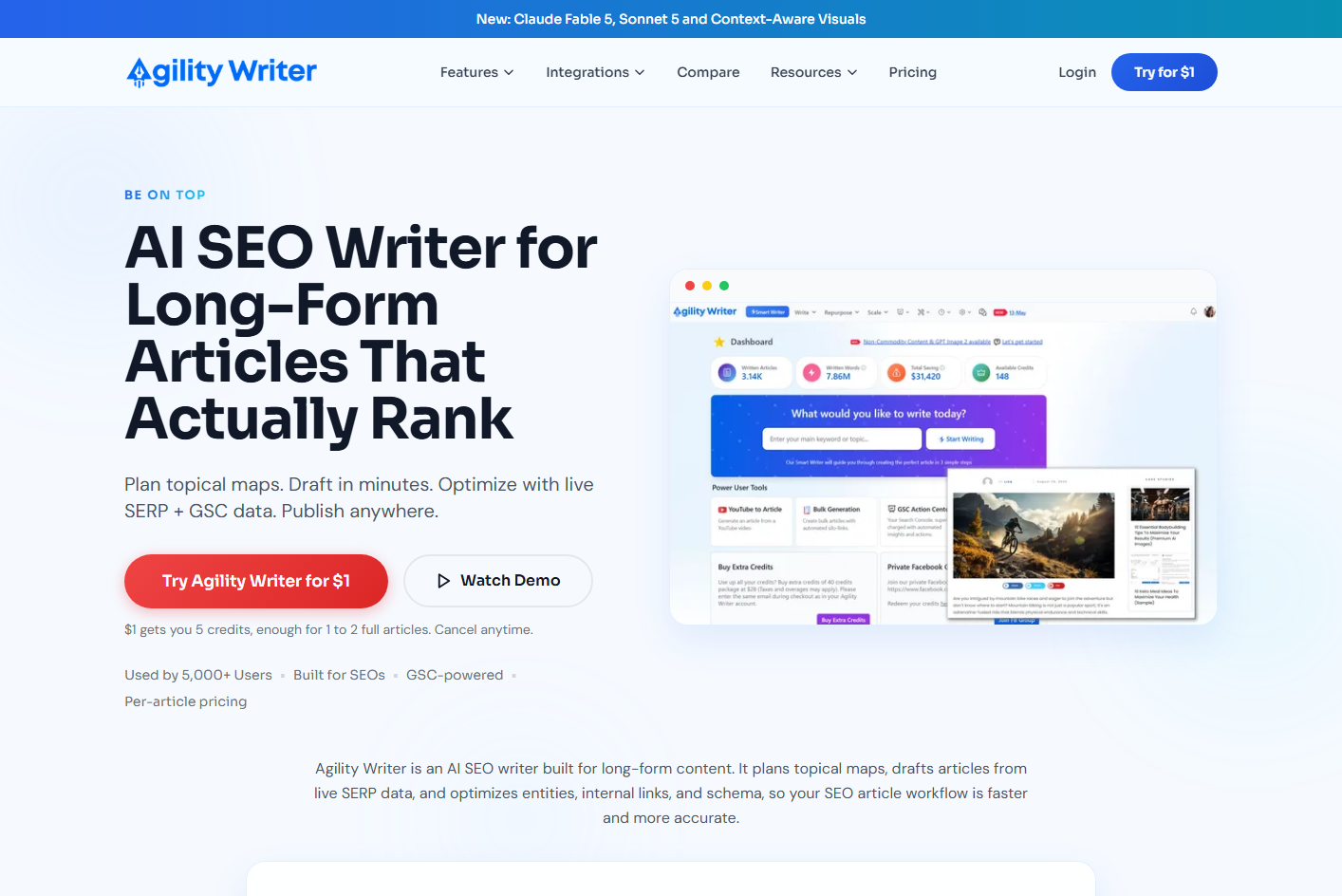
Best for: SEO consultants, affiliate publishers, and agencies that need different article modes, topical planning, bulk runs, and credit rollover.
Workflow snapshot:
- Product type: Credit-based AI SEO article writer.
- Input: Keyword, live SERP data, Search Console data, topical maps, and mode-specific settings.
- Output: Long-form article, product review, roundup, refreshed post, or social assets.
- Automation: High.
- Human review: Required, especially for performance, factuality, and AI-detection claims.
- Replaces or complements: Replaces several format-specific article generators; complements a final optimizer and human editor.
Agility Writer differentiates itself through writing modes. One-click, Advanced, Optimize, Product Review, Roundup Review, and YouTube-to-Article modes target different deliverables and consume different credits. Topical maps, bulk generation, WordPress, Zapier, API access, and Search Console workflows extend it beyond one-off drafting.
The pricing page displayed a $28 monthly list price for Basic with 40 credits and a $1 trial. The page also displayed discounted prices tied to a vendor code. This article uses the list price because a public coupon should not be treated as permanent plan pricing.
Different modes consume different credits, so “up to 40 articles” does not mean 40 advanced or optimized articles. Agencies should estimate their actual mode mix before comparing per-article costs.
Main limitation: The vendor’s public pages use strong ranking, factuality, Helpful Content, and detector language. Treat those as vendor claims, not guarantees. Human source verification remains necessary.
Verdict: Choose Agility Writer when you need several structured long-form formats and want credit rollover. Do not choose it to avoid editorial accountability.
11. SEOWriting.ai: Best for high-volume WordPress and product roundups
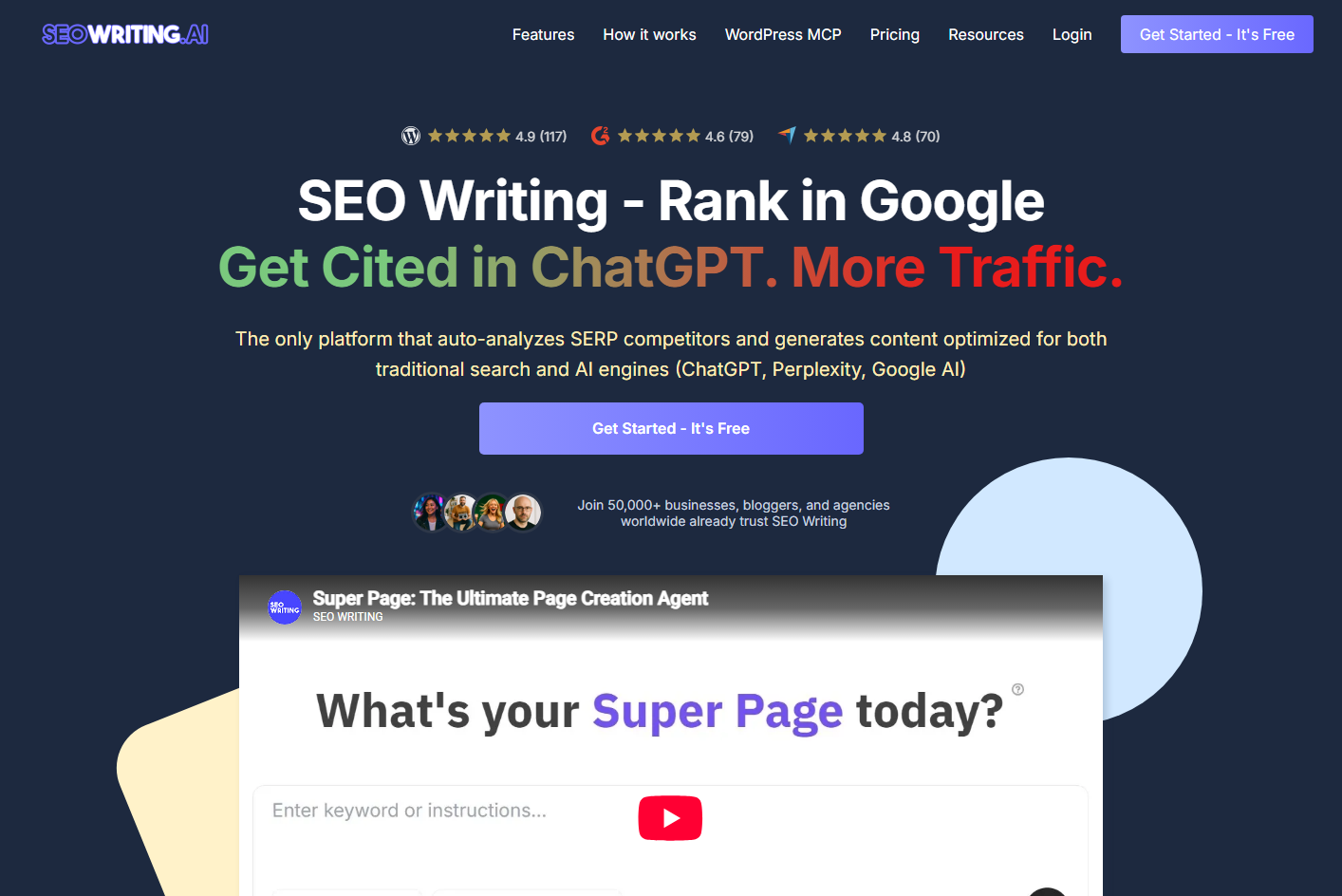
Best for: Publishers who need bulk articles, Amazon-style product roundups, generated images, metadata, and WordPress scheduling from one interface.
Workflow snapshot:
- Product type: One-click and bulk SEO article generator.
- Input: Keyword, article settings, product URLs, optional NLP terms, tone, length, and language.
- Output: Long article, roundup, images, metadata, and a scheduled WordPress post.
- Automation: Very high.
- Human review: Check every product fact, source, link, image, and scheduled post.
- Replaces or complements: Replaces a basic bulk writer and WordPress handoff tool; complements a stricter optimizer and commerce editor.
SEOWriting.ai is designed for volume. Its public workflow covers one-click article generation, bulk runs, product-list inputs, generated images, SEO metadata, and automatic WordPress scheduling. The site says a bulk run can prepare and post many articles, which is useful for operations but not evidence that each article is publication-ready.
The pricing page displayed $14 per month billed annually for Starter, with up to 50 article credits, while three articles were available as a free entry. Professional displayed $59 per month billed annually for up to 250 article credits. Treat those “up to” article counts as credit allowances, not as a guarantee that every generation becomes a completed long-form post.
The central risk is review backlog. If a team can generate 100 posts but only review ten, the extra 90 are not savings. They are unverified liabilities waiting to be published.
Main limitation: Automation depth can outpace governance. Treat bulk generation as a queue builder, not as permission to publish without inspection.
Verdict: Choose SEOWriting.ai when WordPress volume and repeatable product formats matter most, and keep batch size below your editorial review capacity.
12. NEURONwriter: Best budget optimizer with AI-assisted drafting
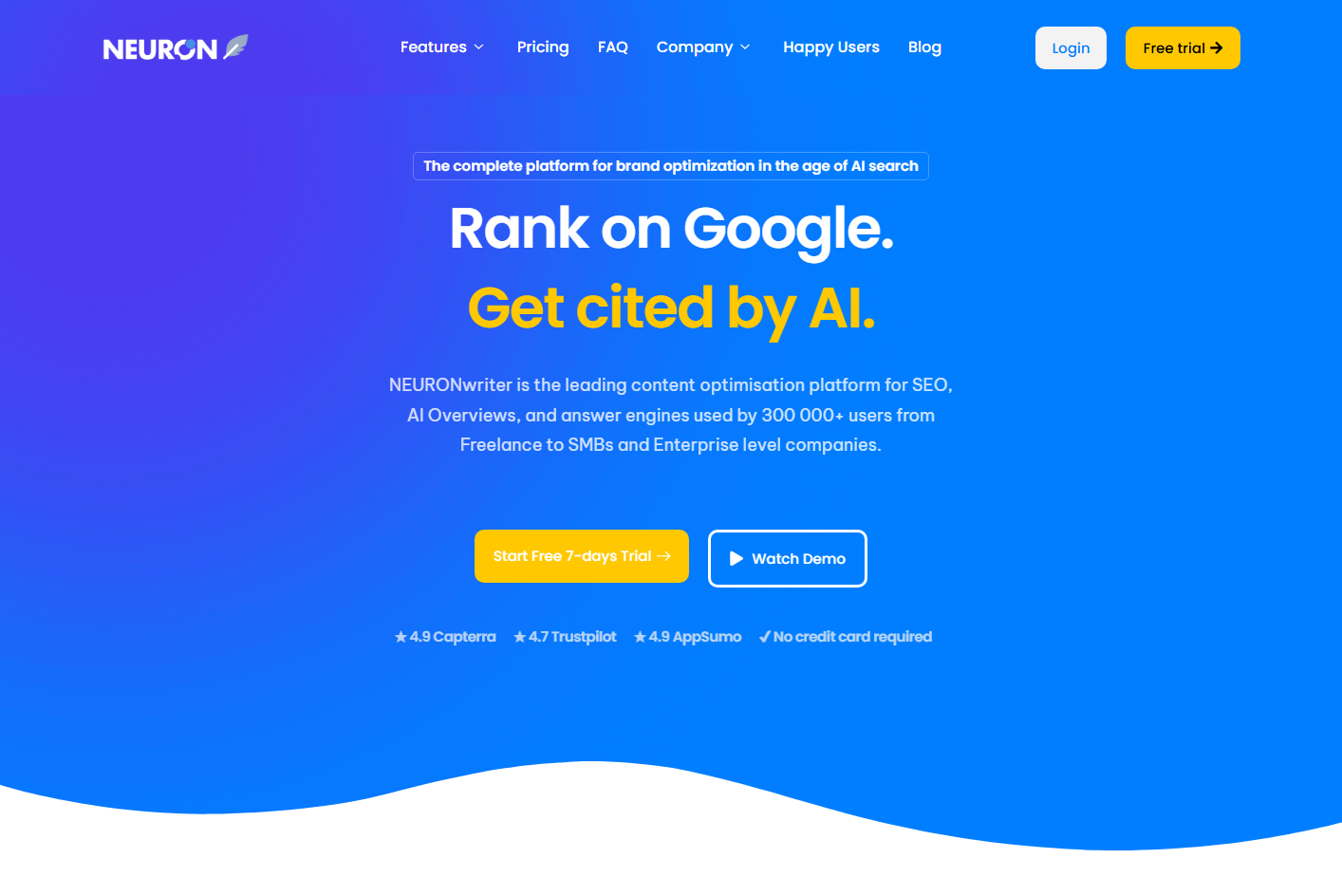
Best for: Freelancers, small businesses, and agencies that want affordable SERP/NLP optimization with briefs, AI drafting, and WordPress support.
Workflow snapshot:
- Product type: SERP and NLP content optimizer with AI writing.
- Input: Selected SERP competitors, NLP terms, Search Console data, and optional user API keys.
- Output: Brief, optimized draft, content score, and WordPress handoff.
- Automation: Medium.
- Human review: The editor controls structure, evidence, semantic fit, and the final page.
- Replaces or complements: Replaces a separate brief and scoring tool; complements a high-volume generator when drafts need stronger optimization control.
NEURONwriter is optimizer-first. It analyzes competing pages, surfaces terms and questions, supports outlines and AI drafting, and can connect to WordPress and Search Console. That makes it less autonomous than Writesonic, ContentPen, or AirOps, but it also gives the editor more control over what enters the draft.
The NEURONwriter pricing page displayed Bronze at $23 per month or $19 per month billed yearly, with limits based on projects, content analyses, AI credits, and monitored questions. The one-click Content Designer article workflow appears on Platinum and Diamond, so buyers should not assume the Bronze entry price includes full article automation. Higher tiers also add projects, analyses, collaboration, and integrations.
The ability to use your own model API keys can separate optimization cost from generation cost, but it also creates another billing and configuration layer.
Read our detailed NEURONwriter review for plan and workflow analysis.
Main limitation: It does not remove as many production steps as an autonomous writing platform. That is a weakness for maximum volume and a strength for teams that want an editor in control.
Verdict: Choose NEURONwriter when affordable optimization and editorial control matter more than hands-off publishing.
More AI writing tools we’ve reviewed
The picks above are ranked by workflow fit, but they are not the only tools in this category worth evaluating. The additional reviews below cover platforms that earn a place in specific setups even when they do not top a general ranking.
AIKTP is a budget-focused bulk SEO writer built around direct WordPress publishing and batch keyword workflows. It suits solo publishers who want low-cost volume production; our AIKTP review walks through its plan limits and WordPress workflow.
AIOSEO approaches AI writing from inside the WordPress dashboard, pairing its AI Assistant and content generation with TruSEO scoring, Link Assistant, and schema tools. WordPress site owners already using the plugin can read our AIOSEO review to see how the AI features fit the broader SEO toolkit.
Arvow is an AI SEO automation platform that generates content, applies technical fixes, and manages backlinks and AI-search visibility in one agentic workflow. Its credit-based pricing and automatic link exchange carry real caveats, which our Arvow review examines in detail.
Clearscope remains the reference point for premium content optimization: briefs, content grading, and inventory reporting built for editorial teams. It is expensive at the entry tier, and our Clearscope review breaks down when the cost pays off.
Content Harmony takes a brief-first approach: research is selected and reviewed before it becomes a brief, and the brief stays separate from the grader. Teams that standardize on briefs can check our Content Harmony review for workflow details and pricing.
Copy.ai has expanded from copy generation into a broader GTM automation platform, with composable workflows, a prospecting cockpit, and usage-based pricing. Sales and marketing operations teams will find the full picture in our Copy.ai review.
Dashword is a fast brief-and-score tool that turns a keyword into an optimized outline quickly, at a premium price point. Teams that value speed can compare it against the picks above using our Dashword review.
MarketMuse is built for strategy-heavy teams: Content Score, Topic Authority, and portfolio intelligence inform what to write and how to prioritize, with pricing that is not published. Our MarketMuse review covers the strategy workflow and the procurement caveats.
Page Optimizer Pro focuses on page-level SEO: Rank Engine diagnostics turn a competitor set into prioritized on-page changes, with AI writing and keyword tools alongside. It uses a credit system, so our Page Optimizer Pro review is worth reading before you commit.
Robinize connects keyword research, drafting, WordPress publication, and rank monitoring in one affordable workflow. AI-credit units are not fully transparent, which our Robinize review explains alongside its $19 and $49 plans.
Rytr is one of the cheapest capable AI writers at $9 per month for unlimited words, covering dozens of use cases from blog posts to emails. Our Rytr review looks at where its quality ceiling sits for SEO work.
Search Atlas bundles content, rank tracking, and agentic SEO features (including OTTO and Atlas Agent) into an all-in-one platform at $99 per month. It changes quickly, so our Search Atlas review captures the current feature set and limits.
SEO Writing AI targets high-volume WordPress production: 50 articles per month on the entry plan, with templates, brand voices, and CMS delivery. Bulk publishers can see the quality trade-offs in our SEO Writing AI review.
WordHero is a budget blogging writer with a lifetime-deal option, brand voices, and long-form presets aimed at solo bloggers. Our WordHero review covers the lifetime pricing math and feature set.
Writecream pairs long-form writing with marketing breadth — templates, outreach tools, and a lifetime option at a low price. Our Writecream review details which workflows it handles well and where it stays shallow.
Where ChatGPT and Claude fit
ChatGPT and Claude are useful writing assistants, but they solve a different layer of the stack. They are flexible drafting and reasoning environments rather than dedicated SEO content operations platforms.
Use a general assistant when you need to:
- explore angles and counterarguments;
- transform source notes into an outline;
- rewrite a section under explicit constraints;
- critique clarity, logic, tone, and missing evidence;
- create custom editorial checklists;
- work with unusual content formats that a template-driven writer does not support.
Do not assume the standalone chat experience provides the same native keyword database, content score, rank tracking, CMS workflow, audit history, or bulk governance as the products ranked above. Those capabilities may require external data, connectors, custom tools, or a separate optimizer.
The practical stack is often a specialist SEO platform plus a general assistant, not one pretending to be the other.
Build a stack without paying for the same capability twice
Map each tool to its primary input and output before adding it.
Lean publisher stack
- Primary writer: KoalaWriter or SEOWriting.ai.
- Optimization: NEURONwriter or Surfer, only if the writer’s native guidance is insufficient.
- Human QA: Product fact check, source verification, originality, internal links, images, and disclosure.
Do not pay for three separate article generators. Spend the saved budget on expert review or original data.
In-house content team stack
- Primary workflow: Frase, Writesonic, or Scalenut.
- Brand governance: Use the platform’s own controls first; add Jasper only when multi-brand governance is a distinct requirement.
- Measurement: Connect Search Console and analytics, but keep performance reporting separate from claims about content quality.
Agency stack
- Primary workflow: Writesonic, Frase, ContentPen, or Agility Writer.
- Client control: Separate workspaces, sources, templates, approvals, and publishing permissions.
- Scaling metric: Cost per approved article, not cost per generated word.
Enterprise content operations stack
- Orchestration: AirOps or a comparable workflow layer.
- Specialist data: SEO research, product data, brand knowledge, compliance sources, and CMS records.
- Governance: Named owners, approval gates, audit trails, access controls, rollback, and monitored failure states.
A writing tool should replace a step, improve a decision, or reduce a measurable handoff. If it only recreates an existing draft in a second interface, it is overlap.
The human review workflow Google still expects
Google’s guidance on generative AI content focuses on whether automation helps people and warns that generating many pages without added value may violate spam policy. Its people-first content guidance asks publishers to make the who, how, and why of content clear. The spam policies define scaled content abuse by purpose and value, not by whether a human or AI typed each sentence.
Use this review sequence before publication:
- Intent: Does the page solve the specific decision implied by the query?
- Sources: Can every material fact, price, specification, and quotation be traced to a reliable source?
- Experience and information gain: What does this page add beyond rearranging the existing SERP?
- Entity consistency: Are product names, categories, attributes, and comparisons accurate throughout?
- Recommendation logic: Does the winner follow from buyer fit, limitation, and evidence rather than commission or feature count?
- Risk: Could an error cause financial, legal, health, reputation, or customer harm?
- Links and media: Are internal links published, external links relevant, and images correctly attributed and described?
- Publication controls: Is the author, reviewer, date, schema, canonical URL, and rollback path correct?
Automation should shorten this process, not erase it.
How we evaluated these AI writing tools
We used public official product, pricing, feature, documentation, and policy pages available on August 5, 2026. We also reviewed the US search landscape for “best AI writing tools” to understand category expectations, but competitor listicles were not used as evidence for product claims.
Each ranked product was evaluated against the same attributes:
- central workflow and buyer fit;
- data inputs and provenance;
- output and publishing path;
- automation depth;
- human-review requirement;
- brand and approval controls;
- CMS, API, and integration depth;
- pricing and the true scaling unit;
- replacement potential and functional overlap;
- hidden editorial or setup cost;
- failure blast radius when used in bulk.
No product received credit for an unsupported ranking promise, detector-bypass claim, testimonial, or vendor ROI statement. Prices are a dated snapshot and may change. No affiliate destination was supplied for this article, so official links are used for evidence and no affiliate route is invented.
Frequently asked questions
What is the best AI writing tool for SEO?
Writesonic is the best overall choice when you want research, article generation, citations, SEO/GEO workflows, audits, and publishing in one platform. KoalaWriter is better for affordable affiliate content, Surfer is better for optimization-led teams, and AirOps is better for enterprise workflow orchestration.
Is ChatGPT the best AI for writing SEO content?
ChatGPT is a flexible drafting and editing assistant, but it is not automatically the best SEO writing workflow. Dedicated platforms can add native SERP research, content scoring, brand controls, CMS publishing, audit history, and bulk governance. ChatGPT can still be valuable beside those tools for reasoning, critique, and custom transformations.
Does Google penalize AI-generated content?
Google does not define quality by the typing method alone. It evaluates usefulness, reliability, originality, and spam behavior. Large-scale, low-value, or deceptive production can violate policy whether it is generated by AI, humans, or both.
What is the best free AI writing tool for SEO?
A general assistant can be the most flexible free starting point, while several specialist platforms offer limited trials or free entry. Free plans rarely include the research depth, article volume, publishing, and governance needed for a production SEO program. Compare the first paid limit you will actually hit rather than choosing only by the free allowance.
Can AI writing tools publish directly to WordPress?
Yes. KoalaWriter, Frase, Scalenut, ContentPen, Agility Writer, SEOWriting.ai, NEURONwriter, and other products in this guide advertise WordPress or CMS publishing. Direct publishing should still use draft status or an approval gate until the workflow has passed factual, editorial, and technical QA.
How much should an agency spend on AI writing software?
Budget by cost per approved deliverable, not cost per generated word. Include software, seats, model or credit usage, editing time, fact checking, failed drafts, client review, and publishing operations. A $200 platform that removes several handoffs can be cheaper than a $20 writer that creates a large QA burden.
Should I use one AI writing tool or a stack?
Start with one primary writing engine. Add an optimizer, brand-governance layer, or orchestrator only when it closes a documented gap. The strongest stack usually has distinct owners for generation, optimization, review, and measurement rather than several tools performing the same drafting job.
