Frase is an SEO and generative engine optimization content platform that combines SERP research, briefs, AI-assisted drafting, in-editor scoring, publishing, and post-publication monitoring.Our review finds its strongest value in keeping that workflow together, but it does not replace technical SEO, link building, original research, fact-checking, or editorial judgment.
| At-a-glance | Details |
|---|---|
| Trial | Start Frase’s 7-day trial |
| Starting price | $49/month on monthly billing, or $39/month when billed yearly |
| Free trial | 7 days, no credit card; capped Professional access |
| Refund policy | Paid fees are non-refundable |
| Core workflow | Research, brief, draft, score, publish, monitor, refresh |
| Best for | In-house content teams, SEO teams, agencies, and search-led publishers |
| Main caution | Frase scores and visibility reports are decision aids, not ranking or citation guarantees |
The choice comes down to whether a connected content loop is worth more to you than a cheaper, narrower optimizer. This Frase review examines current pricing, feature limits, publishing paths, security statements, and the checks a buyer should complete during the trial, using official materials captured on August 2, 2026.
Quick Verdict: Should You Use Frase?
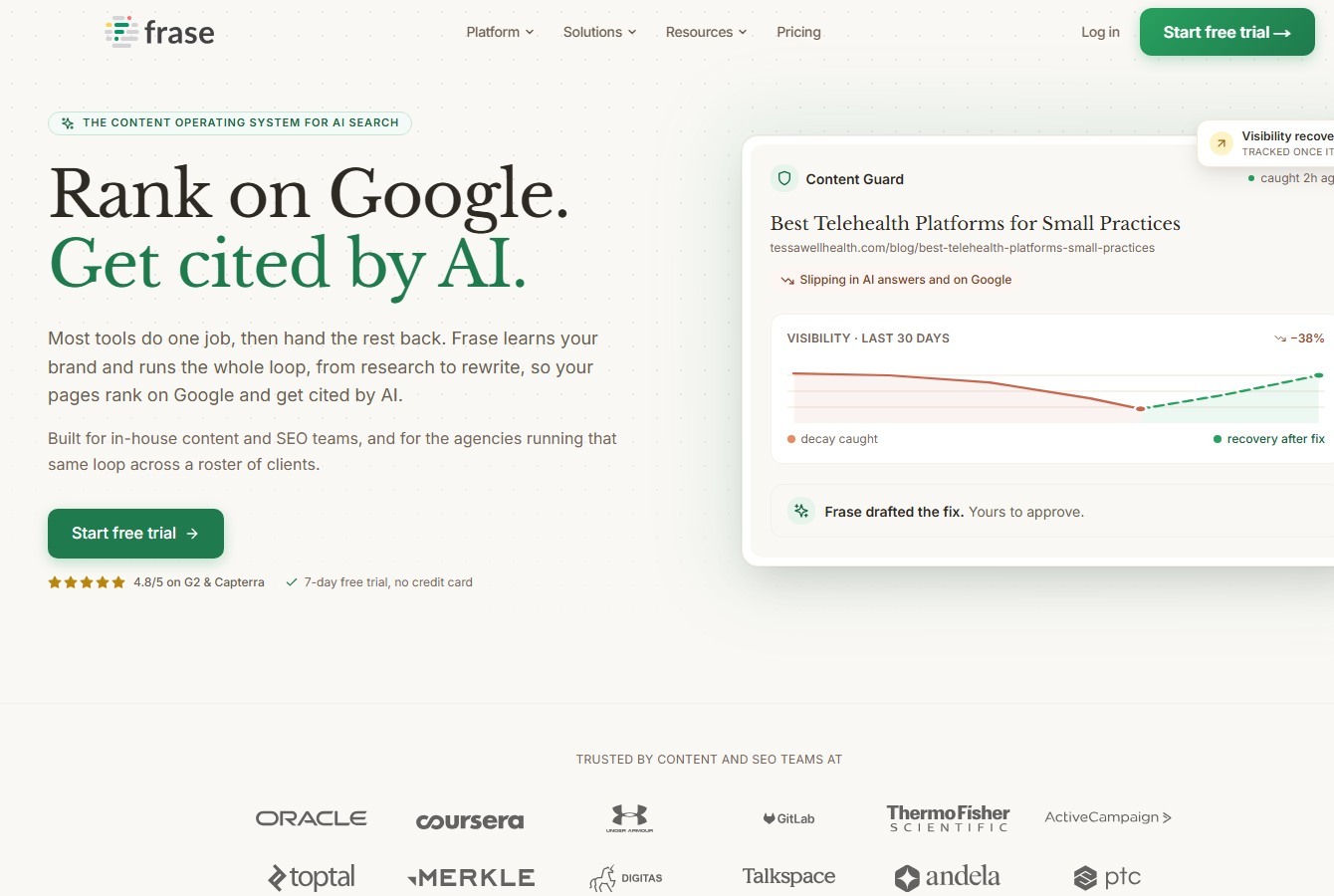
Frase is worth considering when your recurring job is moving from a search topic to a brief, draft, editorial score, CMS handoff, and later refresh. It gives content teams one operating layer for tasks that often live in separate research, writing, optimization, and monitoring tools. That workflow compression is a credible benefit; vendor promises about rankings, traffic, or AI citations are not evidence of outcomes.
Use Frase if you publish or refresh search-led content every month and will use several parts of the loop. Compare alternatives first if you only need an inexpensive content editor, require a full technical SEO and backlink suite, or need broad AI-search monitoring at the lowest tier.
| Decision point | Frase is a fit when… | Compare first when… |
|---|---|---|
| Content production | Briefs, drafts, reviews, and publishing need one workflow | You only need occasional optimization reports |
| Team process | Writers and editors need repeatable handoffs and approvals | One person can manage a simpler tool stack |
| Monitoring | You want page-decay and configured AI-prompt tracking | You need exhaustive brand intelligence or a full rank tracker |
| Automation | CMS, API, or agent workflows can remove recurring handoffs | Your security policy blocks automated publishing connections |
| Budget | Several included jobs can replace point tools | A narrow editor would meet the same need for less |
If that profile matches your team, start the Frase trial and validate one real workflow before choosing a paid plan. The trial matters because paid subscriptions do not include a standard refund window.
What Is Frase?
Frase is a web-based content workflow platform for researching search results, creating briefs, drafting and optimizing content, publishing it, and monitoring selected post-publication signals. The company currently describes it as an “Agentic SEO and GEO” platform and a “content operating system for AI search.” Those are vendor positioning statements, not independent proof that a page will rank or be cited.
The observable product scope is broader than a basic AI writer. Frase brings competitor headings, questions, topics, and source material into a document, adds live SEO and GEO guidance, supports AI-generated text, connects to publishing destinations, and tracks configured search or AI-visibility signals. It is still a content platform rather than a complete substitute for crawling, site architecture, digital PR, backlink acquisition, conversion research, or subject-matter expertise.
That boundary is important. Frase can make content work more organized and measurable inside its own system. It cannot determine whether your argument is original, your evidence is authoritative, your offer is persuasive, or Google and AI systems will reward the finished page.
Who Is Frase Best For?
Frase is best for buyers who have a repeatable content operation rather than a one-off writing need.
- Solo marketers and freelancers can use Starter when one seat, one site, and 10 articles per month cover the workload. The value improves if the same person handles research, drafting, optimization, and WordPress or other CMS publishing.
- In-house content and SEO teams are the clearest Professional-plan audience. Three included seats, five sites, a content calendar, internal-link suggestions, and higher monitoring limits support a writer-editor workflow.
- Agencies and multi-site brands can consider Scale when 10 domains, five seats, larger article and audit allowances, broader AI-engine coverage, and client-ready reporting justify the price jump.
- Teams refreshing an existing library may get more value than teams focused only on new drafts. Site audits, Content Guard, and content-opportunity signals are designed to route declining or underperforming pages back into the editor.
- Developers and operations teams may value the REST API, webhooks, CMS connections, and MCP-based access, provided the plan’s request limits and the organization’s security rules fit.
Frase is a weaker fit for teams whose primary problem is technical auditing, log analysis, backlink research, outreach, digital PR, or enterprise-wide brand monitoring across thousands of prompts. It is also hard to justify if you publish so rarely that the research, publishing, and monitoring layers will sit unused.
What Are Frase’s Key Features?
Frase groups several connected jobs into one content lifecycle. The most important buyer question is not whether each feature exists, but whether the handoffs between them remove enough work to justify the subscription.
SERP research, topic discovery, and content briefs
Frase’s public research materials show a topic-to-brief flow built around current search results, competing pages, headings, questions, topical concepts, and source material.
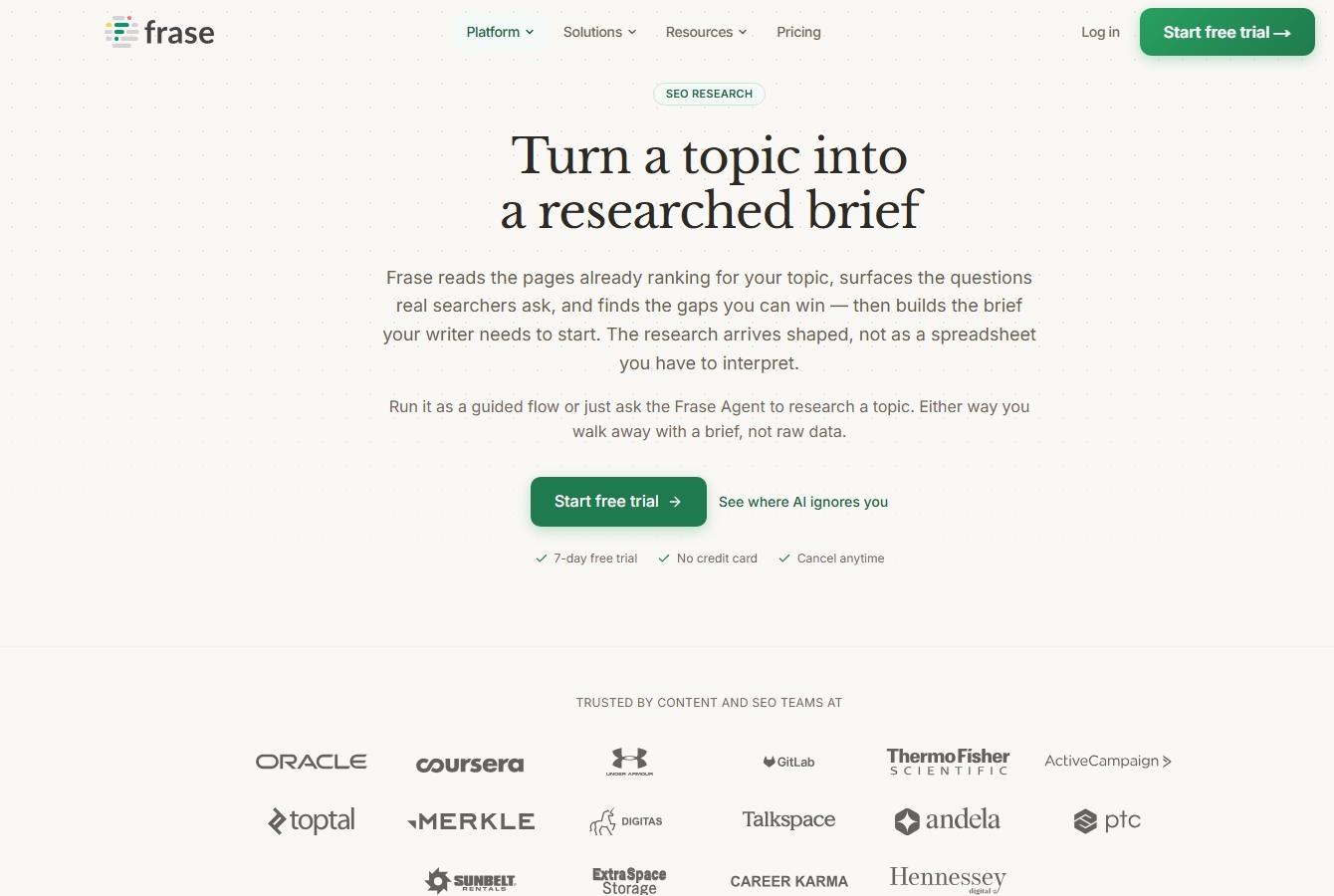
This can reduce tab-switching and give writers a standardized starting point. An editor can compare structures, identify recurring subtopics, collect questions, and turn the findings into a brief without manually reconciling several exports. That is especially useful when multiple writers need consistent inputs.
The risk is competitor convergence. A SERP model describes what already exists; it does not supply a differentiated opinion, first-party data, expert quote, original example, or better product evidence. A strong process should use Frase’s brief as a coverage baseline, then add information that competing pages do not provide.
AI drafting, brand context, and live optimization scores
Frase combines AI-assisted drafting with a live editor, related-topic guidance, and separate SEO and GEO scoring concepts. Its public pages also describe Brand Voice and an agent that can generate drafts or sections from the research context.
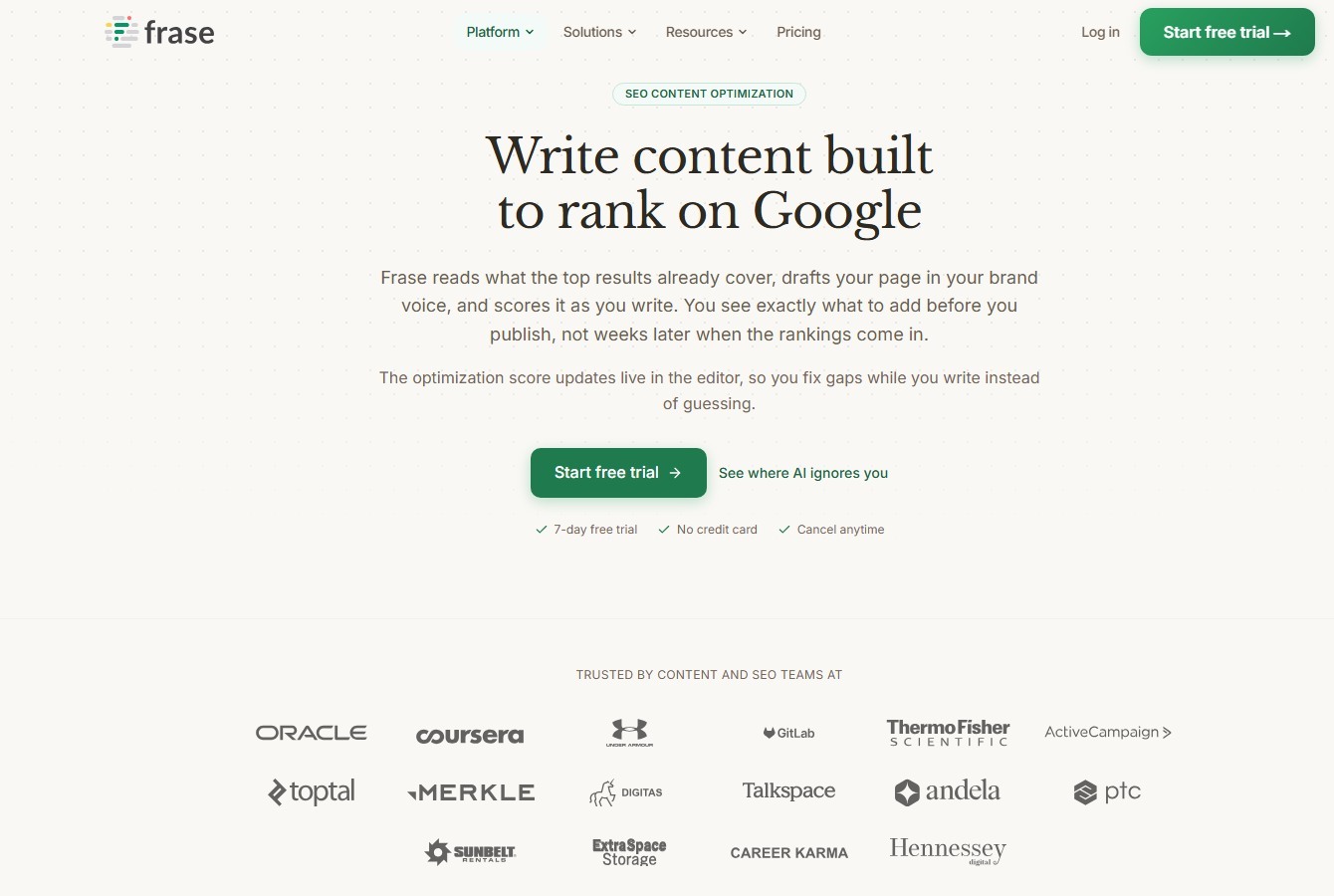
The practical benefit is continuity: the brief, draft, recommendations, and revisions stay in the same document. The limitation is that Frase’s optimization score is a proprietary editorial signal; the reviewed evidence does not establish it as a Google ranking metric. Raising it may indicate better alignment with Frase’s comparison set, but it cannot prove helpfulness, factual accuracy, conversion quality, rankings, or traffic.
The same caution applies to GEO guidance. A GEO score can prompt editors to check clarity, structure, entities, and answer completeness. It is not a probability that ChatGPT, Gemini, Perplexity, Claude, or Google AI will cite the page. AI-generated copy also needs source verification, originality checks, legal review where relevant, and editing for the brand’s actual point of view.
AI Visibility, Content Guard, and refresh signals
Frase publicly presents AI Visibility as monitoring configured prompts across major AI answer engines, with engine coverage and prompt allowances increasing by plan. Content Guard watches selected published pages for Google ranking or traffic decay, then can draft a proposed revision.
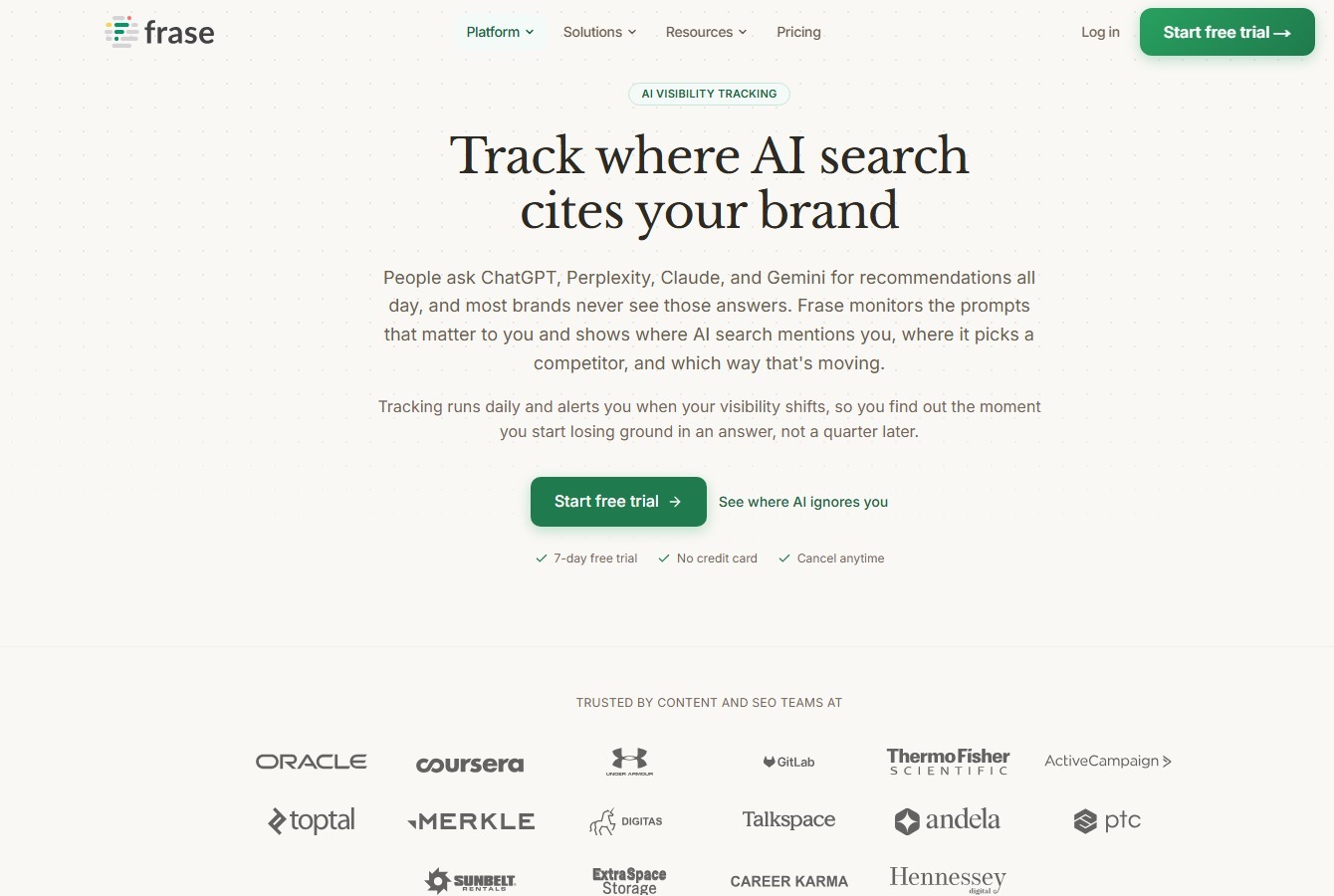
These features connect monitoring to action: a team can identify a lost mention or declining page, request optimization insights, and send the work back into the editor. Frase states that AI Visibility monitors and alerts rather than changing content automatically. Content Guard uses approval by default, although customers can opt into greater autonomy for selected low-risk work.
Treat the data as a sample of configured prompts and supported engines. AI visibility does not guarantee citations, rankings, traffic, or attribution. A reported citation shows what Frase observed for a tracked response; it does not prove why the model selected a source or whether the result represents the wider market.
CMS publishing and FraseCMS
Frase’s public publishing pages describe direct paths to WordPress, Webflow, Sanity, Wix, and its hosted FraseCMS option.
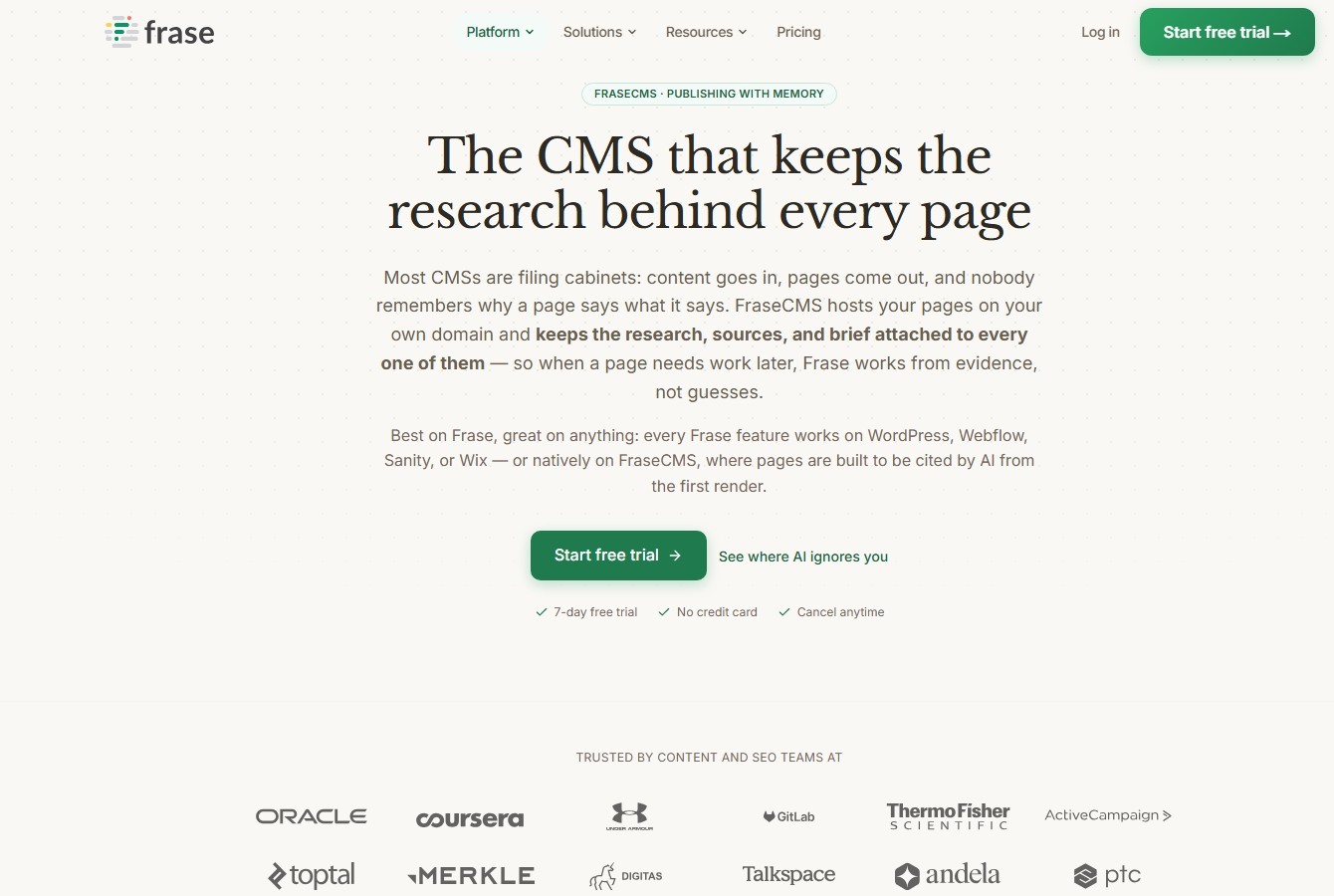
The appeal is a shorter handoff from approved draft to destination. Frase says it can preserve formatting, images, metadata, and supported SEO fields when publishing. FraseCMS can also host content, including a headless delivery path, for teams that do not want a separate CMS workflow.
Those capabilities should be tested against a staging site before production use. Confirm post status, author mapping, URL behavior, featured images, schema, metadata, revisions, rollback, and the exact approval boundary. Public marketing evidence confirms the described publishing options, but it does not prove that every theme, plugin, custom field, or enterprise workflow will map correctly.
Integrations, API, webhooks, and MCP access
Frase lists Google Search Console, CMS publishing, document imports and exports, workflow notifications, a REST API, webhooks, and MCP-compatible assistant access among its integration surfaces.
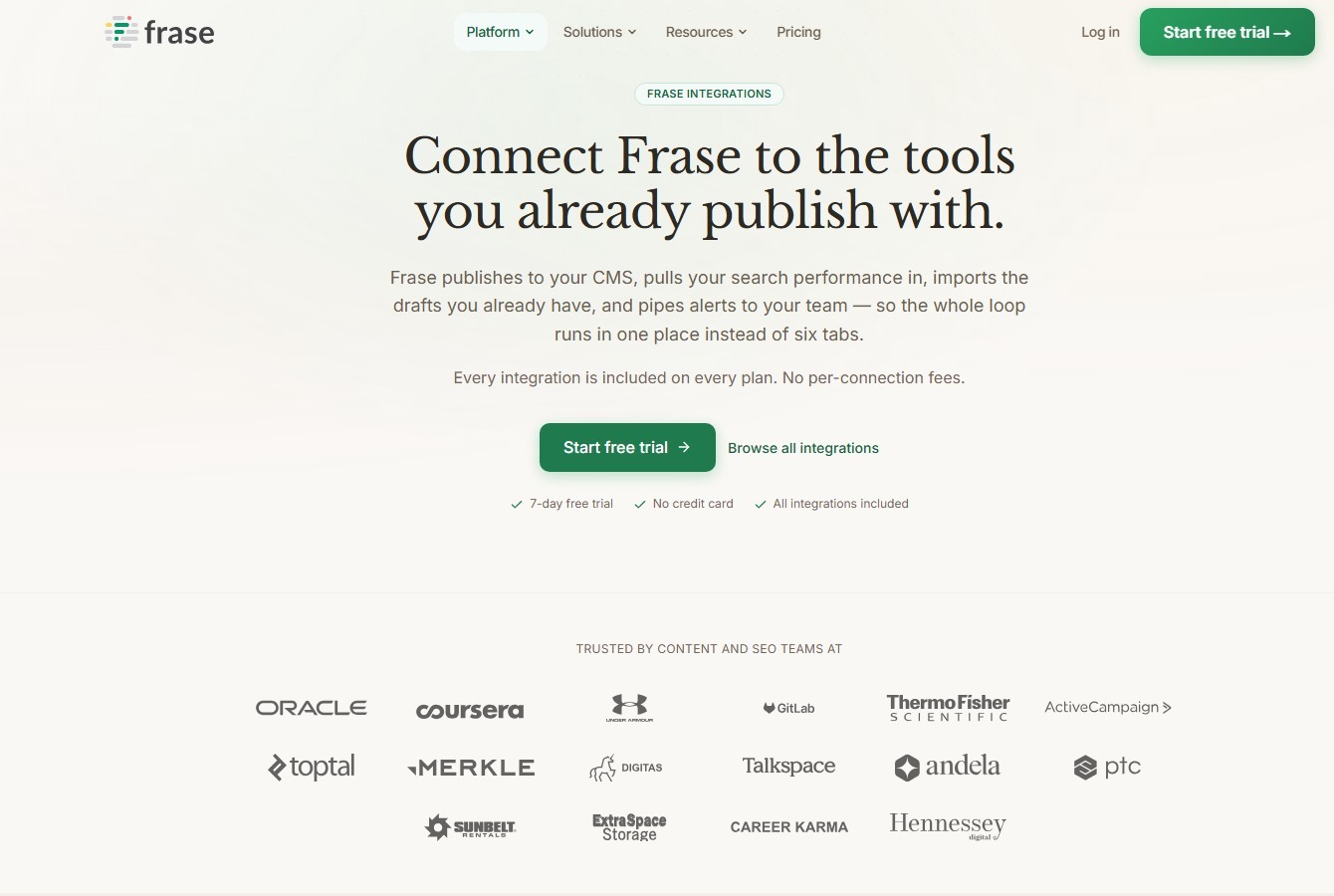
This range matters for teams that want to connect research, content generation, audit data, and publishing to an existing stack. The API documentation presented publicly covers structured content, SERP, audit, scoring, AI Visibility, and publishing workflows, while MCP is positioned as a separate assistant-facing access method.
Integration availability is not the same as unlimited use. The captured pricing comparison listed monthly API request limits of 250 on Starter, 1,000 on Professional, and 3,000 on Scale, with custom Enterprise terms. Buyers should confirm rate limits, authentication, webhook behavior, data fields, write permissions, and support before designing a production automation around any connector.
How Does Frase Work?
A typical Frase workflow has five stages:
- Define the topic and context. Create a document around a query, site, audience, and competing pages. For an existing library, connect the relevant search or site data and choose the page to refresh.
- Build the research and brief. Review the SERP set, exclude irrelevant competitors, collect headings and questions, and turn useful findings into a writer brief. This selection step matters because poor competitors produce poor guidance.
- Draft and optimize. Write manually, use AI assistance, or combine both. Apply topical recommendations selectively while checking sources, adding original evidence, and maintaining a clear search intent.
- Review and publish. Complete factual, legal, brand, and editorial review, then export or send the approved content to a connected CMS. Automation should begin with draft-only publishing on a staging or low-risk workflow.
- Monitor and refresh. Track selected pages, prompts, rankings, traffic-decay signals, and citations. Route meaningful changes back into a brief and revision rather than treating every alert as proof that the page needs rewriting.
The integrated loop is Frase’s main differentiator. The quality of the result still depends on competitor selection, inputs, human review, publishing controls, and the evidence added beyond the model’s recommendations.
What Is Frase Like in Real Use?
The strongest day-to-day advantage appears to be continuity. A user can move from SERP research to a brief, draft, score, publishing destination, and monitoring queue without rebuilding context at each handoff. For an experienced team with defined briefs and approval rules, that can reduce duplicate data entry and make refresh work easier to assign.
Public pages show that setup can involve choosing competitors, defining brand context, connecting sites, mapping CMS permissions, selecting tracked prompts, and deciding which actions require approval. Buyers should test configuration time and connector behavior with their own setup.
Beginners may misuse the visible scores as targets to maximize. That can lead to unnecessary terms, repetitive sections, and content that resembles the comparison set without adding value. Experienced editors are more likely to use the recommendations diagnostically: check missing coverage, reject irrelevant advice, add first-party evidence, and stop when the page answers the user’s need clearly.
Frase cannot remove the difficult parts of publishing trustworthy content. Someone still has to verify AI output, resolve contradictory sources, protect confidential data, review claims, maintain a distinctive point of view, and decide whether an alert represents a real business priority.
How Much Does Frase Cost?
The prices below were captured from Frase’s public US pricing page on August 2, 2026. Frase displayed both monthly billing and lower monthly equivalents billed once per year, so verify the selected billing toggle, taxes, allowances, and checkout terms before purchase.
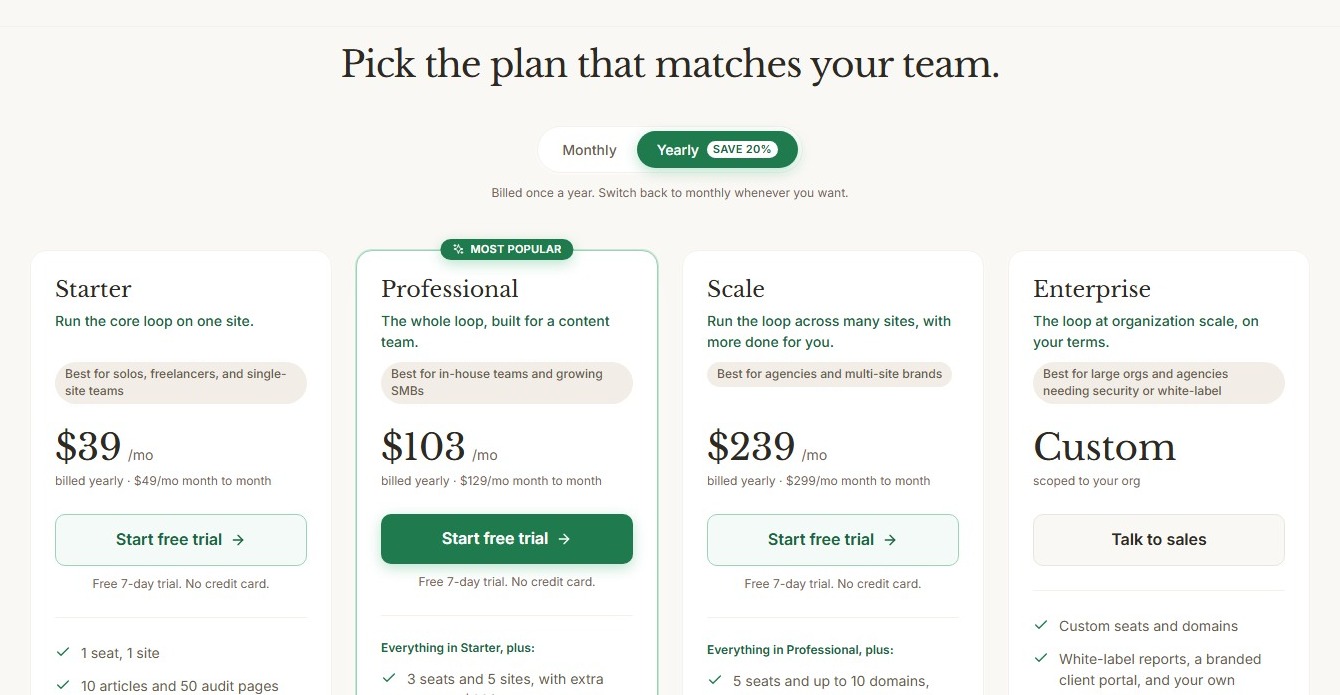
| Plan | Monthly billing | Monthly price when billed yearly | Included seats/sites | Core monthly volume |
|---|---|---|---|---|
| Starter | $49/month | $39/month, billed yearly | 1 seat, 1 site | 10 articles, 50 audit pages, 50 AI Visibility prompts |
| Professional | $129/month | $103/month, billed yearly | 3 seats, 5 sites | 40 articles, 250 audit pages, 200 AI Visibility prompts |
| Scale | $299/month | $239/month, billed yearly | 5 seats, up to 10 domains | 100 articles, 1,000 audit pages, 500 AI Visibility prompts |
| Enterprise | Custom | Custom | Custom | Custom limits, access, history, and support terms |
Starter covers the core loop but stops at its monthly limits. Professional and Scale can use optional pay-as-you-go capacity, which Frase says is off by default, and the captured page listed additional seats at $29 per month. Exact overage charges, API limits, engine coverage, autonomy, reporting, and content formats vary by tier.
The seven-day trial requires no credit card and is described as capped access to the Professional feature set. The captured trial terms included five articles, 50 audit pages, 25 AI prompts, and up to three seats; auto-publishing and other agent autonomy remained disabled. That is enough to evaluate one real workflow, but not to prove ranking or citation outcomes that can take longer to appear.
Frase’s Terms of Service state that all paid fees are final and non-refundable. Use the trial to estimate article volume, audit-page needs, tracked prompts, API requests, seat count, CMS behavior, and annual commitment before paying.
What Are the Pros and Cons of Frase?
Frase’s main strengths are workflow continuity, structured research, and connected publishing and monitoring. Its main tradeoffs are plan complexity, bounded monitoring, score misuse risk, and non-refundable paid fees.
| Pros | Cons |
|---|---|
| Connects research, briefs, drafting, optimization, publishing, and monitoring | Broader workflow can be unnecessary for buyers who need only an editor |
| Converts SERP findings into a usable brief rather than only an export | SERP-derived guidance can encourage sameness without original evidence |
| Supports CMS, API, webhook, and assistant-facing workflows | Connector behavior and permissions still require staging tests |
| Adds page-decay and configured AI-visibility monitoring to the content loop | Monitoring is limited by prompts, pages, engines, and plan allowances |
| Provides a seven-day trial without requiring a card | Paid subscriptions are non-refundable |
| Keeps human approval as the stated default for Content Guard changes | Optional autonomy increases governance and quality-control risk |
The overall balance is favorable for teams that will use multiple stages. Frase is much less compelling when a cheaper optimizer, an existing CMS process, and a separate monitoring tool already cover the same jobs without painful handoffs.
What Are the Best Frase Alternatives?
The closest alternative depends on which part of Frase you actually need:
- NeuronWriter is the value-focused comparison for SERP analysis, NLP guidance, scoring, and AI-assisted writing. Compare it when budget and editor-level optimization matter more than Frase’s broader publishing and monitoring loop.
- Clearscope is the premium editorial comparison. It fits teams that prioritize polished content grading, writer adoption, content inventory, and straightforward collaboration, even at a higher entry price.
- Dashword is the focused, brief-first option. It is worth comparing when a clean SERP report, content brief, editor, and monitoring workflow are more important than a wider automation surface.
| Choose… | When your priority is… |
|---|---|
| Frase | One connected research-to-publish-to-monitor workflow |
| NeuronWriter | Lower-cost NLP and SERP-guided optimization |
| Clearscope | Premium editorial guidance and team-friendly grading |
| Dashword | Simple briefs, scoring, and repeatable writer handoffs |
For a wider view of optimizer tradeoffs, the NeuronWriter alternatives comparison covers eight tools by pricing, brief quality, optimization depth, AI support, and workflow fit. Compare actual allowances rather than assuming that similarly named scores or AI features are equivalent.
Where Does Frase Fall Short?
Frase’s breadth creates several limitations buyers should not overlook.
First, it is not a complete SEO suite. It does not replace deep technical crawling, log-file analysis, backlink research, outreach, digital PR, or a full competitive intelligence platform. Those needs may add subscriptions rather than disappear.
Second, optimization scores can create false precision. Frase’s visible optimization score is a product model of topical alignment, not a Google metric. GEO recommendations and AI Visibility are also product methodologies, not guarantees of citations or rankings. Optimizing only for a visible score can make a page longer without making it more useful.
Third, AI output remains review work. Public product pages demonstrate that generation exists, but they do not prove factual accuracy, originality, brand fidelity, or suitability for regulated topics. Automation raises the cost of a weak approval process because errors can move downstream faster.
Fourth, limits are multidimensional. Articles, audit pages, tracked prompts, engines, Content Guard pages, sites, seats, API requests, history, and autonomy vary by plan. A team can outgrow one allowance before it outgrows the others.
Finally, the trial is short relative to post-publication outcomes, and paid fees are non-refundable. Buyers can test workflow fit in seven days, but they cannot responsibly treat short-term score changes as proof of search or AI performance.
Which Frase Attributes Should Buyers Check?
Before subscribing, test the attributes that could change the buying decision rather than exploring random features.
| Buyer check | What to verify during the trial |
|---|---|
| Research quality | Correct locale, useful competitor set, relevant questions, and removable outliers |
| Editorial guidance | Recommendations improve coverage without keyword stuffing or unnecessary length |
| AI output | Factual error rate, citation workflow, voice consistency, revision time, and originality |
| Publishing | Draft status, author, images, metadata, URLs, schema, custom fields, and rollback |
| Monitoring | Prompt relevance, engine coverage, update cadence, alerts, and historical detail |
| Limits | Articles, audits, prompts, pages watched, API requests, sites, seats, and overages |
| Governance | Roles, approvals, autonomy boundaries, logs, deletion, and export options |
Security, privacy, and procurement checks
Frase’s public security page states SOC 2 Type II attestation, GDPR compliance, encryption at rest and in transit, access controls, audits, secure-development practices, and enterprise SSO or SAML availability.
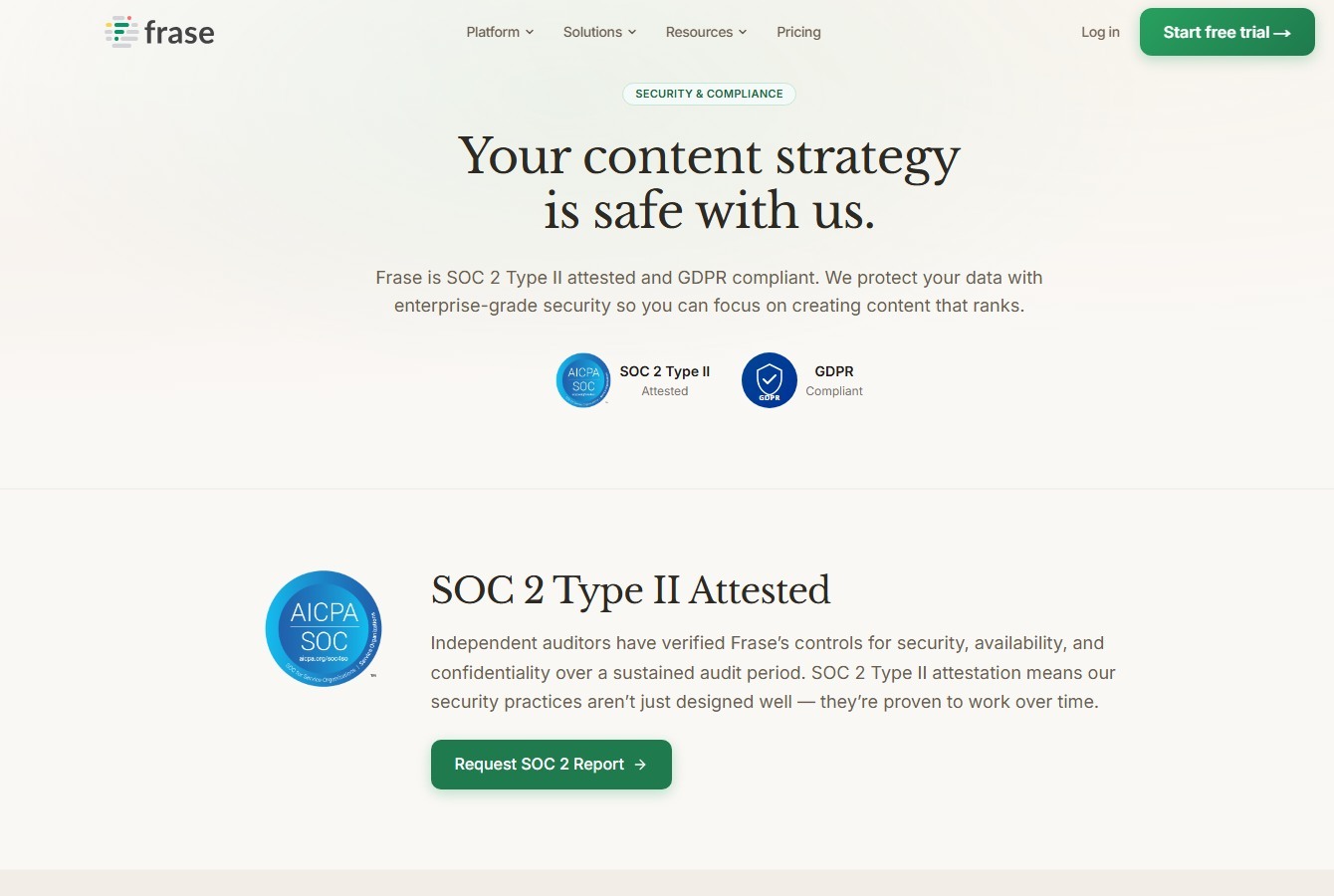
These are vendor-published security statements. Procurement teams should request the SOC 2 report and review the current data processing agreement, subprocessors, data locations, retention, deletion, incident notification, business continuity, service levels, and enterprise access controls.
Frase’s terms state that customer data is not used to train generalized AI or machine-learning models across customers. The same terms allow aggregated, anonymized, or de-identified data for analytics and industry benchmarks, with an opt-out process described. Organizations handling confidential, personal, regulated, or client-owned data should verify the controlling contract rather than relying only on public copy.
A disciplined seven-day test should reproduce one real brief, one edited draft, one staging-site publish, and one monitoring setup. Record the manual time saved, corrections required, connector issues, and projected monthly usage. That evidence is more useful than a demo score.
Is Frase Worth It?
Frase is worth it for a content team that will use the connected loop, not merely the writing editor. Starter can suit one site with a predictable publishing cadence. Professional is the practical team tier when calendars, internal-link suggestions, more sites, and higher limits matter. Scale needs a clear agency or multi-site case to justify the jump.
It is not worth buying on the promise that an SEO score will produce rankings or that AI Visibility will create citations. The economic case should come from fewer handoffs, faster briefs, a consistent review process, safer CMS publishing, and earlier identification of refresh work.
If those benefits map to a real monthly workload, use Frase’s no-card trial to test its research, drafting, scoring, manual publishing, and monitoring flow. Confirm the current price and limits first, keep publishing approvals on, and decide before paying because the standard terms make paid fees non-refundable.
How We Test and Score
ScaleWitAI funds every account used in this review with its own capital. We subscribe to all paid tiers with self-funded plans and never use sponsored, gifted, or vendor-provisioned accounts, so our evaluation reflects the same product a paying customer receives and stays 100% independent of vendor influence.
Evaluation combines standardized test suites with hands-on workflow testing. We use HumanEval-style tasks to probe logic and code reasoning, BLEU/ROUGE-style metrics to measure natural-language quality, and internal stress-test scenarios to map context-window limits and long-input behavior. We run more than 10,000 prompts per AI platform every year, across varied access conditions, and log results against a transparent scoring rubric.
The dataset for this review was collected over 12 months (from August 2025 to August 2026). Historical comparisons track AI model development since 2024, and this report tests and compares 12+ leading AI models and providers on the market.
FAQ
Is Frase good for SEO content?
Frase can be useful for search-led content because it combines SERP research, brief creation, topical guidance, drafting, and refresh monitoring. It is best treated as an editorial decision aid. It does not replace technical SEO, links, first-party expertise, factual review, or a strategy that differentiates the page from existing results.
Does Frase offer a free trial without a credit card?
Yes. Frase’s public pricing page stated on August 2, 2026, that the trial lasts seven days and does not require a credit card. It provides capped Professional access, while auto-publishing and other autonomy features remain disabled. Trial terms can change, so verify them before signing up.
How much does Frase cost?
At the captured US prices, Starter cost $49/month on monthly billing or $39/month when billed yearly. Professional was $129/month on monthly billing or $103/month when billed yearly, and Scale was $299/month on monthly billing or $239/month when billed yearly. Enterprise pricing was custom. Taxes, add-ons, overages, and limits should be checked at checkout.
Is Frase’s optimization score a Google ranking metric?
No reviewed evidence establishes Frase’s optimization score as a Google ranking metric. It is a proprietary product metric based on Frase’s analysis and comparison methodology. A higher score cannot guarantee rankings, traffic, helpfulness, conversions, or inclusion in an AI-generated answer.
Does Frase guarantee AI citations or rankings?
No. AI Visibility monitors configured prompts and reports observed mentions or citations across supported engines. It does not cause a citation, explain every model decision, or represent every possible query. Frase’s own public pricing copy also says it does not promise a ranking or citation during the trial.
Can Frase publish directly to WordPress?
Frase publicly lists direct publishing to WordPress, along with Webflow, Sanity, Wix, and FraseCMS. Its integrations page says supported publishing can carry formatting, metadata, and images.
Are Frase subscriptions refundable?
Frase’s Terms of Service state that all fees paid are final and that refunds are not provided. That makes the no-card trial especially important. Confirm billing frequency, renewal terms, cancellation timing, plan limits, add-ons, and any negotiated Enterprise terms before purchase.
Does Frase use customer data to train its AI models?
Frase’s public terms state that it does not use customer data to train generalized AI or machine-learning models in a way that applies learning across customers. The terms separately permit aggregated, anonymized, or de-identified data for analytics and benchmarks. Buyers with sensitive data should verify the DPA, subprocessors, retention, and opt-out terms.
