SEO Writing AI is a bulk-first content generation platform built to create, optimize, illustrate, and publish long-form articles from one workflow. Its strongest value is production throughput: annual Starter pricing currently provides up to 50 articles per month, unlimited words per generation, Real-Time SERP analysis, a content score, bulk generation, and WordPress integration for $14 per month equivalent. It does not replace keyword strategy, subject-matter expertise, source verification, editing, or search performance accountability.
| At a glance | Details |
|---|---|
| Homepage | Try SEO Writing AI |
| ScaleWitAI rating | 4.3/5 |
| Free access | Three articles and 25,000 words; no payment details required |
| Starting paid price | Starter at $14/month equivalent, billed $168/year |
| Monthly Starter option | Check live checkout; official yearly pricing advertises 25% savings |
| Core workflow | One-click and bulk article generation, SEO scoring, AI images, internal links, and publishing |
| Integrations | WordPress, Shopify, WordPress MCP, OpenAI and Anthropic API-key connections |
| Best for | Bloggers, affiliate publishers, SEO teams, and agencies prioritizing repeatable article volume |
The buying decision is whether automation removes enough research-to-publishing labor without lowering factual accuracy, originality, brand control, and conversion quality. This review uses current public product pages, documentation, pricing, policies, and third-party review signals. It does not claim an authenticated long-term test or guaranteed ranking results.
Quick Verdict: Should You Use SEO Writing AI?
Use SEO Writing AI when article throughput and WordPress handoff are the bottlenecks. It packages Real-Time SERP analysis, article structure, content scoring, AI images, bulk generation, internal and external linking on higher plans, and direct CMS delivery at an unusually low annual entry price. Bloggers and affiliate publishers can test three articles without payment details before accepting recurring billing.
Skip it if your priority is meticulous manual SERP analysis, collaborative editorial briefs, original expert evidence, rigorous citation review, or one premium article at a time. High generation limits can create a false economy when editors spend hours correcting claims, repeated phrasing, irrelevant images, weak product advice, or overlapping keyword targets.
| Choose SEO Writing AI when... | Consider another tool when... |
|---|---|
| You publish repeatable long-form formats at meaningful volume | Every article needs interviews, proprietary research, or regulated review |
| WordPress or Shopify handoff consumes production time | You need deep technical SEO, rank tracking, or backlink research |
| Affiliate roundups and product reviews use a consistent template | Product recommendations must be verified manually against changing inventory |
| Your team has a human editing, sourcing, and internal-link gate | You expect generation volume itself to create search traffic |
Start with the free allocation and use one demanding keyword, one typical commercial page, and one refresh. Test SEO Writing AI with three articles only when you can compare the output against a written brief and a final editorial checklist.
What Is SEO Writing AI?
SEO Writing AI is an AI SEO article production platform for generating and publishing long-form content from a keyword, title, brief, or batch list. The public platform positions itself around one-click blog posts, bulk generation, affiliate content, AI images, Real-Time SERP analysis, a content score, 48 languages, WordPress auto-posting, Shopify publishing, and a WordPress MCP server.

The product boundary is narrower than a complete SEO suite. It helps turn selected topics into articles and moves those documents toward publication. Our AI SEO writing tools hub explains how this production role differs from keyword research, technical SEO, and broader visibility platforms. SEO Writing AI does not independently validate business priority, keyword cannibalization, technical indexability, backlink requirements, conversion economics, legal claims, or whether a topic deserves a page.
That narrowness is useful. Teams that already have keyword research, briefs, approvals, and analytics may not need another all-in-one marketing platform. They may need a fast production engine with predictable article credits and direct CMS delivery.
SEO Writing AI is operated by Cybereter FZ-LLC according to the current privacy policy. The company says it works with models from OpenAI, Anthropic, Meta, DeepSeek, and Groq plus proprietary technology. Model availability and workflow-credit costs can change, so treat the live model selector and documentation as the operational source of truth.
Who Is SEO Writing AI Best For?
SEO Writing AI fits buyers with repeatable content formats and a review process that can absorb machine-generated drafts.
Bloggers building a consistent publishing cadence
A blogger can use Starter for up to 50 article credits each month, WordPress integration, bulk generation, one brand voice, and unlimited words per paid generation. The economics are attractive when the blog has an approved topical map and the owner can edit every draft before publication.
The tool is weaker for a new site without a content strategy. Generating 50 loosely related articles can create cannibalization, shallow topical coverage, and an editing backlog. A low marginal generation cost does not make every keyword valuable.
Affiliate marketers creating reviews and roundups
The platform includes product-list and affiliate-oriented workflows. Official homepage copy says users can add Amazon product URLs or ASINs and generate specifications, features, pros, cons, descriptions, reviews, and roundup blocks.
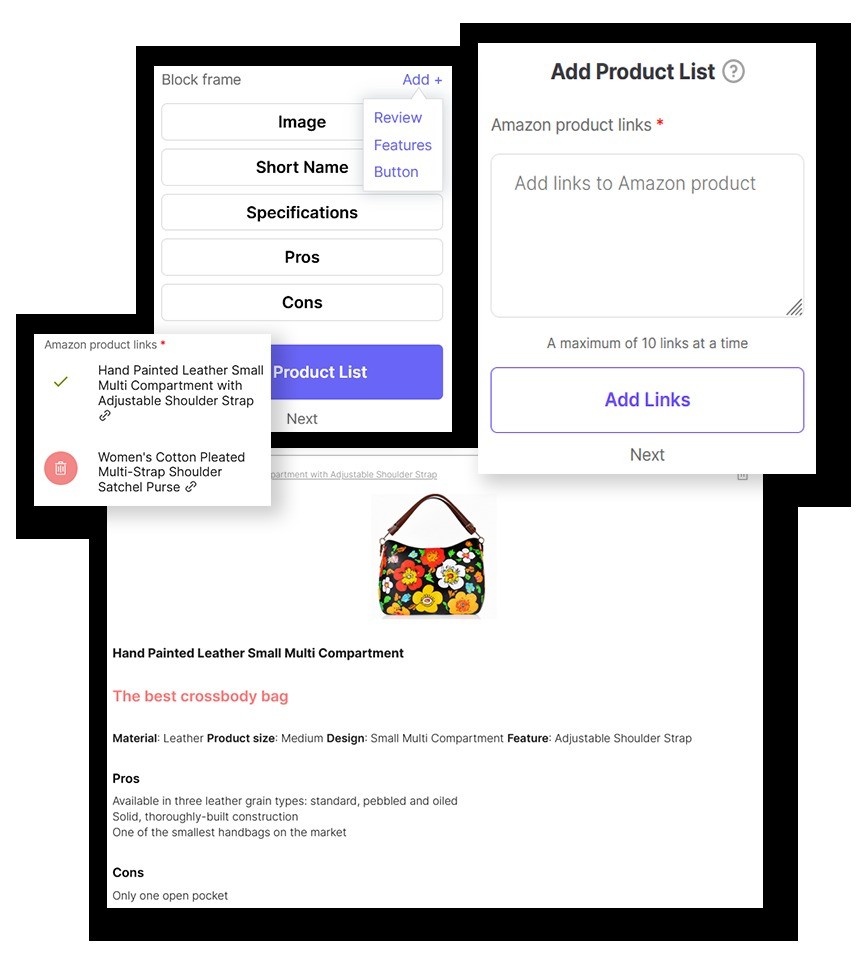
This can accelerate structure and first drafts. It cannot verify current pricing, stock, model variations, warranty language, safety requirements, or personal product experience. Affiliate teams should confirm every commercial claim against the manufacturer or retailer and add original selection logic, testing, images, and decision guidance.
SEO specialists scaling approved keyword maps
SEO teams can feed validated target keywords into Real-Time SERP analysis, generate NLP-related terms, choose article type and length, edit the outline, and use the content score as a coverage signal. The tool can shorten implementation after strategy is complete.
It is not a replacement for Search Console analysis, opportunity scoring, search intent judgment, information architecture, technical audits, or link acquisition. Specialists still decide what should be created, merged, refreshed, redirected, or left unpublished.
Agencies producing content across client sites
Professional and Professional Plus plans increase article credits and brand voices. Internal and external linking are included from Professional upward, while WordPress and Shopify integrations support direct delivery.
Agency value depends on governance. Separate brand voices, site connections, authors, categories, approval states, client facts, and publishing calendars. Do not let a high-volume batch publish across client sites without named editorial and technical owners.
What Are SEO Writing AI's Key Features?
Six feature groups determine whether the platform improves production or simply generates a larger review queue.
One-Click Blog Posts and Bulk Article Generation
The One-Click workflow can generate an article from a main keyword or title. Users can select language, article size, tone, image settings, NLP keywords, folder, and publishing schedule. Bulk Article Generation applies a related configuration across a keyword list.
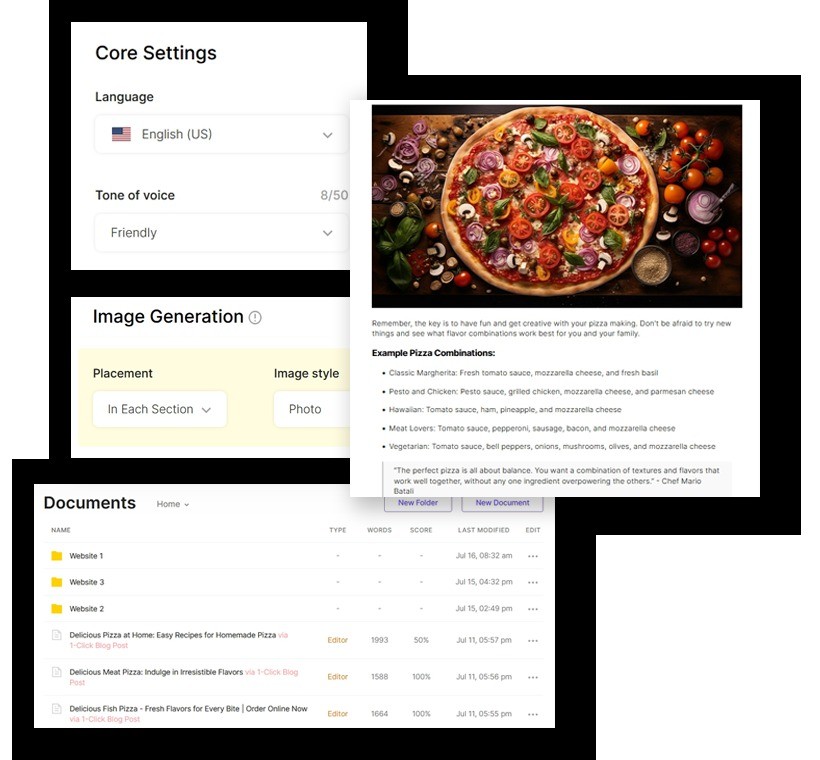
The homepage says a batch can contain up to 100 articles for WordPress auto-posting and promotes generating 1,000 or more articles over multiple runs. Treat those figures as capacity claims, not publishing recommendations. Safe batch size is the number your team can inspect for factual, editorial, visual, link, and CMS correctness before the next batch begins.
Credits, not word count, govern paid Starter and Professional generation according to the homepage FAQ. The selected model can change workflow-credit consumption, and some model configurations cost more than one credit. Check the current model documentation before forecasting monthly output.
Real-Time SERP, NLP Terms, and Content Score
Paid plans include Real-Time SERP and Content Score. Current documentation says selected models can analyze the top results for a main keyword, infer article type, headings, word count, and related terms, then apply those findings during generation.
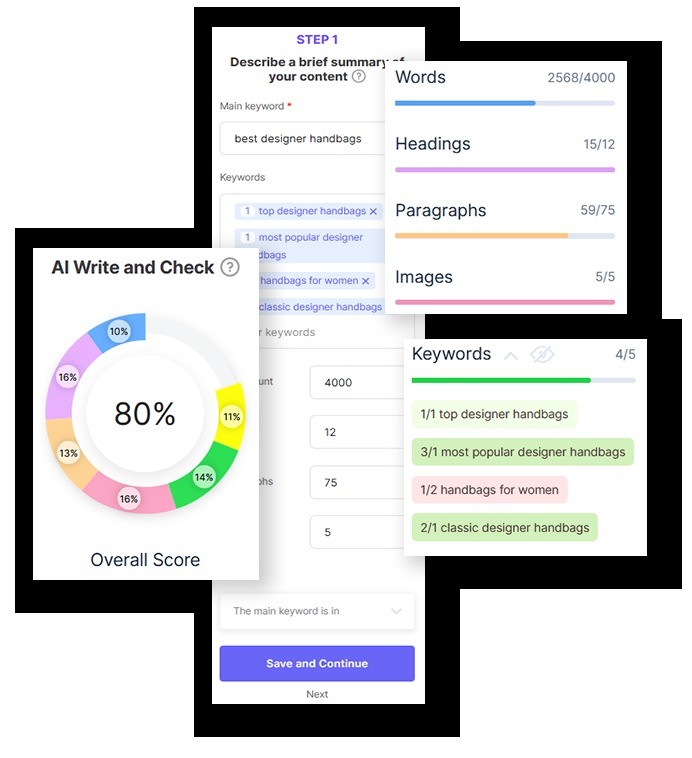
This is useful for baseline contextual coverage. It is not proof that the draft is more helpful than the current results. SERP-derived structure can reproduce the same headings, omissions, and consensus errors already ranking. Editors should add first-party evidence, clearer decision criteria, updated sources, practical examples, and a perspective competitors do not provide.
Do not chase a score to 100 by inserting every term. A content score measures selected textual signals, not factuality, experience, usefulness, brand fit, conversion performance, or eligibility for AI citations.
WordPress, Shopify, and WordPress MCP
The official WordPress plugin connects from the WordPress admin to the user's SEO Writing AI account. Documentation says the workflow can publish titles, article text, images, meta titles, and meta descriptions, and can send posts as drafts, publish immediately, or schedule them.
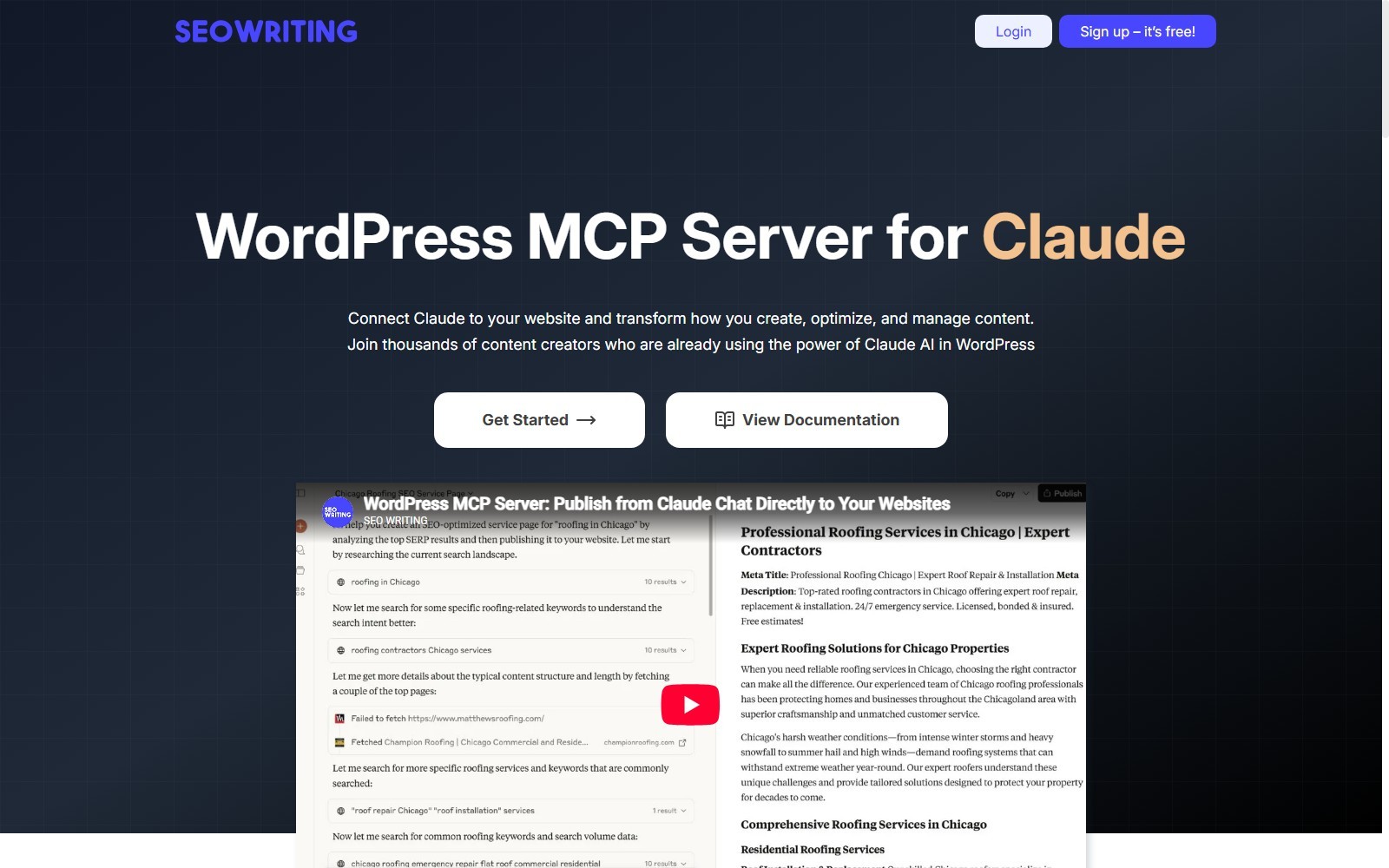
The WordPress MCP server extends the product's publishing and site-operation story. Pricing currently lists seven days of MCP access on the free plan and unlimited MCP generation on paid plans. Buyers should separate article generation credits from MCP availability and confirm which actions, permissions, logs, and limits apply.
Use draft status by default. Verify author, slug, category, tags, featured image, image rights, internal links, external links, metadata, FAQ schema, canonical URL, and formatting inside WordPress. Disconnect the plugin or integration from either side when access is no longer required.
Shopify publishing is also documented for one-click, bulk, and Super Page workflows. Store operators can choose a blog, status, tags, author, slug format, featured image behavior, and excerpt handling. Product and legal copy still requires merchant review.
AI Images and Media Hub
SEO Writing AI can create images within one-click and bulk articles. The homepage says image generation is available on paid plans, while the current comparison table also shows AI Image Generator access on the free tier. The live plan table controls eligibility.
Media Hub settings can include image model, count, size, style, custom style guidance, and prompt details. Some image models consume fractional or additional credits. Generated visuals can save sourcing time but still need quality, accessibility, factual, rights, and brand checks.
Reject images with unreadable text, wrong products, distorted hands or logos, fabricated interfaces, unsafe instructions, or misleading before-and-after claims. Add accurate alt text and compress the final asset before publishing.
Affiliate Content and Product Lists
Product-list tools generate repeated blocks for roundups and single-product reviews. The platform can assist with names, specifications, features, descriptions, pros, and cons from supplied product identifiers.
A buyer should evaluate source freshness and traceability. Product feeds and public pages change. Require a source URL and checked date for every price-sensitive, compatibility, warranty, safety, or performance claim. Do not imply hands-on testing when the article was assembled from public data.
Brand Voice, Links, Humanizer, and Model Choice
Starter includes one brand voice. Professional increases that to five, Professional Plus 1 to ten, and the comparison table currently shows twenty for Professional Plus 2. Professional and higher plans include automated internal and external linking.
The Humanizer is unlimited from Professional upward. It may reduce repetitive phrasing, but it does not establish authorship, expertise, originality, or factual accuracy. Evaluate text against the brand guide rather than an AI-detection score.
Model options can include provider-hosted models and connected OpenAI or Anthropic API keys. A bring-your-own-key workflow can add separate model charges and another credential to secure. Use restricted keys, provider spending limits, and removal procedures when a team member or client offboards.
How Does SEO Writing AI Work?
A controlled production workflow has nine steps:
- Approve the keyword and page role. Define intent, funnel stage, target URL, parent topic, internal-link role, and success metric before generation.
- Choose One-Click or Bulk. Use One-Click while establishing a template. Use Bulk only after several single articles pass review.
- Configure the article. Select language, length, tone, point of view, outline behavior, image settings, NLP terms, links, and destination folder.
- Select the model and forecast credits. Confirm the current credit cost and any separate API charges.
- Inspect SERP assumptions. Review article type, outline, competitors, and terms rather than accepting them automatically.
- Generate as a draft. Do not publish directly during initial validation.
- Run human QA. Verify sources, claims, examples, product details, tone, duplication, links, images, metadata, and conversion elements.
- Publish to a controlled destination. Confirm WordPress or Shopify author, category, slug, images, schema, and scheduling.
- Measure and refresh. Track indexation, queries, engagement, conversions, assisted revenue, and cannibalization. Improve the workflow from observed errors.
The future SEO Writing AI tutorial will document setup and publishing controls in more detail. Until then, keep the CMS connection on least privilege and retain a separate editorial checklist.
What Is SEO Writing AI Like in Real Use?
The documented workflow is optimized for speed: choose a tool, enter a keyword or batch, select options, run generation, monitor status, and publish or schedule.
That design lowers setup friction. The dashboard does not require users to construct a complex prompt chain for every article. Templates, brand voices, images, links, and CMS delivery can be repeated. This is valuable for a content operation whose formats are already proven.
The same convenience hides assumptions. A “complete” draft may make the wrong page type, cite weak sources, repeat common SERP claims, overuse headings, choose irrelevant images, insert risky product advice, or link to the wrong target. Beginners can mistake formatting completeness for editorial readiness.
Public third-party ratings are positive on the product homepage, which currently references WordPress, G2, and Capterra scores. Vendor-displayed ratings are useful discovery signals but not a substitute for reading recent reviews by use case. Look specifically for generation quality, support, billing, credit behavior, WordPress reliability, and how much editing users perform.
The correct trial test is not “Can it generate an article?” It clearly can. The test is whether a representative article reaches publishable quality faster after research, sourcing, editing, media review, CMS formatting, and approval are counted.
How Much Does SEO Writing AI Cost?
The current pricing page defaults to yearly billing and advertises 25% savings. Every plan offers three free articles without a credit card.
| Plan | Monthly billing | Yearly equivalent | Annual charge | Article credits | Key capacity signal |
|---|---|---|---|---|---|
| Free | $0 | $0 | $0 | 3 articles | 25,000 words; no payment details |
| Starter | $19/month | $14/month | $168/year | Up to 50 | One brand voice, bulk generation, WordPress and Shopify |
| Professional | $79/month | $59/month | $708/year | Up to 250 | Five brand voices, internal and external links |
| Professional Plus 1 | $159/month | $119/month | $1,428/year | Up to 500 | Ten brand voices and extra credit packages |
| Professional Plus 2 | $307/month | $230/month | $2,760/year | Up to 1,000 | Plan card shows 25 brand voices; comparison table shows 20 |
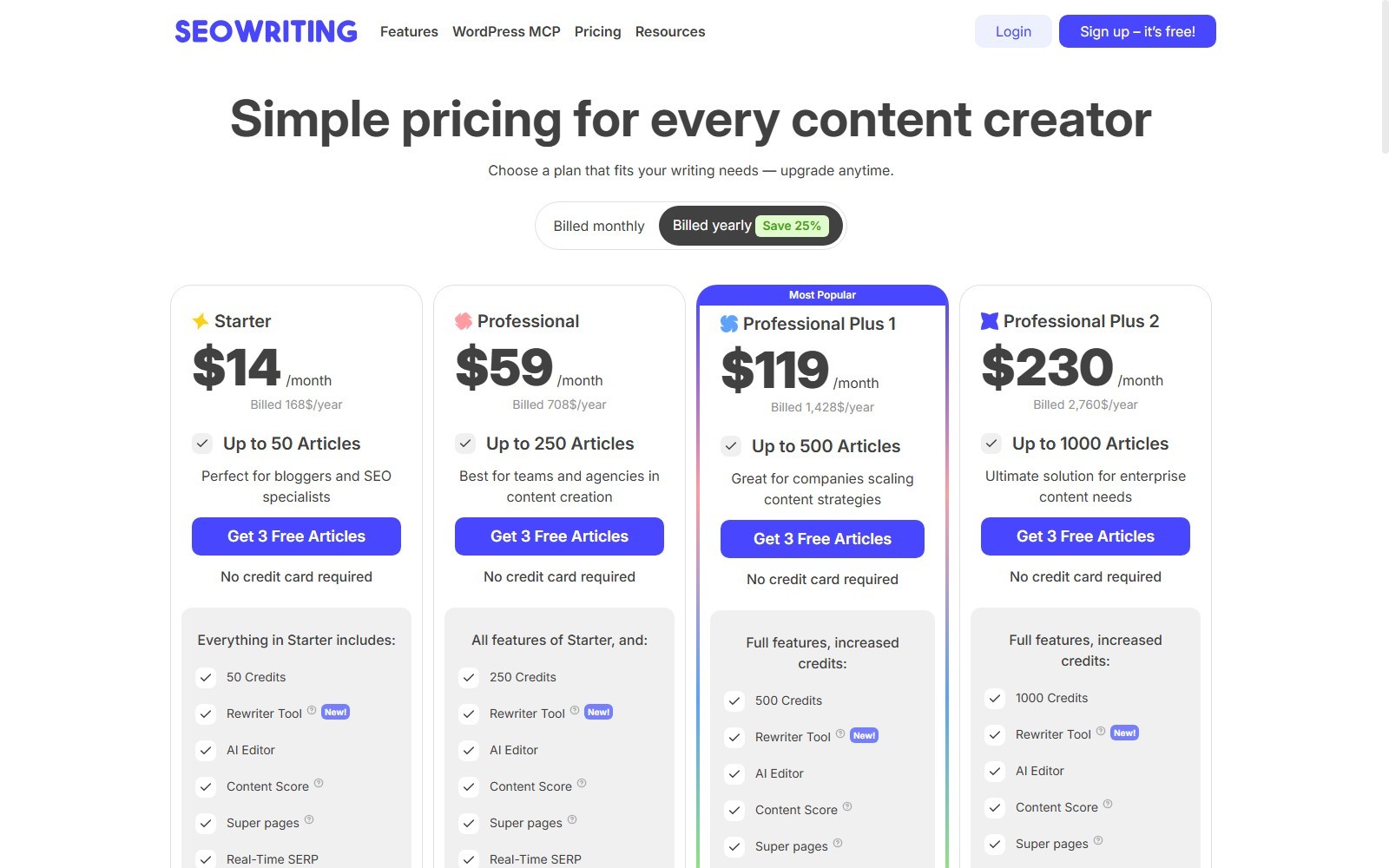
Paid plans advertise unlimited words, but output is constrained by article or workflow credits and model cost. Official AI-model documentation says a generation can consume from one to 15 credits depending on the selected model. “Up to 50 articles” therefore appears to assume one-credit generations and is not always identical to 50 completed articles.
Check the current SEO Writing AI plan and credit limits before choosing a billing term because model costs, included features, and checkout totals can change.
The $14 Starter figure is an annual equivalent, not a month-to-month commitment. Buyers pay $168 for the year; the current month-to-month price is $19. Verify the live toggle and checkout total because price presentation can change.
Professional is the practical agency threshold when automated internal and external linking and multiple brand voices matter. Professional Plus plans are capacity purchases. Compare their cost with editing headcount, separate image tools, WordPress handling, and model/API charges rather than only cost per generated article.
SEO Writing AI's Terms say an initial subscription can receive a full refund when canceled within 14 calendar days of the first purchase, provided usage remains below 50,000 words and five generations. After that threshold or window, the Terms describe the purchase as final, although the company may consider some requests case by case at its sole discretion. Cancellation otherwise leaves access active through the paid period. Documentation says documents are kept for 30 days after the subscription ends, so export before that retention window closes and verify the live policy at checkout.
For current savings and billing checks, use the future SEO Writing AI coupon guide instead of relying on coupon directories.
What Are the Pros and Cons of SEO Writing AI?
SEO Writing AI exchanges manual control for speed, repeatability, and low cost per potential draft.
| Pros | Cons |
|---|---|
| Three articles and 25,000 words can be tested without payment details | Free plan is too small to validate every workflow or niche |
| Starter is $14/month equivalent for up to 50 articles on annual billing | Annual payment is required for the displayed $14 price |
| One-click and bulk modes reduce repetitive prompt and setup work | Bulk generation can multiply factual, overlap, and brand errors |
| Real-Time SERP, NLP terms, and Content Score support baseline optimization | A score does not prove originality, expertise, or ranking ability |
| WordPress, Shopify, and MCP workflows reduce publishing handoffs | Direct publishing increases permissions and quality-control risk |
| AI images, product lists, and affiliate templates support complete drafts | Product facts and generated visuals require manual verification |
| Multiple model providers and API-key connections increase choice | Credit costs and separate API billing complicate forecasting |
| Professional plans add links and more brand voices | Advanced editorial collaboration and governance need validation |
What Are the Best SEO Writing AI Alternatives?
The best alternative depends on whether you want stronger optimization, research, editorial control, affiliate specificity, or autonomous publishing.
| Alternative | Better fit when... | Main trade-off versus SEO Writing AI |
|---|---|---|
| Scalenut | Keyword planning, topic clusters, briefs, and Cruise Mode need tighter connection | Higher entry cost and less emphasis on extremely low-cost bulk output |
| Frase | Teams prioritize SERP briefs, outline control, and content optimization | Bulk publishing automation is less central |
| Surfer | Editorial teams want mature content scoring and structured optimization | AI article volume can cost more and the platform is not bulk-first |
| KoalaWriter | Affiliate publishers want product-aware long-form generation and simple workflows | Team governance and broad optimization tooling differ |
| Writesonic | AI-search visibility, research, brand controls, and multi-format generation matter | Packaging and credit economics are more complex |
| Junia AI | Site-aware strategy, recurring autoblogging, and multi-CMS publishing are the main job | Greater automation creates a wider approval and rollback surface |
| Byword | Programmatic publishers need batch generation from keyword or data lists | Less suited to hands-on editorial optimization |
| Arvow | Agencies want content, technical SEO actions, backlinks, reporting, and LLM visibility together | Broader scope and higher cost than a focused bulk writer |
No alternative is universally better. SEO Writing AI wins on accessible volume and CMS delivery. Frase and Surfer emphasize controlled optimization, KoalaWriter focuses affiliate workflows, Junia AI and Byword push automation, and Arvow targets a wider agency operating system.
Our SEO Writing AI alternatives comparison evaluates eight replacements by bulk capacity, SERP grounding, content scoring, WordPress automation, AI-search support, governance, and total editing burden.
Where Does SEO Writing AI Fall Short?
Generation capacity can outpace review capacity. A 50-, 250-, 500-, or 1,000-article allowance creates value only when the team can validate and improve the output. Publishing more drafts can increase index bloat and brand risk.
SEO optimization is not SEO strategy. Real-Time SERP and NLP terms help shape a page after a keyword is chosen. They do not prove business value, correct intent, site architecture, ranking feasibility, or link requirements.
Public facts still need sources. Long-form AI output can blend accurate and unsupported claims. Medical, financial, legal, safety, technical, and commercial pages need qualified review and explicit citations.
Affiliate blocks can look complete while being wrong. Product specifications, prices, availability, compatibility, and warranties change. Generated pros and cons are not first-hand experience.
WordPress automation increases blast radius. Wrong authors, categories, slugs, images, internal links, or schema can spread across a batch. Draft-first delivery and rollback are mandatory.
Plan economics require credit modeling. Unlimited words do not mean unlimited articles. Model selection, regeneration, images, connected APIs, and additional credit packages affect total cost.
Editorial collaboration may be lighter than enterprise content systems. Agencies should validate roles, approvals, audit history, client separation, exports, and support before replacing a mature workflow.
Cancellation does not create a prorated refund after the initial eligibility window. The Terms allow a full refund within 14 calendar days of the initial purchase only when usage is below 50,000 words and five generations. After that, purchases are described as final, access normally continues through the paid period, and content should be exported before the retention window ends.
Which SEO Writing AI Attributes Should Buyers Check?
Use this checklist during the three-article test and before annual payment:
- Article type accuracy: Does the system choose a format that matches current intent?
- Source traceability: Can an editor identify and verify factual inputs?
- Outline quality: Does structure answer the buyer's decision instead of copying competitors?
- Content score behavior: Are recommendations useful without term stuffing?
- Brand voice: Does one voice profile handle the required markets and formats?
- Product correctness: Are commercial details current and attributable?
- Image quality: Are visuals relevant, accessible, and free from misleading text or objects?
- Internal links: Do target selection and anchors support the actual site architecture?
- WordPress mapping: Are status, author, slug, taxonomy, metadata, and schema correct?
- Credit cost: How many workflow credits does the selected model and article consume?
- Editing time: What is the complete time from keyword to approved publication?
- Performance: Do pages index, earn relevant impressions, engage visitors, and convert without cannibalization?
- Security: Can CMS and API permissions be limited, logged, rotated, and revoked?
- Offboarding: Can content, settings, and data be exported before the retention period ends?
Is SEO Writing AI Worth It?
SEO Writing AI is worth considering for high-volume publishers that already know what to publish and can enforce a draft-first review system. Starter's annual price, three-article free access, bulk generation, WordPress integration, images, and SEO controls create strong potential value for bloggers and affiliate teams.
It is not worth using as an unsupervised traffic machine. Search and AI engines reward useful pages, not generation counts. The true cost includes keyword strategy, fact checking, subject expertise, editing, visual review, internal linking, CMS QA, monitoring, and refreshes.
Run the free allocation against difficult representative topics. Track total editing time and every error category. If the output reaches your quality threshold faster than the current workflow, compare the current SEO Writing AI plans. If not, spend the budget on a more controlled optimizer, stronger research, or fewer expert-led pages.
How We Test and Score
ScaleWitAI funds every account used in this review with its own capital. We subscribe to all paid tiers with self-funded plans and never use sponsored, gifted, or vendor-provisioned accounts, so our evaluation reflects the same product a paying customer receives and stays 100% independent of vendor influence.
Evaluation combines standardized test suites with hands-on workflow testing. We use HumanEval-style tasks to probe logic and code reasoning, BLEU/ROUGE-style metrics to measure natural-language quality, and internal stress-test scenarios to map context-window limits and long-input behavior. We run more than 10,000 prompts per AI platform every year, across varied access conditions, and log results against a transparent scoring rubric.
The dataset for this review was collected over 12 months (from August 2025 to August 2026). Historical comparisons track AI model development since 2024, and this report tests and compares 12+ leading AI models and providers on the market.
Frequently Asked Questions
Is SEO Writing AI free?
SEO Writing AI currently provides three free articles and 25,000 words without requiring payment details. Paid plans increase article credits and unlock the recurring production workflow.
How much does SEO Writing AI cost?
Yearly pricing starts at $14 per month equivalent, billed $168 per year for Starter. Professional is $59 per month equivalent, Professional Plus 1 is $119, and Professional Plus 2 is $230 on the displayed annual plans.
How many articles can SEO Writing AI generate?
The current plan table lists three free articles, up to 50 on Starter, 250 on Professional, 500 on Professional Plus 1, and 1,000 on Professional Plus 2. Actual output depends on workflow-credit cost and regeneration.
Does SEO Writing AI have unlimited words?
Paid plans advertise unlimited words per generation, but generation is constrained by article or workflow credits. Unlimited words should not be interpreted as unlimited completed articles.
Can SEO Writing AI publish to WordPress?
Yes. Official documentation describes a WordPress plugin, one-click delivery, auto-posting, scheduling, images, titles, and metadata. Use draft status until the workflow passes QA.
Does SEO Writing AI support Shopify?
Yes. Current pricing and documentation include a Shopify app and publishing settings for blog, status, tags, author, slug, featured image, and excerpt behavior.
Does SEO Writing AI create AI images?
Yes. It can generate images within one-click and bulk workflows. Availability and model credit cost should be confirmed in the live plan and Media Hub.
Is SEO Writing AI good for affiliate articles?
It is useful for structuring reviews, roundups, and Amazon product blocks. Editors must independently verify specifications, pricing, stock, warranty, safety, and personal-experience claims.
Does SEO Writing AI guarantee rankings or AI citations?
No. SERP analysis, NLP terms, and a content score can support optimization, but rankings and citations depend on intent fit, evidence, originality, authority, links, technical quality, competition, and search-system changes.
Can I cancel SEO Writing AI?
Yes. Cancellation normally takes effect at the end of the paid period. The Terms allow a full refund within 14 calendar days of the initial purchase only when usage is below 50,000 words and five generations; after that, purchases are described as final. Export documents before the stated 30-day post-subscription retention window ends.
