KoalaWriter is a focused AI writing platform for teams that need factual, long-form drafts faster than a blank-page workflow allows. Its strongest combination is Real-Time Data, source filtering, editable outlines, internal-link controls, and bulk production. The trade-off is just as important: research-assisted generation is not the same as verified reporting, and the cheapest plan can become restrictive once model multipliers, reruns, and uncertain Deep Research usage enter the budget.
| At-a-glance | Details |
|---|---|
| Homepage | KoalaWriter official site |
| Overall rating | 8.4/10 for research-assisted content production |
| Starting price | From $9/month |
| Free access | Up to 5,000 Writer words and 25 chat messages; official pages use both “free trial” and “free plan” wording |
| Integrations | WordPress, Shopify, Webflow, Ghost, Google Sheets, Zapier, API |
| Best for | Content operators with a real editorial review process who want to accelerate research, outlines, and first drafts |
Quick Verdict: Should You Use KoalaWriter?
KoalaWriter is worth shortlisting if speed matters, your content needs current sources, and an editor will inspect every important claim before publishing. It is particularly attractive for affiliate publishers, content agencies, niche-site operators, and in-house teams that already know their search intent and need a faster route from keyword to structured draft.
The product is less compelling if you need technical SEO audits, rank tracking, backlink research, sitewide content inventory, or a fully governed enterprise approval system. KoalaWriter is an AI-assisted SEO content generator, not a full SEO platform, fact-checking system, keyword-research suite, subject-matter expert, or autonomous publishing solution.
In this review, fast means that research, outline control, drafting, internal-link suggestions, bulk queues, and CMS delivery can sit in one workflow. It does not mean every draft reduces total editorial hours.
Check KoalaWriter's current plans and free access
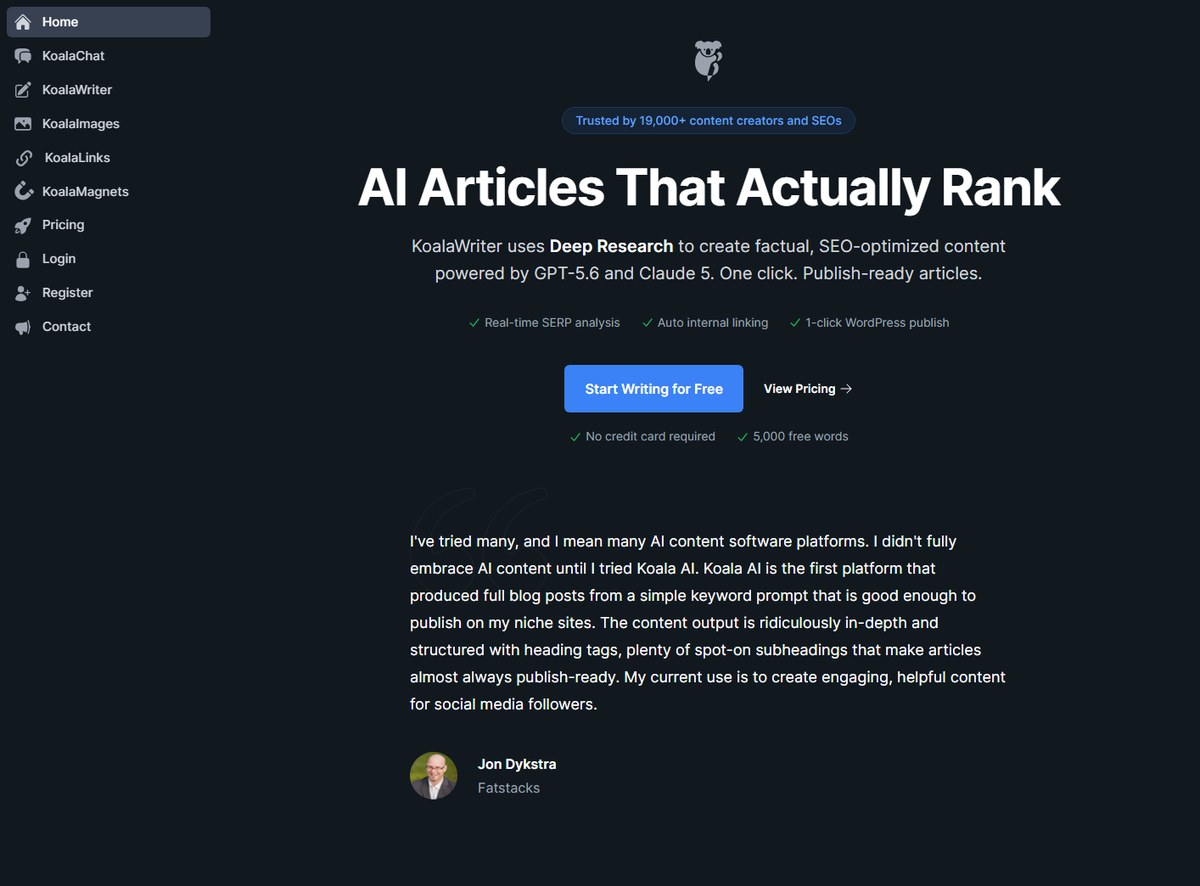
Koala's public homepage makes an aggressive ranking claim. Treat that as positioning, not a guaranteed outcome. Google evaluates whether content is useful, original, and created for people; the presence of an AI writer or optimization score does not change that standard.
What Is KoalaWriter?
KoalaWriter is the long-form writing product inside Koala AI by Koala AI Labs. It turns a target keyword or topic into an outline and article while offering live search research, citations, automatic SEO suggestions, internal links, style controls, images, integrations, and bulk queues. KoalaChat, KoalaImages, KoalaLinks, and KoalaMagnets share the account ecosystem, but this review focuses on the writer.
The category boundary matters. KoalaWriter helps produce and shape page content. It does not replace a crawler, log analyzer, backlink database, rank tracker, analytics platform, or conversion-research tool. In a mature stack, it belongs between topic selection and editorial QA.
You can browse other tools in our AI writing and content optimization hub, but the useful buying question is simple: does KoalaWriter remove enough research and drafting work without creating more verification debt than your team can handle?
Who Is KoalaWriter Best For?
KoalaWriter fits buyers whose main bottleneck is moving from a defined search query to a structured, research-assisted draft. The deciding variable is not article volume alone; it is whether the team can review the resulting facts, citations, voice, links, and final publishing decision.
| Buyer | Publishing volume | Research sensitivity | Editorial capacity | Best-fit decision | Skip if |
|---|---|---|---|---|---|
| Solo creator or affiliate publisher | 4–20 articles/month | Medium | Can fact-check every page | Consider Essentials for a controlled monthly pilot | You expect one-click output to be publish-ready |
| SEO content team | 20–100 articles/month | Medium to high | Has briefs, editors, and approval gates | Professional is the more relevant workflow tier | You need crawls, rank tracking, or backlink research in the same product |
| Agency | 50+ drafts/month | Varies by client | Can separate queues, voices, and QA ownership | Pilot one client and measure cost per approved article before scaling | You need mature roles, client workspaces, and documented approval stages |
| Regulated or expert-led business | Any | High | Subject-matter expert reviews material claims | Use only as a research and first-draft assistant | No qualified reviewer is available |
| Digital business owner | 4–100 articles/month | Medium | Can budget editing and source checks | Buy when accepted-output cost beats the current workflow | You are comparing only cost per generated word |
How the KoalaWriter Workflow Works
A practical workflow has six stages:
- Define the page job. Enter the query, article type, target region and language, voice, point of view, and any background information.
- Choose a research mode. Real-Time Data can fetch current search material. Deep Research expands source collection and synthesis on Professional and higher plans, but public pages do not disclose a current word-credit multiplier.
- Control the source set. Koala documents default, scholarly, and custom source filtering. Custom search operators are useful when a regulated or specialist topic should not rely on any ranking page that happens to appear.
- Edit the outline. Use the documented Outline Editor to reorder sections, remove generic headings, add missing decision criteria, and attach local prompts, keywords, links, or context to individual sections.
- Generate and inspect. Review every statistic, quote, date, named entity, product detail, and destination URL against its original source.
- Publish through an integration or export. Koala publicly lists built-in integrations for WordPress, Shopify, Webflow, Wix, Ghost, Google Sheets, webhooks, and API-based workflows, but publishing should follow approval rather than bypass it.
This sequence is stronger than one-click generation because it puts an editorial checkpoint before and after drafting. Skipping either checkpoint converts speed into cleanup.
What KoalaWriter Documentation and Demonstrations Show
The screens and documentation show how Koala compresses workflow steps and where its own limitations still require an editor to slow down.
The fast part is configuration. Real-Time Data, Automatic SEO, article type, voice, point of view, outline controls, media options, and integrations live in one writing flow. An operator can reuse a preset, inspect the proposed structure, add instructions to a difficult section, and queue multiple articles without rebuilding the process in separate tools. Brand DNA should reduce repeated briefing for teams with a stable audience and editorial voice.
The slow part is verification, and it should stay slow. A source list needs to be checked against the actual claims. Required links need a second pass because Koala's own Outline Editor guide says link inclusion is not guaranteed. Images, product prices, quoted statistics, and named entities also need review. Direct publishing can save clicks after approval, but it should not turn draft generation into automatic release.
For a useful trial, choose one evergreen topic and one volatile topic. Give both the same acceptance checklist: factual-error count, unsupported-claim count, citation match rate, useful-outline percentage, revision time, and publishable-word percentage. The current free allowance is enough to inspect controls for a single article but too small for a dependable long-form quality comparison. A paid monthly pilot is more informative than judging the product from one short sample or a vendor demo.
What Are KoalaWriter's Key Features?
Real-Time Data and source filtering
Koala's Real-Time Data documentation says the feature searches the web for each article or section, cross-references information, and can add citations. The public help center also documents source filtering: default uses ranking pages, scholarly narrows toward Google Scholar material, and custom accepts search operators.
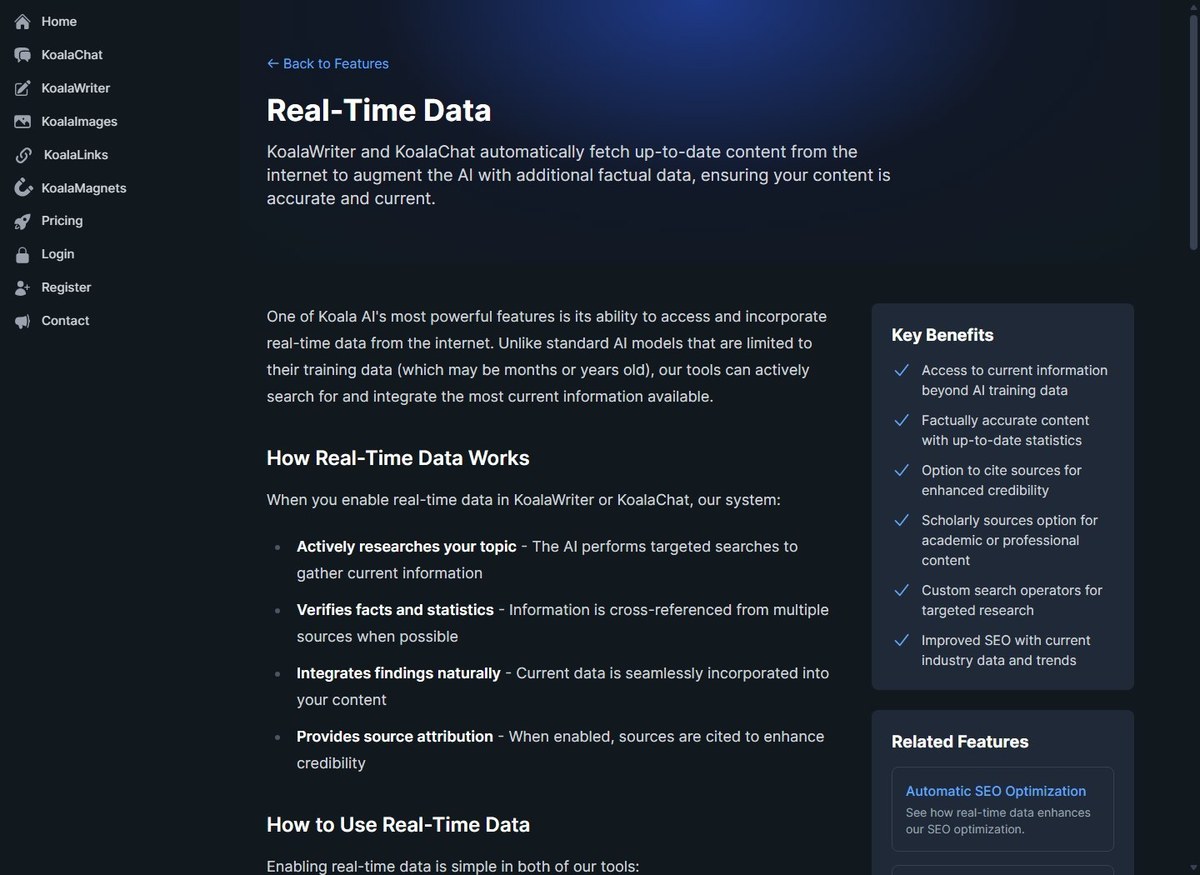
That control is useful for time-sensitive comparisons, software reviews, statistics, and product specifications. It does not make a statement true merely because several pages repeat it. Primary documentation should outrank affiliate summaries, and a cited page should actually support the sentence beside it.
Koala's Deep Research documentation describes broader research and source synthesis. The current pricing page markets up to 100 times more context, but that is a context claim, not a word-credit multiplier. No current official public page we found states a Deep Research word-credit multiplier, so buyers should verify the in-app usage estimate before making it the default for every brief.
Automatic SEO optimization
Koala documents Automatic SEO Optimization as a mode that analyzes search results and recommends relevant terms, entities, and structure. Manual mode gives the editor more control. This can reduce the time spent creating a basic topical checklist, especially when the brief starts with a clear query and comparable competitors.

The limitation is conceptual. Search-result correlation is an input, not a causal ranking formula. A term can be common because competitors cover it, yet still be unnecessary for your page. Use the suggestions to find omissions and intent gaps, not to force every phrase into prose.
Outline Editor and section-level controls
The documented Outline Editor is one of KoalaWriter's best buyer-facing features because it exposes the page structure before generation. Editors can add, delete, reorder, and refresh H2 and H3 sections. Koala also documents background context, section prompts, entities or topics, and URLs to link for individual sections.
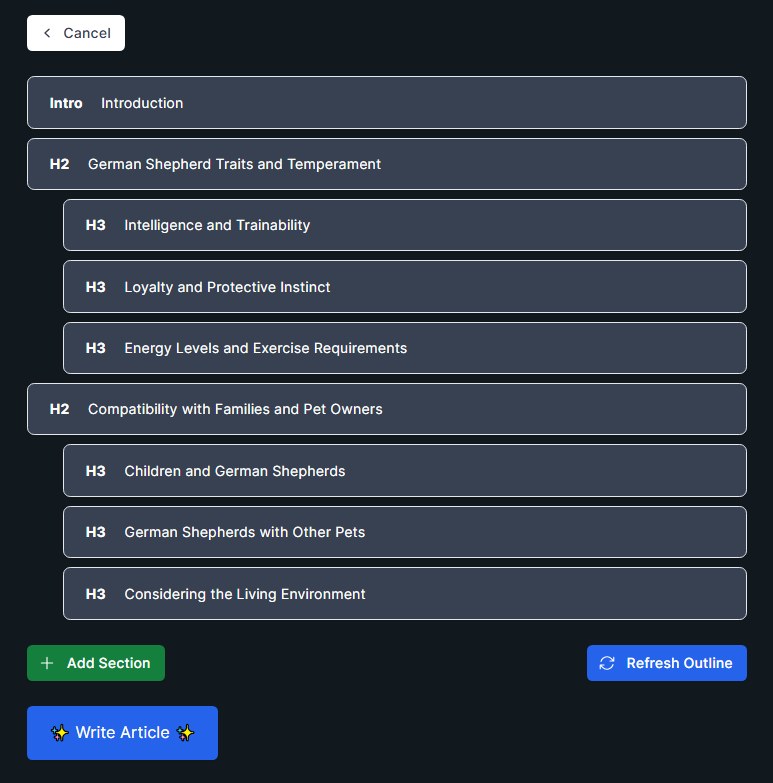
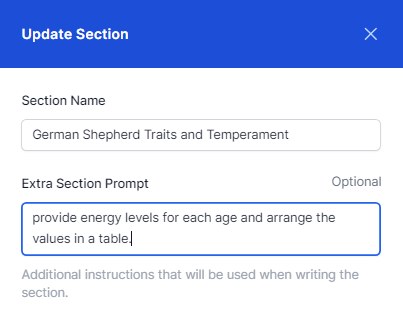
These fields make it easier to specify evidence, comparisons, table formats, or exceptions exactly where they belong. There is still a compliance boundary: Koala's help page says it cannot guarantee the AI will insert a provided link. Required citations and internal links therefore need a post-generation check.
Bulk Mode and publishing integrations
Bulk Mode accepts multiple target keywords, applies shared settings or presets, queues drafts, and can connect with publishing integrations. It is a real productivity feature for repeatable page types.
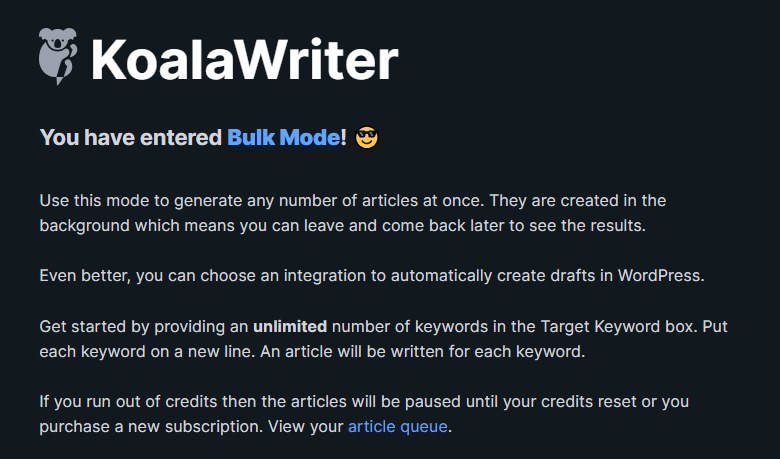
The word "bulk" should describe queue management, not editorial standards. If a team can generate 50 drafts in the time it can properly review five, review throughput becomes the bottleneck. Google explicitly warns against scaled content created primarily to manipulate rankings, regardless of whether automation or people produced it.
Brand DNA and KoalaWriter v2
Koala announced Brand DNA and KoalaWriter v2 in April 2026. The current Brand DNA page still labels it beta and places access through the Beta Program on Professional and higher plans. It stores reusable identity, audience, point of view, style, and business context so editors do not have to rebuild the same instructions for every article.

The image is announcement art rather than interface proof, and the feature remains only as good as the guidance supplied. A saved voice profile can improve consistency, but it cannot manufacture first-hand experience or expertise.
Internal linking, media, and API access
Koala documents automatic internal linking through a domain, sitemap, RSS feed, manual list, and some platform integrations. Current pricing also lists AI images, YouTube embeds, Google Sheets integration, and API access across paid plans, with allowance differences by tier for each feature.
These are valuable workflow conveniences. They also introduce checks that should be explicit in your SOP: validate the target URL, confirm the anchor fits the destination, inspect image rights and relevance, check embed availability, and keep API publishing behind a review gate.
KoalaWriter Pricing and Usage Limits
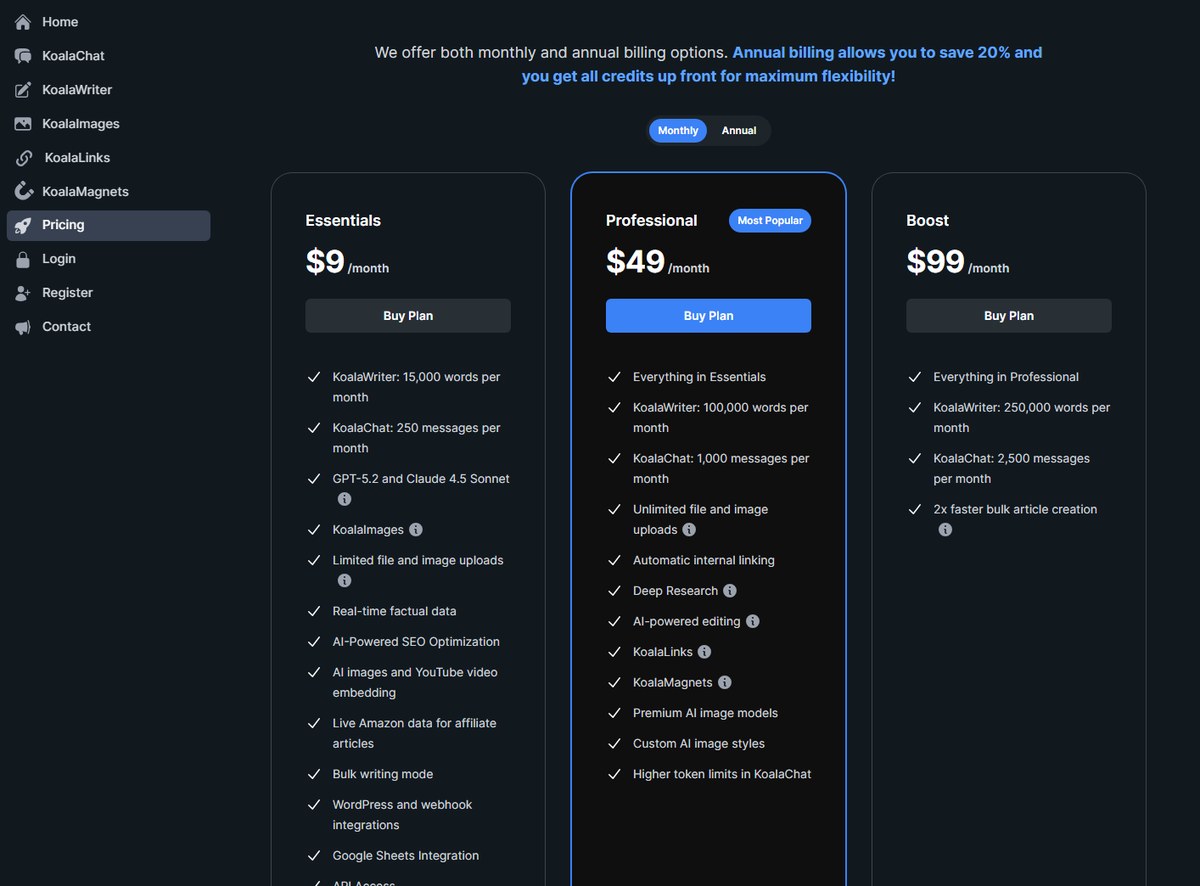
The Koala pricing page was checked on August 5, 2026. It showed nine monthly plans, all with access to the writer and chat products but different allowances. The first three plans are the clearest fit for most individual buyers.
| Plan | Monthly price | Writer words/month | Chat/API/Sheets credits/month | Notable limit or fit |
|---|---|---|---|---|
| Essentials | $9 | 15,000 | 250 | Core writer, Real-Time Data, WordPress/webhooks, Sheets, and API |
| Professional | $49 | 100,000 | 1,000 | Adds automatic internal linking, Deep Research, AI editing, KoalaLinks, and KoalaMagnets |
| Boost | $99 | 250,000 | 2,500 | Adds two-times faster bulk article creation |
| Growth | $179 | 500,000 | 5,000 | Larger teams or portfolio publishing |
| Elite | $350 | 1,000,000 | 10,000 | High-throughput content operations |
| Advanced | $500 | 1,500,000 | 12,500 | Enterprise-grade word budget |
| Scale I | $750 | 2,500,000 | 15,000 | Large programmatic or agency workloads |
| Scale II | $1,250 | 5,000,000 | 20,000 | Very large operations |
| Scale III | $2,000 | 10,000,000 | 25,000 | Maximum listed scale tier |
Google Sheets formulas and API calls share the KoalaChat allowance rather than receiving a separate unlimited pool.
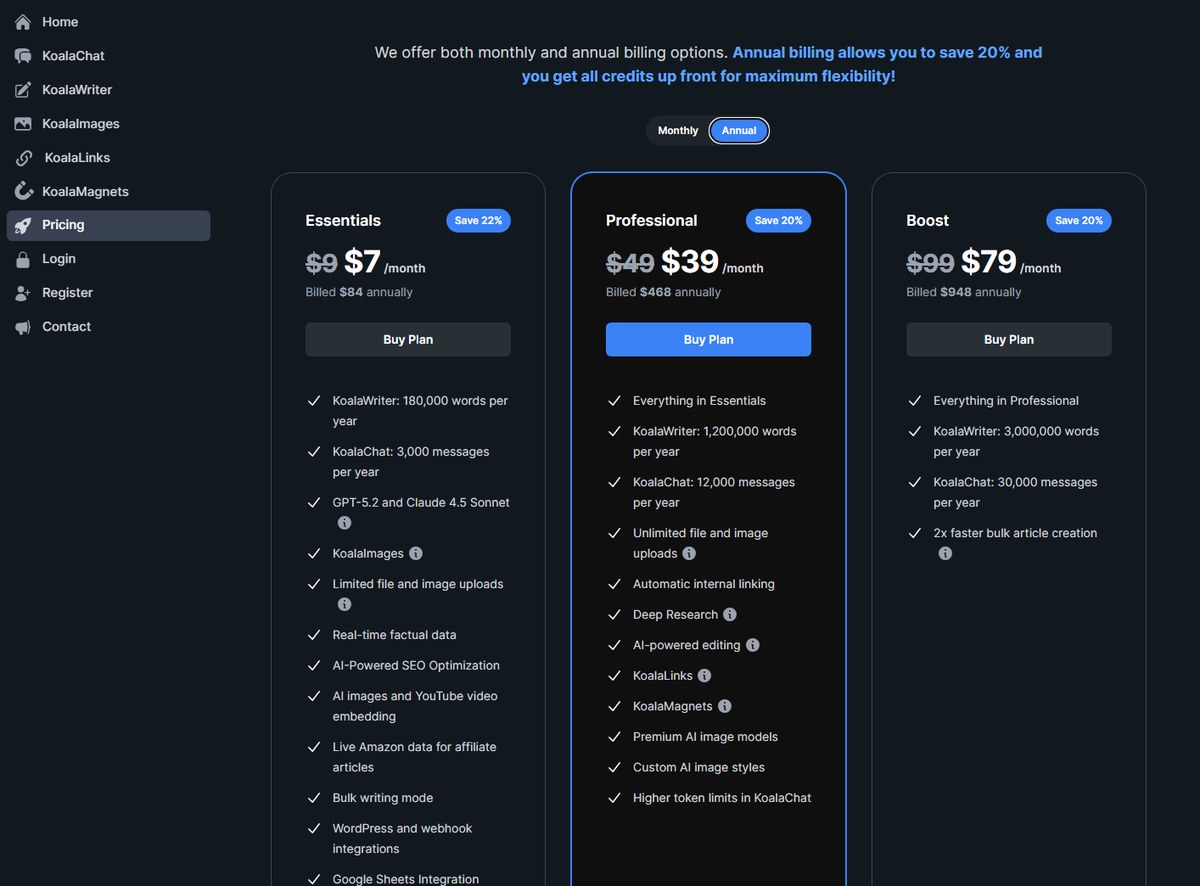
The annual toggle advertised 20% savings. It showed monthly equivalents of $7 for Essentials, $39 for Professional, and $79 for Boost, with annual billing. Those equivalents should not be compared to regular monthly prices as if the commitment were identical.
Koala's pricing FAQ currently calls the allowance a free trial with up to 5,000 Writer words and 25 chat messages, while the changelog also uses “free plans” for some KoalaChat access. Because official wording is mixed, treat this as a limited free allowance rather than assuming a fully specified permanent free tier or a time-limited trial. Monthly credits expire after one month, while annual credits remain available for one year.
Usage math deserves attention. The visible pricing footnote says GPT-5.2 and Claude 4.5 Sonnet count at two times generated words. The newer July 28 changelog lists Claude Sonnet 5, Claude Opus 5, and the GPT-5.6 family, with Opus 5 at three times Writer credits. The public pricing and changelog model labels are not fully synchronized, and no current public Deep Research credit multiplier was found. Estimate cost from the model actually shown in your account, average draft length, reruns, and rejected-output rate.
Paid subscriptions recur until canceled. Koala's terms of service say cancellation is available through the account and takes effect at the end of the current paid term. The legal page also says prices may change and recurring charges continue until cancellation.
Compare KoalaWriter's current monthly and annual terms
How Should You Budget KoalaWriter Beyond the Word Allowance?
Budget from accepted output, not the largest word number on the pricing card. A KoalaWriter allowance measures generated usage, while a content team's real unit of value is the article that survives fact-checking, editing, and stakeholder review.
Start with four measurable inputs: articles per month, target length, the model multiplier displayed in your account, and expected rejection or rewrite rate. Ten 2,000-word drafts use 20,000 baseline words before revisions. A documented two-times legacy-model multiplier turns that workload into 40,000 words, while the current changelog's three-times Opus 5 rule would make it 60,000. Do not insert a Deep Research multiplier into the forecast unless the authenticated usage estimate supplies one.
The sensible operating model is mixed rather than uniform. Use lighter research for stable, low-risk pages. Reserve Deep Research for pages where broader source coverage can change the decision. Keep a separate allowance for reruns after a weak outline, a failed citation, or a brand-voice miss. If a rejected 2,000-word draft consumed credits, it still belongs in the cost calculation even though it never reaches the site.
Editing time can cost more than generation. Track the minutes required to validate every material claim, replace weak sources, add first-hand evidence, repair internal links, and rewrite generic sections. A cheaper tier that produces more cleanup can have a higher effective cost per accepted article than a plan with better controls or a slower manual workflow.
Before annual billing, run a monthly pilot and record four ratios: generated words per accepted word, verified citations per cited claim, editor minutes per publishable 1,000 words, and accepted articles per total drafts. Those values turn Koala's plan table into a workload forecast instead of a guess.
Accuracy, Citations, and Search-Ranking Risk
Koala's strongest selling point is factual content assisted by live research. Its most important limitation is that the same workflow can still produce a sentence that misreads a source, merges two claims, uses an outdated value, or cites a page that does not support the wording.
A defensible review process should include:
- Open every source attached to a material claim.
- Prefer original pricing, legal, product, regulatory, and research pages.
- Check dates, billing basis, geography, units, and plan eligibility.
- Remove claims that cannot be supported without stretching the source.
- Add first-hand evidence, examples, or expert judgment that the model cannot supply.
- Review originality and copyright risk before publishing.
- Recheck volatile claims shortly before release.
Google's people-first content guidance asks whether a page provides original information, substantial value, clear sourcing, and demonstrable expertise. Its spam policies identify scaled content abuse when many pages are created primarily to manipulate rankings. KoalaWriter can speed up a useful editorial process, but it can also speed up a weak one.
Pros and Cons of KoalaWriter
Pros
- Live web research and configurable source filtering are integrated into drafting.
- Editable outlines and section prompts give more control than a single long prompt.
- Bulk queues, presets, internal links, and publishing integrations support repeatable operations.
- Entry pricing is accessible, and official pages provide a limited free allowance before a paid workload.
- Brand DNA beta can make recurring voice and audience instructions easier to maintain for Professional-and-higher users.
Cons
- Research assistance does not remove hallucination or citation-review risk.
- Premium-model multipliers, reruns, and undisclosed Deep Research usage can make headline word allowances difficult to forecast.
- The platform does not replace technical SEO, rank tracking, backlinks, analytics, or conversion research.
- Bulk production can outpace a team's ability to verify and improve drafts.
- Public marketing language about rankings is stronger than the evidence a buyer can independently confirm from product pages.
KoalaWriter vs ChatGPT: Which Fits SEO Production?
KoalaWriter is the better fit for a repeatable SEO article workflow; ChatGPT is the more flexible general assistant. KoalaWriter packages live search inputs, an editable outline, article modes, internal linking, bulk queues, and CMS delivery around a target query. ChatGPT can research, outline, draft, analyze files, and follow custom instructions, but the operator must design and govern more of the workflow.
Choose KoalaWriter when the production unit is a structured article and repeatable controls matter more than open-ended flexibility. Choose ChatGPT when the work spans strategy, analysis, coding, brainstorming, or unusual formats that do not fit a fixed article pipeline. Neither product removes the need to verify facts, add first-hand expertise, and approve the final page.
What Are the Best KoalaWriter Alternatives?
| Alternative | Category | Choose it when | Main trade-off versus KoalaWriter |
|---|---|---|---|
| Scalenut | Broader AI SEO platform | You want writing, content scoring, audits, internal-link management, and AI-visibility functions together | More platform surface and cost; less narrowly focused on fast article production |
| Surfer SEO | Content optimizer and editor | Your priority is collaborative briefs and a mature editor tied to SERP recommendations | Writing automation and live-source controls are not the same package |
| Frase | SERP research and guided editor | You value question discovery, briefs, and guided optimization | Bulk article production is less central |
| Agility Writer | Long-form AI generator | You want another research-led automation workflow and detailed article modes | Requires its own quality and source verification; workflow preferences decide the fit |
The closest alternative is determined by the bottleneck. Choose KoalaWriter when drafting and source-assisted structure are slow. Choose a broader optimizer when briefs, refreshes, audits, or cross-page governance are the bigger problem.
Where Does KoalaWriter Fall Short?
Beyond what competitors offer, Koala has limitations worth stating plainly:
- The word multipliers apply per article, not across articles, so switching to premium models mid-plan still burns credits quickly on long drafts.
- Official pages variously call the limited 5,000-Writer-word and 25-chat-message allowance a free trial or free plan, so long-term free-tier expectations are unclear.
- Deep Research is included on Professional and higher, but current public pages do not expose a word-credit multiplier, making precise cost forecasting difficult without the in-app estimate.
- Internal linking accuracy depends on your sitemap freshness; stale sitemaps produce stale link targets.
- Refund eligibility is conditional: the pricing FAQ asks buyers to contact Koala within 15 days while usage remains below both 15,000 words and 100 messages.
Which KoalaWriter Attributes Should Buyers Check?
Before subscribing, verify these five items on the live Koala pricing page:
- Current annual versus monthly equivalents. Annual savings may shift with promo periods; always confirm the $7/$39/$79 figures were displayed at decision time, not cached.
- Which model selector options are active. The pricing page still foregrounds GPT-5.2 and Claude 4.5 Sonnet, while the July 28 changelog names Sonnet 5, Opus 5, and GPT-5.6 models. Verify the current in-app selector and multiplier instead of assuming either public list is complete.
- Your expected model and rerun mix. Premium models and rejected drafts can consume credits faster than the headline allowance suggests. Treat Deep Research cost as unknown until the account shows its usage estimate.
- The refund threshold against your pilot plan. The public FAQ ties eligibility to contacting Koala within 15 days while staying below both 15,000 words and 100 messages, so test with conservative volume estimates.
- Your integration needs mapped to plan tiers. Essentials lists WordPress, webhooks, Google Sheets, and API access. Professional adds automatic internal linking, Deep Research, KoalaLinks, and KoalaMagnets.
Is KoalaWriter Worth It?
KoalaWriter earns an 8.4/10 editorial score for research-assisted long-form production. Real-Time Data, source filters, Deep Research, the Outline Editor, section prompts, internal links, Brand DNA, and bulk workflows form a coherent product rather than a loose collection of prompt templates.
The decision changes by operating model:
- Buy or pilot it when article production is the bottleneck and every draft already passes through factual and editorial approval.
- Consider it with safeguards when you need current-source assistance but your topics are volatile, commercial, or reputation-sensitive. Start monthly and measure editor minutes plus accepted-output cost.
- Skip it when you need an all-in-one SEO suite, guaranteed link insertion, autonomous factual publishing, mature client approvals, or ranking guarantees.
Try KoalaWriter's free allowance before choosing a paid tier
How We Evaluated KoalaWriter
This review used public first-party product pages, rendered pricing states, help documentation, the changelog, legal terms, and official public interface images checked through August 5, 2026. Material claims are linked where they appear. We did not access a paid workspace, generate comparison drafts, time outputs, test CMS delivery, or measure rankings.
| Editorial attribute | Weight | Evidence considered | Editorial score |
|---|---|---|---|
| Research and drafting utility | 30% | Real-Time Data, source controls, Deep Research, bulk workflow | 8.8 |
| Outline and source control | 25% | Editable structure, section prompts, URL limitation, manual review | 8.8 |
| Workflow and integrations | 20% | CMS, webhooks, Sheets, API, internal-link workflow | 8.7 |
| Plan value and usage clarity | 15% | Pricing, allowances, model conflicts, free-access ambiguity | 7.8 |
| Governance transparency | 10% | Refund terms, beta labeling, guarantees, public limitations | 6.5 |
The weighted result is 8.4/10. These are editorial judgments about the documented buying proposition, not measured product-performance scores.
How We Test and Score
ScaleWitAI funds every account used in this review with its own capital. We subscribe to all paid tiers with self-funded plans and never use sponsored, gifted, or vendor-provisioned accounts, so our evaluation reflects the same product a paying customer receives and stays 100% independent of vendor influence.
Evaluation combines standardized test suites with hands-on workflow testing. We use HumanEval-style tasks to probe logic and code reasoning, BLEU/ROUGE-style metrics to measure natural-language quality, and internal stress-test scenarios to map context-window limits and long-input behavior. We run more than 10,000 prompts per AI platform every year, across varied access conditions, and log results against a transparent scoring rubric.
The dataset for this review was collected over 12 months (from August 2025 to August 2026). Historical comparisons track AI model development since 2024, and this report tests and compares 12+ leading AI models and providers on the market.
Frequently Asked Questions
Is KoalaWriter free?
Koala currently gives free/new users up to 5,000 Writer words and 25 chat messages according to the pricing FAQ checked August 5, 2026. Official pages variously call this a free trial and a free plan, so do not assume a permanent unlimited free tier or a specific trial duration. Monthly credits expire after one month; annual credits remain available for one year.
How much does KoalaWriter cost?
The monthly pricing snapshot started at $9 for 15,000 KoalaWriter words on Essentials. Professional was $49 for 100,000 words, and Boost was $99 for 250,000 words. Higher tiers ranged from $179 to $2,000 per month. Annual billing advertised a 20% saving at the time of research.
Does KoalaWriter produce factual articles?
It can use current web research, source filters, citations, and Deep Research to improve the evidence available during generation. It cannot guarantee that every generated claim, interpretation, date, or citation is correct. Material facts still require human verification before publication.
Can KoalaWriter publish directly to WordPress?
Yes. Koala publicly lists WordPress and other platforms (Shopify, Webflow, Ghost), along with webhooks, Google Sheets, Zapier, and API access depending on the plan tier. Direct publishing should sit behind editorial approval rather than replace it.
Does KoalaWriter guarantee higher rankings?
No reliable tool can guarantee rankings. Koala provides research, structure, optimization recommendations, and drafting assistance. Search performance still depends on intent fit, originality, expertise, technical quality, links, competition, user satisfaction, and many factors outside the writer.
What is the difference between Real-Time Data and Deep Research?
Real-Time Data fetches current search material during generation for each article or section and can add attribution. Deep Research uses broader research and source synthesis. The current pricing page markets up to 100 times more context, but no current public Deep Research word-credit multiplier was found; verify usage inside the account before standardizing it across briefs.
Can KoalaWriter content pass AI detectors?
No detector result can be guaranteed, and detector scores do not prove factual accuracy, originality, human authorship, or search quality. Evaluate KoalaWriter drafts by source support, usefulness, originality, expert contribution, and editorial acceptance rather than trying to optimize for a detector label.
Who is KoalaWriter best for?
It is best for content creators, SEO professionals, agencies, and digital business owners who need faster research-assisted long-form drafting and already have a disciplined editing process. It is not ideal for teams seeking autonomous, unreviewed publishing or a complete all-in-one SEO platform.
