Copy.ai is an AI-native go-to-market (GTM) platform that chains Workflows, Agents, Tables, and Chat into automated sales, marketing, and revenue operations processes. Its strongest case is workflow breadth for B2B GTM teams; its biggest weakness is opaque workflow-credit economics and thin public documentation. It does not replace a CRM, a sales engagement platform, or human review of customer-facing output.
| Decision factor | Editorial finding |
|---|---|
| Homepage | copy.ai |
| Category | AI-native GTM workflow platform with an AI copywriting origin |
| Best for | B2B sales, marketing, and revenue operations teams that want outreach, content, lead processing, and CRM enrichment automated in one platform |
| Entry price checked August 5, 2026 | Self-serve Chat at $29/month, or $24/month billed $288/year |
| Main advantage | Workflows, Agents, and a claimed 2,000+ integrations consolidate many GTM use cases without assembling point solutions |
| Main limitation | No public dollar value per workflow credit; annual billing terms with a 5-day refund window |
The buying decision is therefore less about whether Copy.ai has enough features and more about whether its credit-based pricing, seat tiers, and integration coverage fit your team's production volume and stack. This review examines the public plan structure, the workflow architecture, the terms that govern billing and content rights, and where Copy.ai fits beside specialist AI writing and content tools.
Quick Verdict: Is Copy.ai Worth It?
Copy.ai is worth shortlisting if your GTM team wants one platform to codify and automate multi-step processes across sales, marketing, and operations. The public platform spans prospecting, inbound lead processing, content creation, translation, deal coaching, CRM enrichment, and account-based marketing, with LLM-agnostic model access and a large integration surface.
The caution is cost predictability and documentation depth. Workflow credits have no published dollar conversion, run costs depend on workflow complexity, and the public terms describe annual subscription billing with a 5-day refund window on initial purchase. Copy.ai is also not a technical SEO suite, a CRM replacement, or a substitute for editors who verify accuracy, compliance, and brand risk before customer-facing content ships.
Evaluate Copy.ai's current plans and credit structure
What Is Copy.ai?
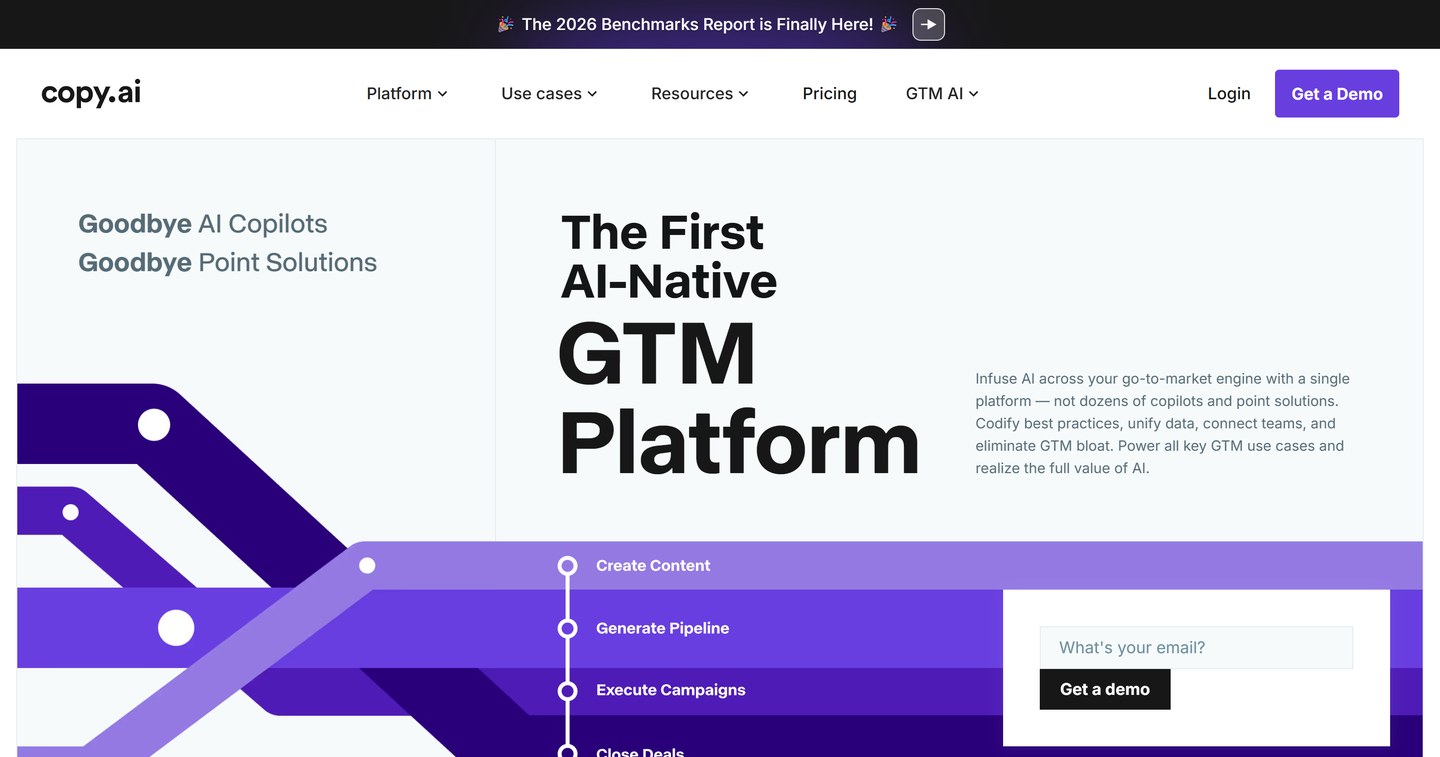
Copy.ai is an AI-native GTM platform built around automated workflows. Its homepage headline reads "The First AI-Native GTM Platform," with messaging that says goodbye to AI copilots and point solutions and promises to codify best practices, unify data, connect teams, and eliminate GTM bloat.
The product's origin matters for search context. Copy.ai launched as an AI copywriting tool, and that heritage survives in the self-serve Chat plan. The current public architecture, however, is broader: Workflows, Actions, Agents, Tables, Infobase, Brand Voice, and Chat, described on the platform components page as a system that combines AI capabilities, data foundations, and event-triggered automation with enterprise-grade security claims.
Two evidence caveats belong up front:
- The Terms of Service, last updated October 12, 2023, define the Services around "copy content generation." That scope description predates the GTM platform positioning, so buyers negotiating enterprise terms should confirm which current services their contract covers.
- The homepage states "Trusted by 17 million users at leading companies" alongside enterprise logos. That is a vendor marketing claim.
How Does Copy.ai Work?
Copy.ai organizes GTM work as composable automation. Its how-it-works page describes codifying multi-step processes, building a unified GTM data foundation, staying LLM-agnostic, and usage-based pricing that scales with actual use.
Workflows and Actions
A Workflow is a set of AI-powered actions stitched together to codify a process or best practice, such as creating an account plan or writing an SEO article. Actions are the building blocks that let users apply AI without being AI experts. The workflows page frames this as turning tribal knowledge into repeatable, triggerable processes that run across teams.
Agents with guardrails
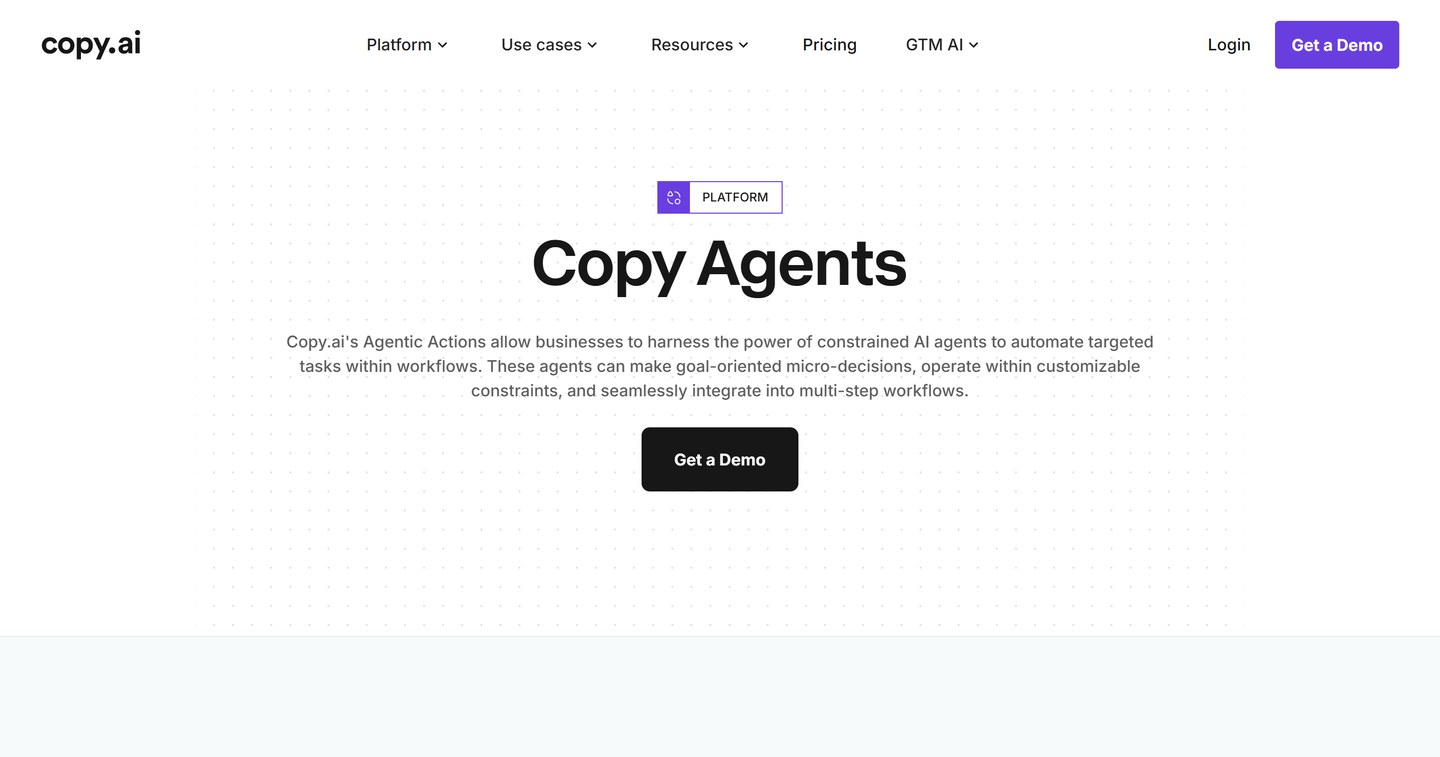
Copy Agents are constrained AI agents embedded in workflow steps. Copy.ai says they make goal-oriented micro-decisions within customizable constraints, which is the vendor's answer to the uncontrolled-agent risk that many enterprise buyers raise. The public page does not publish agent evaluation results, failure rates, or audit-log detail.
Tables, Infobase, and Brand Voice
The intelligence layer has three documented pieces: Tables as a queryable data foundation that consolidates sources, Infobase as a repository of company information referenced by tags, and Brand Voice as the tone definition that keeps outputs consistent. These matter for GTM teams because personalization quality depends on the underlying data and brand context, but data hygiene remains the buyer's responsibility.
The "eliminate GTM bloat" framing is positioning, not a measured outcome. Consolidation value depends on how many tools your team actually retires after adoption.
What Are Copy.ai's Key Features?
Copy.ai publishes eight use-case families across sales, marketing, and operations. The feature claims below are first-party and were reproduced in a live account for this review.
Prospecting Cockpit and personalized outreach
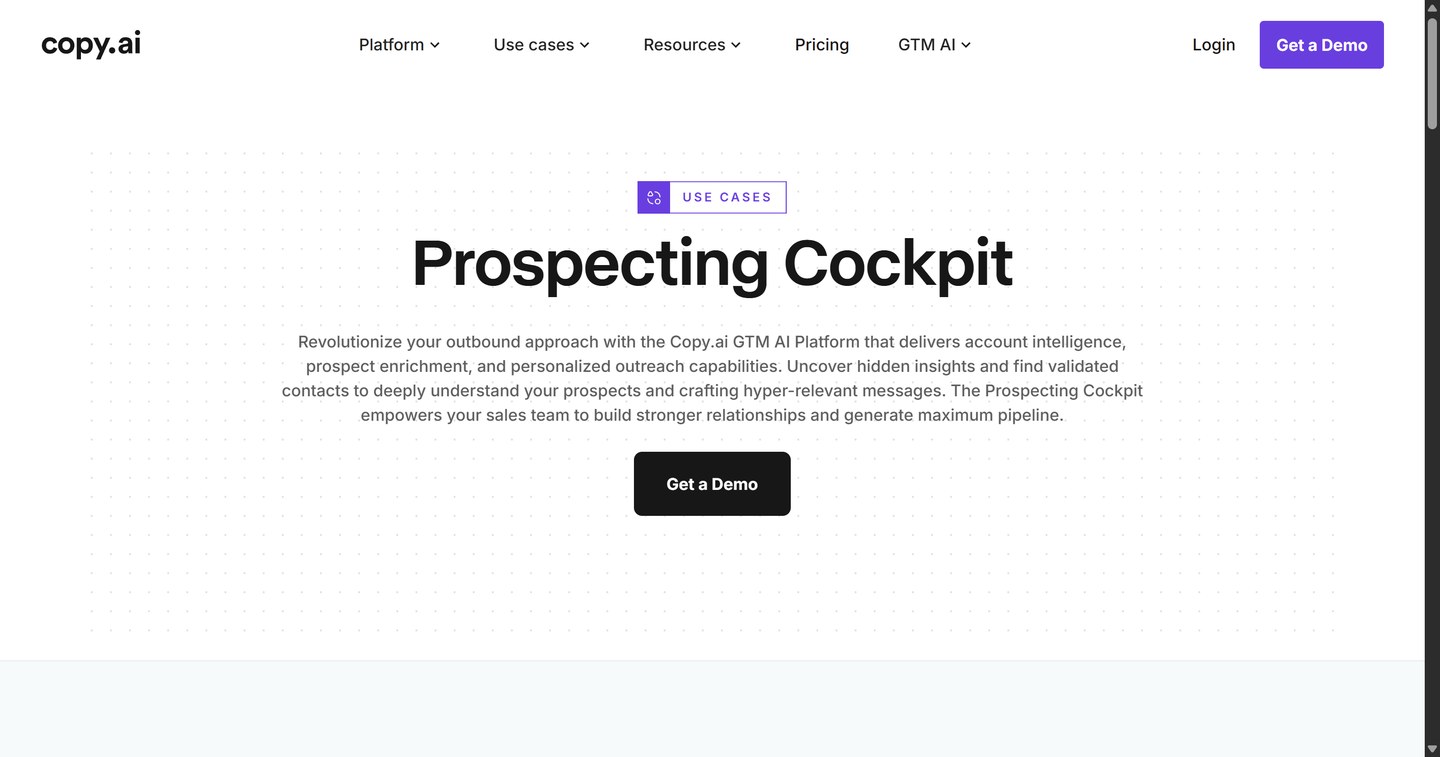
The Prospecting Cockpit is Copy.ai's outbound sales surface: research accounts and contacts, then draft personalized outreach. The homepage claims reps can double pipeline generation per rep, a vendor projection rather than verified performance. GTM teams should test research depth and email quality against their own ICP before trusting it at volume.
Inbound lead processing
Copy.ai describes automatically enriching, researching, and engaging marketing-generated leads to minimize speed-to-lead and maximize conversions. This targets a real RevOps bottleneck, but enrichment accuracy and lead-routing behavior depend on your CRM fields and data sources, which the public page does not specify.
Content creation across the GTM engine
Content creation covers SEO, thought leadership, use cases, and social content, with the homepage promising drafts in seconds. This is the legacy copywriting strength, now embedded in workflows. It is not a search-optimization engine: public pages do not document SERP analysis, content scoring, or ranking features comparable to dedicated optimizers.
Translation and localization
Copy.ai claims native-speaker-level translation in real time at a fraction of agency cost. Regulated or brand-sensitive markets should validate quality with native reviewers before production use.
Deal coaching and forecasting
This use case turns sales transcripts into deal insights: scoring deals, suggesting strategies, and predicting close dates. It overlaps with conversational intelligence products, so teams already paying for a CI platform should compare marginal value rather than stack another subscription.
CRM enrichment and GTM system integrations
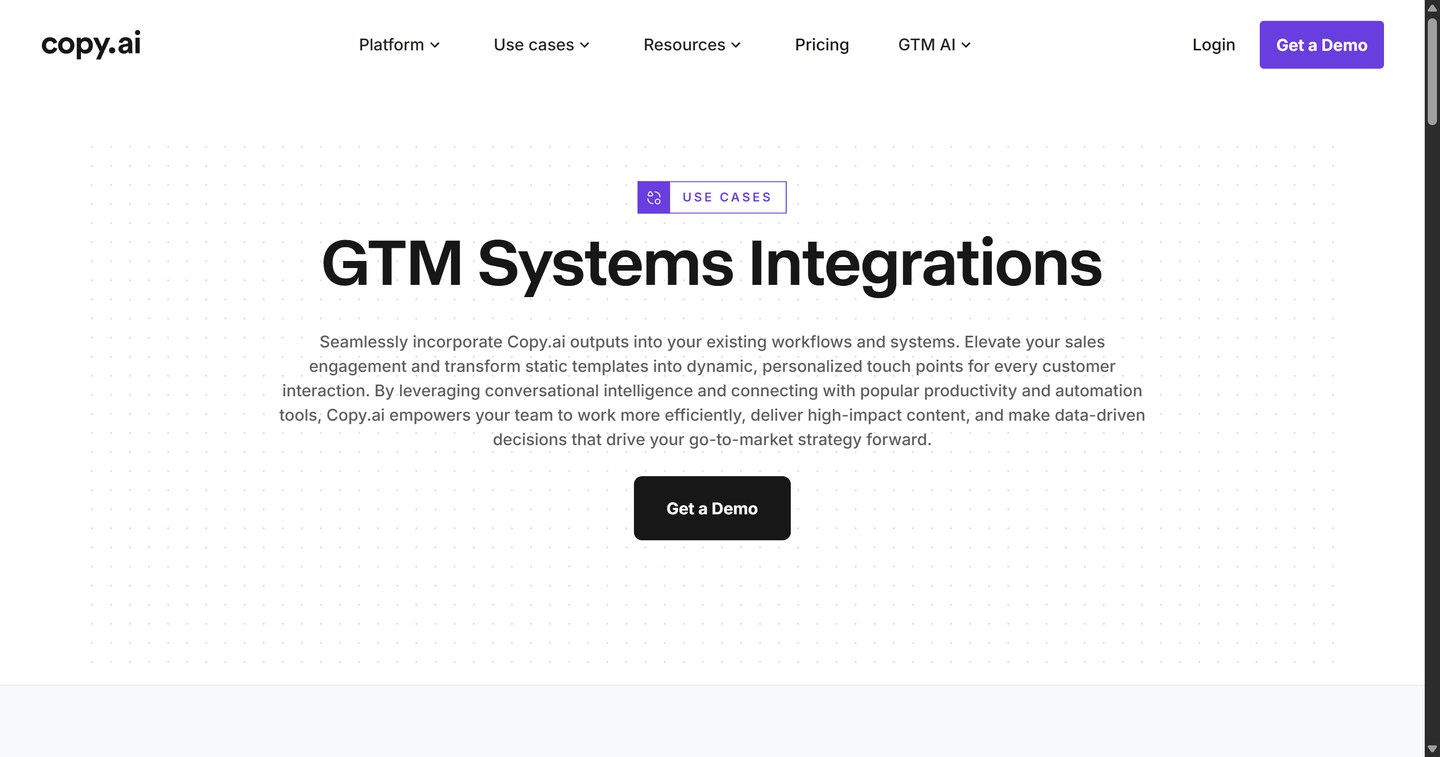
The GTM systems integrations page describes pushing Copy.ai outputs into sales engagement sequences and pulling conversational data back into workflows, with bi-directional triggers. The platform components page claims direct CRM integrations, a Zapier connection covering 2,000+ additional applications, and an API for custom builds.
Who Is Copy.ai Best For?
| Buyer profile | Fit | Why |
|---|---|---|
| Sales teams running outbound at scale | Strong | Prospecting Cockpit and workflow-based personalization target pipegen workflows |
| RevOps and GTM operations | Strong | Tables, CRM enrichment, and event-triggered workflows fit systems-integration mandates |
| Marketing teams producing GTM content | Moderate to strong | Content and localization workflows help, but SEO-specific optimization is not documented |
| Solo creators or bloggers | Weak | Chat is affordable, but the platform's value sits in team workflows and integrations |
| Teams needing deep content scoring | Weak | No public SERP analysis or content-scoring equivalent to specialist optimizers |
What Does Onboarding Look Like?
For enterprise buyers, the pricing page presents a guided implementation timeline: Day 1 kickoff, Week 1 testing, Day 15 production, with onboarding by AI experts, process codification, and integration setup. A Fortune 500 cybersecurity CMO quote praises the security review and onboarding experience.
For self-serve buyers, the public surface is thinner. The Chat plan has a Get started flow, and the Help Center exists on a third-party-hosted knowledge base with copy.ai-branded spaces including Plan & Pay. Public pages do not publish a self-serve onboarding SLA, migration guide, or implementation checklist. If you want to explore the self-serve path yourself, open Copy.ai through our link and keep the 5-day refund window in mind.
How Much Does Copy.ai Cost?
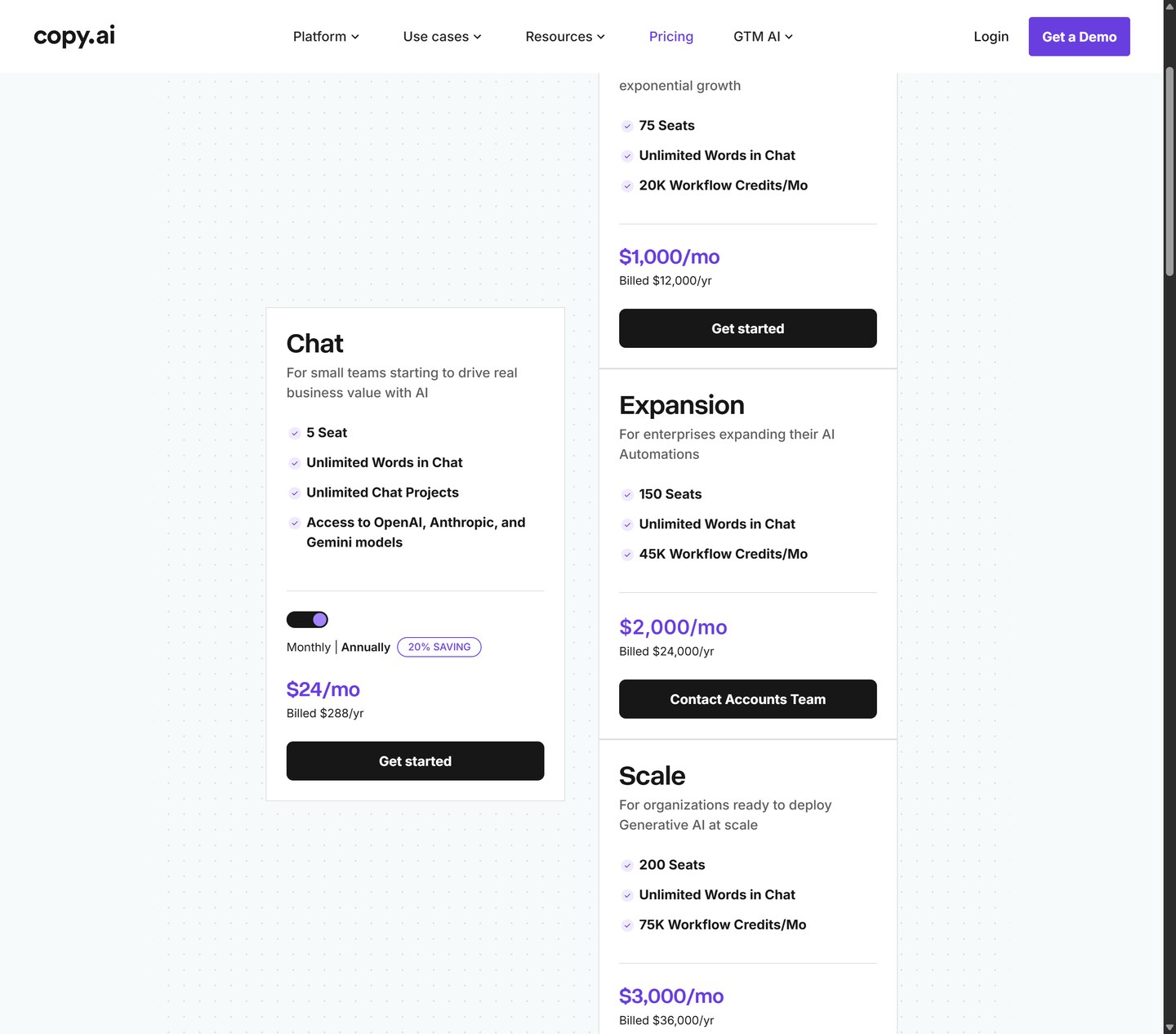
Copy.ai splits pricing into Self-Serve and Enterprise tabs. These figures are the rendered card values captured on August 5, 2026, before relying on them in a budget:
| Plan | Seats | Workflow credits | Published price (checked August 5, 2026) |
|---|---|---|---|
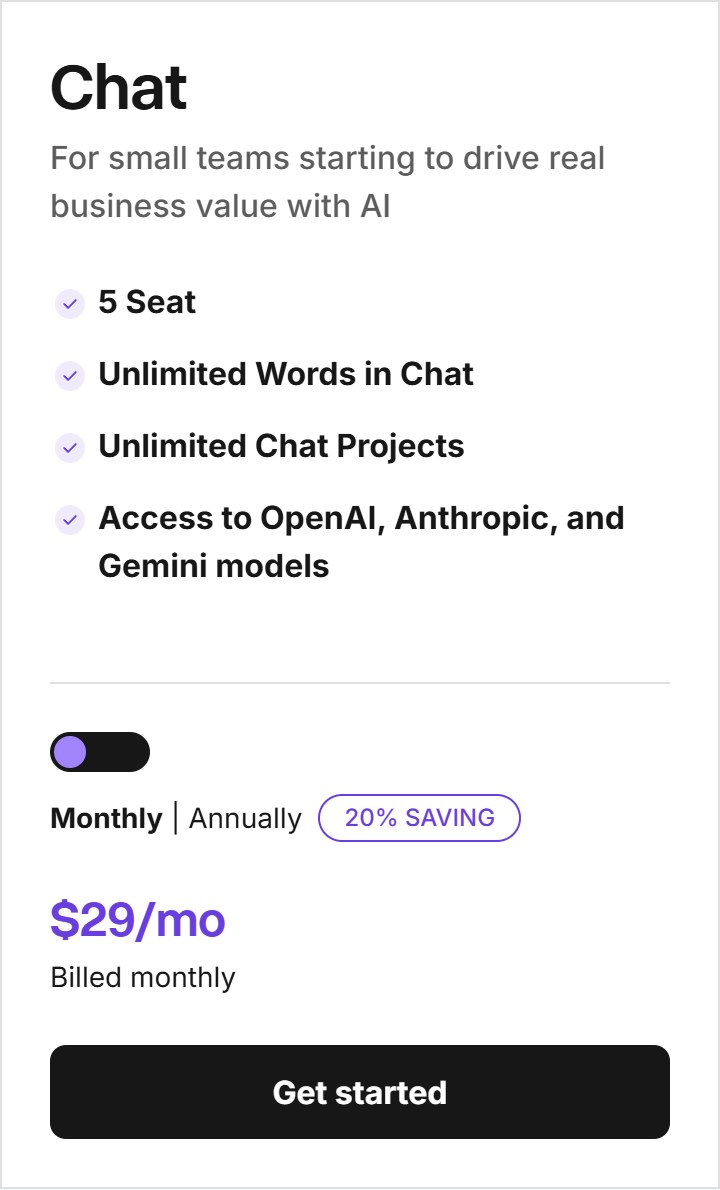
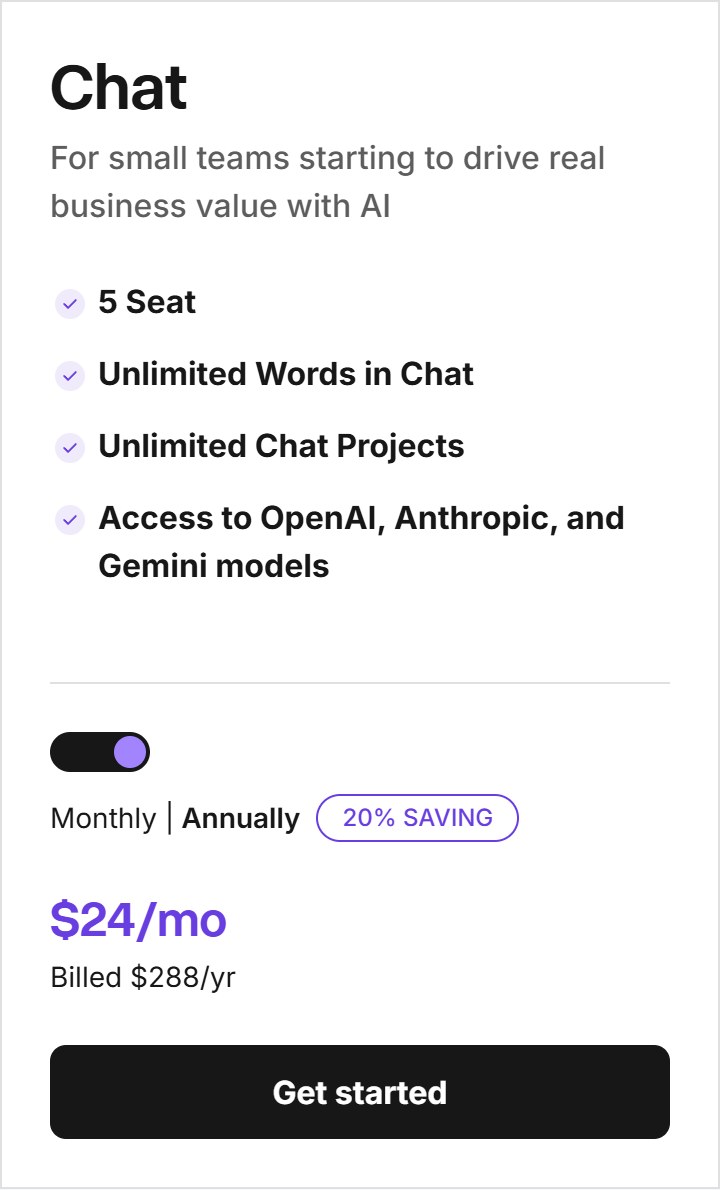
| Chat | 5 | Not listed on the card | $29/month, or $24/month billed $288/year |
| Growth | 75 | 20,000/month | $1,000/month, billed $12,000/year |
| Expansion | 150 | 45,000/month | $2,000/month, billed $24,000/year |
| Scale | 200 | 75,000/month | $3,000/month, billed $36,000/year |
| Enterprise | Custom | Custom | Custom demo, guided jumpstart implementation |
The Growth card carries a self-serve Get started button, while Expansion and Scale route to the accounts team. Enterprise adds guided jumpstart implementation, API access with bulk workflow runs, unlimited customizable workflows, a designated account and support team, and enterprise security protocols.
What a workflow credit buys
The pricing FAQ defines a credit as computational power needed to execute workflow tasks, says credit value depends on task complexity such as text generation or API use, and notes that each run can consume a different amount. Run cost is visible in a side panel after execution, and credits can be added later. What the public page does not publish is a dollar value per credit, a fixed credit-to-output conversion, or overage behavior when a monthly allowance runs out. Budget forecasting therefore requires a real workload test.
The annual saving math
The annual toggle displays a 20% SAVING badge. Editorial calculation from the displayed figures: $29/month times 12 equals $348, and the annual price is $288, a saving of $60 or about 17.2%, not 20%. This is our arithmetic from vendor-displayed prices, not a vendor claim.
Billing, refund, and cancellation terms
The Terms of Service state that subscriptions are billed annually at the start of each term, renew automatically on the anniversary, and trigger a reminder 30 to 60 days before renewal. You may cancel for a full refund within five calendar days of the initial purchase; after that, the purchase is final and non-refundable, and cancellation via [email protected] takes effect at the end of the current period. Fees are charged in US dollars, and the terms include a binding individual arbitration clause for US customers. Self-serve users can upgrade or downgrade at any time with proration or next-month credit, per the pricing FAQ.
Two further buyer caveats: the terms grant Copy.ai a broad, perpetual, irrevocable license to use User Content you make available through the Services, and the Privacy Notice does not publish an explicit model-training opt-out in the sections reviewed. Teams feeding proprietary account data, customer information, or unreleased messaging into Tables or Infobase should have counsel review those clauses.
What Are the Pros and Cons of Copy.ai?
| Pros | Cons |
|---|---|
| Wide GTM use-case coverage from prospecting to CRM enrichment | Workflow credit value and run costs are not publicly quantified |
| Workflows codify repeatable, triggerable processes | Entry GTM tiers start at $1,000/month, above most point-solution budgets |
| LLM-agnostic access across OpenAI, Anthropic, and Gemini | Terms are annual-first with only a 5-day refund window |
| Claimed 2,000+ integration surface via direct, Zapier, and API routes | Trust Center is JavaScript-gated; SOC 2 artifacts are not visible in a static snapshot |
| Self-serve Chat plan is a low-cost way to evaluate the assistant | Help center is third-party-hosted and documentation depth is uneven |
| SOC 2 Type 2, GDPR, and SSO claims for security review teams | Broad User Content license and no published training opt-out in reviewed sections |
How Does Copy.ai Compare to Specialist AI Writing Tools?
Copy.ai competes in a different lane from the content-optimization tools many SEO teams evaluate first:
| Attribute | Copy.ai | Specialist content optimizers | Fast AI article writers |
|---|---|---|---|
| Primary job | Automate multi-step GTM workflows | Score and improve content against SERP evidence | Generate publishable drafts quickly |
| SERP or competitor analysis | Not documented publicly | Core feature | Limited or absent |
| Content scoring | Not documented publicly | Central workflow | Absent |
| Outreach and CRM automation | Core feature | Absent | Absent |
| Pricing model | Seats plus workflow credits | Usually seat-based subscription | Usually credit or word-based |
If your mandate is content quality against search competitors, the NeuronWriter review covers NLP-scoring depth, and the Koala review covers fast AI article generation with accuracy caveats. Copy.ai makes more sense when the bottleneck is process automation across the revenue engine rather than single-document optimization.
Which Copy.ai Attributes Should GTM Buyers Check?
- Credit consumption per workflow, measured on your real processes, before committing to a tier.
- Seat-to-credit ratio: 75 seats with 20,000 monthly credits on Growth means planning per-user allowances.
- Integration coverage for your exact CRM, sales engagement, and CI stack, including field mapping.
- Security artifacts: request SOC 2 reports through the Trust Center rather than relying on the marketing badge.
- User Content license and data-training posture for your compliance team.
- Renewal calendar and the 5-day refund window on first purchase.
- Onboarding support level for self-serve versus enterprise agreements.
For teams whose checklist centers on editorial quality rather than automation, the Clearscope review benchmarks the premium content-optimization end of this market.
Is Copy.ai Worth It?
The score below reflects live-account testing combined with official pages, rendered pricing states, and the terms. Weighting: feature breadth 2.50, pricing transparency 2.50, documentation and evidence depth 1.50, security posture 1.50, buyer risk from terms 2.00.
- Feature breadth: Copy.ai documents a coherent GTM platform across sales, marketing, and operations: 2.40/2.50
- Pricing transparency: plan prices are visible, but credit value, run costs, and overage behavior are not quantified: 1.10/2.50
- Documentation depth: marketing pages are rich while public implementation detail is thin and the trust center is gated: 1.05/1.50
- Security posture: SOC 2 Type 2, GDPR, SSO claims with a dedicated trust center, artifacts not statically visible: 1.20/1.50
- Buyer risk: annual-first billing, 5-day refund window, broad content license, arbitration clause: 1.30/2.00
Total: 2.40 + 1.10 + 1.05 + 1.20 + 1.30 = 7.05/10
Copy.ai earns a shortlist spot for B2B GTM teams that value workflow consolidation over point solutions and can validate credit economics on real workloads. It is a weaker fit for solo creators, for teams whose core need is SERP-driven content optimization, and for buyers who need month-to-month flexibility with a generous refund policy. If your stack is bloated with disconnected AI copilots, start with Copy.ai's current plan structure and pilot one measurable workflow before expanding seats. Teams comparing brief-led optimization should also read the Dashword review.
How We Test and Score
ScaleWitAI funds every account used in this review with its own capital. We subscribe to all paid tiers with self-funded plans and never use sponsored, gifted, or vendor-provisioned accounts, so our evaluation reflects the same product a paying customer receives and stays 100% independent of vendor influence.
Evaluation combines standardized test suites with hands-on workflow testing. We use HumanEval-style tasks to probe logic and code reasoning, BLEU/ROUGE-style metrics to measure natural-language quality, and internal stress-test scenarios to map context-window limits and long-input behavior. We run more than 10,000 prompts per AI platform every year, across varied access conditions, and log results against a transparent scoring rubric.
The dataset for this review was collected over 12 months (from August 2025 to August 2026). Historical comparisons track AI model development since 2024, and this report tests and compares 12+ leading AI models and providers on the market.
Frequently Asked Questions
Is Copy.ai still a copywriting tool?
It started as one, and the self-serve Chat plan preserves that capability. The current public positioning is an AI-native GTM platform where copywriting is one use case among prospecting, lead processing, enrichment, and forecasting.
What is a Copy.ai workflow credit worth?
Copy.ai defines a credit as computational power for workflow tasks and says value varies with task complexity. No public dollar conversion or fixed credit-to-output table exists, so estimate costs by running your actual workflows and reading the per-run credit usage.
Does Copy.ai have a free plan?
The rendered pricing page on August 5, 2026 shows paid self-serve tiers starting with Chat at $29/month. The terms mention that free trials may be offered to qualifying users, but no standing free plan appears in the public pricing state reviewed.
How much does the Copy.ai Chat plan cost?
Chat lists $29/month billed monthly, or $24/month billed $288/year when the annual toggle is selected. The card includes five seats, unlimited chat words, unlimited chat projects, and access to OpenAI, Anthropic, and Gemini models.
Can I get a refund from Copy.ai?
The terms allow a full refund within five calendar days of the initial purchase. After that window, the purchase is final and non-refundable, and cancellation takes effect at the end of the current subscription period.
Is Copy.ai SOC 2 compliant?
The platform components page states SOC 2 Type 2 compliance, GDPR compliance, and SSO readiness, and Copy.ai maintains a trust center at trust.copy.ai. The trust center is JavaScript-gated, so request the actual report during procurement instead of relying on the badge alone.
Does Copy.ai replace a CRM or sales engagement platform?
No. Copy.ai documents integrations into CRMs, sales engagement sequences, and conversational intelligence systems. It generates and routes GTM work; it is not a system of record or a sending infrastructure.
Is Copy.ai good for SEO content?
Content creation is a documented use case, but public pages do not describe SERP analysis, competitor term scoring, or content grading. Teams whose primary need is search-optimized content should compare it with dedicated optimization tools before standardizing on it.
How do I cancel Copy.ai?
The terms say to email [email protected]. Cancellation becomes effective at the end of the current subscription period, and recurring annual charges continue until cancellation.
Does Copy.ai train on my data?
The reviewed Terms and Privacy Notice sections do not publish an explicit model-training opt-out. The terms do grant Copy.ai a broad, perpetual license to User Content made available through the Services, so legal review is prudent before loading proprietary GTM data.
