Scalenut makes the most sense for teams that want keyword planning, AI-assisted article production, content optimization, sitewide refresh workflows, internal linking, and AI-answer visibility in one platform. Its strongest case is the connected loop from research and creation to optimization, prompt monitoring, citation analysis, and recommended next actions.
| Decision factor | Editorial finding |
|---|---|
| Best for | SEO and content teams responsible for both Google performance and brand visibility in AI answers |
| Strongest capability | A broad workflow connecting Cruise Mode, GEO AI Editor, content operations, and AI Visibility |
| AI-answer coverage | Brand mentions, prompt coverage, trends, competitors, citations, recommendations, and AI bot traffic, with plan-dependent access |
| Starting price | Starter is listed at $59/month on monthly billing; an annual promotion displayed $24/month when checked August 2, 2026 |
| Free access | Scalenut advertises a 7-day trial; its current app FAQ says users who discontinue move to a free plan, but public pricing does not define that plan's limits |
| Main trade-off | Broad coverage creates plan complexity, AI bot traffic needs Cloudflare, and Scalenut currently says it does not offer an API |
| Overall score | 8.2/10 |
That combination matters for marketing leaders who now report on two discovery systems at once: conventional search and generative answer platforms. A broad feature list still does not prove output accuracy, ranking lift, or citation growth.

Quick Verdict: Is Scalenut Worth It?
Scalenut is worth shortlisting when one team owns content strategy, article production, optimization, and AI visibility reporting. It is less persuasive when you only need a focused content editor, a broad technical and backlink suite, or an API-first publishing engine.
Our evidence-based rating is 8.2/10. Scalenut earns high marks for workflow breadth and for connecting AI visibility findings to actions inside the same product. It loses points because important capabilities and usage limits vary by plan, AI Traffic Monitor requires a Cloudflare connection, there is no current public API, and vendor-generated scores still require independent validation.
Check Scalenut's current plans and 7-day risk-free trial
What Is Scalenut?
Scalenut is a web-based SEO and content marketing platform. It combines keyword and topic planning, SERP-informed research, an AI article writer called Cruise Mode, a GEO AI Editor, content optimization, content auditing, internal linking, integrations, and AI visibility monitoring.
Within the broader AI writing and content optimization tools category, Scalenut is best understood as a content operations suite rather than a general chatbot. A chatbot can draft text after a prompt. Scalenut adds a repeatable process around the draft: choose a target topic, inspect competing pages, build an outline, include key terms and references, score the result, connect publishing tools, revisit existing pages, and track how selected AI engines represent a brand.
That category boundary matters. Scalenut can reduce the number of separate content tools a team needs, but it does not automatically replace a technical crawler, a large backlink index, a rank tracker, analytics, editorial fact-checking, or conversion research. Buyers should judge it by the workflow it consolidates, not by the longest feature list on the pricing page.
How Scalenut Works
A practical Scalenut workflow has six stages:
- Plan the topic. Use keyword and topic research to identify clusters, intent, and opportunities.
- Set the article context. Choose the target audience, article type, tone, reference pages, and relevant prompts or terms.
- Build and review the outline. Cruise Mode proposes headings, competitor structures, questions, and possible content gaps.
- Generate or import a draft. The AI writer creates a first draft, or the team can optimize existing content in the editor.
- Review the GEO and SEO guidance. Editors inspect key terms, structure, readability, reference coverage, and the unified Content Score without treating the score as a guarantee.
- Publish, audit, link, and monitor. Supported integrations help move content to a CMS, while audit, internal-linking, and AI Visibility modules support the post-publication loop.
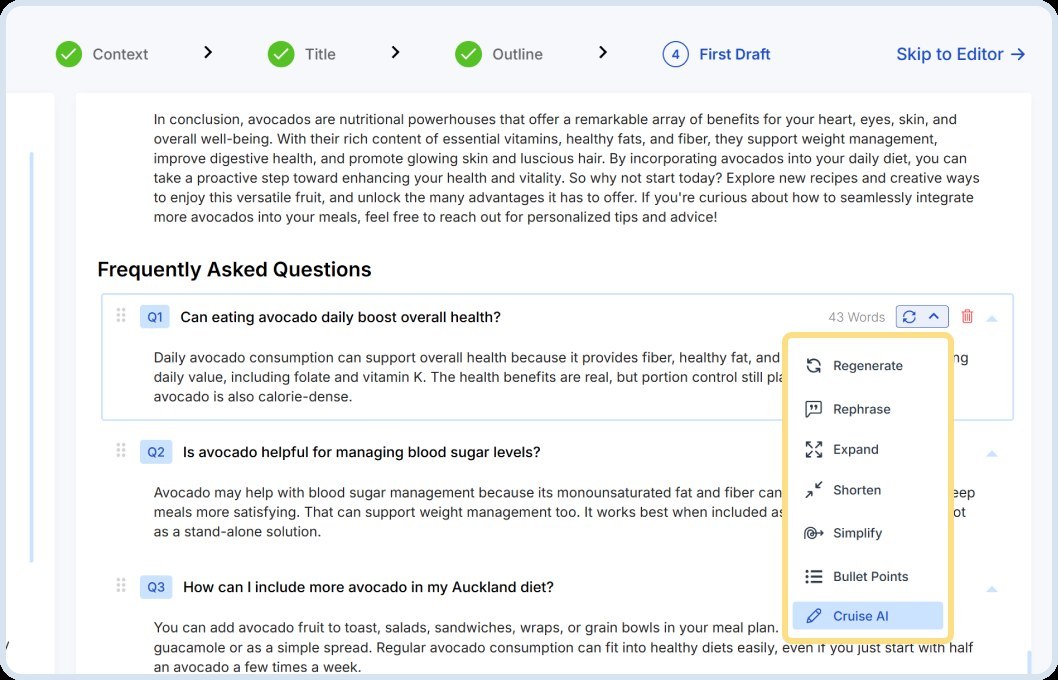
This is more useful than asking an AI writer for a finished article in one step. It creates review points where a strategist can reject a weak source, remove an irrelevant heading, add original evidence, or correct a factual error. Those controls only help when the team actually uses them. Automating the workflow does not transfer editorial responsibility to the software.
Key Scalenut Features That Matter Most
Cruise Mode and Content Research
Cruise Mode is Scalenut's guided long-form writer. Current help documentation describes a workflow that can use up to five reference articles, AI and SERP inputs, NLP-extracted key terms, top-ranked outlines, frequently asked questions, and identified gaps or gains before generating the first draft.
Its main advantage is structure. A content lead can review context and outline decisions before the tool writes thousands of words. Writers can see which competing headings influenced the brief and can add, edit, reorder, or remove sections. This makes Cruise Mode more controllable than an opaque one-prompt generator.
The limitation is source quality. A top-ranking page can still contain stale data, shallow reasoning, or unsupported claims. An AI-generated outline can reproduce the same consensus gaps as the pages it studies. Use official documents, first-party data, subject-matter experts, and original examples to improve the brief instead of treating the SERP as a ground-truth dataset.
GEO AI Editor and Content Score
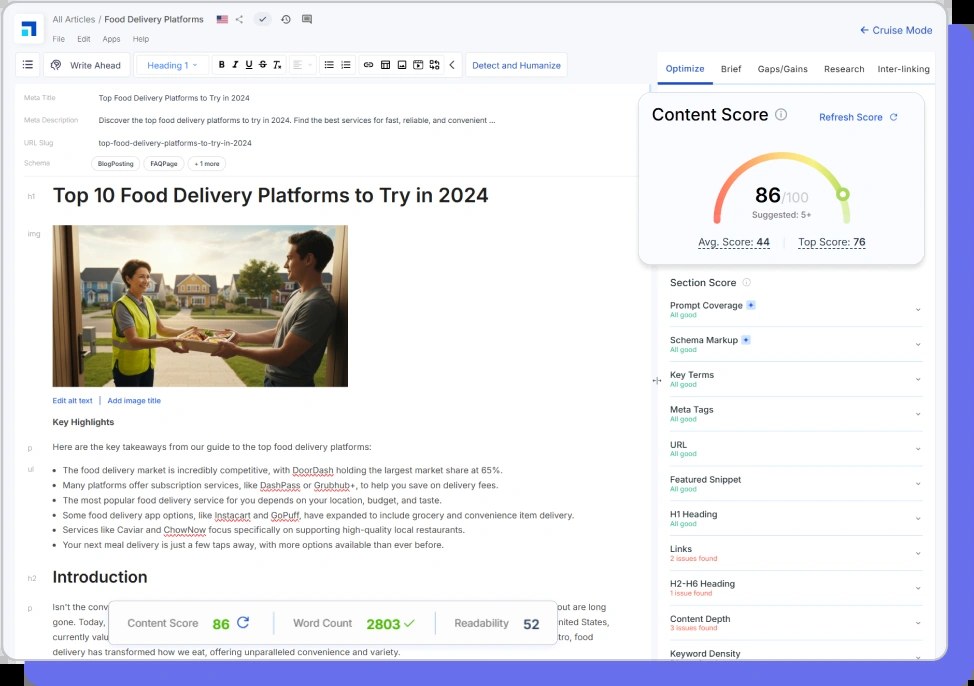
The GEO AI Editor combines a writing canvas with real-time optimization feedback. Scalenut's public help documentation says the unified Content Score considers modern discoverability and provides section-level guidance alongside word count and readability. The editor also exposes competitor outlines and reference information.
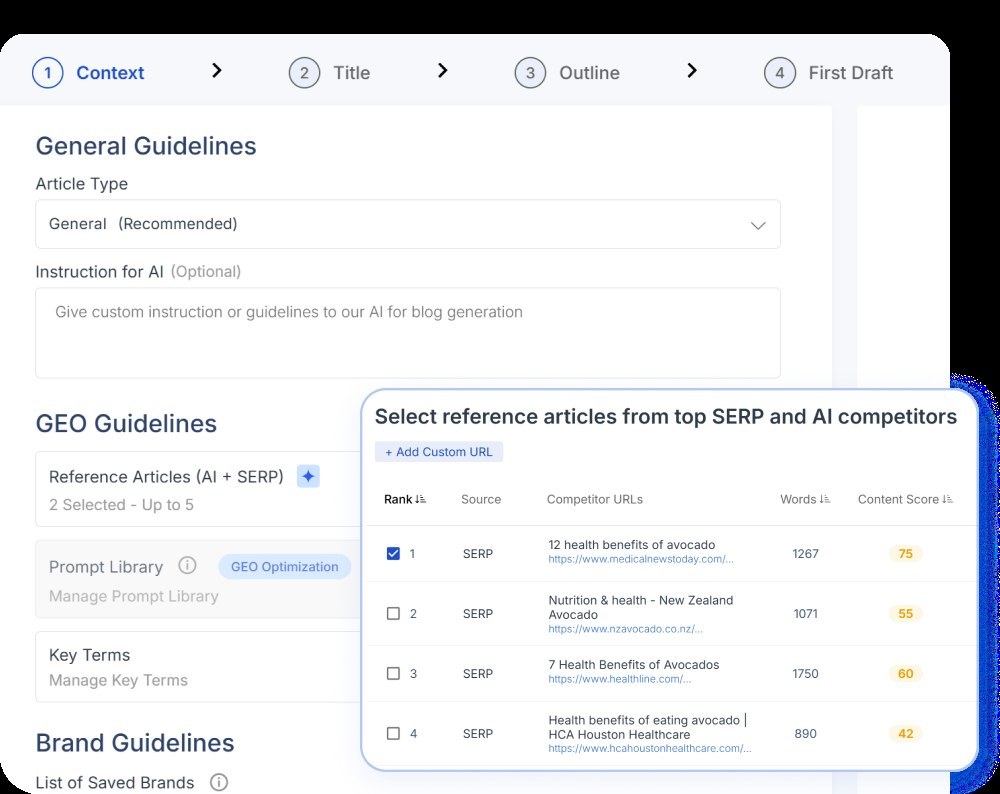
This can make review standards easier to repeat across writers. A team can use the same checklist for intent coverage, terminology, structure, metadata, and content depth. It can also highlight obvious omissions before a page reaches final editorial review.
Do not confuse a higher Scalenut score with proven performance. Scalenut controls its own scoring model, not Google's ranking systems or an answer engine's citation logic. The score cannot confirm that a statistic is current, that a quote is authentic, that a recommendation fits the reader, or that a page deserves to rank. It is a diagnostic signal, not a causal result.
AI Visibility Tracking
Scalenut's AI Visibility product tracks how selected answer platforms represent a brand. Public materials describe brand mentions, prompt coverage, visibility trends, competitor presence, source domains, sentiment, and AI bot activity. A current help page specifically names ChatGPT, Google AI Overviews, and Perplexity; the exact engines and limits available depend on the selected plan.
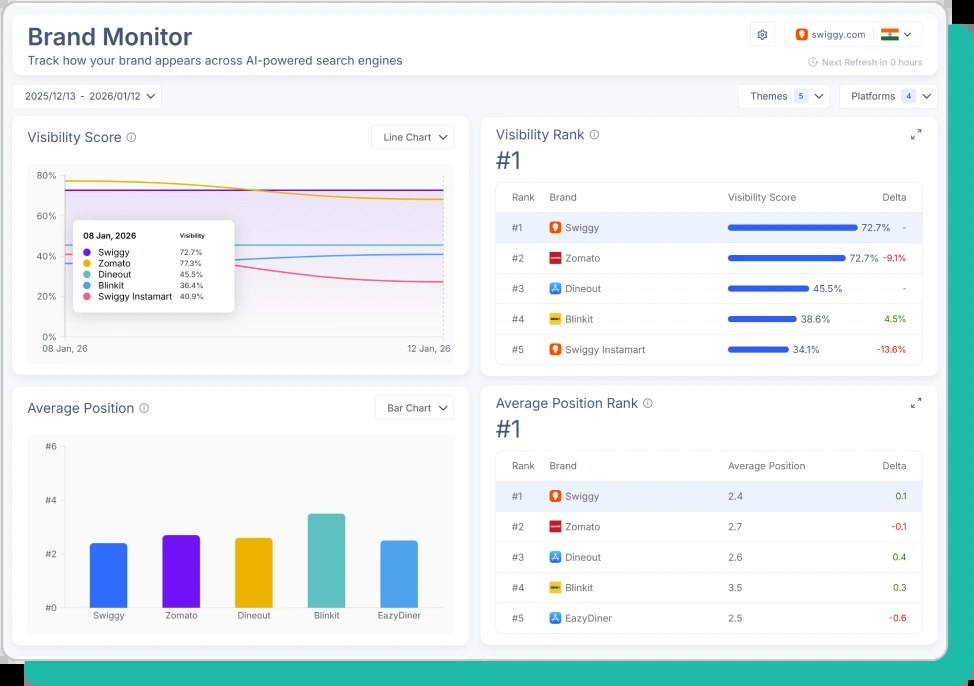
For a digital marketing leader, this creates a more useful reporting question than a generic claim that a brand is "optimized for AI." Teams can define a prompt set, observe whether the brand appears, inspect cited sources, compare selected competitors, and track movement over time.
The measurement still has boundaries. A tracked prompt set is a sample, not every question a buyer asks. Outputs can vary by engine, date, location, user context, model update, and retrieval behavior. Scalenut's public FAQ says visibility data refreshes regularly, weekly by default, so buyers should not assume every dashboard value is real-time. Use trends as directional evidence and preserve the exact engine, prompt set, location, and refresh cadence in reporting.
Recommendations, Citation Opportunities, and Execution
Scalenut's Recommendations module turns visibility data into suggested actions. Its help documentation describes three broad paths: create content for missing prompts, identify domains that answer engines already cite, and participate in relevant community discussions. Suggested content can flow into Cruise Mode, while some backlink opportunities connect to Scalenut's marketplace.
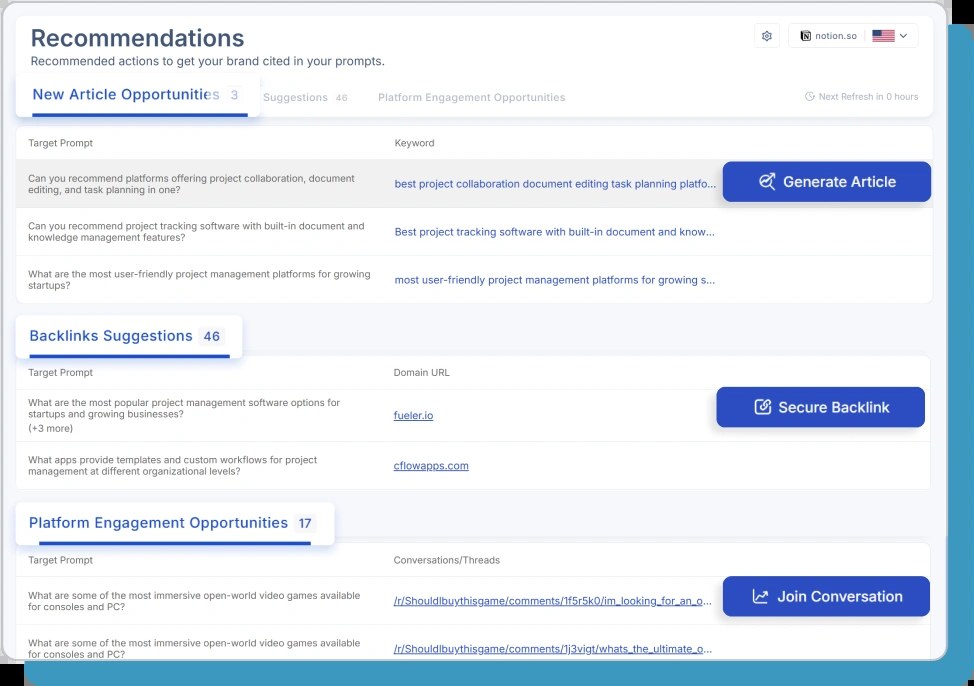
This connection from measurement to execution is one of Scalenut's best product ideas. A dashboard is easier to justify when it produces a prioritized work queue. It can help a team separate a content gap from an authority or distribution gap.
It also creates a conflict worth managing. Scalenut can recommend a domain and also offer a route to buy a backlink through its marketplace. That does not make the recommendation invalid, but the team should evaluate relevance, editorial quality, disclosure, link attributes, risk, and expected audience value independently. A cited domain is not automatically a good paid-link opportunity.
Content Audit and Link Manager
Scalenut's Content Audit is designed to identify existing pages that may need updates. That can support a refresh program when teams already have dozens or hundreds of URLs. The right operating model is to combine the audit with Google Search Console, analytics, crawling data, conversion data, and a manual SERP review. A declining page may have a content problem, but it may also have an indexing, technical, intent, seasonality, or competition problem.
Link Manager focuses on internal linking. Scalenut markets it as an AI system that detects, fixes, and deploys internal links across a connected domain. That can reduce manual discovery work, especially on large sites. Before deploying changes, review the target URL, anchor text, page status, canonical destination, and whether the link genuinely helps the reader. Back up the site and test on a limited set of pages before broad automation.
Integrations and Publishing
The current public integrations page shows WordPress Publisher, Semrush-powered Cluster Booster and Keyword Researcher, Copyscape Plagiarism Checker, and Shopify Publisher. These integrations can remove export steps and keep research, writing, checking, and publishing closer together.
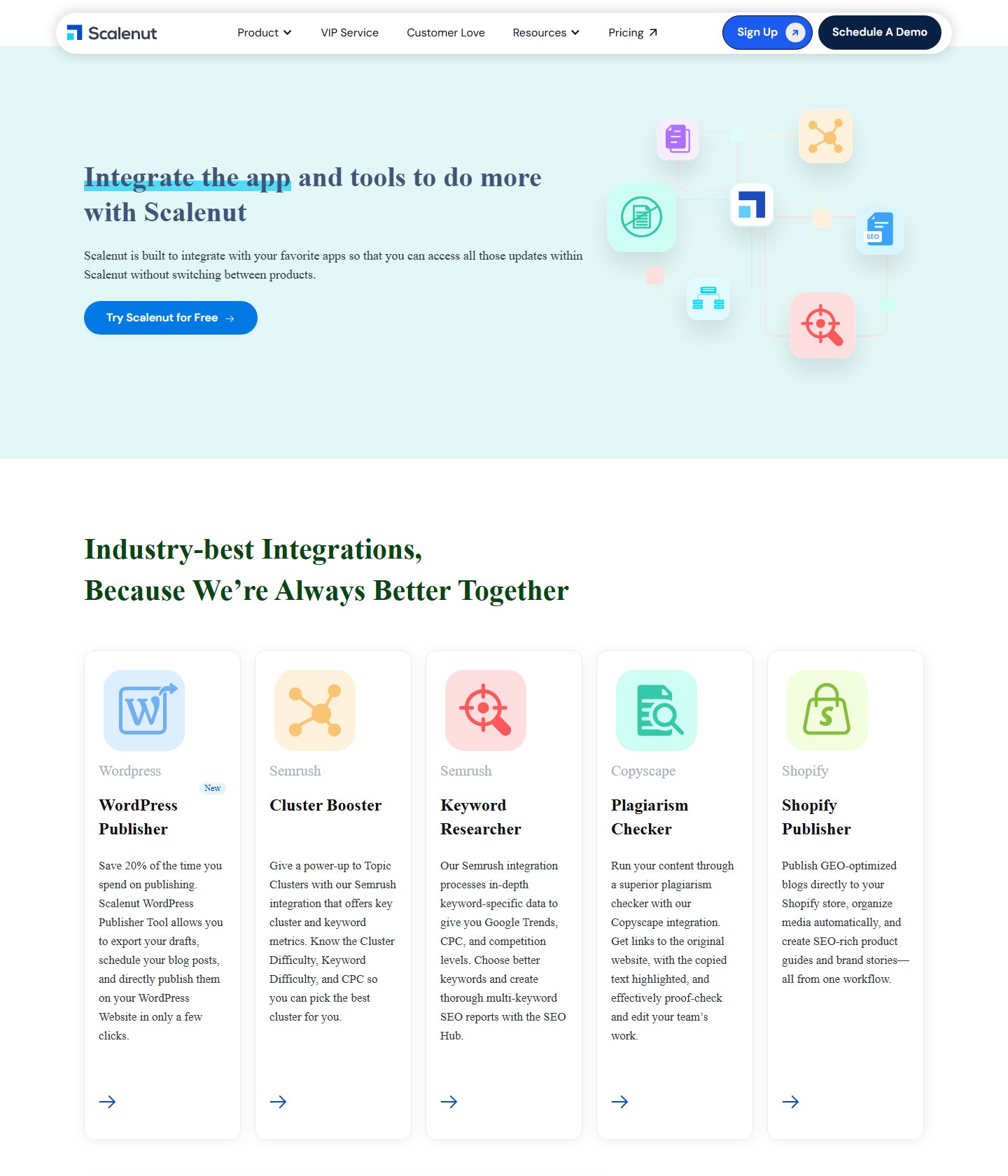
The most important integration limitation is outside that logo grid: Scalenut's help center currently states that the platform does not offer an API. Teams that need custom programmatic generation, automated briefs, bulk exports, or integration with an internal content pipeline should verify the roadmap before purchase. A native WordPress or Shopify workflow is not equivalent to an open API.
What Scalenut Does Well
It Connects Google and AI-Answer Workflows
Many tools optimize a document or monitor AI answers, but fewer connect planning, creation, optimization, monitoring, and recommended actions. Scalenut's broad model is useful for teams that want one operating system for both traditional SEO and generative engine optimization.
It Adds Review Gates Before and After Generation
Cruise Mode separates context, title, outline, and draft stages. The editor then adds scoring and recommendations. Audit and visibility tools continue the process after publication. This makes the platform more suitable for a managed editorial workflow than a one-click writing promise.
It Provides Actionable Visibility Context
Brand mentions alone are a weak metric. Scalenut also describes prompt gaps, sources, competitor comparisons, recommendations, and AI crawler activity. Those dimensions can help teams decide whether the next action is a new page, an update, stronger evidence, distribution, or technical access for crawlers.
It Covers Several Common Publishing Dependencies
WordPress, Shopify, Semrush-derived data, and Copyscape appear in the public integrations catalog. Teams should verify plan access and current behavior, but the documented workflow addresses practical handoffs rather than stopping at a generated draft.
Scalenut Limitations and Risks
Broad Scope Means More Plan and Workflow Complexity
Scalenut now spans article production, optimization, audit, links, AI visibility, social engagement, and backlink opportunities. Buyers need to map required capabilities to the actual plan, usage allowance, number of users, AI visibility channels, and refresh cadence. A feature appearing on the homepage does not prove it is available at the desired tier.
AI Traffic Monitor Requires Cloudflare
Scalenut's AI Traffic Monitor help guide says the module requires a Cloudflare integration and a token with Worker permissions so it can identify AI crawler traffic at the edge. That requirement may be reasonable technically, but it excludes sites that do not use Cloudflare and introduces security and procurement review. It also means the full attribution story is not a plug-and-play analytics script.
There Is No Current Public API
The official help answer is direct: Scalenut currently does not offer an API. Native integrations cover common publishing paths, but engineering teams cannot assume they can build a custom high-volume workflow around public endpoints.
AI Output and Scores Still Need Human Verification
Cruise Mode, the GEO AI Editor, and automated recommendations can accelerate research and drafting. They cannot establish originality, expertise, legal safety, factual accuracy, or reader value. Google's guidance allows generative AI to support content work but warns against scaled content created primarily to manipulate rankings. Every draft needs source checking, useful additions, and accountable editorial review.
Public Legal and Procurement Evidence Needs Review
Scalenut's public terms say the company offers a 7-day risk-free trial and is generally not obligated to provide refunds after the trial. Its public privacy policy displayed a November 2020 update date when checked. We did not confirm a public SOC 2 report, ISO certificate, current subprocessor list, or product-specific DPA in the reviewed materials. Enterprise buyers should request current evidence for data use, retention, deletion, model training, subprocessors, incident notification, access controls, and cross-border transfers.
Vendor Claims Are Not Outcome Proof
Scalenut uses strong marketing language about speed, visibility, and growth. Public product pages can confirm what the vendor says a feature does, but they do not prove causal ranking improvements or guaranteed AI citations. A buyer should measure editorial cycle time, correction rate, organic performance, prompt coverage, citation quality, and conversion outcomes during a controlled evaluation.
Scalenut Pricing and Free Trial
Scalenut's public pricing page displayed the following US commercial structure on August 2, 2026. The page was promoting 60% off and doubled usage limits on annual plans, so the sale figures are volatile. The regular monthly prices and the promotional annual equivalents should not be mixed when comparing total cost.
| Plan | Monthly price listed | Annual promotion displayed | Best evaluation fit |
|---|---|---|---|
| Starter | $59/month | $24/month, billed annually | Founders and small teams testing the connected content and visibility workflow |
| Plus | $89/month | $36/month, billed annually | Growing content teams that need more users and production capacity |
| Professional | $199/month | $80/month, billed annually | Agencies and larger teams with substantially higher usage requirements |
| VIP Service | Custom | Custom | Buyers seeking managed GEO and SEO services rather than software alone |
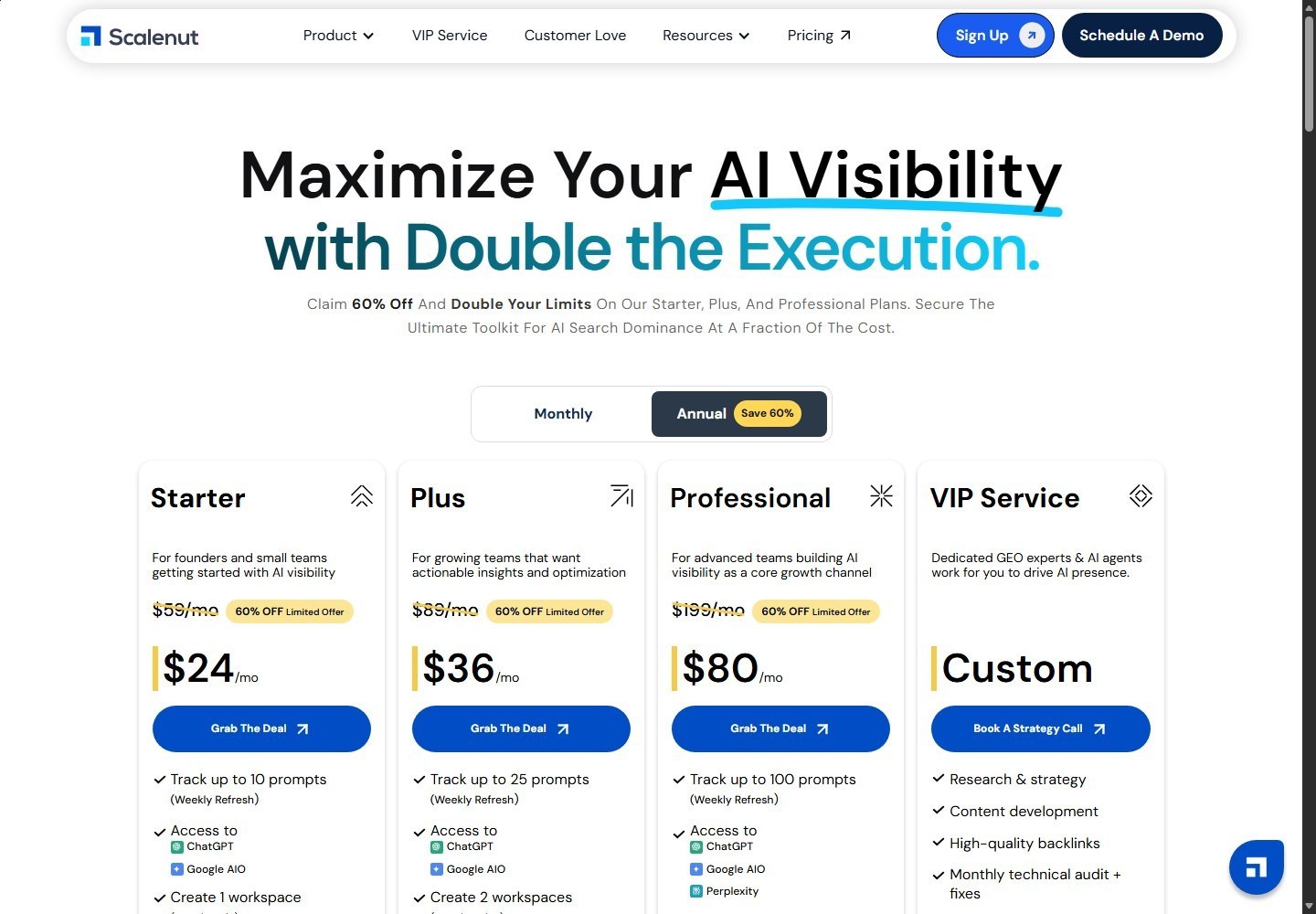
The pricing page advertises a free trial, while Scalenut's Terms and Conditions call it a 7-day risk-free trial. The same legal page says Scalenut is generally not obligated to issue a refund and does not offer refunds after the trial period, although it invites contact when there has been no platform usage and reserves the right to decline a request.
Scalenut's current app FAQ says users can cancel at any time and retain service through the end of the billing cycle. It also says a user who discontinues the selected plan moves to a "free plan." Public pricing does not define that plan's limits, and the reviewed pages did not clearly establish whether the trial converts into a paid renewal automatically. Confirm the plan transition and billing terms in checkout before starting.
Before checkout, verify five details in the live order summary:
- whether the selected price is monthly billing or a monthly equivalent billed annually;
- the promotion's renewal price after the discounted term;
- article, optimization, prompt, channel, and user limits;
- which AI engines and refresh cadence the plan includes;
- the exact cancellation and refund process for the purchaser's location.
Review Scalenut's current pricing and trial terms
Is Scalenut Accurate, and Can It Improve Visibility?
Scalenut can improve the consistency of research and optimization decisions, but the reviewed public evidence does not prove that its score or recommendations cause higher rankings or more AI citations. Accuracy depends on the query, selected competitors, reference pages, prompts, connected domain data, and the editorial process around the tool.
A useful pilot should track operational and outcome metrics separately:
- time from brief approval to publish-ready draft;
- number and severity of factual corrections;
- editor revisions per article;
- percentage of recommendations accepted or rejected, with reasons;
- organic impressions, qualified visits, and conversions for matched pages;
- brand mention and citation movement for a fixed prompt set;
- false positives or unexplained changes in AI visibility reporting;
- total software and labor cost per useful published page.
Run the same test on a representative group of pages and preserve a control workflow where practical. A green score is not the success metric. Better decisions, fewer preventable errors, and measurable audience outcomes are.
Scalenut Pros and Cons
Pros
- Broad workflow from topic planning and Cruise Mode to optimization, audit, links, and AI visibility.
- AI Visibility goes beyond mentions to prompts, competitors, sources, sentiment, recommendations, and bot traffic.
- Guided outline and reference stages give editors opportunities to intervene before draft generation.
- Public WordPress, Shopify, Semrush, and Copyscape integrations address common content handoffs.
- Content and citation recommendations connect reporting to an actionable queue.
- Three self-serve tiers give teams a path to test fit before enterprise or managed service discussions.
Cons
- Plan limits, promotional pricing, AI visibility channels, and refresh cadence require careful comparison.
- AI Traffic Monitor requires Cloudflare and a privileged token setup.
- Scalenut currently says it does not provide an API.
- Content Score and vendor recommendations can encourage formulaic optimization if human editors do not challenge them.
- The vendor's backlink marketplace creates a commercial relationship around some recommended opportunities.
- Refund language is restrictive after the trial, and the public privacy material reviewed was dated November 2020.
- A full SEO stack may still require technical crawling, backlink intelligence, rank tracking, analytics, and conversion tools.
Scalenut Alternatives
Choose an alternative based on the capability Scalenut would not solve well enough, not on a generic winner label. The rows below are shortlist paths, not unsupported claims that one vendor is universally better.
| Alternative | Add it to the shortlist when | Verify before choosing |
|---|---|---|
| Surfer | A focused content editor and optimization workflow is the main decision | Current document limits, audit coverage, AI tracking, users, integrations, and annual cost |
| Frase | SERP research, briefing, and answer-focused content production lead the checklist | Current research depth, optimizer behavior, GEO monitoring, collaboration, and usage limits |
| Clearscope | Editorial content optimization and a streamlined scoring process are central | Current pricing, scoring inputs, AI visibility features, team workflow, and integrations |
| Writesonic | AI article generation plus a broad AI search visibility product is required | Current plan gates, factual controls, brand monitoring, users, and annual cost |
| Semrush or Ahrefs | Technical SEO, backlinks, rank tracking, and broad competitive intelligence dominate | Current content creation, optimization, AI visibility, database scope, and total stack cost |
Scalenut deserves an early pilot when a team wants content operations and AI visibility in the same product. A focused optimizer may be simpler for an editorial team. A broad SEO suite may be better when technical and off-page work dominates. An API-first buyer should look elsewhere unless Scalenut's roadmap changes.
Who Should Use Scalenut?
Shortlist Scalenut if:
- one team owns content planning, production, optimization, and AI-answer visibility;
- you publish or refresh enough pages to benefit from a repeatable Cruise Mode and audit workflow;
- prompt, citation, source, competitor, and bot visibility belong in the same reporting process;
- WordPress, Shopify, Semrush data, or Copyscape can reduce your publishing handoffs;
- your editors will review references, claims, scores, links, and generated output before publication.
Compare or skip it if:
- you only need a lightweight writing assistant or a focused content score;
- technical crawling, backlinks, rank tracking, or local SEO are the primary problem;
- a public API is mandatory for your content pipeline;
- your site cannot or will not use Cloudflare for AI bot traffic monitoring;
- procurement requires current certifications and contractual evidence that the vendor has not supplied;
- your team is likely to chase an optimization score instead of improving evidence and reader usefulness.
Final Verdict: Should You Buy Scalenut?
Scalenut connects traditional SEO content work with AI-answer visibility in a single workflow. Cruise Mode structures research and drafting. The GEO AI Editor adds repeatable optimization guidance. Audit and Link Manager extend the work across an existing site. AI Visibility then monitors prompts, mentions, competitors, sources, recommendations, and crawler activity.
The connected model is its main advantage, while operational fit is the main concern. Teams must verify plan gates, promotion terms, renewal cost, engine coverage, refresh cadence, Cloudflare requirements, and the absence of an API. They must also keep human fact-checking and editorial judgment outside the score.
Our evidence-based rating is 8.2/10. Scalenut is a strong shortlist choice for content and SEO teams that now own both Google and AI visibility. It is not an outcome guarantee or a complete replacement for every SEO, analytics, security, and editorial tool.
Check Scalenut's current plans and confirm your required limits
How We Test and Score
ScaleWitAI funds every account used in this review with its own capital. We subscribe to all paid tiers with self-funded plans and never use sponsored, gifted, or vendor-provisioned accounts, so our evaluation reflects the same product a paying customer receives and stays 100% independent of vendor influence.
Evaluation combines standardized test suites with hands-on workflow testing. We use HumanEval-style tasks to probe logic and code reasoning, BLEU/ROUGE-style metrics to measure natural-language quality, and internal stress-test scenarios to map context-window limits and long-input behavior. We run more than 10,000 prompts per AI platform every year, across varied access conditions, and log results against a transparent scoring rubric.
The dataset for this review was collected over 12 months (from August 2025 to August 2026). Historical comparisons track AI model development since 2024, and this report tests and compares 12+ leading AI models and providers on the market.
Frequently Asked Questions
What is Scalenut?
Scalenut is a web platform for SEO content planning, AI-assisted article writing, content optimization, auditing, internal linking, publishing integrations, and AI-answer visibility monitoring. Its main value is connecting those stages in one operating workflow.
How much does Scalenut cost?
On August 2, 2026, Scalenut listed regular monthly prices of $59 for Starter, $89 for Plus, and $199 for Professional. An annual promotion displayed monthly equivalents of $24, $36, and $80 respectively. Verify billing basis, renewal price, and current limits at checkout.
Does Scalenut offer a free trial?
Yes. The pricing page advertises a free trial, and Scalenut's legal terms call it a 7-day risk-free trial. Its current app FAQ says users can cancel at any time, retain service through the end of the billing cycle, and move to a free plan if they discontinue. Public pricing does not define that free plan's limits or clearly state the trial-to-paid conversion behavior. The terms say refunds are generally not offered after the trial, so confirm billing conditions before starting.
Which AI engines does Scalenut track?
Current public documentation specifically names ChatGPT, Google AI Overviews, and Perplexity. Scalenut says platform availability depends on the plan, so verify the included engines, prompt allowance, and refresh cadence for the tier you are considering.
Does Scalenut have an API?
No public API was available in the reviewed evidence. Scalenut's official help page states that the platform currently does not offer an API. Teams needing custom automation should verify whether the roadmap or enterprise offering has changed.
Can Scalenut guarantee higher Google rankings or AI citations?
No. Scalenut can organize research, highlight gaps, score content, and monitor a selected prompt set, but it cannot control search ranking systems, answer-engine behavior, competitors, links, technical health, or user response. Measure outcomes independently.
Is Scalenut better than Surfer SEO?
Neither is universally better. Scalenut is attractive when a buyer wants a broad creation, optimization, site operations, and AI visibility workflow. Surfer belongs on the shortlist when a focused content optimization process is the central need. Compare the same usage, collaboration, tracking, integration, and annual-cost requirements.
