Byword is worth shortlisting when your bottleneck is producing, optimizing, and publishing many SEO pages through one system, but it is not a substitute for editorial judgment, subject-matter expertise, or a defensible search strategy. Its official product pages show a unusually broad workflow: research intelligence, multi-model generation, voice matching, live optimization, programmatic templates, bulk queues, and direct CMS or API delivery. The trade-off is equally clear: plans start at $99 per month, the strongest automation can multiply weak decisions, and Byword’s performance claims remain vendor claims unless your own controlled test confirms them.
| At a glance | Details |
|---|---|
| Product | Byword, an AI article and programmatic SEO platform |
| Best for | SEO teams, content operations teams, and agencies with repeatable publishing volume |
| Starting price | $99/month for 25 articles; $83/month on annual billing |
| Free access | 5 free articles, no credit card required; not described as a time-limited trial |
| Core workflow | Research, generate, optimize, build pages, and publish |
| Publishing | WordPress, Webflow, Shopify, Ghost, HubSpot, Medium, exports, automation, API, and webhooks |
| Main caution | Human review and page-level value are still required; an SEO score does not predict rankings |
| Website | Check Byword availability and plans |
$1$2 The practical buying question is whether Byword can remove enough research, drafting, QA, and publishing work from your operation without lowering the value of each page.
Quick Verdict: Should You Use Byword?
Use Byword if you already have keyword ownership, editorial standards, and a publishing system, but need more throughput. The product’s strongest case is operational consolidation. A team can move from topic research to an article or templated page, optimize it, and route it to a CMS without stitching together several unrelated tools. The five free articles provide a reasonable way to test output quality before paying.
Skip it if your main problem is choosing a viable market, earning expert credibility, producing original data, or fixing technical SEO. Also pause if you publish only a few articles per month: the $99 Starter plan may cost more than a general AI assistant plus a focused optimizer. Byword becomes more compelling as repeatability, CMS delivery, and per-article workflow cost matter more than the lowest subscription price.
| Choose Byword when… | Choose another route when… |
|---|---|
| You produce at least a steady batch of SEO articles | You need occasional drafts, not an operating system |
| You need programmatic templates tied to CSV or API data | Every piece is bespoke thought leadership |
| Brand consistency is hard across writers or clients | You need rigorous human reporting or original interviews |
| Direct CMS publishing or API automation saves real labor | Your biggest gap is technical SEO or backlink acquisition |
| Your team can review facts, sources, and search intent | You plan to publish AI output without expert QA |
Because the affiliate route currently returns 404, this package is blocked from public release until the redirect is repaired. Once it works, qualified buyers can test Byword with the five-article free allowance; do not treat that allowance as proof that the workflow will fit your site.
What Is Byword?
Byword is an AI-first content production platform built around SEO articles and programmatic pages. Its public positioning is broader than “AI writer.” The platform presents research, writing, optimization, page templating, and distribution as connected stages in one content operation.
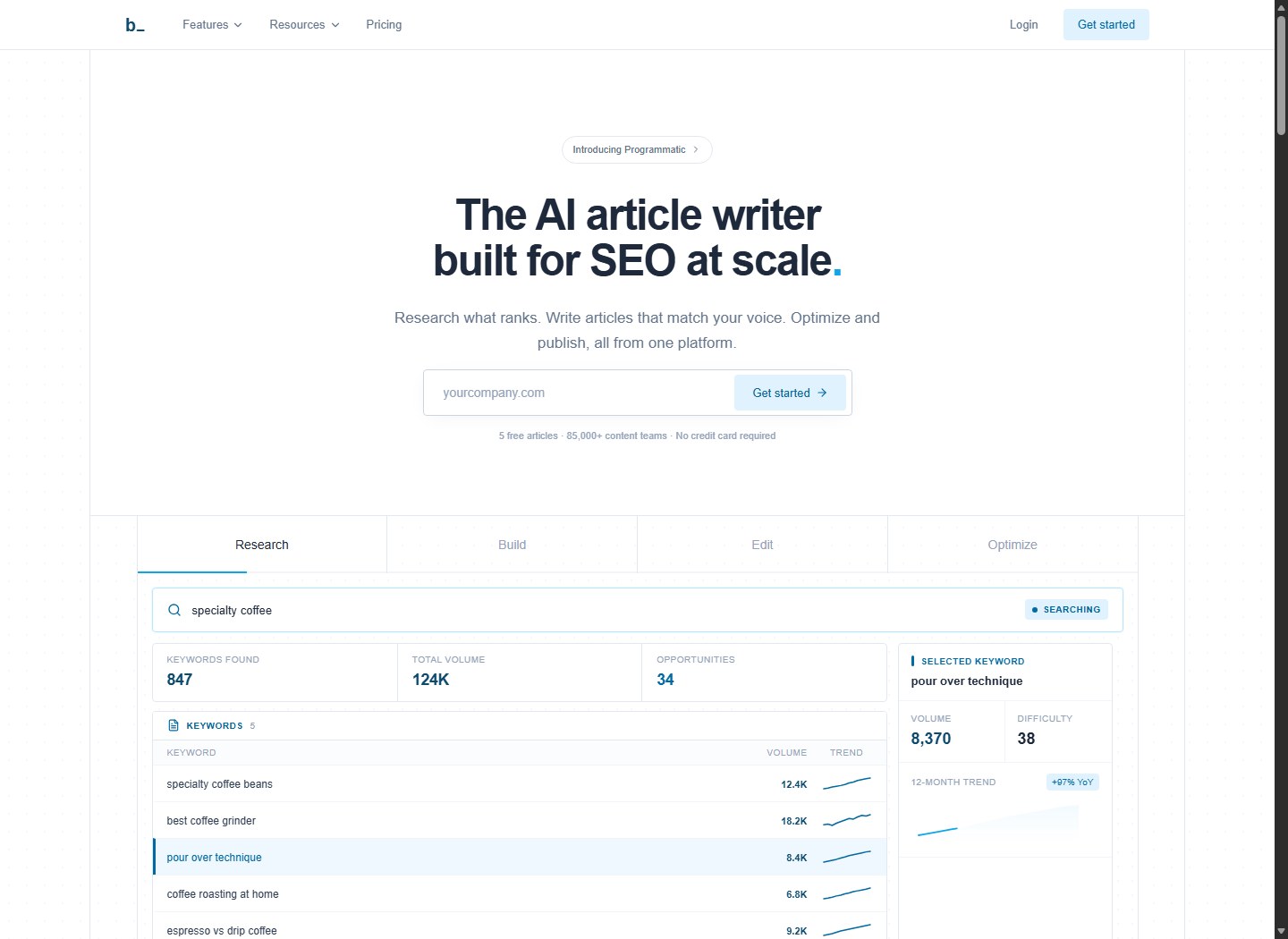
Byword’s public generation page currently names GPT-5.4, Claude Opus 4.6, and Gemini 3.1 Pro as available models. It says Byword can select a model or let the user choose. Model availability can change, so buyers should verify the model list inside the account rather than base a long-term purchase on today’s names.
Who Is Byword Best For?
Byword fits organizations that can turn repeatable content production into measurable business value. Volume alone is not enough. The buyer needs a valid topic strategy, a review process, and a way to measure qualified outcomes.
SEO and content teams
An in-house team is a strong fit when it has a backlog of validated topics but limited drafting and production capacity. Byword can centralize initial research, brand-aware generation, optimization, and handoff to the CMS. The benefit is less context switching and more consistent output structure.
The team still needs ownership for factual accuracy, product truth, legal review, conversion paths, and post-publication updates. If nobody is accountable for those steps, faster drafting only creates a larger maintenance backlog.
Agencies and multi-client operations
Agencies may get more value from reusable workflows than from raw writing speed. Brand-voice inputs, domains, team seats, templates, and automated publishing can reduce repetitive production work across clients. The Standard plan’s three included seats and unlimited domains are more relevant here than the Starter plan’s solo orientation and five-domain limit.
Agency buyers should test isolation between client knowledge, voice assets, integrations, and approval paths. They should also calculate overage credits and extra seats, not just the headline subscription.
Programmatic SEO teams
Byword is a logical candidate for location pages, integration directories, product comparisons, feature pages, alternatives pages, and industry or role pages. Its official programmatic page shows templates with variables such as {service}, {city}, {product}, {competitor}, {app}, and {industry}, plus CSV or API inputs.
The wrong buyer is a team using templates to disguise duplication. A programmatic project needs unique data, meaningful page-level differences, appropriate indexation rules, and a useful destination for each query. Templates are infrastructure, not the strategy.
Who should probably skip it
Low-volume solo writers may find a general AI tool cheaper and more flexible. Editorial brands built primarily on interviews, investigations, or personal experience will use less of Byword’s automation. Technical SEO teams that need crawling, log analysis, rank tracking, or link intelligence should look elsewhere or budget for complementary tools.
How Does Byword Research Intelligence Work?
Byword’s Research Intelligence is designed to turn a topic or domain into ranked content opportunities and then pass a selected opportunity into generation. According to the official research page, the system combines keyword metrics, competitor analysis, SERP signals, content-gap discovery, clustering, and opportunity scoring.
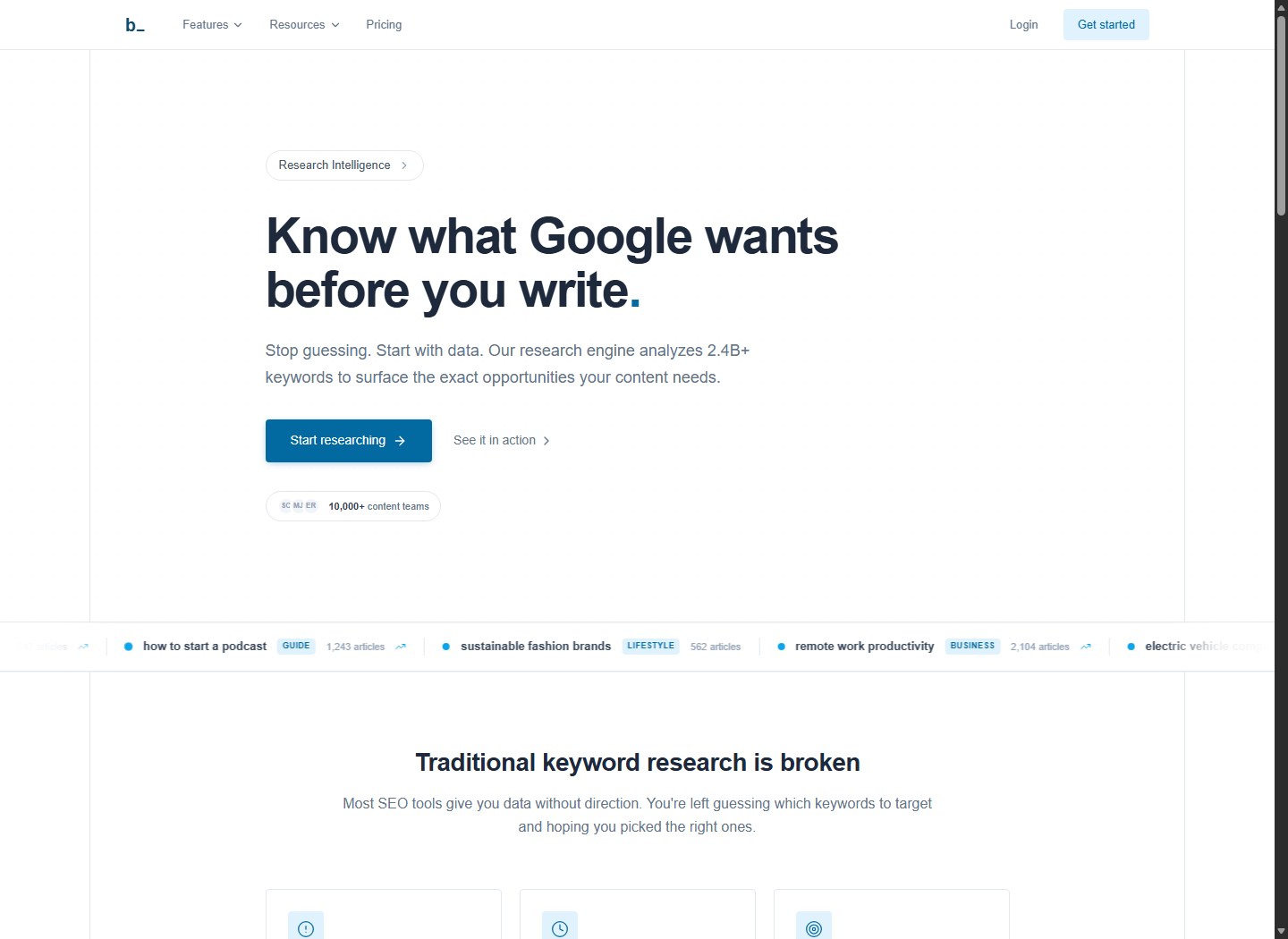
The public page says its index covers 2.4 billion or more keywords and that data freshness is under 24 hours. It also displays a 95% accuracy claim. These are vendor-reported figures without a public methodology on the feature page, so they should be treated as claims to validate, not as audited benchmarks.
Keyword and opportunity discovery
Byword says the research view includes volume, difficulty, cost per click, trends, and search intent. Its stated workflow is simple: enter a topic, review ranked opportunities, select candidates, and generate content. That can shorten the distance between ideation and production.
Search volume, difficulty, and opportunity scores are estimates. A high score cannot account fully for your domain authority, product relevance, conversion economics, information advantage, or internal-link capacity. Use the score to prioritize investigation, not outsource the decision.
Competitor, SERP, and content-gap signals
The official page says Byword can show keywords driving competitor traffic, analyze SERP features and ranking factors, and identify gaps. This is useful for building a baseline brief: search intent, common subtopics, page formats, and questions that searchers expect.
A useful brief should go beyond consensus. If every generated article reproduces the same headings as the current results, the output may be comprehensive but undifferentiated. Editors should add proprietary product knowledge, expert commentary, original examples, first-party data, or a clearer decision framework.
Clusters and briefs
Cluster analysis can group related keywords into themes, reducing accidental overlap between pages. This is particularly important at scale, where separate rows in a keyword sheet may represent the same intent. Before generation, assign one canonical intent per page, map supporting terms to that page, and decide whether closely related targets belong in sections rather than separate URLs.
How Do AI Generation and Brand Voice Work?
Byword generates long-form content from a topic, brief, template, and optional brand or knowledge inputs. Its generation page emphasizes multi-model access, article-type structures, voice matching, a custom knowledge base, built-in SEO architecture, batch generation, and exports.
Brand voice inputs
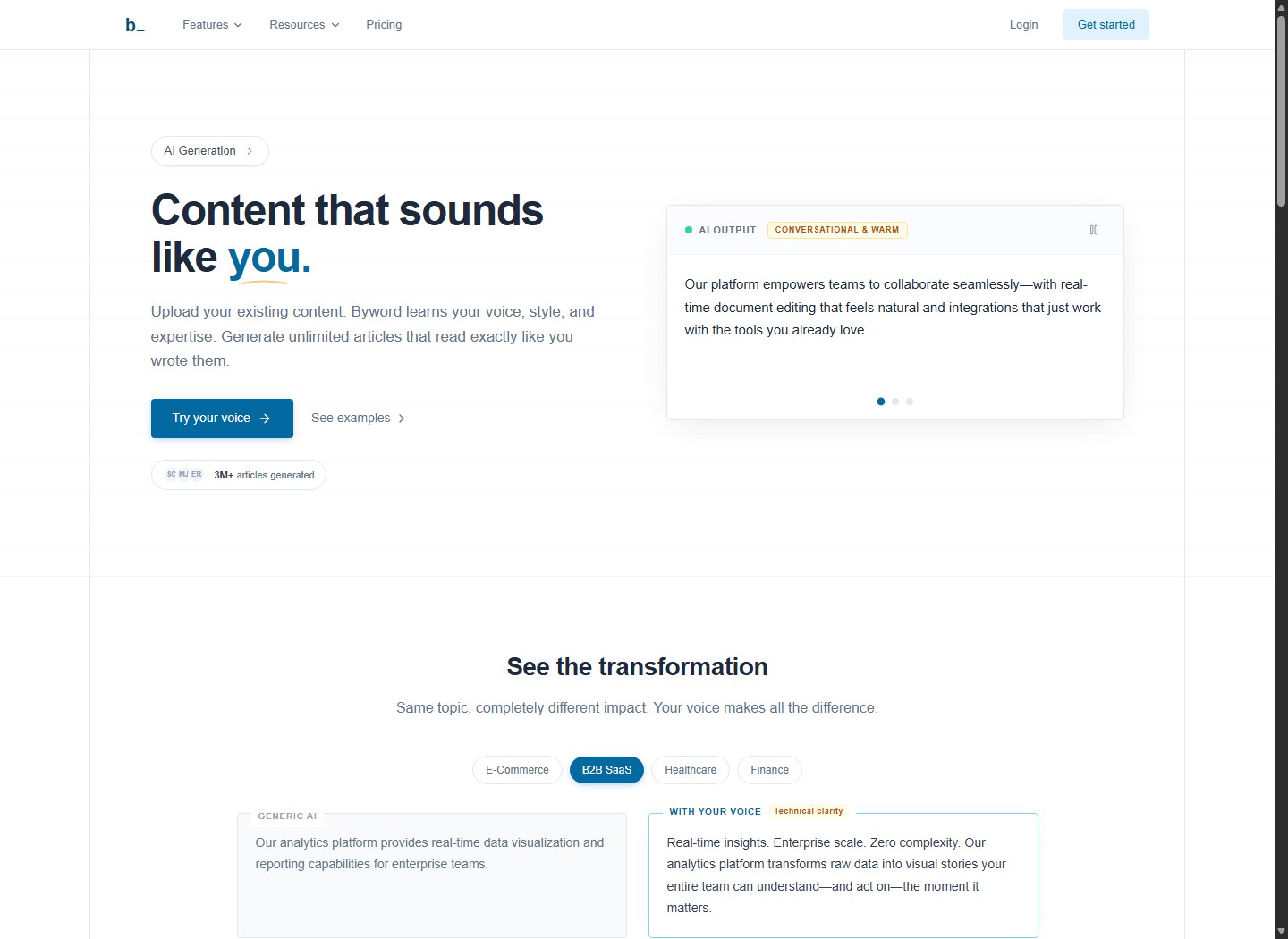
Byword says users can upload existing blog posts, documents, style guides, and company materials. The system analyzes sentence structure, vocabulary, tone, flow, and terminology, then applies that pattern to generated work. It also supports proprietary documents, specifications, and data through a custom knowledge base.
This can improve consistency without making the output automatically authentic. A voice model can reproduce surface patterns while missing judgment, humor, cultural context, or product nuance. Define prohibited claims, required terminology, reading level, evidence rules, and audience assumptions in addition to uploading samples.
The feature page displays a 99% voice-match example and says readers cannot tell the difference. That is a marketing claim, not a reliable guarantee. There is no universal, objective percentage for “sounds like our brand,” and performance will vary with source material and subject.
Models and article structures
The current public model list includes GPT-5.4, Claude Opus 4.6, and Gemini 3.1 Pro. Byword also lists guides, listicles, reviews, how-to articles, news, and comparisons as supported formats. Its SEO architecture references headers, meta descriptions, and schema markup.
Knowledge grounding and factual review
A custom knowledge base can reduce unsupported product statements if its sources are accurate and current. It can also repeat obsolete internal material. Give every source an owner, effective date, and review status. Confirm that each citation supports the associated claim. For regulated, medical, financial, or legal topics, use qualified reviewers and primary sources.
Bulk generation
Byword’s generation page says users can queue 10 or 10,000 articles and run them in parallel without rate limits. Treat this as a capability claim, then test practical account constraints, credit use, queue behavior, failure recovery, and quality variance. The business question is not “Can it generate 10,000?” but “Can we review, differentiate, publish, measure, and maintain 10,000 pages responsibly?”
How Does Byword Optimization and Scoring Work?
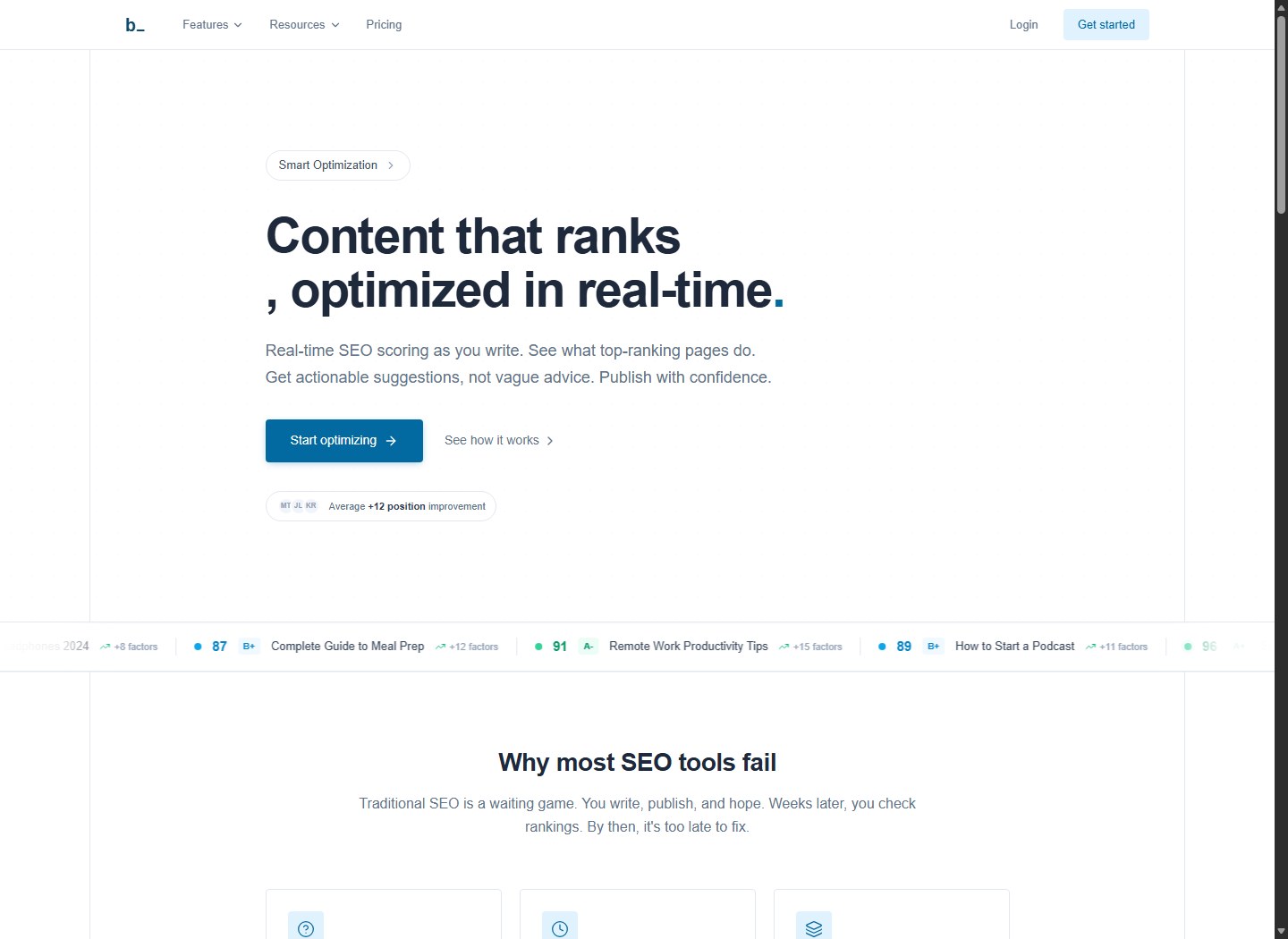
Byword provides a live content score and recommendations while a draft changes. The official optimization page says it analyzes 147 factors, updates in under three seconds, and grades content from A to F. It lists competitor patterns, keyword intent and placement, semantic relevance, technical elements, readability, and actionable suggestions.
What the score can help with
A score is useful as a repeatable QA checklist. It can flag missing topic coverage, awkward headings, thin sections, absent metadata, unreadable paragraphs, or a draft that diverges sharply from pages satisfying the same query. This is especially helpful when many writers or client teams need a shared baseline.
The tool’s recommendations appear more practical than a single number. Examples on the page include adding a relevant topic, shortening a paragraph, or changing keyword placement. Those prompts can help an editor locate weaknesses quickly.
What the score cannot prove
An optimization score does not guarantee rankings, traffic, conversions, citations in AI answers, or Helpful Content compliance. Search performance also depends on intent satisfaction, originality, authority, links, technical accessibility, site quality, freshness, user experience, and competition.
Byword displays claims such as an average position improvement and a ranking correlation, plus testimonials describing ranking gains. Without a published methodology, sample definition, control group, and independent replication, these should not be used in an ROI forecast. The feature page even uses “know it will rank” language. Buyers should read that as promotional copy, not an outcome guarantee.
How to use scoring safely
Set a score range as a diagnostic gate, not a publishing target. Editors should be allowed to reject a suggestion when it creates repetition, harms readability, introduces an unsupported entity, or pushes the article beyond the query’s needs. Record why a recommendation was rejected so the team learns which signals help its niche.
Use post-publication data to recalibrate. Compare impressions, qualified clicks, engagement, assisted conversions, and update burden against a baseline. A score is valuable only when it correlates with outcomes that matter to your business.
What Can Byword Do for Programmatic SEO and Pages?
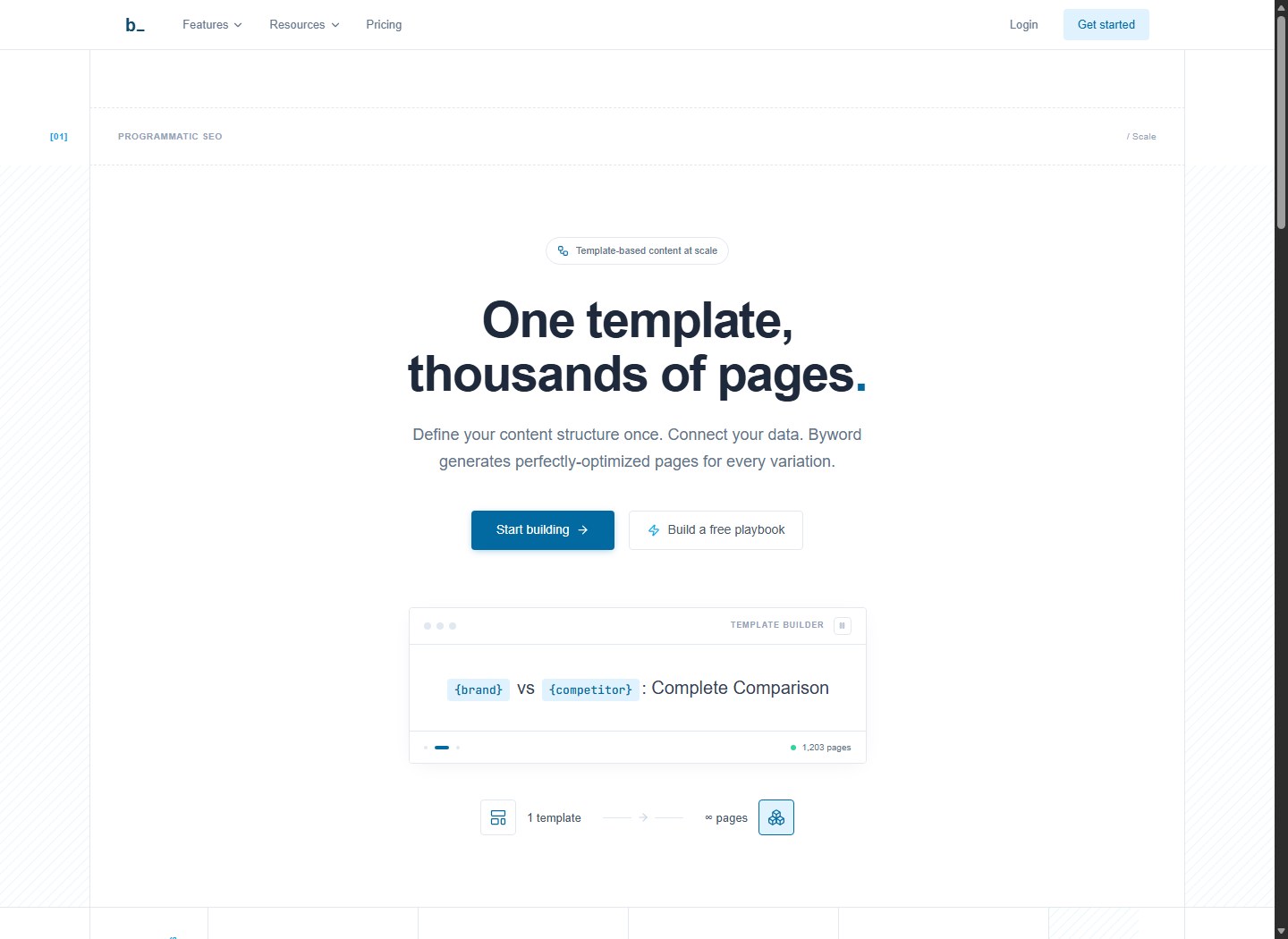
Byword’s programmatic workflow connects a reusable template to a dataset, generates a page for each valid row, and routes the output toward publication. The official feature page lists location, versus, alternatives, feature, integration, and use-case templates, and says a library contains more than 50 templates.
Templates and variables
A template defines recurring sections and variable fields. A location page might combine service and city data. An integration page might combine an app and platform. A comparison may combine product and competitor records. Byword says users can upload CSV data or connect an API, define the content structure, generate at scale, and deploy the results.
This design reduces engineering work, but every row should pass an eligibility rule. A location page should exist only where the business serves that location and provides local value. Integration and comparison pages need verified, row-specific facts.
Page-level uniqueness
Swapping nouns is not information gain. Each generated page should have distinctive facts, constraints, examples, recommendations, and next steps. Use row-level data such as availability, pricing, compatibility, local regulations, implementation steps, screenshots, or first-party outcomes where appropriate.
Create automated checks for duplicate titles, repeated paragraphs, empty variables, contradictory fields, unsupported superlatives, and near-identical pages. Low-value rows should remain ungenerated, unindexed, or merged into a stronger hub.
Cost and speed claims
Byword’s programmatic page compares manual and automated production using figures such as one day for 500 pages, roughly $1 per page, 99.8% consistency, and substantial savings. Those figures are vendor marketing examples. They do not include your research, data engineering, editorial review, legal approval, design, technical QA, indexation management, or maintenance costs.
How Do Integrations, API, Webhooks, and CMS Publishing Work?
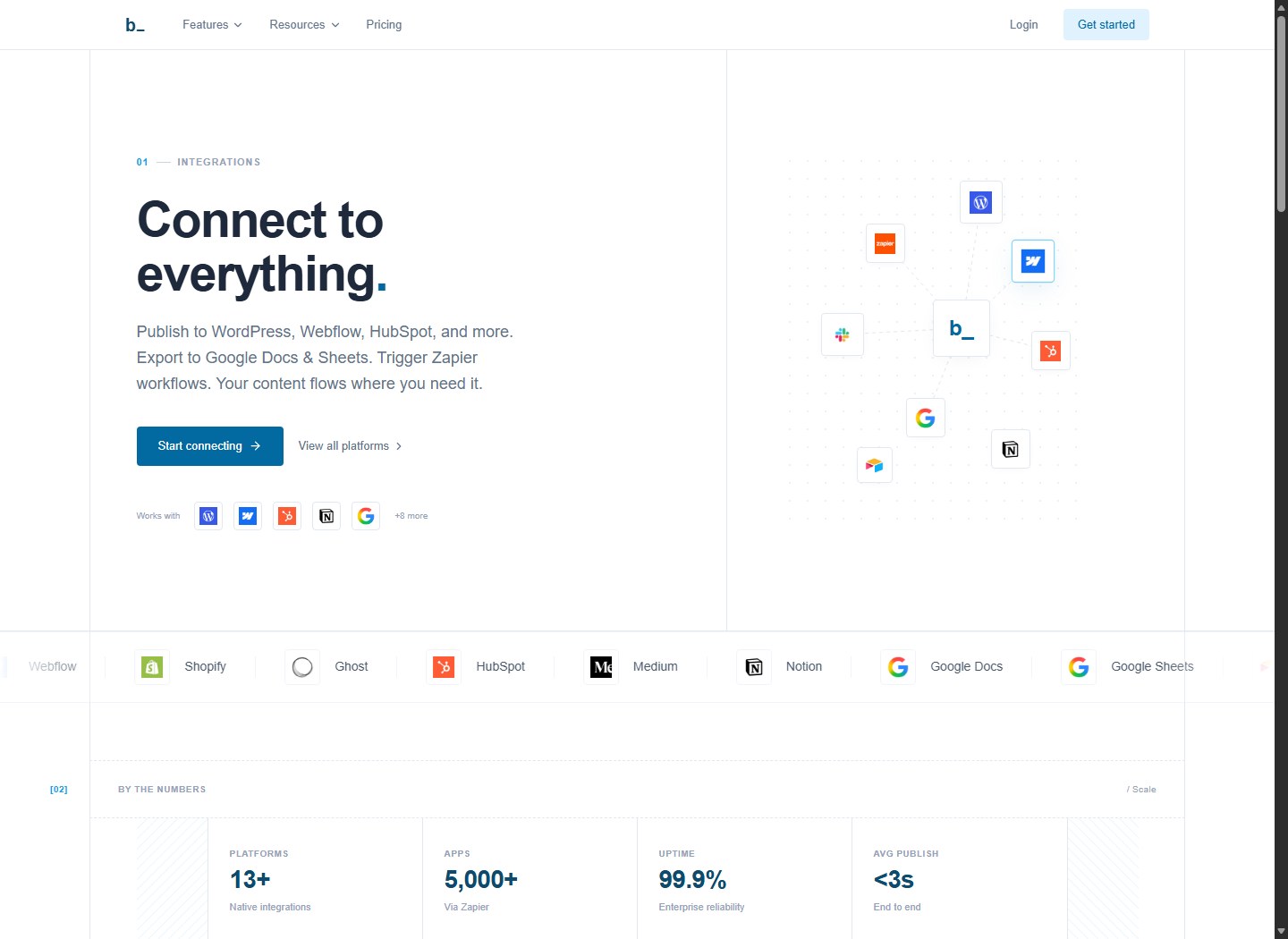
Byword can publish or export content through native connections, automation platforms, webhooks, and a REST API. Its integrations page currently lists 13 or more native integrations and access to more than 5,000 apps through Zapier.
CMS and publishing destinations
The official page names six publishing platforms: WordPress for posts and pages, Webflow for CMS collections, Shopify for product descriptions and blog content, Ghost for blog publishing, HubSpot for blog posts and landing pages, and Medium for stories.
Export and data destinations include Notion, Google Docs, Google Sheets, and Airtable. Automation options include Slack notifications, Zapier, and Make. The page also says users can publish to multiple destinations and that failed publishes are retried with notifications.
Direct publishing can remove tedious copying, but draft-first should be the default. Confirm title, slug, author, status, taxonomy, canonical, schema, images, alt text, affiliate attributes, and internal links before content becomes public. Test how updates behave so a republish does not duplicate pages or overwrite human edits.
API and webhooks
Byword’s public API entry point describes the HTTP API as the choice for fixed request and response contracts, while its MCP documentation is positioned for assistants that select and combine tools. The integrations page advertises a REST API, webhook events, sample code, 12 endpoints, a 1,000-request-per-hour limit, and SDK availability.
The pricing comparison says API access is added on Standard and Scale, while webhooks appear in the feature matrix. Confirm exact plan entitlements inside checkout or with support because visual checkmarks are not always extractable from a public comparison table.
Before automating, test authentication, idempotency, retries, timeouts, event signatures, error payloads, status transitions, credit consumption, and rate-limit headers. Store secrets outside prompts and content files. Log each request and resulting CMS object so failed or duplicate publishes can be reconciled.
How Much Does Byword Cost?
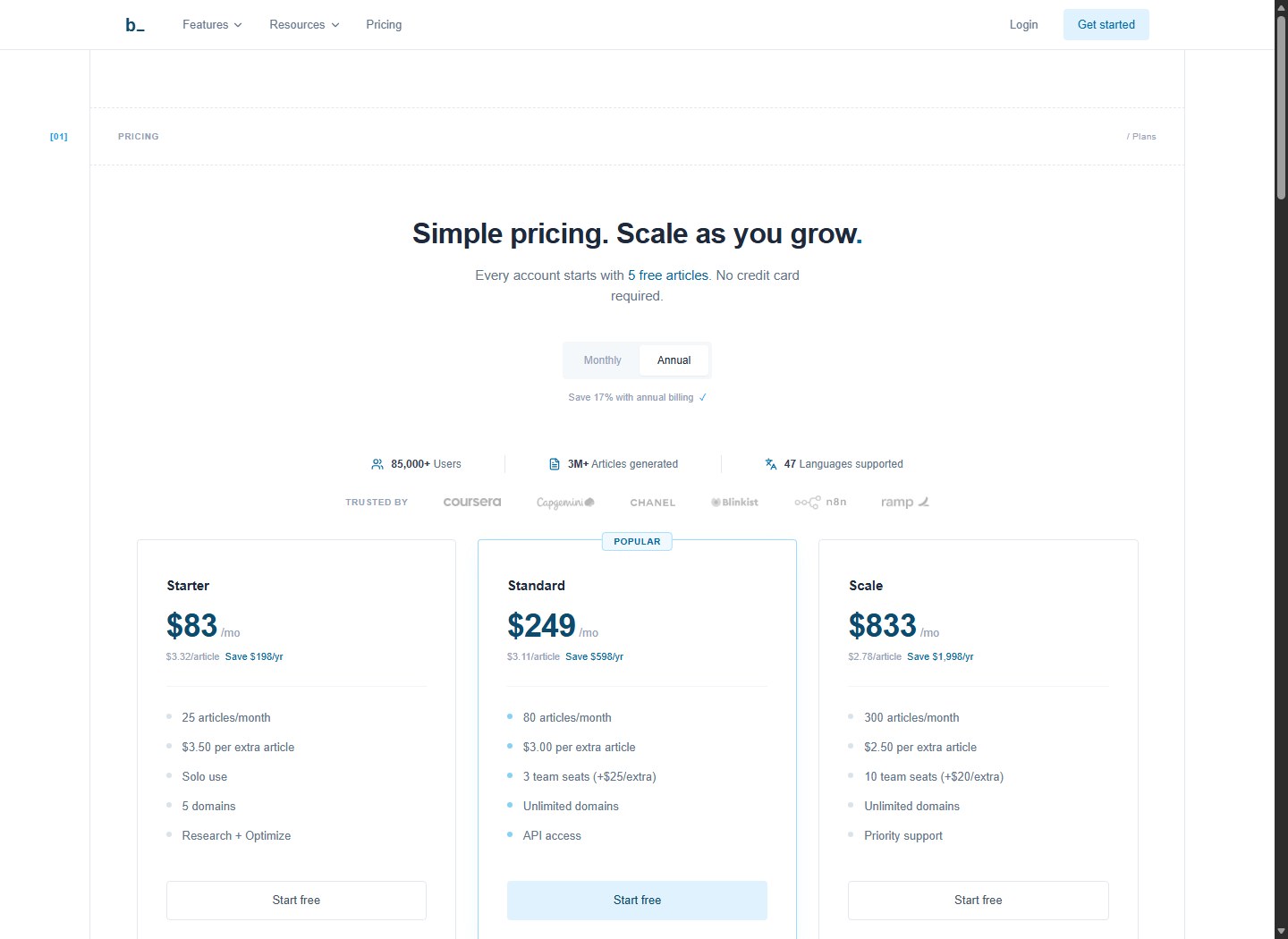
Byword starts at $99 per month for 25 article credits, with five free articles available before purchase. The free allowance requires no credit card and includes full article features according to the pricing page. Byword describes it as five free articles, not a seven-day or fourteen-day trial.
| Plan | Monthly billing | Annual equivalent | Included articles | Overage | Team and domain notes |
|---|---|---|---|---|---|
| Free | $0 | $0 | 5 total | Public table lists $5 credit price | 3 domains; basic voice and research |
| Starter | $99/month | $83/month | 25/month | $3.50/article | Solo use, 5 domains |
| Standard | $299/month | $249/month | 80/month | $3.00/article | 3 seats, $25 per extra seat, unlimited domains, API access |
| Scale | $999/month | $833/month | 300/month | $2.50/article | 10 seats, $20 per extra seat, unlimited domains, priority support |
Annual billing is advertised as a 17% saving and requires a longer commitment. The pricing page says credits accumulate. Verify rollover terms, cancellation treatment, tax, refund policy, and whether unused credits expire before committing.
The page also promotes an Unlimited or enterprise option using customer-provided model keys, but the public display showed zero-dollar values that did not represent credible pricing during this research session. High-volume buyers should request a written quote covering platform fees, model costs, fair-use terms, support, seats, and data handling.
Is the price reasonable?
The answer depends on fully loaded cost per approved page. Divide subscription, overages, seats, editing, fact-checking, images, and publishing QA by the number of pages that pass review, then compare that figure with your current process.
The five free articles are enough to measure revision effort across several intents. Do not test five versions of the easiest topic. Include one factual guide, one commercial page, one brand-heavy article, one difficult niche topic, and one page that uses an integration or template.
Once the route is fixed, teams that meet the buyer criteria can compare Byword’s current plan limits before subscribing. Public release must remain blocked while that route returns 404.
What Are Byword’s Main Strengths and Limits?
Byword’s strength is workflow breadth; its limit is that automation quality still depends on inputs and governance. The platform combines more stages than a narrow writer or optimizer, which can create meaningful operational leverage for the right team.
| Strength | Why it matters | Limit or caveat |
|---|---|---|
| Research-to-publish workflow | Reduces handoffs and context switching | Consolidation can hide weak research assumptions |
| Brand voice and knowledge inputs | Improves consistency across teams and clients | Voice matching is not genuine expertise or guaranteed authenticity |
| Live optimization | Creates a repeatable editorial checklist | Scores cannot predict rankings or revenue |
| Programmatic templates and datasets | Supports repeatable page families | Thin or duplicate pages can become scaled content abuse |
| Bulk queues | Removes serial drafting bottlenecks | Review, differentiation, and maintenance do not scale automatically |
| CMS, API, and webhook delivery | Reduces manual publishing work | Requires security, idempotency, taxonomy, and status controls |
| Five free articles | Enables a low-friction evaluation | Five outputs cannot prove long-term search performance |
The public pages contain aggressive claims about accuracy, voice match, speed, consistency, position improvement, return on investment, and guaranteed-sounding ranking outcomes. A responsible review separates those claims from independently verifiable product facts. Byword may still deliver substantial value, but your decision should rest on a controlled evaluation.
How Should You Evaluate Byword Before Buying?
Run a controlled production test that measures editorial effort and business readiness, not just draft quality. The five free articles make a small pre-purchase test possible, although authenticated feature and integration access should be verified in the account.
Define a baseline and sample
Select five topics representing your real workload. For each, record the time and cost of your current process: research, brief, draft, editing, fact-checking, optimization, upload, and approval. Freeze the target intent, source requirements, brand rules, and acceptance rubric before generating.
Create one Byword version and one baseline version without telling the reviewer which is which where practical. Do not publish both versions. Compare them offline to avoid duplicate content and attribution problems.
Score what matters
Use a rubric with pass/fail gates and graded criteria:
- Intent fit: Does the page answer the actual query and buyer stage?
- Factual support: Can every material claim be traced to a current, authoritative source?
- Original value: Does the draft add expertise, data, examples, or decisions beyond SERP consensus?
- Brand fidelity: Does it follow terminology, tone, prohibited claims, and audience assumptions?
- Structure and readability: Are headings, tables, paragraphs, and next steps useful?
- SEO hygiene: Are title, metadata, headings, links, and schema appropriate without stuffing?
- Production effort: How many minutes and specialist touches are required to approve it?
- Publishing integrity: Does the CMS output preserve slug, status, author, formatting, and links?
Track hallucinations, citation mismatches, vague passages, duplicated phrasing, and recommendations rejected from the optimizer. A draft that looks polished but requires extensive verification may not improve economics.
Test automation separately
Use a staging CMS and draft status. Send one item, retry it, update it, and intentionally fail it. Verify that the process does not duplicate content and that logs identify the resulting CMS record. Test webhooks and API limits with non-sensitive data. Never make bulk publishing the first integration test.
Set a buying threshold
Decide in advance what success means. A sensible threshold might require all factual gates to pass, a lower median approval time than the baseline, no critical publishing errors, and a fully loaded cost that fits the content budget. These are process criteria, not invented performance promises.
If Byword passes, expand in stages: five drafts, then twenty, then a limited page family. Review search and conversion data over an appropriate period before increasing indexable output.
What Are the Best Byword Alternatives?
The best alternative depends on which part of Byword you value most. No single substitute needs to match every research, generation, optimization, programmatic, and publishing feature.
| Alternative | Consider it when… | Main difference to examine |
|---|---|---|
| Jasper | Brand governance and multi-channel marketing matter more than SEO page operations | Broader marketing workflows versus Byword’s SEO and pSEO focus |
| Surfer | Content Editor analysis and optimization discipline are the priority | Deeper optimizer-first workflow; generation and pSEO economics differ |
| Frase | SERP briefing, question research, and editor-led optimization drive the process | Research/editor emphasis versus Byword’s bulk publishing orientation |
| Contentbase | You want an SEO or GEO agent and a more managed programmatic approach | Hosting, automation scope, and infrastructure ownership |
| General AI model plus CMS automation | You have engineering resources and want maximum control | Lower platform coupling but more prompt, QA, and integration work |
Jasper is a better comparison for marketing teams that need brand knowledge across campaign formats, not only search articles. Surfer is a stronger candidate when the content editor and SERP-based optimization are the central purchase. Frase fits research-heavy writers who want to build briefs and optimize interactively. Contentbase belongs on the shortlist for teams considering managed programmatic workflows. A custom stack can be cheaper at scale but moves maintenance, security, model routing, and publishing reliability onto your team.
Request the same five-topic test from every finalist. Compare approved output cost, not demo polish or the highest optimization score.
Is Byword Safe for Helpful Content and AI Detection?
Byword can be used in a people-first workflow, but no AI writing tool makes content automatically helpful, safe from spam policies, or undetectable. Google’s official guidance says generative AI can help with research and structure, while generating many pages without adding user value may violate the scaled content abuse policy. Google evaluates whether content is helpful and reliable, not whether a particular vendor generated it.
Helpful Content and scaled content abuse
Google’s Helpful Content guidance is now part of broader core ranking systems rather than a standalone update. The practical standard remains useful: create content for an audience, show who is responsible, explain how and why it was made when relevant, and provide original value.
For Byword users, that means:
- validate every target against a real user need;
- add first-party evidence, expert review, or original decision support;
- cite primary sources and verify that citations support the claims;
- avoid generating separate URLs for near-identical intents;
- disclose automation when readers would reasonably expect to know;
- maintain author, reviewer, and update accountability;
- monitor and improve or remove pages that provide little value.
Programmatic SEO is not inherently abusive. The risk appears when scale is used primarily to manipulate rankings with unoriginal or low-value pages. A well-designed template with unique data and useful row-level answers can serve users; a thousand noun-swapped pages cannot.
AI detection caveats
Do not set “passes an AI detector” as the quality objective. AI-text detectors can produce false positives and false negatives. OpenAI withdrew its own classifier because of low accuracy, which illustrates why detector scores are weak evidence of authorship.
Trying to evade detectors can make writing worse by encouraging awkward phrasing or random variation. Focus on truth, specificity, source quality, coherent reasoning, and accountable editing. A human editor should improve the substance, not merely “humanize” sentence patterns.
A safe publishing policy
Require source verification for material claims, subject-matter review for sensitive topics, plagiarism checks, brand and legal approval, and draft-first CMS delivery. Keep generation records and source dates. Sample published pages regularly for factual drift, broken links, duplication, and declining usefulness.
No workflow can guarantee rankings or immunity from search updates. The defensible goal is a documented process that makes each page more useful and more accurate than an unreviewed draft.
Is Byword Worth It?
Byword is worth it for teams that can convert automation into approved, differentiated pages and measurable publishing savings. It is a weak purchase for low-volume users, teams without editorial controls, or organizations expecting an SEO score to replace strategy.
The clearest value case is an SEO or agency operation paying people to move content among research, writing, optimization, spreadsheets, and CMS tools. Byword can consolidate much of that motion. Its programmatic templates and API options make it particularly relevant when a validated dataset supports many genuinely useful pages.
The strongest reason to wait is operational readiness. Without source standards, page ownership, review capacity, analytics, and pruning rules, more generation capacity is likely to amplify waste.
Use the five free articles to measure approval time and error rate. Then model the appropriate paid tier with overages and seats. Buy only if the controlled test beats your baseline without weakening factual, editorial, or publishing standards. Also verify current checkout terms because features, models, and prices can change after this review’s August 1, 2026 research cutoff.
How We Test and Score
ScaleWitAI funds every account used in this review with its own capital. We subscribe to all paid tiers with self-funded plans and never use sponsored, gifted, or vendor-provisioned accounts, so our evaluation reflects the same product a paying customer receives and stays 100% independent of vendor influence.
Evaluation combines standardized test suites with hands-on workflow testing. We use HumanEval-style tasks to probe logic and code reasoning, BLEU/ROUGE-style metrics to measure natural-language quality, and internal stress-test scenarios to map context-window limits and long-input behavior. We run more than 10,000 prompts per AI platform every year, across varied access conditions, and log results against a transparent scoring rubric.
The dataset for this review was collected over 12 months (from August 2025 to August 2026). Historical comparisons track AI model development since 2024, and this report tests and compares 12+ leading AI models and providers on the market.
FAQ
Does Byword offer a free trial?
Byword offers five free articles with no credit card required. Its pricing page describes an article allowance rather than a time-limited trial. Verify account limits before starting.
How much does Byword cost?
Monthly plans start at $99 for 25 articles. Standard costs $299 for 80 articles, and Scale costs $999 for 300 articles. Annual equivalents shown publicly are $83, $249, and $833 per month, respectively.
Can Byword publish directly to WordPress?
Yes, Byword lists native WordPress publishing for posts and pages. Use draft status first and verify slug, author, taxonomy, formatting, links, schema, and images before publication.
Does Byword support programmatic SEO?
Yes, Byword supports templates connected to CSV or API data. Its public examples include location, comparison, alternatives, feature, integration, and use-case pages. Every generated page still needs unique value and QA.
Does Byword have an API and webhooks?
Byword advertises a REST API and webhook events. Its pricing page indicates API access on Standard and Scale. Confirm exact plan entitlements, limits, authentication, and event behavior before purchase.
Can Byword match a brand voice?
Byword can learn patterns from uploaded articles, documents, and style guides. This may improve consistency, but vendor voice-match percentages are not guarantees, and expert editorial review remains necessary.
Will a high Byword optimization score guarantee rankings?
No. A content score can identify coverage, readability, and on-page issues, but rankings also depend on intent, originality, authority, links, technical quality, competition, and site-wide signals.
Is Byword content safe from Google penalties?
No tool can guarantee that. Google permits useful applications of generative AI but warns that scaled, unoriginal content created mainly to manipulate rankings can violate spam policies. Human review and page-level value are essential.
Can AI detectors identify Byword content?
Detector results are not reliable proof of authorship. Do not buy Byword based on “undetectable AI” claims or optimize drafts to fool detectors. Optimize for accurate, original, people-first content instead.
Who owns articles generated with Byword?
Byword’s homepage FAQ says generated articles belong to the customer. Review the current terms for licensing, uploaded knowledge, training use, retention, and deletion requirements before adding confidential material.
