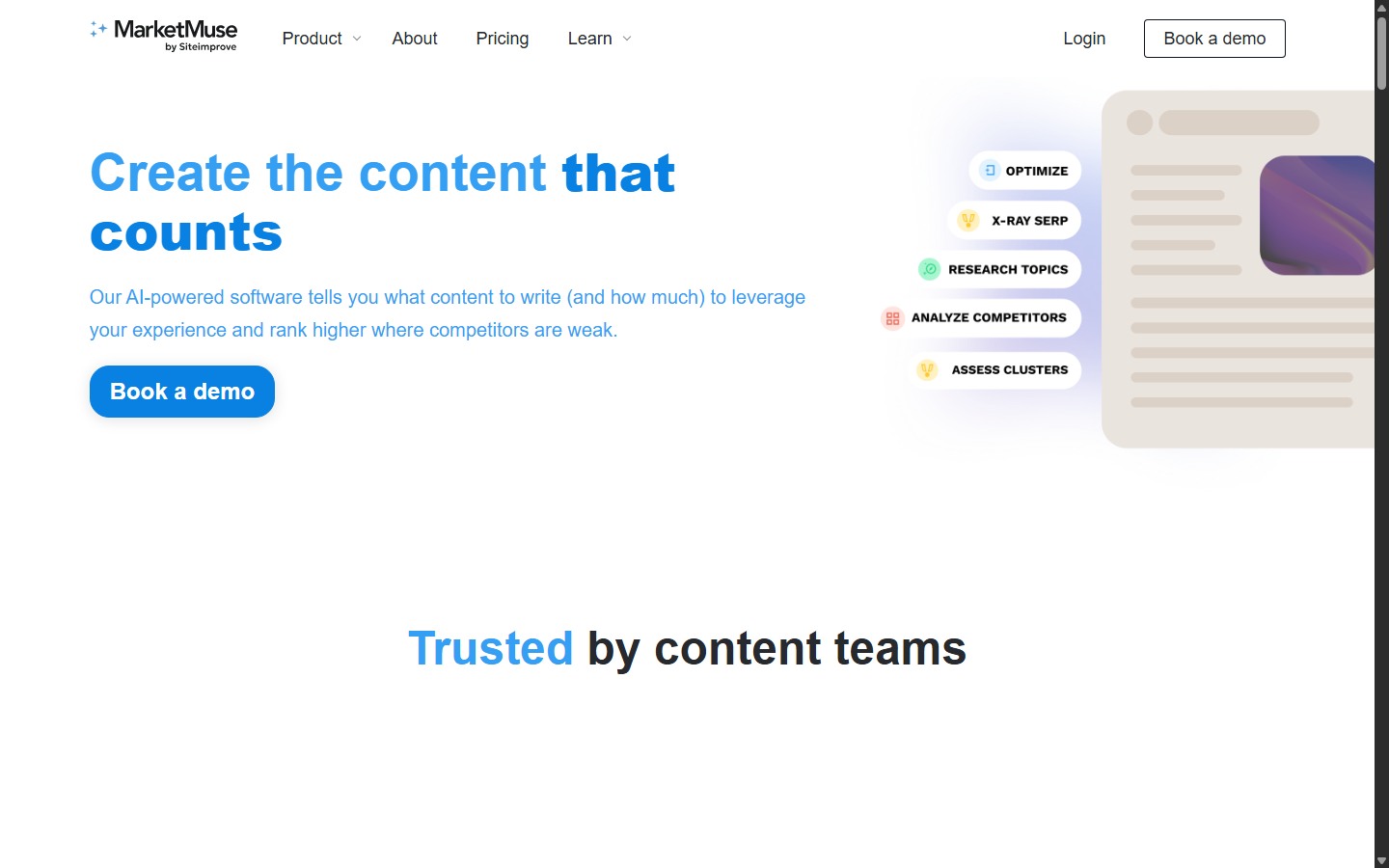
MarketMuse is a content strategy platform for researching topics, prioritizing a content inventory, building plans and briefs, and optimizing individual pages. It is most compelling for established teams that need to decide what to create or update across many pages, not just raise an in-editor score. It does not replace a CMS, human editorial judgment, Search Console, analytics, or technical SEO software.
| At-a-glance | MarketMuse review finding |
|---|---|
| Homepage | MarketMuse |
| Verdict | Strong shortlist for portfolio-level content strategy, conditional on the commercial terms and a representative demo |
| Editorial score | 7.9/10, weighted for strategy depth, portfolio intelligence, planning workflow, transparency, breadth, and governance evidence |
| Best for | SEO leaders, content strategists, brands, publishers, and agencies managing substantial content inventories |
| Skip if | You need transparent self-serve paid pricing, a low-cost drafting assistant, native CMS management, or AI-search citation monitoring |
| Public price | Free tier listed, but public self-serve signup currently says sign-up is disabled; no plan displays a dollar amount |
| Paid plans | Optimize, Research, and Strategy, all routed to a demo |
| Core strengths | Inventory intelligence, Topic Authority, Personalized Difficulty, content planning, briefs, Heatmap, and Optimize |
| Main caution | MarketMuse metrics are proprietary decision aids, not Google metrics or outcome guarantees |
| Current provider | Siteimprove acquired MarketMuse; current terms took effect June 30, 2026 |
The buying decision is therefore broader than comparing content editors. Buyers must judge whether portfolio prioritization saves enough research and coordination time to justify undisclosed paid pricing, limited briefs and strategy documents, and a post-acquisition procurement review. The editorial rubric scores strategy depth 9.0/10, portfolio intelligence 9.0, planning and briefs 8.5, price transparency 4.0, workflow breadth 8.0, and governance evidence 7.5, weighted at 25%, 20%, 15%, 15%, 15%, and 10%, respectively. The weighted 7.875 result rounds to 7.9/10; it is a ScaleWitAI decision score, not a MarketMuse metric or a prediction of search performance.
Quick Verdict
Use MarketMuse when your main problem is choosing the right work across a content portfolio. Its public product pages connect site inventory, topic-level opportunity, competitive gaps, planning documents, content briefs, and page optimization. That is a more strategic proposition than opening one keyword report and scoring one draft.
Skip or compare it first if you are a solo writer, need an immediately visible paid price, want a CMS replacement, or primarily need technical audits, backlinks, rank tracking, autonomous publishing, or large-scale AI-search monitoring. MarketMuse can organize evidence and recommendations, but it cannot guarantee rankings, traffic, authority, citations, or return on investment.
| Decision point | Recommendation |
|---|---|
| Best reason to shortlist | Prioritize creation and refresh opportunities across many pages and topics |
| Best low-risk entry | Ask Sales whether the listed Free tier can be enabled before relying on its 10-query allowance |
| What the listed Free tier cannot prove | Even if enabled, it cannot test inventory quality, tracked-topic prioritization, briefs, or strategy documents |
| Paid-plan gate | Request a demo and written commercial terms using your own representative site and topics |
| Essential validation | Compare MarketMuse recommendations with Search Console, analytics, business value, and editorial expertise |
| Procurement trigger | Review Siteimprove terms, privacy, security, support, export, roadmap, and renewal details |
Check MarketMuse's current plans and demo options only after defining the inventory, users, briefs, tracked topics, exports, and support your team needs.
What Is MarketMuse?
MarketMuse is a content strategy and optimization platform built around the sequence Research, Plan, Brief, and Write. Its public materials describe an automated inventory of published pages and topics, proprietary opportunity metrics, competitive and cluster analysis, strategy documents, customizable briefs, and the Optimize writing application.
The category boundary matters. MarketMuse is broader than a focused content editor because it helps decide which pages and topic clusters deserve attention before a writer starts. It is narrower than a complete SEO suite because it is not presented as a technical crawler, backlink platform, rank tracker, or CMS. MarketMuse explicitly says it creates a content inventory but does not manage or change site content directly.
There is also a material lifecycle change. The subscription agreement effective June 30, 2026 states that Siteimprove acquired MarketMuse, now makes the services available, and replaced the former MarketMuse agreement. The product name remains MarketMuse, while the current contracting, privacy, support, and roadmap context sits with Siteimprove.
Who Is MarketMuse Best For?
MarketMuse is best for teams whose content decisions have become too numerous or interconnected for spreadsheets and one-keyword-at-a-time research. The likely fit is an organization with enough existing pages, topic clusters, writers, and refresh work for inventory-level prioritization to matter.
- SEO leaders and content strategists can compare topic opportunities, existing coverage, competitive gaps, and estimated effort before assigning work.
- Publishers and brands can use page-topic relationships and planning documents to separate likely updates from net-new content needs.
- Agencies can benefit when standardized plans and briefs reduce manual SERP review, although site, user, brief, and document limits require careful quoting.
- Editors and writers can receive structured guidance, questions, topics, linking suggestions, and target scores instead of a raw keyword list.
MarketMuse is a weaker fit for occasional bloggers, teams buying mainly for AI drafting, or organizations that require a public self-serve price before evaluation. It is also a poor substitute for original reporting, subject-matter expertise, conversion research, analytics interpretation, or technical remediation.
What Are MarketMuse's Key Features?
MarketMuse's key features are content inventory, personalized opportunity metrics, content planning, cluster and competitive analysis, content briefs, and Optimize. Topic Authority, Personalized Difficulty, and Content Score are proprietary MarketMuse metrics, not Google metrics. They can guide investigation, but they do not prove how Google evaluates a page or predict an outcome with certainty.
Content Inventory, Topic Authority, and Personalized Difficulty
Inventory is the strategic foundation of paid MarketMuse use. The pricing FAQ defines it as a regularly updated list of published pages, topics, and page-topic combinations, with tracked topics that may or may not already rank. This creates a portfolio view of existing coverage and possible gaps.
Personalized Difficulty uses a 1-100 scale, with a higher value described as harder for the specific site. MarketMuse says it considers the domain's topical coverage, current and historical performance, and other factors. Topic Authority considers breadth, comprehensiveness, performance, and potential relative to competing domains. Competitive Advantage is the difference between generic Difficulty and Personalized Difficulty.
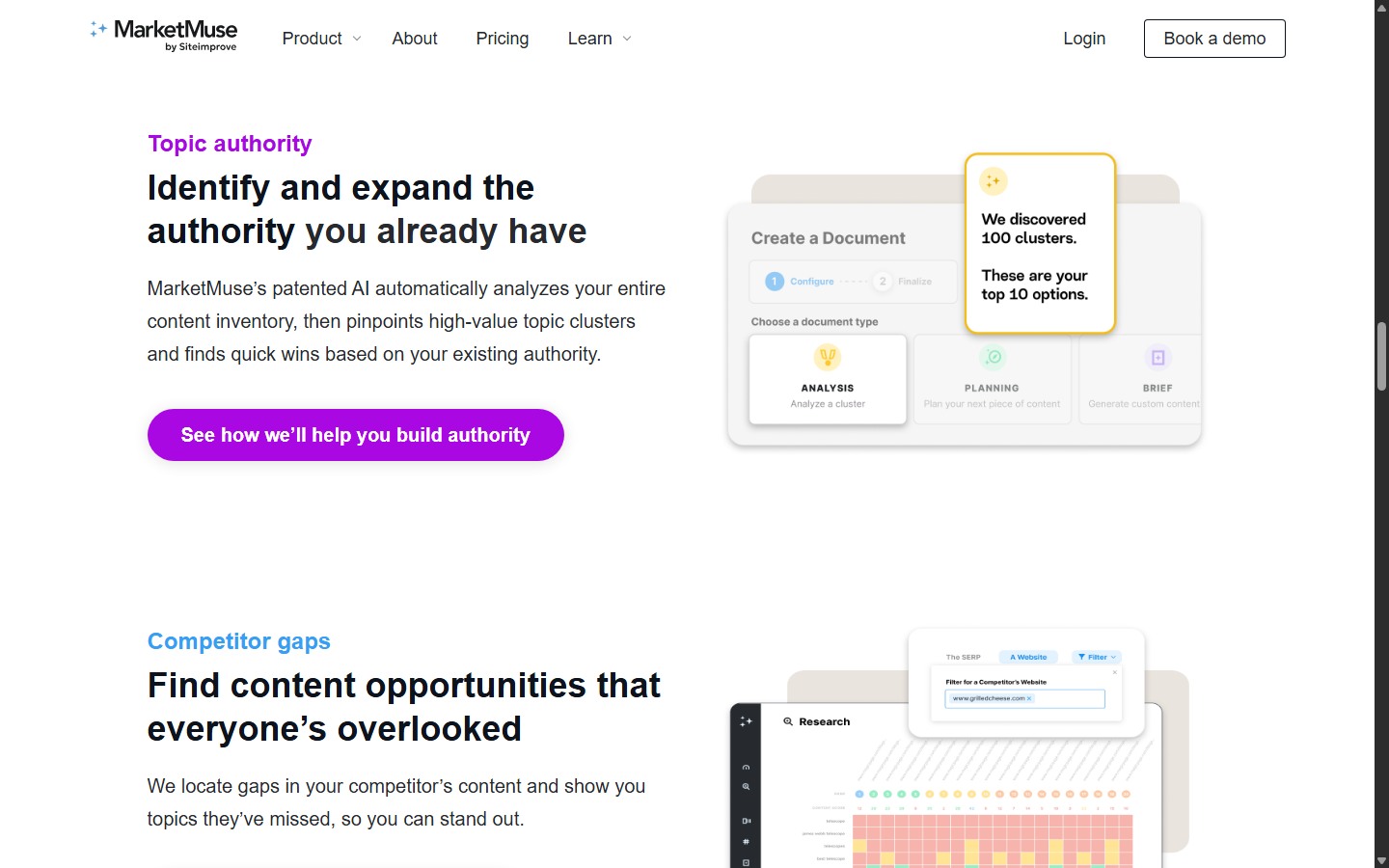
The practical value is prioritization, not certainty. Validate high-priority recommendations against first-party performance data, revenue or lead value, intent, maintenance cost, and editorial knowledge before changing the roadmap.
Content Planning and Strategy Documents
Content Planning turns inventory and topic research into recommendations about what to create and what to update. Public documentation lists an executive summary, content plan recommendations, content groups, cluster details, a competitive overview, and ideas that can become briefs. Cluster details may include the ranking URL and position, search volume, parent keyword, Topic Authority, Personalized Difficulty, and intent match.
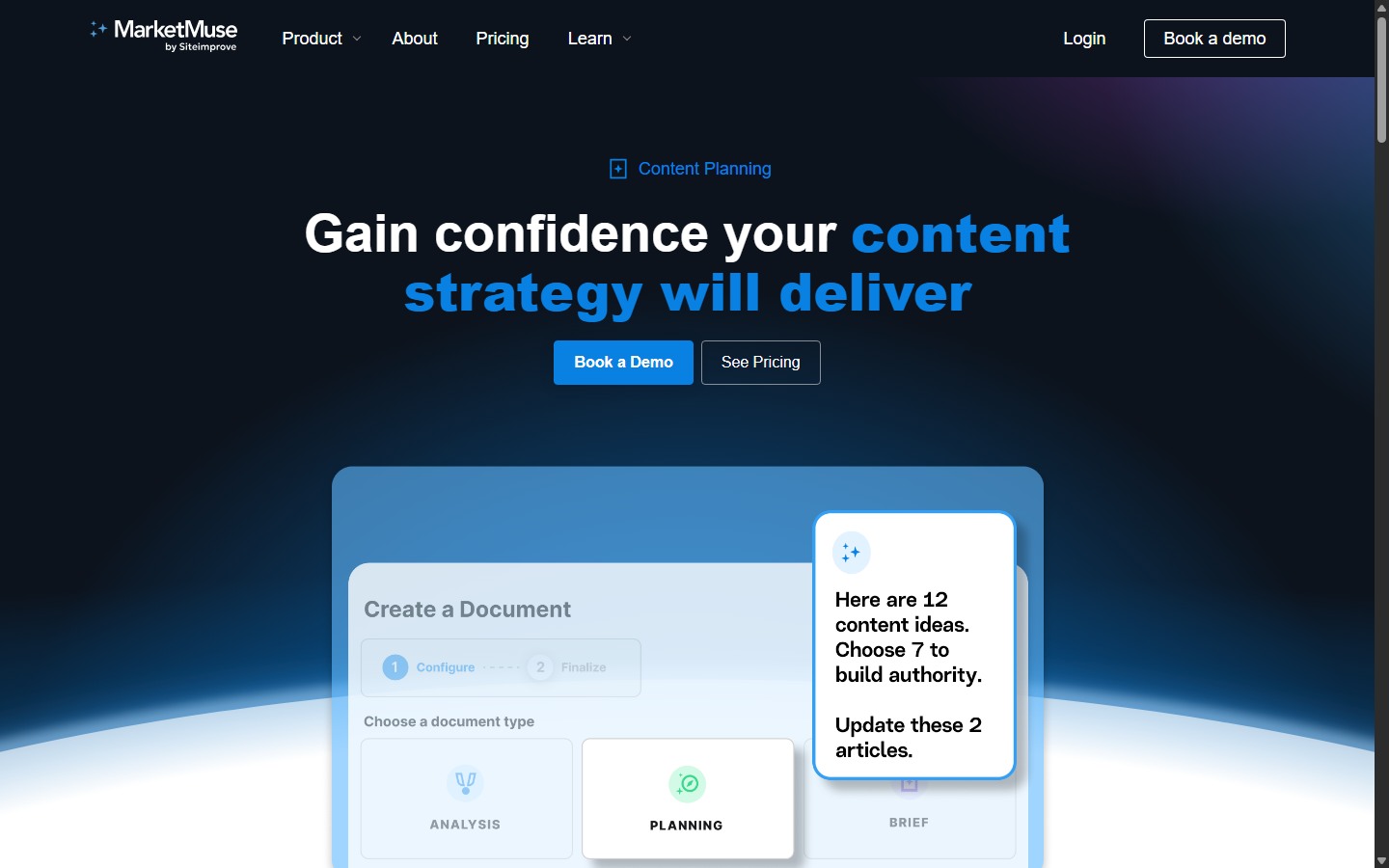
A shared decision record for strategists, editors, and stakeholders is a practical reason to consider MarketMuse over a lightweight optimizer. The plan still requires review because an algorithm cannot know unpublished product priorities, legal risk, conversion value, or which expert evidence the organization can actually produce.
Content Clusters and Site Heatmap
The cluster workflow compares existing coverage with related subjects and helps teams decide which clusters to expand. MarketMuse says Heatmap can evaluate a site's cluster on a topic up to 20 pages deep. Its Content Clusters FAQ says all subscriptions receive SERP Heatmap and only Strategy receives site-level Heatmap, but the current pricing matrix lists "Site Heatmap & Connect" for Free, Optimize, Research, and Strategy. These first-party surfaces conflict, so buyers should confirm each Heatmap entitlement in the demo and order form.
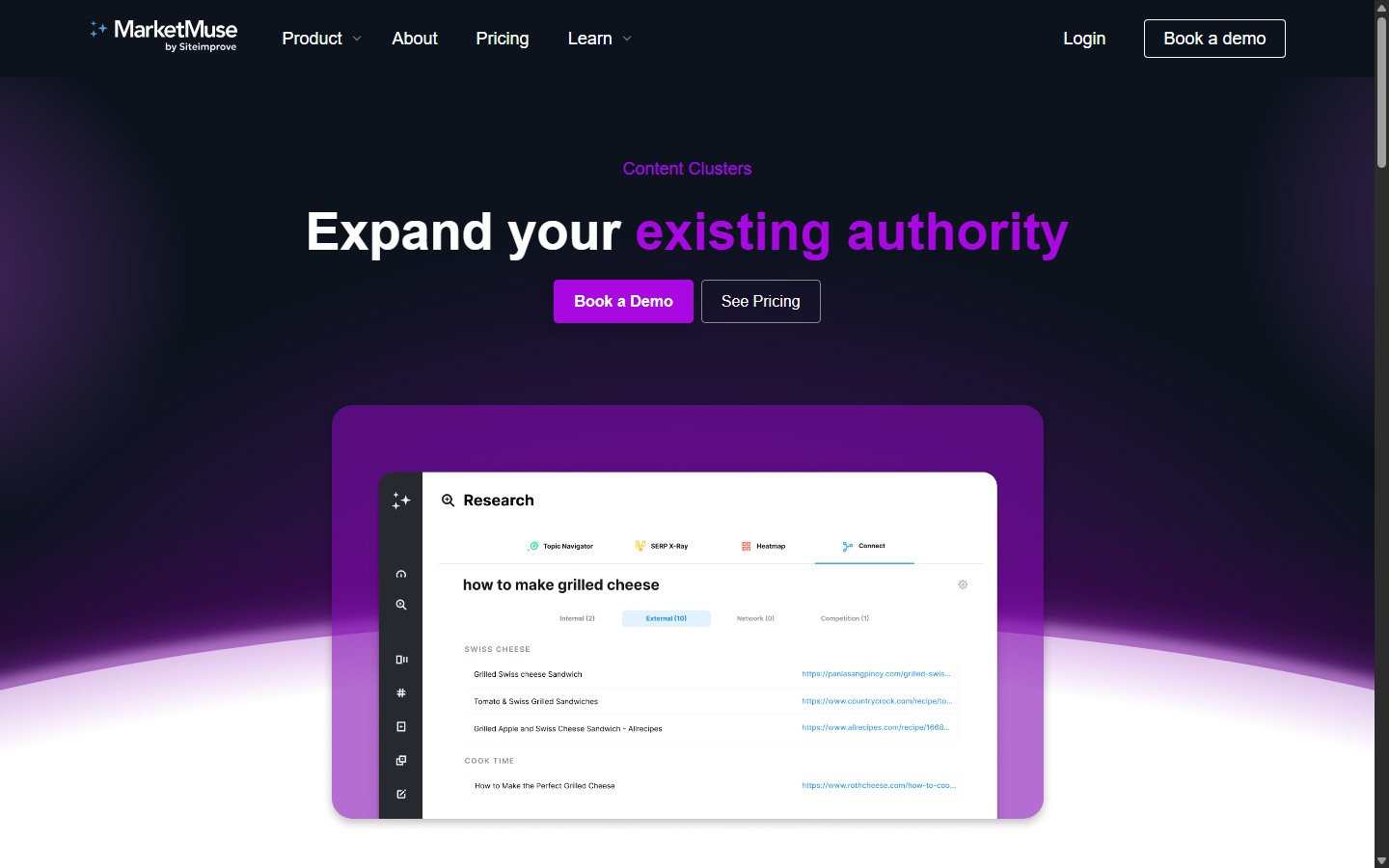
Cluster depth is not a command to create more URLs. Buyers should merge overlapping intent, avoid thin variations, and ask what distinct evidence each page contributes. MarketMuse can expose coverage patterns, but it cannot grant authority or guarantee that expanding a cluster will improve search performance.
Competitive Analysis, SERP X-Ray, and Heatmap
MarketMuse's competitive analysis uses Heatmap to compare the top 20 search results or filter a competitor's cluster. The public page describes red grid cells as gaps, Content Score as a quality signal, and SERP X-Ray as a way to compare page structure and coverage.
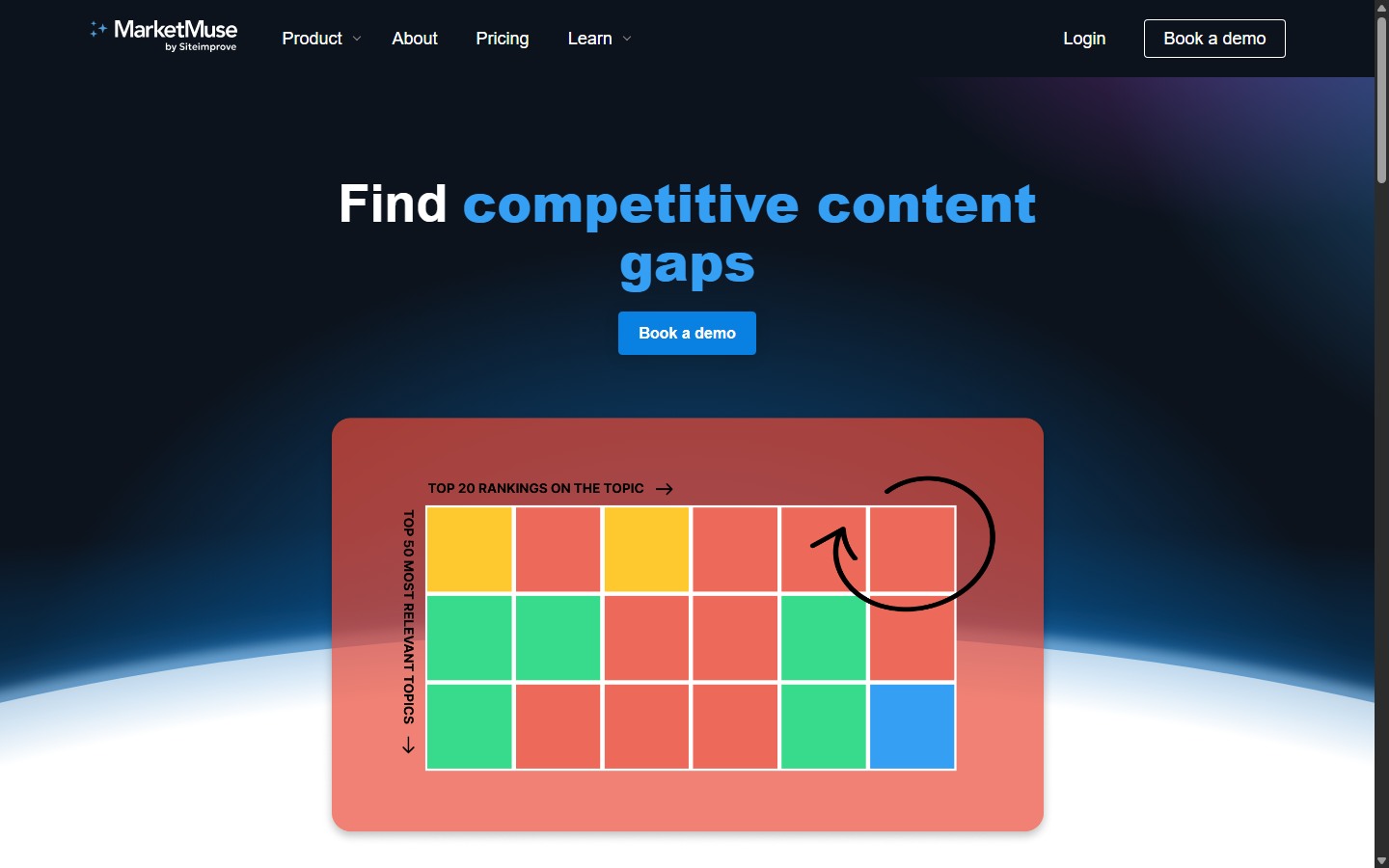
This can compress a slow manual comparison into a useful visual. The risk is convergence toward the existing SERP. Common headings and topics establish a baseline, not information gain. Strong content still needs first-party facts, expert interpretation, original examples, a clear point of view, and a reason to exist beyond matching competitors.
Content Briefs and Writer Handoffs
MarketMuse publicly lists nine brief types: Article, Comparison, FAQ Collection, Guide, How-to, Listicle, Local, News/Event, and Product Review. Brief inputs can cover point of view, expertise, personal experience, audience personalization, style, tone, proof and fact statements, linguistic context, buyer journey, intent, structure, references, and target market. Exports to Google Docs and Microsoft Word are documented.
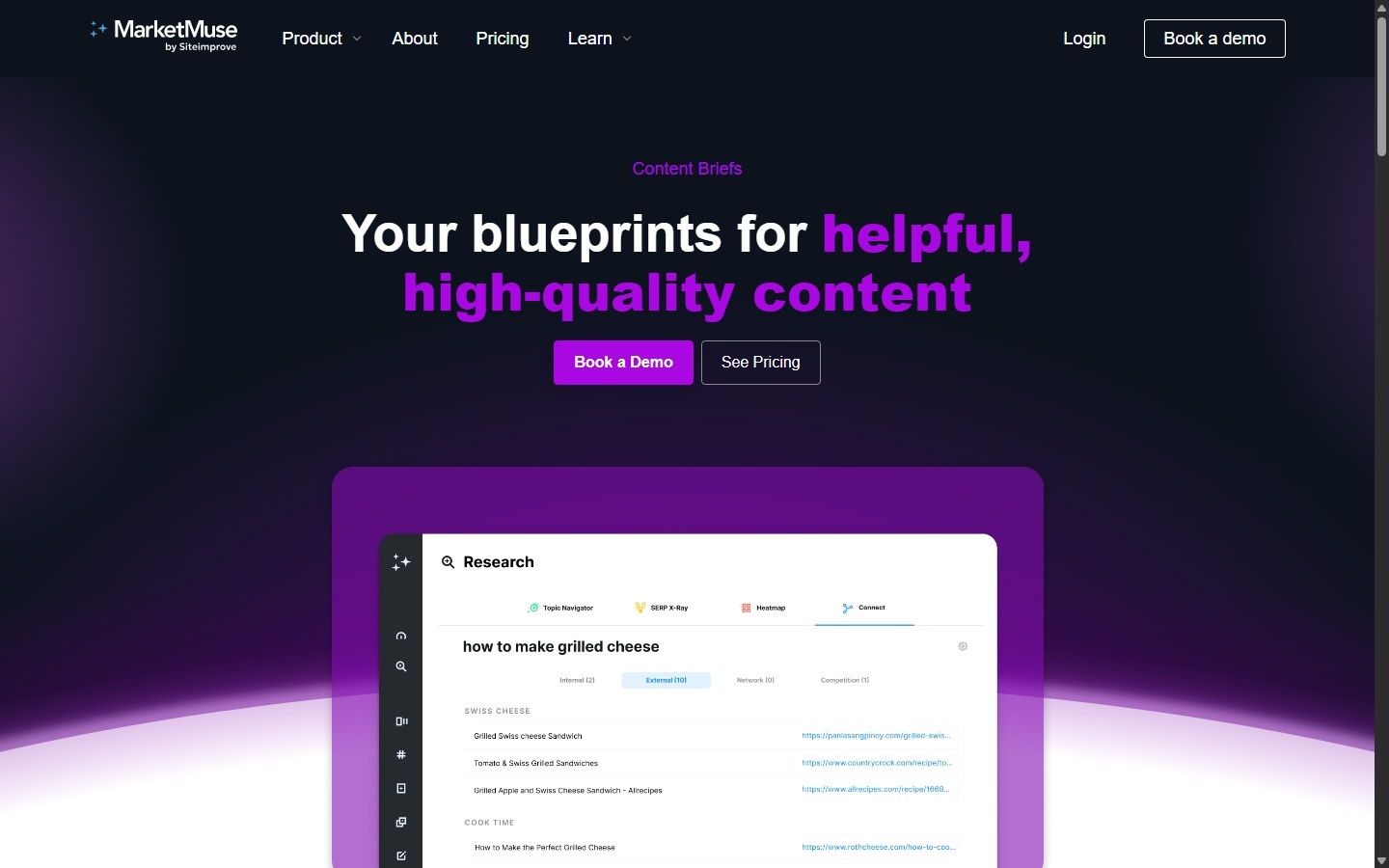
Plan access is important. Optimize and Research explicitly list Article Briefs, while Strategy lists all nine brief types. Monthly brief limits are five, 10, and 20 across those paid plans. Agencies should model real assignments, revisions, and client volume rather than assuming every team can generate every brief type without a cap.
Optimize and Content Score
Optimize supports writing, review, and gap analysis around a focus topic. MarketMuse says it builds a topic model, scores a page according to included subtopics, scores competitive pages, and derives a Target Content Score. The Optimize page also describes one-to-one comparisons with top-ranking pages and export to Word or Google Docs.

MarketMuse positions Content Score as a coverage diagnostic. It is not a Google ranking factor, and a higher score can coexist with weak facts, repetitive prose, poor intent fit, or no original value. MarketMuse markets generative AI support inside Optimize, yet also says it does not write content for customers. Human review remains necessary, and the current terms warn that AI output can be inaccurate, incomplete, biased, or unexpected.
How Does MarketMuse Work?
MarketMuse works by moving from site and topic evidence to a prioritized plan, then to a brief and an optimized draft. A practical workflow looks like this:
- Establish the scope. Connect a representative site inventory on an eligible plan. If Sales enables the listed Free tier, use its limited queries only to inspect the applications.
- Choose a focus topic. Entering a focus topic in Research, Compete, or Optimize consumes a query when the plan has a query limit.
- Review the evidence. Inspect inventory relationships, Personalized Difficulty, Topic Authority, competitive gaps, intent, and cluster depth. Reject irrelevant SERP examples.
- Prioritize work. Decide whether to create, update, consolidate, or defer. Use a Strategy Document when the plan and decision warrant one.
- Build the handoff. Generate an eligible brief, then add the organization's facts, sources, audience, angle, prohibited claims, and acceptance criteria.
- Write and optimize selectively. Use Content Score and topic suggestions to find omissions, not to force every term into the draft.
- Export and validate. Move approved writing or documents through the available export tools, then complete CMS, legal, accessibility, metadata, and performance QA elsewhere.
The workflow is strongest when MarketMuse informs an existing editorial system. It is not documented as a direct replacement for that system.
What Is MarketMuse Like in Real Use? Its documented workflow spans inventory, planning, briefs, and optimization, which involves more stages than a single-keyword editor.
Setup value depends on the quality of the inventory and topic model. A serious demo should use the buyer's own representative site, not a polished sample account. Ask the team to show crawl freshness, page-topic relationships, false positives, one difficult cluster, a content plan, one brief, an Optimize pass, permissions, export, and reporting.
Experienced teams are more likely to benefit because they can challenge the metrics with Search Console, analytics, technical findings, business priorities, and subject expertise. Beginners may treat Topic Authority as Google's authority score, Personalized Difficulty as a ranking forecast, or Content Score as a target to maximize. Those interpretations overstate what proprietary metrics can prove.
Public evidence did not establish a native CMS publishing system, broad public API, webhooks, approval gates, detailed role controls, or dedicated AI-search citation tracking. Do not infer that these capabilities are absent in every contract or account. Treat them as unconfirmed and ask for a live demonstration when they matter.
How Much Does MarketMuse Cost?
MarketMuse publicly lists a Free tier, but its linked signup page currently says sign-up is disabled and directs prospective users to Sales. No plan displays a dollar price. Optimize, Research, and Strategy all say "Book a demo." Historical reviews and third-party pages may quote older Standard or Premium pricing, but those amounts should not be treated as current MarketMuse prices.
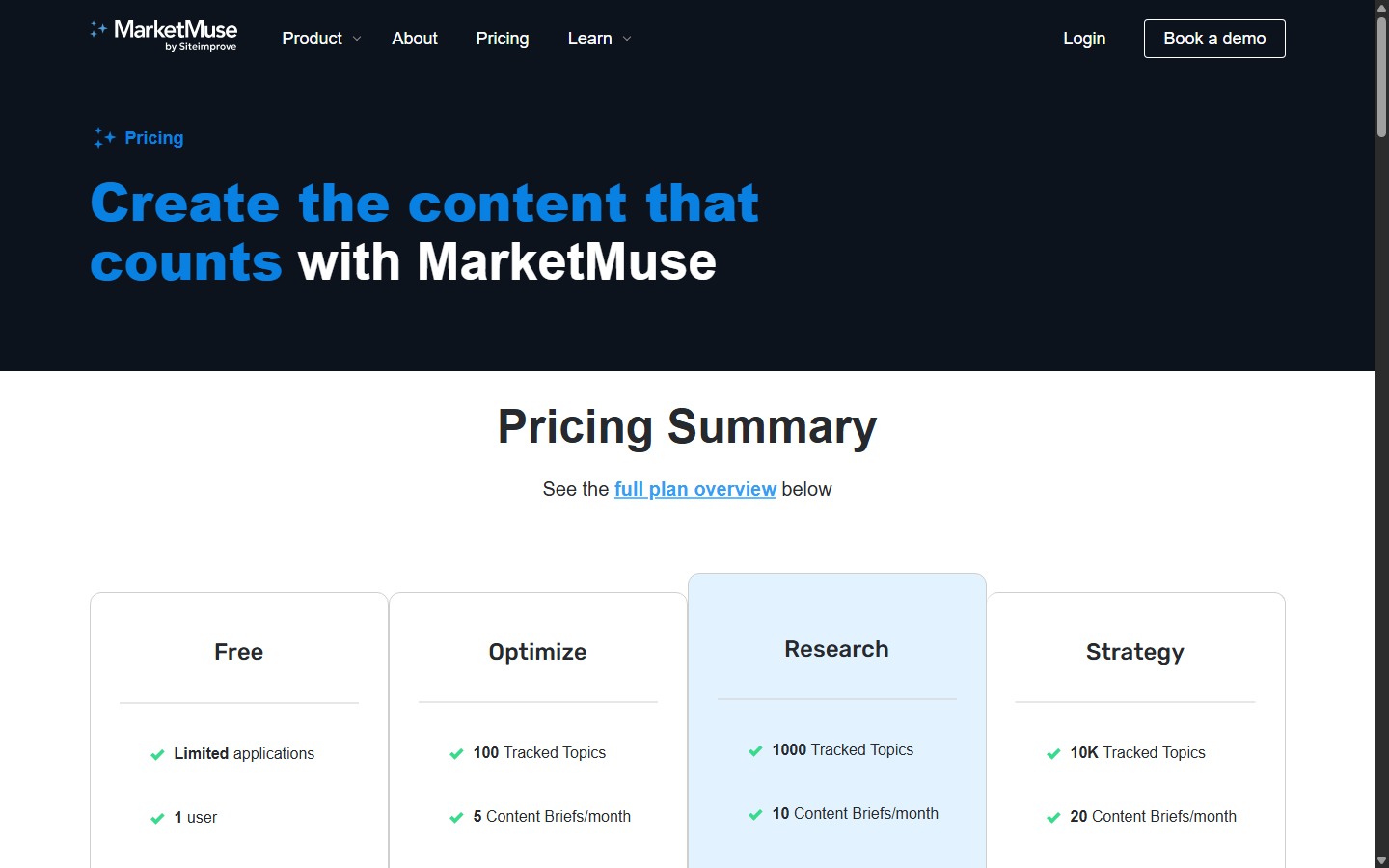
| Plan | Public price | Inventory and users | Tracked topics | Briefs and strategy documents | Queries |
|---|---|---|---|---|---|
| Free | Listed as Free; public self-serve signup disabled | No inventory; 1 user | None | No briefs; no strategy documents | 10 per month if access is enabled |
| Optimize | Price not public; demo required | 1 inventory; 1 user | 100 | 5 Article Briefs and 1 Strategy Document per month | 100 per month |
| Research | Price not public; demo required | 1 inventory; 3 users | 1,000 | 10 Article Briefs and 3 Strategy Documents per month | Unlimited |
| Strategy | Price not public; demo required | 1 inventory; 5 users | 10,000 | 20 briefs, all nine types, and 5 Strategy Documents per month | Unlimited |
The pricing matrix lists limited application access, Topic Navigator, Keywords, SERP X-Ray and SERP Heatmap, saved-writing export, and 10 monthly queries for Free, but no inventory, tracked topics, briefs, or strategy documents. It also lists "Site Heatmap & Connect" for Free, while the Content Clusters FAQ limits site-level Heatmap to Strategy; confirm the actual scope before relying on either capability. Because public self-serve signup is disabled, these are documented entitlements rather than proof that a new user can activate the tier today.
The pricing-page footer links to "Start my free trial," but that route resolves to a MarketMuse signup page stating, "Sign up is disabled" and directing interested users to Sales. The public pricing copy does not state a trial duration, card requirement, or automatic paid conversion. Treat the Free tier and trial as listed offers whose current availability and onboarding terms require Sales confirmation, not as self-serve access.
Request complete written commercial terms covering subscription length, onboarding, support, additional sites, users, tracked topics, brief or document overages, data migration, and renewal pricing. Current terms say the default subscription is one month unless the order states otherwise, fees are prepaid, and the subscription renews automatically. Either party may cancel at any time; notice before the current term ends stops the next renewal, access continues through that term, and fees are generally nonrefundable.
The same terms, effective June 30, 2026, identify Siteimprove as the provider after its acquisition of MarketMuse. Commercial evaluation should therefore include both product limits and the current Siteimprove agreement.
What Are the Pros and Cons of MarketMuse?
MarketMuse's main advantage is portfolio-level decision support; its main disadvantages are commercial opacity and the risk of overtrusting proprietary models.
| Pros | Cons |
|---|---|
| Inventory connects pages, topics, and tracked opportunities | No public dollar prices for Optimize, Research, or Strategy |
| Personalized Difficulty adjusts difficulty to the site's modeled context | Proprietary metrics can look more certain than the evidence supports |
| Planning documents connect research to create and update decisions | Brief, strategy-document, user, site, and tracked-topic limits apply |
| Heatmap and SERP X-Ray compress competitive and cluster research | SERP-derived guidance can encourage formulaic coverage |
| Nine brief types support varied editorial handoffs on Strategy | Optimize and Research explicitly list only Article Brief access |
| Optimize brings topic modeling into drafting and refresh work | MarketMuse does not replace a CMS or full SEO suite |
| Word and Google Docs exports support handoffs | Current terms do not guarantee one unified, comprehensive data export |
| A listed Free tier may allow a limited initial look if Sales enables access | Public self-serve signup is disabled, and the tier cannot test inventory, tracked topics, briefs, or strategy documents |
What Are the Best MarketMuse Alternatives?
The best alternative depends on whether portfolio strategy is actually the job to be done. For a wider category view, the published comparison of NeuronWriter alternatives separates strategy platforms from page-level optimizers and brief-first tools.
| Alternative | Better fit when | Main trade-off versus MarketMuse |
|---|---|---|
| NeuronWriter review | A value-focused, self-serve SERP and content optimization workflow matters more than inventory strategy | Narrower portfolio planning and authority analysis |
| Clearscope review | Editorial adoption, live grading, collaboration, and ongoing Google or AI visibility monitoring are priorities | Less centered on MarketMuse-style Personalized Difficulty and strategy documents |
| Dashword review | A linear report-to-brief-to-editor workflow and lower operational complexity are the goal | Less inventory and cluster-level strategic depth |
None of these tools is universally better. Run the same topic, existing page, evidence pack, and acceptance criteria through each shortlist candidate. Compare the cost and labor required to reach an approved decision or article, not the number of features or the highest proprietary score.
Where Does MarketMuse Fall Short?
MarketMuse falls short most clearly on price transparency. A buyer cannot calculate cost per tracked topic, brief, document, user, or site from the public page because every paid tier routes buyers to a demo and publishes no dollar price.
Plan limits can constrain the workflow that justifies the platform. Optimize and Research list only Article Brief access, while Strategy unlocks all nine brief types. One included inventory across paid tiers and fixed user, brief, document, and tracked-topic limits may create extra charges or force process compromises.
Its metrics can encourage false precision. Personalized Difficulty, Topic Authority, Competitive Advantage, and Content Score can improve prioritization, but the formulas are proprietary. None is a Google metric or a guarantee of rankings, traffic, authority, or revenue.
MarketMuse is not the final execution layer. It explicitly does not replace a CMS. Public pages reviewed for this package did not verify broad API access, webhooks, granular approval gates, or native publishing. Teams with complex integrations must prove the workflow in a demo.
The acquisition adds procurement work. Siteimprove's terms now govern the service, and the agreement limits export expectations to available module tools. Buyers should not assume the legacy commercial, privacy, support, or roadmap model remains unchanged.
What Should Buyers Check Before Choosing MarketMuse?
A useful MarketMuse evaluation should prove portfolio decisions with the buyer's own data and close every commercial or governance gap in writing. Use these checks during the demo and procurement process.
| Buyer check | Evidence to request |
|---|---|
| Full cost | Written pricing and terms for the required sites, users, topics, briefs, documents, onboarding, support, overages, and renewal |
| Inventory quality | Crawl scope, refresh cadence, exclusions, canonical handling, duplicate pages, and correction workflow on a representative site |
| Metric usefulness | Examples where Personalized Difficulty, Topic Authority, and Content Score agree or conflict with first-party data |
| Planning proof | One real create, update, consolidate, or defer decision with the assumptions exposed |
| Brief fit | Required brief types, customization fields, monthly capacity, revisions, assignment workflow, and exports |
| Team governance | Roles, permissions, SSO, audit logs, approvals, account removal, and client or site separation |
| Integration path | Document export, CMS handoff, API or webhook scope, reporting, retries, and support ownership |
| Exit readiness | Module-by-module export formats, deletion timing, retention, and migration assistance before termination |
| Acquisition continuity | Siteimprove contracting entity, roadmap, support model, service levels, migration plans, and renewal protections |
The current terms provide several concrete trust facts. Customer data remains the customer's property, while Siteimprove receives rights to process it to provide the service and owns aggregated anonymous data. Service processing incorporates the Siteimprove Privacy Policy and Global DPA. AI features may use third-party providers including OpenAI and Amazon Bedrock; the terms tell customers not to submit personal data to AI features and require human review of outputs.
Those statements are not a full security dossier. Request current subprocessors, data locations, retention, deletion, encryption, security certifications, incident response, role controls, and contractual service commitments when sensitive or regulated content is involved. Also plan exports before termination because the terms do not guarantee a unified or comprehensive export across modules.
Set the decision rule before the demo. A sensible purchase requires MarketMuse to improve prioritization quality or reduce research and coordination labor without weakening editorial quality, governance, or the team's ability to exit.
Is MarketMuse Worth It?
MarketMuse can be worth it for an established content organization that needs portfolio intelligence and can validate the commercial terms against saved planning labor and better prioritization. Its documented combination of inventory, personalized metrics, cluster and competitive analysis, plans, briefs, and optimization is meaningfully broader than a page-level scoring tool.
It is not worth buying on the assumption that a score will create rankings, traffic, authority, citations, or ROI. If Sales enables the listed Free tier, it may support a limited application check; public self-serve signup was disabled when reviewed. A paid decision requires a representative demo, complete written pricing and terms, and a Siteimprove procurement review. If those checks do not prove incremental value, choose a narrower and more transparent optimizer.
Evaluate MarketMuse with a representative content portfolio, then compare the proposed total cost with your existing research, briefing, editorial, and maintenance process.
Research method: $1$2
How We Test and Score
ScaleWitAI funds every account used in this review with its own capital. We subscribe to all paid tiers with self-funded plans and never use sponsored, gifted, or vendor-provisioned accounts, so our evaluation reflects the same product a paying customer receives and stays 100% independent of vendor influence.
Evaluation combines standardized test suites with hands-on workflow testing. We use HumanEval-style tasks to probe logic and code reasoning, BLEU/ROUGE-style metrics to measure natural-language quality, and internal stress-test scenarios to map context-window limits and long-input behavior. We run more than 10,000 prompts per AI platform every year, across varied access conditions, and log results against a transparent scoring rubric.
The dataset for this review was collected over 12 months (from August 2025 to August 2026). Historical comparisons track AI model development since 2024, and this report tests and compares 12+ leading AI models and providers on the market.
FAQ
How much does MarketMuse cost?
MarketMuse publicly lists a Free tier, but no dollar amount is displayed for it and the linked public signup page currently says sign-up is disabled. Paid plan prices are also not publicly displayed for Optimize, Research, or Strategy; all three route buyers to a demo. Ask Sales to confirm Free-tier availability, and request the complete paid order-form cost and renewal terms. Do not use historical Standard or Premium prices from third-party reviews as current pricing.
Does MarketMuse have a free plan?
MarketMuse's pricing matrix lists a Free tier with one user, 10 queries per month, and limited application access. However, the linked public signup page currently says sign-up is disabled and directs prospective users to Sales. If access is enabled, the tier still excludes site inventory, tracked topics, content briefs, and strategy documents, so it cannot demonstrate the complete portfolio-planning proposition.
Is MarketMuse Topic Authority a Google metric?
No. Topic Authority is MarketMuse's proprietary metric for evaluating modeled breadth, comprehensiveness, performance, and relative opportunity around a topic. Google does not publish or endorse it as a Google metric. Use it as a decision aid alongside Search Console, analytics, technical evidence, business value, and expert judgment.
What is Personalized Difficulty in MarketMuse?
Personalized Difficulty is a MarketMuse metric on a 1-100 scale that adjusts difficulty to the site's modeled topic coverage and performance. A higher number is described as harder for that site. It is not a ranking forecast or a Google score,.
Is MarketMuse Content Score a ranking factor?
No. MarketMuse says Content Score reflects inclusion of subtopics from its topic model and uses competitive pages to derive a target. It can reveal possible coverage gaps, but a higher score does not guarantee quality, rankings, traffic, authority, or conversions.
Does MarketMuse replace a CMS?
No. MarketMuse explicitly says it creates a content inventory and decision data but does not manage or change site content directly. Writers can export supported content and documents, but the CMS handoff, publishing controls, metadata, rendering, and final QA remain separate responsibilities.
Did Siteimprove acquire MarketMuse?
Yes. MarketMuse's current subscription agreement states that Siteimprove acquired MarketMuse and now provides the services formerly offered by MarketMuse. Those replacement terms took effect June 30, 2026. Buyers should confirm the current contracting, privacy, support, roadmap, export, and renewal details.
Who should choose MarketMuse over a simpler content optimizer?
Choose MarketMuse when the central problem is deciding what to create, update, consolidate, or defer across a content inventory and multiple topic clusters. Choose a simpler optimizer when you mainly need affordable SERP research, briefs, and page-level scoring for a known keyword.
Can MarketMuse guarantee rankings, traffic, or authority?
No. Neither the public product evidence nor the current terms support such a guarantee. The terms specifically state that results, recommendations, and outputs may not be accurate or achieve a particular outcome. MarketMuse should inform a broader strategy, not replace validation or responsible editorial decisions.
