Content Harmony is an SEO content workflow platform that turns one target query into a Keyword Report, a customizable writer brief, and a Content Grader. Its strongest value is standardizing strategist-to-writer handoffs, not replacing a full keyword database, technical SEO suite, CMS, or the judgment needed to create differentiated content.
| At-a-glance | Details |
|---|---|
| Homepage | Try Content Harmony |
| ScaleWitAI rating | 4.3/5 |
| Starting price | $50/month for 5 Content Workflows |
| Trial | $10 for 10 workflow credits; no automatic renewal |
| Core workflow | Keyword Report, Content Brief, Content Grader |
| Collaboration | Unlimited users and projects on standard plans |
| Best for | SEO strategists, agencies, in-house content teams, and freelance writers with recurring brief needs |
The buying decision is whether a repeatable research-to-brief process saves more than the credit-based subscription costs. This Content Harmony review examines current pricing, workflow depth, practical limits, and close alternatives so US content teams can decide whether better briefs are worth the starting fee.
Quick Verdict: Should You Use Content Harmony?
Use Content Harmony when briefing is a recurring operational bottleneck and several people need the same definition of a complete draft. Its unified workflow collects search intent, competitor structures, questions, sources, visual patterns, and topic recommendations before turning selected evidence into an editable brief. The grader then gives writers and editors a common coverage check.
Skip it if you need broad keyword discovery, rank tracking, technical audits, automatic CMS publishing, or an AI system that chooses and writes your entire content plan. The paid trial is unusually buyer-friendly: $10 buys 10 workflow credits, has no time limit or automatic renewal, and gives a realistic test across several topics. Run ten real Content Harmony workflows before moving to a subscription.
| Choose Content Harmony when... | Consider another tool when... |
|---|---|
| Strategists repeatedly build detailed SEO briefs | You publish too little to use five workflows monthly |
| Agencies need consistent client and writer handoffs | You need a full SEO research and tracking suite |
| Unlimited collaborators matter | You want an AI-first long-form writing environment |
| Intent, questions, sources, visuals, and outlines belong in one report | You need native CMS scheduling and publishing |
What Is Content Harmony?
Content Harmony is a browser-based research, content brief, and on-page optimization platform built around a unit called a Content Workflow. One workflow includes a Keyword Report, Content Brief, and Content Grader for one page or target query. Rather than selling seats, standard plans allocate monthly workflow credits while including unlimited users and projects.
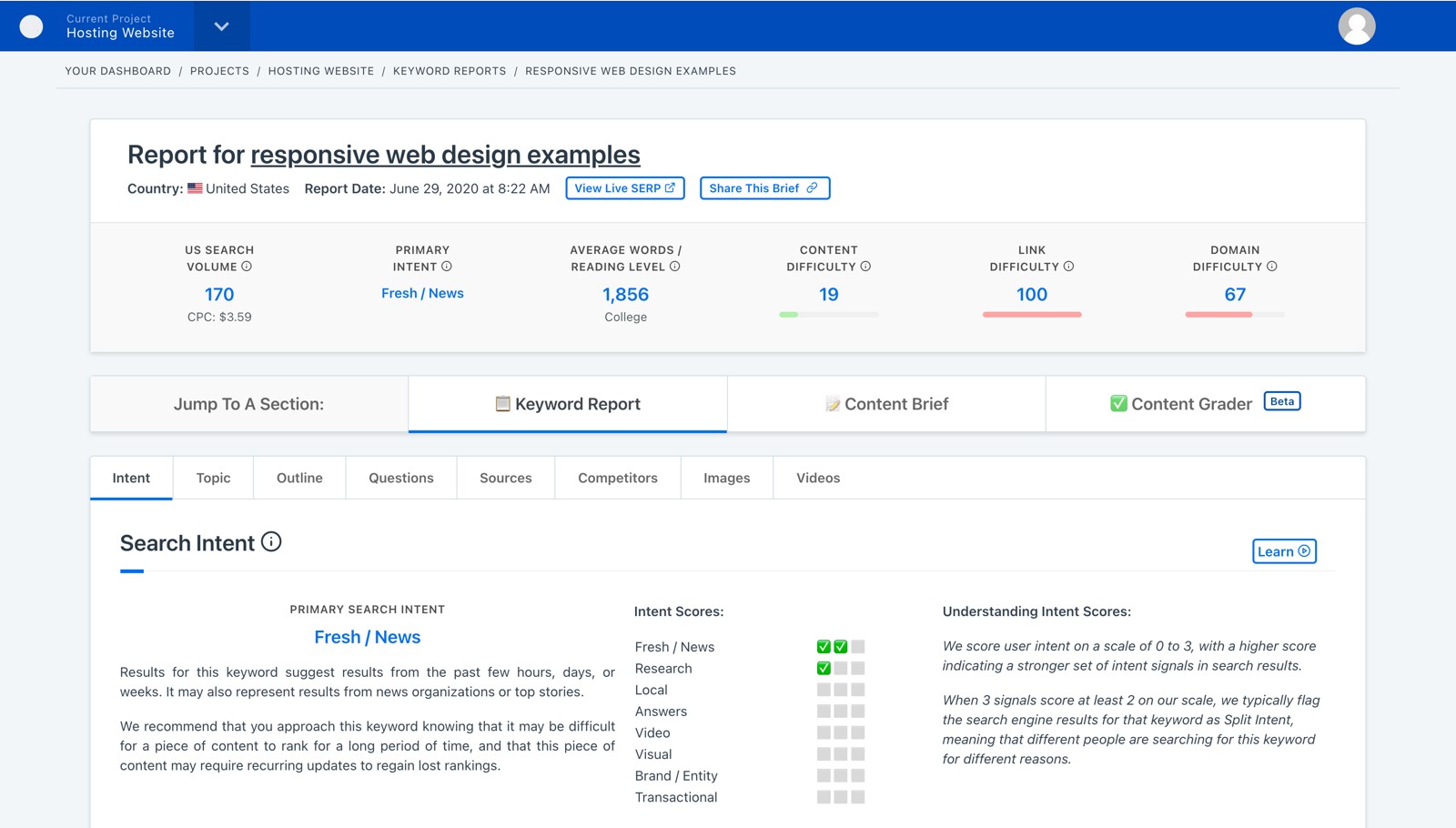
Its category boundary is important. Content Harmony is closer to Clearscope, Frase, Surfer SEO, and MarketMuse than to Ahrefs or Semrush. It analyzes one target topic deeply, helps a strategist convert SERP evidence into instructions, and evaluates draft coverage. It does not replace site crawling, backlink analysis, keyword portfolio discovery, subject-matter expertise, or final editorial approval.
The product grew from an agency briefing process, which explains its strategist-led design. Research is not presented merely as a score beside a writing box. Users review evidence, highlight useful findings, organize a brief, share it with collaborators, and grade a draft against a topic model.
Who Is Content Harmony Best For?
Content Harmony delivers the clearest value when a team produces enough search-led pages to reuse one structured process.
SEO strategists managing recurring content production
Strategists can evaluate intent, ranking-page structures, questions, authoritative references, difficulty signals, and visual expectations in one report. That reduces tab switching while preserving the human decision about which evidence belongs in the final brief.
Content marketing agencies coordinating clients and writers
Unlimited projects let an agency separate clients, while unlimited users remove the pressure to share credentials or reserve seats for only a few people. Custom templates can standardize brand requirements and deliverables across accounts. The caveat is that workflow credits, not users, determine capacity, so agencies should include exploratory and abandoned reports in their volume forecast.
In-house content teams building repeatable standards
A team can encode audience, brand, product, compliance, internal-link, visual, and editorial requirements into reusable brief templates. This is more valuable than a term list when several strategists or freelance writers must produce consistent work.
Freelance writers who also provide strategy
A freelancer who sells research and briefs can use the $10 trial or Standard 5 plan economically. A writer who only receives finished briefs from clients may not need a full subscription, especially because collaborators can access shareable brief and grader links when the owner permits it.
Teams refreshing existing content
The Content Grader can import a published URL or accept pasted copy, then surface unused phrases and coverage gaps. This supports refresh work, but the platform does not by itself diagnose whether traffic changed because of intent, competitors, seasonality, links, technical issues, or AI answer features.
What Are Content Harmony’s Key Features?
Keyword Reports for intent, competitors, questions, and sources
Every workflow starts with a Keyword Report. Current official product pages list Search Intent, Topic Analysis, Competitor Outlines, Questions, Authoritative Sources, Competitor Analysis, Image and Visual Analysis, Videos, and internal-link recommendations among its research modules.
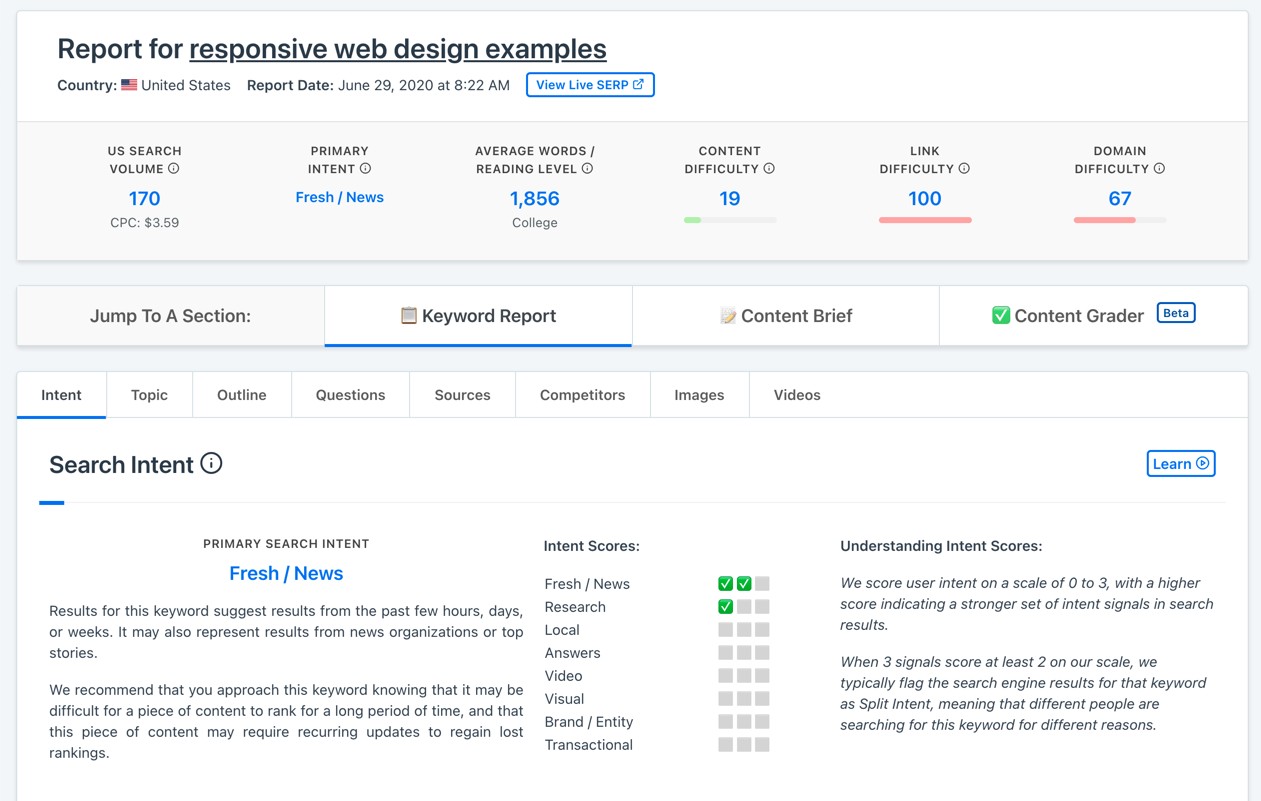
This report is valuable because the elements are connected to briefing. A strategist can highlight useful headings, questions, sources, and other findings instead of copying them manually between tabs. The benefit is faster assembly, not automatic strategy. Users still need to exclude irrelevant result types, resolve mixed intent, and decide what unique evidence the new page will add.
Search intent classification before the brief
Content Harmony expands beyond a single informational, navigational, or transactional label. Its current system evaluates multiple result attributes and surfaces formats such as video, freshness, research, local, answers, visual, brand/entity, and transactional signals.
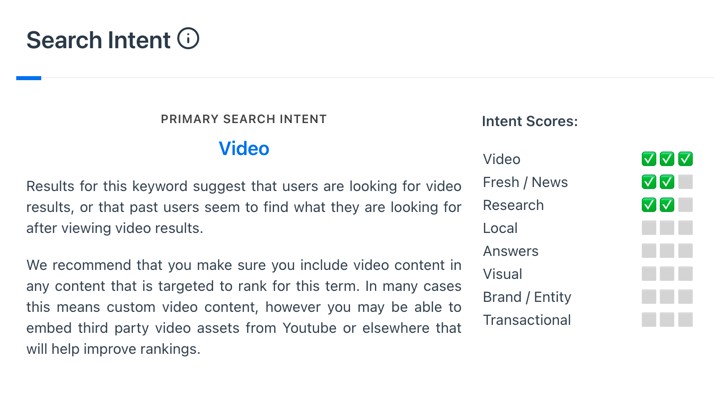
That helps prevent expensive mismatches. If the SERP favors current news, visual demonstrations, product pages, or video, a text-heavy generic article may be the wrong deliverable. Treat intent scores as evidence from the present result set, then validate the dominant job the searcher needs to complete.
Custom Content Brief Builder and reusable templates
The brief builder uses a customizable block editor with text, lists, tables, checklists, comments, notes, and highlighted data from the Keyword Report. Teams can create multiple templates for different clients or content types rather than forcing every page into one generic outline.
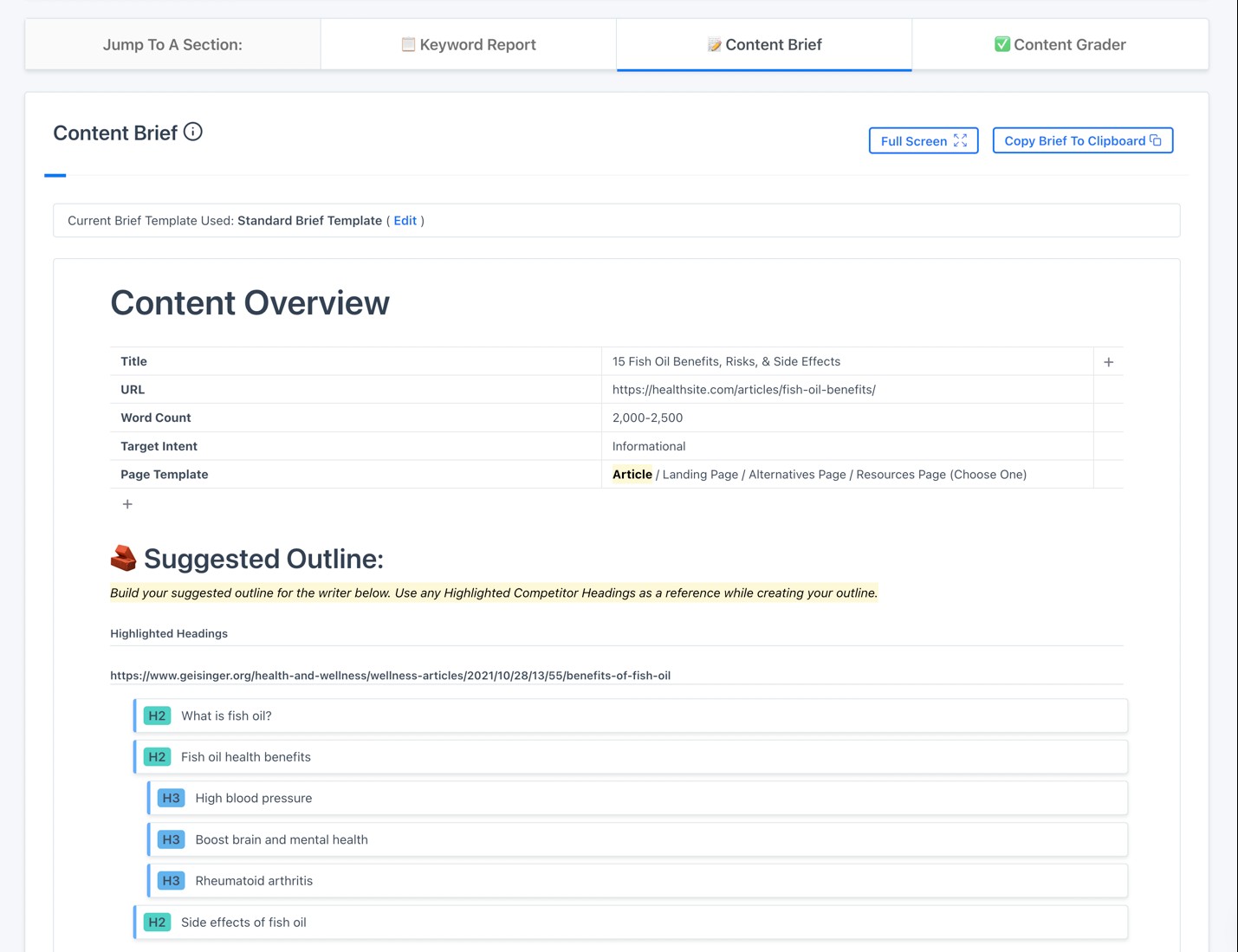
This is the product’s central differentiator. A useful brief can combine SEO evidence with audience context, product positioning, prohibited claims, SME questions, internal links, visual requirements, sources, conversion goals, and acceptance criteria. Writers receive a decision document instead of a keyword export.
Content Grader for topic coverage and refreshes
The Content Grader evaluates how comprehensively a draft covers the target topic. It can work with pasted content or a live URL, show used and unused phrases, and provide weighted topic guidance. Content Harmony explicitly warns that a grade does not measure writing quality, factual accuracy, originality, authority, or the probability of ranking.
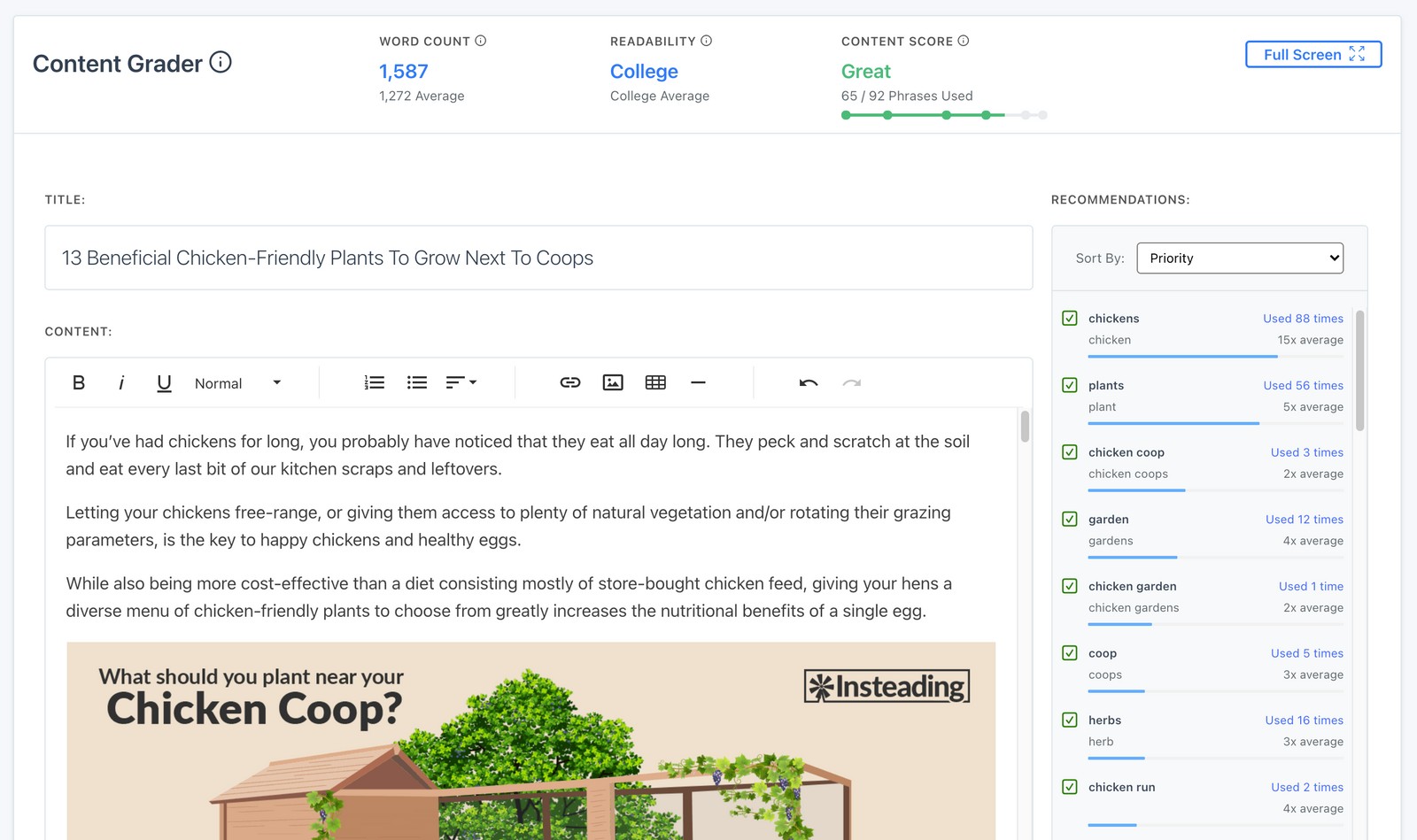
That restraint is useful. The grader is best used to locate omissions and prompt editorial questions, not to make every recommended phrase appear. A term shared by ranking pages may be essential, optional, context-specific, or irrelevant to the angle. Editors should stop when further additions weaken clarity or duplicate existing coverage.
Sharing, unlimited collaboration, and workflow handoffs
Users can share briefs and graders through links and control whether guests receive read-only or editable access. Official examples also show brief exports or copies in Google Docs and Notion. Shareable URLs can be placed inside Trello, Basecamp, Airtable, or other project systems, but a linked handoff should not be confused with a deep native integration.
The 2025 interface relaunch introduced lighter navigation across projects, reports, production workflows, templates, and account tools.
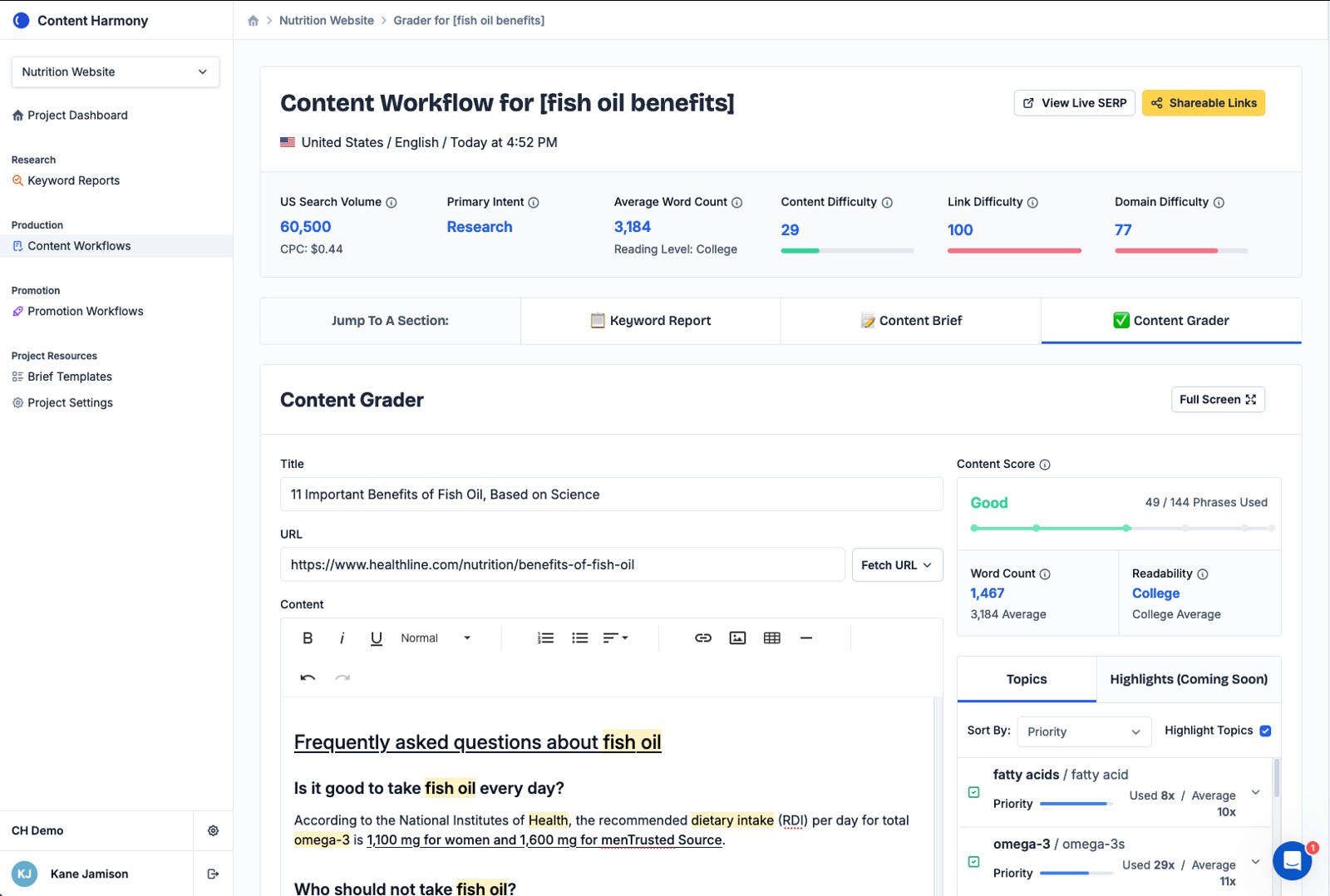
Unlimited users and projects are especially helpful for agencies and distributed teams. Buyers should still test permission boundaries, client isolation, approval rules, and guest access because “unlimited users” does not automatically mean enterprise-grade governance.
API access and newer workflow automation
Content Harmony announced expanded API access covering sections across Keyword Reports, Content Briefs, and Content Graders. Its 2025 updates also added AI Overviews inside reports, an EditorNinja handoff, URL import, a command palette, billing controls, bulk highlighting, and clipboard export for grader phrases.
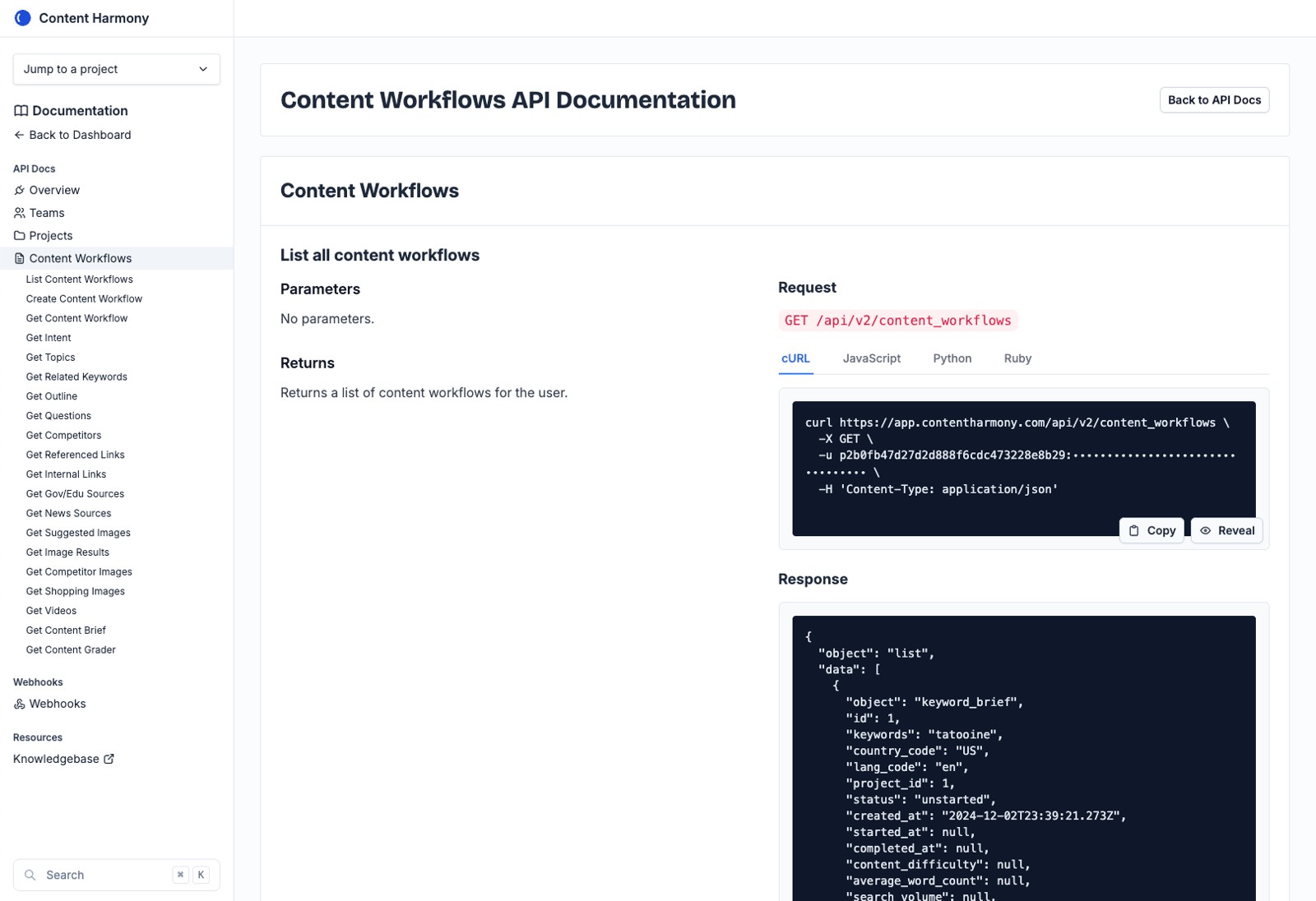
The API can help an engineering-enabled team move data into an internal content system or AI workflow. It is not a plug-and-play promise. Confirm plan access, authentication, endpoints, rate limits, support, and the resources needed to maintain the integration before including API value in the business case.
How Does Content Harmony Work?
A practical Content Harmony workflow has seven steps:
- Create a project and choose the target query. Use a keyword already approved for production rather than consuming credits on unqualified ideas.
- Run the Keyword Report. Select the target country and wait for SERP, topic, question, source, visual, and competitor data.
- Validate intent and competitors. Remove mismatched result types and note whether freshness, video, product, local, or other formats matter.
- Highlight evidence for the brief. Select useful headings, questions, sources, entities, visual ideas, and internal links; do not highlight everything.
- Build the brief from a template. Add audience, angle, product facts, SME inputs, original-data needs, calls to action, and acceptance criteria.
- Share and draft. Give the writer an editable or read-only link, or move the brief into the team’s existing document and project workflow.
- Grade, edit, and publish. Use coverage suggestions selectively, verify every claim, complete the CMS handoff, and measure results in Search Console and analytics.
The wider AI SEO writing and optimization tools hub explains where brief-and-grader platforms fit beside technical SEO, research, drafting, and publishing systems.
What Is Content Harmony Like in Real Use?
This review is based on current product documentation, official interface examples, update notes, pricing, independent buyer feedback, and live-account testing. The visible workflow is deliberately strategist-first: research is reviewed and selected before it becomes a brief, and the brief remains distinct from the grader.
The first source of friction is report judgment. A novice may accept the entire SERP set, highlight every frequent heading, and interpret topic recommendations as mandatory keywords. That creates a longer but less differentiated brief. An experienced strategist will identify the dominant intent, remove outliers, group overlapping ideas, and specify what the page must contribute beyond the current results.
The strongest operational effect is consistency. Templates and unlimited collaborators make it easier to teach a repeatable method and review whether key inputs are present. The potential downside is template complacency: teams can standardize an outdated or generic process just as easily as a strong one. Review templates quarterly and keep page-specific decision fields visible.
The grader requires similar discipline. Independent reviews commonly praise time savings and brief quality, while criticisms focus on narrower optimization or research capabilities than some competitors. Those views fit the product boundary: Content Harmony is strongest as a connected research-to-brief workflow, not as an all-purpose AI writer or enterprise content intelligence suite.
The final handoff still needs process design. Teams must decide where final copy lives, how images and metadata are approved, who publishes, how schema is added, and what triggers a refresh. Content Harmony can improve the brief and draft, but it does not own the full production chain by default.
How Much Does Content Harmony Cost?
Content Harmony prices standard subscriptions by monthly Content Workflow credits, with unlimited users and projects.
| Option | Current price | Workflow allowance | Buyer note |
|---|---|---|---|
| Paid trial | $10 one time | 10 credits | Full access; no time limit; no automatic renewal; trial credits valid for one year |
| Standard 5 | $50/month | 5 per month | About $10 per workflow; shown around $42/month when paid annually |
| Standard 12 | $99/month | 12 per month | About $8.25 per workflow before annual savings |
| Standard 25 | $199/month | 25 per month | About $7.96 per workflow |
| Standard 50 | $299/month | 50 per month | About $5.98 per workflow |
| Standard 100 | $599/month | 100 per month | About $5.99 per workflow |
| Standard 150 | $799/month | 150 per month | About $5.33 per workflow |
| Enterprise | Custom quote | 200+ | Confirm procurement, invoicing, data, and support terms directly |
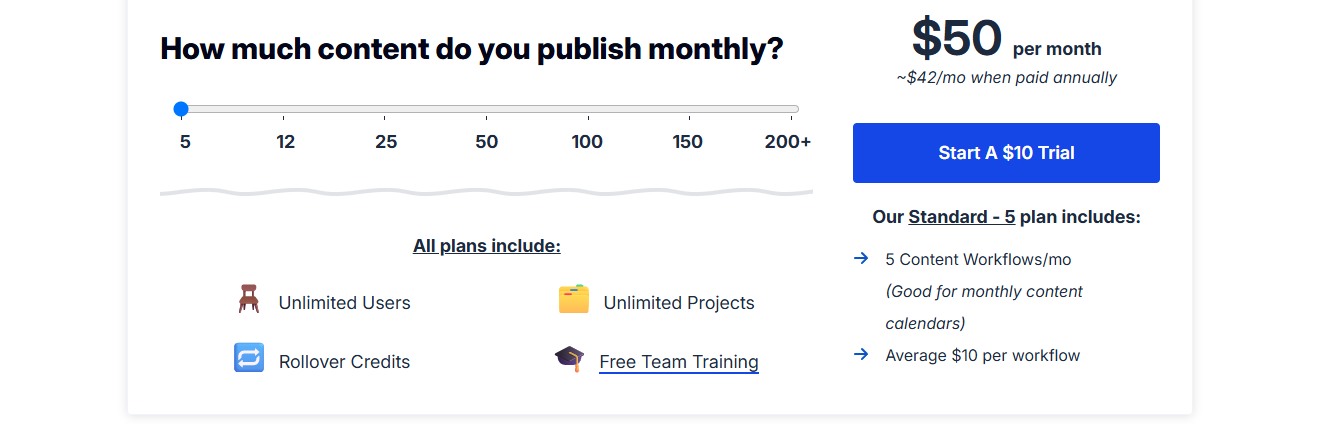
Monthly subscription credits are valid for 90 days rather than expiring immediately at month-end. Completed workflows remain in the account for ongoing brief and grader editing. Annual subscribers receive the year’s credits upfront, and the official pricing page says annual plans include more than one month free. Trial credits are treated differently: the sign-up page says they remain valid for a full year.
The trial is not free, but its terms reduce subscription risk. You pay $10 for 10 workflows, there is no time limit or automatic billing, and you upgrade only when ready. Test Content Harmony with ten representative assignments, including one new brief, one refresh, and one mixed-intent query.
The terms updated July 14, 2025 do not publish a broad refund promise. They say offerings and prices may change, purchases may be refused or canceled in specified circumstances, and users may terminate by discontinuing use. Before an annual or enterprise purchase, ask Content Harmony to document renewal, cancellation, unused-credit, refund, data-export, and service-level terms in writing.
For current promotions, use our Content Harmony coupon and trial verification rather than relying on third-party code directories.
What Are the Pros and Cons of Content Harmony?
Content Harmony's trade-offs center on workflow consistency versus credit limits and platform scope.
| Pros | Cons |
|---|---|
| Connects research, briefs, and grading in one workflow | Does not replace broad keyword research or technical SEO tools |
| $10 trial provides 10 real workflow credits | Recurring value depends on using monthly credits consistently |
| Unlimited users and projects on standard plans | Credit-based pricing can penalize exploratory or abandoned reports |
| Custom templates standardize agency and in-house handoffs | SERP-derived briefs can encourage look-alike content |
| Rich intent, question, source, competitor, and visual research | Grading measures coverage, not quality, accuracy, or ranking probability |
| Shareable briefs and graders support external writers | Native CMS publishing and complete content operations are not the core product |
| API and newer updates expand automation options | Advanced teams must validate API access, permissions, and governance |
What Are the Best Content Harmony Alternatives?
The best alternative depends on which capability you value more than Content Harmony’s brief workflow.
| Alternative | Better fit when... | Trade-off to verify |
|---|---|---|
| Clearscope | Writers need a polished optimization editor, strong term discovery, and a premium editorial experience | Higher entry cost, report limits, and whether brief depth matches your process |
| Frase | A lower-cost AI-assisted research, brief, and drafting workflow matters | Usage limits, add-ons, and how much strategist control remains |
| Surfer SEO | You want a larger content optimization ecosystem and writing integrations | Credit rules, feature breadth, and total subscription cost |
| MarketMuse | Portfolio planning, inventory analysis, topical authority, and personalized difficulty matter | Learning curve, implementation effort, and enterprise pricing |
| Keyword Insights | Clustering, content planning, and brief creation need to start from larger keyword sets | Optimization depth, workflow credits, and collaboration model |
Content Harmony is the brief-standardization choice in this group. Clearscope and Surfer emphasize polished optimization ecosystems, Frase leans further into AI-assisted production, MarketMuse adds strategic inventory intelligence, and Keyword Insights starts earlier with clustering and planning. Our Content Harmony alternatives comparison evaluates the close options by briefing, scoring, collaboration, and price fit.
Where Does Content Harmony Fall Short?
The platform begins after topic selection. It can deeply analyze a target query, but teams still need a process for market research, keyword discovery, opportunity prioritization, and deciding what not to create.
Workflow credits require discipline. Standard 5 is affordable at $50, yet five reports can disappear quickly when teams test keyword variants, refreshes, mixed intents, or ideas that never reach production. Forecast attempted reports rather than published pages alone.
SERP evidence can produce sameness. Competitor outlines, common topics, questions, and target coverage establish a baseline. They do not supply first-hand experience, proprietary data, customer interviews, expert opinions, or a distinct point of view.
A grader is not a quality oracle. Content Harmony itself explains that its score measures topic coverage. It cannot prove that the writing is accurate, persuasive, useful, original, compliant, or likely to rank.
The production chain remains incomplete. Shareable links, exports, API access, and selected partner integrations help with handoffs, but buyers expecting built-in calendars, approvals, CMS publishing, technical audits, rank tracking, or AI visibility monitoring may need additional systems.
Public product images span several interface generations. The 2025 UI update shows active product development, but some official feature pages still use older examples. Verify any must-have screen or behavior during the paid trial instead of assuming every illustration matches the present account.
Which Content Harmony Attributes Should Buyers Check?
Before subscribing, evaluate the product against your actual operation:
- Attempted workflows per month: Count new briefs, refreshes, variants, and reports that may be abandoned.
- Research responsibility: Identify who validates intent, competitor relevance, and information-gain requirements.
- Template maturity: Confirm the brief includes audience, conversion, SME, sourcing, visual, internal-link, brand, and compliance fields.
- Writer handoff: Test guest links, editing permissions, comments, exports, and where final copy will live.
- Optimization policy: Define when a grader suggestion is optional, irrelevant, or harmful to clarity.
- Country and language coverage: Confirm the exact market and language needed for every client before buying credits.
- API and integration requirements: Separate native integrations, link-based handoffs, exports, and custom API work.
- Governance: Validate client separation, user access, approval history, data retention, and procurement needs.
- Commercial terms: Get annual pricing, renewals, cancellations, refunds, credit expiry, and enterprise commitments in writing.
- Success measures: Track research time, brief-editing time, writer questions, revision rounds, on-time approvals, and organic outcomes, not the content score alone.
Is Content Harmony Worth It?
Content Harmony is worth considering when a consistent brief saves more labor and rework than the credit costs. The $50 Standard 5 plan is accessible for a small professional team, while unlimited users and projects make the economics attractive for agencies that collaborate widely but produce a controlled number of briefs.
It is harder to justify for occasional publishers, teams that already have a mature manual brief system, or buyers seeking one all-in-one SEO and AI writing platform. Its real value is operational: turning scattered research into repeatable instructions and giving writers and editors a shared coverage framework.
The safest decision is to use the $10 trial on representative work. Measure how long research takes, how much the template needs editing, whether writers ask fewer questions, and whether the grader finds meaningful omissions. If those gains repeat, start a Content Harmony subscription. If they do not, compare the closer alternatives before changing your production process.
How We Test and Score
ScaleWitAI funds every account used in this review with its own capital. We subscribe to all paid tiers with self-funded plans and never use sponsored, gifted, or vendor-provisioned accounts, so our evaluation reflects the same product a paying customer receives and stays 100% independent of vendor influence.
Evaluation combines standardized test suites with hands-on workflow testing. We use HumanEval-style tasks to probe logic and code reasoning, BLEU/ROUGE-style metrics to measure natural-language quality, and internal stress-test scenarios to map context-window limits and long-input behavior. We run more than 10,000 prompts per AI platform every year, across varied access conditions, and log results against a transparent scoring rubric.
The dataset for this review was collected over 12 months (from August 2025 to August 2026). Historical comparisons track AI model development since 2024, and this report tests and compares 12+ leading AI models and providers on the market.
FAQ
Is Content Harmony free?
No. Content Harmony offers a paid trial: $10 for 10 Content Workflow credits. The official sign-up page says the trial has no time limit or automatic renewal, and those credits remain valid for one year.
How much does Content Harmony cost?
Standard plans currently start at $50 per month for five workflows. The public slider also shows $99 for 12, $199 for 25, and $299 for 50 workflows per month. Annual pricing provides more than one month free, while enterprise pricing requires confirmation.
What is included in a Content Workflow?
One Content Workflow includes a Keyword Report, customizable Content Brief, and Content Grader for one target page or query. Completed workflows remain available for continued brief and grader editing.
Do Content Harmony credits expire?
Monthly subscription credits are valid for 90 days. Annual subscribers receive the year’s credits upfront to use during the annual period. The separate $10 trial credits are valid for one year according to the official sign-up page.
Can Content Harmony replace Semrush or Ahrefs?
No. Content Harmony focuses on deep research, briefs, and content grading for an approved topic. It does not replace a broad keyword database, backlink analysis, technical audits, rank tracking, or complete competitive intelligence.
Does Content Harmony write articles with AI?
Content Harmony has AI-assisted suggestions and workflow features, but its core product is not an autonomous long-form writer. Teams still need human research, drafting, fact-checking, subject expertise, brand editing, and publishing.
Is Content Harmony good for agencies?
Yes, when agencies need standardized briefs across multiple clients and writers. Unlimited users and projects help collaboration, but agencies should calculate attempted workflows, test permissions, and confirm enterprise governance requirements.
Does Content Harmony publish directly to WordPress?
Native WordPress publishing is not presented as the core workflow on the current public product pages. Teams can share or export briefs and use API-based automation, but should verify the exact CMS handoff and formatting requirements during the trial.
