Our verdict: Agility Writer is a strong fit for SEO teams that need structured long-form drafts, topical planning, research controls, and batch production in one credit-based platform. Its main value is workflow consolidation, not push-button rankings. You still need an editor to verify facts, add genuine experience, protect brand voice, and decide whether each page deserves to exist.
| At a glance | Details |
|---|---|
| Product | Agility Writer, an AI-assisted SEO content production platform |
| Best for | SEO agencies, affiliate publishers, in-house content teams, and programmatic operators with editorial controls |
| Starting monthly price | $28 per month for Basic, before any optional promotion, as listed August 1, 2026 |
| Trial | $1 one-time trial; official pages say it provides 5 credits and enough capacity for about 1 to 2 long-form articles |
| Core workflow | Topical maps, SERP-informed outlines, long-form drafting, factual research, citations, optimization, bulk generation, and publishing integrations |
| API access | Official pricing lists API access on Pro, Premium, and yearly plans; official API copy is inconsistent about the tier name, so confirm in checkout |
| Key caution | Vendor quality, ranking, Helpful Content, and AI-detection statements are not guarantees |
| Editorial rating | 4.2/5 |
The buying decision comes down to governance. If your team already has briefs, source standards, editors, and a measured publishing process, Agility Writer can remove repetitive setup work. If you expect a machine to research, write, fact-check, optimize, and publish without accountable human review, the same scale features can multiply weak claims and thin pages just as quickly.
Quick Verdict: Should You Use Agility Writer?
Use Agility Writer if long-form SEO production is a recurring operational problem and you can assign human ownership to research approval, editing, and post-publication measurement. Its combination of Advanced and Optimize modes, Fact Sheets, Topical Map Helper, G-Smart Optimizer, Bulk Mode, WordPress, Zapier, and API options addresses more of the content lifecycle than a basic prompt interface.
Skip it if you publish only a few short articles, need a pure optimization editor rather than a drafting system, or lack the time to inspect sources and outputs. Also pause if API access is central to your purchase: the public pricing page and API page use conflicting plan labels, so obtain written confirmation of eligibility before building around it.
| Choose Agility Writer when | Consider another route when |
|---|---|
| You produce long-form content every month | Your volume is too low to justify a dedicated workflow |
| You want one system for maps, drafts, research, and bulk jobs | You mainly need content scoring for human-written drafts |
| You can review every source-sensitive claim | You want unattended publishing with no editorial gate |
| Credit rollover improves your planning | You prefer unlimited or word-based billing |
| Your developers can validate API access and behavior | You need a mature, fully documented public API before purchase |
If that profile matches your team, you can review Agility Writer as a possible paid workflow. This is a buyer CTA, not evidence that the route or offer has been verified.
What Is Agility Writer?
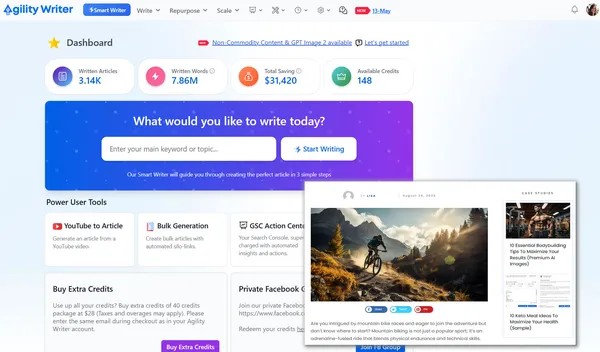
Agility Writer is an AI-assisted SEO writing and content operations platform from ADE Marketing. The vendor positions it around long-form articles built from live SERP research, with tools for planning topical clusters, creating outlines, generating drafts, attaching custom knowledge, adding citations, auditing content, and moving finished work into publishing systems.
Agility Writer sits between content strategy, research automation, drafting, and publishing. That breadth can reduce handoffs, but it also expands the quality-control surface across sources, prose, links, schema, and publishing settings.
We classify it as a production system for repeatable SEO workflows. It can accelerate research and drafting, but it cannot supply real customer experience, regulated expertise, product testing, or editorial accountability. Those remain human responsibilities.
Who Is Agility Writer Best For?
SEO agencies managing repeatable client workflows
Agencies can benefit when they need consistent briefs, source rules, tone settings, and delivery formats across many accounts. Fact Sheets can centralize approved brand and product details, while project settings and reusable writing controls can reduce repeated setup. Bulk jobs and publishing integrations may improve throughput once the agency has a reliable review queue.
The fit is weaker for agencies that promise bespoke thought leadership but rely mostly on generated summaries. Clients paying for expertise need original interviews, internal data, practitioner observations, and accountable authorship. Agility Writer can support that work, but it cannot manufacture authentic experience.
Affiliate publishers producing research-heavy pages
Affiliate operators can use the review and roundup templates, factual research settings, citations, comparison structures, and reusable product Fact Sheets. These capabilities can help maintain consistency across a cluster of reviews and comparisons. Our Agility Writer Power-Up workflow guide is the more relevant next step when you need section-level instructions and custom knowledge rather than another product overview.
The risk is commercial bias. A generated review can sound confident even when no one tested the product. Publishers should clearly separate documented facts, vendor claims, editorial analysis, and actual hands-on evidence.
In-house SEO and content teams
In-house teams may get value from connecting product knowledge, existing page refreshes, Google Search Console opportunities, WordPress, and content calendars. A controlled Fact Sheet library can reduce price or feature drift across pages. G-Smart can create a structured review step for older content, although its suggestions should be treated as prompts for editorial judgment, not instructions from Google.
Programmatic SEO operators with safeguards
Bulk Advanced and API workflows are relevant to operators building location pages, directories, integration pages, or large informational clusters. The system supports CSV inputs, job-based generation, internal silo links, and custom routing options. But programmatic output needs stronger controls than one-off content: page-level value tests, duplicate detection, factual validators, templates with real differentiation, and staged publishing.
If programmatic production is your main use case, see our guide to using Agility Writer for programmatic workflows. The unusual slug spelling is intentional and preserved.
Who should not buy it
Do not buy Agility Writer solely to avoid writers, guarantee rankings, or bypass detection software. It is also a poor fit when your content depends on firsthand laboratory work, regulated advice, confidential internal data that cannot enter a third-party system, or highly distinctive executive voice without substantial editing.
Core Writing Modes and Features
1-Click, Smart Writer, and Advanced Mode
1-Click is the speed-oriented path. The current official pricing table assigns it one credit and a 3,000-word ceiling. It is suited to lower-risk, straightforward topics where a standard structure is acceptable. Speed is the benefit, but reduced setup can also mean fewer chances to constrain claims or shape the outline.
Smart Writer is positioned as a guided option with many settings handled automatically. It may suit users who find the full control panel overwhelming. Advanced Mode is the better fit for custom outlines, per-section controls, factual-data choices, longer articles, audience settings, tone, point of view, and custom knowledge. Official feature pages list a ceiling of up to 7,000 words for Advanced Mode and two base credits per article, although premium models can consume more credits.
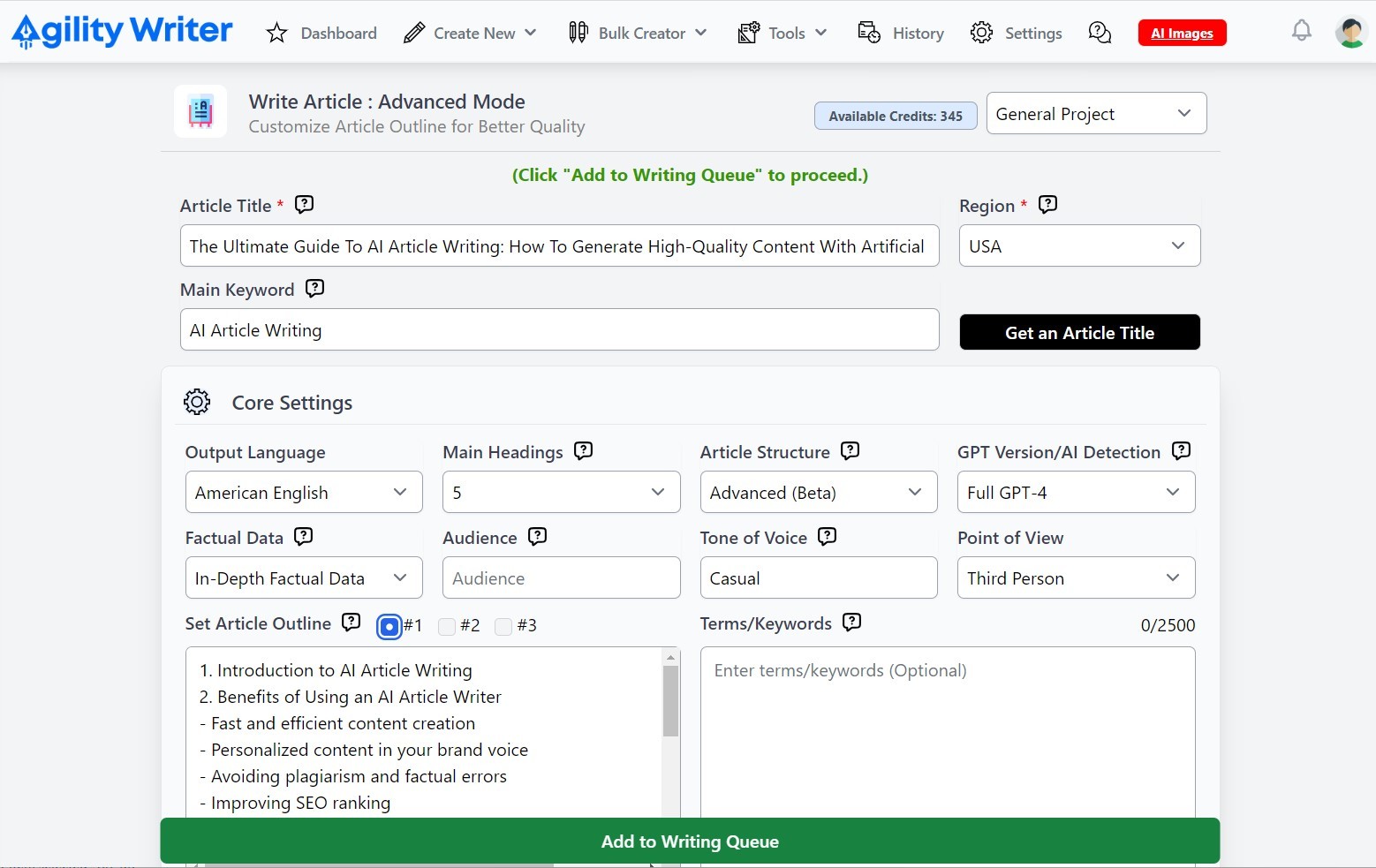
Our editorial rule is simple: use the lightest mode that still gives the page the controls it needs. A low-risk glossary page does not require the same process as a financial comparison, software review, or statistics-heavy pillar.
Optimize Mode
Optimize Mode is designed for SERP-aligned drafting and current official pricing assigns it three credits with a 5,000-word ceiling. It combines outline and keyword considerations with research inputs. That may reduce the need to move between a writer and a separate optimization interface.
However, SERP alignment can become imitation if every page follows the same competitors. A useful editor should ask what the existing results omit, what evidence your organization can contribute, and whether the query needs another page at all. Optimize Mode can help frame coverage; it cannot decide your unique contribution.
Review, roundup, rewrite, and video workflows
Single Product Review and Product Roundup templates provide commercial structures such as use cases, comparisons, pros, cons, and CTAs. Rewrite and YouTube-to-Article modes cover repurposing. These can save formatting time, but they do not grant permission to reuse third-party material or turn a source into original reporting. Teams must still respect copyright, quotations, attribution, and platform terms.
How the Topical Map Helper Fits Content Planning
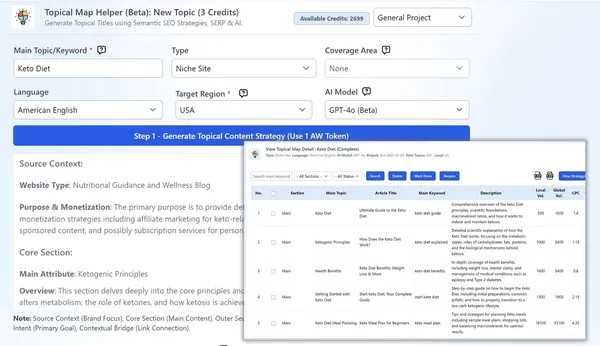
The Topical Map Helper starts with a seed topic, site type, language, region, and central entity. According to the official feature page, it produces core and supporting topics, entity hints, search intent tags, supplementary questions, and a starter internal-link blueprint. Users can export a map to CSV or move items into Advanced or Bulk Mode.
This is useful at the planning stage because it turns an unstructured keyword list into a reviewable architecture. Agencies can use it to define hubs and spokes, affiliate teams can map review and comparison intent, and local operators can organize service and location coverage. The handoff into bulk generation reduces repeated data entry.
The vendor itself states that no tool builds a 100 percent perfect topical map. We agree. Before approving a map, check at least five things:
- Entity scope: Is the central entity correct, or has the system mixed adjacent markets?
- Intent separation: Do two proposed pages answer the same query and risk cannibalization?
- Business relevance: Does each page serve a real audience need connected to the site?
- Evidence capacity: Can your team produce trustworthy information for every proposed topic?
- Link logic: Do internal links help readers move between parent, supporting, and decision pages?
Search volume and CPC can help prioritize, but they should not be the sole reason to publish. Low-volume supporting topics may add useful context, while high-volume topics may be poor choices if the site lacks expertise.
There is also an official-public inconsistency to verify before purchase. The Topical Map FAQ says each map costs three credits and is not part of the trial, while CTA copy on the same page says the $1 trial has full Topical Map access. We would not promise trial availability until the checkout or support team confirms the current rule.
G-Smart Optimizer and Helpful Content Alignment
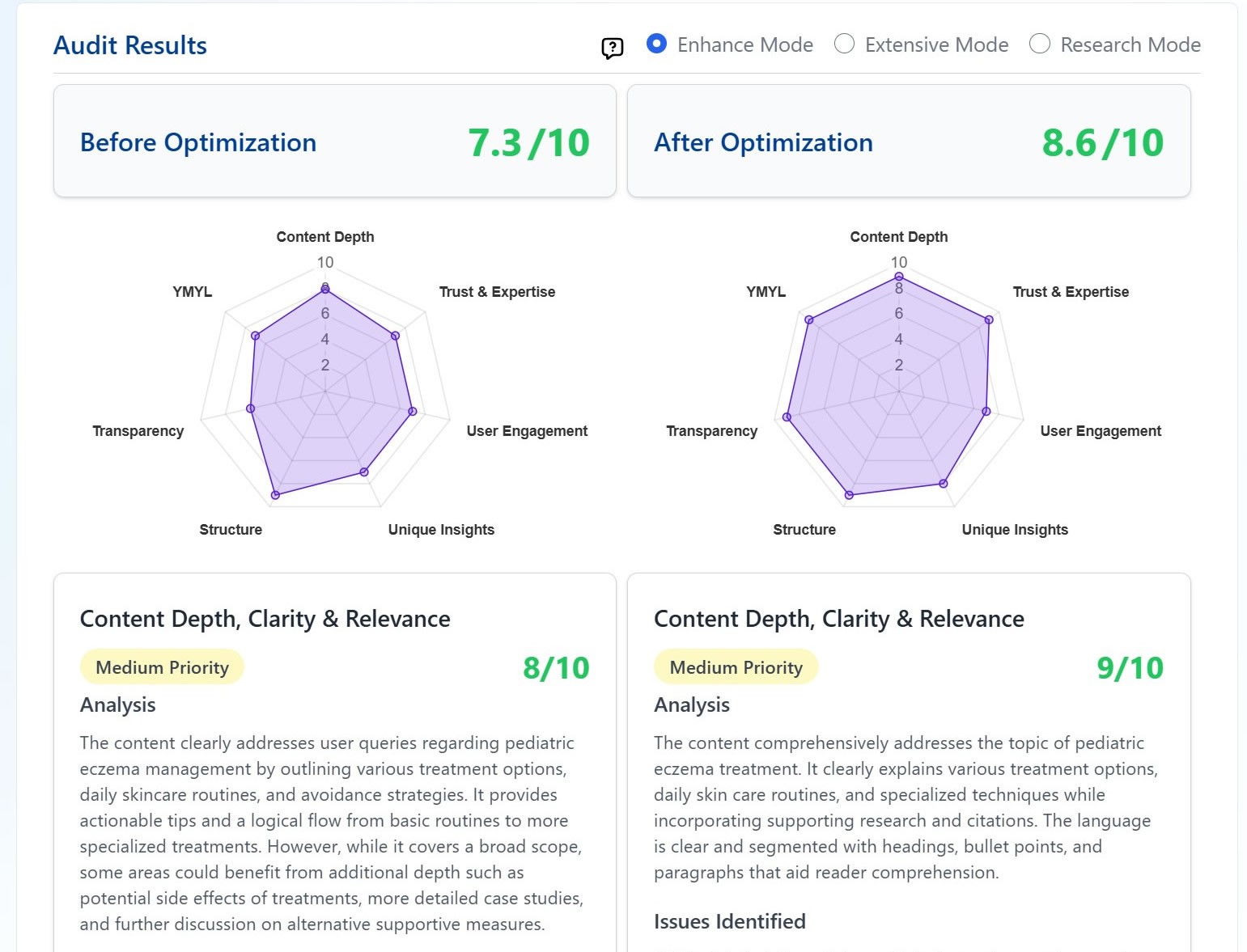
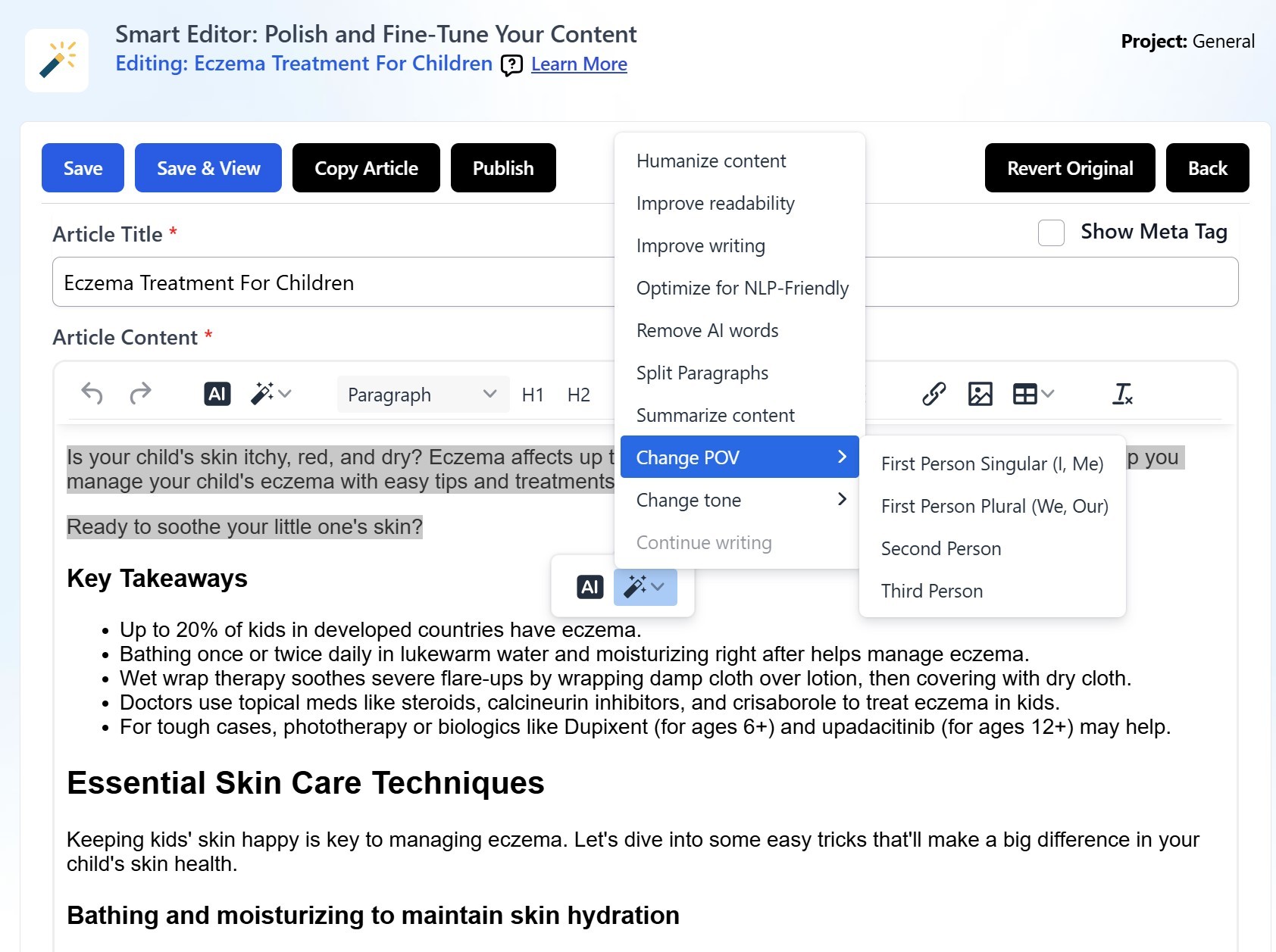
G-Smart Optimizer audits a draft against checks that Agility Writer says are mapped to Google’s Search Quality Rater Guidelines and helpful-content guidance. The product offers Enhance, Extensive, and Research modes. Enhance aims to preserve voice while making smaller clarity changes. Extensive performs deeper rewriting and may alter tone or keyword density. Research can add new sections, facts, references, and citations.
This can be valuable as an editorial checklist. A side-by-side revision view and rollback option make changes easier to inspect than an opaque one-click replacement. Project-level auto-audit settings may also help teams standardize a minimum review step.
But the phrase “aligned with Google’s guidance” needs careful interpretation. Google states that quality-rater guidelines help raters evaluate search systems and are not a guide to ranking first. Google also says its automated ranking systems use many factors, that E-E-A-T is not one specific ranking factor, and that generative AI can be useful when it adds value. Large-scale generation without added value may violate the scaled content abuse policy.
Therefore, G-Smart cannot verify Google compliance, certify Helpful Content performance, recover traffic on command, or guarantee rankings. It is a vendor-built interpretation of public guidance. Use its score to prompt editorial questions about purpose, evidence, originality, authorship, focus, and whether a qualified editor would approve the page without seeing an SEO score.
The official help article dated February 28, 2026 also labels G-Smart as beta and notes limitations. Research Mode may significantly increase length or change focus, Extensive may change tone and keyword density, and the help page says an article can be optimized only once because of API costs. These constraints reinforce the need to preserve versions and review changes rather than automatically replacing a strong draft.
AI Detection Claims Need Strong Caveats
Agility Writer markets an Anti-AI Detection writing style and discusses lower flag rates from tools such as Originality.ai and GPTZero. An older official help page, updated September 19, 2024, reports an internal test of 30 English articles and says scores varied widely. It also says the approach did not handle Originality.ai 3.0 and that quality and readability may differ.
We do not treat those vendor tests as an independent benchmark. Detector versions change, prompts and topics affect results, and false positives are well documented as a practical concern. A score from one detector does not establish authorship, originality, accuracy, or search quality. It can also change after minor edits or a detector update.
More importantly, Google does not require content to pass a third-party AI detector. Google’s current generative-AI guidance focuses on accuracy, quality, relevance, added value, Search Essentials, and spam policies. Using automation primarily to manipulate rankings can violate policy, while responsible AI assistance is not automatically disallowed.
For buyers, the practical rule is to use any anti-detection style only as a writing-style experiment, never as a guaranteed bypass mechanism. Do not promise clients a particular detector score. Do not publish low-value pages because a detector labels them human. Evaluate clarity, originality, evidence, usefulness, and brand fit instead.
Factuality, Citations, and Custom Knowledge Workflow
Agility Writer offers Standard Factual Data, custom source URLs, In-Depth Research, and an In-Depth Research plus Cite option in documented workflows. Fact Sheets can store reusable research about brands, products, or services, either through AI research with citations or manual input. Per-section Power-Up controls and Custom Knowledge can further constrain what the draft uses.
These are meaningful controls, but “research-backed” does not mean automatically correct. A crawler can select an outdated page, misunderstand a table, cite a source that does not support the sentence, or repeat a vendor claim as fact. Citation presence is not citation quality.
A defensible workflow looks like this:
- Define source priority before generation. Put first-party product documentation, government data, standards bodies, peer-reviewed work, or named experts above generic summaries.
- Create a dated Fact Sheet. Record pricing, plan limits, feature availability, terminology, and source URLs with a last-checked date.
- Use custom sources for high-risk claims. Do not let general SERP selection determine medical, financial, legal, safety, or contractual facts.
- Generate citations where useful. Require links for prices, statistics, technical constraints, and attributed claims.
- Open every cited source. Verify the source says what the draft claims, applies to the same market and date, and is not circular reporting.
- Separate claim types. Label vendor claims, customer anecdotes, measured test results, and editorial judgments differently.
- Run a stale-data check. Recheck pricing, trial terms, models, integrations, and policies immediately before publication.
- Assign accountable approval. A named editor should own the final page and its refresh schedule.
Fact Sheets are especially useful for comparison clusters because one approved record can reduce contradictions across several pages. The downside is synchronized error: one wrong Fact Sheet can spread the same mistake everywhere. Versioning and scheduled review are essential.
Bulk, API, and Programmatic Use
Bulk Advanced accepts titles, keywords, URLs or YouTube sources, CSV files, and location lists. Official documentation says it can queue up to 200 articles, while Bulk 1-Click supports up to 50 per batch. It can add silo links for supported input paths, use factual research and citations, enrich entities, and pass completed work into WordPress. URL or YouTube rewriting does not support silo links on the documented path.
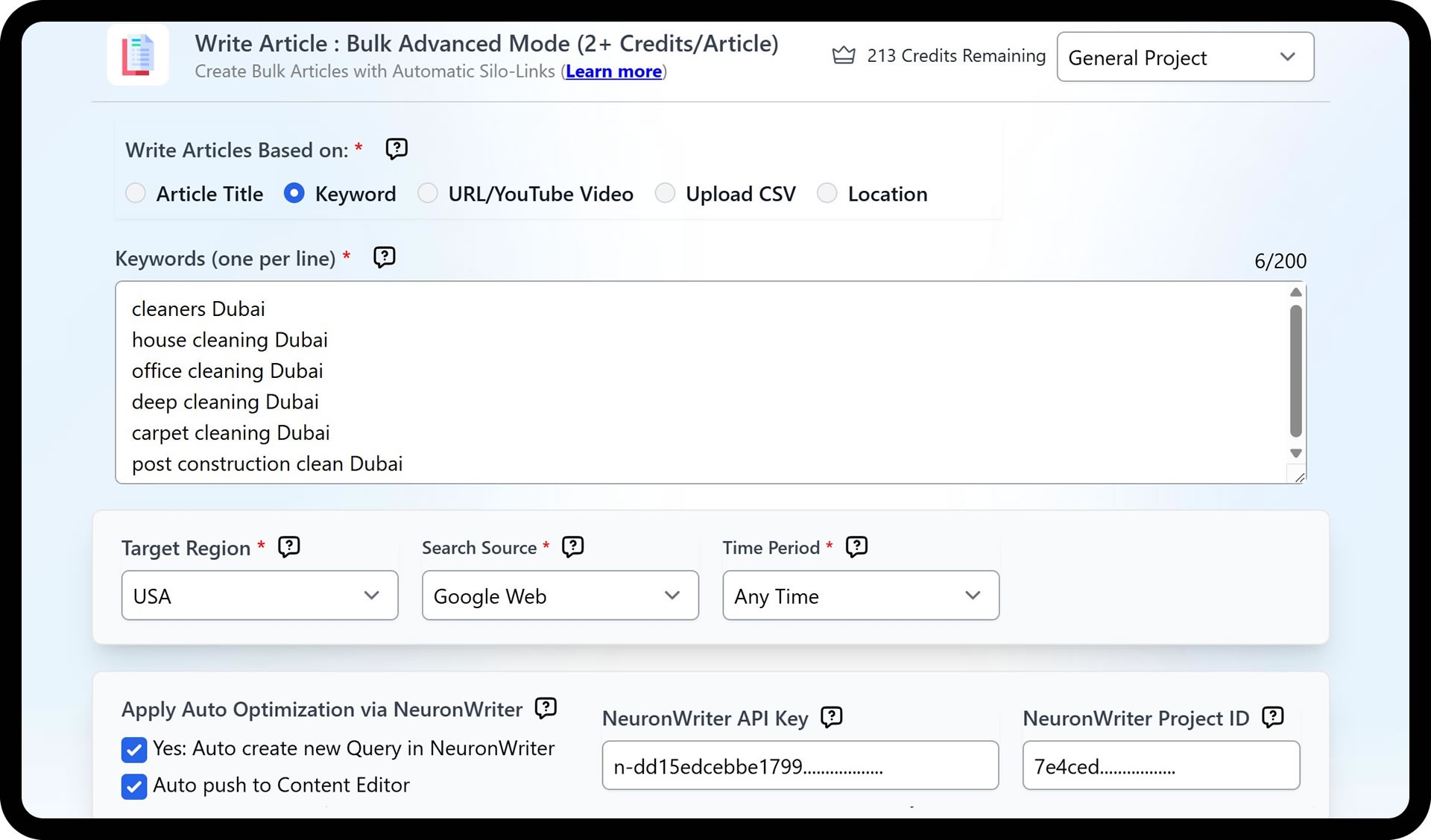
The CSV workflow can include custom outlines, keywords, and NeuronWriter Query IDs. This is useful for controlled clusters because each row can carry page-specific instructions instead of applying one generic prompt to every URL. Still, “up to 200” is capacity, not a recommendation to publish 200 pages at once.
The REST API is presented as an asynchronous job workflow: create a job, track status, fetch the article, and route it onward. Zapier serves no-code routing, while the WordPress integration supports direct scheduling and publishing.
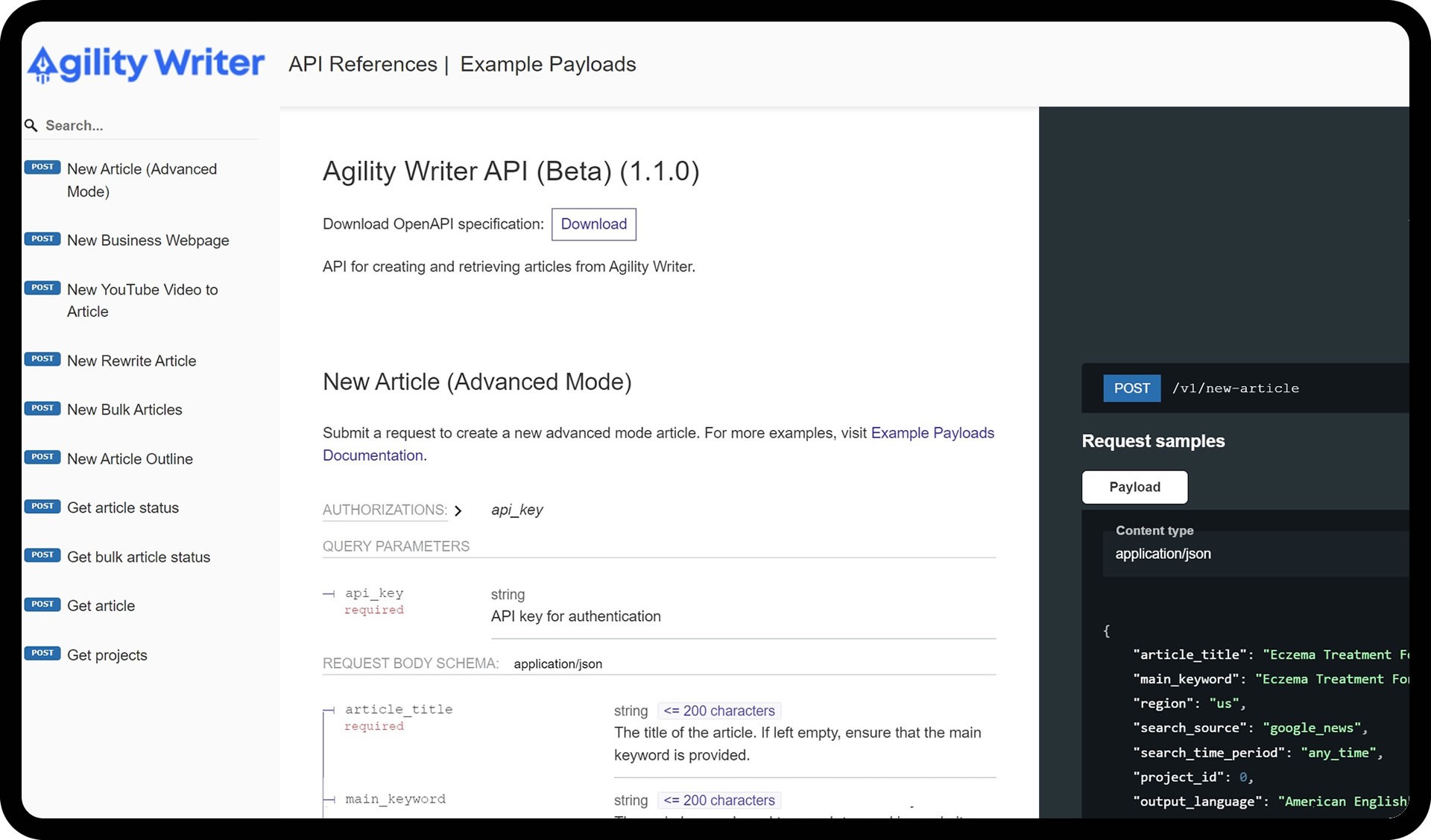
Plan access requires confirmation. The pricing page retrieved August 1, 2026 says Pro, Premium, and all yearly plans include API access. The API page says “Standard plans and above,” even though the public pricing table does not list a current Standard monthly tier, and one trial CTA suggests API trial access. Because those public statements conflict, buyers should ask support to confirm the exact plan, trial access, rate limits, endpoint coverage, webhook behavior, concurrency, and credit accounting.
A safe programmatic architecture needs a validated keyword and URL manifest, unique-value requirements, source allowlists, duplicate checks, prohibited-claim rules, link and schema validation, human review, staged publishing, monitoring, and rollback procedures.
Automation should stop when a source fails, a required fact is missing, or a page has no distinct value. A successful API response only proves that a job completed, not that the page is fit to publish.
A Controlled Evaluation Plan Before You Scale
We recommend evaluating Agility Writer with a small, documented sample rather than a demo or detector score.
Build a representative test set
Choose six to ten pages that reflect your actual workload: one low-risk informational article, one technical guide, one commercial comparison, one product review, one refresh of an existing page, and one small batch with related intent. Exclude YMYL content from the first trial unless a qualified subject-matter expert will review it.
Establish a baseline
Have your current process produce comparable briefs or drafts. Record human research time, drafting time, editing time, total cost, citation defects, factual corrections, and number of revision rounds. Avoid using rankings as the only trial metric because new pages need time and search outcomes have many confounding variables.
Define acceptance gates
A draft passes only when it meets prewritten criteria for source quality, factual accuracy, intent match, originality of analysis, brand voice, internal links, formatting, and legal or compliance review. Use the same rubric for Agility Writer and your baseline.
Run modes deliberately
Use 1-Click on a low-risk page, Advanced on the technical or pillar page, Optimize on a competitive query, and Bulk Advanced on a three-to-five-page cluster. Test Fact Sheets by using one approved product record across a review and comparison. Test G-Smart on a copy of a draft and compare each change before accepting it.
Measure editorial economics
The meaningful ROI calculation is not subscription price divided by the vendor’s maximum article count. Use:
Effective cost per approved page = subscription and credit cost + research labor + editing labor + QA labor + rework cost, divided by pages that pass.
Also track defect escape rate after publication. A cheap draft that requires extensive repair or causes corrections is not inexpensive.
Set a scale decision
Scale only if the test reduces cost or cycle time without lowering acceptance rates. Keep the first production batch small, audit every page, and increase volume gradually. If quality drops as volume rises, tighten templates, source controls, or batch size before adding more credits.
Current Pricing and Trial
The official pricing page was checked on August 1, 2026. We are reporting list prices and excluding the coupon shown on Agility Writer’s site because this review does not validate or authorize that offer.
| Plan | Official public list price | Included credits | Public positioning |
|---|---|---|---|
| Trial | $1 one time | 5 credits stated on the homepage and pricing CTA | About 1 to 2 long-form articles; trial feature scope has conflicting public copy |
| Basic | $28 per month | 40 per month | Solo bloggers and small teams; no API according to the pricing page |
| Pro | $98 per month | 150 per month | Agencies and consultants; API and Zapier listed |
| Premium | $228 per month | 380 per month | High-volume and programmatic teams; API and Zapier listed |
| Yearly Starter | $240 per year | 300 per year | Annual entry plan; API and Zapier listed |
| Yearly Growth | $980 per year | 1,400 per year | Agency-oriented annual plan |
| Yearly Scale | $2,480 per year | 3,700 per year | Highest listed annual capacity |
Unused credits are described as rolling over while a qualifying subscription remains active. Credit use varies by mode: the current table lists one credit for 1-Click, two for Advanced, three for Optimize, two for Product Review, three for Roundup Review, and two for YouTube-to-Article. Premium models and some options may consume extra credits. Taxes and overages may apply.
The trial is not presented as free. Official public copy calls it a $1 one-time trial, generally says five credits, and estimates one to two long-form articles. Yet feature eligibility is not perfectly consistent across public pages. Confirm what is included at checkout, whether payment details are required, how cancellation works, and which integrations are enabled.
For ongoing promotion research rather than review claims, use our Agility Writer coupon and deal verification page. We do not reproduce a code here, promise savings, or treat an unverified promotion as part of the product’s value.
If the list-price economics fit your pilot, you can consider the documented $1 Agility Writer trial. The ScaleWitAI route currently requires repair before public release, so this wording does not claim the link has been verified.
Agility Writer Pros and Cons
| Pros | Cons |
|---|---|
| Broad workflow from topical planning through publishing | Breadth creates a learning curve and more settings to govern |
| Multiple modes let teams trade speed for control | Vendor copy sometimes overstates ranking or detector outcomes |
| Fact Sheets and custom knowledge can reduce data drift | A wrong reusable fact can spread across many pages |
| Factual research and citation options support evidence workflows | Citations still require source-by-source human verification |
| Bulk and API capabilities suit agencies and programmatic teams | Public API tier and trial statements are inconsistent |
| Credit rollover may help uneven production schedules | Credit cost varies by mode and premium options |
| G-Smart offers comparisons and rollback | It is a vendor interpretation of guidance, not a Google certification |
| $1 trial lowers the cost of a controlled pilot | Trial feature scope is unclear across official pages |
The central advantage is workflow integration. The central risk is false confidence: a smooth pipeline can resemble quality assurance even when no qualified editor has validated the output.
Limitations Buyers Should Understand
First, there is no ranking guarantee. SERP research, entity coverage, internal links, and helpful-content checks can inform a page, but search performance also depends on intent satisfaction, competition, site quality, links, technical health, reputation, freshness, and many other factors.
Second, AI detection is not a reliable buying outcome. A style preset may change detector scores, but it cannot guarantee passage, prove human authorship, or establish quality. Detector optimization can also harm readability.
Third, factual research is probabilistic. Live crawling and citations reduce some risk but do not eliminate outdated facts, unsupported synthesis, or source mismatch. High-stakes content requires qualified review.
Fourth, scale magnifies governance failures. Internal links can be irrelevant, local pages can become near duplicates, and generic experience statements can create misleading authorship signals. Never enable generated first-person experience unless it reflects documented, real experience attributable to the author or organization.
Fifth, public documentation is inconsistent in places. API plan names, trial access, and Topical Map trial eligibility do not fully agree. Treat checkout terms and written support confirmation as controlling.
Finally, no public feature list can answer whether the output matches your brand. Run the controlled test, calculate approved-page economics, and keep the source artifacts needed to audit future changes.
Close Alternatives to Agility Writer
Koala Writer
Koala is a close alternative for buyers who prioritize a streamlined article workflow and straightforward generation. Compare research controls, outline flexibility, bulk needs, and approved-page cost rather than headline output volume. Our detailed Agility Writer vs Koala comparison is the right next read for that decision.
SEO Writing AI
SEO Writing AI competes for high-volume, templated, and one-click content use cases. Buyers should compare bulk inputs, product workflows, source controls, output review requirements, and pricing at their actual mode settings. See Agility Writer vs SEO Writing AI for the focused matchup.
Surfer AI
Surfer AI is relevant when content optimization and the broader Surfer ecosystem carry more weight than Agility Writer’s credit-based production model. The decision is not simply which tool gives a higher score. Compare editor fit, research traceability, collaboration, integrations, and cost per approved article in Agility Writer vs Surfer AI.
Writesonic
Writesonic may suit teams seeking a broader marketing and generative-search toolset around content creation. Agility Writer is more narrowly framed around long-form SEO production. Evaluate which surrounding features you will actually use in our Agility Writer vs Writesonic comparison.
Is Agility Writer Worth It?
Agility Writer is worth a controlled trial for teams publishing enough long-form SEO content to benefit from reusable research, multiple writing modes, and batch operations. Basic has a low list-price entry point, while Pro and higher tiers target agencies and automation. The potential ROI comes from fewer repetitive handoffs and faster approved production, not from assuming every credit equals a publishable article.
For a solo publisher producing only two or three carefully researched pieces each month, the feature set may be more system than necessary. For an agency producing dozens of pages with editors already in place, the workflow consolidation can be compelling. Programmatic teams have the strongest scale case and the highest governance burden.
Our recommendation is to buy only after three checks: verify current plan and trial terms, run the evaluation rubric on representative pages, and calculate cost per approved page. Do not include speculative ranking lifts or detector passage in the ROI model.
Public release of this review is currently blocked because the supplied ScaleWitAI affiliate route returns a direct 404 with no redirect as of August 1, 2026. Once that route is repaired and rechecked, qualified buyers can evaluate Agility Writer through the ScaleWitAI buyer route. Until then, this CTA should not be interpreted as route verification.
How We Test and Score
ScaleWitAI funds every account used in this review with its own capital. We subscribe to all paid tiers with self-funded plans and never use sponsored, gifted, or vendor-provisioned accounts, so our evaluation reflects the same product a paying customer receives and stays 100% independent of vendor influence.
Evaluation combines standardized test suites with hands-on workflow testing. We use HumanEval-style tasks to probe logic and code reasoning, BLEU/ROUGE-style metrics to measure natural-language quality, and internal stress-test scenarios to map context-window limits and long-input behavior. We run more than 10,000 prompts per AI platform every year, across varied access conditions, and log results against a transparent scoring rubric.
The dataset for this review was collected over 12 months (from August 2025 to August 2026). Historical comparisons track AI model development since 2024, and this report tests and compares 12+ leading AI models and providers on the market.
FAQ
Is Agility Writer a general AI writer or an SEO platform?
It is an AI-assisted SEO production platform spanning topical planning, research, writing, optimization, bulk generation, and publishing connections. Human editorial and factual review remain necessary.
How much does Agility Writer cost?
As checked August 1, 2026, official list prices start at $28 per month for Basic with 40 credits. Pro is listed at $98 per month with 150 credits, and Premium at $228 per month with 380 credits. Annual list prices range from $240 to $2,480. Optional promotions are excluded from this review.
Does Agility Writer have a free trial?
No free trial was documented. Official pages advertise a $1 one-time trial with five credits, generally described as enough for one to two long-form articles. Public pages conflict on access to certain features, so confirm the trial scope and cancellation terms at checkout.
Can Agility Writer guarantee Google rankings or Helpful Content compliance?
No. G-Smart is a vendor-built audit based on the company’s interpretation of public Google guidance. Google says quality-rater guidelines are not a guide to ranking first, and its systems use many factors. No content tool can certify compliance or guarantee rankings.
Will Agility Writer content pass AI detectors?
There is no dependable guarantee. Agility Writer offers an Anti-AI Detection style and publishes vendor test claims, but detector scores vary by version, topic, settings, and edits. A detector score does not prove quality, accuracy, originality, or Google acceptance.
How should teams verify citations?
Open every source, confirm it directly supports the sentence, check its date and jurisdiction, identify whether it is first-party or independent, and preserve a claim-to-source record. Recheck volatile facts such as prices, limits, integrations, and policies immediately before publishing.
Is Agility Writer suitable for programmatic SEO?
It has relevant capabilities, including Bulk Advanced, CSV inputs, internal silo links, asynchronous API jobs, WordPress, and Zapier. Suitability depends on your controls for unique value, source quality, duplication, editorial review, staged publishing, and rollback. Automation capacity is not evidence that every generated page should be indexed.
Which plan includes API access?
The official pricing page says Pro, Premium, and all yearly plans include API access. The API page uses the phrase “Standard plans and above,” despite no current Standard monthly tier appearing in the public pricing table. Confirm the exact entitlement, trial access, limits, and documentation with support before purchase.
What is the best way to test Agility Writer?
Use six to ten representative pages, compare them with your current process, and measure research time, editing time, factual defects, source quality, revision count, and cost per approved page. Test modes deliberately and avoid immediate bulk publishing.
Who should avoid Agility Writer?
Avoid it if you want unattended publishing, guaranteed rankings, guaranteed detector passage, or synthetic firsthand experience. It may also be unsuitable for regulated, confidential, or highly specialized content unless qualified reviewers and data-handling controls are in place.
