The best AI SEO tool is not automatically the best AI writer. SEO is a system: you discover demand, map intent, create and optimize pages, fix technical problems, connect the site, build authority, and measure visibility in both Google and AI answers. A list that ranks content generators against one another misses most of that work.
My best overall AI SEO tool is Semrush because it covers the widest useful span of keyword research, competitive analysis, site auditing, content, links, rankings, and AI visibility. Ahrefs is the stronger research choice for many keyword and link teams, LinkStorm is more focused for internal links, Localo is built around local search, and Writesonic is a clearer fit when AI-answer visibility is the actual KPI.
An AI SEO tool qualifies for this list when it uses search data, site data, competitor evidence, or search-performance feedback to influence an SEO decision or deliverable. Grammarly and Originality.ai are useful editorial controls, but they appear later as adjacent workflow tools rather than ranked AI SEO platforms.
My quick picks:
- Best overall suite: Semrush
- Best keyword and backlink research: Ahrefs
- Best AI drafting workflow: KoalaWriter
- Best content optimizer: Surfer SEO
- Best technical automation: Search Atlas
- Best local SEO workflow: Localo
- Best AI visibility and GEO platform: Writesonic
Compare the best AI SEO tools at a glance
AI SEO products fall into three practical layers. Evidence systems help teams decide what to do. Execution systems create or deploy an action. Measurement systems show whether traditional or AI-search visibility changed. Some products span more than one layer, but buyers should compare tools by the data they consume and the output they own.
| Tool | Best SEO job | Main output | Best buyer | Public starting price checked Aug. 5, 2026 |
|---|---|---|---|---|
| Semrush | Full SEO and AI-search suite | Research, audits, recommendations, tracking | Teams wanting one core platform | $117.33/month billed annually; $139 monthly Semrush pricing |
| Ahrefs | Keyword, competitor, and backlink research | Prioritized research and monitoring | SEO specialists and link teams | $129/month for Lite Ahrefs pricing |
| KoalaWriter | AI drafting | Research-assisted article draft | Niche publishers and lean content teams | $9/month KoalaWriter pricing |
| Surfer SEO | Content optimization | Content score, recommendations, and draft assistance | Editorial SEO teams | $49/month billed annually for Discovery Surfer pricing |
| Alli AI | On-page deployment | Sitewide code and content changes | Agencies and large sites | $249/month billed annually for Business Alli AI pricing |
| Search Atlas | Technical and on-page automation | Audits, recommendations, and controlled deployment | Agencies and multi-site operators | $99/month Search Atlas product page |
| LinkStorm | Internal linking | Link opportunities, anchors, audits, auto-linking | Publishers and content-heavy sites | $30/month LinkStorm pricing |
| Pitchbox | Backlink outreach | Prospects, personalized outreach, follow-ups, CRM | Link-building and digital PR teams | $210/month billed annually for Pro Pitchbox pricing |
| SE Ranking | Rank and AI-prompt tracking | Daily tracking, reporting, and alerts | Agencies and growth teams | $103.20/month billed annually; $129 monthly SE Ranking pricing |
| Localo | Local SEO | GBP tasks, local ranks, reviews, and reports | Local businesses and agencies | $39/month billed annually; $49 monthly Localo pricing |
| WordLift | Schema and entity SEO | Knowledge graph and structured data | Enterprise publishers and ecommerce | Business+ shown from $879/month billed annually WordLift pricing |
| Writesonic | AI visibility and GEO | Prompt monitoring, citations, sentiment, and actions | Brands measuring AI-answer presence | $79/month billed annually Writesonic AI Visibility |
A useful buying rule is to identify the input and output before comparing features. Crawl data leading to a deployable fix is technical automation. A draft leading to a score is editorial guidance. Tracked prompts leading to citation and sentiment reports are AI-visibility measurement. Those products have different budgets, risks, and owners.
How to choose an AI SEO tool for your workflow
Map the bottleneck before choosing the brand:
- Discover: keyword demand, search intent, competitors, SERPs, and backlinks.
- Create: briefs, research-assisted drafts, and production workflows.
- Optimize: content quality, on-page elements, internal links, schema, and entity clarity.
- Deploy: approved changes across a page, site, or client portfolio.
- Build authority: prospecting, digital PR, outreach, and off-site corroboration.
- Measure and refresh: rankings, local visibility, AI mentions, citations, outcomes, and decay.
AI depth also matters. An AI-native specialist is designed around an AI workflow. An AI-assisted SEO platform applies AI to proprietary SEO data. An AI-added platform may offer useful AI features without changing the core product. The label matters less than whether the system has reliable data, a defined output, and appropriate human controls.
Use four automation levels when comparing risk:
- Insight: the tool reports evidence; a person chooses every action.
- Recommendation: the tool proposes a change; a person approves and implements it.
- Assisted deployment: the tool can ship an approved change and retain logs.
- Sitewide automation: the tool can act at scale, so tests, permissions, monitoring, and rollback are mandatory.
Buy one core suite when shared data, fewer integrations, and one budget owner matter more than specialist depth. Add a specialist only when it produces a different output, has a dedicated owner, and can replace manual work or another subscription.
Why ChatGPT is not a numbered winner
ChatGPT is useful for clustering supplied keywords, drafting regex, explaining crawl exports, generating schema candidates, and creating first-pass briefs. I did not rank it as a standalone SEO platform because it does not provide a proprietary keyword database, backlink index, site crawler, rank tracker, local grid, or stable AI-visibility dataset. It becomes more reliable when an SEO system supplies the evidence and a defined workflow controls the output.
How these AI SEO tools were evaluated
Each ranked product was evaluated on the same semantic decision model:
- Primary SEO job: the bottleneck it solves.
- Data provenance: SERPs, crawls, proprietary indexes, site content, GBP data, or sampled AI prompts.
- Output type: insight, draft, score, recommendation, deployment, outreach, or measurement.
- Human control: approvals, permissions, audit logs, and rollback.
- Workflow fit: integrations, collaboration, reporting, and handoffs.
- Pricing unit: seats, projects, words, URLs, credits, keywords, prompts, locations, or managed service.
- Risk: factual errors, over-optimization, unwanted changes, spammy outreach, or misleading visibility scores.
Research combined official product and pricing pages with a competitor-SERP coverage audit. Prices were checked on August 5, 2026 and can change. Vendor feature statements are treated as vendor claims, not independent performance proof. I did not have authenticated access to every paid workspace or matched-output tests using one common site, so this guide does not invent usage duration, ranking gains, or ROI.
1. Semrush: Best overall AI SEO suite
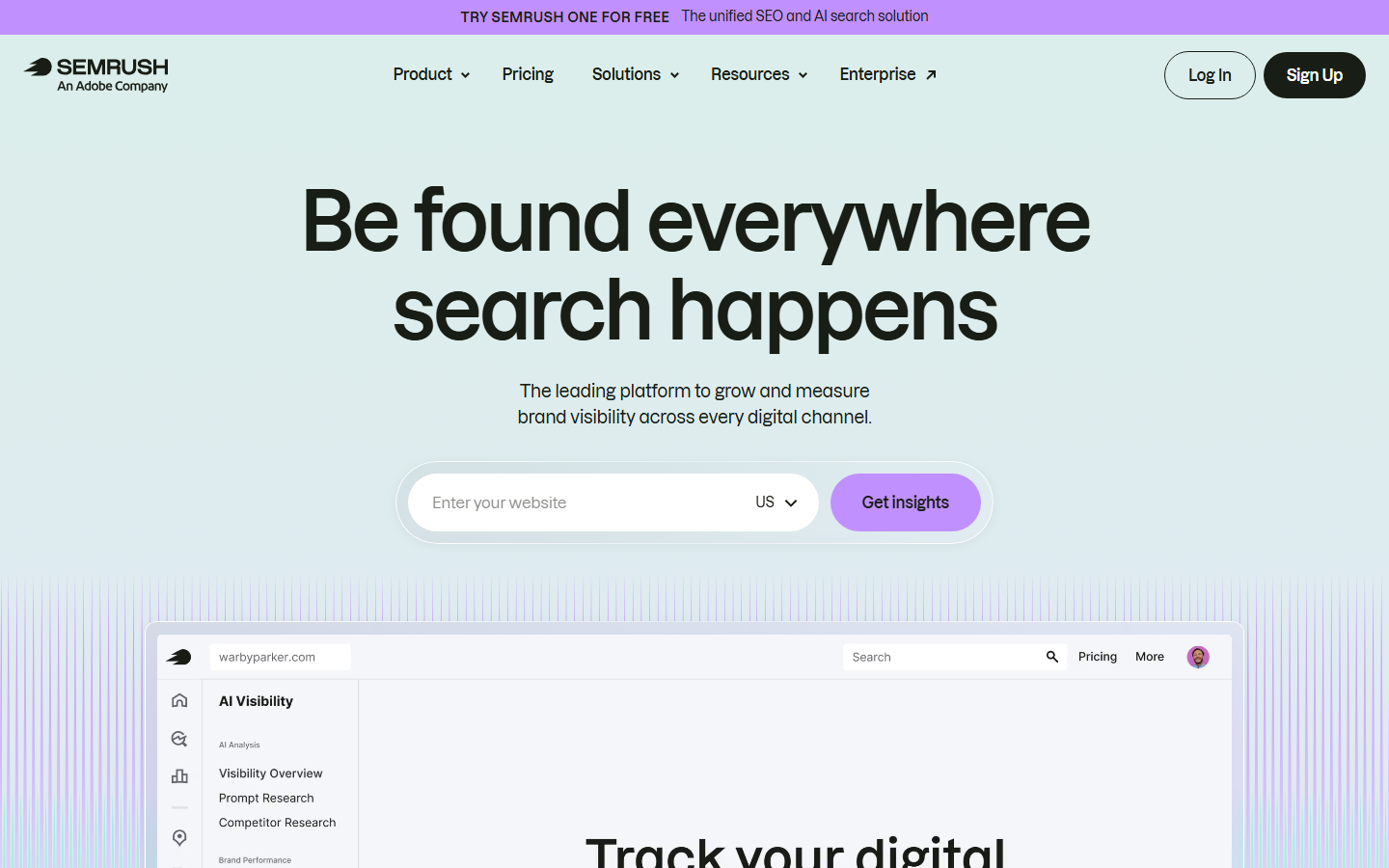
Best for: marketing and SEO teams that want one system for research, auditing, rankings, content, competitive intelligence, backlinks, and AI visibility.
Stack position: Core suite. Input: keyword, competitor, crawl, backlink, ranking, and AI-visibility data. Output: prioritized research, audits, recommendations, and monitoring. Automation: analysis and alerts are automated, but implementation remains human-controlled. Replaces or complements: it can replace several disconnected research and reporting dashboards; add specialists only where a measured bottleneck remains.
Semrush wins the overall position because it can serve as the operating layer beneath most of this list. At the Aug. 5, 2026 research cutoff, its SEO and AI Search plans combined classic SEO datasets with AI visibility features, daily keyword tracking, site monitoring, and competitive analysis Semrush pricing. That makes it easier to answer one practical question: what should the team work on next?
The advantage is not that Semrush has the best specialist feature in every category. It is that keyword discovery, competitor research, technical findings, link data, rank tracking, and AI-search insights can share project context. For an in-house team or small agency, that reduces exports, duplicated projects, and disagreements between dashboards.
Why I rank it first: it covers the largest number of root SEO jobs without becoming a generic chatbot. The underlying SEO data matters more than the presence of a text generator.
Where it falls short: entry pricing is substantial, add-ons can change the real bill, and specialist teams may still prefer Ahrefs for research, Surfer for editorial optimization, or a dedicated GEO platform for deeper prompt analysis. Buy Semrush as the core system, not as proof that you will never need another tool.
2. Ahrefs: Best for AI-assisted keyword and backlink research
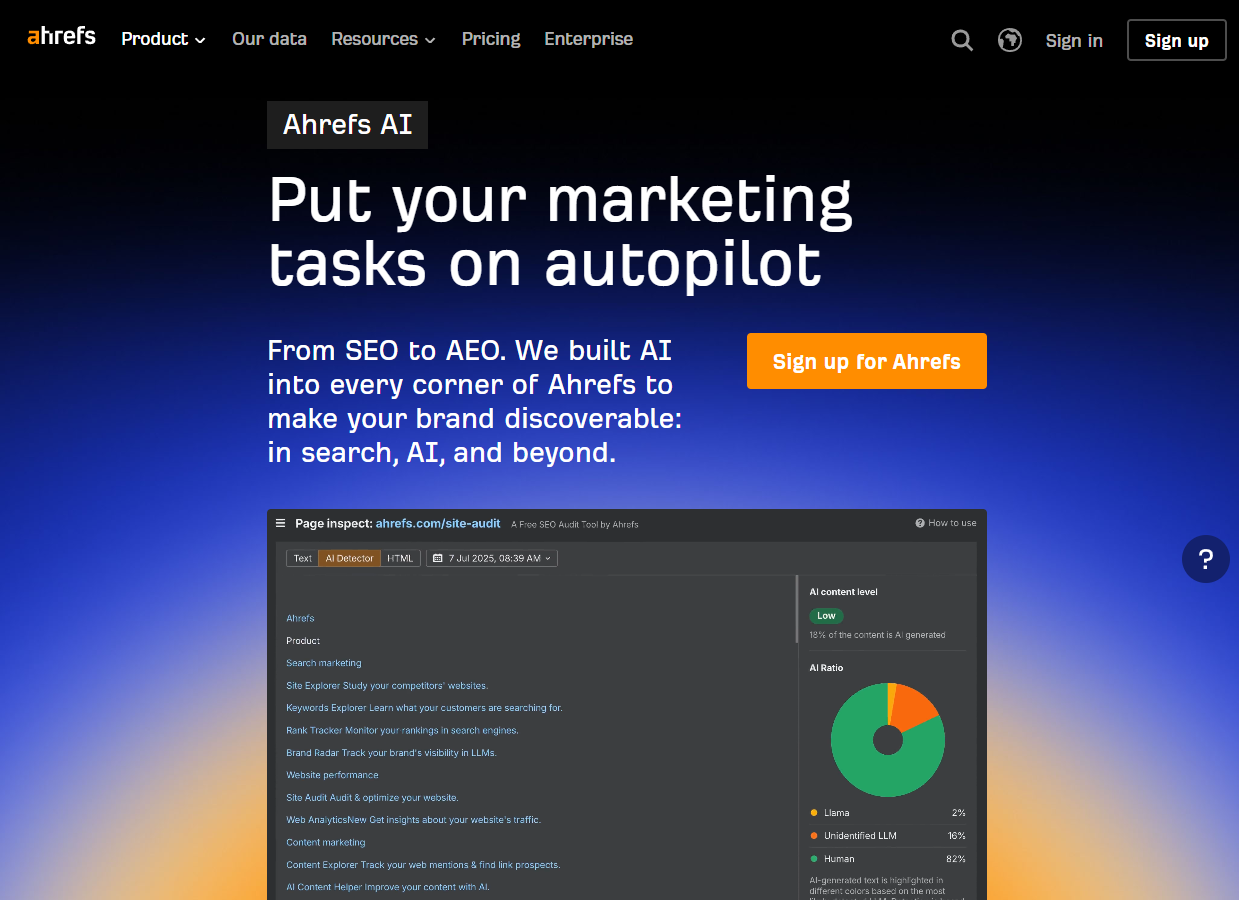
Best for: SEO specialists who make decisions from keyword, competitor, content, and backlink data.
Stack position: Research and evidence layer. Input: Ahrefs keyword, content, web, and backlink indexes. Output: market, competitor, topic, link, and visibility decisions. Automation: AI assists analysis, but humans choose targets and actions. Replaces or complements: it can replace separate keyword and backlink databases; complement it with deployment, local, or specialized content tools.
Ahrefs is my research pick because its AI layer sits on top of data that SEO teams already use for demand and authority analysis. The official AI product page covers topic discovery, intent decoding, AI Content Helper, Brand Radar, AI citations, always-on audits, patches, and AI-content detection Ahrefs AI. That breadth is useful, but the core reason to buy remains the underlying keyword and backlink indexes.
Use it when your bottleneck is not writing a paragraph. Use it when you need to decide which market to enter, which competing pages attract links, where content gaps exist, and whether a topic has enough business value to justify production.
Why it beats a prompt-only research workflow: a language model can cluster a supplied keyword list, but it does not create reliable search-demand or backlink data by itself. Ahrefs gives AI a structured evidence layer.
Where it falls short: Lite starts at $129 per month, tracked AI prompts are limited by plan, and the platform now covers enough jobs that buyers must watch add-on costs Ahrefs pricing. Semrush is the easier default when reporting and all-in-one project management matter more than research depth.
3. KoalaWriter: Best for research-assisted AI drafting
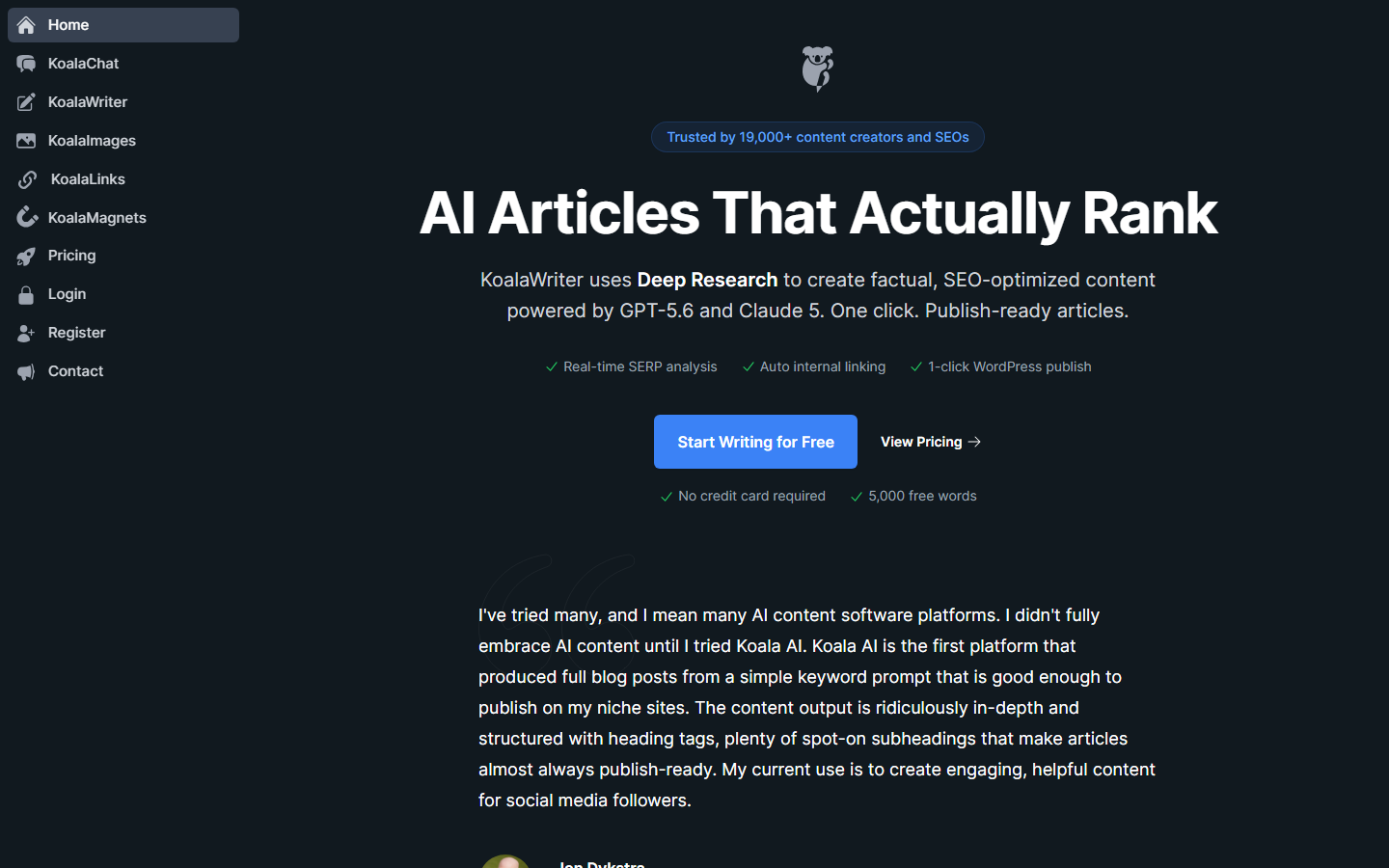
Best for: affiliate publishers, niche-site builders, and lean teams that need first drafts faster.
Stack position: Specialist creation layer. Input: a query, instructions, SERP research, and publishing settings. Output: a structured long-form draft. Automation: drafting and production steps are highly automated, while fact checking and editorial approval remain manual. Replaces or complements: it can replace a blank-chat drafting process, but not keyword intelligence, content optimization, or editorial verification.
KoalaWriter has one clear job: turn a query and instructions into a usable long-form draft with less setup than a general-purpose chat interface KoalaWriter product page. At the research cutoff, plans started at $9 per month and meter KoalaWriter by generated words KoalaWriter pricing. That pricing makes it easy to test without committing to an enterprise content platform.
I prefer it to a blank chatbot for repeatable production because the workflow is shaped around articles rather than conversations. Bulk creation, article structure, links, and integrations reduce the operational work around the model.
The limitation is editorial risk. Research assistance is not the same as verified reporting. Dates, prices, product capabilities, statistics, and first-person claims still require source checks. A fast draft that creates two hours of verification debt is not cheap content.
Google’s published guidance does not ban AI-assisted content. It focuses on whether content is helpful and created for people, while warning against automation used primarily to manipulate rankings Google Search guidance on AI content. That is the right quality standard: use KoalaWriter for production leverage, not for unsupervised publishing.
Read our KoalaWriter review for its strongest workflows and accuracy limits.
4. Surfer SEO: Best for content optimization
Best for: content teams that want a repeatable optimization process before and after publication.
Stack position: Specialist optimization layer. Input: a target query, competing pages, and the draft or published URL. Output: a content score, brief, and revision recommendations. Automation: analysis is automated; an editor decides which recommendations preserve intent and readability. Replaces or complements: it can replace manual SERP term extraction and complement a writer or core SEO suite.
Surfer is not primarily a keyword database or a technical crawler. It is an editorial decision system. It analyzes the pages competing for a query, turns that evidence into content guidance, and helps teams create or revise a document against a consistent brief Surfer product page.
That makes Surfer most valuable after you have selected the topic. It helps answer questions such as: Which concepts appear across relevant competitors? Is the page underdeveloped? Which existing URLs are losing ground and need refreshes?
Why I choose it for optimization: the interface turns SERP analysis into a workflow writers and editors can actually follow. At the research cutoff, Discovery started at $49 per month billed annually, while the broader Standard plan is considerably more expensive Surfer pricing.
Where it falls short: a content score is a diagnostic, not a ranking guarantee. Chasing every recommended term can damage readability and blur the page’s macro context. The editor still needs to decide which attributes belong, which claims need evidence, and what original information the page adds.
5. Alli AI: Best for on-page deployment at scale
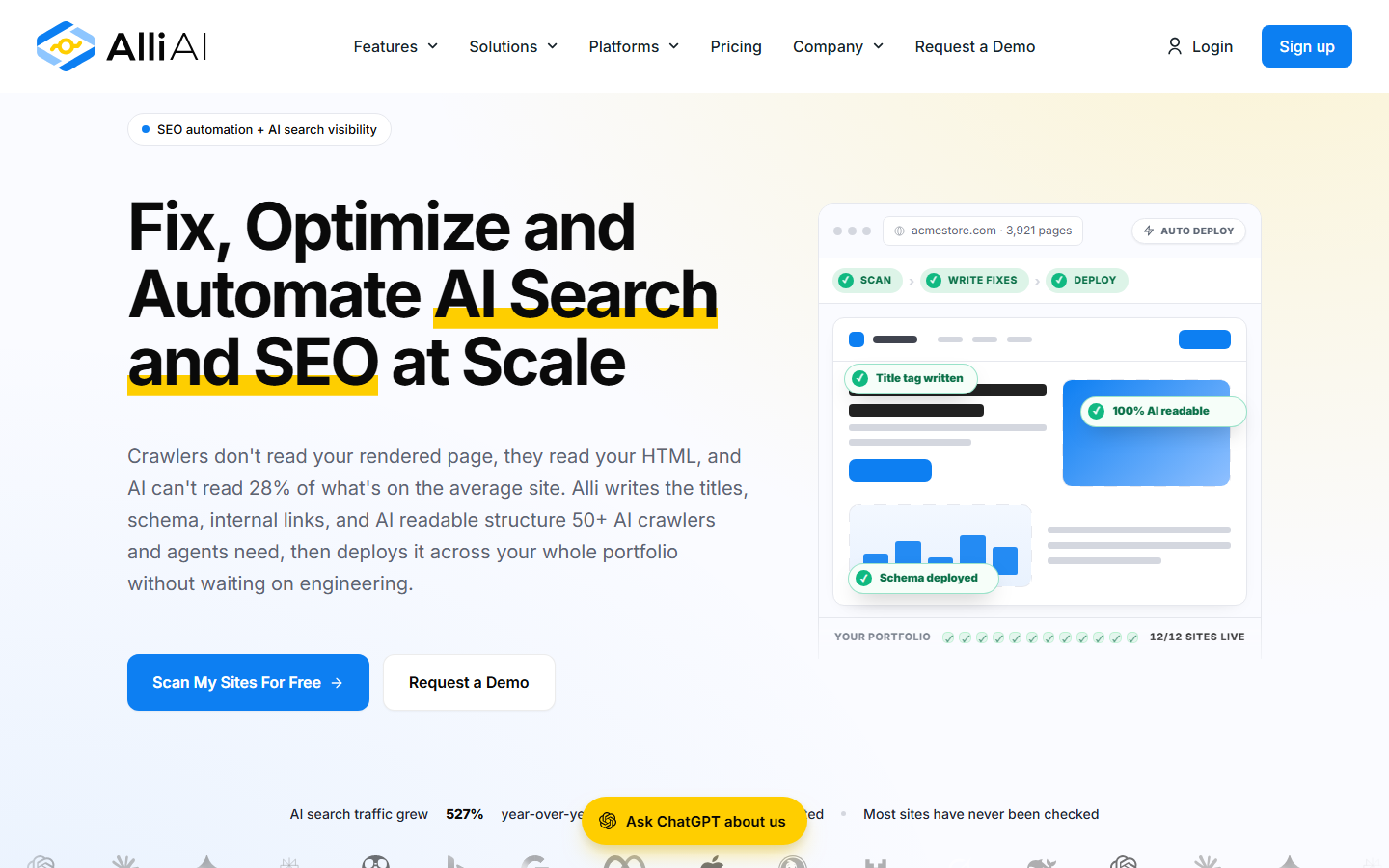
Best for: agencies and multi-page sites where finding recommendations is easier than implementing them.
Stack position: Controlled execution layer. Input: site pages, code, and on-page findings. Output: deployable title, schema, link, content, and technical changes. Automation: high, so approval scopes, logs, testing, and rollback are mandatory. Replaces or complements: it can replace parts of a repetitive implementation queue, but not strategic technical review.
Alli AI belongs in the on-page category because its differentiator is deployment. Its pricing page lists the Business plan at $249 per month when billed annually, includes a 10-day trial, and says the platform can apply technical AEO, GEO, and SEO optimizations across a site Alli AI pricing. This is a different value proposition from a tool that exports another task list.
Use it when title changes, content adjustments, schema, internal fixes, or code-level recommendations are stuck behind development queues. The potential gain comes from shortening the path from finding an issue to shipping a controlled change.
Why it is not my overall winner: deployment power increases risk. A recommendation engine can be wrong at scale as efficiently as it can be right. Teams need approval scopes, logs, rollback procedures, and small test batches before sitewide releases.
Best buying test: choose ten representative URLs, record the proposed change, expected outcome, and rollback method, then evaluate the trial. Do not judge the platform by the number of recommendations it generates.
6. Search Atlas: Best for controlled technical SEO automation
Best for: agencies and operators who want recommendations plus implementation inside a broader SEO platform.
Stack position: Broad suite with an execution layer. Input: crawl, content, link, local, and visibility data. Output: audits, priorities, recommendations, and controlled OTTO SEO deployment. Automation: medium to high, with governance required before sitewide action. Replaces or complements: it may replace several agency tools or become a duplicate when Semrush, a content optimizer, and local/link platforms are already established.
Search Atlas earns the technical automation pick because OTTO SEO is designed to move from audits and prioritized recommendations toward deployment. At the research cutoff, the public platform combined OTTO SEO with content, local, link, and LLM-visibility capabilities, starting at $99 per month Search Atlas product page.
The strongest use case is a multi-client or multi-site workflow where the cost of moving findings between a crawler, spreadsheet, ticketing system, CMS, and reporting dashboard becomes material. Consolidation can reduce that friction.
Why I prefer it over automatic site changes with no review: the useful workflow is recommendation, approval, deployment, monitoring, and rollback. Automation should make governance faster, not remove governance.
Where it falls short: broad suites create overlap. If you already pay for Semrush, a content optimizer, a local tool, and a link platform, Search Atlas may replace several subscriptions or become an expensive duplicate. Map each feature to an owner before buying.
7. LinkStorm: Best for AI-assisted internal linking
Best for: publishers, ecommerce sites, and content libraries with orphan pages or weak contextual connections.
Stack position: Specialist site-connection layer. Input: the site corpus, URLs, anchors, and existing link graph. Output: opportunities, audits, anchor suggestions, and selected auto-links. Automation: recommendation-first with optional rule-based execution. Replaces or complements: it can replace spreadsheet-based internal-link discovery and complement any suite whose link suggestions are too shallow.
Internal linking deserves its own tool category. The input is your site’s URL and content graph, while the output is a set of page-to-page relationships. LinkStorm identifies relevant opportunities, audits problems, optimizes anchor choices, and can automate selected linking rules LinkStorm product page. At the research cutoff, plans started at $30 per month for up to 1,000 URLs and credits LinkStorm pricing.
This job matters in semantic SEO because internal links communicate contextual hierarchy. A broad parent page should connect to deeper micro-context pages, while anchors should describe the destination rather than repeat the same generic phrase everywhere.
Why I choose LinkStorm: it is focused enough to expose gaps that an all-in-one dashboard can bury. It also makes the size of the site a visible pricing unit.
Where it can go wrong: semantic similarity is not editorial intent. Automatically linking every related phrase can create noisy anchors, excessive link density, or loops. Prioritize orphan resolution, important commercial pages, and genuine next-step relationships before enabling broad auto-linking.
8. Pitchbox: Best for AI-assisted link-building outreach
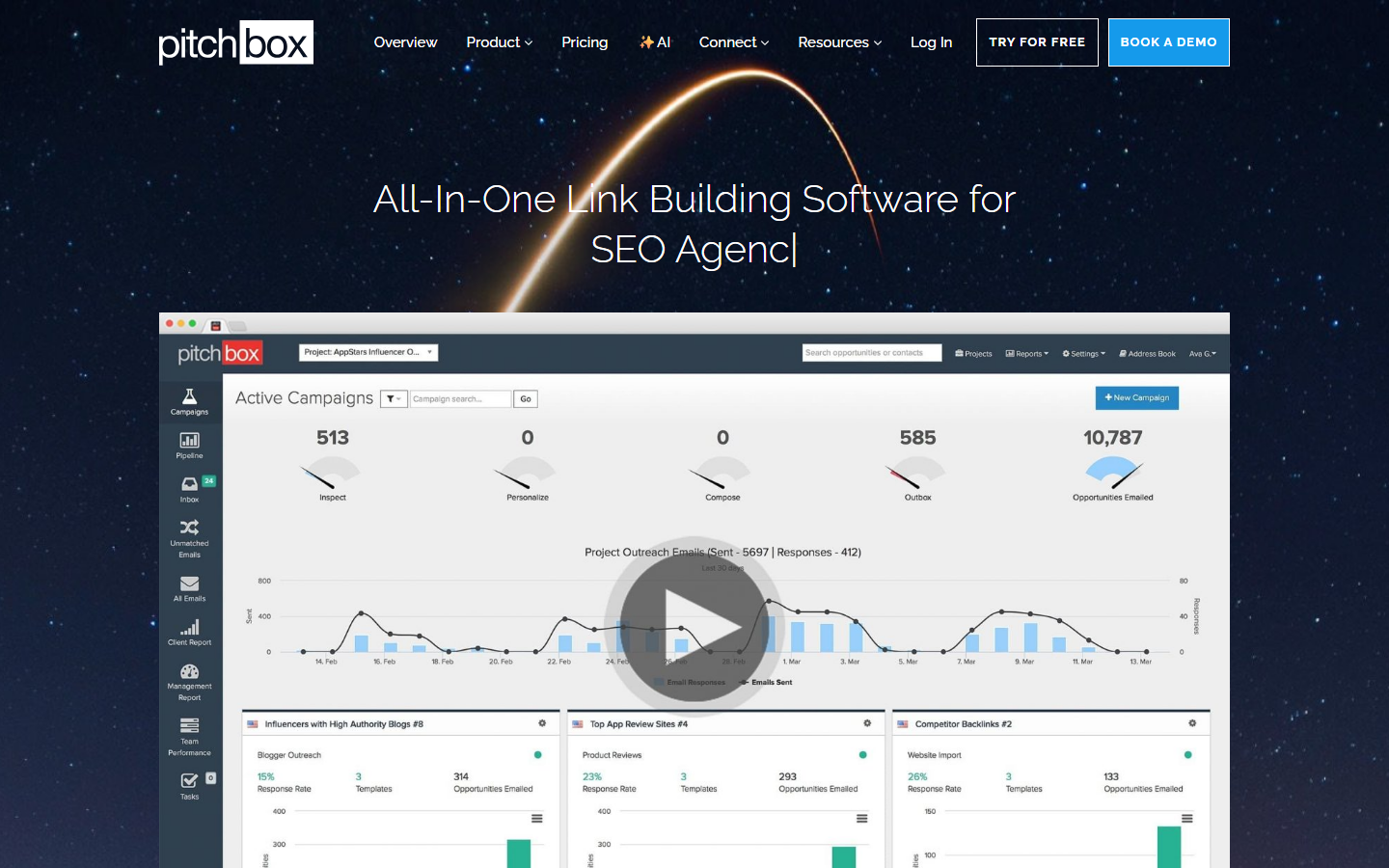
Best for: agencies, publishers, and digital PR teams running repeatable outreach campaigns.
Stack position: Authority-acquisition workflow layer. Input: prospects, campaign criteria, contacts, templates, and response history. Output: personalized outreach, follow-ups, CRM records, and reports. Automation: operational tasks can be automated, but asset quality, targeting, and relationship judgment remain human responsibilities. Replaces or complements: it can replace disconnected prospecting, mailbox, and outreach spreadsheets; it does not replace backlink analysis or digital PR strategy.
Backlink work has two separate layers: analysis and acquisition. Ahrefs is my pick for analyzing links and competitors. Pitchbox is the pick for operational outreach. Its official platform covers prospecting, AI personalization, template assistance, reply handling, automated follow-ups, a link-building CRM, and reporting Pitchbox pricing.
The real value is workflow control. Teams can segment prospects, assign work, personalize at scale, monitor replies, and retain campaign history. That is more defensible than asking a chatbot to generate hundreds of superficially personalized emails.
Where it falls short: Pro starts at $210 per month when billed annually, and automation cannot create a compelling reason for a publisher to link Pitchbox pricing. Weak assets plus AI personalization still produce weak outreach. The platform fits teams with an existing digital PR or link-acquisition process, not buyers looking for a push-button backlink generator.
9. SE Ranking: Best for rank tracking and agency reporting
Best for: agencies and growth teams that need daily keyword tracking, client reporting, and AI-prompt monitoring.
Stack position: Measurement and agency-operations layer. Input: keywords, locations, domains, competitors, and sampled AI prompts. Output: rank history, visibility reports, alerts, and client reporting. Automation: scheduled measurement and reporting are automated; diagnosis and prioritization remain human. Replaces or complements: it can replace a standalone rank tracker and reporting dashboard, but may overlap with other all-in-one suites.
Rank tracking is the measurement layer of the stack. SE Ranking combines daily keyword positions with projects, reports, competitor tracking, content and audit tools, and AI-search visibility SE Ranking product page. At the research cutoff, its Core plan was $103.20 per month when billed annually or $129 monthly, covering 2,000 daily tracked keywords and 100 prompts SE Ranking pricing.
I choose it here because the pricing units connect directly to measurement work: projects, keywords, prompts, domains, and manager seats. Agencies can estimate the cost per client more clearly than with a vague AI-credit pool.
Where it falls short: it can overlap with Semrush, Ahrefs, Search Atlas, and Writesonic. If traditional rank tracking is already reliable, do not migrate solely because another dashboard adds an AI label. Compare location support, update frequency, SERP features, prompt engines, exports, and client reporting first.
10. Localo: Best for local SEO workflows
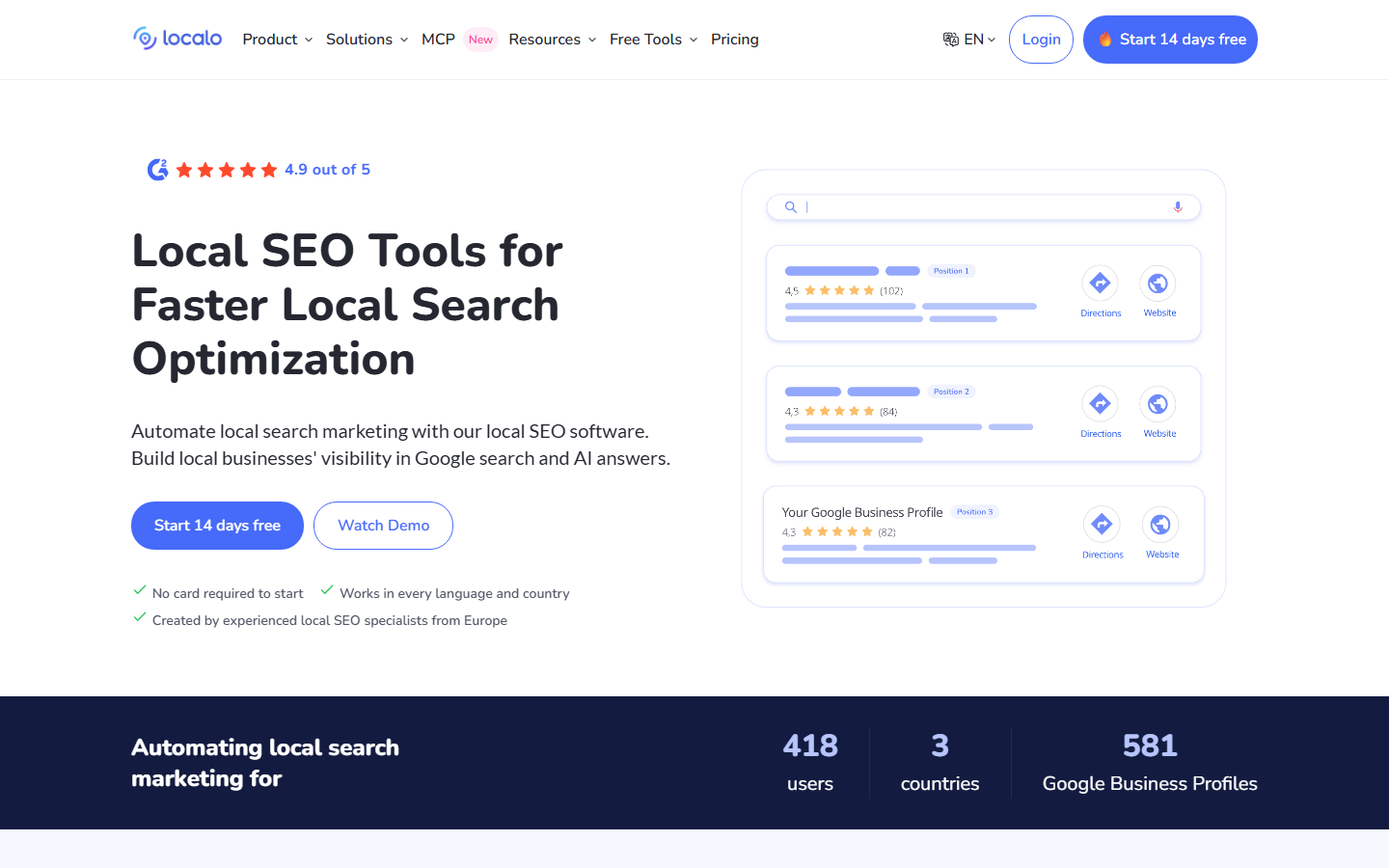
Best for: local business owners, freelancers, and agencies managing Google Business Profiles.
Stack position: Vertical local-search layer. Input: Google Business Profiles, locations, local rankings, listings, reviews, and posts. Output: local tasks, rank monitoring, listing fixes, content, and reports. Automation: routine analysis and workflow support are automated, while profile changes and reputation decisions require owner review. Replaces or complements: it can replace generic local spreadsheets and complement a national SEO suite.
Local SEO has a different entity model from national content SEO. Locations, categories, service areas, reviews, map rankings, citations, posts, and listing consistency all matter. Localo builds its workflow around those objects rather than treating a location as another keyword project.
The official platform includes local rank tracking, listing issue detection, Google Posts, review workflows, directory work, client reports, GBP statistics, and an AI agent Localo product page. At the research cutoff, a single-business plan was $39 per month billed annually or $49 monthly, with a 14-day trial Localo pricing.
Why I choose it: the tasks and outputs are understandable to an owner who does not want to operate an enterprise SEO suite. An agency can also use the Pro workflow across multiple profiles.
Where it falls short: Localo is not the right research platform for national keywords, editorial content portfolios, or backlink analysis. Buy it because local visibility is a core revenue channel, not because it contains AI.
11. WordLift: Best for schema, entities, and knowledge graphs
Best for: enterprise publishers, ecommerce catalogs, and organizations investing in structured data and entity-level search visibility.
Stack position: Entity and structured-data layer. Input: site content, recognized entities, taxonomy, and business data. Output: linked entities, knowledge-graph relationships, and structured data. Automation: entity extraction and markup can be automated, but ontology design and validation require specialist oversight. Replaces or complements: it can replace isolated schema generation for complex publishers, while smaller sites may need only supported schema basics.
Schema tools should not merely generate JSON-LD from a title. WordLift’s deeper proposition is to identify entities, connect them through a knowledge graph, and produce structured data that represents those relationships WordLift product page. That aligns with semantic SEO because it clarifies what an entity is, which attributes belong to it, and how it connects to other entities.
Why I rank it for this category: the output can become a reusable data layer for search engines, AI discovery, content systems, and internal applications. That is more valuable than pasting isolated schema snippets into pages.
Where it falls short: implementation is more strategic and expensive than a basic schema plugin. The public Business+ plan was displayed from $879 per month billed annually at the research cutoff WordLift pricing. Small sites should first fix content accuracy, crawlability, canonicalization, and supported schema basics before investing in a managed knowledge graph.
12. Writesonic: Best for AI visibility and GEO
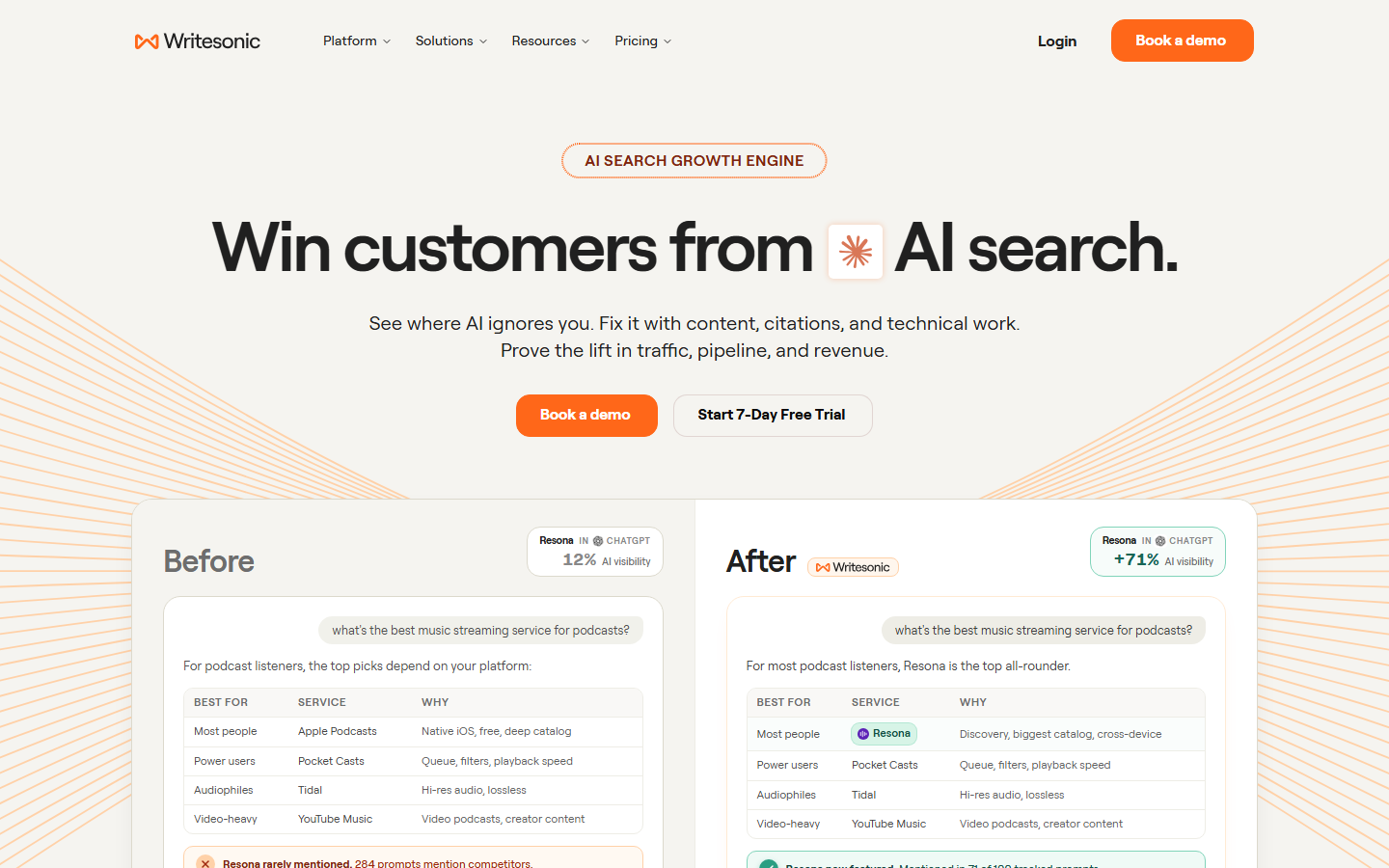
Best for: brands and agencies that need to monitor ChatGPT, Gemini, Google AI Overviews, citations, sentiment, and competitor presence.
Stack position: AI-answer measurement and action layer. Input: tracked prompts, brand/entity mentions, citations, competitors, and AI-engine responses. Output: visibility monitoring, citation analysis, sentiment, gaps, and recommended actions. Automation: monitoring is automated; causal diagnosis and content or authority changes require human validation. Replaces or complements: it complements traditional rank tracking and should not replace core keyword, crawl, backlink, or conversion data.
AI visibility is a measurement category, not a replacement for SEO. Writesonic tracks prompts and brand presence, analyzes citations and sentiment, benchmarks competitors, and connects findings to recommended actions Writesonic AI Visibility. At the research cutoff, its Starter plan was $79 per month billed annually.
I choose Writesonic because it closes more of the loop between observation and execution than a prompt-monitoring dashboard alone. A useful GEO workflow is: identify a visibility gap, inspect which sources are cited, determine whether the gap is content, authority, entity clarity, or technical access, then make and measure a specific change.
Where it falls short: prompt tracking is sampled measurement. Results vary by engine, location, account context, prompt wording, and time. A single visibility score should not become the company’s definition of demand or revenue.
Traditional search rankings, qualified traffic, conversions, branded demand, backlinks, and AI citations should be read together. Do not cancel your core SEO data platform because an AI visibility chart moved.
Adjacent editorial QA tools for an AI SEO workflow
Grammarly and Originality.ai can strengthen content governance, but neither meets this article’s strict definition of a ranked AI SEO platform because neither starts with native search, crawl, backlink, local, or search-performance data. Treat them as optional control layers after the SEO strategy and evidence are established.
Grammarly: language and readability control
Best for: any team publishing content written by employees, freelancers, agencies, or AI systems.
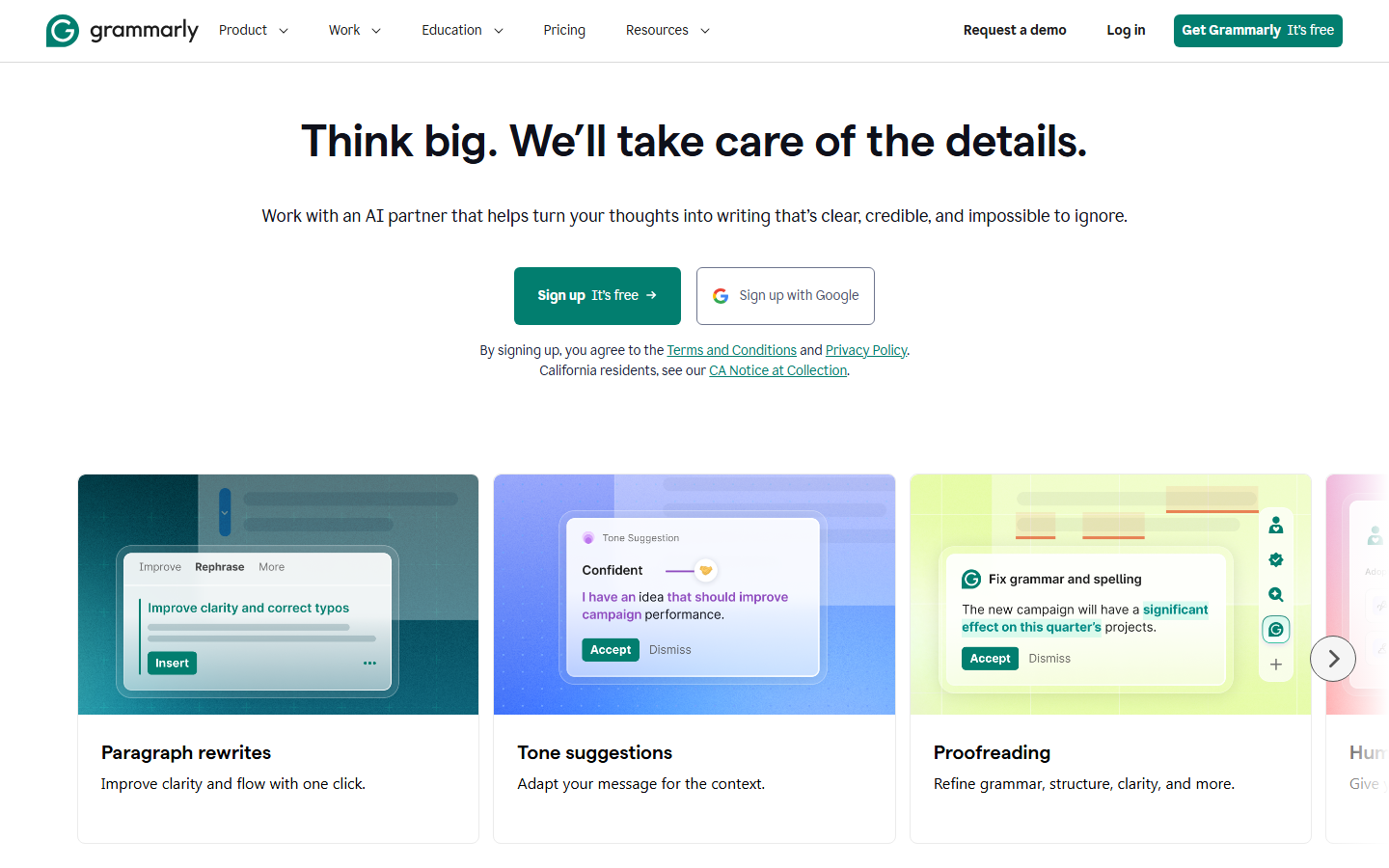
A grammar checker is not an SEO ranking tool, but editorial quality is part of the production system. Grammarly catches mechanical errors, unclear phrasing, tone problems, and inconsistent sentences before publication. At the research cutoff, the product also included rewrites and AI agents, with a free plan and Pro at $12 per month Grammarly plans.
I place Grammarly after optimization tools because the order matters. First establish intent, facts, structure, and entity coverage. Then improve clarity. Rewriting too early can make accurate technical language more generic.
Why it belongs in an AI SEO stack: AI drafts often sound fluent while hiding repetition, vague claims, or abrupt transitions. Grammarly gives editors a consistent QA pass across writers and applications.
Where it falls short: accepting every suggestion can flatten brand voice or alter meaning. It does not validate facts, search intent, entity relationships, or topical authority. Treat it as a language-control layer, not an SEO score.
Originality.ai: editorial governance signal
Best for: publishers, agencies, and content managers who need documented QA across external contributors.
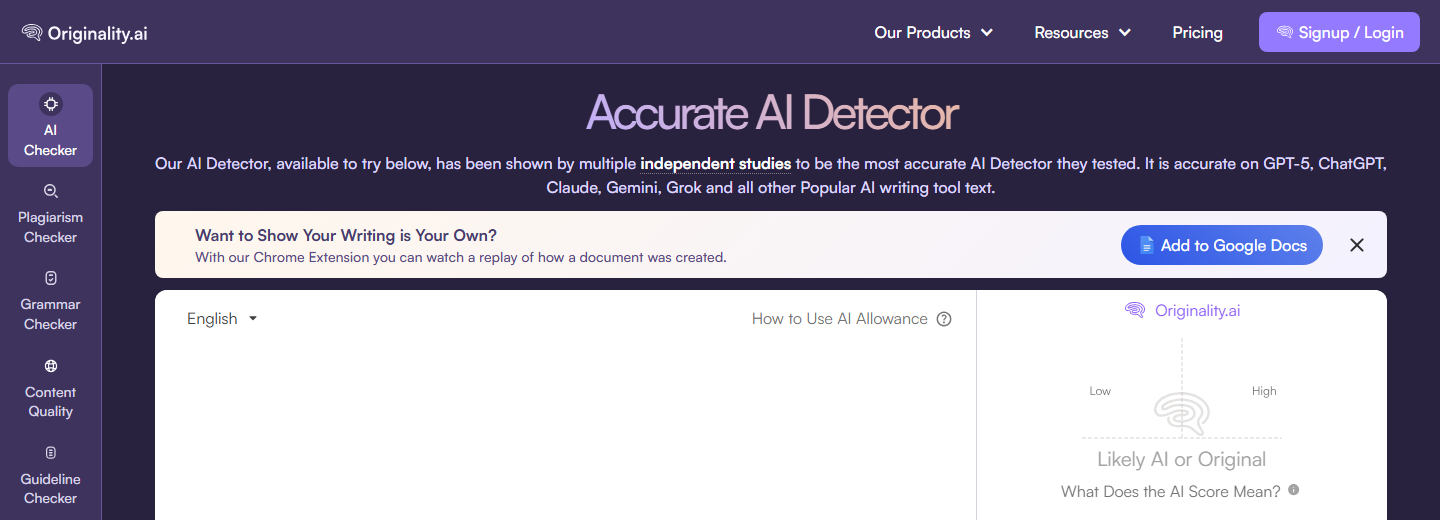
Originality.ai combines AI detection with plagiarism checks, readability, content-quality tools, and scan records Originality.ai product page. At the research cutoff, the Pro plan was $12.95 per month when billed annually or $14.95 monthly Originality.ai pricing. Its strongest value is governance: a team can retain evidence that content passed through a defined review process.
However, an AI detector does not prove authorship, and a probability score is not a Google ranking factor. False positives and false negatives make punitive use risky. Google says it evaluates helpfulness and quality rather than rewarding or banning content based simply on whether AI helped create it Google Search guidance on AI content.
How I would use it: investigate unusual submissions, check plagiarism, record scans, and trigger human review. I would not reject a writer or remove a page based on one detector score.
Where it falls short: detection can distract teams from more important checks such as factual accuracy, original reporting, source quality, search intent, and information gain.
Build an AI SEO stack without paying for overlap
Use one core suite when:
- The team is small and duplicated workflows cost more than feature gaps.
- Keyword, competitor, technical, backlink, and reporting data need shared projects.
- You want fewer integrations and one budget owner.
- Semrush, Ahrefs, Search Atlas, or SE Ranking covers at least 70 percent of the work performed every week.
Add a specialist when:
- The bottleneck is specific and measurable, such as internal linking across 10,000 URLs.
- The specialist produces a different output, not a prettier copy of the same report.
- The workflow has a dedicated owner, approval process, and success metric.
- The subscription replaces manual hours or another product.
| Stack layer | What it can replace or complement | Main overlap risk |
|---|---|---|
| Core suite | Separate research, audit, rank, and reporting dashboards | Paying for two broad platforms with the same projects and reports |
| Content specialist | Manual briefs, SERP extraction, drafting, or optimization | Buying several tools that all produce briefs and scores |
| Deployment layer | Engineering tickets and repetitive on-page implementation | Automating recommendations before approvals and rollback exist |
| Authority layer | Prospecting, outreach, and campaign spreadsheets | Paying for outreach software without an active digital PR process |
| Measurement layer | Standalone rank, local, or AI-prompt tracking | Treating sampled visibility as revenue or replacing first-party analytics |
| QA control layer | Language review, plagiarism checks, and scan records | Using QA scores as proof of SEO quality or authorship |
My lean stack for an affiliate publisher would be Ahrefs or Semrush + KoalaWriter + Surfer + LinkStorm, with Grammarly or Originality.ai added only when a documented editorial need justifies them. A local agency should start with Semrush or SE Ranking + Localo, then add Pitchbox only if link outreach is an active service. A multi-site agency considering automated deployment should compare Search Atlas and Alli AI in a controlled URL test before choosing both.
Before renewal, record active users, workflows completed, actions shipped, duplicated capabilities, pricing expansion units, and whether the tool replaced another cost. A low entry price can become expensive when the bill scales by websites, pages, words, prompts, tracked keywords, or locations.
The most common buying mistake is paying for five products that all generate content briefs. The second is buying automation before defining approvals and rollback. Build the stack around distinct data and outputs.
If content optimization remains the bottleneck, compare Clearscope and NeuronWriter before paying for another writer or overlapping content suite.
Frequently asked questions
What is the best AI SEO tool overall?
Semrush is the best overall choice for teams that want keyword research, competitor analysis, site auditing, content, backlinks, rankings, and AI visibility in one platform. Ahrefs is a stronger alternative when keyword and backlink research are the center of the workflow. The correct specialist depends on the bottleneck.
Can AI SEO tools replace an SEO specialist?
No. AI can accelerate research, clustering, drafting, QA, deployment, and monitoring, but an SEO specialist still defines the business objective, validates intent, judges evidence, controls technical risk, and connects search performance to revenue.
What are the best free AI SEO tools?
The most useful free starting stack is Google Search Console for first-party performance data, a free crawler or limited crawl tier for technical checks, and controlled use of a general AI assistant for clustering or explanation. Free tools support individual tasks but do not replace reliable keyword, backlink, rank-tracking, local, or AI-visibility datasets.
Are AI writing tools safe for SEO?
AI-assisted writing is not automatically unsafe. Google Search guidance on AI content focuses on content quality and helpfulness rather than whether AI was involved. The risk comes from inaccurate, unoriginal, thin, or search-manipulation content. Human review, primary sources, original information, and clear authorship remain necessary.
What is the difference between SEO, AEO, and GEO tools?
SEO tools improve visibility in traditional search results. AEO tools focus on answer formats such as featured snippets and direct responses. GEO tools monitor and influence how brands and sources appear in generative answers from systems such as ChatGPT, Gemini, and Google AI Overviews. The workflows overlap because clear entities, authoritative sources, crawlability, useful content, and brand mentions matter across all three.
Which AI SEO stack is best for a small business?
A small business should avoid overlapping subscriptions. Start with one core platform for research, auditing, and tracking. A local business should prioritize a local SEO workflow such as Localo. Add a writer, optimizer, internal-linking tool, or QA layer only when publishing volume and a measured bottleneck justify the cost.
How often should I review an AI SEO software stack?
Review the stack every quarter and before annual renewals. Record active users, workflows completed, recommendations implemented, time saved, traffic or conversion outcomes, and duplicated features. Cancel products that generate reports nobody owns or actions nobody ships.
