PageOptimizer Pro, usually called POP, combines competitor-based on-page analysis, content briefs, an AI writer, keyword clustering, NLP entities, E-E-A-T checks, schema recommendations, page monitoring, and API access. Its breadth is impressive for a focused optimization platform. The buying friction is not feature scarcity. It is understanding report quotas, AI credits, add-ons, account limits, and several first-party pages that do not agree on every usage detail.
| Decision factor | Editorial finding |
|---|---|
| Homepage | PageOptimizer Pro official site |
| Best for | SEO professionals, agencies, and site owners who want detailed page-level recommendations and will make editorial decisions rather than chase a score |
| Core advantage | Rank Engine diagnostics connect to briefs, writing, entities, schema, E-E-A-T checks, keyword tools, and monitoring |
| Main limitation | Plans still have quotas and a separate credit economy; some current marketing and help pages conflict on exact AI usage |
| Entry price checked August 5, 2026 | Basic at $40 per month; Unlimited at $72; Teams at $143 |
| Evaluation path | POP offers a no-signup public demo and separately gives paid subscriptions a seven-day refund guarantee; this is not evidence of a seven-day free subscription trial |
Quick Verdict
PageOptimizer Pro is worth considering when your team needs a structured on-page workflow that goes beyond a basic term list. It is especially useful for agencies and experienced operators who want competitor selection, content briefs, page structure, NLP entities, schema, E-E-A-T signals, and monitoring in one focused system.
The value is weaker for beginners who want a single green score to make decisions for them. POP can tell you what comparable pages contain and where a target page differs. It cannot decide whether a competitor is genuinely relevant, create original expertise, fix technical SEO across a site, earn links, or guarantee visibility in Google or AI answers.
Check PageOptimizer Pro's current trial and plan details
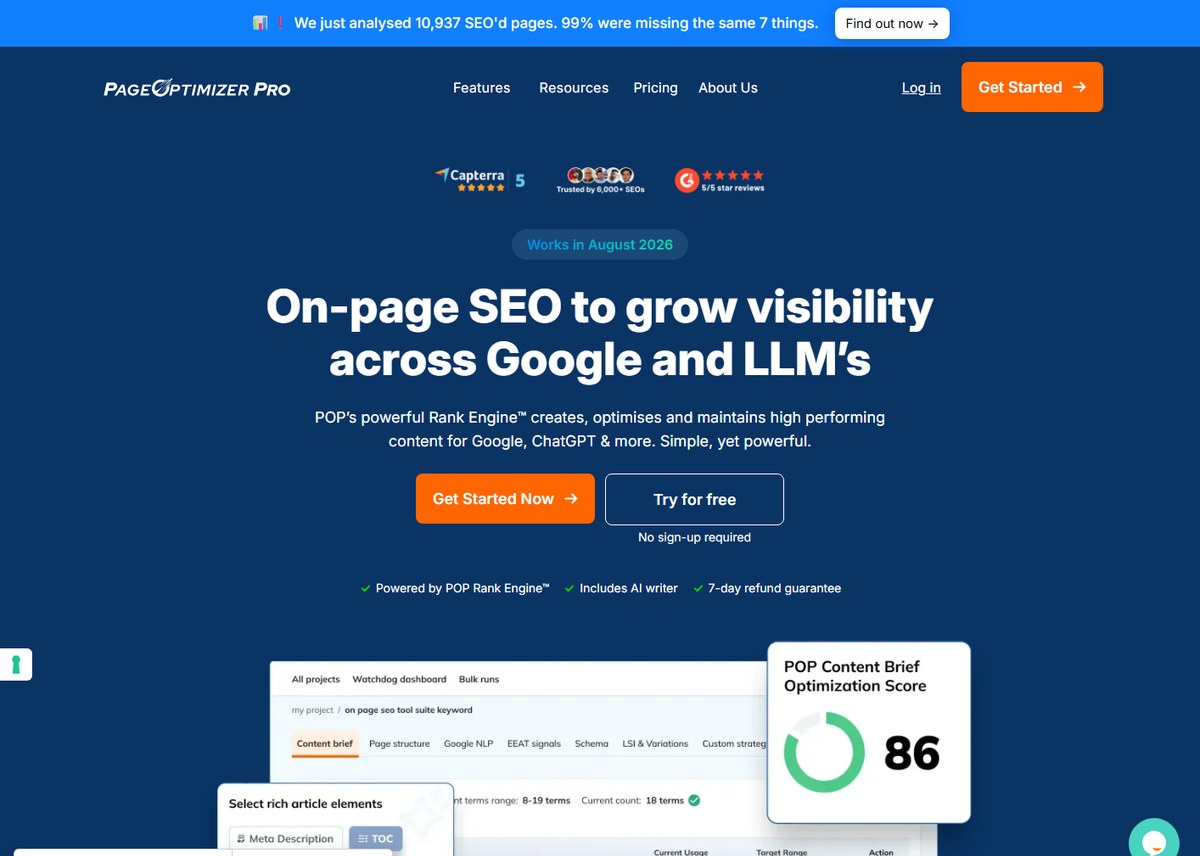
POP's homepage says the platform supports visibility across Google and LLMs. Treat that as positioning. A page must still satisfy the query, provide original value, and be technically accessible before any optimizer can help.
What Is PageOptimizer Pro?
PageOptimizer Pro is a web-based on-page SEO and content optimization platform associated with Kyle Roof. Its Rank Engine compares a target page and selected competitors, then generates recommendations for page elements, terms, structure, entities, schema, and related signals. POP's current product suite extends that analysis into content briefs, a content editor, AI writing, keyword research, a Chrome extension, Watchdog monitoring, E-E-A-T checks, and API access.
The category boundary is important. POP is more than an AI writer, but it is not a complete technical SEO, backlink, analytics, or enterprise content-governance platform. It is best understood as a page-level decision system with connected production and monitoring tools.
The right buying question is not "Can POP raise a score?" It is "Can POP help our team choose better page changes, document those decisions, and revisit important content without replacing judgment with correlation?"
For neighboring products and category context, browse our AI writing and content optimization hub. This review keeps its decision centered on POP's page-level workflow rather than treating every AI writer or broad SEO suite as a direct substitute.
How PageOptimizer Pro Works
A disciplined POP workflow looks like this:
- Create a project and select a target query. The page, locale, device, and query context should match the real search opportunity.
- Choose competitors carefully. Irrelevant directories, forums, homepages, or differently intended pages can distort every recommendation that follows.
- Run the Rank Engine analysis. POP compares page factors and reports gaps, target ranges, scores, and prioritized actions.
- Build or import a brief. Use the content brief, page structure, terms, NLP entities, schema, and E-E-A-T modules to define the page job.
- Write in the editor or AI Writer. Automatic mode prioritizes speed; Guided Writing exposes more outline and content decisions.
- Review the page as an editor. Confirm intent, claims, examples, sources, conversion path, and natural language instead of optimizing every metric mechanically.
- Monitor important URLs. Watchdog can flag score changes so refresh work becomes a maintained process rather than a launch-only task.
That sequence makes POP useful to agencies because it produces a repeatable brief and review trail. It also exposes the main risk: a bad competitor set can make a polished report confidently irrelevant.
What Public PageOptimizer Pro Evidence Shows The documented screens still show a workflow with more setup decisions than a minimalist content editor.
The first judgment call is the competitor set. A useful POP report depends on pages that answer the same query with the same intent, locale, and page type. An operator who accepts a directory, forum thread, homepage, and product page as equivalent competitors may receive precise recommendations for the wrong comparison. Experienced SEOs will recognize and correct that problem. A beginner may only see a score.
Once the comparison set is sound, the product's breadth becomes practical. The content brief can define page structure, terms, entities, word-count context, and recommendations before the writer begins. The AI Writer can work from that analysis. Schema and E-E-A-T checks address visible implementation details, while Watchdog extends the process beyond publication. Agencies can turn those stages into a repeatable client deliverable rather than a collection of screenshots from unrelated tools.
A controlled evaluation should include three jobs: one net-new article, one declining commercial page, and one page with an unusual intent. Record setup time, recommendation acceptance rate, false positives, editor revision time, credits consumed, and whether Watchdog identifies changes worth acting on. Confirm the actual trial or refund conditions at checkout before starting the clock.
What Are PageOptimizer Pro's Key Features?
Rank Engine and content briefs
POP says its Rank Engine draws on hundreds of tests and analyzes hundreds of factors. Those numbers are vendor-reported. The practical value is the report structure: it turns a competitor set into page-element ranges, term guidance, word-count context, and prioritized changes.
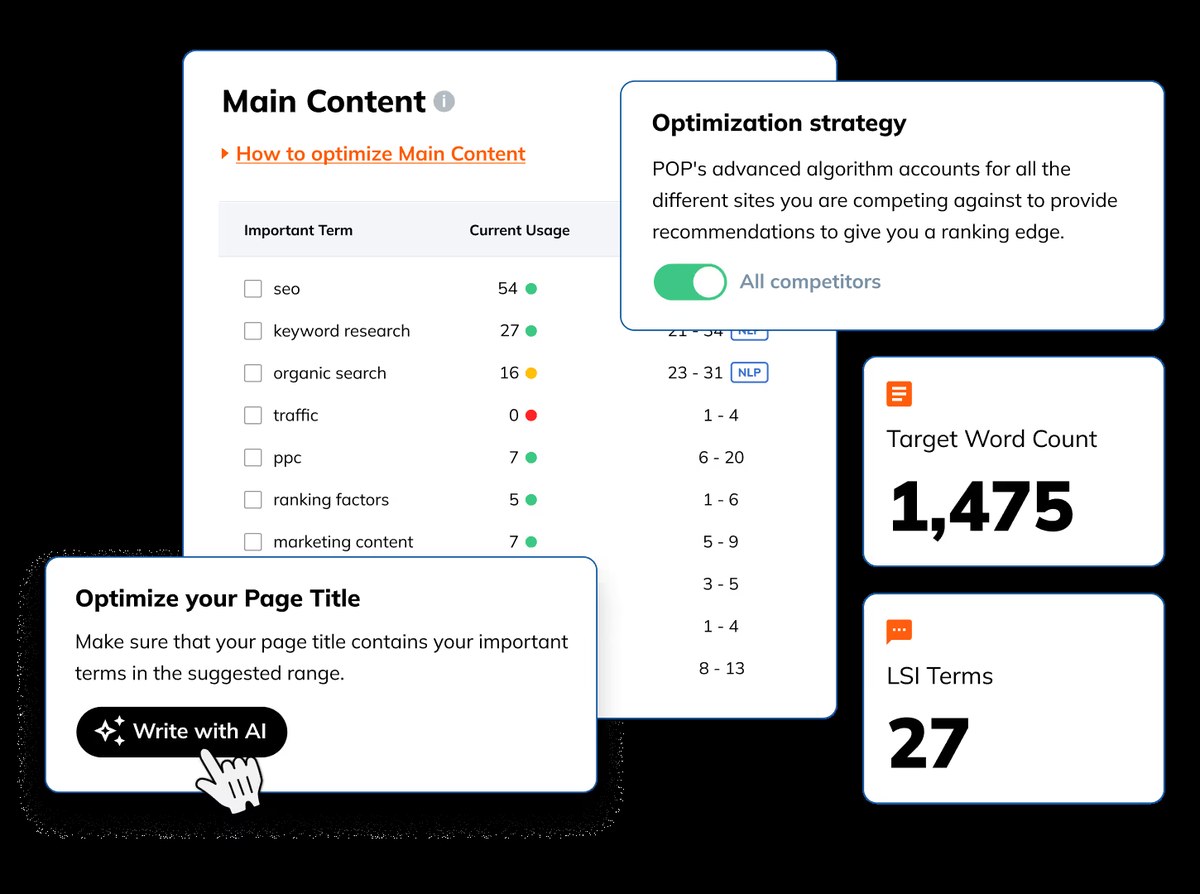
A content brief can reduce handoff friction between an SEO lead and a writer. It can also become counterproductive when teams treat target ranges as mandatory quotas. A score should diagnose the page, not flatten its voice or replace the search intent.
POP AI Writer in automatic and guided modes
The POP AI Writer offers automatic and Guided Writing paths. Public workflow material shows configuration for target word count, competitors, page type, outline, a user-supplied API key, and content elements. Guided mode is the more defensible choice when the page needs a deliberate argument or evidence sequence.
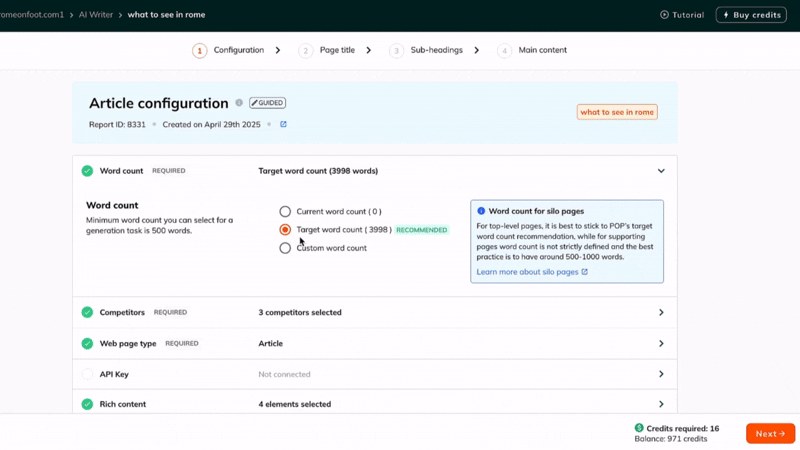
The writer is integrated with POP's optimization data, which is more useful than pasting a disconnected term list into a generic chatbot. It still cannot provide first-hand experience, determine whether a source is authoritative, or verify every generated fact. Human review remains part of the product cost.
Keyword Insights, strategy, and clustering
POP's keyword tools can discover or import terms, group them into clusters, and build a strategy before a page report is created. This helps teams separate query research from drafting and can reduce accidental cannibalization.
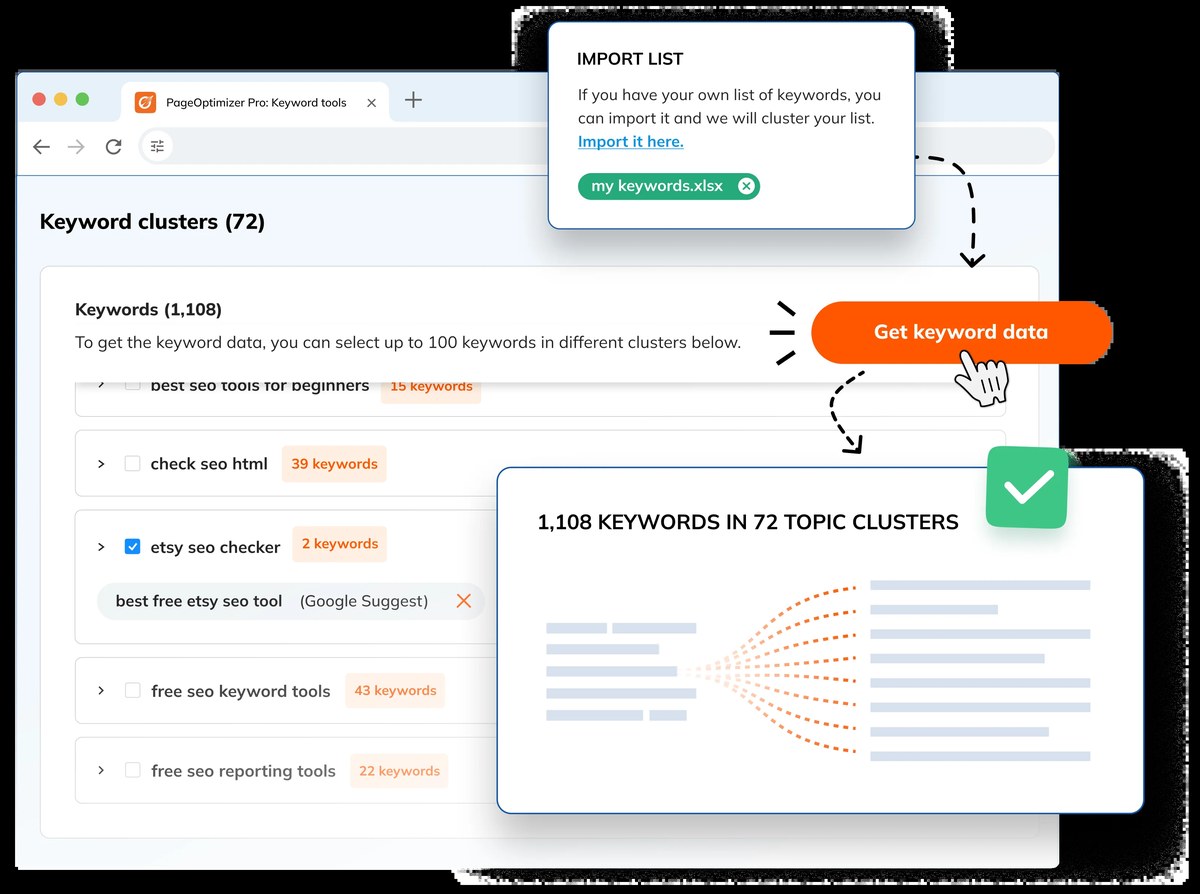
Clustering remains a hypothesis. Similar wording does not always mean the same intent, and a cluster should not automatically become a site architecture. Verify the search results, business value, and relationship to existing pages before creating new URLs.
NLP entities and content editor
POP's NLP module compares entities identified on the target and competing pages. Missing entities can reveal genuine coverage gaps, especially where a topic includes people, products, places, organizations, or defined concepts.
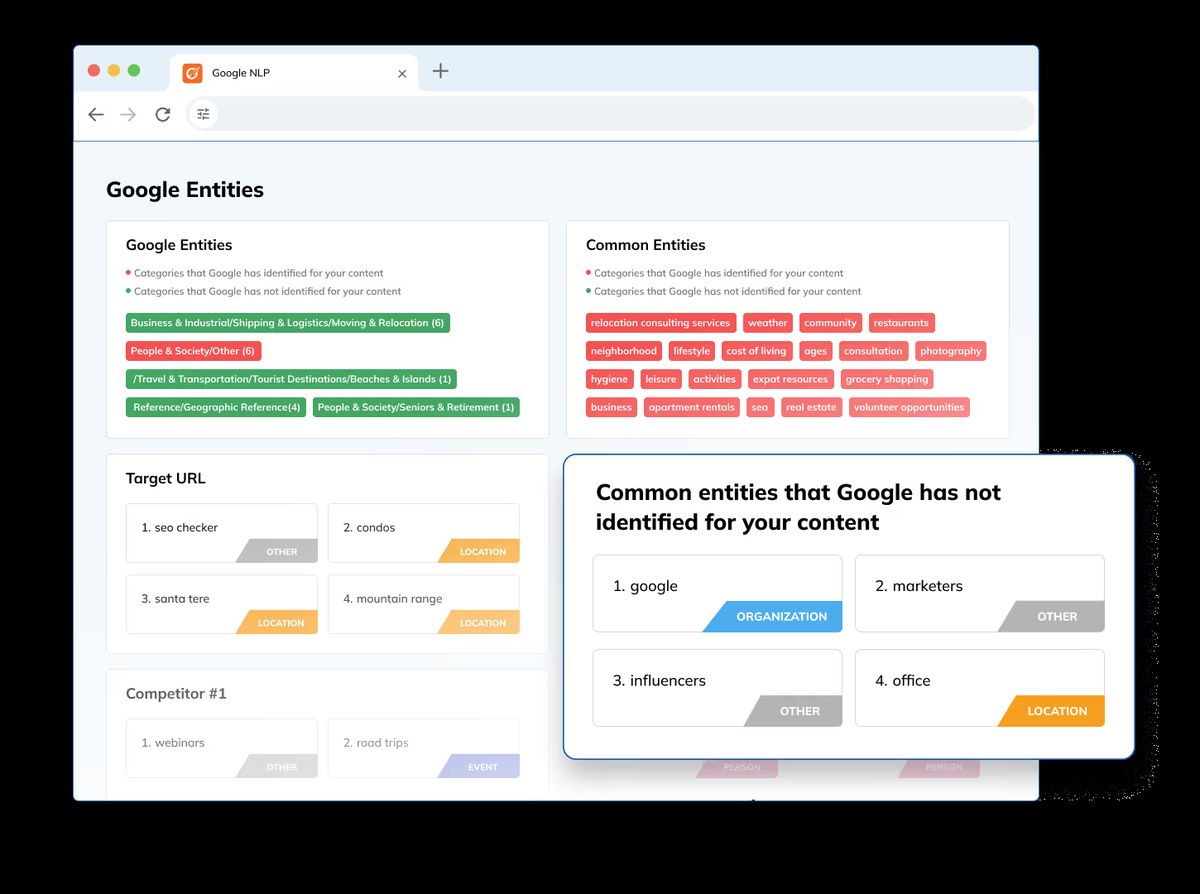
The feature is easiest to misuse when a missing entity becomes a required keyword. Add an entity only when it helps answer the reader. The Content Editor and Chrome extension can bring recommendations closer to the draft or live page, but editorial coherence matters more than hitting every range.
Schema recommendations
POP Schema compares markup used by competitors and surfaces supported recommendations. This is useful for discovery and implementation planning.
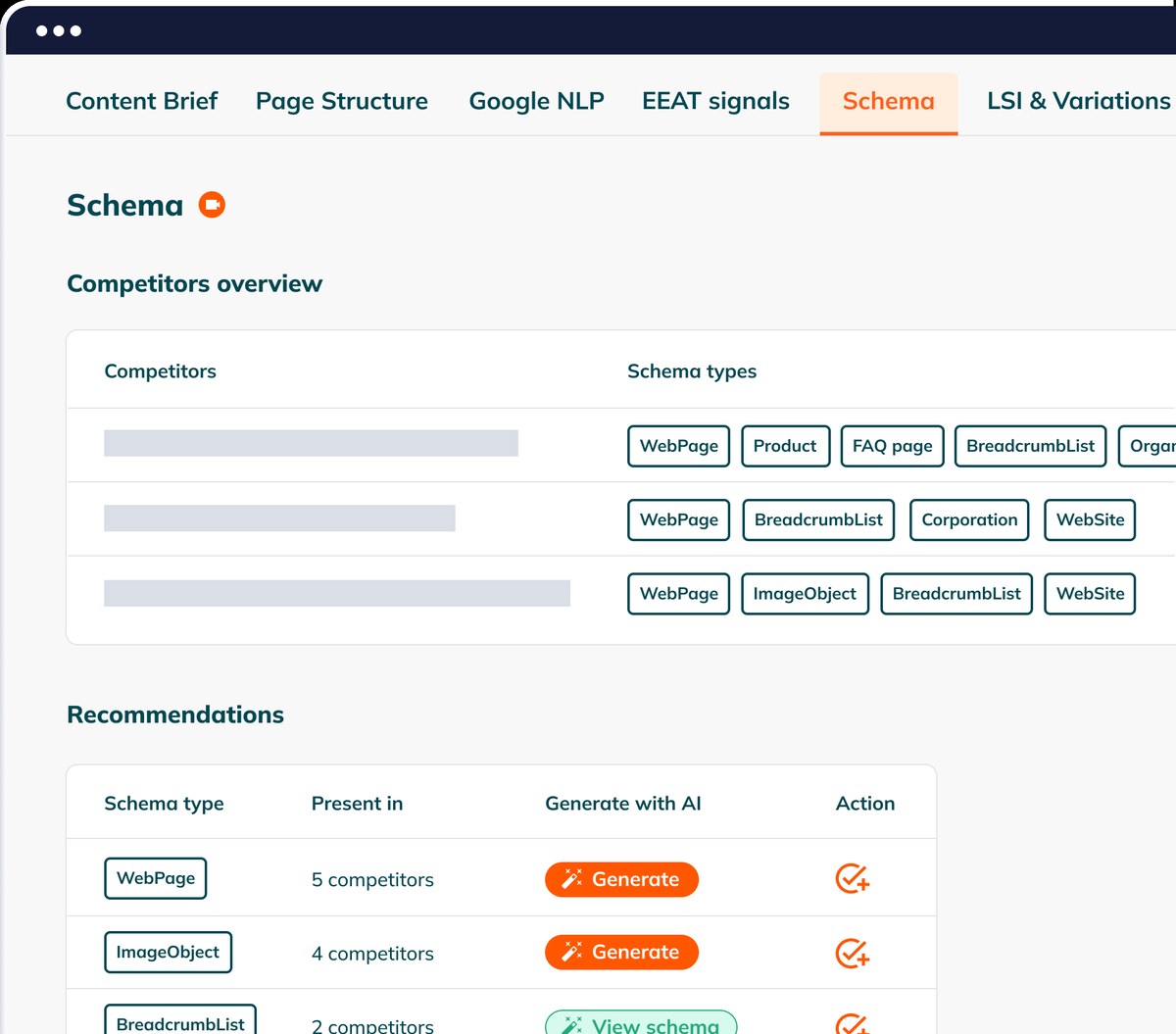
Schema must describe visible, truthful page content and follow Google's structured-data policies. Competitor adoption does not make a type eligible, and generated markup should be validated before deployment.
NextGen E-E-A-T checks
The E-E-A-T module looks for observable signals such as author-page links, social descriptions, and organization markup. That checklist can catch omissions in page presentation.
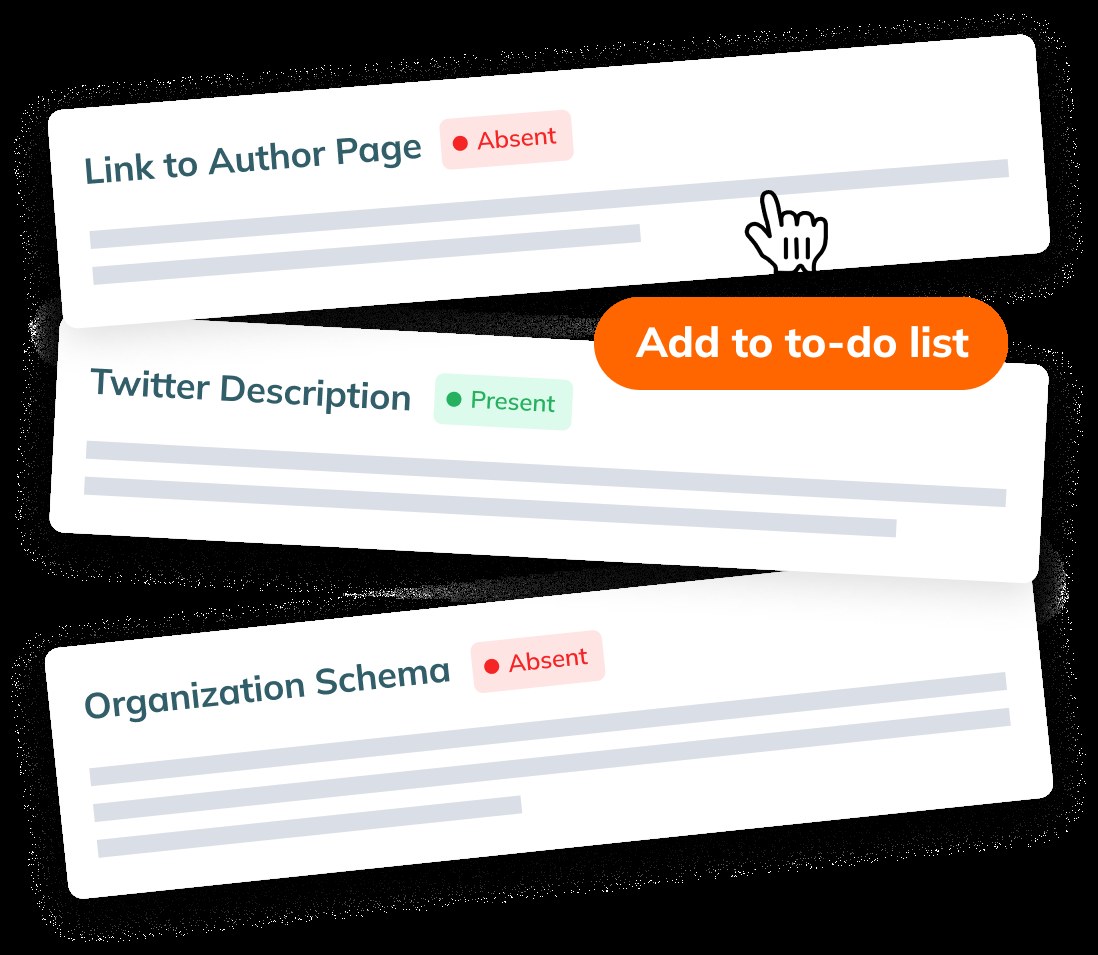
It cannot create genuine experience, expertise, authority, or trust. Those qualities come from who produced the information, how it was verified, what original evidence the page adds, and the broader reputation of the source. Use the module as a quality-control prompt, not as an E-E-A-T scorecard.
Watchdog monitoring
Watchdog monitors saved pages and can alert teams when optimization conditions or scores change. This is valuable for high-revenue pages, seasonal content, or client retainers because competitor sets and search results are not static.
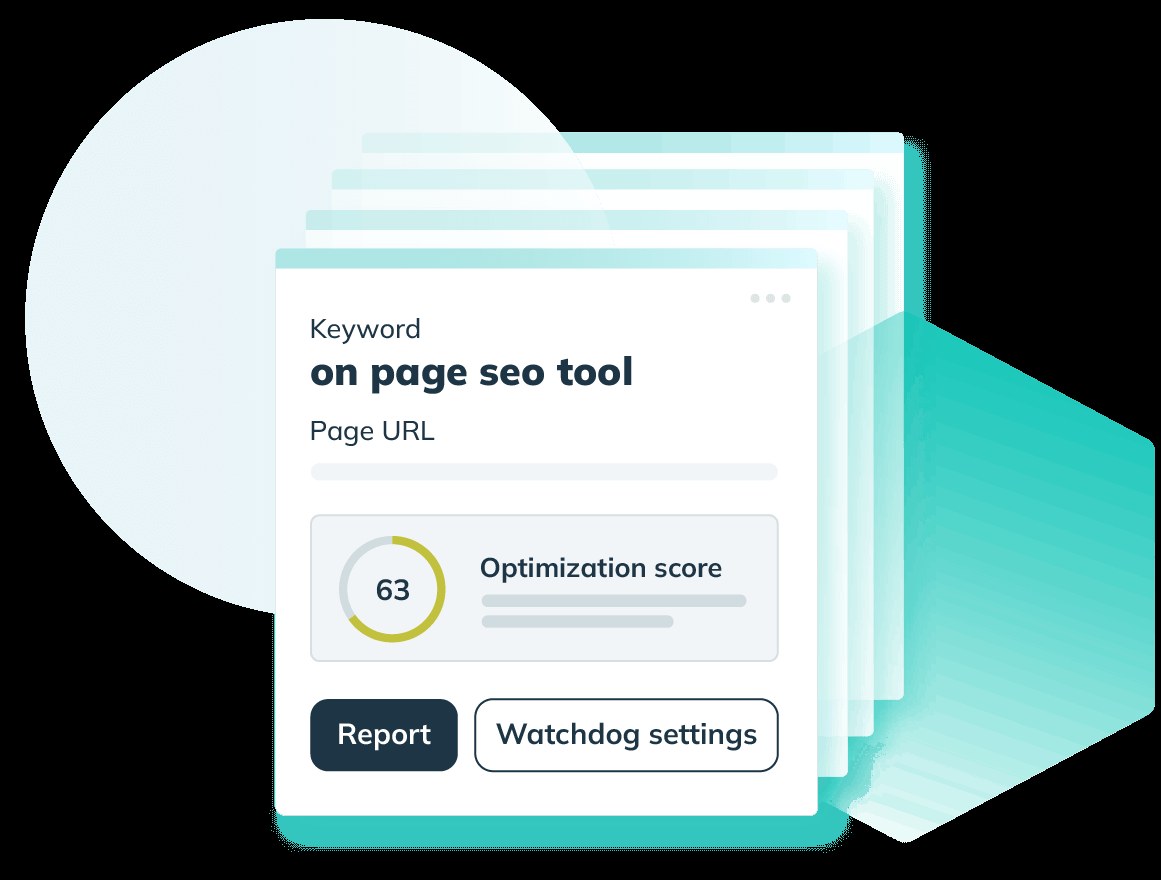
A change alert is a reason to investigate, not an automatic instruction to edit. Some movement reflects competitor churn or SERP composition rather than a defect on your page.
API and workflow automation
POP's public API page describes API access for reports, scores, audits, and custom interfaces. Current official API material lists a $10-per-month add-on across POP plans, with two POP credits consumed per API call. POP also documents separate pay-as-you-go and deferred-billing developer routes, so a normal subscription alone should not be treated as unrestricted API access.
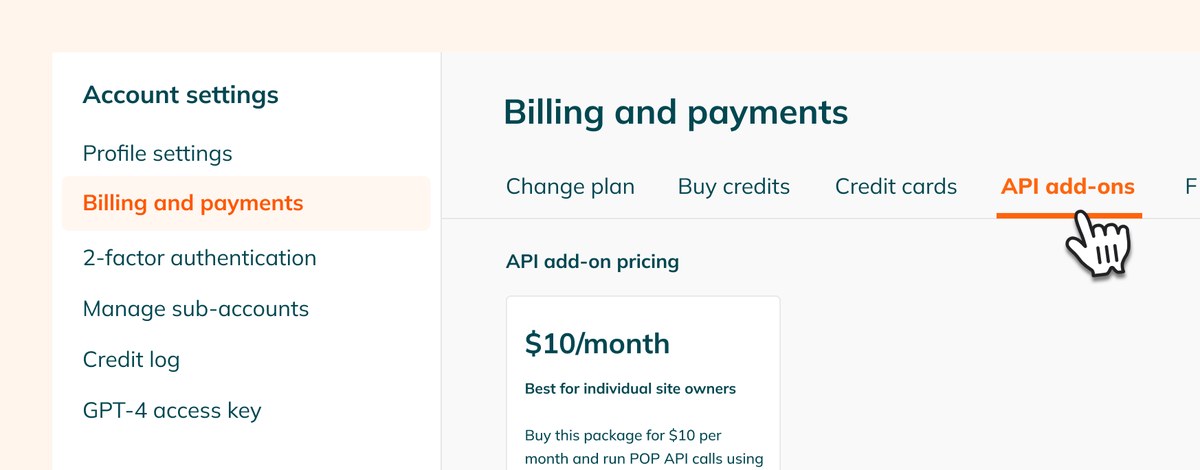
API availability can make POP more useful to agencies with internal dashboards or repeatable client reporting. Confirm endpoint scope, rate limits, account eligibility, and current add-on pricing before designing a production dependency.
Page Optimizer Pro Pricing
Pricing was checked on August 5, 2026. POP’s current pricing page separates plan price from the shared credit pool, and those two limits should not be blended.
| Plan | Monthly price | Current public limits highlighted | Best fit |
|---|---|---|---|
| Basic | $40/month | 20 shared POP credits; comparison table lists 10 Watchdog pages; report runs consume credits | Small sites testing a controlled number of pages |
| Unlimited | $72/month | 50 shared credits; reports and Watchdog runs are advertised as unlimited under fair use; Terms cap page runs at 450 per consecutive 90 days; comparison table lists 200 Watchdog pages | Active consultants and publishers |
| Teams | $143/month | 120 shared credits; reports and Watchdog runs are advertised as unlimited under fair use; Terms cap page runs at 900 per consecutive 90 days; comparison table lists 500 Watchdog pages; starts with 5 sub-accounts | Agencies and multi-user operations |
| White Glove | From $275/month | Managed on-page SEO service with service-specific deliverables | Buyers outsourcing execution rather than licensing software alone |
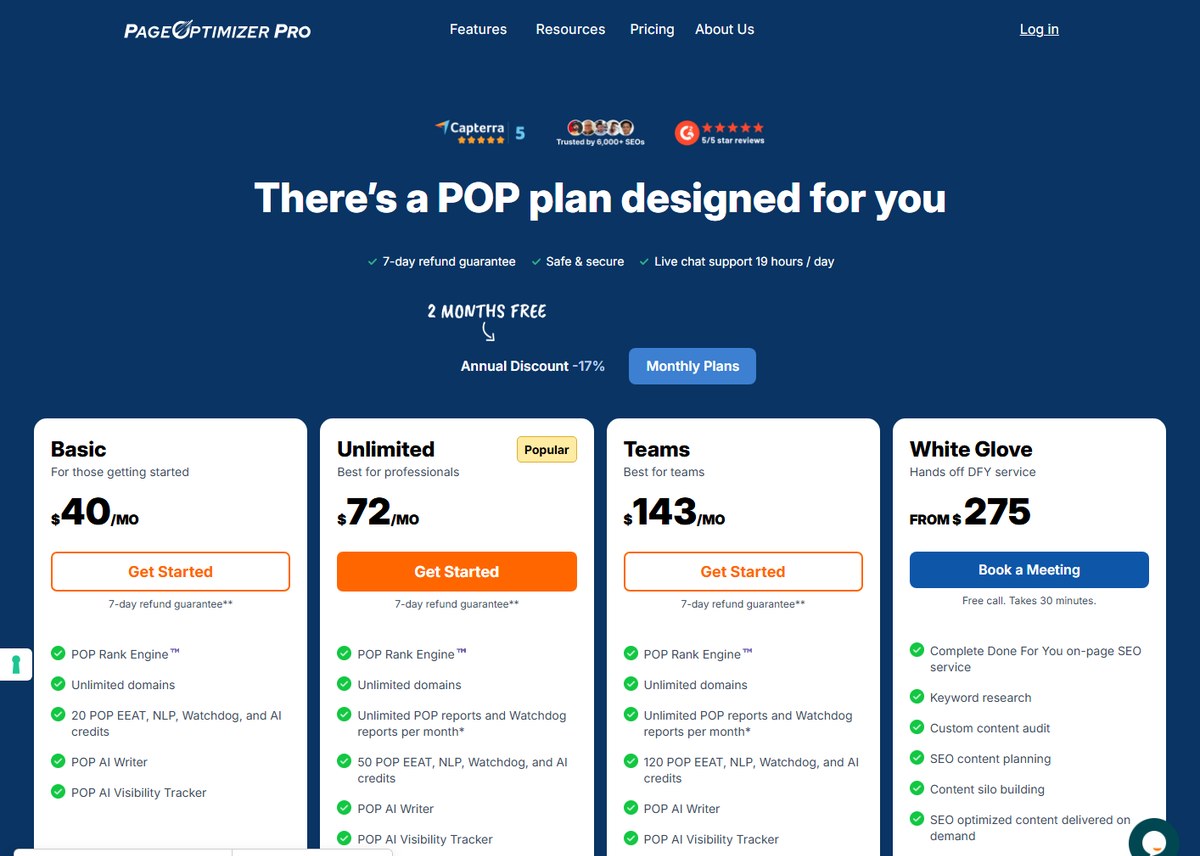
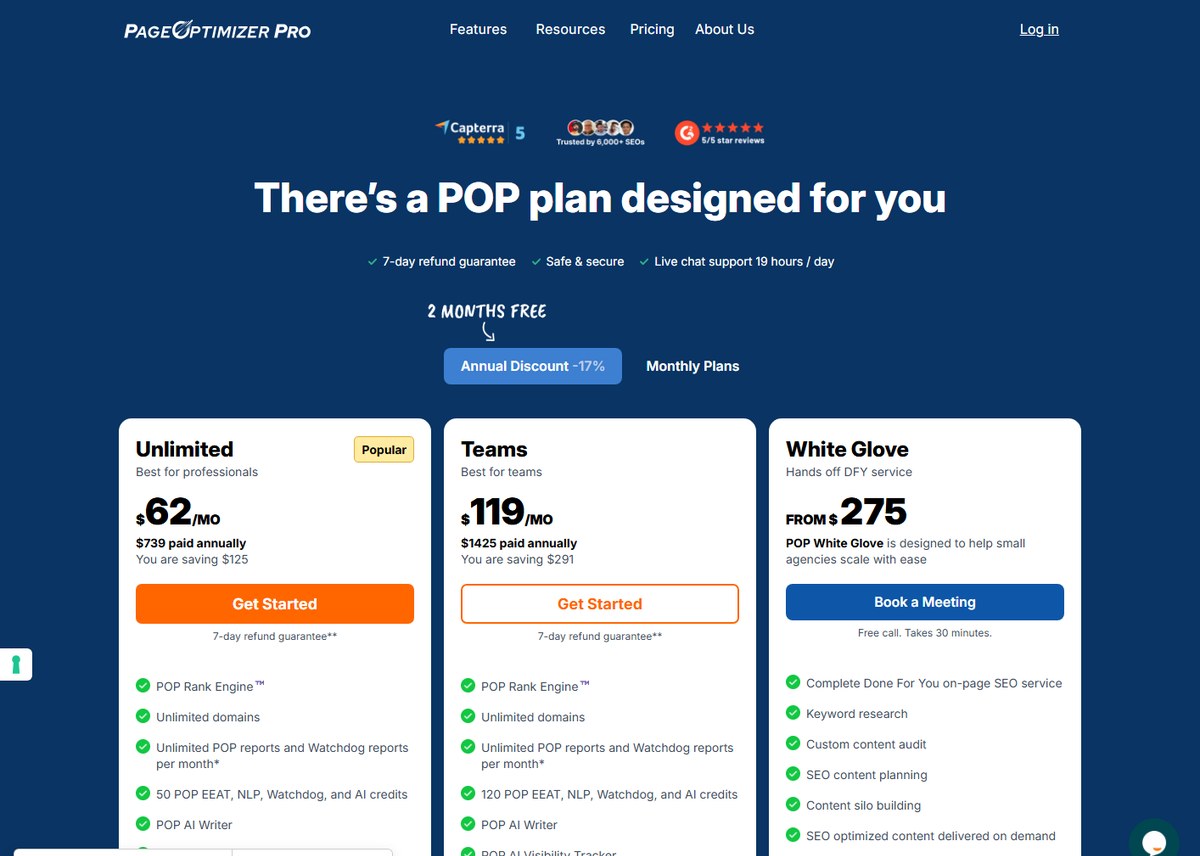
The annual state displayed Unlimited at a $62 monthly equivalent, billed $739 annually, and Teams at a $119 monthly equivalent, billed $1,425 annually. The page labeled those offers as saving $125 and $291 respectively. Basic did not appear as a matching annual card, so do not infer an annual Basic discount.
The homepage displays “Try for free” with the note “No sign-up required” and links to a public demo route. That is a no-signup demo, not a verified time-limited subscription trial. Paid plan cards separately state a “7-day refund guarantee,” and the refund policy limits that request window to the first seven days of the subscription period, subject to fair use and other conditions.
Subscriptions automatically renew. POP’s terms say cancellation occurs in the dashboard, access continues through the current paid term, and fees are not prorated. The refund page also says a refund request does not cancel the subscription.
POP credits: the current page still conflicts with itself
The comparison table lists 20, 50, and 120 shared monthly POP credits for Basic, Unlimited, and Teams. Current official help lists a new Basic optimization report at two credits, a score-update rerun at one, and a rerun that switches setup or applies changes at two. The separate graduated one-to-five-credit table is tied to keyword-tool usage, not ordinary report creation; other first-party keyword pages use different rates, so this review does not convert that conflict into a single budget number.
For AI writing without a user-supplied OpenAI key, official first-party material conflicts between three and four POP credits per 1,000 words. With an OpenAI key, the current help matrix lists two POP credits per article regardless of length, plus the user’s separate OpenAI API bill. Each article includes five free regenerations; later title, heading, paragraph, list, table, FAQ, meta, introduction, or conclusion actions are shown as one credit. Verify the live meter before forecasting production.
Watchdog limits are also inconsistent on the same pricing page. The comparison table shows 10, 200, and 500 pages, while a lower explanatory block says Unlimited offers 100 and Teams offers 250. That is not a small editorial difference. Ask support which limit applies before choosing a plan for monitoring.
Review POP’s live limits before committing to annual billing
How Many POP Reports and AI Credits Do You Need?
Forecast report analysis, shared-credit actions, monitored pages, and user access separately. “Unlimited” means report runs are advertised as unlimited under fair use on the higher plans; it does not make AI generation, NLP, E-E-A-T, Watchdog capacity, or seats unlimited.
A Basic user running six new optimization reports would use 12 of the listed 20 credits before AI writing, NLP, E-E-A-T, Watchdog, or other metered actions. One 1,000-word AI draft without an OpenAI key would take another three or four credits under the conflicting official rates, leaving four or five. Basic is therefore better treated as a low-volume optimization plan than a production content factory.
Unlimited and Teams separate unlimited report runs from shared monthly credits, which makes their economics more predictable for analysis-heavy workflows. The question becomes accepted output: how many briefs, usable draft sections, entity checks, and monitored pages survive editorial review per 50 or 120 credits? A cheaper nominal draft is not cheaper if editors discard it.
For an agency, seats and client isolation may become the binding limit before credits. Teams starts with five sub-accounts, with additional seats displayed at $12 per month or $120 per year. Confirm whether projects, secret keys, exports, and client permissions match the handoff model before annual billing.
Run the evaluation with a meter sheet. Record starting and ending credits, report keyword counts, monitored pages, generated words, rewrites, accepted recommendations, and editor time. This reveals operating cost better than the plan name.
Can POP Improve Google and AI Search Visibility?
POP can improve the quality of the optimization process by making page differences visible and connecting them to a brief. It cannot prove that a recommended edit caused a ranking change. Search results depend on intent, technical accessibility, site reputation, links, originality, user response, competition, and query-specific systems beyond on-page terms.
The same caution applies to AI visibility. POP lists an AI Visibility Tracker on all current plans and says it monitors ChatGPT, Google AI Overviews and AI Mode, Gemini, Claude, and Perplexity. It reports mentions, recommendations, citations, share of conversation, competitors, and query fan-out. Those are observability outputs, not proof that a POP recommendation caused referral traffic or improved AI visibility. Inspect prompt coverage, geography, refresh cadence, and citation methodology before treating the module as a buying reason.
A safe operating rule is to optimize for the reader first, use POP to find defensible omissions, and record why each major edit was made. Google's helpful-content guidance asks for original information, substantial value, clear sourcing, and expertise. A higher page score does not substitute for those signals.
Pros and Cons of PageOptimizer Pro
Pros
- Deeper page-level diagnostics than a simple keyword checklist.
- Connected briefs, AI writing, NLP entities, schema, E-E-A-T, and monitoring.
- Competitor selection and page structure can support repeatable agency workflows.
- Keyword clustering and Watchdog extend value before and after drafting.
- API access and team plans support operational integration.
- A no-signup public demo and separate seven-day refund guarantee provide two evaluation paths with different conditions.
Cons
- Reports, Watchdog pages, accounts, and AI credits remain limited by plan.
- Current public pages conflict on some AI credit and language details.
- Competitor selection can skew the entire analysis.
- Interface breadth may overwhelm buyers who want a minimal editor.
- The platform does not replace technical SEO, backlinks, analytics, or true subject expertise.
- Scores and vendor ranking stories can encourage correlation-driven edits if governance is weak.
Page Optimizer Pro Alternatives
| Alternative | Choose it when | Main trade-off versus POP |
|---|---|---|
| Surfer SEO | You prioritize a polished collaborative content editor, briefs, and broad market adoption | POP offers a different diagnostic depth, E-E-A-T, Schema, and Watchdog mix |
| Frase | Research, questions, SERP summaries, and guided briefing are the main bottlenecks | Less emphasis on POP's page-factor and monitoring stack |
| Clearscope | Editorial adoption, term guidance, and a clean writer experience matter more than many modules | Higher-cost positioning and fewer POP-style technical page checks |
| NeuronWriter | You need a lower-cost NLP editor and content scoring workflow | Different agency, API, monitoring, and advanced diagnostic trade-offs |
POP competes most directly with content optimization tools, not broad suites such as Semrush or Ahrefs. A broad suite may identify the opportunity; POP can help decide what to change on the target page.
Who Should Use PageOptimizer Pro?
| Buyer | Fit | Why | What to verify first |
|---|---|---|---|
| SEO professional | Strong | Deep page diagnostics, competitor control, entities, schema, and update workflows | Whether the report logic fits your query and locale mix |
| Marketing agency | Strong with Teams | Briefs, sub-accounts, exports, Watchdog, and repeatable client deliverables | Seats, client isolation, Watchdog limits, and shared-credit usage |
| Content creator | Conditional | Briefs and guided writing can structure drafts and refreshes | Editorial revision time and credit cost per accepted section |
| Website owner | Conditional | Basic can support a small set of important pages | Whether technical SEO, analytics, and backlinks remain uncovered |
| Enterprise governance team | Weak to conditional | Public product evidence does not establish enterprise security or compliance depth | Security, retention, permissions, procurement, and support requirements |
POP is a strong fit for:
- SEO professionals who understand search intent and competitor selection.
- Agencies that need documented briefs, repeatable audits, user seats, and monitoring.
- Content creators updating existing pages, not only generating new drafts.
- Website owners managing a portfolio of commercial or evergreen URLs.
- Teams that want schema, entity, and E-E-A-T checks beside content recommendations.
- Developers who can benefit from API-connected reporting.
It is a weak fit for:
- Beginners expecting a score to replace SEO judgment.
- Teams primarily needing site crawling, indexation debugging, backlinks, or rank tracking.
- Publishers without a fact-checking and originality process for AI writing.
- Buyers who cannot predict report and credit usage.
- Organizations that need enterprise security or governance conclusions beyond public documentation.
How We Evaluated PageOptimizer Pro
POP’s rendered monthly and annual pricing states, homepage, AI Writer, keyword tools, Schema, Watchdog, E-E-A-T, API documentation, terms, refund policy, and public interface visuals were captured on August 5, 2026. We also compared the product’s claims with Google Search Central guidance on people-first content and structured data. The 8/10 score weights diagnostic depth at 30%, workflow control at 25%, production and monitoring coverage at 20%, plan value and usage clarity at 15%, and governance transparency at 10%. POP scores lower on usage clarity because its current pricing page contains conflicting Watchdog limits and first-party pages conflict on AI Writer credit rates.
Final Decision
PageOptimizer Pro earns an 8/10 editorial score for page-level SEO and content optimization. Rank Engine reports, briefs, AI writing, keyword clustering, NLP entities, schema, E-E-A-T checks, Watchdog, and API access make it more operationally complete than a narrow content score.
The product is most valuable when an experienced operator interprets the report. It is least valuable when a team treats competitor averages as rules or pursues a perfect score without improving the answer. Use the available evaluation or refund window to test three representative jobs: a new article, an important update, and a page with an unusual intent. Track setup time, useful recommendations, false positives, credits consumed, and editor acceptance before choosing annual billing.
Check PageOptimizer Pro’s current evaluation terms
How We Test and Score
ScaleWitAI funds every account used in this review with its own capital. We subscribe to all paid tiers with self-funded plans and never use sponsored, gifted, or vendor-provisioned accounts, so our evaluation reflects the same product a paying customer receives and stays 100% independent of vendor influence.
Evaluation combines standardized test suites with hands-on workflow testing. We use HumanEval-style tasks to probe logic and code reasoning, BLEU/ROUGE-style metrics to measure natural-language quality, and internal stress-test scenarios to map context-window limits and long-input behavior. We run more than 10,000 prompts per AI platform every year, across varied access conditions, and log results against a transparent scoring rubric.
The dataset for this review was collected over 12 months (from August 2025 to August 2026). Historical comparisons track AI model development since 2024, and this report tests and compares 12+ leading AI models and providers on the market.
Frequently Asked Questions
How much is Page Optimizer Pro?
On August 5, 2026, monthly prices were $40 for Basic, $72 for Unlimited, and $143 for Teams. White Glove started at $275. Annual cards showed $62 and $119 monthly equivalents for Unlimited and Teams, billed $739 and $1,425 annually.
Does PageOptimizer Pro have a free trial?
POP offers a “Try for free” public demo with “No sign-up required.” That is not the same as a seven-day subscription trial. Paid plans separately carry a seven-day refund guarantee, subject to fair use and the refund terms.
Is PageOptimizer Pro an AI writer?
It includes an AI Writer with automatic and guided workflows, but that is one part of the platform. POP also covers page analysis, briefs, keyword tools, NLP entities, schema, E-E-A-T checks, monitoring, and API access.
Will a higher POP score guarantee higher rankings?
No. A score reflects POP's analysis of selected competitors and factors. Rankings depend on many additional variables, and competitor correlation does not prove causation. Use the score to prioritize investigation, not as a guarantee.
Is POP good for existing content or only new articles?
Both. Briefs and AI writing support new pages, while Rank Engine reports, the Content Editor, Chrome extension, Watchdog, schema, and E-E-A-T checks can support updates to existing URLs.
What are the best Page Optimizer Pro alternatives?
Surfer SEO, Frase, Clearscope, and NeuronWriter are close content optimization alternatives. The best choice depends on whether you prioritize editor simplicity, research, collaboration, price, diagnostics, monitoring, or API workflows.
How do PageOptimizer Pro credits work?
The current comparison table lists 20, 50, and 120 shared credits for Basic, Unlimited, and Teams. Official help lists a new Basic report at two credits, a score-update rerun at one, and a setup-change rerun at two. AI Writer material conflicts between three and four credits per 1,000 words without an OpenAI key; with a key, the current matrix lists two POP credits per article plus separate OpenAI charges.
Does POP guarantee visibility in Google or AI search engines?
No. POP can identify page differences and provide a structured optimization workflow, but it cannot guarantee rankings, traffic, conversions, or inclusion in AI answers. Its AI Visibility Tracker should be evaluated by engine coverage, prompt set, geography, update cadence, and citation methodology.
Is PageOptimizer Pro the same as a complete SEO suite?
No. POP focuses on page-level optimization and connected content workflows. Most teams still need crawling, analytics, rank tracking, backlink research, conversion data, and editorial expertise from other tools or processes.
