Surfer SEO is a strong choice for teams that want one workflow for SERP-informed content optimization, content refreshes, and AI-search visibility. Its Content Editor remains the clearest reason to buy because it turns competitor and topic signals into real-time guidance that writers, editors, and SEO leads can apply consistently.
| Decision factor | Editorial finding |
|---|---|
| Best for | SEO professionals, content teams, agencies, and brands coordinating Google and AI-search optimization |
| Strongest capability | Content Editor with actionable, real-time optimization guidance |
| Broader workflow | Topical Map, keyword research, Content Audit, AI Tracker, collaboration, integrations, and automation |
| Starting price | Discovery is listed at $49 per month when billed yearly, checked August 2, 2026 |
| Free access | No ongoing free full plan was confirmed; eligible new accounts can receive a 7-day Pro trial that auto-converts unless canceled |
| Main trade-off | Meaningful team, AI visibility, automation, and API capabilities are divided across increasingly expensive tiers |
| Accuracy boundary | Content Score is a diagnostic, not a Google ranking factor or guarantee |
| Overall score | 8.4/10 |
The platform is more ambitious than a writing scorecard. Current plans combine Content Editor, Content Audit, Topical Map, keyword research, collaboration, and varying levels of AI Tracker access.
Quick Verdict: Should You Use Surfer SEO?
Use Surfer SEO when your team will repeat the full research, optimization, refresh, and monitored-visibility loop often enough to justify the plan cost. Compare lower-cost content optimizers first if you publish infrequently, and choose a broader SEO suite instead if backlinks, technical crawling, rank tracking, or a large keyword database are your primary needs.
Our evidence-based rating is 8.4/10. Surfer is strongest as a connected content-operations layer, but its price rises quickly when a buyer needs more seats, daily AI tracking, higher page limits, API access, or enterprise controls.
Review Surfer SEO's current plans and 7-day Pro trial
What Is Surfer SEO?
Surfer SEO is a cloud platform for planning, creating, optimizing, auditing, and monitoring search-focused content. The public site now uses Surfer and Positive Surfer branding, but the product's center of gravity is still recognizable: analyze the search landscape, translate the findings into a content brief and editor, then monitor published pages and refresh opportunities.
Within the broader AI writing and content optimization tools category, the important boundary is what Surfer does not try to be. It does not offer the same all-purpose backlink, competitor, technical crawling, and keyword intelligence stack as Ahrefs or Semrush. Its value is narrower and more operational: helping a content team decide what to cover, how to structure a page, where coverage is thin, which existing pages deserve attention, and how visible a brand is in selected AI-answer environments.
That focus can be an advantage. A writer does not need to interpret a large SEO database before editing a page. An agency can standardize briefs and approval steps. An SEO lead can move from a declining URL in Content Audit into Content Editor, then monitor selected AI prompts. The drawback is stack overlap: many buyers will still pay for a crawler, backlink database, analytics platform, and editorial QA.
How Does Surfer SEO Work?
A typical Surfer workflow has five stages:
- Choose a target query and location. Surfer analyzes the relevant search results and lets the user review or adjust the competitor set.
- Build the brief. Content Editor derives term, topic, heading, length, image, and structure guidance from selected pages and its language models.
- Write or import content. A team can start inside Surfer, import an existing URL, use Surfy or other AI assistance, or collaborate through supported integrations.
- Review recommendations instead of chasing a perfect score. Editors decide which terms, facts, headings, and links genuinely help the reader.
- Publish, audit, and monitor. Connected site and Google Search Console data can feed Content Audit and Topical Map, while AI Tracker monitors a defined prompt set on eligible plans.

This process is more useful than treating Surfer as a keyword-density tool. The competitor selection and target location affect the recommendation set. A local service page should not be modeled on a national glossary. A product comparison should not blindly inherit the word count or headings of an unrelated result. The editor still owns search intent, evidence quality, brand fit, and final usefulness.
Surfer SEO Features: What Matters Most
Content Editor and the Current Content Score
Content Editor is Surfer's strongest and most mature buying case. It can start from a query or import an existing URL, then show recommendations while the draft changes. The current public documentation describes Content Score as a combination of:
- SEO Score: term use, topical coverage, structure, and alignment with relevant top-performing pages.
- AI Search Score: Facts Coverage plus Upfront Intent Alignment, or how comprehensively the page addresses relevant concepts and how clearly it answers the main need near the beginning.
Surfer says scores below 33 indicate substantial optimization gaps, 33 to 66 indicates a reasonable foundation, and above 66 is ready to compete. More important, its own guidance says a perfect 100 is usually unnecessary and advises aiming roughly 10 to 20 points above selected competitors rather than over-optimizing.
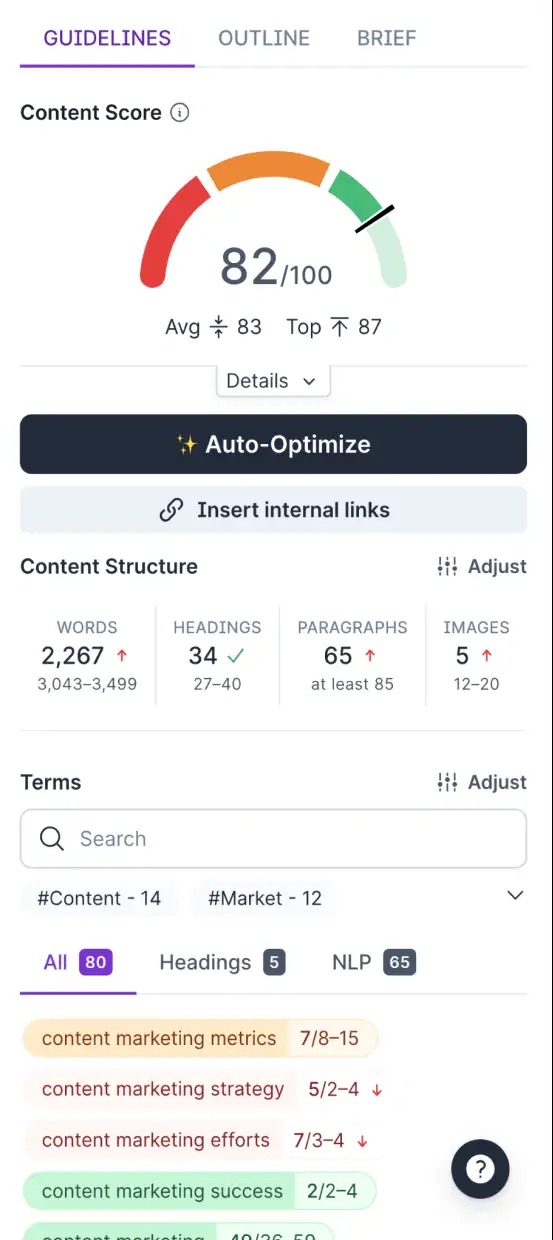
That is the right way to use the score. It can reveal a missing entity, an underdeveloped subtopic, or an unusually thin section. It cannot determine whether a claim is true, whether original research is persuasive, whether examples are useful, or whether Google will rank the page. Google publishes its own ranking systems; Surfer's metric is not one of them.
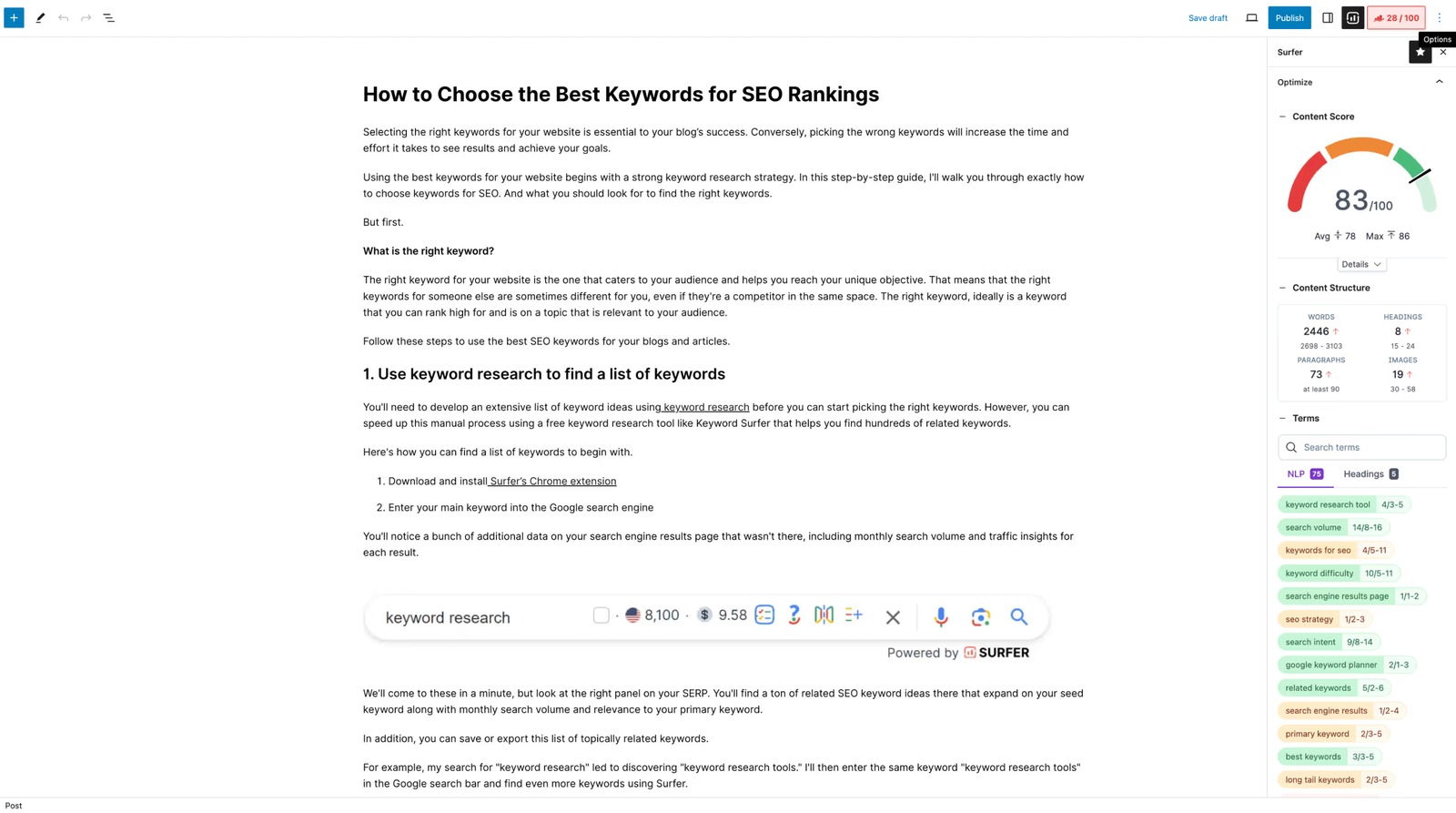
Content Editor also supports outlines, notes, shareable links, comments, real-time collaboration, URL imports, and Auto-Optimize. Auto-Optimize proposes changes and lets users compare, accept, undo, or reject them. That review step matters. Adding every recommended phrase can make an article repetitive or distort its meaning.
Content Audit for Refresh Prioritization
Content Audit brings existing pages into the workflow. With a connected property, Surfer says it surfaces pages with traffic or ranking changes, recommends opportunities, and can send a selected page into Content Editor. For teams with hundreds of URLs, the documented workflow can serve as a queue of pages to inspect.
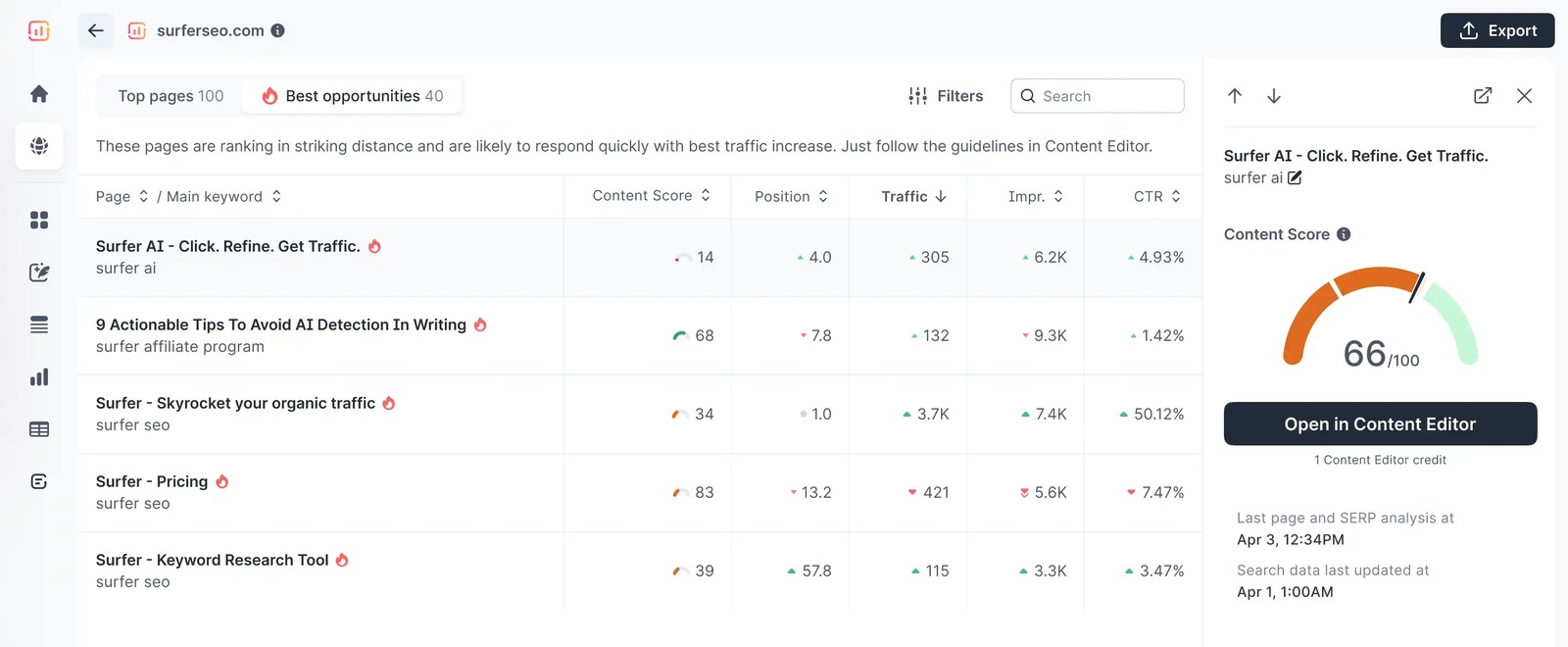
The tool should still be treated as a prioritization layer. A traffic decline could reflect seasonality, indexing, a site migration, changed intent, stronger competitors, or a technical issue outside Surfer's content recommendations. Content Audit does not remove the need to inspect Google Search Console, analytics, crawling data, the live SERP, and the page itself.
Topical Map and Keyword Research
Topical Map helps teams move from isolated keywords to a broader content plan. Surfer uses connected domain and Google Search Console context to map existing coverage, gaps, topic clusters, and possible next pages. Its marketing page says the map refreshes every 14 days, which makes it more useful as an operating view than a one-time export.

There is one public documentation conflict worth noting. The marketing page says all countries are supported or can be enabled, while a help article describes 23 supported countries. The United States is supported, but international teams should verify the exact country and language combination before building their workflow around it.
Surfer's keyword research and topic-planning tools are useful for content ideation, but they do not turn the platform into a full keyword and backlink suite. Teams that need extensive competitive databases, historical rankings, link indexes, and technical research will normally pair Surfer with another SEO platform.
AI Tracker and AI Search Analytics
AI Tracker measures how a defined brand appears across selected AI-answer systems. Current public materials describe Visibility Score, mentions, mention gaps, sentiment, competitor share, prompt-level results, and cited sources. Higher Full AI SEO tiers cover ChatGPT, Perplexity, Google AI Mode, Google AI Overviews, and Gemini, with limits and refresh cadence determined by plan.

This gives GEO and AEO teams a repeatable monitoring layer, but its scope needs careful interpretation. A prompt set is a sample, not every question a buyer might ask. Answers can vary by model, date, location, personalization, and system behavior. A Visibility Score is therefore a directional measurement for the tracked setup, not a universal share of AI search.
Surfer also sells standalone AI Search Analytics for teams that want tracking without the full content toolkit. The public help center lists 50, 100, 200, or unlimited daily-tracked prompt tiers. At the time of research, the 50-prompt tier was listed at $95 monthly or $82 per month on yearly billing. This is a separate commercial path, so compare it with the AI Tracker allowance already included in a Full AI SEO plan.
Surfy, Surfer AI, Auto-Optimize, Detector, and Humanizer
Surfer includes multiple automation layers. Surfy assists inside Content Editor, Surfer AI can generate content, and Auto-Optimize can apply suggested improvements for review. The company also offers an AI Detector and Humanizer. Public help materials describe the detector as unlimited and the Humanizer as sharing an allowance that varies by account status, with 50,000 words per month stated for active subscriptions.
These tools can accelerate drafting and cleanup, but none should be treated as an assurance that a page is accurate, original, human-authored, undetectable, or eligible to rank. Google says generative AI can support research and structure, while scaled generation without added value may violate spam policies. Human review should verify claims, sources, quotations, links, tone, intellectual property, and audience usefulness before publication.
Integrations, Collaboration, and Agency Workflow
The current pricing comparison lists WordPress and Google Docs across paid plans, Contentful on Pro and above, Zapier on Peace of Mind, and API access on Peace of Mind and Enterprise. Exact availability is plan-sensitive, so a logo on an integrations page is not enough to assume access on a lower tier.
For agencies, Surfer's team controls may matter as much as the score. The public comparison lists one seat on Discovery, three on Standard, five on Pro, and ten on Peace of Mind. It also distinguishes brand workspaces, content history, activity logs, comments, folders, collaboration links, and onboarding by tier.
Automated internal linking has prerequisites. Surfer's semantic mode requires a Google Search Console connection and a Content Audit project for the domain. Its documentation also warns that AI-generated external links can occasionally be incorrect or hallucinated. Every suggested destination and anchor still needs verification.
Public API documentation describes endpoint rate limits, monthly or annual quotas, and webhooks registered with support. Surfer also notes that there is no API endpoint for checking remaining quota programmatically. Engineering teams should model retries, quota monitoring, and plan limits before using it in a high-volume publishing pipeline.
Surfer SEO Pricing and Free Trial
The public Full AI SEO page displayed the following US prices on August 2, 2026. The four self-serve prices are monthly equivalents billed yearly, not month-to-month totals; Enterprise is shown separately as a tailored package from $999/month. Pricing, limits, integrations, and fair-use rules are volatile, so verify checkout before purchase.
| Plan | Price shown | Key public limits and fit |
|---|---|---|
| Discovery | $49/month billed yearly | 120 documents per year, 10 tracked pages, no tracked AI prompts, one seat; entry-level optimization |
| Standard | $99/month billed yearly | 360 documents per year, 25 AI prompts refreshed weekly, 50 tracked pages, three seats |
| Pro | $182/month billed yearly | 360 documents per year, 50 AI prompts refreshed daily, 200 tracked pages, five seats, more integrations and brand workspaces |
| Peace of Mind | $299/month billed yearly | Unlimited documents subject to fair use, 100 daily-refreshed prompts, 500 tracked pages, ten seats, API access |
| Enterprise | From $999/month, tailored | Custom limits, SSO, advisory, legal onboarding, white-label options, priority support, and enterprise controls |
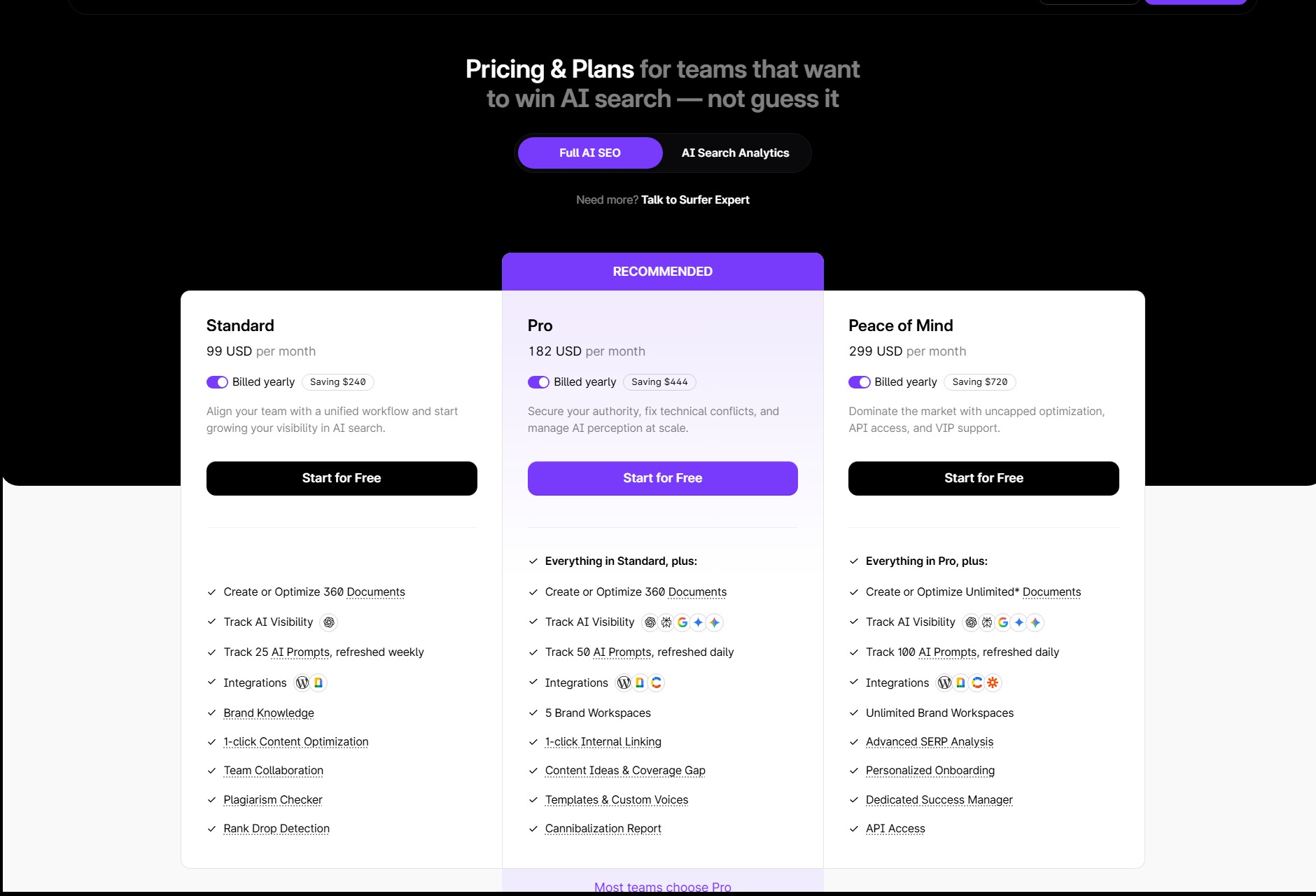
Eligible new accounts can receive a 7-day Pro trial. Surfer requires billing details and a selected post-trial plan at checkout. The trial does not cancel automatically: it converts and charges the selected subscription unless the user cancels before the seven days end. This is a trial, not an ongoing free plan.
Surfer says subscriptions can be canceled and remain active through the current billing period. It also says saved Content Editors, Audits, tracked Sites, and other work are deleted when access expires, so export anything needed before the end date. Accounts cannot be paused.
Refund expectations need equal care. The public regulations state that prepaid annual fees are not generally refundable, although a customer may request a proportional recalculation that Surfer may accept. Statutory consumer rights can differ, but US business buyers should not assume a general money-back guarantee.
Check Surfer SEO's current plan and trial terms
Is Surfer SEO Accurate, and Can It Improve Rankings?
Surfer's accuracy depends on the query, location, selected comparison pages, and connected data, and its public evidence does not establish causal ranking lift. Its documented signals can flag topic gaps, unusual structure, weak intent alignment, and neglected refresh opportunities, but ScaleWitAI did not benchmark their accuracy or speed against a manual review.
It cannot prove causal ranking lift. Search results change, competitors update pages, links and brand signals matter, technical problems intervene, and Google uses many systems that Surfer does not control. Public vendor case studies may show what selected customers achieved, but they do not predict a new customer's outcome.
A responsible evaluation asks whether Surfer improves decision quality and cycle time:
- Did briefs require fewer revisions?
- Did editors catch important omissions earlier?
- Did the team refresh the right pages sooner?
- Did writers preserve accuracy and readability while meeting useful coverage goals?
- Did tracked Google and AI visibility move over a defined period?
- Did the gains justify the software and editorial labor cost?
Run those measurements during the trial. Do not judge the product only by whether a score turns green.
Surfer SEO Pros and Cons
Pros
- Content Editor translates complex search and topic signals into a practical writing interface.
- The workflow now connects planning, creation, optimization, audit, internal linking, and AI visibility.
- The documented workflow includes comments, external collaboration links, Google Docs, and WordPress.
- Plan-level AI Tracker access supports brands monitoring both Google and emerging answer platforms.
- Surfer's own score guidance discourages chasing 100 and acknowledges over-optimization risk.
- Public API, quota, webhook, DPA, and subprocessor documentation provides useful procurement inputs.
Cons
- Pricing rises quickly when a team needs daily AI tracking, more workspaces, API access, or high limits.
- It remains an additional tool for teams that also need backlinks, broad keyword intelligence, technical crawling, and analytics.
- Recommendations depend on the query, location, and selected competitors; a weak setup can produce weak guidance.
- Content Score can encourage formulaic writing if teams reward the number instead of reader value.
- Trial conversion is automatic, annual refund terms are restrictive, and saved work is deleted after subscription expiration.
- Public marketing and help pages are not perfectly synchronized, as shown by the Topical Map country-language conflict.
- Enterprise security claims are not the same as public evidence of a SOC 2 or ISO certification.
Security, Privacy, and Enterprise Procurement
Surfer's customer privacy notice names Surfer sp. z o.o. as controller and includes data-processing terms for employee or associate data entrusted through a customer account. Its public subprocessor list includes Google Cloud Platform and Cloudflare, along with billing, analytics, support, AI, and operational providers. The DPA text says entrusted data will be deleted or returned within 30 days after contract termination or a written deletion request, subject to backups and legal requirements.
The Enterprise page states that Surfer supports SSO, encryption in transit and at rest, real-time monitoring, and internal and external audits. Those are vendor claims, not independent certification evidence. We did not confirm a public SOC 2 report or ISO certificate.
Before an agency or enterprise team connects confidential drafts, Search Console data, client sites, or automation, procurement should request:
- current SOC 2 or ISO evidence if the organization requires it;
- the current DPA and complete subprocessor schedule;
- data-residency and cross-border transfer terms;
- incident-notification, retention, deletion, backup, and export details;
- a clear answer on whether customer prompts, drafts, or connected data are used for model training;
- SSO, API, audit-log, support SLA, and legal-onboarding terms for the selected plan.
Surfer SEO Alternatives
No single alternative is best for every buyer; use the missing capability and total annual cost to build a shortlist. The rows below are evaluation paths, not unsupported rankings or claims that one product is more mature than another.
| Alternative | Add it to the shortlist when | Verify before choosing |
|---|---|---|
| Clearscope | A content-optimization workflow is the main buying question | Current scoring inputs, collaboration, integrations, AI-visibility coverage, and annual cost |
| NeuronWriter | Budget sensitivity is central to the buying decision | Current limits, scoring workflow, team controls, AI-visibility coverage, and annual cost |
| Page Optimizer Pro | Focused on-page guidance is the main buying question | Current recommendation depth, workflow controls, reporting, integrations, and annual cost |
| Frase | Research and briefing workflow is the main buying question | Current research, drafting, optimization, collaboration, and annual cost |
| Ahrefs or Semrush | The required checklist extends beyond content operations | Current keyword, backlink, rank, competitor, technical, content, and AI-search capabilities |
Select an alternative only after comparing the same EAV checklist: annual cost, document allowance, users, optimization guidance, audit, integrations, data export, and AI-visibility monitoring. This avoids treating either a lower sticker price or a longer feature list as proof of better fit.
Who Should Buy Surfer SEO?
Buy or trial Surfer first if:
- your team publishes or refreshes enough pages to use Content Editor every month;
- you need standardized briefs and review rules across writers, brands, or clients;
- Content Audit and Topical Map will feed a recurring content roadmap;
- Google optimization and monitored AI-answer visibility belong in the same operating process;
- collaboration, WordPress, Google Docs, or higher-tier automation belongs on your required-capability checklist.
Compare or skip it if:
- you publish only a few pages and cannot use the annual document allowance;
- your primary problems are backlinks, technical crawling, local listings, or rank tracking;
- you need API access but cannot justify Peace of Mind or Enterprise;
- your organization requires certifications or contractual controls that have not yet been verified;
- your team is likely to optimize for a green score rather than evidence, expertise, and reader outcomes.
Final Verdict: Is Surfer SEO Worth It?
Surfer SEO is worth considering for serious content operations because its strongest features cover connected stages. Content Editor presents recommendations. Topical Map and keyword research inform what to create. Content Audit identifies what to revisit. AI Tracker extends measurement into selected answer platforms. Collaboration and integrations provide controls for a standardized process.
The product is less compelling as an occasional writing assistant. Discovery lowers the entry point, but the team and AI-search value becomes clearer on Standard, Pro, or Peace of Mind, where annual cost is substantial. Buyers should calculate usage, not just feature count.
Our evidence-based rating is 8.4/10. Surfer earns high marks for core content optimization and an increasingly coherent Google-plus-AI workflow. It loses points for pricing, plan gates, documentation conflicts, and procurement questions that require direct verification. Use the trial to measure time saved and decision quality, and treat every score as an informed prompt for human review, not a promise.
Review Surfer SEO's current plans and trial terms
How We Test and Score
ScaleWitAI funds every account used in this review with its own capital. We subscribe to all paid tiers with self-funded plans and never use sponsored, gifted, or vendor-provisioned accounts, so our evaluation reflects the same product a paying customer receives and stays 100% independent of vendor influence.
Evaluation combines standardized test suites with hands-on workflow testing. We use HumanEval-style tasks to probe logic and code reasoning, BLEU/ROUGE-style metrics to measure natural-language quality, and internal stress-test scenarios to map context-window limits and long-input behavior. We run more than 10,000 prompts per AI platform every year, across varied access conditions, and log results against a transparent scoring rubric.
The dataset for this review was collected over 12 months (from August 2025 to August 2026). Historical comparisons track AI model development since 2024, and this report tests and compares 12+ leading AI models and providers on the market.
Frequently Asked Questions
Is Surfer SEO any good?
Yes, for teams that need repeatable content optimization. Content Editor is the strongest reason to use it, and the broader Audit, Topical Map, collaboration, and AI Tracker workflow adds value at scale. It is less attractive for occasional users or buyers who actually need a full SEO suite.
Can I use Surfer SEO for free?
No ongoing free Full AI SEO plan was confirmed. Eligible new accounts can receive a 7-day Pro trial, but billing details are required and the trial automatically converts unless canceled before it ends.
How does Surfer SEO work?
Surfer analyzes relevant search competitors for a target query and location, then turns the findings into content, term, fact, heading, structure, and image guidance. Teams can write or import a page, review the recommendations, publish through supported workflows, and use connected audit or tracking tools afterward.
What is a good Surfer Content Score?
Surfer's public guidance says a score above 66 is ready to compete, but it also advises against chasing 100. A more useful target is roughly 10 to 20 points above the selected competitors while preserving accuracy, natural language, and search intent.
Does Surfer SEO guarantee higher rankings?
No. Surfer can improve coverage and workflow consistency, but it cannot control Google's ranking systems, competitors, backlinks, technical health, or audience response. Measure ranking and traffic outcomes separately.
Does Surfer SEO have a WordPress plugin?
Surfer publicly documents a WordPress integration and shows WordPress in its current plan comparison. Verify the required plan, plugin requirements, and publishing workflow before purchase because integration access can change.
Can Surfer SEO replace Ahrefs or Semrush?
Not by default. This review evaluates Surfer as a content optimization, audit, and AI-visibility workflow. If the required checklist also includes keyword databases, backlink indexes, rank tracking, or technical crawling, compare those capabilities separately and choose the combination that covers the documented requirements.
