Robinize is a focused SEO content optimization platform that connects competitor research, content recommendations, AI-assisted drafting, WordPress publishing, and rank tracking. Its strongest case is workflow breadth at a low entry price; its biggest weakness is unclear AI-credit economics and limited public documentation.
| Decision factor | Editorial finding |
|---|---|
| Homepage | robinize.com |
| Category | SEO content optimization and AI-assisted writing platform |
| Best for | Content creators, SEO strategists, and small marketing teams that want research, drafting, publishing, and tracking in one workflow |
| Starting price checked August 5, 2026 | Free plan; Individual at $19/month; Team at $49/month |
| Main advantage | Analyzes the top 20 competitors and connects recommendations to AI drafting, WordPress publishing, and rank tracking |
| Main limitation | Public pages list AI credits but do not explain what one credit buys or how each action consumes credits |
The buying decision is therefore less about whether Robinize has enough features and more about whether its monthly report, project, research, tracking, and unexplained AI-credit limits fit your production volume. This review examines those limits, the annual-price math, the public workflow evidence, and where Robinize fits beside other AI writing and content optimization tools.
Quick Verdict: Is Robinize Worth It?
Robinize is worth shortlisting if you want a budget-friendly, end-to-end SEO content workflow rather than the deepest specialist optimizer. The Free plan is unusually useful for evaluation, while Individual and Team combine competitor research, reports, AI assistance, WordPress publishing, and rank tracking under one subscription.
The caution is operational clarity. Robinize lists 30, 200, or 1,500 AI credits by plan, but its public pages do not define the consumption unit. That makes accepted-output cost hard to forecast. The platform is also not a technical crawler, backlink database, analytics suite, or substitute for an editor who can verify intent, evidence, originality, and factual accuracy.
Evaluate Robinize's current plan and quotas
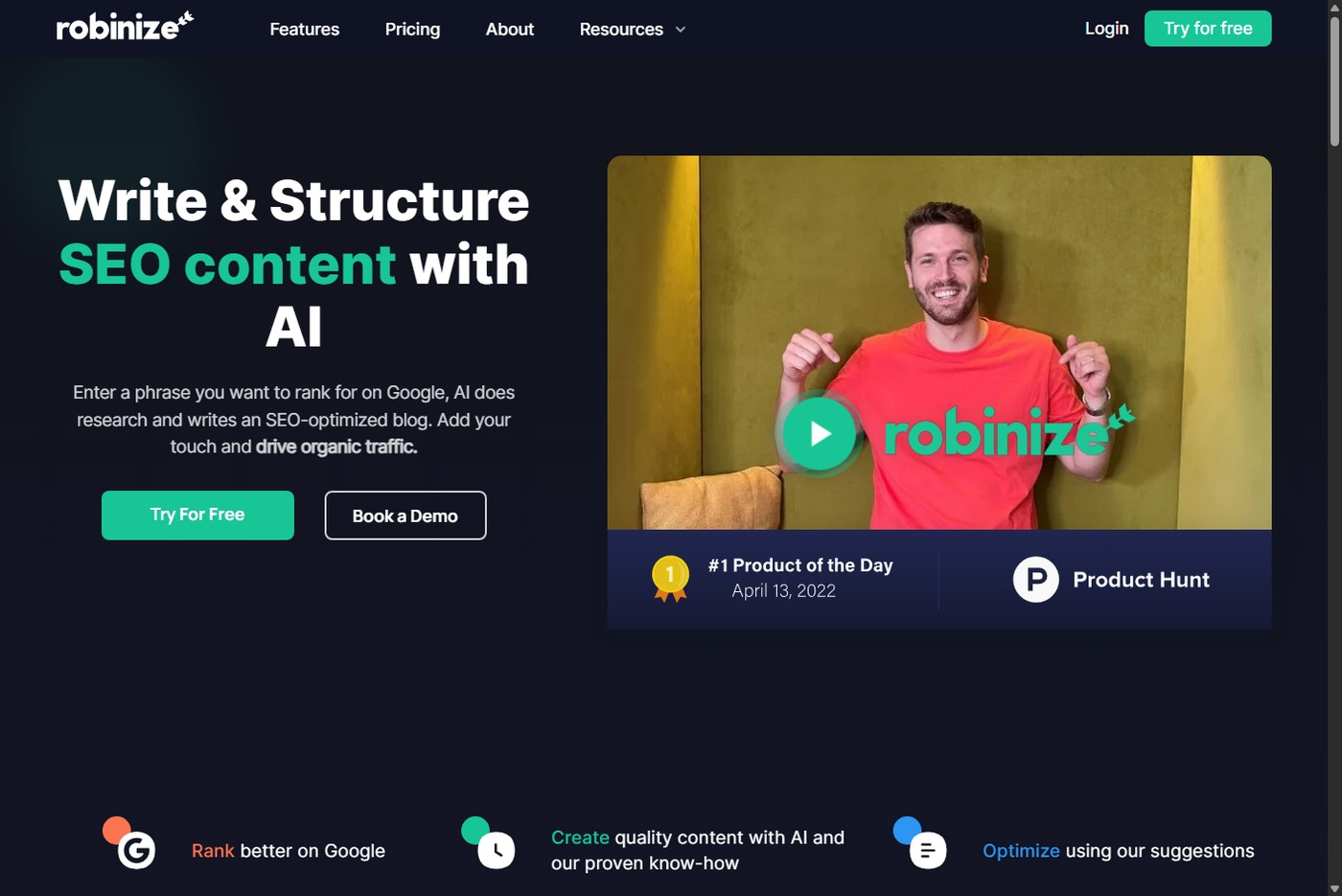
Robinize's homepage positions the product around AI-assisted SEO content research and writing. The screenshot is marketing evidence, not a performance result. Elsewhere on the public page, Robinize describes a five-stage flow spanning keyword research, a competitor report, AI-assisted article creation, WordPress publishing, and rank tracking.
What Is Robinize?
Robinize is an SEO content optimization and AI writing platform built around competitor-page research. Its public homepage says a user enters a target phrase, Robinize researches competing content, and the AI module helps construct an optimized article that the user can edit and publish.
The category boundary matters. Robinize is broader than a keyword-density editor because it includes projects, keyword research, content reports, AI generation, WordPress integration, and plan-limited rank tracking. It is narrower than an all-in-one SEO suite because public materials do not establish site crawling, backlink intelligence, technical issue remediation, analytics attribution, or enterprise content governance.
Robinize's public pages do not present a fully consistent legal identity. Its About page describes Robinize as a product under the ZenDev umbrella, while its Terms of Service define “Robinize” as ZenDev d.o.o. and Alviral d.o.o., both based in Mostar, Bosnia and Herzegovina. The site footer says “Robinize, Inc.” without explaining the relationship. Robinize is currently marketed as self-serve and exposes a public registration form; US buyers that need a contract, tax form, invoice, or data-processing agreement should confirm the contracting entity.
How Does Robinize Work?
Robinize organizes content production into a linear workflow:
- Create a project. A folder stores keyword research, reports, and writing for one website.
- Research a target keyword. Robinize surfaces related terms, volume, difficulty, and competitor opportunities.
- Generate a detailed report. The system evaluates what the top 20 competitors cover, including terms, questions, outlines, and content-score context.
- Build and edit the article. The AI module can generate sections from selected questions and revise or regenerate output.
- Publish or export. Robinize documents direct publishing to WordPress, currently its only named CMS integration.
- Track the keyword. Rank tracking monitors position changes over time within the plan's keyword allowance.
That sequence can reduce handoffs for a solo creator or a small team. It can also amplify a weak premise. If the target keyword has mixed intent, or if the top-ranking pages are not true business competitors, a detailed report may optimize the wrong page type with impressive precision.
What Are Robinize's Key Features?
Keyword research and competitor opportunities
Robinize's feature documentation says its keyword module identifies terms that competitors rank for, gaps, and related opportunities. The interface displays keyword volume, difficulty, topic information, and a route to generate a report.
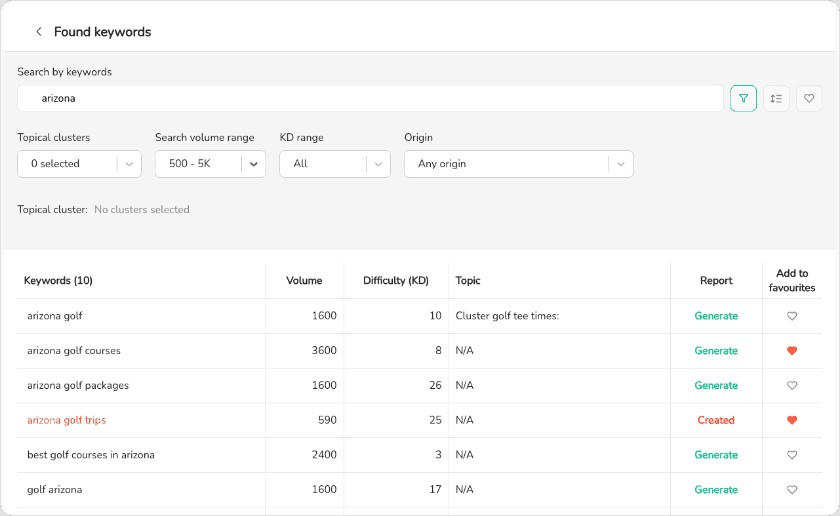
This is useful for moving from a broad topic to a report candidate without switching products. It is not evidence that every suggested keyword deserves its own URL. Search intent, business value, an existing content inventory, and cannibalization risk still require editorial review.
Top-20 competitor reports, terms, and inspiration
The homepage says Robinize's detailed report examines the top 20 competitors. The public interface groups information into Terms, Inspiration, Outlines, and SERP views. Robinize also describes questions from Google's People Also Ask and related sub-keywords as inputs for understanding user intent and planning subheadings.
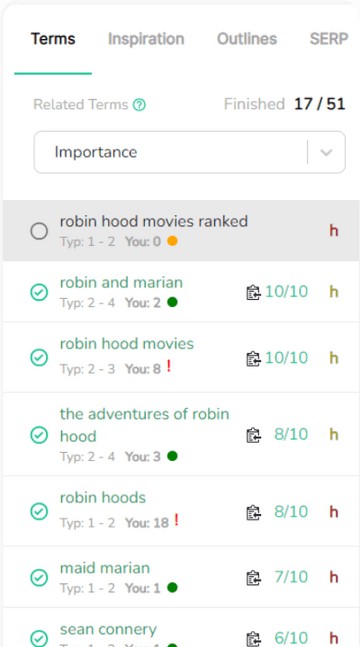
The screenshot uses a sample “Robin Hood movies” query. Its values demonstrate interface structure, not customer performance or a universal recommendation threshold. A content strategist should validate competitors before treating term ranges as an editorial checklist.
Content score, length, and readability recommendations
Robinize documents a content score from 1 to 10, recommended content length, word-count comparison, and readability based on Flesch reading ease. These attributes create an objective review target, but the score is Robinize's proprietary guidance, not a Google metric.
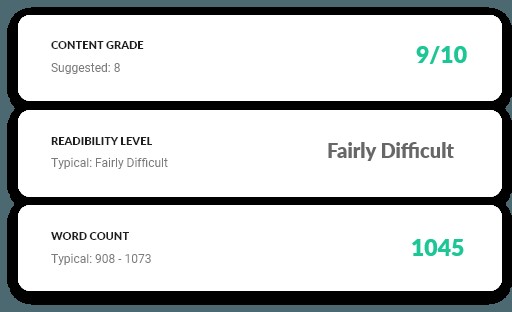
A higher score cannot guarantee rankings, helpfulness, conversions, or factual quality. Use it to find omissions and investigate differences, not to force every term into a natural draft.
AI outline and section generation
The AI content builder lets users select questions found in competing content, arrange those questions into an outline, and generate sections. Robinize says a user can ask the AI to modify a section, regenerate it, or suggest a title and meta description.
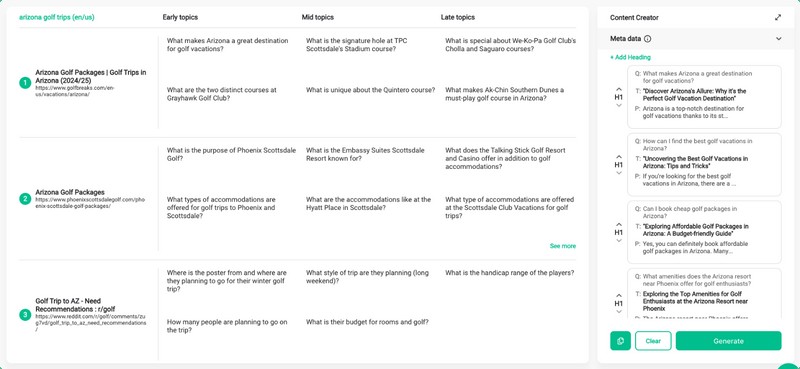
This integrated context is more useful than passing an isolated keyword list to a generic chatbot. It still does not verify sources, detect every factual error, establish first-hand experience, or prove originality. Public pages also do not identify the underlying model, context limits, or the number of credits consumed by each generation and regeneration action.
WordPress publishing
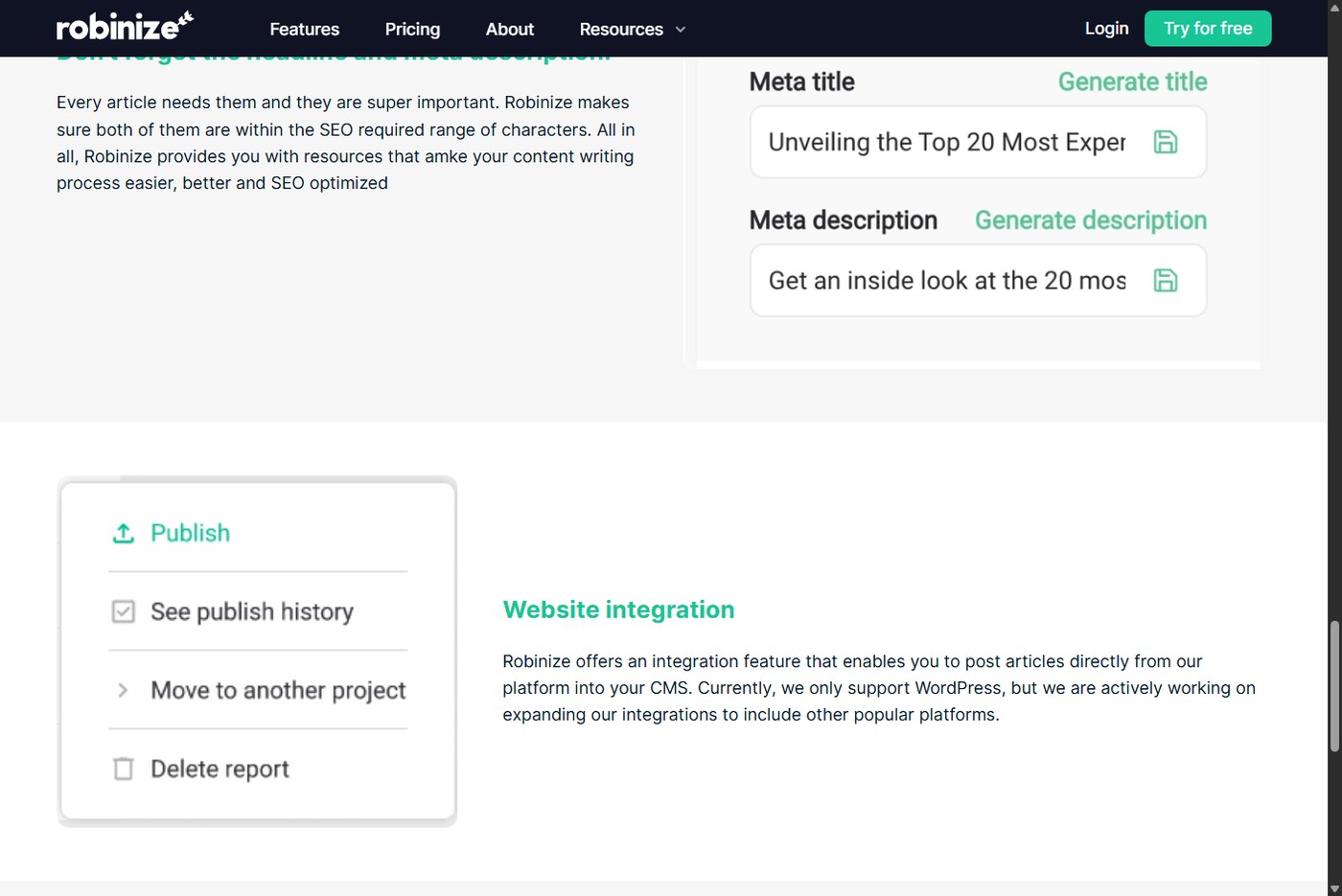
Robinize says users can post articles directly from the platform into a CMS and that WordPress is currently the only supported integration. Public materials do not explain authentication, post-status behavior, field mapping, rollback, or formatting edge cases, so those implementation details should be tested with a noncritical site before production use.
Rank tracking and 13-language positioning
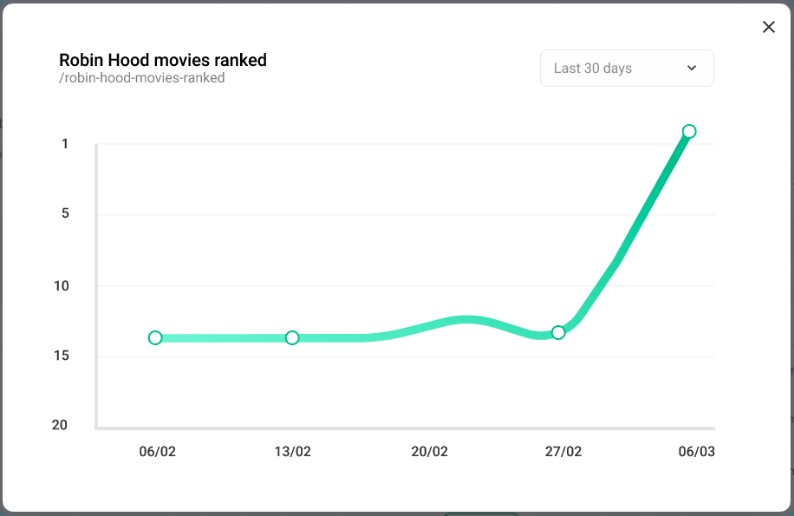
Robinize includes keyword rank tracking and describes it as a way to follow a keyword's Google position over time. Pricing limits tracked keywords to 3 on Free, 50 on Individual, and 200 on Team.
The homepage lists 13 languages: English, Swedish, German, Norwegian, French, Italian, Spanish, Portuguese, Dutch, Danish, Croatian, Serbian, and Bosnian. It does not clearly document whether all 13 receive equal keyword data, scoring quality, AI-generation quality, interface localization, and rank-tracking coverage. Multilingual teams should test their exact language and market rather than infer feature parity from the list.
What We Verified, and What Remains Uncertain
The evidence is strong enough to confirm the marketed workflow and displayed plan limits. Longer observation windows are still needed to judge $1.
A controlled buyer evaluation should use three representative jobs: one new article, one existing page needing a refresh, and one ambiguous query with mixed intent. Record report setup time, useful recommendations, rejected recommendations, AI credits consumed, revision time, WordPress formatting cleanup, and tracked-keyword behavior. The accepted article, not the nominal generation, is the correct cost unit.
How Much Does Robinize Cost?
Pricing was checked in the rendered public interface on August 5, 2026. Robinize separates monthly and annual billing while keeping the same monthly feature allowances.
| Plan | Displayed price | Current public capacity | Best fit |
|---|---|---|---|
| Free | $0/month | 1 seat; 3 reports/month; 2 projects; 30 AI credits; 2 keyword researches; 3 tracked keywords | Low-risk workflow evaluation |
| Individual | $19/month or $199/year | 1 seat; 10 reports/month; 3 projects; 200 AI credits; 10 keyword researches; 50 tracked keywords | Solo creators and consultants |
| Team | $49/month or $499/year | 3 seats; 50 reports/month; 20 projects; 1,500 AI credits; 40 keyword researches; 200 tracked keywords; Premium Support | Small content and marketing teams |
| Enterprise | Quote | “Contact us for a quota”; public cards do not list exact limits | Buyers needing a negotiated package |
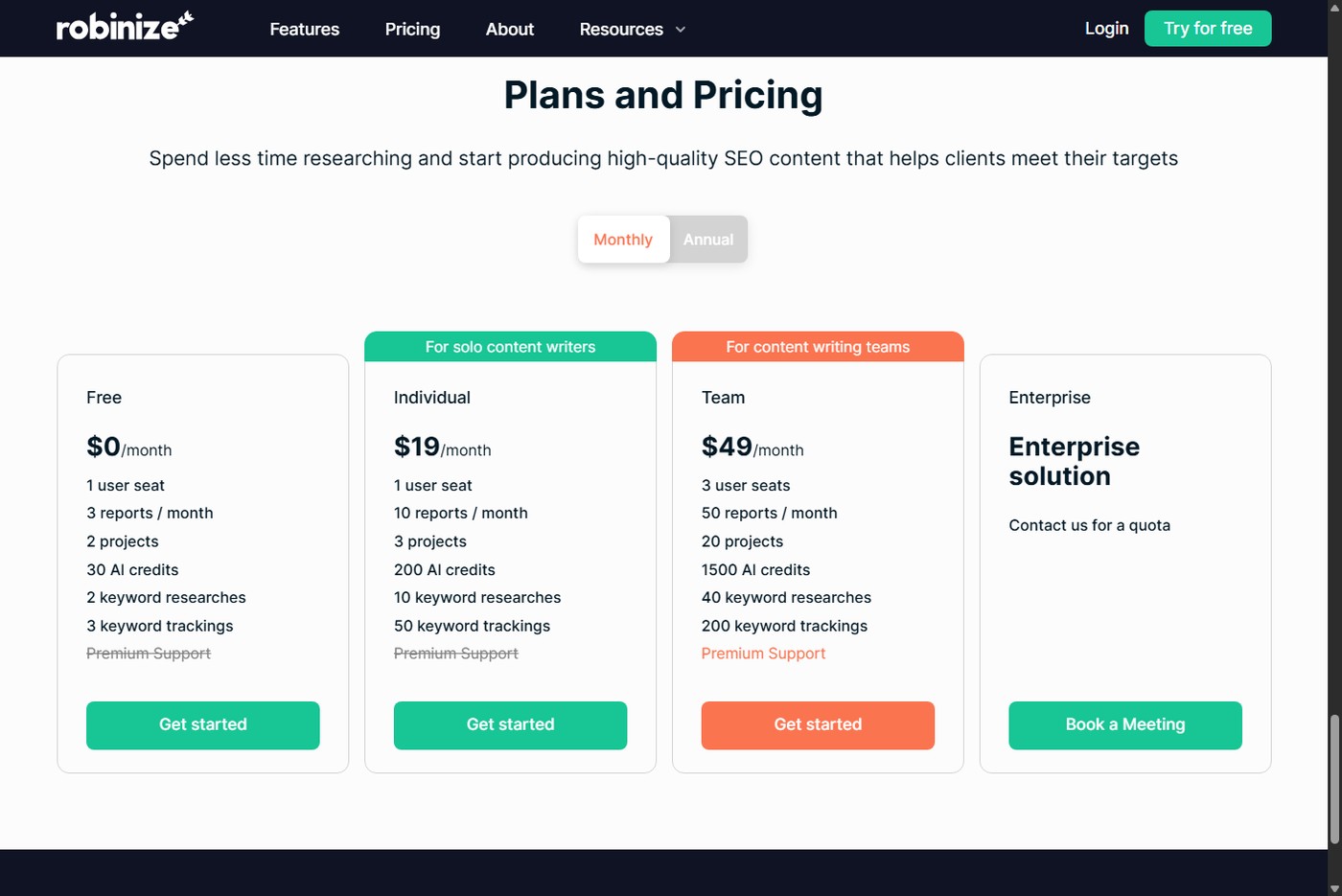
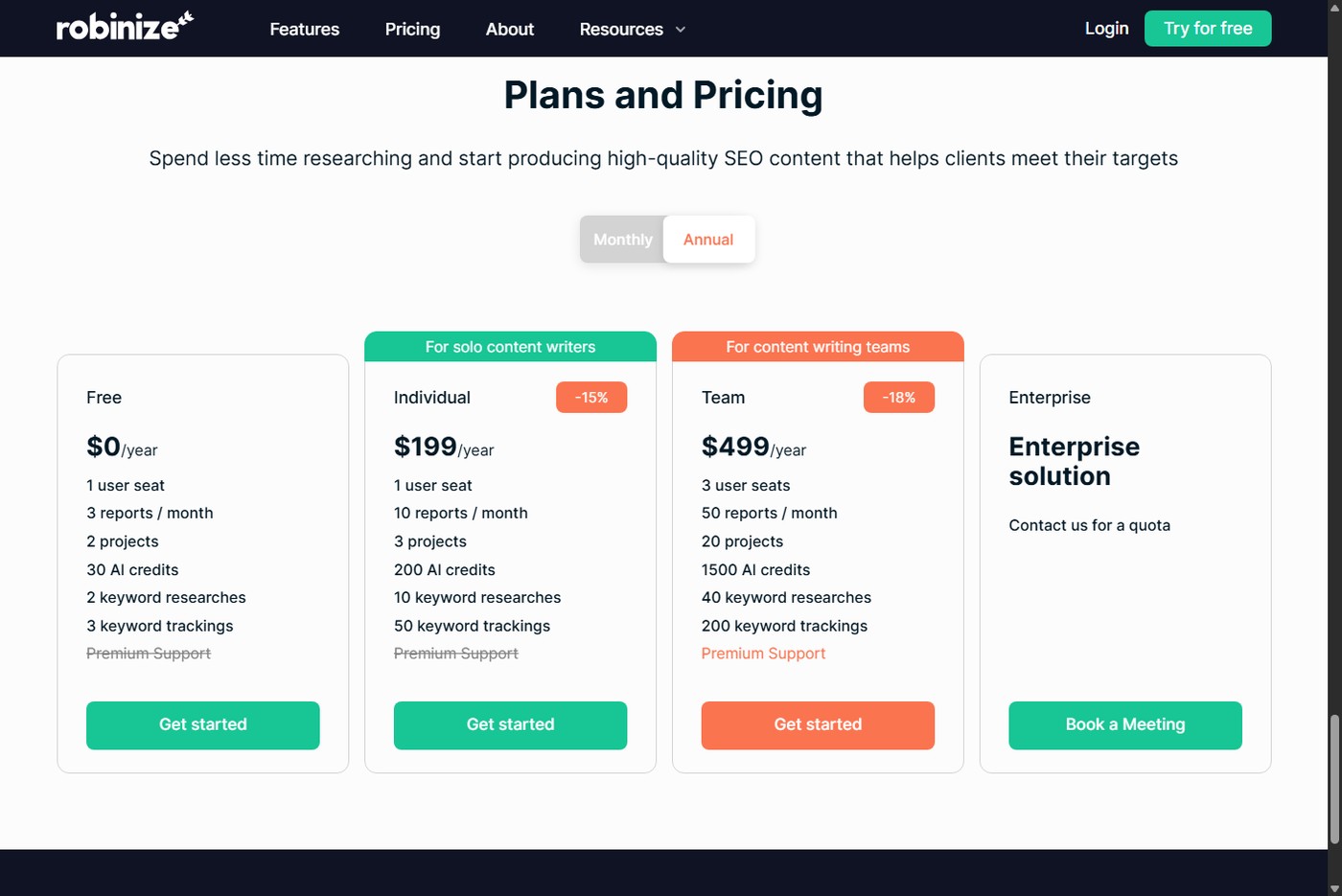
The cards use a dollar sign but do not label the billing currency or explain taxes. Only reports explicitly say “per month.” The reviewed public pages do not establish whether AI credits, keyword researches, or keyword trackings reset monthly, annually, or on another schedule. Confirm currency, tax treatment, renewal price, and each quota period at checkout.
Annual discount badges do not match simple displayed-price math
The annual cards show a -15% badge for Individual and -18% for Team. Comparing the visible totals with the current monthly cards produces different simple savings:
- Individual: $19 × 12 = $228; the $199 annual total saves $29, or about 12.7%.
- Team: $49 × 12 = $588; the $499 annual total saves $89, or about 15.1%.
Promotional baselines or rounding could explain the badges, but the public page does not show that calculation. Treat the annual totals as the reliable checkout comparison and verify the final charge before committing.
AI-credit value remains the central pricing unknown
The cards list AI-credit pools, but the reviewed public pages do not explain one credit's unit, generation costs, regeneration costs, rollover, overages, or behavior after exhaustion. This omission prevents a defensible cost-per-accepted-article estimate. A Free account is the safest place to record the live meter before selecting Individual or Team.
Check Robinize's live pricing and credit meter
What Do Robinize's Billing and Data Terms Mean?
Robinize's Terms say subscriptions automatically renew for periods matching the initial term unless either party requests termination at least 30 days before the current term ends. The company may change fees at the end of an initial or renewal period with 30 days' notice. The Terms state that customers shall be billed for usage exceeding the plan's Service Capacity or otherwise requiring additional fees, although the public pricing cards do not display an overage rate.
The Terms do not present a broad public money-back guarantee. A narrow refund clause applies when Robinize terminates after certain intellectual-property remediation is not commercially practical, which is not the same as a normal buyer refund window. The public Free plan is therefore a clearer evaluation path than assuming a paid trial.
After termination, the Terms say customer data will remain available for electronic retrieval for 30 days; Robinize may then delete stored customer data. The Terms state that customers own their Customer Data, while also allowing Robinize to analyze service-use and performance information, including information concerning Customer Data, to improve the service and disclose aggregate or de-identified results. The Privacy Policy says third-party vendors and hosting partners provide infrastructure and that data may travel through third-party networks. Public materials do not establish a SOC 2 report, DPA, subprocessor list, SSO, granular roles, or retention controls suitable for enterprise procurement.
Every pricing card contains “Premium Support” text, although the rendered Free and Individual cards visually strike it out while Team presents it as included. The Terms commit only to reasonable technical support by email and publish no response-time SLA. Treat support scope as a Team-plan claim unless Robinize confirms otherwise.
Can Robinize Boost Organic Search Traffic?
Robinize can improve the process used to research and optimize a page, but it cannot guarantee organic traffic. Competitor coverage, term guidance, readability, a content score, and rank tracking can make decisions more visible. They do not prove that an edit caused a ranking change.
Google's people-first content guidance prioritizes original value, clear sourcing, expertise, and content created primarily for people. Its spam policies also apply when automation produces content at scale without sufficient value. A safe Robinize workflow uses AI for structure and drafting, then requires source verification, original examples, editorial judgment, and a reason for the page to exist.
Who Is Robinize Best For?
The practical fit depends on the buyer's production model, first binding quota, and ability to review AI-assisted output.
| Buyer | Fit | Why | Verify first |
|---|---|---|---|
| Solo content creator | Strong | Free or $19 plan connects research, reports, AI assistance, publishing, and tracking | Credits consumed per accepted article |
| SEO strategist | Strong to conditional | Top-20 comparison, terms, outlines, score, readability, and tracking support page-level analysis | Competitor controls and keyword-data coverage for the target market |
| Small marketing team | Strong with Team | Three seats, 50 monthly reports, 20 projects, 1,500 credits, WordPress, and 200 tracked keywords | Roles, approvals, shared-credit behavior, and support scope |
| Multilingual publisher | Conditional | Thirteen languages are listed publicly | Whether research, scoring, generation, and tracking perform equally in each market |
| Enterprise governance team | Weak to conditional | Enterprise package is available by quote | Security, procurement, SSO, retention, DPA, roles, and audit requirements |
Robinize is a weaker fit for teams that primarily need technical crawling, backlink research, advanced analytics attribution, enterprise approval chains, or independently validated AI-output quality.
What Are the Pros and Cons of Robinize?
Pros
- Broad workflow at a low price: competitor research, reports, AI drafting, WordPress, and rank tracking start on a Free plan.
- Useful plan transparency: reports, projects, seats, research runs, and tracked keywords are visible on the public cards.
- Actionable content context: terms, questions, outlines, score, length, and Flesch readability connect research to editing.
- Direct publishing path: WordPress integration can reduce copy-and-paste work.
- Team capacity: the $49 monthly plan includes three seats and materially higher allowances.
Cons
- AI-credit consumption is not publicly defined.
- The annual discount badges do not match simple arithmetic from the displayed monthly and annual totals.
- Public WordPress documentation omits setup and field-mapping details.
- Language parity, rank-tracking accuracy, and data methodology are not established publicly.
- Security and governance documentation is too thin for an enterprise decision without direct diligence.
- A top-competitor model can mislead users who do not validate intent and page type.
What Are the Best Robinize Alternatives?
The closest alternatives overlap on SERP research, content guidance, AI assistance, or workflow management, but differ in breadth and operating model.
| Alternative | Choose it when | Main trade-off versus Robinize |
|---|---|---|
| Surfer SEO | A mature collaborative content editor and broad content-optimization ecosystem matter most | Usually a higher-cost workflow; Robinize offers a simpler low-entry path with native tracking allowances |
| Frase | SERP research, questions, briefs, and an AI-assisted editor are the main job | Different monitoring and publishing emphasis; compare current quotas directly |
| NeuronWriter | You want a value-focused NLP editor, entity guidance, and content scoring | Robinize puts more visible emphasis on its linear research-to-WordPress-to-tracking workflow |
| Scalenut | You need a broader planning, generation, optimization, and AI-search-oriented suite | Greater suite breadth can add cost and complexity that a small Robinize buyer may not need |
These are close category alternatives, not universal replacements. Compare the same units: accepted articles, research runs, user seats, projects, tracked keywords, publishing path, and editorial review time.
Where Does Robinize Fall Short?
Robinize falls shortest on public operational clarity, not basic feature coverage. The product pages explain what the workflow contains, but they do not answer several questions that determine production cost and risk:
- What does one AI credit buy?
- How many credits do generation, revision, and regeneration consume?
- Do credits reset, roll over, or incur overages?
- Which search database, location, device, and refresh cadence power keyword and rank data?
- What fields and post statuses does the WordPress integration support?
- Which controls protect unpublished client content?
- Do all 13 languages receive equal research and generation support?
- Which entity signs contracts and issues invoices: ZenDev d.o.o., Alviral d.o.o., or “Robinize, Inc.”?
- What support response time, onboarding, and escalation path does “Premium Support” include?
A Free account can answer some usage questions. Security, contractual, and enterprise-governance gaps require written confirmation rather than assumptions. On August 5, 2026, Robinize's linked Help Center returned a 404 page, while its linked public roadmap exposed a login surface rather than public feature details. Neither result proves inactivity, but both reduce the documentation available for independent buyer verification.
How We Evaluated RobinizeThis review uses a five-part rubric: workflow coverage 30%, plan value and capacity 25%, pricing and usage clarity 20%, publishing and monitoring utility 15%, and governance transparency 10%.
The component scores are workflow coverage 8.5/10, plan value and capacity 8.0/10, pricing and usage clarity 5.5/10, publishing and monitoring utility 8.0/10, and governance transparency 6.5/10. Applying the published weights gives 2.55 + 2.00 + 1.10 + 1.20 + 0.65 = 7.50/10.
We assigned no points for claimed traffic growth, “10X” speed, AI quality, rank-tracking accuracy, or ease of use because those outcomes require longer measurement windows than a single review cycle. Robinize scores well for connected workflow and entry-level value, but loses points for undefined AI-credit units, unexplained annual badges, implementation gaps, and limited governance evidence.
Robinize Final Verdict: Who Should Buy It?
Robinize earns a 7.5/10 editorial score. It is a strong-value candidate for creators and small teams that want one path from keyword research to an optimized draft, WordPress publication, and basic rank monitoring. The Free plan makes evaluation practical, and the $19 and $49 monthly tiers expose most capacity limits clearly.
The deciding caveat is AI-credit opacity. Do not buy annual access until a representative article reveals how credits move through research, generation, regeneration, and revision. If that meter fits your accepted-output economics, Robinize offers an unusually complete workflow for the price. If you need deeper documentation, enterprise controls, or proven multilingual parity, compare a more established specialist or suite first.
Start with Robinize's Free plan and verify the live limits
How We Test and Score
ScaleWitAI funds every account used in this review with its own capital. We subscribe to all paid tiers with self-funded plans and never use sponsored, gifted, or vendor-provisioned accounts, so our evaluation reflects the same product a paying customer receives and stays 100% independent of vendor influence.
Evaluation combines standardized test suites with hands-on workflow testing. We use HumanEval-style tasks to probe logic and code reasoning, BLEU/ROUGE-style metrics to measure natural-language quality, and internal stress-test scenarios to map context-window limits and long-input behavior. We run more than 10,000 prompts per AI platform every year, across varied access conditions, and log results against a transparent scoring rubric.
The dataset for this review was collected over 12 months (from August 2025 to August 2026). Historical comparisons track AI model development since 2024, and this report tests and compares 12+ leading AI models and providers on the market.
Frequently Asked Questions
Is Robinize free?
Yes. Robinize publicly lists a Free plan with one seat, three reports per month, two projects, 30 AI credits, two keyword researches, and three tracked keywords. The registration form asks for a name, email, password, and optional phone number; no payment field was visible on the public registration screen checked for this review.
How much does Robinize cost?
On August 5, 2026, Robinize displayed Individual at $19 per month or $199 per year and Team at $49 per month or $499 per year. Enterprise pricing was quote-based. Verify checkout because commercial terms can change.
Does Robinize offer a lifetime deal?
No current lifetime deal was found on Robinize's official pricing surface checked on August 5, 2026. The public options shown were Free, monthly, annual, and Enterprise by quote. Historical marketplace offers do not establish current availability, so verify Robinize's own pricing page before buying.
What does one Robinize AI credit buy?
The reviewed public pages did not define one AI credit or show costs for generation, regeneration, and revision actions. Use the Free plan to measure live consumption against a representative article before paying annually.
Does Robinize analyze competitors?
Yes. Robinize says a detailed report analyzes what the top 20 competitors cover and organizes guidance into terms, inspiration, outlines, and SERP context. The user must still confirm that those pages match the target intent and page type.
Does Robinize integrate with WordPress?
Robinize publicly documents direct article publishing to a CMS and says WordPress is currently its only supported integration. Setup, post-status, field-mapping, and rollback details were not clearly documented on the reviewed public pages.
Does Robinize include rank tracking?
Yes. Robinize documents keyword-position tracking over time. Public plan cards list 3 tracked keywords on Free, 50 on Individual, and 200 on Team, but do not clearly state update frequency, device, or geographic granularity.
Which languages does Robinize support?
Robinize lists English, Swedish, German, Norwegian, French, Italian, Spanish, Portuguese, Dutch, Danish, Croatian, Serbian, and Bosnian. Public pages do not establish equal keyword, scoring, generation, and tracking quality across every language.
Does Robinize guarantee higher Google rankings?
No. Competitor research, recommendations, AI assistance, content scoring, and rank tracking can support an optimization process, but none can guarantee rankings, traffic, conversions, or helpful content.
What are the best Robinize alternatives?
Surfer SEO, Frase, NeuronWriter, and Scalenut are close alternatives. Choose by workflow depth, seats, accepted-output cost, publishing needs, monitoring, documentation, and governance rather than by content score alone.
