NeuronWriter is the stronger starting point for budget-aware writers, small agencies, and teams that want SERP analysis, NLP guidance, AI credits, and content analyses at a lower displayed price. Surfer SEO is the stronger choice when the buyer can justify a higher annual-billing baseline for a broader documented workflow that includes Content Editor, Content Audit, Topical Map, integrations, and AI visibility tracking. Neither vendor's score, recommendation, or visibility metric guarantees rankings, traffic, mentions, or AI citations.
| At a glance | Surfer SEO | NeuronWriter |
|---|---|---|
| Public starting price checked August 10, 2026 | Discovery: $49/month, billed yearly | Bronze: $23/month or $19/month billed yearly |
| Entry-plan workload | 120 documents and 10 tracked pages | 25 content-writer analyses, 2 projects, 15,000 AI credits, and 5 standard AI-monitored questions |
| Public trial or evaluation path | Pricing page says Start for Free; reviewed page did not state a duration | 7-day free trial, no credit card required |
| Core optimization model | Content Editor with Content Score, outlines, topic coverage, and integrations | Content Writer with competitor-based NLP terms, content guidance, internal-link support, and CMS export |
| Broader workflow | Content Audit, Topical Map, AI Tracker, Sites, and integrations | Content Designer, Content Plan, Generative AI, AI Visibility, integrations, and team management |
| Best starting fit | Teams that want optimization, audit, topical planning, and visibility tools in one product family | Teams that want lower-cost content optimization with explicit project, analysis, AI-credit, and monitoring allowances |
| Surfer plan evaluation | Evaluate Surfer's current eligible plans | Not applicable |
The public price cards do not measure identical work. Surfer meters documents, tracked pages, AI prompts, workspaces, and seats, while NeuronWriter meters projects, content analyses, AI credits, monitored questions, plagiarism checks, and plan-gated integrations.
Quick Verdict: Should You Choose Surfer SEO or NeuronWriter?
Choose NeuronWriter when price sensitivity, content-analysis allowances, NLP guidance, AI credits, and a clearly stated trial are the main buying conditions. Choose Surfer SEO when Content Audit, Topical Map, a wider visible integration catalog, and plan-based AI visibility tracking are important enough to justify its higher starting commitment. The right answer depends on which workload unit and workflow stage your team will exhaust first.
| If your primary condition is... | Better starting point | Why |
|---|---|---|
| Lowest displayed entry price | NeuronWriter | Bronze is listed at $23 monthly or $19 per month billed yearly, below Surfer Discovery at $49 per month billed yearly. |
| A documented 7-day no-card trial | NeuronWriter | Its homepage explicitly lists a 7-day free trial and says no credit card is required. |
| Existing-content auditing and topic-cluster planning in the same product family | Surfer SEO | Surfer documents Content Audit and Topical Map alongside its Content Editor. |
| Explicit content-analysis and AI-credit allowances | NeuronWriter | Its pricing page lists analyses and AI credits for every public tier. |
| A broader public integration catalog for content operations | Surfer SEO | Surfer publicly lists WordPress, Google Docs, Contentful, Zapier, ChatGPT, Jasper, and additional connections. |
| A content score before publishing | Tie, with a workflow test | Both vendors document optimization guidance, but neither proprietary score is a search-engine ranking metric. |
If Surfer's broader documented workflow matches your operating model, review its current eligible plans before treating an annual-equivalent price as a final workload quote.
What Is Surfer SEO?
Surfer SEO is a vendor-described AI SEO and content-intelligence platform that combines live content optimization with topic planning, existing-content audits, integrations, and AI visibility monitoring. Its homepage positions the product around visibility in Google AI Overviews, Gemini, ChatGPT, Claude, Perplexity, and traditional search.

Surfer's public evidence supports a broader workflow than a stand-alone writing editor. The Content Editor documents a real-time Content Score, outline support, keyword and entity guidance, topic coverage, and integrations. The Content Audit describes domain-level review, Google Search Console connectivity, ranking-change monitoring, opportunity prioritization, and weekly recommendations. The Topical Map adds cluster discovery, competitor-coverage views, and topic-gap planning.
What Is NeuronWriter?
NeuronWriter is a vendor-described content-optimization and AI-visibility platform built around competitor research, NLP term guidance, content planning, AI-assisted drafting, integrations, and monitored brand discussions. Its homepage positions the product for both traditional Google optimization and visibility across AI systems. For a broader entity-level assessment, see our NeuronWriter review.

NeuronWriter organizes its content workflow through several named modules. Content Designer generates an editable title, description, and H1-to-H3 structure from keywords and project context. Content Writer documents competitor-derived NLP suggestions, internal-link recommendations, Google Search Console connectivity, and WordPress export. Generative AI adds templates, term insertion, and bring-your-own-key options on applicable plans. The practical buyer question is not whether it has many labels, but whether the plan's analysis, credit, project, monitoring, and collaboration allowances match production volume.
How Do Their Content-Optimization Workflows Differ?
Surfer SEO connects live optimization to a broader audit and topical-planning system, while NeuronWriter emphasizes competitor analysis, NLP coverage, content design, AI-assisted drafting, and explicit content-analysis allowances. Both can support a structured editorial process, but their public plan units and surrounding modules make them operationally different.
| Workflow attribute | Surfer SEO | NeuronWriter | Buyer interpretation |
|---|---|---|---|
| Live optimization | Content Editor documents a responsive Content Score and guidelines | Content Writer documents competitor-based NLP term suggestions and optimization guidance | Treat both as editorial aids, not ranking guarantees. |
| Outline and brief creation | Outline Builder proposes headings and questions | Content Designer generates title, description, and H1-to-H3 structure from project context and keywords | Test whether generated structure fits your editorial brief and search intent. |
| Existing-content work | Content Audit prioritizes pages and ranking opportunities | GSC and internal-link features support optimization and content management on applicable plans | Surfer documents a more explicit domain-audit module. |
| Topic planning | Topical Map identifies gaps, clusters, and competitor coverage | Content Plan and Content Ideas support tasks and topic development | Compare planning depth, limits, and handoff requirements. |
| AI writing | Surfy assists editing and rephrasing inside Content Editor | Generative AI, templates, Content Designer, and optional external AI keys support drafting | Verify credit usage and human-review controls before scaling. |
| AI visibility | AI Tracker and pricing materials document prompt and model coverage by plan | AI Visibility tracks monitored discussions and visibility metrics across named AI engines | Confirm prompt counts, refresh cadence, models, and export needs. |
How Does Surfer SEO Handle Optimization and Planning?
Surfer's documented workflow moves from Content Editor guidance into domain auditing, topical planning, integrations, and AI visibility features. The Content Editor says its score responds in real time and evaluates areas such as keyword optimization, entities, link equity, relevance, topic coverage, and topical authority. Its Outline Builder proposes headings and questions, while the surrounding product family gives strategists separate modules for existing pages and topic opportunities.

A proprietary Content Score can standardize review, but it should remain one input. Subject-matter review, factual verification, original information, search-intent fit, technical delivery, and editorial quality still determine whether content deserves to be published.
How Does NeuronWriter Handle Optimization and Content Production?
NeuronWriter's documented workflow combines competitor-derived NLP recommendations with project context, content structure, AI-assisted drafting, internal linking, and CMS handoffs. The Content Writer page says NLP Terms are derived from top Google competitors and describes WordPress export, Google Search Console data, and internal-link assistance. Content Designer adds automatic structure, while Generative AI adds templates and optional external model keys.
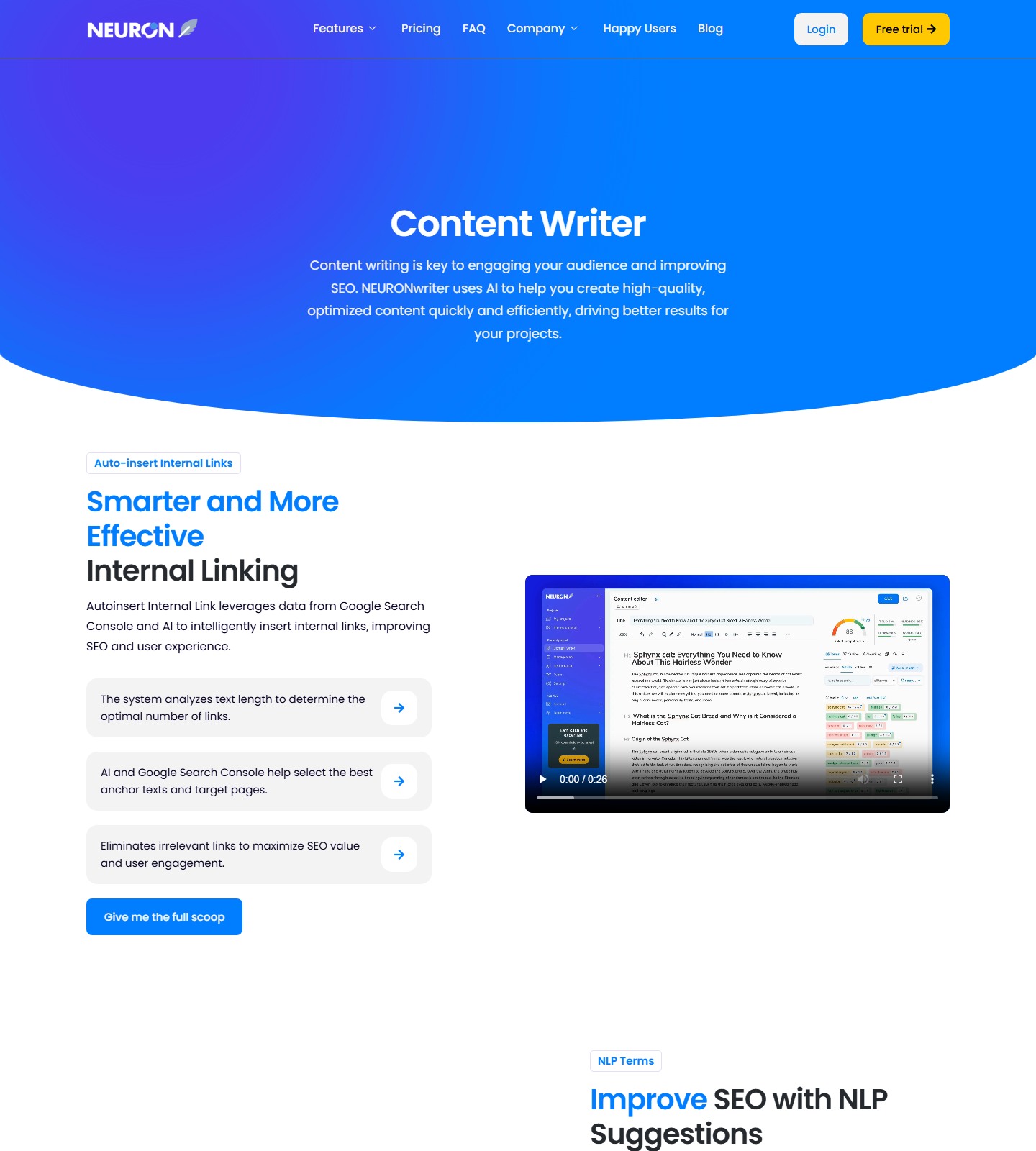
The buyer risk is similar to Surfer's: recommended terms can help expose coverage gaps, but they can also encourage formulaic writing if a team treats suggested frequency as a target rather than context. An editorial workflow should reject irrelevant terms and preserve clarity, originality, and evidence quality.
Which Tool Handles AI Visibility Better?
Neither vendor's public documentation establishes a universal AI-visibility winner because useful coverage depends on the engines, monitored prompts, refresh cadence, brand scope, and decisions supported by the data. Surfer documents AI visibility across Google and several named AI systems, while NeuronWriter documents monitored discussions and visibility metrics across Google AI Overviews, AI Mode, ChatGPT, and Perplexity.
Surfer's pricing page ties AI prompt allowances and refresh frequency to selected plans. Standard lists 25 prompts refreshed weekly, Pro lists 50 refreshed daily, and Peace of Mind lists 100 refreshed daily in the reviewed Full AI SEO view. NeuronWriter's pricing page lists standard AI-monitored question allowances by tier, beginning with 5 on Bronze and increasing through higher plans. Its AI Visibility page describes visibility score, sentiment, share of voice, citation analysis, trend charts, and query-level monitoring.
Use this decision rule:
- Choose Surfer's approach if your team wants AI visibility tied to Content Editor, Content Audit, Topical Map, and brand-workspace features in the same documented product family.
- Choose NeuronWriter's approach if your team wants a lower-cost entry route with a small named allowance of monitored questions and content optimization in the same account.
- Choose neither tool only for a headline visibility score unless the vendor can show how prompts are chosen, where queries run, how often data refreshes, and how the result becomes an editorial or brand action.
AI mentions and citations vary by model, prompt, location, retrieval state, personalization, and source availability. Monitoring can describe sampled visibility; it cannot guarantee that optimization will create a mention or citation.
How Do Pricing and Scaling Units Compare?
NeuronWriter has the lower displayed entry price, but its projects, analyses, AI credits, and monitored questions are not directly interchangeable with Surfer's documents, pages, prompts, workspaces, and seats. Compare workload capacity, billing period, collaboration needs, and renewal terms before calling either platform cheaper for a real production team.
| Public plan and unit checked August 10, 2026 | Surfer SEO | NeuronWriter | What to verify before buying |
|---|---|---|---|
| Entry tier | Discovery: $49/month billed yearly; 120 documents and 10 tracked pages | Bronze: $23 monthly or $19/month billed yearly; 2 projects, 25 analyses, 15,000 AI credits, 5 monitored questions | Whether a document, analysis, project, page, prompt, or credit is the limiting unit |
| Individual or small-team step | Standard: $99/month billed yearly; 360 documents, 25 AI prompts refreshed weekly | Silver: $45 monthly or $37/month billed yearly; 5 projects, 50 analyses, 30,000 AI credits, 7 questions | Required integrations, sharing permissions, and refresh cadence |
| Agency-oriented public tier | Pro: $182/month billed yearly; 360 documents, 50 daily AI prompts, 5 brand workspaces | Gold: $69 monthly or $57/month billed yearly; 10 projects, 75 analyses, 45,000 credits, unlimited team sharing | Number of clients, active briefs, reviewers, plagiarism checks, and monitored topics |
| Higher-scale route | Peace of Mind: $299/month billed yearly with unlimited documents subject to fair-use language; Enterprise: $999/month tailored packages | Platinum: $93 monthly or $77/month billed yearly; Diamond: $117 monthly or $97/month billed yearly, with larger project and analysis limits | API access, security, overages, fair use, onboarding, procurement, and account support |
| Trial or evaluation language | Start for Free is displayed; duration was not stated on the reviewed pricing screen | 7-day free trial with no credit card required | Conversion behavior, cancellation steps, saved work, renewal, and refund terms |
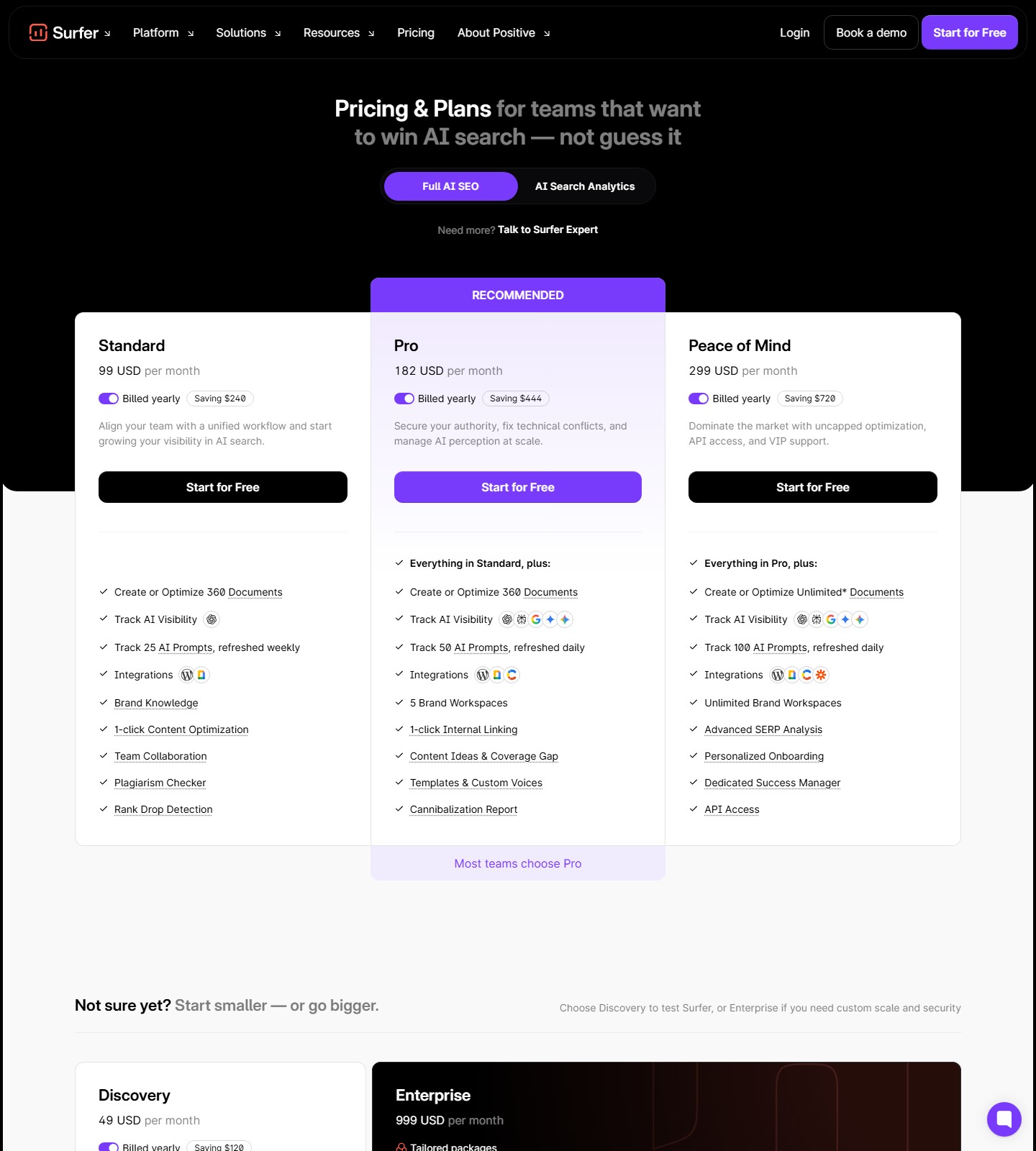
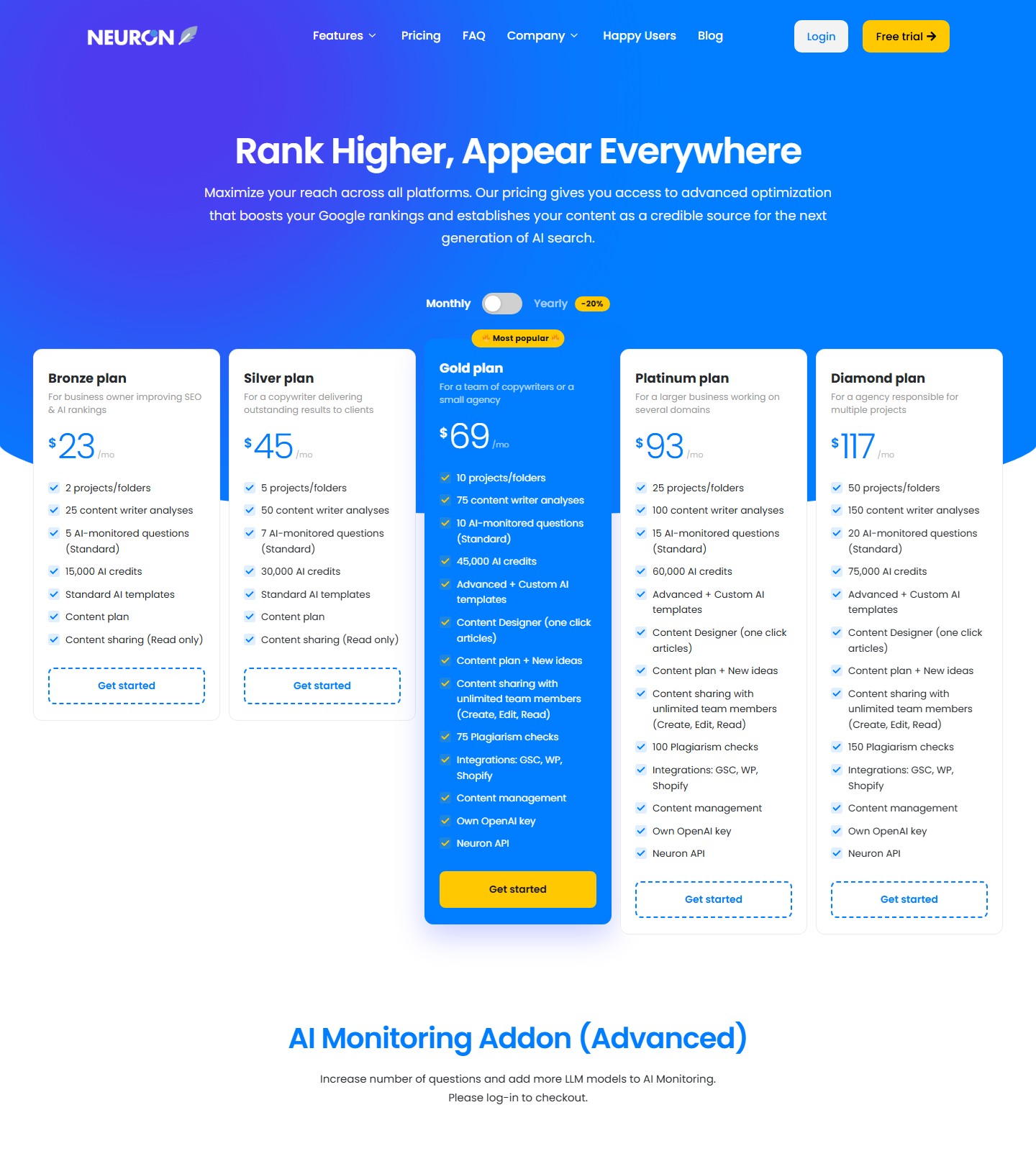
The pricing conclusion is conditional. NeuronWriter is less expensive at the displayed entry point and across the reviewed public tiers, but it is not automatically the lower-cost choice for every workload. An agency should map monthly briefs, refreshes, analyses, AI generation, monitored questions, projects, and collaborators to both vendors' units before choosing.
Which Planning, Maintenance, Integration, and Collaboration Features Matter?
Surfer documents the stronger combined audit and topical-planning story, while NeuronWriter documents lower-cost content planning, task management, team sharing, content management, and plan-gated integrations. Operational fit depends on whether the team needs a domain-wide refresh queue, a writing-production system, or both.
| Operating need | Surfer SEO evidence | NeuronWriter evidence | Buyer check |
|---|---|---|---|
| Existing-content prioritization | Content Audit connects GSC data, page performance, ranking changes, and opportunity recommendations | GSC integration, internal-link assistance, and content management appear in the documented workflow | Can the system produce the refresh queue and evidence your editors need? |
| Topic and cluster planning | Topical Map documents gaps, competitor coverage, cluster ideas, and GSC connectivity | Content Plan, Content Ideas, and Content Designer support topic development and task planning | Are planning limits and outputs reusable across client or brand workspaces? |
| WordPress workflow | Surfer documents WordPress among its integrations | NeuronWriter documents WordPress import/export on applicable plans | Test custom fields, formatting, media, links, and revision behavior. |
| Other publishing connections | Google Docs, Contentful, Zapier, ChatGPT, Jasper, and additional integrations are publicly listed | WordPress, Google Docs via extension, Shopify, GSC, Zapier, and API-related options appear in public materials and plan cards | Confirm exact plan gates and permission requirements. |
| Team workflow | Team Collaboration and brand-workspace features appear on selected Surfer plans | Team sharing with create, edit, and read permissions begins on Gold; Team Management documents assignments and deadlines | Check seats, roles, clients, audit history, and approval controls. |
| Automation and API | API Access appears on Peace of Mind; Enterprise is tailored | Neuron API, own OpenAI key, Zapier, and content-management features appear on applicable higher plans | Require API documentation, rate limits, security review, and failure-handling tests. |
An integration name does not prove operational fit. Run a controlled evaluation using a real brief, draft, review cycle, CMS handoff, internal links, structured fields, and a revision request before standardizing either tool across an agency or enterprise team.
Which Teams Should Choose Surfer SEO?
Surfer SEO is the stronger starting point for teams that value a broader documented SEO workflow more than the lowest subscription price. It is easier to justify when Content Audit, Topical Map, Content Editor, integration breadth, and AI visibility are all part of the same operating plan.
Choose Surfer SEO if these conditions are true:
- Your team needs a documented domain-audit and topic-gap workflow beside the content editor.
- Annual billing fits procurement and the document, page, prompt, workspace, and seat allowances match forecast volume.
- Editors use WordPress, Google Docs, Contentful, Zapier, ChatGPT, Jasper, or another publicly listed connection.
- AI visibility must sit beside content optimization and existing-content work in one product family.
- Human review and factual QA will remain mandatory instead of treating Content Score as an automatic publishing rule.
Surfer is not the safer choice merely because it has a broader feature list. It must replace enough separate work, reduce enough handoff friction, or improve enough visibility into the content backlog to justify the higher baseline.
Which Teams Should Choose NeuronWriter?
NeuronWriter is the stronger starting point for freelancers, budget-aware content teams, and agencies that want content analyses, NLP guidance, AI credits, planning, and AI monitoring at a lower displayed price. Its public tiers expose many of the units that a team must forecast, and Gold introduces collaboration and integration features relevant to small agencies.
Choose NeuronWriter if these conditions are true:
- Your budget favors a $23 monthly Bronze entry or a $19 monthly annual-equivalent entry over Surfer Discovery.
- Projects, content analyses, AI credits, monitored questions, and plagiarism checks can be mapped to real monthly production.
- Writers need competitor-derived NLP guidance, structure generation, AI-assisted drafting, and WordPress handoff.
- A 7-day no-card trial supports a controlled evaluation before committing.
- Gold or a higher tier provides the sharing, integrations, content management, API, and project capacity required by the team.
For other tools that compete for this workflow, see our NeuronWriter alternatives guide. Do not choose NeuronWriter only because it is cheaper on the pricing page if your team would need several manual systems to replace a Surfer module it actually uses.
What Are the Pros and Cons of Surfer SEO and NeuronWriter?
Surfer's main advantage is its broader documented AI SEO workflow, while NeuronWriter's main advantage is lower displayed pricing with explicit content-analysis, AI-credit, project, and monitoring allowances. The trade-off is workflow breadth versus lower-cost, metered content production.
What Are Surfer SEO's Main Pros and Cons?
Surfer SEO's strongest public advantages are Content Editor, Content Audit, Topical Map, integration breadth, and AI visibility in one product family; its main cautions are annual-billing labels, a higher entry price, and several non-equivalent workload units.
- Pros: broader documented optimization and planning workflow, domain-audit capability, many visible integrations, plan-based AI visibility, and higher-tier API and workspace options.
- Cons: $49 entry requires yearly billing in the reviewed view, higher-scale plans rise quickly, and documents, pages, prompts, workspaces, and seats require workload modeling.
What Are NeuronWriter's Main Pros and Cons?
NeuronWriter's strongest public advantages are lower prices, a documented trial, NLP-guided content analysis, AI credits, planning, and visible tier allowances; its main cautions are plan-gated collaboration and integrations plus several separate capacity units.
- Pros: $23 monthly entry, $19 annual-equivalent Bronze price, 7-day no-card trial, explicit content-analysis and AI-credit limits, Content Designer, WordPress workflow, and collaboration on applicable tiers.
- Cons: Bronze and Silver have read-only sharing, stronger team and integration features begin on higher plans, and analyses, credits, projects, monitored questions, and checks can each become a bottleneck.
What Trade-Offs Should You Check Before Switching?
The largest switching risk is choosing a tool whose quota, data model, and collaboration workflow do not match how your team plans, produces, refreshes, approves, and publishes content. Confirm the following details with the vendor and in a controlled trial before replacing an existing system.
| Buyer check | Why it matters | Practical question |
|---|---|---|
| Work-unit math | Surfer and NeuronWriter charge against different operating units | What exact action consumes a document, analysis, AI credit, page, prompt, project, or monitored question? |
| Billing and renewal | Surfer's reviewed prices use yearly billing; NeuronWriter shows monthly and yearly options | What is due today, what renews, and what happens when the plan changes? |
| AI visibility data | A sampled mention or visibility score is not a guaranteed outcome | Which models, prompts, locations, refreshes, histories, and exports are included? |
| Score portability | Scores and NLP suggestions are proprietary editorial aids | Can old briefs, recommendations, targets, and history move into the new workflow? |
| Collaboration | Agencies and enterprises need repeatable roles and approvals | Which seats, client spaces, permissions, comments, deadlines, and audit records are available? |
| Publishing integrations | A logo on an integrations page does not prove CMS fit | Can the team draft, review, export, update, and preserve links and structured fields without rework? |
No public source reviewed for this comparison proves one-click migration of proprietary scores or recommendation history between the products. Treat migration testing and data export as procurement requirements rather than assuming that similar feature labels represent compatible workflows.
Is Surfer SEO or NeuronWriter Better for Your Team?
NeuronWriter is the better value-led choice when lower displayed pricing, explicit content-analysis allowances, AI credits, and a documented trial are the priority; Surfer SEO is the better workflow-led choice when Content Audit, Topical Map, wider integrations, and plan-based AI visibility justify the higher annual commitment. For a solo writer or small agency, NeuronWriter is usually the easier controlled starting test. For a mature content operation, Surfer deserves consideration when its broader modules replace real tools or manual processes.
The rational next step is to calculate one month of actual projects, new articles, refreshes, analyses, AI generations, monitored questions, tracked pages, collaborators, and CMS handoffs against both pricing models. Then run the same brief and revision process through each evaluation route without treating either score as proof of search performance.
FAQ
Is NeuronWriter cheaper than Surfer SEO?
At the displayed entry price, NeuronWriter is cheaper: Bronze is listed at $23 monthly or $19 per month billed yearly, while Surfer Discovery is listed at $49 per month billed yearly. This is not a complete workload-cost comparison because the tools meter different units and include different surrounding modules.
Does NeuronWriter offer a free trial?
NeuronWriter's reviewed homepage states that it offers a 7-day free trial with no credit card required. Verify current conversion, saved-work, cancellation, and plan-access conditions immediately before starting.
Is Surfer SEO better than NeuronWriter for AI visibility?
Surfer is not universally better for AI visibility; the decision depends on supported engines, prompt or question allowances, refresh cadence, brand scope, history, and exports. Surfer documents visibility within a broader SEO workflow, while NeuronWriter documents monitored discussions and visibility metrics with lower-cost entry allowances.
Which tool is better for content agencies?
NeuronWriter is often the easier starting point for budget-aware small agencies, while Surfer can fit agencies that need broader auditing, topical planning, integrations, and brand-workspace functions. Map client projects, analyses, collaborators, pages, prompts, credits, and approvals before deciding.
Do Surfer SEO and NeuronWriter integrate with WordPress?
Both vendors publicly document WordPress workflows. Surfer lists WordPress among its integrations, while NeuronWriter describes WordPress import and export on applicable plans. Test custom fields, formatting, media, links, and updates in your own CMS environment.
Can either content score guarantee Google rankings or AI citations?
No proprietary content score can guarantee Google rankings, ChatGPT mentions, Gemini citations, Perplexity citations, or Google AI Overview inclusion. Scores and NLP recommendations can guide editorial review, but outcomes still depend on relevance, usefulness, evidence, technical delivery, authority signals, competition, and changing retrieval systems.