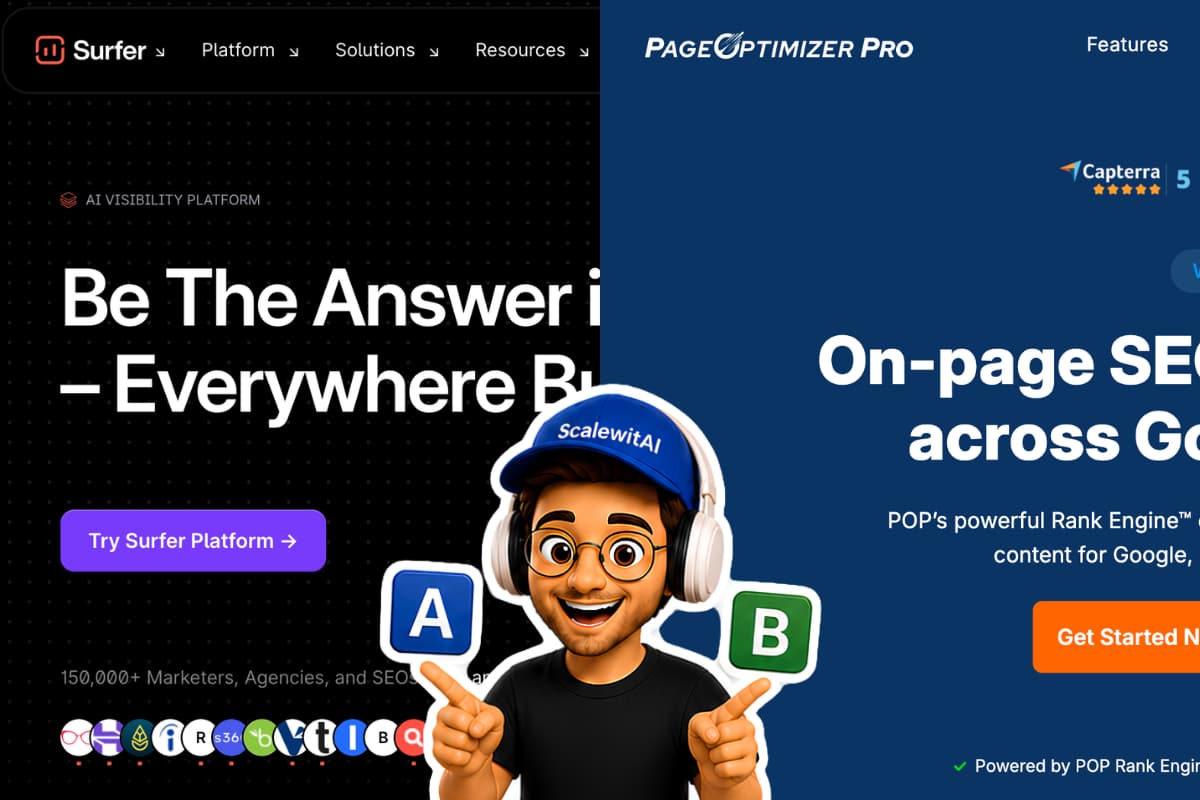
Surfer SEO is the better starting point for teams that want a lower listed entry price and a visible stack for content creation, optimization, audits, topic planning, integrations, and AI visibility. Clearscope is the better fit for teams that can justify a higher starting price for a workflow organized around topic discovery, drafting, optimization, protection, and AI-search visibility. Neither platform's score, recommendation, or AI-visibility metric guarantees rankings, traffic, citations, or mentions.
| At a glance | Surfer SEO | Clearscope |
|---|---|---|
| Public starting price checked August 10, 2026 | $49/month for Discovery, billed yearly | $129/month for Essentials |
| Trial or evaluation path | Public pages say Start for Free; duration was not stated on the reviewed pricing page | 14-day free trial |
| Content workflow | Content Editor, Content Audit, Topical Map, AI Tracker | Discover, Write, Optimize, Protect, Expand |
| Visible integration examples | WordPress, Google Docs, Contentful, Zapier, ChatGPT | Google Docs, Microsoft Word, WordPress |
| Best fit | Teams that need a lower-cost entry route and a broader visible SEO workflow | Teams that can budget for a content-operations platform with prompt, page, topic, and draft allowances |
| Surfer plan evaluation | Review Surfer’s current plan options | Not applicable |
The public price cards are not a like-for-like quota comparison. Surfer's selected Full AI SEO pricing view uses annual billing and document, page, prompt, workspace, and seat limits, while Clearscope lists monthly plans with tracked prompts, Pages, Topic Explorations, and Drafts.
Quick Verdict: Should You Choose Surfer SEO or Clearscope?
Choose Surfer SEO when a lower entry price, several visible SEO workflow modules, and plan-based AI-prompt tracking matter more than a premium editorial operating model. Choose Clearscope when your team can budget for its higher entry price and wants its documented Discover, Write, Optimize, Protect, and Expand workflow. The correct choice depends on the work unit your team will exhaust first, not on a single content score.
| If your primary condition is... | Better starting point | Why |
|---|---|---|
| Lower listed entry price for an AI SEO workflow | Surfer SEO | Discovery is displayed at $49/month billed yearly, while Clearscope Essentials is displayed at $129/month. |
| A public 14-day free trial | Clearscope | Its pricing page explicitly states a 14-day free trial. |
| One documented stack for editor guidelines, audit opportunities, topical planning, and AI visibility | Surfer SEO | The vendor documents Content Editor, Content Audit, Topical Map, and AI visibility functions. |
| A product sequence built around discovery, writing, optimization, protection, and visibility | Clearscope | Its public product navigation and pages organize the workflow as Discover, Write, Optimize, Protect, and Expand. |
| Comparing a content score before publishing | Tie, with a workflow check | Both vendors document real-time content guidance, but neither score is a search-engine ranking metric. |
If Surfer's entry price and documented workflow match your operating model, evaluate Surfer’s current eligible plans before treating any public price card as a final quote.
What Is Surfer SEO?
Surfer SEO is a vendor-described AI SEO and content-intelligence platform that combines content optimization with topic planning, existing-content audits, integrations, and AI-search visibility tracking. Its homepage positions the product around Google, AI Overviews, Gemini, ChatGPT, Claude, Perplexity, and related visibility workflows, while its pricing matrix names Content Audit, Topical Map, and AI Tracker capabilities.
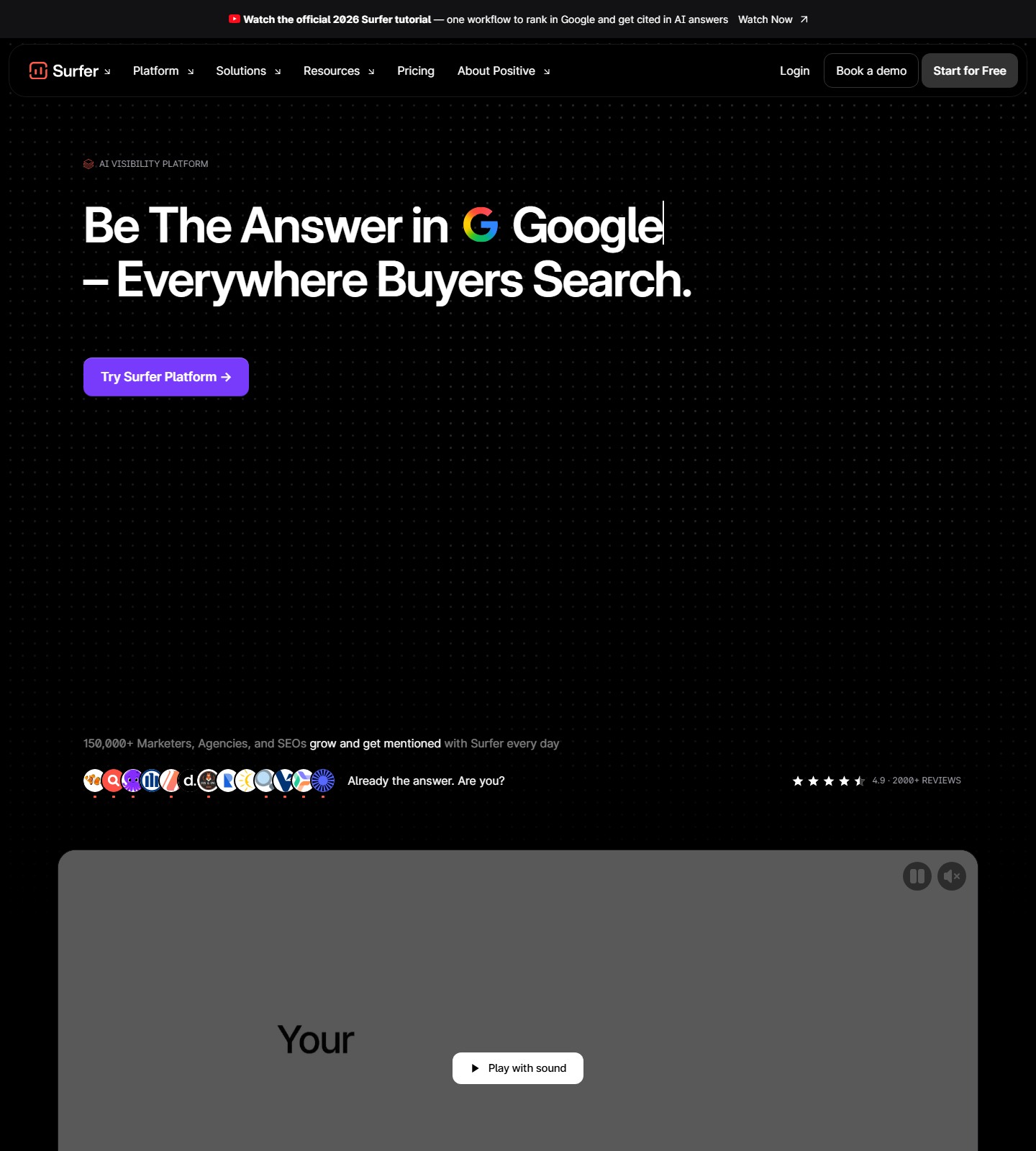
Surfer's public evidence supports a broad buyer narrative rather than a single-editor narrative. The Content Editor page describes a live Content Score, outline support, topic coverage guidance, and integrations. The Content Audit page describes domain performance monitoring, ranking-drop information, and weekly opportunity recommendations. The Topical Map page describes topic-cluster ideas, Google Search Console connectivity, and coverage visualization.
What Is Clearscope?
Clearscope is a vendor-described SEO and AI-search visibility platform organized around discovering topics, writing, optimizing, protecting published content, and expanding brand visibility. Its homepage describes visibility across Google and AI platforms such as ChatGPT and Gemini, then presents product areas for Discover, Write, Optimize, Protect, and Expand. For a fuller entity-level evaluation, see our Clearscope review.
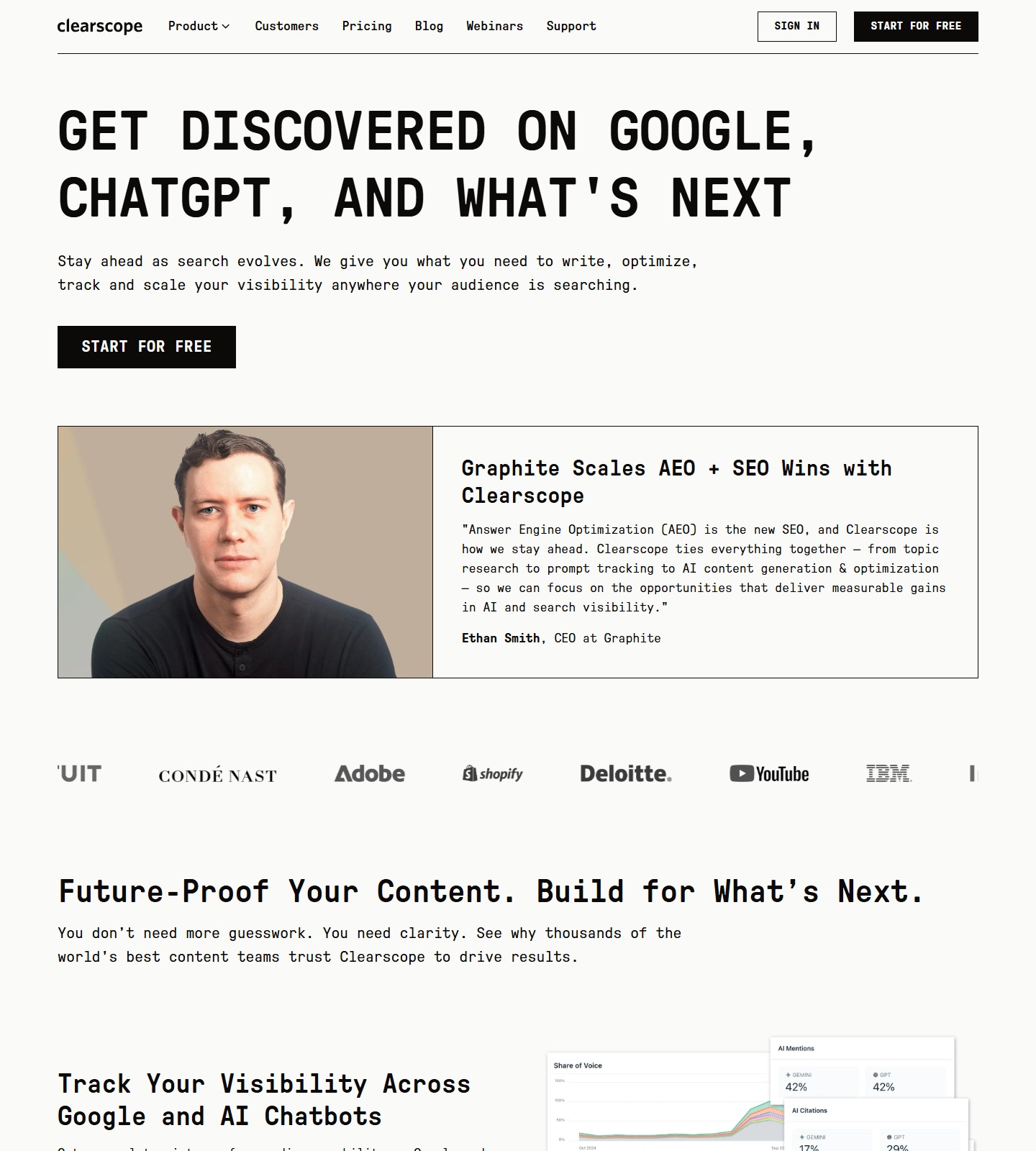
The documented Clearscope workflow has a different product language from Surfer's but overlaps in several buyer jobs. Its Discover page describes topic and keyword research, including search-intent and competitive-insight inputs. Its Optimize page describes real-time topic-coverage feedback and content scoring. Its Protect page describes ongoing monitoring and alerts for search issues, broken links, and optimization opportunities.
How Do Their Content-Optimization Workflows Differ?
Surfer SEO presents content optimization as part of a wider AI SEO stack, while Clearscope presents it as one stage in a more explicitly named content-operations sequence. That distinction matters most when an agency or enterprise team must decide whether its bottleneck is briefing, drafting, updating, monitoring, or reporting.
| Workflow attribute | Surfer SEO | Clearscope | Buyer interpretation |
|---|---|---|---|
| Live optimization guidance | Content Editor documents a real-time Content Score and guidelines | Optimize documents real-time topic-coverage feedback and a content score | Treat both as editorial guidance, not as ranking guarantees. |
| Topic planning | Topical Map documents cluster ideas and coverage visualization | Discover documents topic, keyword, intent, and competitor inputs | Choose the planning view your strategists can actually operationalize. |
| Existing-content work | Content Audit documents opportunity and ranking-drop workflows | Protect documents monitoring, alerts, and SEO-risk workflows | Compare the backlog and reporting unit before migrating existing content. |
| AI visibility | Pricing and homepage materials document AI-prompt and visibility features | Expand documents AI citations, share of voice, and visibility context | Confirm the prompts, models, pages, and reporting cadence your plan includes. |
How Does Surfer SEO Handle Optimization and Planning?
Surfer's documented workflow combines Content Editor guidance with content-audit opportunities and topic-cluster planning. The Content Editor says its Content Score is a real-time responsive metric and lists keyword optimization, entity extraction, link equity, content relevance, topic coverage, and topical authority as inputs. The same page also lists Google Docs, ChatGPT, WordPress, and Contentful among its integration examples.

The important limitation is interpretive: a proprietary score can help standardize an editorial process, but it does not prove that Google or an AI system will rank, cite, or recommend the content. A team should use it as a quality-control input alongside factual review, original research, search-intent checks, and an approved publishing process.
How Does Clearscope Handle Optimization and Editorial Control?
Clearscope documents real-time topic-coverage feedback, content scoring, and integrations that support a collaborative editorial workflow. Its Optimize page says that it provides content-quality and keyword-coverage guidance while a draft is being created, and it lists Google Docs, Microsoft Word, and WordPress as integration examples. Our guide to the Clearscope grading system explains how its F-to-A++ score is intended to be interpreted.
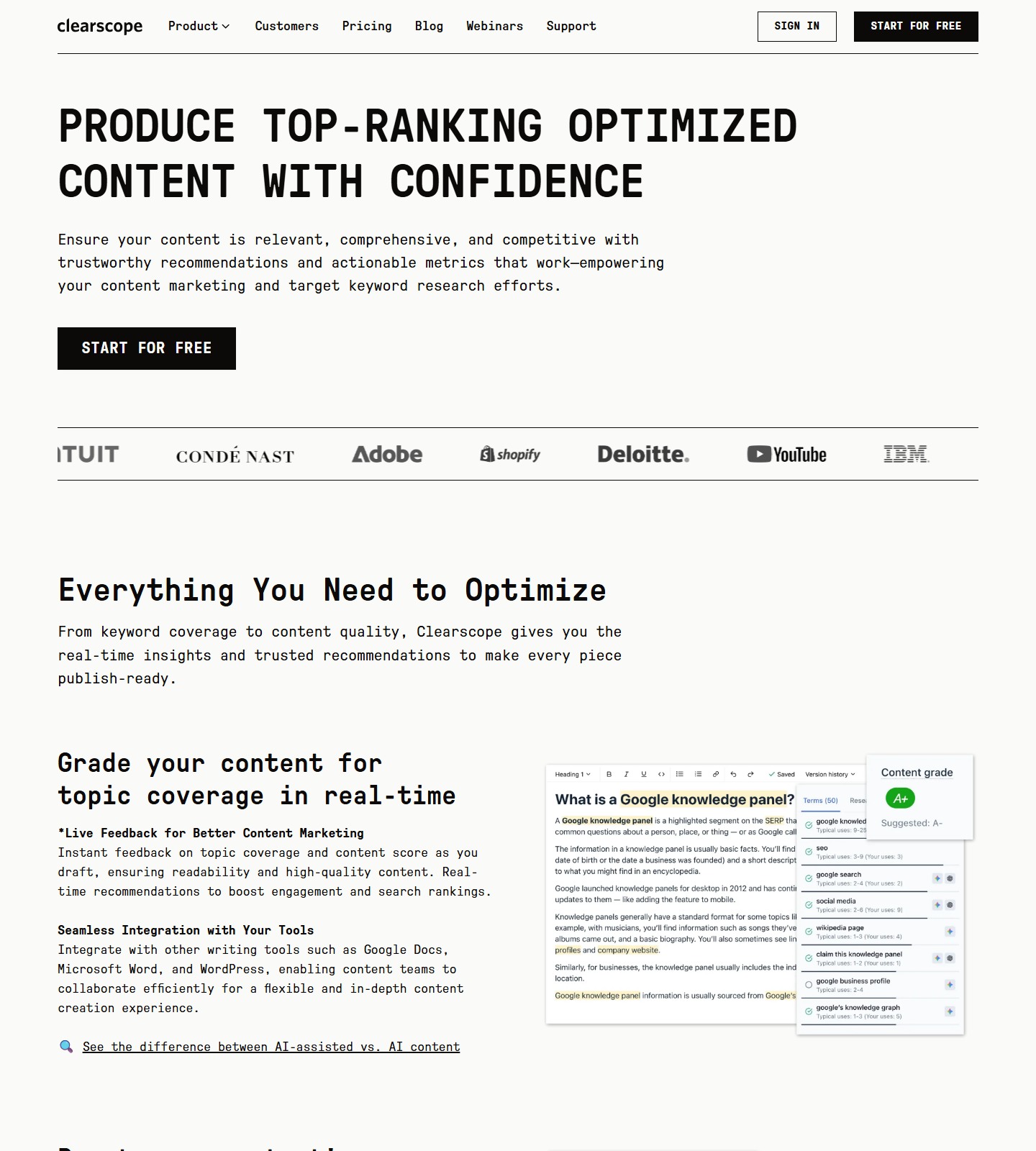
For an enterprise content team, the practical comparison is not "which score is higher?" It is whether writers, editors, SEO leads, and subject-matter reviewers can agree on the instructions, verify the claims, and move a draft through review without converting a tool recommendation into a rigid keyword checklist.
Which Tool Handles AI Visibility Better?
Neither vendor's public documentation establishes a universal AI-visibility winner, because the useful plan depends on the prompts, models, tracked pages, reporting cadence, and decision workflow your team needs. Surfer's pricing page documents plan-specific AI prompt tracking, refreshed weekly or daily at selected plan levels, while Clearscope's Expand page describes monitoring Google performance alongside AI mentions, citations, and topic-level share of voice.
Surfer's public plan comparison lists tracking across ChatGPT, Perplexity, Google AI Mode, Google AI Overviews, and Google Gemini for selected plans. Clearscope's public materials describe tracking across Google and AI chatbots, with the homepage naming ChatGPT and Gemini. These statements are vendor documentation of available workflows, not independent proof that either product will improve mentions or citations.
Use this decision rule instead:
- Choose Surfer's approach if your team wants documented AI-prompt allowances tied to the same product family as Content Editor, Content Audit, and Topical Map.
- Choose Clearscope's approach if your team wants documented visibility, citation, and share-of-voice framing alongside its Discover, Optimize, and Protect workflow.
- Do not choose either tool only for an AI score if the vendor cannot show how prompts are selected, how data refreshes, what model coverage applies to your plan, and how the result becomes an editorial action.
How Do Pricing and Scaling Units Compare?
Surfer SEO has the lower displayed entry price, but Clearscope's price cards use different units, so a buyer must compare workload capacity before calling either platform cheaper. Surfer's reviewed Full AI SEO view displays Discovery at $49/month, Standard at $99/month, Pro at $182/month, and Peace of Mind at $299/month, with those first four figures labeled as billed yearly. Clearscope's pricing page displays Essentials at $129/month, Business at $399/month, and Enterprise at a custom price.
| Public plan and unit checked August 10, 2026 | Surfer SEO | Clearscope | What to verify before buying |
|---|---|---|---|
| Entry plan | Discovery: $49/month billed yearly, 120 documents and 10 tracked pages | Essentials: $129/month, 50 tracked prompts, 50 Pages, 20 monthly Topic Explorations, 20 monthly Drafts | Whether a document, Page, prompt, topic exploration, or draft is your limiting unit |
| Mid-tier plan | Standard: $99/month billed yearly; Pro: $182/month billed yearly | Business: $399/month, 300 tracked prompts, 300 Pages, 50 monthly Topic Explorations, 20 monthly Drafts | Required users, brand workspaces, refresh cadence, and collaboration controls |
| Higher-scale route | Peace of Mind: $299/month billed yearly with unlimited documents subject to fair usage; Enterprise: $999/month tailored packages | Enterprise: custom credits, agreements, crawler whitelisting, and SSO | Fair-use terms, overages, security, procurement, onboarding, and contractual scope |
| Trial or cancellation language | Start for Free appears publicly, but no duration was stated on the reviewed Surfer pricing screen | 14-day free trial; monthly plans state no minimum contract and cancellation anytime | Trial conversion, payment authorization, renewal, and refund terms in checkout or contract |
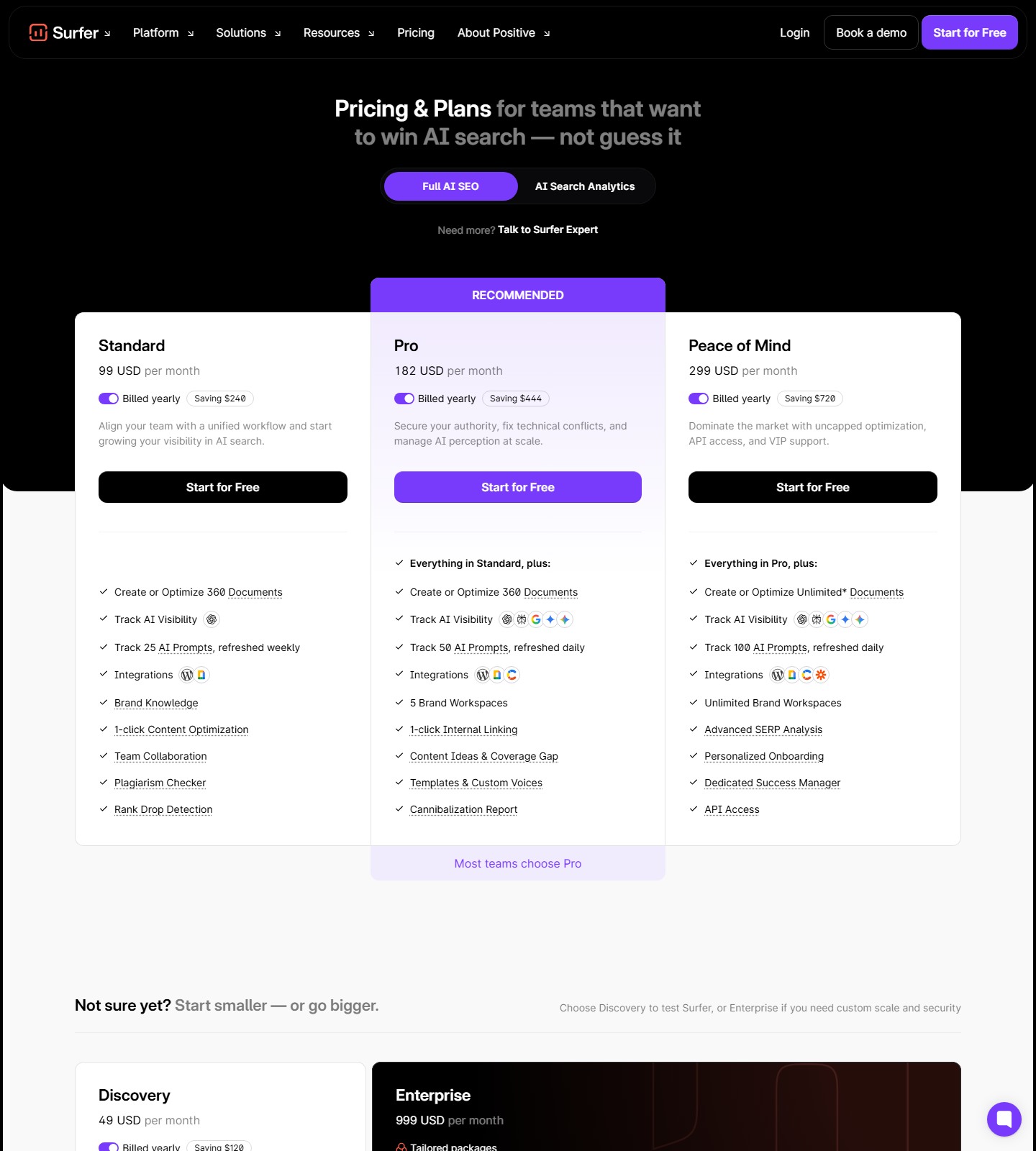
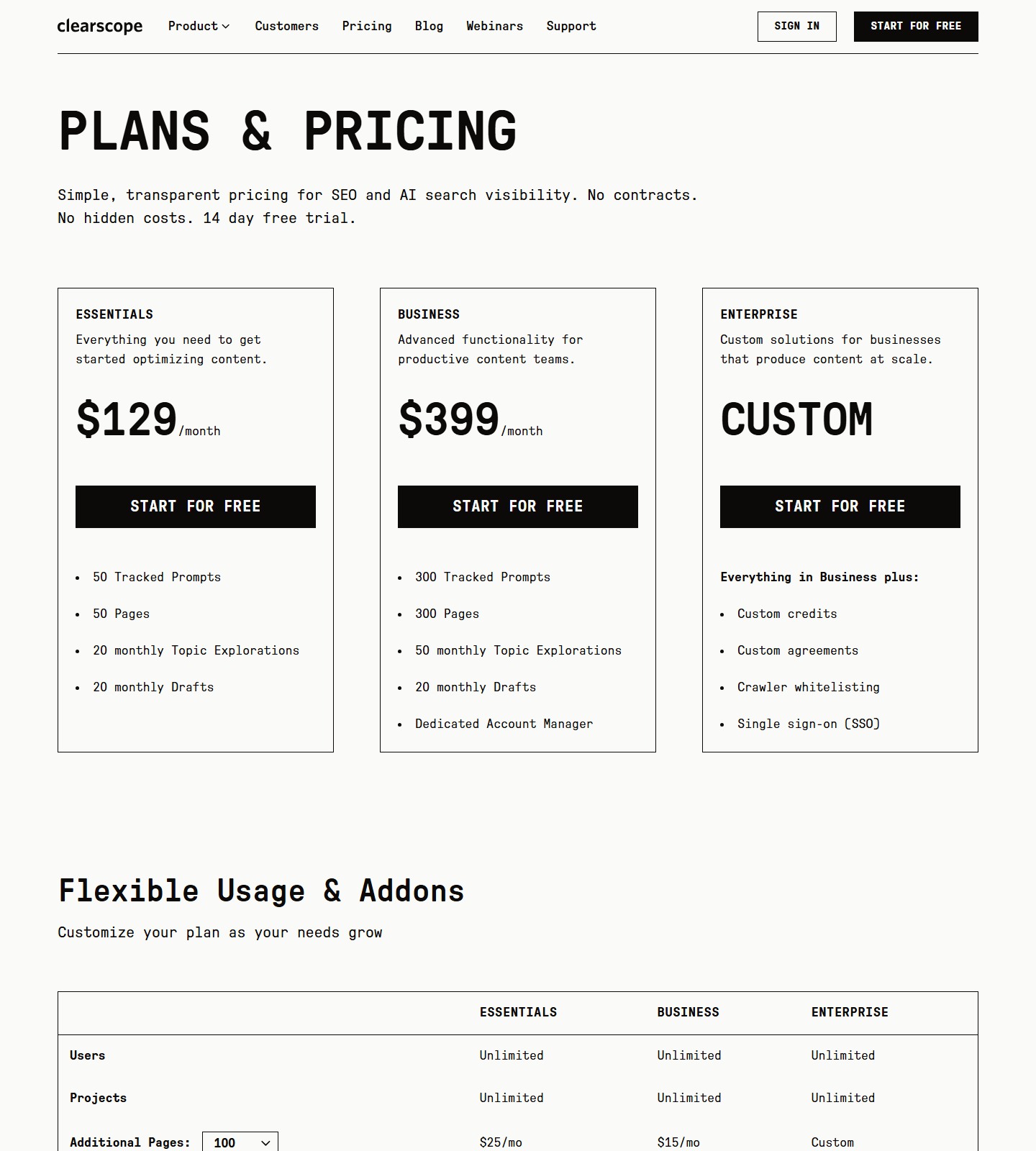
The pricing conclusion is conditional. Surfer is cheaper at the published entry point, but it is not automatically cheaper for your workload. A content agency with many prompts, pages, drafts, or reviewers should turn its current monthly volume into the vendors' actual units and validate the result in a sales conversation or checkout flow.
Which Integrations and Publishing Workflows Matter?
Surfer SEO documents the broader set of integration examples in the reviewed public material, while Clearscope explicitly documents editorial integrations with Google Docs, Microsoft Word, and WordPress. Surfer's integrations page names WordPress, Google Docs, Zapier, Contentful, ChatGPT, and other workflow connections. Clearscope's Optimize page names Google Docs, Microsoft Word, and WordPress.
For teams that need a Google Docs handoff, read our Clearscope Google Docs setup guide before treating an integration label as proof that it fits your permissions, publishing workflow, or quality-review policy. For either vendor, test the exact editor, CMS, role permissions, and export behavior used by your team.
At an agency or enterprise level, run a controlled workflow test instead of only checking an integrations page. Build a brief, assign a writer, revise against the tool guidance, collect specialist review, publish a draft, and record where handoffs duplicate work. Include your real structured styles, custom fields, approval comments, regulated claims, and multilingual requirements where relevant. That makes the integration decision about repeatability and governance, not just feature availability.
Which Teams Should Choose Surfer SEO?
Surfer SEO is the stronger starting point for budget-aware SEO teams, agencies that want documented planning and audit modules beside the editor, and teams that want AI-visibility tracking inside the same product family. The lower published Discovery price makes it easier to evaluate a broader visible stack before committing to a higher recurring baseline.
Choose Surfer SEO if these statements are true:
- You want a documented entry route below Clearscope Essentials, and annual billing fits your procurement model.
- Your team needs one vendor-facing workflow that includes content guidance, existing-content opportunities, topic planning, and AI-visibility functions.
- You can map documents, tracked pages, AI prompts, workspaces, and seats to your real publishing volume.
- You need public integration examples beyond a document editor, such as WordPress, Zapier, Contentful, or ChatGPT.
- You will keep human subject-matter review and factual QA in the workflow instead of treating Content Score as an automatic publishing rule.
Which Teams Should Choose Clearscope?
Clearscope is the stronger starting point for teams that can support its higher baseline price and prefer a public product model centered on discovering, writing, optimizing, protecting, and expanding visibility. Its Essentials plan also provides a clearly stated 14-day free trial, which can make a structured evaluation easier before a longer commitment.
Choose Clearscope if these statements are true:
- Your budget supports a $129/month Essentials starting point, and the tracked-prompt, Page, Topic Exploration, and Draft units match your forecast.
- You want a product vocabulary that separates research, editorial production, content optimization, monitoring, and AI visibility.
- Your team values a documented 14-day trial and needs unlimited users and projects as listed on the pricing page.
- Your editors rely on Google Docs, Microsoft Word, or WordPress, and you will test the exact collaboration workflow before rollout.
- You need content-monitoring and visibility views to inform a human editorial backlog, not to replace editorial judgment.
For a broader peer set before deciding, compare the other documented fit models in our Clearscope alternatives guide.
What Are the Pros and Cons of Surfer SEO and Clearscope?
Surfer SEO offers the lower published entry point and a broader visible module set, while Clearscope offers a clearly named content-operations sequence and a documented 14-day trial at a higher starting price.
What Are Surfer SEO’s Main Pros and Cons?
Surfer SEO’s main advantages are its lower displayed entry price and the documented combination of Content Editor, Content Audit, Topical Map, integrations, and AI visibility features; its main cautions are annual-billing labels and plan units that require workload math.
- Pros: lower published starting price, several visible SEO workflow modules, broader public integration examples, and plan-based AI visibility allowances.
- Cons: the lowest displayed prices are billed yearly, documents and tracked pages are not directly comparable with Clearscope’s units, and public scores or AI metrics do not establish ranking outcomes.
What Are Clearscope’s Main Pros and Cons?
Clearscope’s main advantages are its documented Discover, Write, Optimize, Protect, and Expand sequence plus a stated 14-day trial; its main cautions are the higher entry price and a capacity model that must be checked across prompts, Pages, Topic Explorations, and Drafts.
- Pros: explicit content-operations stages, real-time topic-coverage guidance, public editorial integration examples, and a documented trial path.
- Cons: higher published starting price, different workload units that complicate direct cost comparisons, and no guarantee that a content grade or visibility metric will produce rankings or AI citations.
What Trade-Offs Should You Check Before Switching?
The largest switching risk is not the content score; it is choosing a platform whose quota, data, and collaboration model does not match your production process. Confirm the following details with the vendor before you migrate a team or replace an existing workflow.
| Buyer check | Why it matters | Practical question |
|---|---|---|
| Work-unit math | Surfer and Clearscope price different units | Which exact monthly activity consumes a document, Page, prompt, topic exploration, or draft? |
| Billing and renewal | Surfer's displayed figures use annual billing, while Clearscope displays monthly prices | What is due today, what renews automatically, and what happens after a plan change? |
| AI visibility data | A mention or visibility score is not a guaranteed business outcome | Which models, prompts, locations, refreshes, and exports are available on this plan? |
| Score portability | Scores and guidelines are product-specific editorial aids | Can old briefs, content history, targets, and exports move into the new workflow cleanly? |
| Collaboration controls | Agencies and enterprise teams need repeatable review | Which roles, seats, workspaces, audit history, and approval paths are included? |
| Publishing integrations | An integration name does not prove operational fit | Can the team draft, review, export, and publish without losing guidance or links? |
No public source reviewed for this comparison proves a one-click migration of proprietary scores between the tools. Treat migration testing as a procurement requirement rather than assuming that similar feature labels mean the same data model or workflow.
Is Surfer SEO or Clearscope Better for Your Team?
Surfer SEO is the better value-led choice when a lower listed entry price and a broad documented AI SEO workflow are the priority; Clearscope is the better premium-workflow choice when its higher starting price, trial, and content-operations model fit your team's capacity plan. The rational next step is to compare your actual monthly inventory, prompts, drafts, editors, and reporting needs against the vendors' displayed units, then run a controlled trial or demo with the content your team already publishes.
FAQ
Is Surfer SEO cheaper than Clearscope?
At the displayed entry price, Surfer SEO is lower: Discovery is shown at $49/month billed yearly, while Clearscope Essentials is shown at $129/month. The result is not a complete cost comparison because Surfer and Clearscope meter different workloads and billing periods.
Does Clearscope offer a free trial?
Clearscope's reviewed pricing page states that it offers a 14-day free trial. Verify the current checkout terms, payment authorization, and conversion conditions before starting.
Does Surfer SEO integrate with WordPress?
Surfer's reviewed integrations and Content Editor pages list WordPress among their integration examples. Confirm the exact features available to your plan and publishing environment.
Does Clearscope support AI-search visibility work?
Clearscope's public homepage and Expand page describe visibility across Google and AI systems, including AI mentions, citations, and share-of-voice context. Those descriptions are vendor documentation, not a guarantee of AI citations or rankings.
Is a content score a Google ranking factor?
No proprietary tool score should be treated as a Google ranking factor. A score can guide editorial revisions, but search outcomes still depend on relevance, usefulness, technical delivery, authority signals, competition, and changing search systems.
Can either tool guarantee ChatGPT, Gemini, or Google AI Overview citations?
No. AI answers can vary by model, prompt, location, retrieval state, personalization, and source availability, so a tracking or optimization feature cannot guarantee a mention, citation, or recommendation.