Surfer SEO works by analyzing search results with NLP and machine learning across 500+ signals, then guiding your content through a connected loop: plan with Topical Map, write and score with Content Editor, generate with Surfer AI, and audit with Content Audit. Surfer describes itself as an all-in-one platform for AI Search Optimization and visibility that combines the newest AI technologies, NLP solutions, and analysis of over 500 ranking indicators to help brands stand out in Google results and AI answers.
| At-a-glance | Details |
|---|---|
| Tool | Surfer SEO |
| What it is | AI SEO and content intelligence platform |
| Core technology | NLP solutions, machine learning, 500+ signals analysis |
| Main tools | Topical Map, Content Editor, Surfer AI, Content Audit, AI Tracker, Rank Tracker |
| Workflow | Research, create, audit, monitor |
| Scoring | Content Score, SEO Score, AI Search Score |
| Main caveat | Scores are proprietary signals, not ranking guarantees |
| Check date | August 10, 2026 |
Quick Answer: How Does Surfer SEO Work?
Surfer analyzes the pages that currently rank for your keyword and location, extracts what they have in common (terms, entities, structure, coverage), and turns that analysis into real-time writing guidelines and scores. Surfer states its guidelines are real-time, competition-based, and Google-compliant, built with NLP solutions, machine learning, and an analysis of over 500 web and AI signals.
- Plan: Topical Map and Keyword Research find topics, clusters, and gaps.
- Create: Content Editor guides writing with live scores; Surfer AI can generate drafts.
- Audit: Content Audit finds underperforming pages and recommends refreshes.
- Monitor: AI Tracker and Rank Tracker watch AI citations and keyword positions.
If this workflow fits your process, check Surfer's current access options before building your content pipeline.
What Surfer Is (and What It Is Not)
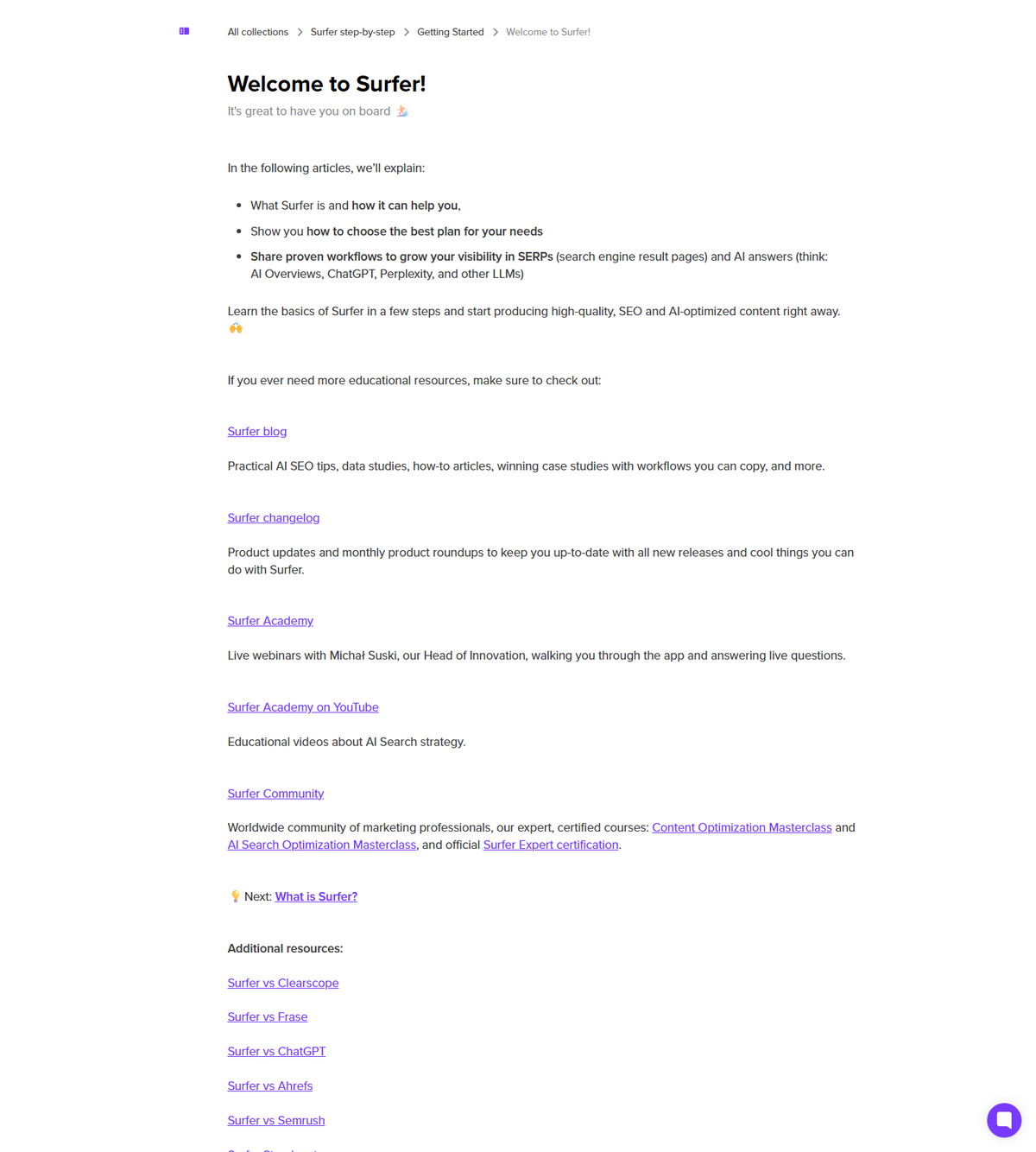
Surfer is a platform of connected tools, not a single extension or a writing app. Its official getting-started article describes it as the all-in-one platform for AI Search Optimization and visibility, helping brands show up on Google, inside AI-generated answers, and across the web.
What it is:
- A content planning and optimization platform.
- An AI visibility tracking platform.
- A set of connected tools sharing the same research layer.
What it is not:
- Not a single Chrome extension (Keyword Surfer and the Docs extension are separate products).
- Not just an AI writer (Surfer AI is one tool inside the platform).
- Not a rank tracker alone (Rank Tracker is one of several modules).
- Not a guarantee of rankings or citations, despite vendor outcome language on product pages.
The Technology Behind Surfer
Surfer states its engine combines NLP solutions, machine learning, and analysis of over 500 web and AI signals. The What is Surfer article documents the same approach: newest AI technologies, NLP solutions, and analysis of over 500 ranking indicators.
The technology does three documented jobs:
- SERP analysis: evaluates the actual pages ranking for a keyword and location.
- Term and entity extraction: identifies what top pages have in common and groups terms by intent.
- Real-time guidance: generates competition-based guidelines that update as you write.
| Technology layer | Documented job |
|---|---|
| NLP solutions | Understand language, terms, and entities |
| Machine learning | Model ranking patterns from analyzed pages |
| 500+ signal analysis | Combine web and AI signals into guidelines |
| Real-time updates | Refresh guidance as the SERP changes |
Surfer describes its guidelines as Google-compliant and designed to improve both ranking and AI citations. That is vendor methodology language: the signals are proprietary, and the outcomes are not guaranteed.
The Surfer Tool Set and What Each Tool Does
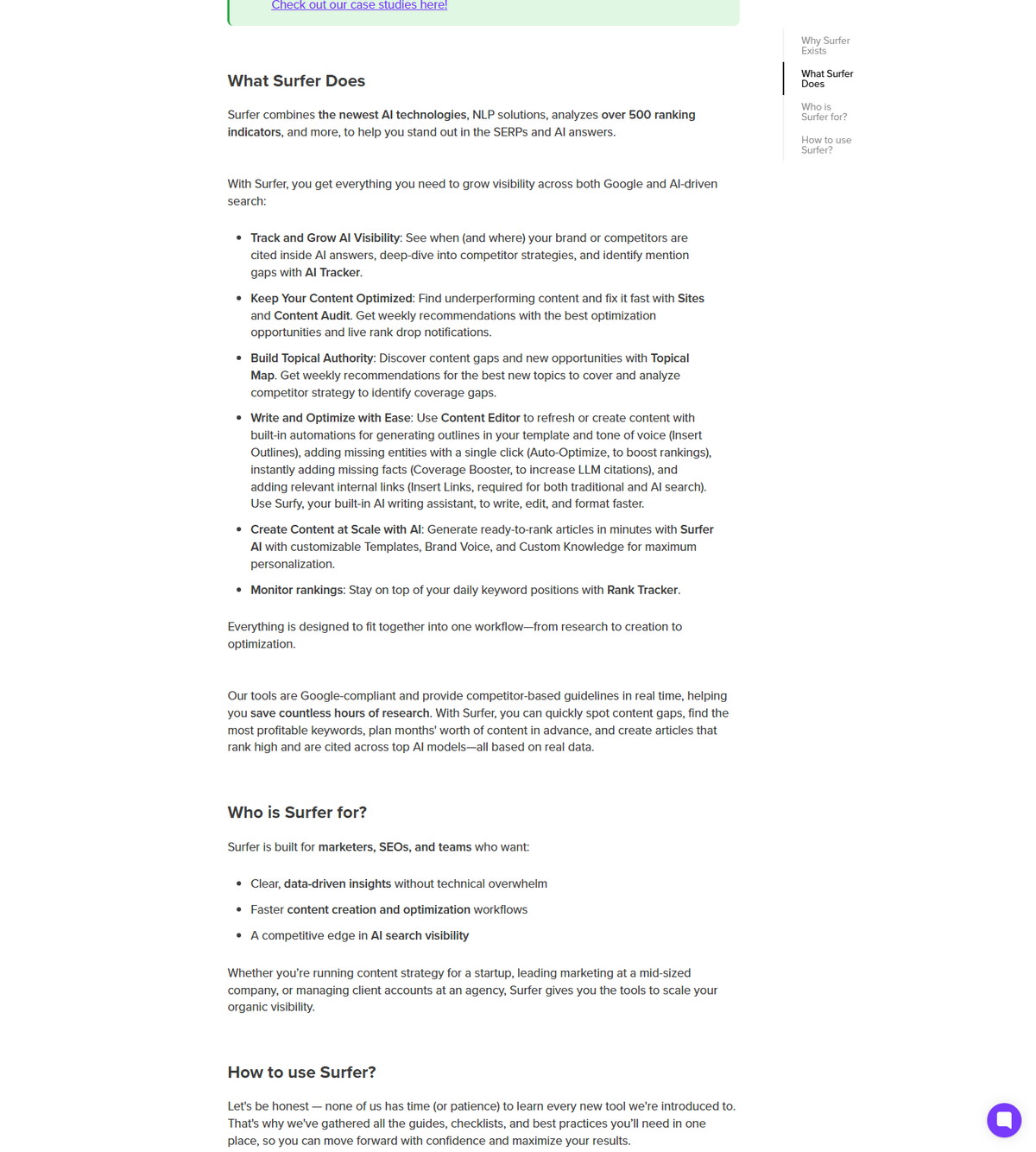
Surfer organizes its platform into tools that cover discovery, creation, optimization, and monitoring. The What is Surfer article documents each one.
| Tool | Documented job |
|---|---|
| AI Tracker | Track when and where brands or competitors are cited in AI answers; identify mention gaps |
| Sites and Content Audit | Find underperforming content, weekly optimization recommendations, rank drop notifications |
| Topical Map | Discover content gaps and new topics; weekly recommendations for topical authority |
| Content Editor | Write or refresh content with guidelines, outlines, Auto-Optimize, Coverage Booster, Insert Links, and Surfy |
| Surfer AI | Generate ready-to-rank articles with Templates, Brand Voice, and Custom Knowledge |
| Rank Tracker | Monitor daily keyword positions |
Surfer documents Content Editor automations including Insert Outlines, Auto-Optimize for adding missing entities, Coverage Booster for adding missing facts, Insert Links for internal linking, and Surfy as the built-in AI writing assistant.
The Surfer Content Loop: Research, Create, Audit
Surfer's workflow runs in a loop: research and plan, create and optimize, audit and monitor. The product pages document the same three-stage structure.
| Stage | Tool | What happens |
|---|---|---|
| Research and plan | Sites, Topical Map, Keyword Research | Find gaps, clusters, and topics |
| Create and optimize | Content Editor, Surfer AI | Write or generate with live guidelines and scores |
| Audit and monitor | Content Audit, AI Tracker, Rank Tracker | Track positions, AI citations, and refresh opportunities |
Surfer states everything is designed to fit together into one workflow, from research to creation to optimization. The loop repeats: audit findings feed new plans, and new content expands the map.

How Content Score and SEO Score Work
Content Score is Surfer's 0-100 optimization metric built from SEO Score and AI Search Score, both updating in real time as you write. Surfer's documentation describes the components and their limits.
- SEO Score reflects alignment with traditional search factors: keyword usage, topical coverage, structure, and alignment with top-performing pages, with term context mattering more than frequency.
- AI Search Score reflects how well content is structured for AI-powered search, based on Facts Coverage and Upfront Intent Alignment.
- Content Score bands: below 33 needs work, 33 to 66 is reasonably optimized, above 66 is ready to compete.
| Score | What it reflects |
|---|---|
| SEO Score | Keyword usage, topical coverage, structure, alignment with top pages |
| AI Search Score | Facts Coverage and Upfront Intent Alignment |
| Content Score | Combined 0-100 optimization level |
The scores are proprietary workflow signals. They are not Google metrics, and Surfer's own guidance warns that chasing a perfect score can hurt content.
How Surfer Tracks AI Visibility
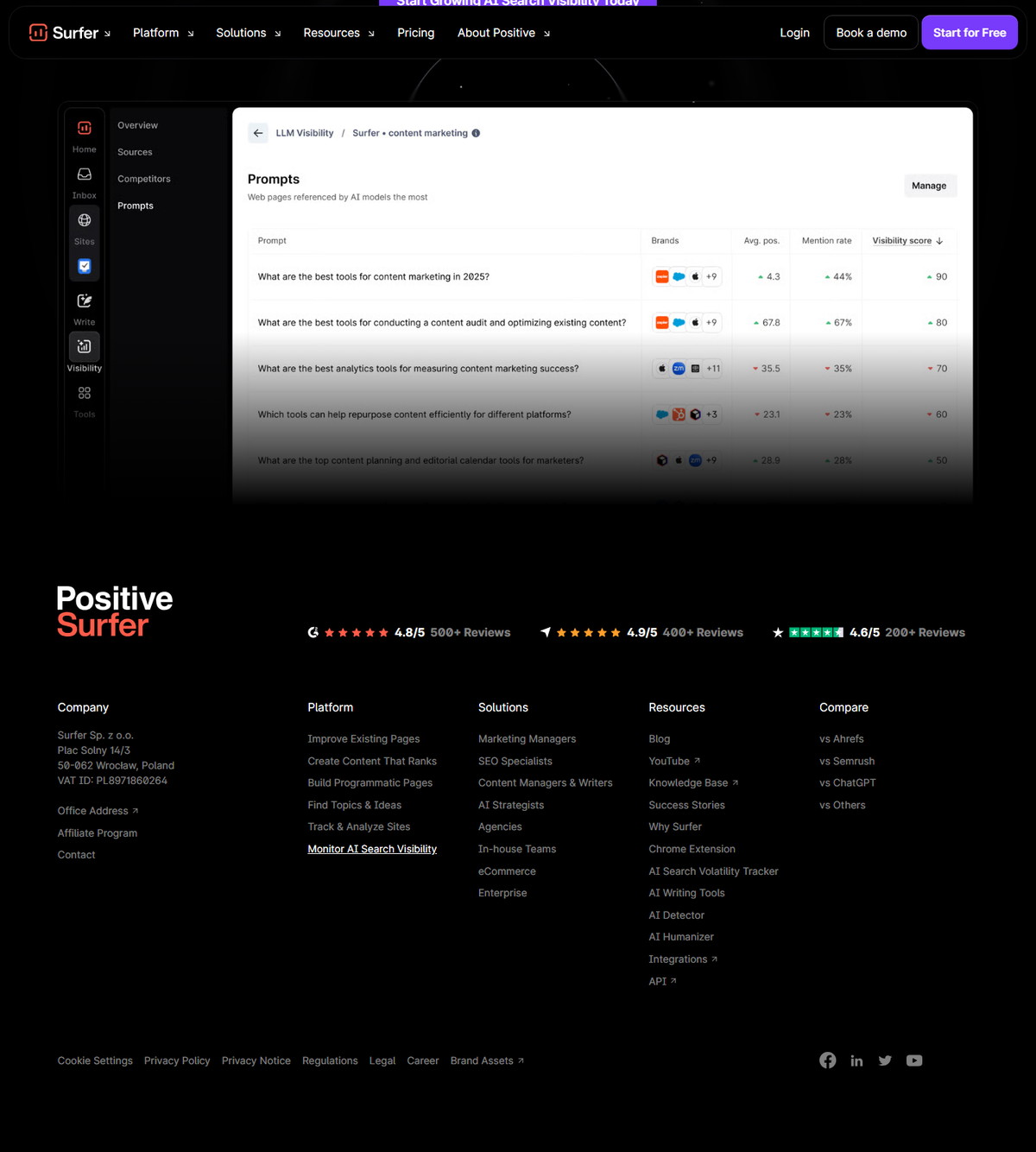
AI Tracker monitors where brands and competitors appear in AI-generated answers, with visibility scores and mention gaps. Surfer documents the feature inside the What is Surfer overview and across its AI visibility materials.
Documented capabilities:
- See when and where your brand or competitors are cited inside AI answers.
- Deep-dive into competitor strategies.
- Identify mention gaps.
- Track across models such as ChatGPT, Gemini, and AI Overviews.
AI visibility data is sampled from configured prompts and can vary by model, run, location, and personalization. Coverage improvements are not guarantees of citations or mentions.
The Dashboard and Recommendations
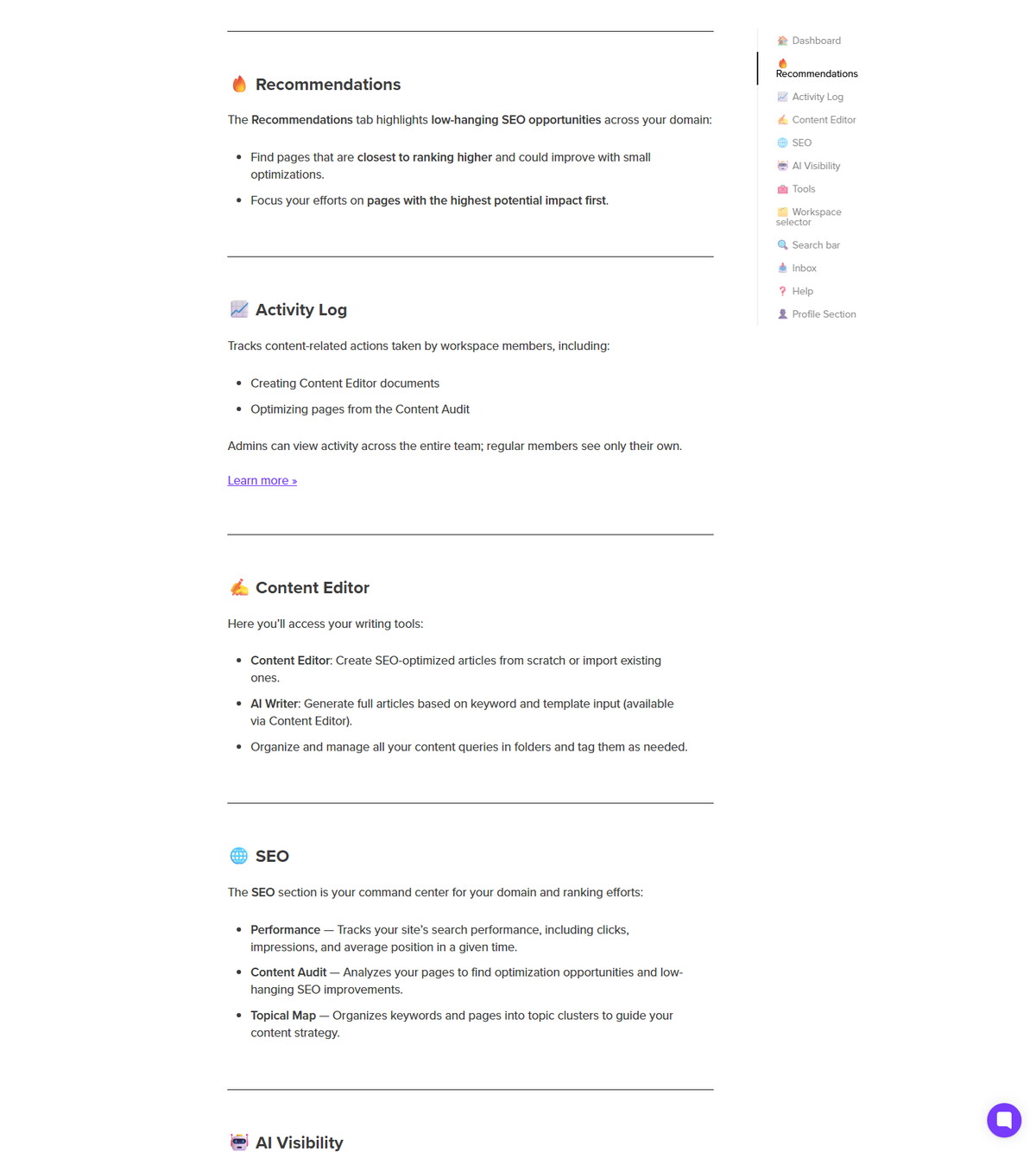
The Surfer dashboard gives an overview of recent work, and the Recommendations tab highlights low-hanging SEO opportunities. The dashboard guide documents both.
- Dashboard: summary of recent work, including Topical Maps, Audit, SERP Analyzer, and Content Editor queries, with one-click return to writing or research.
- Recommendations: pages closest to ranking higher that could improve with small optimizations, prioritized by potential impact.
- Activity Log: content-related actions by workspace members, with admins seeing team-wide activity.
The dashboard is the navigation hub: everything else in the platform is reachable from the left sidebar.
What Surfer Does Not Do
Surfer does not replace your judgment, your analytics, or the search engines themselves. The documented boundaries keep expectations honest.
- It does not guarantee rankings, traffic, conversions, or AI citations; outcome language on product pages is vendor positioning.
- It does not publish content for you; the WordPress plugin and exports hand off to your CMS workflow.
- Its scores are not Google metrics; they are proprietary optimization signals.
- AI visibility tracking is sampled and directional, not an exhaustive measurement of every AI answer.
- A perfect Content Score is documented as usually impossible and not the goal.
The practical result: use Surfer for research and guidance, then validate with your own analytics after publishing.
FAQ
Is Surfer SEO an AI tool?
Yes. Surfer states it combines the newest AI technologies, NLP solutions, and analysis of over 500 ranking indicators. Its tools include AI generation with Surfer AI, AI visibility tracking, and AI-assisted optimization inside Content Editor.
How does Surfer get its data?
Surfer analyzes the actual pages ranking for your keyword and location, extracts terms and entities, and combines that with partner search volume data and its own NLP and machine learning analysis. Guidelines are documented as real-time and competition-based.
What is a Content Score in Surfer?
Content Score is Surfer's 0-100 optimization metric built from SEO Score and AI Search Score. It reflects how well content aligns with top-performing pages and with AI search expectations, and it updates in real time as you write.
Does Surfer write content for me?
Surfer AI can generate articles from guidelines, and Surfy assists with editing and formatting, but Content Editor is designed for manual writing with guidance. You keep control of the final content either way.
Is Surfer SEO a Chrome extension?
No. Surfer is a platform; Keyword Surfer and Surfer for Google Docs and ChatGPT are separate Chrome extensions. The extensions surface part of Surfer's data in other tools but are not the platform itself.
Does Surfer guarantee rankings?
No. Surfer's scores, guidelines, and AI visibility data are proprietary signals, and outcome language on product pages is vendor positioning. Rankings, traffic, and citations should be validated with your own analytics.
How long does it take to see results with Surfer?
Surfer does not document a universal timeline for results, and its marketing materials should not be read as a time guarantee. Outcomes depend on your niche, content quality, competition, and publishing consistency.