Surfer SEO's AI Content Detector is useful as a first-pass editorial signal: it estimates whether English text resembles patterns associated with AI writing and highlights passages for review. It is not reliable enough to prove authorship, justify disciplinary action, validate originality, or predict Google rankings. The safest workflow is to test a substantial draft, inspect the flagged passages, review facts and reader value, revise with a human editor, and record the score as one input rather than a verdict.
| At a glance | Current public evidence |
|---|---|
| Tool | Surfer SEO AI Content Detector |
| Public access | Free detector page; exact free-input allowance is not stated in the reviewed page text |
| Language | English only as of August 10, 2026 |
| Output | Probability-style AI/human assessment plus highlighted passages |
| Paid positioning | Surfer pricing lists AI Detector and Humanizer across current platform plans |
| Best use | Editorial triage before factual, quality, policy, and human review |
| Main limitation | False positives and false negatives; Surfer says scores are estimates, especially weak on short text |
| Surfer access | Evaluate Surfer's current eligible plans |
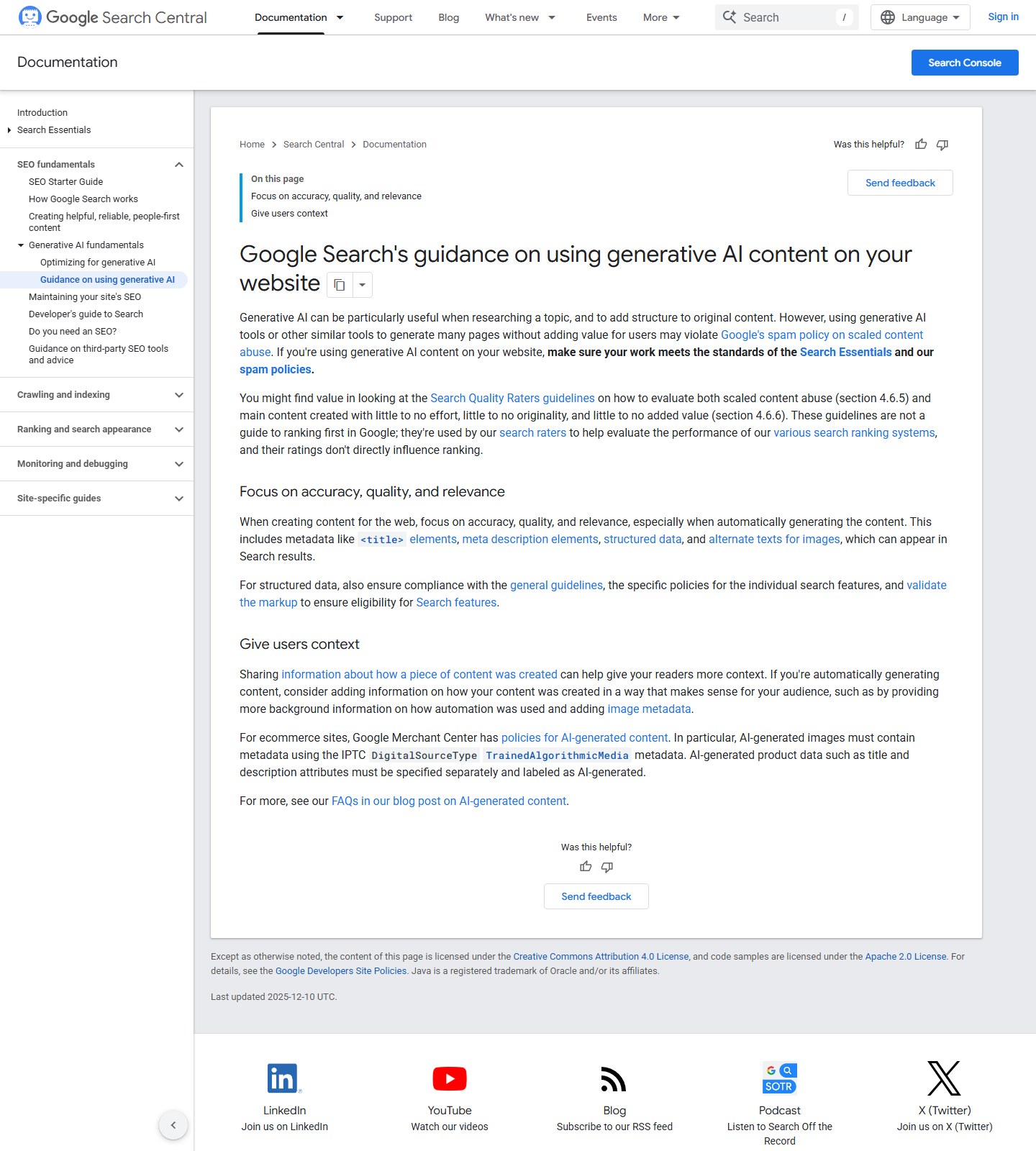
For SEO teams, the detector should answer “Which passages deserve closer review?” rather than “Was this written by AI?” Google asks publishers to focus on accuracy, quality, relevance, and people-first value. It also treats scaled content created mainly to manipulate rankings as spam regardless of whether automation, humans, or both produced it. A lower AI probability cannot substitute for evidence, expertise, originality, or editorial accountability.
Quick Answer: What Does Surfer SEO's AI Content Detector Do?
Surfer's detector analyzes English text for linguistic patterns associated with machine-generated and human writing, then returns a probability-style assessment and highlights likely AI passages. The public detector page describes analysis of writing patterns, language use, and other linguistic features. Surfer's own accuracy guide says the result is an estimate that works best as a first screen alongside human review.
The tool can help an editor prioritize passages that look formulaic, repetitive, uniformly structured, or unusually predictable. It cannot determine who typed the words, whether an author used an assistant for research, whether a passage is factually correct, or whether Google will reward the page. Those questions require separate evidence and review.
What Is the Surfer SEO AI Content Detector?
The Surfer SEO AI Content Detector is a public English-language classifier designed to estimate whether pasted text resembles AI-generated or human-written content. Surfer markets a free detector page and a paid workflow that connects detection with its Humanizer and broader content platform.
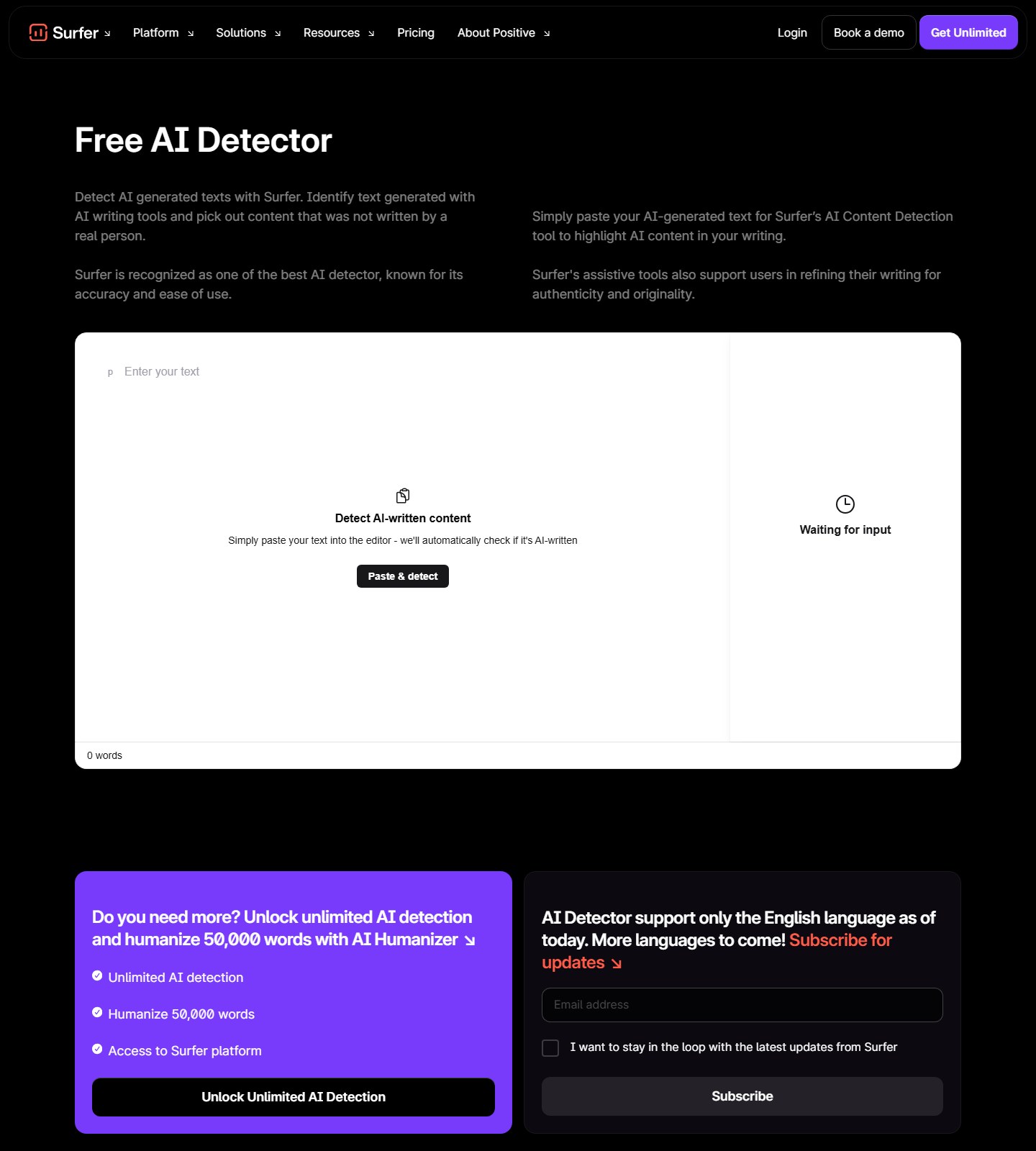
The page says the detector can highlight likely AI writing and currently supports English only. It also promotes “unlimited AI detection” alongside 50,000 Humanizer words and access to the Surfer platform. The reviewed public text does not state a precise free-input allowance, so teams should not convert “free detector” into an undocumented unlimited-free claim.
Surfer pricing currently lists AI Detector and Humanizer in Discovery, Standard, Pro, and Peace of Mind. That plan inclusion does not make detector scores SEO metrics. It only describes access to Surfer's toolset.
How Does Surfer's AI Detection Work?
Surfer documents a classifier-style process that evaluates patterns such as predictability, sentence variation, word choice, syntax, and other linguistic signals before assigning a probability. Its how-detectors-work guide discusses classifiers, embeddings, perplexity, and burstiness.

- Perplexity describes how predictable a sequence appears to a model. More predictable prose can resemble generated text, but predictable human writing is still possible.
- Burstiness describes variation in sentence length and structure. Uniform prose may attract a stronger AI signal, but many professional or non-native writers use consistent structures.
- Classifiers learn distinctions from labeled human and machine samples. Their output depends on training data, model design, language, text length, and the generation systems represented in those samples.
- Probability scoring expresses model confidence, not historical proof of authorship.
Surfer also discusses watermarking as a separate approach. A watermark can only identify output from systems that intentionally embed a compatible signal; it does not turn a general classifier into a universal detector.
What Does a Surfer AI Detector Result Actually Mean?
A Surfer result means the submitted text statistically resembles patterns the model associates with AI or human writing; it does not certify authorship, quality, originality, or search performance. Read the percentage and highlighted passages as review priorities.
<div class="scalewitai-table-scroll" role="region" aria-label="Surfer SEO AI Content Detector guide data table” style=”max-width:100%”>| Result element | Defensible interpretation | Unsafe interpretation |
|---|---|---|
| High AI probability | The sample resembles patterns in the detector's AI training examples | The author definitely used AI |
| High human probability | The sample resembles patterns in the detector's human examples | The text is proven human-authored |
| Highlighted passage | Inspect this passage for repetition, predictability, tone, or weak specificity | Delete or penalize the passage automatically |
| Changed score after editing | The revised text changed the model's pattern match | The revision is now accurate, original, or Google-safe |
| Different result in another detector | Models, thresholds, or training data differ | One tool must be lying |