Rytr and Scalenut both generate marketing copy, but they solve different primary problems. Rytr is the better fit for fast, low-cost short-form drafting and editing, while Scalenut is the stronger choice for teams that need keyword planning, search-informed briefs, long-form article production, optimization, and publishing in one workflow. There is no universal winner because the right purchase depends on whether writing speed or SEO operations is the bottleneck.
| At a glance | Rytr | Scalenut |
|---|---|---|
| Primary identity | Lightweight AI writing and editing assistant | SEO and GEO content planning, creation, optimization, and visibility platform |
| Best for | Copywriters, freelancers, founders, and marketers producing short copy | SEO teams, content marketers, agencies, and brands managing search-led articles |
| Public monthly pricing checked August 1, 2026 | Free $0; Unlimited $9; Premium $29 | Starter $59; Plus $89; Professional $199; promotions may reduce annual equivalents |
| Free evaluation path | Free plan with 10,000 characters per month | Pricing page advertises a 7-day free trial |
| Voice controls | Preset tones and paid Tone Match options | Tone of Voice controls; pricing page lists unlimited tone of voice |
| SEO research workflow | No comparable end-to-end SERP research and planning workflow documented on current product pages | Keyword clusters, article creation, content optimization, audits, and AI visibility features |
| Plagiarism workflow | Copyscape-powered checker with plan-based checks | Copyscape integration requiring a Copyscape account and API key |
| API | Public availability is not clear enough to treat as a buying advantage | Official help page says Scalenut currently does not offer an API |
Choose Rytr when you already know what to say and want help saying it quickly. Choose Scalenut when your team must decide what to publish, structure an article from search evidence, optimize it, and move it toward a CMS. Readers who need a deeper look at Rytr’s product boundaries can use our contextual Rytr review; this comparison focuses specifically on the workflow trade-off with Scalenut.
Quick Verdict: Rytr or Scalenut?
Rytr wins on simplicity, entry cost, and rapid short-form assistance. Scalenut wins on SEO research, content planning, optimization, collaboration depth, and long-form workflow coverage. If your backlog consists of emails, social captions, ad variants, product snippets, rewrites, and tone adjustments, Scalenut can be more platform than you need. If your backlog consists of keyword clusters, briefs, optimized articles, refreshes, and publishing tasks, Rytr leaves major steps to other tools and manual processes.
| Choose | When it makes sense | Main compromise |
|---|---|---|
| Rytr | You want an affordable writing assistant for compact, frequent copy tasks | Limited strategic SEO workflow and fewer content-operations controls |
| Scalenut | You want research, planning, drafting, optimization, and distribution support around SEO/GEO content | Higher cost and more workflow complexity |
| Neither yet | You cannot define output volume, approval requirements, or the business value of faster production | Buying before measuring the bottleneck can add software without improving throughput |
For an individual who primarily writes copy, start with Rytr’s free plan and test whether its character allowance and editing workflow remove meaningful work. If the fit is clear, you can check the current Rytr offer before upgrading. For an SEO-led team, evaluate Scalenut against an actual article pipeline rather than a collection of isolated prompts.
The Category Boundary Matters More Than the Feature Count
Calling both products “AI writers” hides the most important difference. As our How to Use Rytr workflow shows, Rytr is primarily a writing assistant: users select a use case, provide context, choose language or tone options, generate variants, and edit the result. Its current public site emphasizes more than 40 use cases, inline improvements, rephrasing, expansion, shortening, a Chrome extension, Tone Match, and plagiarism checks.
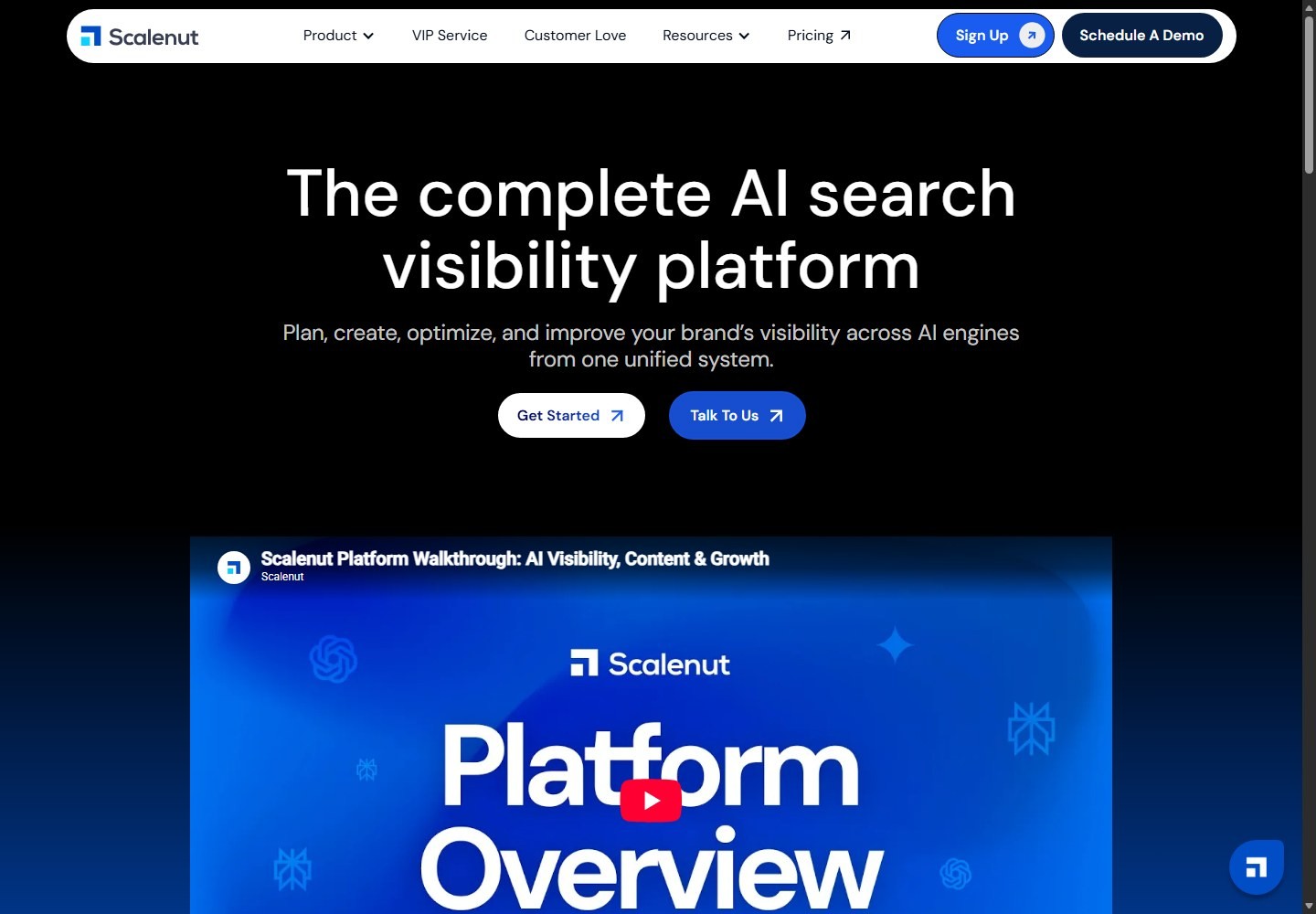
Scalenut now presents a broader SEO and generative engine optimization platform. Its public workflow spans visibility tracking, recommendations, an article writer, content optimization, audits, keyword clusters, internal linking, and publishing integrations. Copy generation is one component inside a larger operating system for finding opportunities and executing content against them.
This boundary prevents a misleading checklist comparison. Rytr does not need every SEO planning feature to be useful, and Scalenut does not need to be the fastest way to rewrite one paragraph. The decision should follow the job:
* Sentence and asset production: Rytr is the more focused tool. * Search-led article operations: Scalenut offers the more complete workflow. * Mixed marketing department: The products could coexist, but only if each replaces measurable manual work.
What Are Rytr and Scalenut?
Rytr is a lightweight AI writing and editing assistant
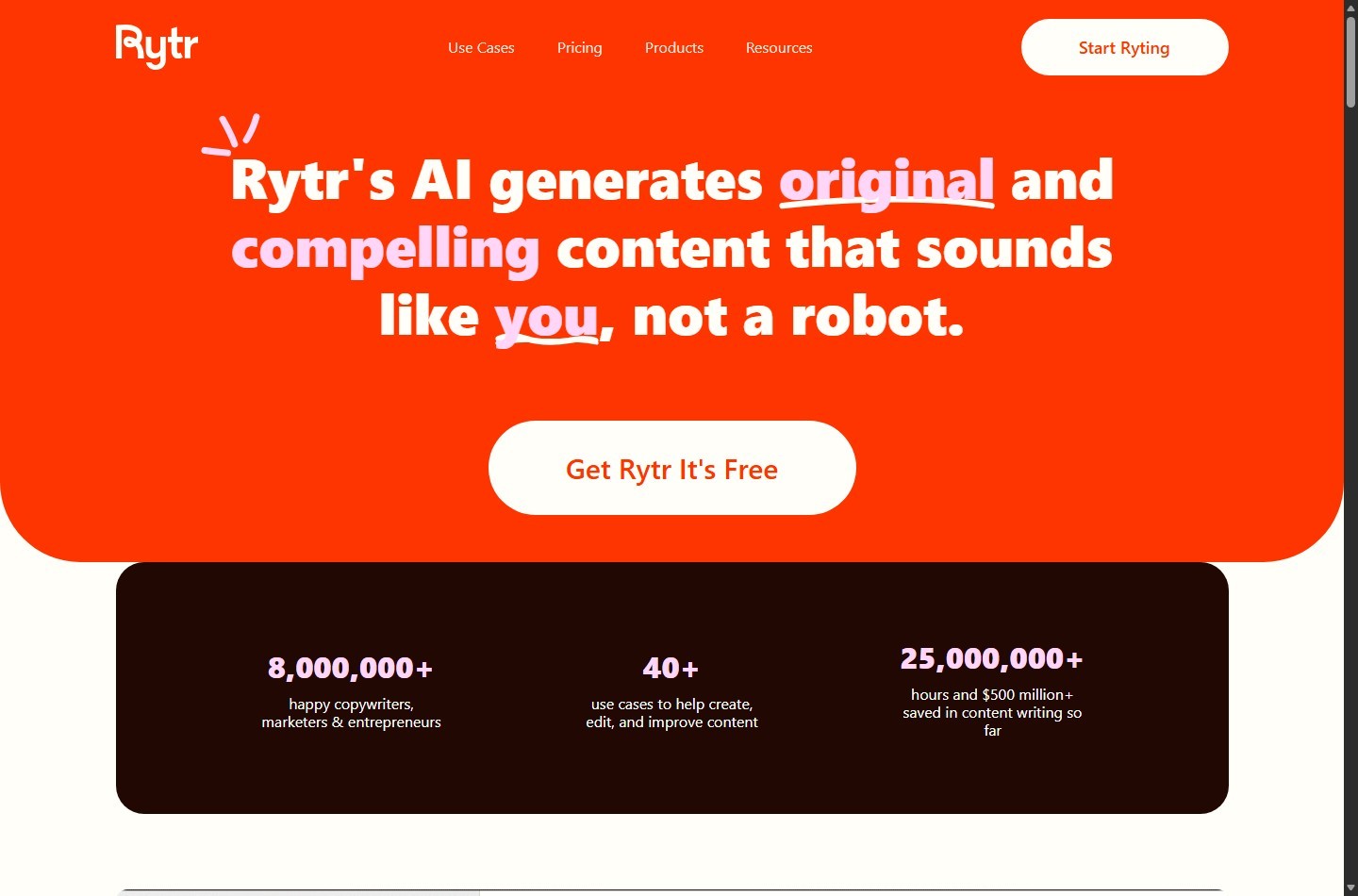
Rytr is designed around quick generation and revision. Its homepage lists use cases for completing text, continuing a draft, expanding or shortening copy, improving grammar and readability, generating paragraphs, rephrasing, and following a custom command. A browser extension extends some of that assistance to other writing surfaces.
That product identity suits users who arrive with a clear task and enough subject knowledge to judge the output. A marketer can turn a product angle into several captions, a freelancer can create email variations, and an entrepreneur can tighten a landing-page section. Rytr helps reduce blank-page time, but the user still owns research, factual verification, campaign strategy, and final editorial judgment.
Scalenut is an SEO and GEO content workflow platform
Scalenut combines content planning and production with search and AI visibility functions. Its current site describes a workflow that can track brand visibility, surface gaps and recommendations, then execute through an article writer, content optimizer, content audit, and GEO score. Its pricing page also lists keyword clustering, workspaces, team features, integrations, and higher-plan capabilities such as internal linking and topic-gap recommendations.

The value is orchestration. Instead of moving manually from keyword research to competitor review, brief creation, drafting, optimization, and publishing, teams can keep more of that sequence in one environment. This does not remove the need for expertise. Editors must still verify facts, challenge generic recommendations, apply brand standards, and decide whether search demand supports the business objective.
How Do Their Workflows Compare?
Rytr’s shortest useful loop is straightforward:
- Select a use case, language, and tone.
- Enter context or instructions.
- Generate one or more variants.
- Improve, shorten, expand, rephrase, or continue the chosen text.
- Verify facts, originality, voice, and fit before publishing.
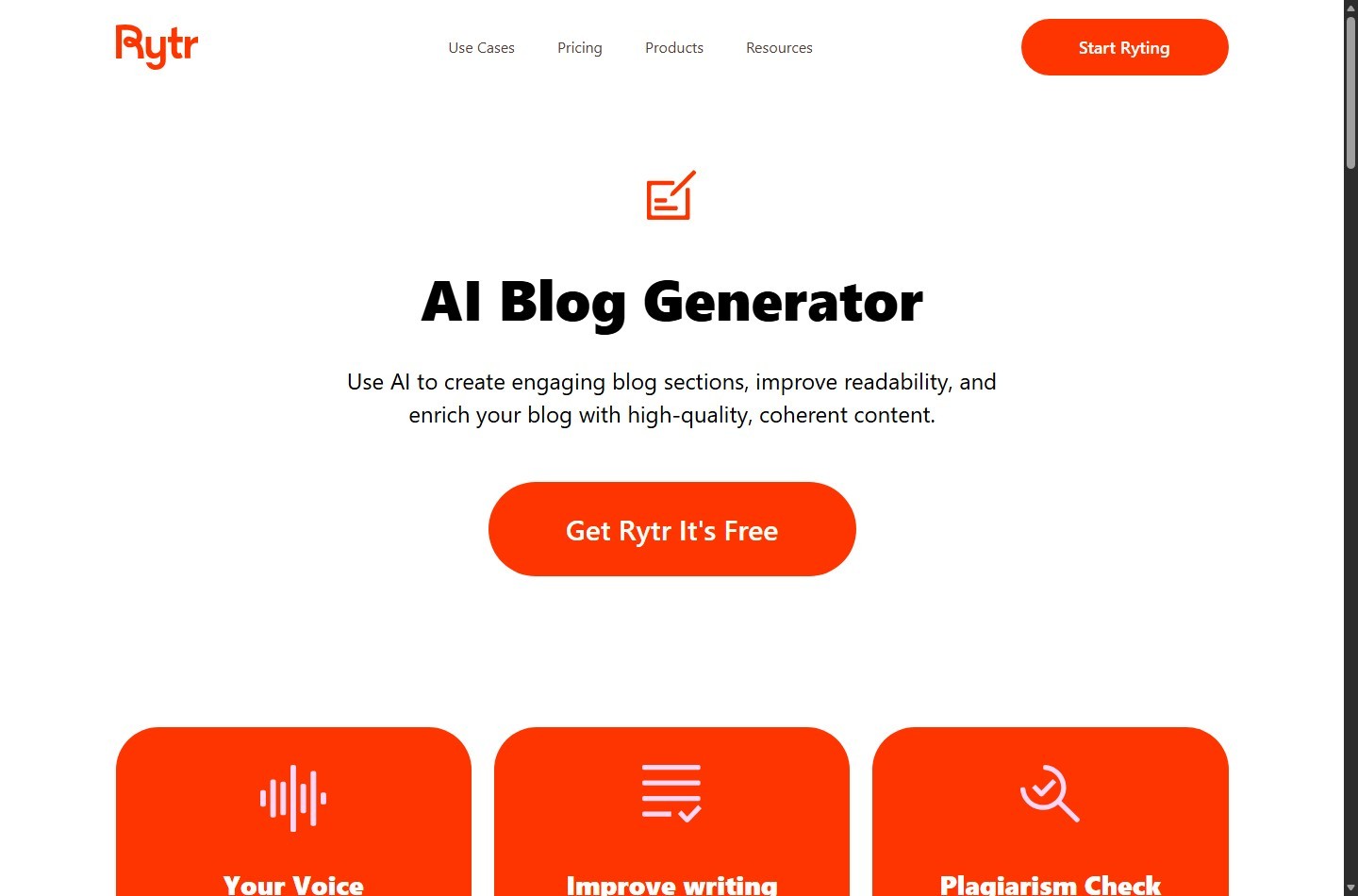
That loop is well matched to high-frequency micro-assets. It can also contribute to long-form work, but Rytr’s own help guidance describes a section-by-section process: generate an idea and outline, edit headings, then create paragraphs for individual topics. This is a writing sequence rather than a full research and optimization system.
Scalenut’s typical content loop is broader:
- Identify a topic or opportunity through planning and visibility data.
- Build keyword clusters or define a target query.
- create an article through the Article Writer or related content workflow.
- assess and improve the draft with optimization recommendations.
- manage collaboration and move approved work toward WordPress or Shopify where the plan supports auto-publishing.
- revisit existing pages through audits, optimization, and visibility tracking.
The extra stages matter only when your team uses them. A solo copywriter who never runs a content audit receives little value from audit capacity. An SEO manager coordinating dozens of articles may save more time from repeatable briefs, workspaces, optimization, and publishing than from raw text generation.
| Workflow stage | Rytr | Scalenut | Practical implication |
|---|---|---|---|
| Idea to short copy | Direct use-case and prompt workflow | Available inside a broader platform | Rytr usually has less setup for isolated copy |
| Keyword and topic planning | Manual or external tools | Keyword clusters and planning features | Scalenut can reduce tool switching for SEO programs |
| Long-form structure | Outline and section generation | Search-led article and optimization workflow | Scalenut better matches repeatable article operations |
| Revision | Improve, rephrase, expand, shorten, continue | Editor and content optimization actions | Rytr favors sentence-level speed; Scalenut adds SEO context |
| Publishing | Copy/export and browser-extension workflows | WordPress and Shopify integrations listed publicly | Scalenut can cover more of the handoff on eligible plans |
| Refresh cycle | Primarily manual | Content optimization and audit capabilities | Scalenut better supports ongoing content maintenance |
Which Features Create Real Buyer Value?
A feature earns its place only if it shortens a recurring task, improves a controlled quality metric, or reduces coordination cost. Rytr’s strongest value features are generation templates, compact editor commands, the Chrome extension, presets, Tone Match, and included plagiarism checks on paid plans. They are close to the moment a writer produces or edits copy.
Scalenut’s strongest differentiators are the connected planning and SEO layers: keyword clusters, article creation, content optimization, content audits, visibility tracking, workspaces, internal linking, and supported publishing integrations. These features address process consistency across a content program rather than one writer’s next sentence.
| Capability | Rytr | Scalenut | Edge |
|---|---|---|---|
| Short-form templates and quick variants | Core strength | Part of broader creation tooling | Rytr |
| Inline rewriting and text improvement | Core strength | Available through editing and optimization workflows | Rytr for speed |
| Custom voice controls | Tone Match varies by paid plan | Tone of Voice listed across current plans | Depends on evaluation quality |
| Keyword clustering | Not a core documented workflow | Included with plan-based limits | Scalenut |
| Search-informed article workflow | Basic outline and section generation | Article Writer plus optimizer and planning | Scalenut |
| Content audits and refreshes | Not a core documented workflow | Included at higher levels and plan limits | Scalenut |
| AI visibility tracking | Not a core documented workflow | Included with prompt and engine limits | Scalenut |
| Browser extension | Publicly promoted | Not the primary workflow | Rytr |
| CMS publishing | No current native WordPress claim used here | WordPress and Shopify integrations listed | Scalenut |
| Public API | Unclear from current public evidence | Official help says no API | Neither is an API-first choice |
Avoid selecting either product from the row count. Decide which three capabilities sit on your critical path, then test those capabilities with real briefs and approval criteria.
Rytr vs Scalenut Pricing and ROI
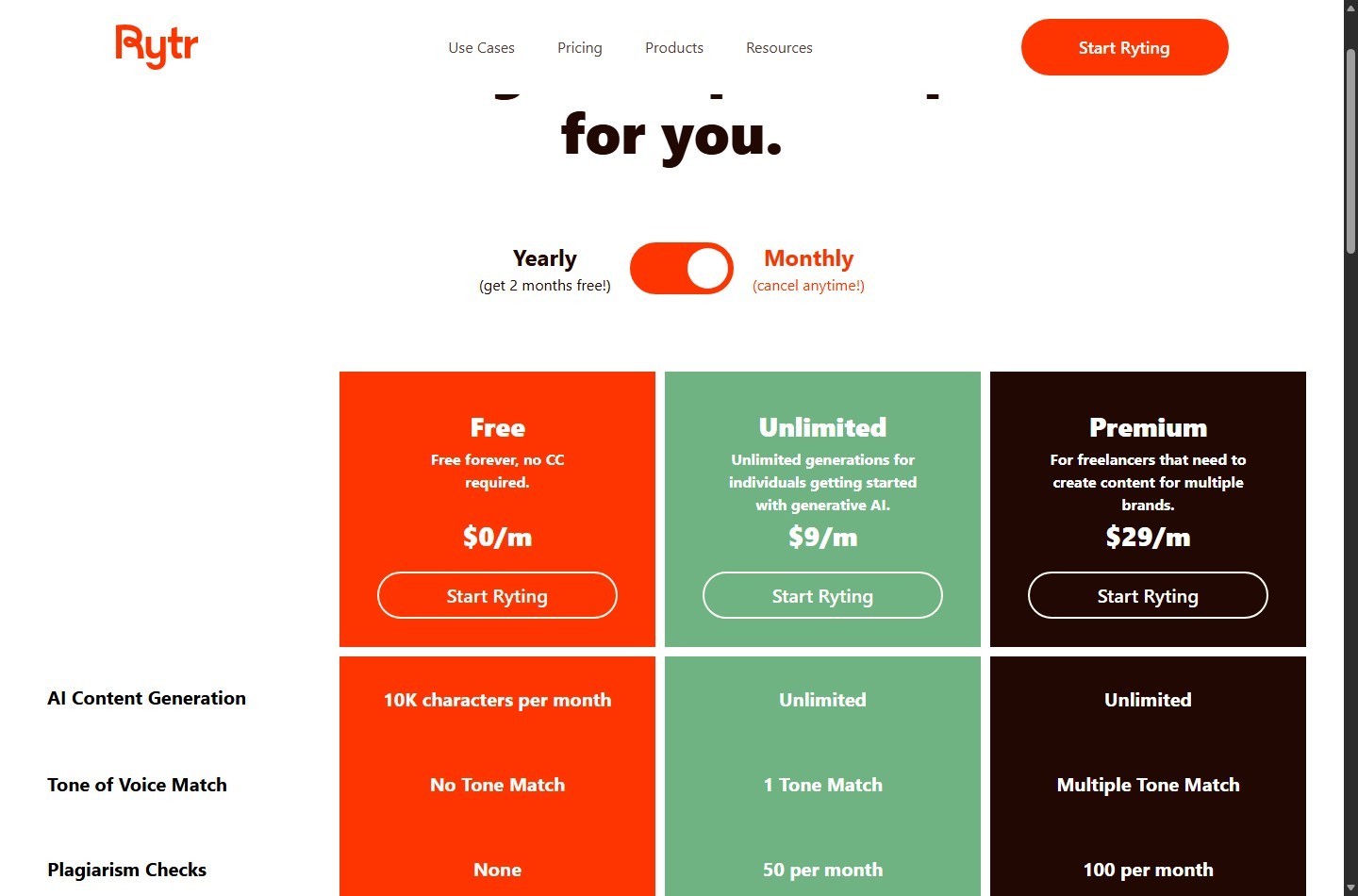
Rytr has the lower entry cost. Its official pricing page, checked August 1, 2026, lists Free at $0, Unlimited at $9 per month, and Premium at $29 per month for monthly billing. The annual display lists effective monthly equivalents of $7.50 for Unlimited and $24.16 for Premium. The Free plan includes 10,000 generated characters per month; paid plans list unlimited content generation, with differences in Tone Match, plagiarism checks, languages, input limits, and priority support.
Scalenut’s current pricing is more complex because the page displays standard monthly prices and a limited annual promotion. Standard monthly prices shown at the time of research were $59 for Starter, $89 for Plus, and $199 for Professional. The annual promotional display showed $24, $36, and $80 per month respectively, alongside “60% off” language and temporarily doubled usage limits. Because promotions can expire or change, treat those lower figures as a dated offer, not a permanent baseline. Confirm billing frequency, renewal terms, usage limits, and checkout price before paying.

| Product and plan | Public price checked August 1, 2026 | Selected public limits or positioning | Pricing caution |
|---|---|---|---|
| Rytr Free | $0 | 10,000 characters monthly; no Tone Match or plagiarism checks in pricing table | Enough to test fit, not necessarily production volume |
| Rytr Unlimited | $9 monthly; $7.50 monthly equivalent annually | Unlimited generation, one Tone Match, 50 plagiarism checks monthly | Fair-use and plan terms still apply |
| Rytr Premium | $29 monthly; $24.16 monthly equivalent annually | Multiple Tone Match, 100 plagiarism checks, expanded language access | Official pages conflict on exact tone/language counts |
| Scalenut Starter | $59 monthly; promotional annual display $24 monthly | One workspace, five standard articles and optimizations monthly, 10 tracked prompts | Promotion and doubled limits are volatile |
| Scalenut Plus | $89 monthly; promotional annual display $36 monthly | Two workspaces, 30 standard articles/optimizations, up to four team members | Confirm which features require this tier |
| Scalenut Professional | $199 monthly; promotional annual display $80 monthly | Unlimited workspaces and members; higher content and visibility limits | Validate whether volume justifies the jump |
Calculate ROI from approved output, not generated words. A useful formula is:
Monthly value = hours saved on work that survives review × fully loaded hourly cost + avoided tool costs − subscription cost − added review and coordination cost.
Rytr can produce positive ROI with a small time saving because its subscription is inexpensive. Scalenut needs a larger operational return, but it can replace or consolidate more steps for an active SEO team. Check the current Rytr coupon and annual billing evidence if your decision hinges on an offer, annual commitment, usage allowances, or the difference between Unlimited and Premium.
Which Tool Produces Better Writing Quality?
No responsible comparison can declare a permanent quality winner from vendor pages. Output changes with the brief, input material, topic, language, tone settings, and product updates. Neither tool should receive credit for accuracy, originality, or brand fit until its draft passes the same controlled review.
Rytr’s workflow may feel better for short copy because the task and evaluation unit are small. You can request variants, select the strongest line, and revise it quickly. Scalenut has more context for search-led long-form work because it connects the draft with planning and optimization information. That context can improve coverage and structure, but a higher content score does not prove factual accuracy, expertise, conversion performance, or originality.
A controlled evaluation plan
Run the following test before buying an annual plan:
- Prepare a shared source pack. Include an approved product brief, factual reference sheet, audience profile, prohibited claims, brand voice examples, and target query where relevant.
- Choose six tasks. Use two short-form assets, two editing tasks, one new long-form article, and one existing-article refresh. This prevents either product’s favored category from dominating the result.
- Standardize inputs. Give both tools equivalent facts, constraints, desired length, reading level, and CTA objective. Record every prompt and setting.
- Blind the review. Remove product names from outputs and ask at least two editors to score them independently.
- Use a fixed rubric. Score factual accuracy, instruction adherence, voice similarity, structural usefulness, originality risk, editing time, and publish readiness on the same scale.
- Measure total effort. Record research time, setup time, generation time, editing time, verification time, and handoff time. Fast generation can still create slow production.
- Recheck claims externally. Treat both products as drafting systems, not sources.
- Compare cost per approved asset. Divide subscription and labor costs by work that passes review, not by generations produced.
| Metric | Weight suggestion | What to record |
|---|---|---|
| Factual accuracy | 25% | Unsupported, outdated, or contradictory claims |
| Editorial effort | 20% | Minutes to reach publishable quality |
| Instruction adherence | 15% | Required points, exclusions, format, and CTA compliance |
| Voice fit | 15% | Similarity to approved samples without awkward imitation |
| Structure and coverage | 15% | Useful organization, missing concepts, repetition |
| Originality risk | 10% | Plagiarism-check findings plus manual review |
Do not turn this into a one-prompt beauty contest. The best tool is the one that reduces total cost per approved asset while maintaining your risk threshold.
How Do Voice and Tone Controls Compare?
Rytr markets more than 20 pre-programmed tones and Tone Match, which analyzes a writing sample to mirror a user, company, or client style. Its pricing table assigns no Tone Match to Free, one to Unlimited, and “Multiple Tone Match” to Premium. The homepage separately says Premium can build five personal tones. Because the wording differs, buyers should verify the current in-app allowance before choosing a plan specifically for multiple brands.
Scalenut’s pricing page lists Tone of Voice across plans and currently describes it as unlimited. The same page positions voice inside a larger content creation system, which may suit teams applying one brand standard across articles and workspaces. Public marketing copy does not establish which product reproduces nuance better.
Test voice with three samples: a new paragraph, a rewrite of weak copy, and a constrained promotional asset. Penalize copied phrasing, exaggerated claims, generic transitions, and loss of brand-specific vocabulary. Voice controls can reduce first-pass editing, but they do not replace a style guide or reviewer.
How Do Plagiarism Checks Compare?
Rytr’s checker is powered by Copyscape. The current pricing table includes no checks on Free, 50 per month on Unlimited, and 100 per month on Premium. This inclusion is convenient for an individual writer because checks sit close to the generation workflow.
Scalenut documents a Copyscape integration inside its app. Its help article instructs users to connect a Copyscape account with a username and API key, then run the checker in the article editor. That means availability and cost can depend on the external Copyscape account and its limits rather than an included Scalenut allowance.
A clean plagiarism result is not a guarantee of originality, factual correctness, copyright safety, or search performance. Check quoted language, product names, definitions, and common phrases manually. Also use editorial review to detect close paraphrasing or idea appropriation that a text-matching system may not capture.
Which Is Better for SEO and Content Planning?
Scalenut is the clear choice when SEO planning is the primary requirement. Current official materials describe keyword clustering, article creation, optimization, content audits, internal linking, topic gaps, and AI visibility tracking. These functions help a team connect discovery, execution, and refresh work around a consistent target.
Rytr can help write titles, descriptions, outlines, paragraphs, and other search-facing copy. It can also follow keywords supplied by the user. What it does not provide, is a comparable end-to-end system for building keyword clusters, analyzing article opportunities, optimizing against search-informed recommendations, auditing a site, and tracking AI visibility.
That does not make Scalenut an automatic SEO win. Search performance depends on intent alignment, differentiated information, technical health, authority, links, user satisfaction, and ongoing maintenance. Treat scores and recommendations as decision support. For buyers comparing other workflow shapes, our Rytr alternatives guide maps options by writing, SEO, and team needs.
Teams, Integrations, and API Access
Scalenut is better structured for a content operation. Its pricing page lists one workspace on Starter, two on Plus, and unlimited workspaces on Professional. Plus lists up to four team members, while Professional lists unlimited members. The page also names WordPress, Shopify, Semrush, and Copyscape integrations, with auto-publishing called out on Plus.
Rytr’s public help center says team and company plans are supported through separate member accounts managed by an admin. However, the same help article includes references to older “Saver” plan naming and future collaboration features. That makes the page a weak basis for current seat pricing or advanced collaboration claims. Verify seat terms and document-sharing controls inside the sales or billing flow before committing an agency.
API buyers should be cautious. Scalenut’s official help page states that it currently does not offer an API. Rytr’s help-center index references an API article, but current accessible public evidence was not clear enough to verify broad API availability, eligibility, documentation, or pricing. Neither product should be shortlisted as an API-first automation layer without written confirmation and current technical documentation.
Privacy and Data Handling Questions
Both vendors publish privacy policies, but procurement should look beyond a privacy-policy link. Rytr says it collects account, device, usage, and content-generation data; may use third-party vendors; retains personal data as necessary for stated purposes and legal obligations; and provides GDPR and CCPA rights. It also says information may be processed in the United States.
Scalenut’s public privacy policy, marked last updated November 2020, describes collection of account, payment, tracking, and platform-usage data; use of affiliates and external providers; retention for service and legal purposes; and user rights. The age of the displayed update is a reason to request current documentation rather than assume the page answers modern AI-data questions.
Before uploading confidential client or company material, ask both vendors:
* Is prompt and generated content used for model training or product improvement, and can customers opt out? * What are the retention and deletion timelines for content, backups, and logs? * Where is data stored and processed? * Which subprocessors receive content or account data? * Are encryption, SSO, role controls, audit logs, and a data processing agreement available on the intended plan? * How are connected WordPress, Shopify, Copyscape, or browser-extension credentials scoped and revoked?
Do not upload regulated, privileged, unreleased, or contract-restricted material until legal and security reviewers approve the terms.
Where Does Each Tool Fall Short?
Rytr limitations
Rytr’s focus creates its main constraints. It helps generate and revise text, but the user must bring or obtain research, search strategy, factual sources, editorial standards, approval logic, and publishing controls. Long-form production can become a section-by-section process, which may increase repetition and consistency work. The free plan’s character limit is useful for evaluation but easy to outgrow.
Official pages also conflict on language and Tone Match details. The pricing page lists 35+ languages for Premium, the homepage says 40+, the plagiarism page says its checker works in more than 30 languages, and an official help article says Rytr supports 30+ languages. These may describe different scopes or update cycles. Verify the exact target language and plan entitlement before purchase.
Scalenut limitations
Scalenut costs more and asks users to adopt a larger workflow. Teams can waste money if they buy planning, optimization, audits, or visibility tracking but continue working in disconnected spreadsheets and documents. Its breadth also increases setup, governance, and training requirements.
The pricing page mixes standard monthly pricing with a limited annual promotion and doubled limits, so screenshots or summaries can age quickly. The official help center says there is no API. Copyscape checking requires a connected Copyscape account and API key. Finally, search and GEO scores are proxies, not proof of rankings, citations, traffic, leads, or revenue.
Who Should Buy Rytr, Scalenut, or Neither?
| Buyer | Better fit | Why |
|---|---|---|
| Freelance copywriter | Rytr | Low-cost help with variants, rewrites, tone, and compact deliverables |
| Solo founder writing emails and social posts | Rytr | Simple workflow and a free evaluation tier |
| Content marketer publishing search-led articles | Scalenut | Planning, article creation, and optimization are connected |
| SEO agency managing domains and approvals | Scalenut, especially higher tiers | Workspaces, team allowances, audits, and publishing integrations fit operations |
| Brand with strict confidential-data controls | Neither until procurement approval | Public policies alone may not answer training, retention, or enterprise-control questions |
| Developer building automated generation | Neither by default | Scalenut says no API, and Rytr API availability was not publicly clear enough for reliance |
| Occasional writer with low volume | Rytr Free or existing general-purpose tools | A paid SEO platform may not create enough incremental value |
| Team without a documented content process | Neither yet | Software will not repair unclear ownership, briefs, reviews, or success metrics |
Rytr is the sensible default for buyers optimizing time to first usable draft on short assets. Scalenut is the sensible default for buyers optimizing time from topic opportunity to approved, optimized article. If your organization does both, map costs separately. A Scalenut subscription for the SEO team and a Rytr subscription for a high-volume copywriter can be more rational than forcing every task through one product.
The Purchase Decision in One Minute
Pick Rytr if all three statements are true:
* Your primary tasks are short copy, rewrites, and editing. * You already have reliable research and publishing processes. * Low cost and low setup matter more than integrated SEO planning.
Pick Scalenut if all three statements are true:
* Search-led articles and content refreshes drive meaningful business value. * Your team will use planning, optimization, workspaces, or publishing integrations every month. * You can measure approved output, organic visibility, and production time well enough to justify the higher cost.
Choose neither until later if you cannot name the bottleneck, baseline monthly output, review standard, or owner. Run the controlled evaluation with five to ten real assets, calculate cost per approved item, and confirm current checkout terms. If Rytr proves the better operational fit, review the live Rytr purchase path only after checking that the offer and redirect are working.
FAQ
Is Rytr better than Scalenut?
Rytr is better for inexpensive, fast short-form drafting, rewriting, and tone-based copy assistance. Scalenut is better for keyword planning, search-led article workflows, content optimization, audits, team workspaces, and supported publishing integrations. The winner depends on the bottleneck.
Is Scalenut worth the higher price?
It can be when a team consistently uses its planning, article, optimization, audit, collaboration, and publishing functions. Measure time and tool costs saved per approved article. It is harder to justify for occasional copy generation or teams that will ignore the broader workflow.
Does Rytr include a plagiarism checker?
Paid Rytr plans list Copyscape-powered plagiarism checks. The official pricing page currently shows 50 checks per month on Unlimited and 100 on Premium, with none on Free. A passed check is not a guarantee of originality or legal safety.
Does Scalenut include plagiarism checking?
Scalenut documents a Copyscape integration. Its help instructions require users to connect a Copyscape username and API key. Confirm Copyscape pricing, credits, and limits separately because the integration does not necessarily mean checks are included in the Scalenut subscription.
Which is better for SEO articles?
Scalenut has the stronger documented workflow for SEO articles because it connects keyword planning, article creation, optimization, audits, and visibility features. Rytr can generate outlines and paragraphs, but research, optimization, and content operations require more external work.
Which has better brand voice controls?
Both advertise voice controls. Rytr offers preset tones and plan-dependent Tone Match; Scalenut lists Tone of Voice within its content platform. Test both against approved brand samples because feature availability does not establish output quality.
Does either product offer an API?
Scalenut’s official help page says it currently does not offer an API. Rytr’s public help index references API information, but accessible evidence was insufficient to confirm current availability, eligibility, or terms. Obtain written confirmation and documentation before planning an integration.
Can a team use Rytr and Scalenut together?
Yes, if roles are clear. A copywriter could use Rytr for rapid campaign assets while an SEO team uses Scalenut for research-led articles and refreshes. Track overlap and approved-output costs so the combination does not become redundant software.