Rytr is easy to like when the job is simple: open a template, enter a prompt, and turn an idea into usable copy without paying enterprise prices. The harder question is whether that streamlined workflow still fits once you need search research, brand governance, campaign automation, in-line editing, or performance data.
| Quick answer | Best fit | Entry pricing or access caveat |
|---|---|---|
| Jasper | Brand-governed marketing teams | 7-day Pro trial; current public page may require checkout for the live price |
| Copy.ai | Repeatable go-to-market workflows | Chat from $29 monthly or $24 monthly billed annually |
| Scalenut | SEO and GEO article production | Starter $59 monthly; promotional annual price shown as $24 monthly |
| Writesonic | SEO content plus AI-search visibility | Starter $79 monthly billed annually; free start advertised |
| Anyword | Performance-minded ad and campaign copy | Starter $49 monthly or $39 monthly billed annually; 7-day trial |
| Grammarly | Editing inside everyday work apps | Free plan; Pro displayed from $12, with eligibility and billing context to verify |
| Quillbot | Paraphrasing and document transformation | Free tier; Premium $8.33 monthly billed $99.95 annually in official US pricing guidance |
| Wordtune | Sentence-level rewriting and English fluency | Free tier; Advanced $4.89 monthly billed annually after a 3-day trial |
The best replacement is not the tool with the longest feature list. It is the one that removes the next bottleneck in your workflow. This guide compares eight close AI writing alternatives by buyer job, cost of switching, access limits, and the tradeoff you accept. If you first need a baseline for what Rytr already offers, our contextual Rytr review covers its templates, tones, browser extension, and plan structure.
Why look for an alternative to Rytr?
Rytr's official pricing page lists a free plan with 10,000 characters per month, an Unlimited plan at $7.50 per month, and Premium at $24.16 per month on the annual view. That makes Rytr a strong value option for short copy, ideation, rephrasing, and freelancers who want several tones without a large fixed software cost.
A switch becomes rational when the saved labor or reduced rework is worth more than the price gap. Common triggers include:
- You need research and optimization around the draft. Rytr can generate copy, but SEO-focused platforms connect planning, briefs, article creation, optimization, and publishing.
- Your team needs governed brand context. A few personal tones are different from shared audiences, knowledge, style rules, permissions, and approval workflows.
- You want automation beyond one prompt. Go-to-market teams may need a repeatable process that moves account data through research, personalization, and asset generation.
- Editing is the primary job. If most of your day is spent improving existing writing in email, documents, and web apps, an in-line writing assistant may replace Rytr more cleanly than another generator.
- Copy decisions depend on performance data. Paid media teams may value predicted response and campaign data more than a broad library of templates.
There is no universal upgrade path. A solo freelancer writing captions may get lower ROI from an enterprise marketing platform than from Rytr. A content team publishing search-led articles may save money overall by paying more for research, optimization, and workflow controls.
How we selected these Rytr alternatives
We kept the list close to AI writing and content work. Each product can replace at least one meaningful Rytr workflow, but each earns its place through a distinct buyer job. We excluded broad SEO suites that only happen to include a text generator and general chatbots that lack a focused writing workflow.
The evaluation uses current public information from official homepages, pricing pages, help centers, and product documentation checked on August 1, 2026. Pricing is volatile, localized, and sometimes presented differently by billing cycle, campaign, or region. Treat every amount as a decision-screening figure and confirm the checkout total, renewal terms, seat count, and included usage before buying.
| Selection factor | What it means for a Rytr buyer |
|---|---|
| Workflow proximity | The product directly creates, rewrites, or improves marketing and business content |
| Distinct advantage | It solves a buyer job that Rytr handles less deeply |
| Switching value | The added workflow can plausibly reduce tools, handoffs, or editing time |
| Access transparency | A buyer can identify a free tier, trial, public entry price, or sales gate |
| Tradeoff clarity | Higher price, narrower scope, usage limits, or added complexity is stated plainly |
Rytr alternatives compared at a glance
| Alternative | Best for | Why it can replace Rytr | Main tradeoff |
|---|---|---|---|
| Jasper | Multi-person marketing teams | Shared brand context, marketing agents, and content pipelines | Higher cost and setup burden |
| Copy.ai | GTM operations | Chat plus workflows, tables, integrations, and Infobase | Broader, process-heavy platform |
| Scalenut | Search-led publishers | Keyword clusters, article generation, optimization, audits, and publishing | More SEO complexity than a simple writer |
| Writesonic | Teams combining content and AI visibility | AI Article Writer, content strategy, audits, and AI-search tracking | Current entry plan is visibility-led and expensive |
| Anyword | Paid and lifecycle marketers | Copy generation with performance predictions and brand context | Prediction allowances and higher price |
| Grammarly | Professionals editing across apps | Grammar, tone, rewriting, and AI prompts in the flow of work | Less template-led campaign creation |
| Quillbot | Writers transforming existing text | Paraphrasing modes, summaries, grammar, translation, and document tools | Less focused on end-to-end marketing campaigns |
| Wordtune | English rewriting and fluency | Contextual rewrites, tone shifts, shortening, expansion, and summaries | English-first output and daily limits below Unlimited |
1. Jasper: Best for governed, on-brand marketing production
Best for: Marketing teams that need shared brand voice, approved knowledge, multi-channel campaigns, and controlled workflows.
Jasper replaces Rytr when content generation is no longer an individual task. Its current platform positioning centers on purpose-built marketing agents, content pipelines, and Jasper IQ. The official site says Jasper IQ can hold brand voice, style guides, audiences, and company knowledge so marketers can apply the same context across assets. That is a material step beyond selecting a tone each time you generate a piece of copy.
The platform also supports marketing use cases such as blog posts, ad campaigns, social media campaigns, landing pages, press releases, and content repurposing. Jasper's pricing comparison lists a marketing editor, rewriting controls, collaboration, browser extensions, and more than 100 purpose-built marketing agents. For a team that currently copies Rytr outputs into separate briefs, brand documents, and review systems, Jasper can consolidate more of the production layer.
Why Jasper can replace Rytr
Rytr's strength is fast, economical generation. Jasper's replacement case is governance. Shared audiences, institutional knowledge, style rules, document collaboration, and content pipelines can reduce the back-and-forth that occurs after a first draft. The buyer is paying for consistency and operational control, not merely more words.
Main tradeoff
Jasper is a heavier system. Teams need to prepare knowledge, define brand rules, choose agents, and train users. That investment can be wasteful for one person producing occasional captions or emails. Some advanced functions, custom workflows, administration, and enterprise controls are tied to Business access.
Current pricing and access caveat
Jasper advertises a 7-day free trial of Pro. Its current public pricing page explains monthly and annual Pro billing, with roughly 20% savings for an annual commitment, but the extracted public page does not expose a dependable live dollar amount. Business pricing is customized and starts with a 12-month commitment. Verify the Pro checkout price rather than relying on older articles or third-party listings.
Buyer fit: Choose Jasper if brand consistency and coordinated campaign production are measurable business problems. Keep Rytr if you are a solo operator who mainly needs inexpensive drafts and can manage voice manually.
2. Copy.ai: Best for repeatable go-to-market workflows
Best for: Revenue, sales, marketing, and operations teams that want AI to run repeatable GTM processes, not just generate isolated copy.
Copy.ai has moved beyond the familiar template writer category. Its official homepage positions the product as a GTM AI platform with Workflows, Actions, Agents, Tables, Chat, Infobase, Brand Voice, and more than 2,000 integrations. Content creation remains a stated use case, including SEO, thought leadership, use cases, and social content, but the larger value is connecting generation to a process.
A practical replacement scenario is sales outreach. Instead of asking Rytr for one email, a team can build a process that researches accounts and contacts, uses stored company information, and drafts personalized outreach. The same logic applies to localization, account-based marketing, inbound lead processing, and content operations. Chat still provides a familiar one-off interface when automation is unnecessary.
Why Copy.ai can replace Rytr
Copy.ai covers the short-form ideation and drafting job while adding reusable workflow structure. Its Chat plan includes access to OpenAI, Anthropic, and Gemini models, unlimited words in Chat, unlimited Chat projects, and five seats according to the official pricing page. That can be attractive to a small team that would otherwise maintain separate individual writing subscriptions.
Main tradeoff
The product's GTM scope may be excessive if you only want a clean writing editor. Workflow credits, integration design, data structure, and process ownership introduce operational decisions that Rytr largely avoids. The pricing jump from Chat to automation-oriented business tiers is also substantial.
Current pricing and access caveat
The Chat plan is $29 per month or $24 per month billed at $288 annually. The official page lists Growth at $1,000 per month billed annually with 75 seats and 20,000 workflow credits per month; larger tiers increase from there. This means the low-cost plan is primarily Chat access, while serious workflow automation is a different buying category.
Buyer fit: Copy.ai fits small teams that want shared chat access or larger GTM organizations with a defined automation case. It is less compelling for a freelancer who would not use workflows, tables, or integrations.
3. Scalenut: Best for SEO and GEO article production
Best for: Publishers, content teams, and agencies that want research, article creation, optimization, audits, and publishing in one search-focused workflow.
Scalenut is the clearest upgrade when Rytr's blank-prompt workflow creates too much work before and after the draft. Its official pricing page groups AI visibility tracking with a GEO content engine. Plans include article creation, optimization of existing articles, keyword clusters, content scoring, and supported integrations. Higher tiers add content audits, internal linking, topic gaps, auto-publishing, more workspaces, and collaboration.
That changes the unit of work. Rytr helps create a passage or asset. Scalenut is built around moving a search topic through planning, generation, optimization, and ongoing visibility work. For buyers who publish search-led long-form content, the extra context can justify a higher subscription if it replaces separate briefing or optimization steps.
Why Scalenut can replace Rytr
Scalenut still performs the core AI writing job, but it wraps the draft in keyword clustering, competitive context, scoring, optimization, and publishing. A content manager can assign value to fewer handoffs, not just faster text generation. Teams also get tone-of-voice controls and increasingly broader AI-search visibility features.
Main tradeoff
The interface and plan limits are organized around SEO and GEO production, so the product is less economical for everyday emails, quick captions, or general copy. Search metrics and optimization guidance also require editorial judgment. A score is a planning signal, not proof that a page will rank or convert.
Current pricing and access caveat
The official page lists Starter at $59 per month with a 7-day trial, five articles per month on the monthly view, one workspace, and weekly visibility tracking. A promotional annual view displays $24 per month and doubled limits, but it is explicitly presented as a limited offer. Plus is $89 monthly and Professional is $199 monthly before the displayed promotion. Confirm duration, renewal price, and live limits at checkout.
For a focused decision between low-cost writing and a search-led production system, the Rytr vs Scalenut comparison explains where the added SEO workflow can earn back its cost.
Buyer fit: Pick Scalenut if articles are acquired through keyword and AI-search strategy and you will use optimization or publishing features every month. Stay with Rytr if search research happens elsewhere or most assignments are short copy.
4. Writesonic: Best for content teams tying writing to AI-search visibility
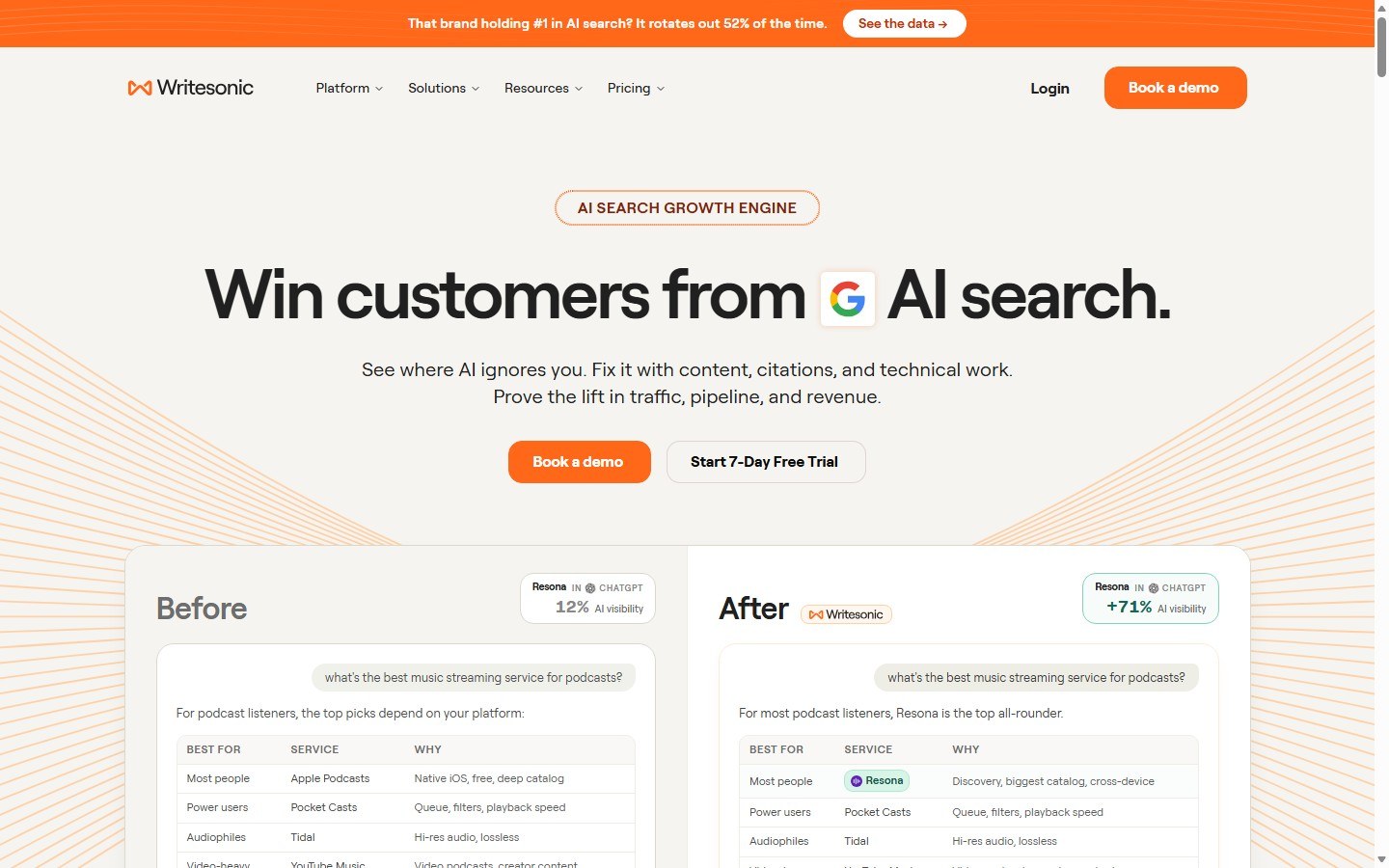
Best for: Established marketing teams that want AI article creation, SEO workflows, site audits, and monitoring of how their brand appears in AI answers.
Writesonic's current product and pricing direction is broader than a conventional AI writer. The Starter plan combines AI-search visibility tracking across ChatGPT, Gemini, and Google AI Overviews with content strategy, an SEO and Content AI Agent, an AI Article Writer, and site audits. The official plan comparison also lists Google Search Console and WordPress integrations.
This makes Writesonic a replacement for buyers whose definition of writing now includes discoverability in search and AI answer engines. Instead of stopping at a draft, the workflow can connect article creation to audits and visibility signals. That is a closer fit for a content-led company than for a user who simply wants product descriptions or social captions.
Why Writesonic can replace Rytr
The AI Article Writer and content strategy components cover long-form production, while writing styles provide brand context. Site audits and visibility tracking then extend the process into measurement and remediation. A team can evaluate the subscription as a combination of writer, search workflow, and visibility platform rather than as a direct price-per-word competitor.
Main tradeoff
Writesonic's current entry packaging is expensive relative to Rytr and is led by AI visibility. Buyers who do not need prompt tracking, audits, or GEO work may pay for a platform layer they rarely use. Some content optimization and advanced Action Center capabilities are not available at the lowest level according to the comparison table.
Current pricing and access caveat
Starter is $79 per month billed annually. Basic is $199, Growth is $399, and Enterprise is custom. The page says buyers can start free without a credit card, but it does not frame that access as a broad permanent free writing plan. Fair-use terms apply, and article allowances can depend on the selected tier or add-on. Confirm current monthly billing options and content limits before switching.
Buyer fit: Writesonic fits a marketing team with budget and a clear need to connect content production to AI-search visibility. It is a poor value replacement for a cost-sensitive freelancer using Rytr mainly for short-form copy.
5. Anyword: Best for performance-minded ad and campaign copy
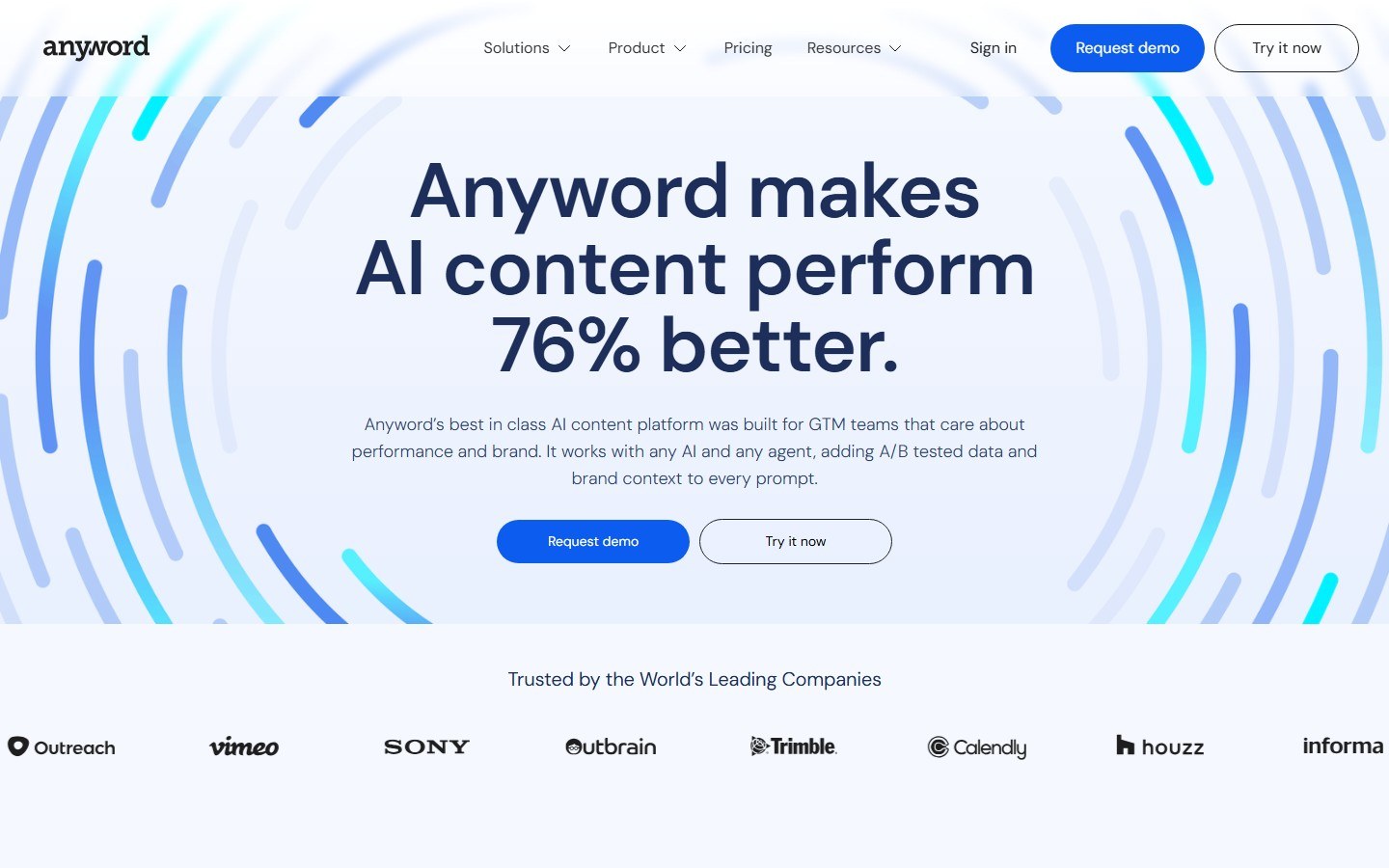
Best for: Demand generation, paid media, lifecycle, and product marketers who choose among copy variants using performance-oriented data.
Anyword replaces Rytr from a different angle. Both tools can produce ads, emails, landing-page copy, social posts, and blog content, but Anyword centers its product on performance predictions, a data-driven editor, brand voice, and content intelligence. Its official site describes predictions designed to help marketers compare variations before publishing and tools that connect past campaign data on higher plans.
For a paid media team, generating ten headlines is only the first step. The expensive part is deciding what to launch, coordinating brand context, and learning from results. Anyword's Starter plan pairs unlimited copy generation with one brand voice, performance predictions, a content improver, more than 100 marketing templates and prompts, Blog Wizard, and a Chrome extension.
Why Anyword can replace Rytr
The core replacement case is prioritization. Rytr can accelerate variant creation, while Anyword is designed to add a performance-data layer to variant selection. Teams that already spend meaningfully on distribution may see more value in structured decision support than in the lowest possible writing subscription.
Main tradeoff
Prediction scores are not guaranteed campaign outcomes. Media cost, audience quality, offer, placement, creative, and landing-page experience still affect results. The entry plan also limits the number of performance predictions, and deeper use of historical campaign data sits on custom-priced tiers. Buyers should treat the score as another input, not an automatic publishing decision.
Current pricing and access caveat
Starter is $49 monthly or $39 per month billed annually and includes a 7-day free trial. The annual Starter view lists 100 performance predictions, one seat, one workspace, and one brand voice. Data-Driven is $99 monthly or $79 per month billed annually and includes three seats plus real-time predictions for manual edits. Business and Enterprise use custom pricing.
Buyer fit: Anyword is a practical Rytr alternative when copy is tied to measurable paid or lifecycle campaigns. It is difficult to justify for occasional organic posts where prediction allowances and performance data will not influence spend.
6. Grammarly: Best for editing across everyday work apps
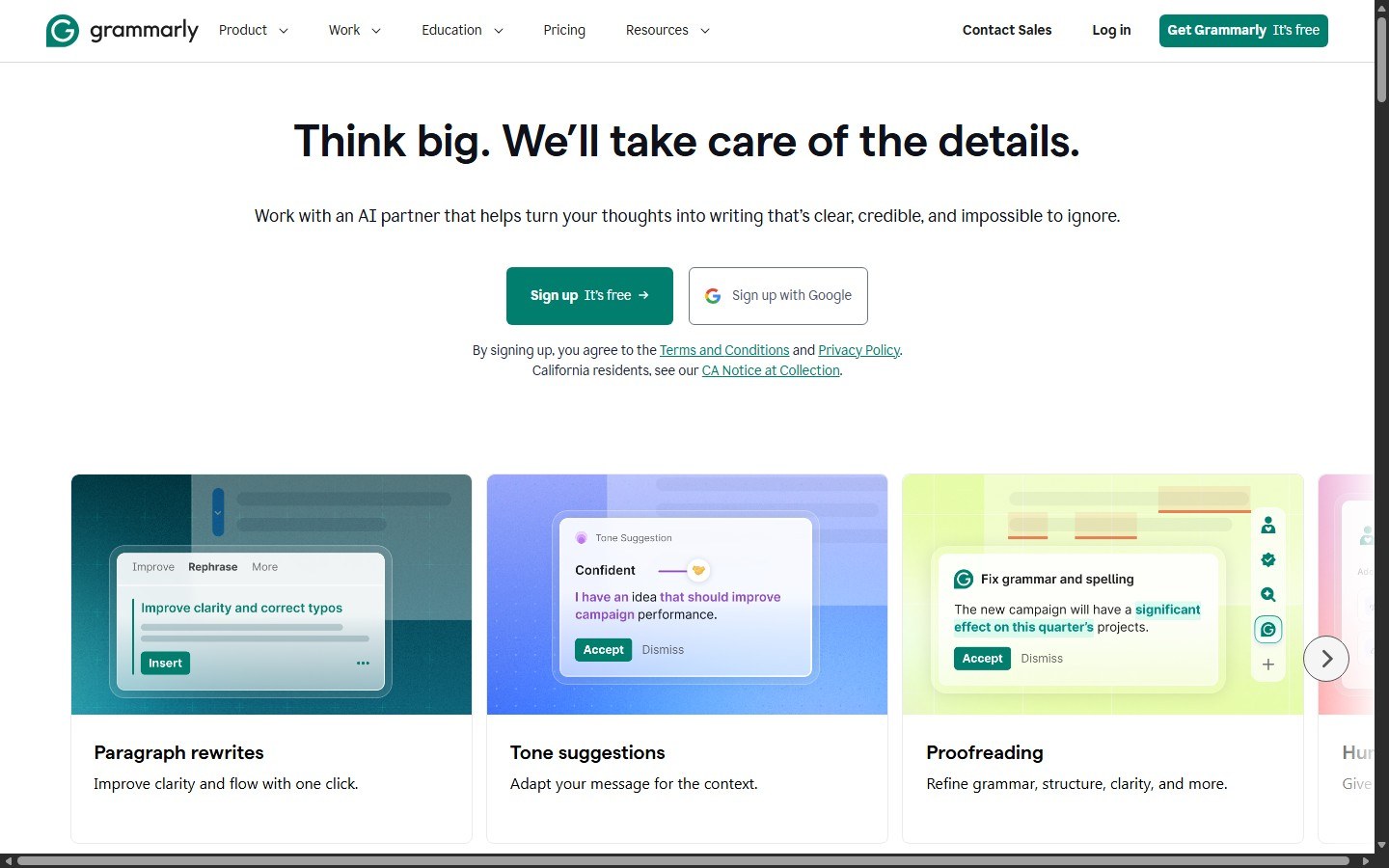
Best for: Professionals and teams that spend more time correcting, rewriting, and aligning existing text than generating campaign assets from templates.
Grammarly is the strongest workflow substitute when writing happens everywhere. Its official product pages emphasize spelling and grammar correction, tone, full-sentence rewrites, fluency, plagiarism and AI-text detection, generative prompts, style guides, brand tones, and proactive assistance across apps. That puts help closer to email, documents, support tools, and browser-based work.
Rytr offers a Chrome extension and editing use cases, but Grammarly makes in-context revision the center of the product. A consultant can refine client email, a marketer can rewrite a paragraph, and a team can apply a shared style guide without first moving every draft into a separate generator.
Why Grammarly can replace Rytr
The replacement logic is based on where the work begins. If users usually bring existing text and want it clearer, more concise, more fluent, or more on-brand, Grammarly can remove an app switch. The free and Pro plans also include generative AI prompts, so it can help create text when needed rather than functioning only as a checker.
Main tradeoff
Grammarly is not primarily a template-led marketing production suite. It can generate and rewrite, but buyers looking for structured blog workflows, keyword research, campaign pipelines, or performance predictions will need another system. AI-prompt allowances also matter for users who plan to generate at high volume.
Current pricing and access caveat
The official US plans page displays Free at $0 and Pro from $12 with a trial, 2,000 AI prompts per member per month, one style guide, and one brand tone. Another official Pro page clarifies $12 per member per month billed annually and $30 when billed monthly. Grammarly also notes eligibility and regional plan differences, so verify the plan name, billing cycle, and local offer presented to your account.
Buyer fit: Choose Grammarly if the ROI comes from fewer errors and faster revision across daily communications. Choose a generator-first alternative if you need batches of channel-specific marketing assets from structured inputs.
7. Quillbot: Best for paraphrasing and document transformation
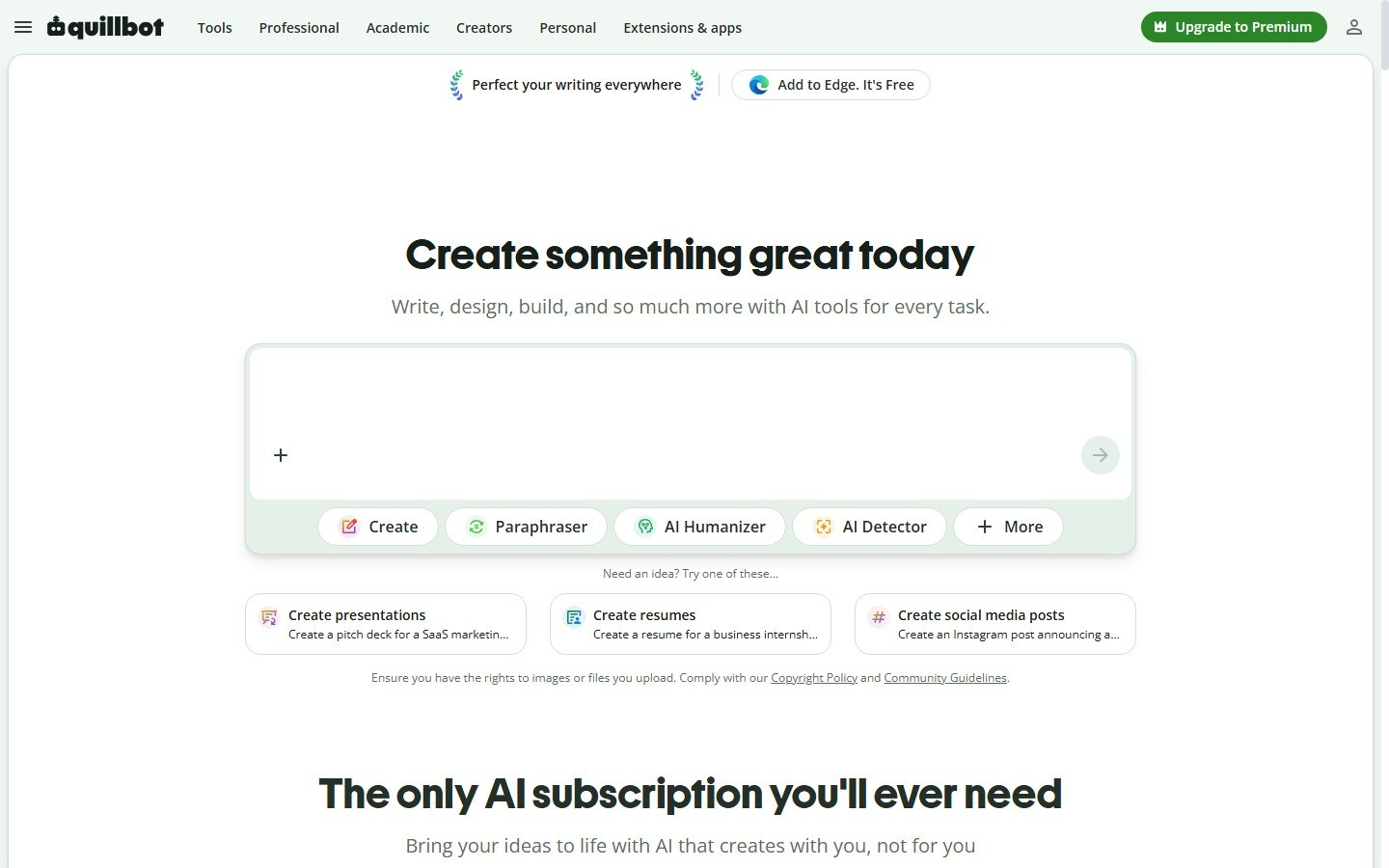
Best for: Writers, students, researchers, and professionals who need to rephrase, summarize, translate, check, and transform existing material.
Quillbot began with a clear paraphrasing identity and now presents a broader creation suite. Its official homepage lists Paraphraser, Grammar Checker, Humanizer, AI Chat, Summarizer, Translator, citation tools, document creation, extensions, and apps. Premium expands paraphrasing modes, custom modes, summarization limits, translation, plagiarism checking, and other writing controls.
The overlap with Rytr is strongest in rewriting, summarizing, paragraph generation, and browser-based assistance. Quillbot is a better fit when the source text already exists and the user wants several transformations. It is also available across Chrome, Edge, Word, macOS, Windows, and mobile environments, which can reduce copy-and-paste friction.
Why Quillbot can replace Rytr
Quillbot provides a focused toolset for turning source material into clearer, shorter, differently toned, or translated text. AI Chat and document tools extend it into ideation and drafting. For a researcher or editor, that combination can cover more of the daily workflow than Rytr's marketing-oriented use cases.
Main tradeoff
Quillbot is less purpose-built for coordinated marketing campaigns, shared brand governance, SEO planning, or ad-performance decisions. Users should also apply normal source and citation discipline. Paraphrasing does not remove the obligation to represent sources accurately or follow academic and client policies.
Current pricing and access caveat
A free plan is available, but the Paraphraser is capped at 125 words per input and offers two modes. Quillbot's official US pricing guidance lists Premium at $19.95 monthly or $8.33 per month when $99.95 is billed annually. The live pricing page may localize currency. Premium includes unlimited paraphrasing, while specific tools still have stated allowances, such as 25,000 plagiarism-check words per month on the current comparison.
Buyer fit: Quillbot is the better replacement for transformation-heavy work involving existing documents. Rytr or a campaign platform remains more natural for marketers starting from a brief and producing many distinct asset types.
8. Wordtune: Best for sentence-level rewriting and English fluency

Best for: Professionals, non-native English writers, support teams, and marketers who want contextual alternatives without handing the entire draft to a campaign generator.
Wordtune focuses on helping users express an existing idea more clearly. Its official product pages highlight contextual rewrite suggestions, formal and casual tone shifts, proofreading, continuation, shortening, expansion, summaries, and translation into English from supported languages. The workflow is intentionally close to the sentence and paragraph.
That makes Wordtune a credible Rytr alternative for people who know what they want to say but want better phrasing. The user retains control over the idea, selects among alternatives, and can adjust fluency or vocabulary. For client email, support responses, internal communication, and revision-heavy content, this narrower approach may be more efficient than choosing a marketing template.
Why Wordtune can replace Rytr
Wordtune covers rephrasing, continuation, tone changes, grammar, and summarization, which overlap with several common Rytr use cases. It also works across everyday writing environments. The free plan offers enough limited activity to establish whether contextual rewriting fits the buyer's habits before paying.
Main tradeoff
Wordtune is English-first for writing, even though it can translate several languages into English. The lower paid plan still imposes daily rewrite and monthly summary limits. It does not replace a search-content platform, a shared campaign system, or a performance-copy product.
Current pricing and access caveat
Basic is free with 10 rewrites and AI suggestions per day and three AI summaries per month. Advanced is shown at $6.99 monthly or $4.89 per month billed annually, with 30 rewrites per day and 15 monthly summaries. Unlimited is $9.99 monthly or $6.99 per month billed annually. Paid plans advertise a 3-day trial that requires payment information, and the official policy says refunds are not offered, so cancel before renewal if it is not a fit.
Buyer fit: Wordtune is a strong low-cost switch for sentence-level revision and English fluency. It is not the right replacement if your bottleneck is research, team governance, content operations, or multi-asset campaign automation.
Which Rytr alternative should you choose?
Start with the work you repeat every week, then price the bottleneck rather than the software in isolation.
| If your recurring bottleneck is... | Shortlist | Decision test |
|---|---|---|
| Brand inconsistency across a marketing team | Jasper | Will shared knowledge, style rules, and pipelines reduce review cycles? |
| Manual research and personalization in GTM | Copy.ai | Do you have a repeatable workflow and an owner for automation? |
| Search-led article planning and optimization | Scalenut | Will you use clusters, optimization, audits, or publishing every month? |
| Connecting content to AI-search visibility | Writesonic | Is GEO monitoring important enough to justify the entry price? |
| Choosing paid campaign copy variants | Anyword | Will prediction data influence meaningful media or lifecycle spend? |
| Editing messages across many apps | Grammarly | Is revision volume larger than net-new asset generation? |
| Reworking and summarizing source documents | Quillbot | Does most work begin with text that already exists? |
| Improving English phrasing sentence by sentence | Wordtune | Do contextual rewrites solve the problem without a full content platform? |
For cost-sensitive solo work, compare every upgrade against Rytr's $7.50 annual-billing Unlimited rate. If a new tool does not eliminate another subscription, reduce a recurring handoff, or save billable time, the upgrade may not produce ROI.
If Rytr still matches your actual workload, there is no need to switch for feature-list prestige. You can keep Rytr for low-cost short-form generation and add a specialist only when a specific workflow earns its cost.
A practical migration checklist
- Export the prompts and inputs that matter. Save briefs, tone examples, reusable instructions, and approved outputs outside Rytr.
- Choose one representative workflow. Test a real article brief, ad set, client email sequence, or editing batch. Do not judge a platform from a novelty prompt.
- Define acceptance criteria before the trial. Track setup time, editing time, number of handoffs, required corrections, and publishing steps. Avoid unsupported assumptions about output quality.
- Check the full subscription boundary. Confirm billing cycle, trial conversion, seats, usage limits, fair-use policy, add-ons, and renewal price.
- Review data handling and permissions. This matters when uploading customer information, internal knowledge, campaign history, or unpublished product details.
- Run both tools briefly if the cost is acceptable. A parallel period reveals hidden dependencies and makes it easier to compare workflow time.
- Cancel before the trial or renewal deadline if needed. Several vendors require payment details or automatically renew subscriptions.
The cleanest migration usually preserves your best prompts but changes the surrounding process. A writing platform creates value when it reduces the work around generation, not merely when it offers a different text box.
FAQ
What is the best free Rytr alternative?
The answer depends on the task. Grammarly has a free plan for grammar, tone visibility, and limited AI prompts. Wordtune offers limited daily rewrites and summaries. Quillbot provides free paraphrasing and writing tools with input limits. These products are stronger for editing or transformation than for replacing every Rytr marketing template. Compare the free limit against Rytr's own 10,000-character monthly plan before moving.
Which Rytr alternative is best for long-form SEO content?
Scalenut is the most direct choice in this list for keyword clusters, article creation, optimization, content audits, and publishing. Writesonic is another option when AI-search visibility is part of the requirement. Both cost materially more than Rytr, so the added research and optimization workflow needs to save enough time or replace other tools.
Which alternative is closest to Rytr for rewriting?
Wordtune and Quillbot are the closest specialist options. Wordtune emphasizes contextual sentence rewrites, tone, fluency, and English expression. Quillbot emphasizes paraphrasing modes, document transformation, summaries, translation, and a broader set of writing utilities. Grammarly is a better fit when rewriting must happen across many work apps with grammar and style guidance.
Is Jasper better than Rytr?
Jasper is better suited to marketing teams that need shared brand context, company knowledge, purpose-built agents, collaboration, and content pipelines. Rytr is usually the more economical choice for an individual producing straightforward short-form copy. The right answer depends on whether governance and team workflow are worth the added setup and subscription cost.
Is there a cheaper alternative to Rytr?
Rytr is already one of the lowest-priced paid generators in this comparison. Wordtune's annual Advanced and Unlimited rates can be lower, but its workflow is narrower and focused on rewriting. Free plans from Grammarly, Quillbot, and Wordtune may cost less for light editing, but their limits and use cases differ from Rytr's Unlimited generation plan.
Which Rytr alternative is best for ad copy?
Anyword is the most specialized option here for performance-oriented ad and campaign copy because it combines generation with performance predictions and brand context. Jasper is better when ad copy is one asset within a larger governed campaign workflow. Rytr can remain sufficient when you need inexpensive variations and already have a separate testing process.
Can I keep Rytr and add a specialist instead of replacing it?
Yes. That is often the highest-ROI choice. Keep Rytr for quick ideation and short copy, then add Grammarly or Wordtune for editing, Quillbot for transformation, or an SEO platform for search articles. Continue with Rytr if its simple workflow still fits, and only pay for a second tool when the specialized job recurs often enough to justify it.
How often should I recheck pricing?
Check pricing immediately before starting a trial and again before the first renewal. Vendors change plan names, limits, promotions, billing-cycle discounts, seat allowances, and regional availability. Save a copy of the checkout terms and confirm whether a displayed monthly amount is actually billed monthly or charged as one annual payment.