Writecream is better for creators and small teams that want low-cost writing, outreach, audio, images, and basic SEO production. Writesonic is better for organizations that want a deeper SEO/GEO system with AI visibility tracking, agentic article production, technical actions, citation work, and measurement. The closest overlap is article creation, but Writesonic now sells an AI search growth platform while Writecream sells a broad utility suite.
| Decision point | Writecream | Writesonic |
|---|---|---|
| Primary category | AI content, SEO, outreach, and multimedia suite | AI Search Growth Engine and visibility platform |
| Article workflow | Lexi research, scoring, drafting, and export | Agentic article pipeline with research and citations |
| GEO | Tools and claims inside a lightweight suite | Visibility tracking, prompt intelligence, action, and measurement |
| Outreach | Cold-email, LinkedIn, audio, and image icebreakers | Citation outreach and growth workflows, not the same sales use case |
| Integrations | Chrome, mobile, WordPress path, CSV workflows | Broader documented platform integrations and API ecosystem |
| Entry posture | Free and plans from $29/month | Free entry, paid search-growth tiers from $79/month billed annually |
| Bottom line | Better breadth per dollar | Better SEO/GEO depth and operational measurement |

Writecream vs Writesonic: the direct answer
Choose Writecream when your priority is inexpensive production across several formats. It is useful for a creator or small agency that wants SEO drafts, social and ad copy, cold outreach, voice-over, podcasts, images, and WordPress handoff in one menu.
Choose Writesonic when search visibility is the operating problem. Its current public platform is designed to track brand presence across AI and traditional search, identify opportunities, create or optimize content, take technical or outreach actions, and measure changes.
Writesonic's deeper system costs more and may be excessive for occasional drafting. Writecream's low price does not give the same measurement, agent, integration, or governance depth.
The products now compete at different layers
Writecream is an output suite
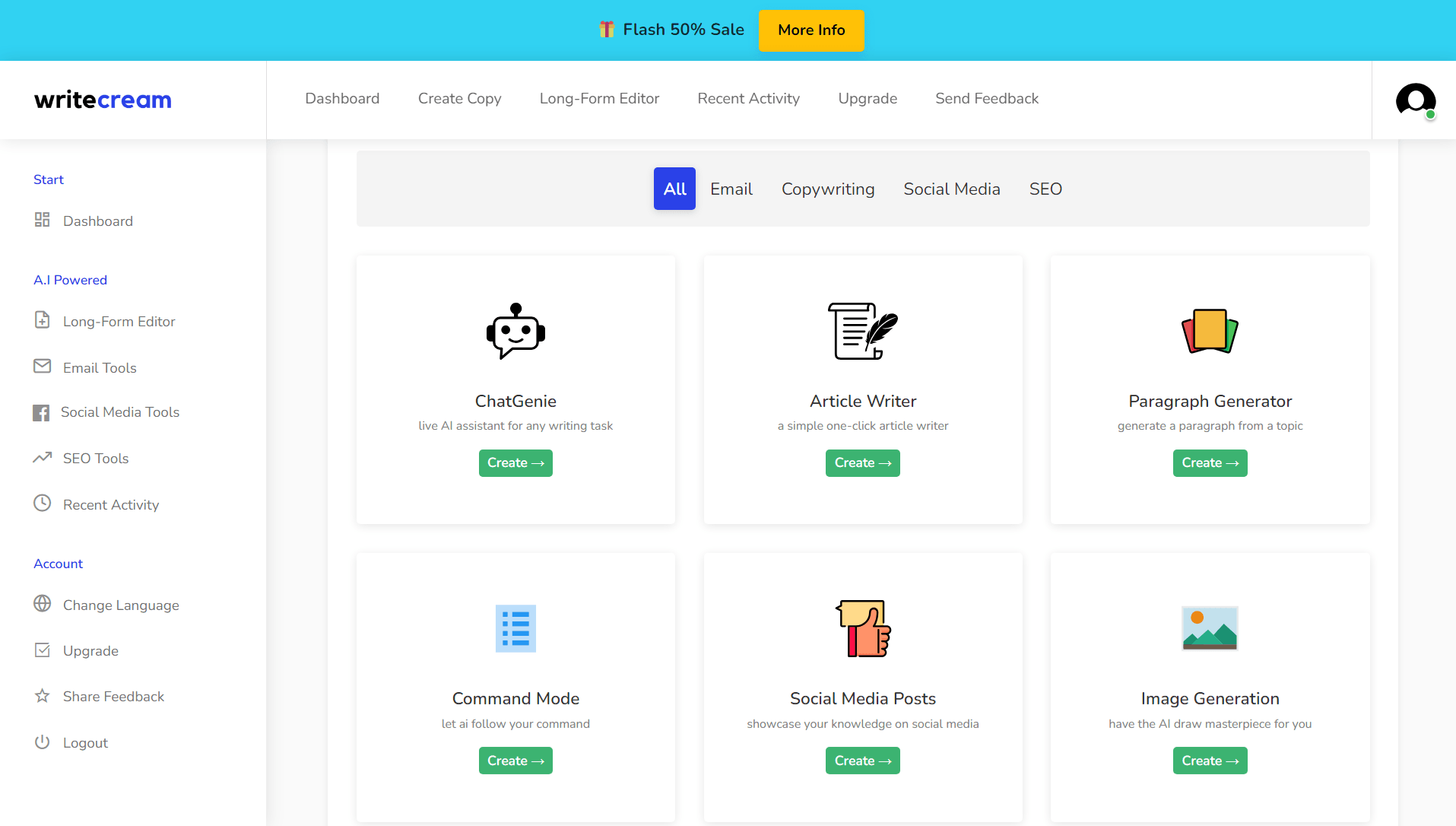
Writecream organizes work around named generators and the Lexi SEO workspace. The user chooses a task, supplies inputs, generates a draft or media asset, and reviews it.
This is efficient when the business already knows what to create. It is less complete when the team needs to discover where the brand is absent, prioritize opportunities, coordinate technical changes, and track impact.
Writesonic is a search-growth loop
Writesonic now describes a loop that can be summarized as track, prioritize, act, and measure. Its public platform focuses on AI visibility, prompt and citation data, content strategy, article creation, optimization, technical SEO, and outreach.

The shift matters. An old “AI writer versus AI writer” comparison would omit much of Writesonic's current value proposition.
Article creation: guided draft versus agentic pipeline
Writecream's Lexi flow combines query research, competitor inputs, SEO scoring, article creation, and WordPress export. It gives a small team a visible path from keyword to draft.
Writesonic's AI Article Writer is positioned as an agentic content pipeline that performs many steps, uses research and citations, applies expert frameworks, and targets both Google and AI-search visibility.

The decision is about process depth:
- Writecream is faster to understand and cheaper to try.
- Writesonic exposes more of the research, optimization, and search-growth system.
- Both still require source verification and editorial approval.
SEO and GEO depth
Writesonic has the stronger current SEO/GEO position. Public materials describe tracking prompts and answers across ChatGPT, Gemini, Google AI Overviews, and other surfaces; measuring brand visibility and citations; prioritizing opportunities; optimizing content; and supporting technical or citation actions.
Writecream markets SEO, AEO, GEO, backlink automation, and Lexi. Those tools may be sufficient for a smaller operation, but public evidence does not establish comparable measurement depth, data freshness, or integration coverage.
| Search-growth job | Writecream | Writesonic |
|---|---|---|
| Generate an optimized draft | Yes, through Lexi and article tools | Yes, through AI Article Writer and optimization workflows |
| Track brand visibility across AI search | Public GEO claims/tools | Central current product category |
| Prioritize prompts and citation gaps | Lighter public evidence | Explicit platform workflow |
| Technical and content action layer | Limited public detail | Broader public agent and audit story |
| Measure business impact | External analytics still needed | Platform emphasizes repeat measurement |
| Guaranteed rank or AI citation | No | No |
An SEO professional should verify which engines, countries, prompts, refresh rates, credits, and data exports are included. “AI visibility” scores from different vendors are not standardized.
Outreach means different things here
Writecream's outreach tools target sales prospecting. They can create cold-email and LinkedIn icebreakers from profile or website URLs and support batch inputs. Audio and image icebreakers are adjacent options.
Writesonic's outreach emphasis is closer to authority and citations for search growth. That is not a replacement for a sales-personalization workflow.
Sales teams should prefer Writecream between these two if prospect messages are the job. SEO and PR teams may prefer Writesonic when outreach is tied to citations, content authority, or AI-search presence.
Neither product manages legal consent or deliverability by merely generating copy.
Content optimization and evidence
Writesonic publishes content-optimization documentation and frames the platform around evidence, gaps, and actions. This can improve process visibility for an SEO team.
Writecream's Lexi scoring can help structure editing, but a proprietary score should not become the publication goal. Both scores need to be treated as diagnostic inputs.
A robust content review still checks:
- whether each factual claim maps to a current source;
- whether citations actually support the nearby sentence;
- whether the page resolves the reader's decision;
- whether examples are original and useful;
- whether the content adds experience or analysis beyond a generated summary;
- whether technical SEO, links, schema, and media are correct.
Integrations and automation
Writecream publicly supports a Chrome extension, Android and iOS apps, a WordPress publishing path through Lexi, and CSV-style batch outreach. Its public API request has historically been listed as under consideration, so custom API automation should not be promised without vendor confirmation.
Writesonic publishes a more developed integration and API ecosystem. Public documentation describes platform integrations and plan-dependent access. This makes it better suited to an operational search stack, but teams must map every connector, permission, rate limit, and credit cost.
Do not treat a connector logo as proof of bidirectional synchronization. Test the exact object and field flow your process needs.
Brand, teams, and governance
Writesonic's current privacy policy, updated May 13, 2026, includes AI-specific sections, retention, security, international transfers, and data-rights information. Its terms also warn that AI output can be inaccurate, incomplete, biased, offensive, or infringing and requires human review.
Writecream publishes privacy, terms, and refund pages but leaves more public gaps about prompt retention, model training, subprocessors, certifications, and enterprise workspace controls.
Writesonic's fuller documentation is a procurement advantage, not an automatic safety verdict. Buyers still need a current DPA, security evidence, subprocessor details, deletion tests, and plan-specific controls.
Audio, images, and creator breadth
Writecream has the stronger breadth for media creators. Its public suite includes voice-overs, podcasts, audio icebreakers, image icebreakers, and image generation beside text and SEO.
Writesonic supports image and content workflows, but its current center of gravity is search visibility and growth. If audio outreach or podcast creation matters, compare exact tools rather than paying for search infrastructure you will not use.
Pricing and plan economics
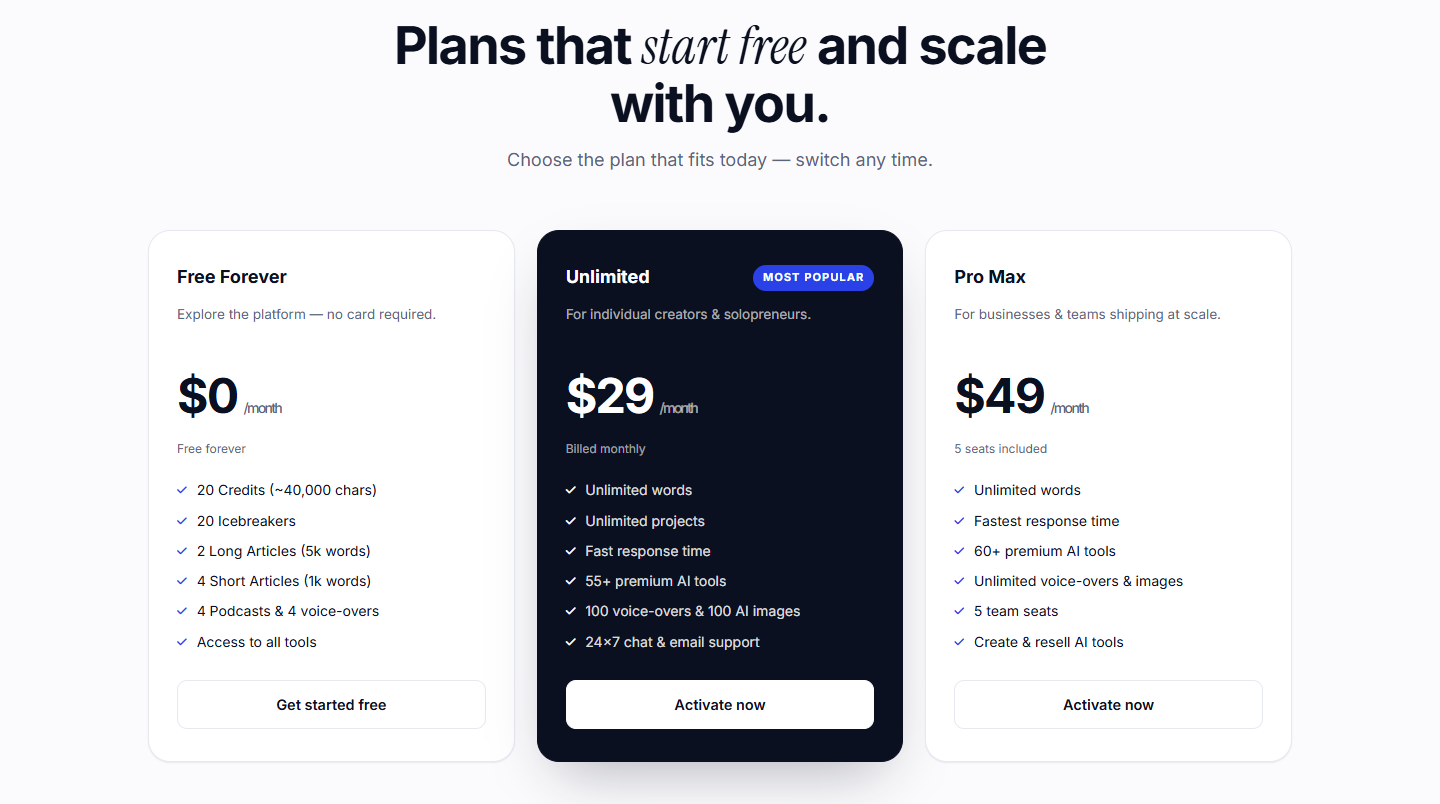
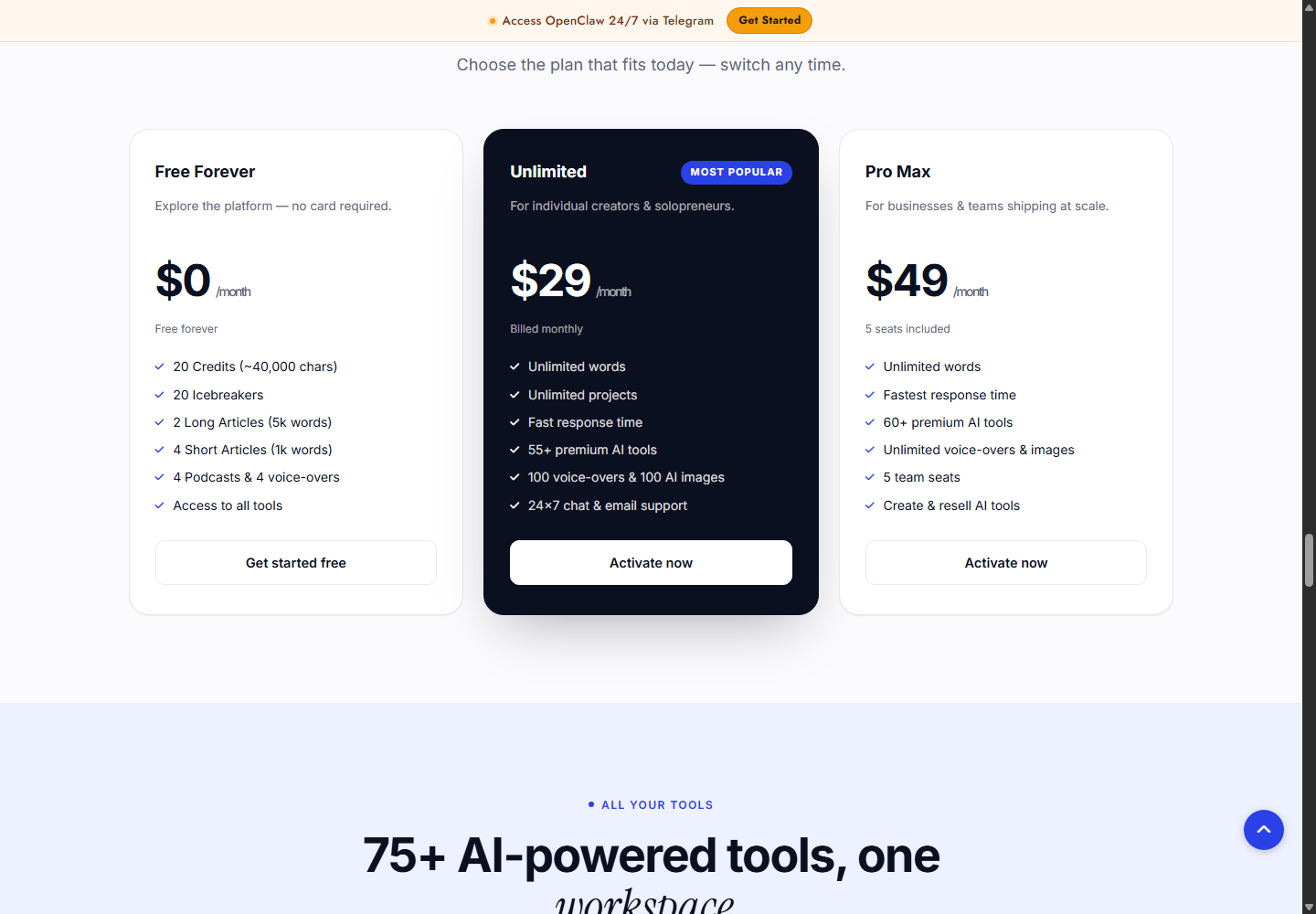
Writecream's homepage currently lists Free Forever, Unlimited at $29 per month, and Pro Max at $49 per month. It also promotes a separate $59 lifetime offer. Public free allowance wording conflicts, and “unlimited words” does not remove image, voice, SEO-data, or fair-use limits.
Writesonic's current public search-growth pricing starts with a Starter tier at $79 per month billed annually. Higher tiers increase tracked prompts, sites, articles, audits, agents, and other allowances, while Enterprise uses a sales path. Its free entry lets users evaluate before buying, subject to current limits.

See Writecream's current lower-cost options
A useful buyer calculation is:
- Writecream value: subscriptions replaced by article, outreach, audio, and image utilities.
- Writesonic value: analyst hours, content operations, monitoring, and search actions replaced or improved.
Do not compare $29 and $79 as if both plans buy the same job.
Who should choose Writecream?
Writecream is the stronger fit for:
- solo creators and small agencies;
- teams mixing SEO drafts with sales outreach;
- users who need voice, podcast, audio, and image tools;
- buyers prioritizing low monthly cost;
- workflows that can keep research and measurement in other systems.
Read our full Writecream review for the product boundary and caveats. Our Writecream alternatives guide compares other close content and optimization options.
Who should choose Writesonic?
Writesonic is the stronger fit for:
- SEO and GEO teams responsible for brand visibility;
- organizations tracking prompts, citations, competitors, and outcomes;
- teams wanting a deeper article and optimization pipeline;
- buyers who need integrations, APIs, and operational measurement;
- organizations that can justify the higher cost through search-growth work.
Questions that decide whether GEO software is worth the premium
A deeper platform only creates value when its data and actions are usable. Before paying for Writesonic's search-growth tiers, verify:
- which answer engines and Google surfaces are monitored;
- whether prompts are vendor-selected, user-defined, or both;
- country, language, device, and model coverage;
- refresh frequency and historical retention;
- how citation, mention, sentiment, and visibility scores are calculated;
- whether raw prompts, responses, sources, and timestamps can be exported;
- how the platform distinguishes brand-owned, earned, and incorrect citations;
- which technical fixes can be executed versus only recommended;
- credit consumption for articles, audits, agents, API calls, and outreach;
- whether a site or workspace can be transferred at contract end.
Then create a baseline before acting. Save the tracked prompt set, source URLs, rankings, AI answers, analytics, and conversion events. Without a baseline, a dashboard can show movement without proving that the platform caused it.
When Writecream is enough
Writecream may be sufficient when an SEO professional already has trusted keyword, rank, analytics, crawl, and AI-visibility data. In that case, Lexi can function as a lower-cost drafting and editing layer while measurement remains elsewhere.
When Writesonic earns its cost
Writesonic becomes more defensible when the team would otherwise assemble several systems and analysts to monitor AI visibility, identify citation gaps, produce or optimize content, coordinate technical actions, and report progress. The pilot should quantify tools replaced and hours saved.
Do not compare only article quality. Compare the full closed loop from evidence to action to measurement. If the team will use only the AI Article Writer, calculate whether a narrower content optimizer would be more economical.
Final verdict
Writecream wins for affordable multi-format production. Writesonic wins for serious SEO/GEO operations. Choose Writecream when the goal is to create many kinds of marketing assets with a small budget. Choose Writesonic when the team needs to discover, prioritize, execute, and measure search opportunities across Google and AI answer engines.
Run a pilot on one real topic cluster and one real visibility problem. Measure source accuracy, publication time, technical actions completed, citations or rankings observed, and ongoing analyst labor. Do not decide from a vendor score or a generated draft alone.
Try Writecream for the lower-cost all-in-one workflow
Frequently asked questions
Is Writesonic better than Writecream for SEO?
Writesonic has the stronger current public platform for SEO/GEO visibility, tracking, optimization, and measurement. Writecream offers a lighter Lexi workflow that may be sufficient for smaller teams.
Is Writecream cheaper than Writesonic?
Yes at the current public paid entry points. Writecream Unlimited is $29 per month, while Writesonic Starter is displayed at $79 per month billed annually. The plans solve different operational problems.
Which tool is better for cold email?
Writecream has more explicit cold-email, LinkedIn, audio, and image icebreaker tools. Writesonic's outreach is more closely tied to search authority and citations.
Does Writesonic have a free plan?
Writesonic provides a free entry path without a credit card on its current pricing page, subject to changing limits. Verify the available credits and features when registering.
Can Writecream replace Writesonic?
It can replace some drafting and lightweight optimization tasks. It does not publicly demonstrate the same depth in AI visibility tracking, prompt intelligence, technical actions, integrations, or measurement.