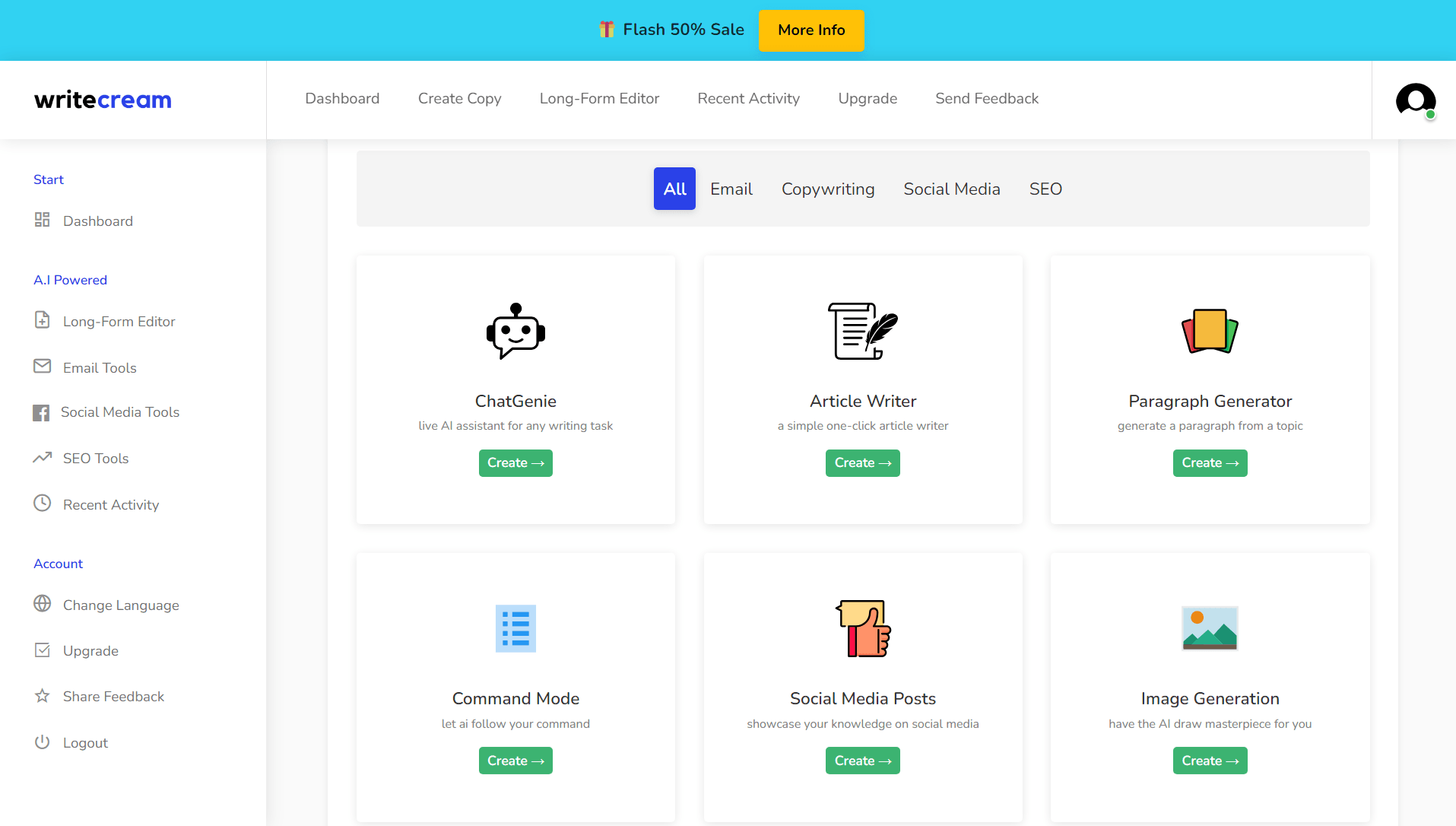
Writecream AI Humanizer is a public rewriting tool that turns AI-generated text into more conversational wording. Its practical value is tone and readability improvement, not proof that a person wrote the text. Writecream markets detector bypass, but its public page does not provide a validation dataset, accuracy benchmark, false-positive rate, or guarantee that another detector will classify the result in a particular way.
| At a glance | Details |
|---|---|
| Tool | Writecream AI to Humanizer Tool |
| Public workflow | Paste text, select Humanize, copy the revision |
| Account requirement | Vendor page says no login is required |
| Best use | First-pass tone, rhythm, and readability revision |
| Not proof of | Human authorship, factual accuracy, originality, SEO performance, or policy compliance |
| Editorial rule | Preserve meaning, verify every claim, and make a substantive human contribution |
This guide explains what the Humanizer publicly claims, how to use it responsibly, and how to evaluate the result for content, SEO, marketing, and sales work. Sources were checked on August 2, 2026. We used public documentation only and did not submit text through an authenticated Writecream account.
What is Writecream AI Humanizer?
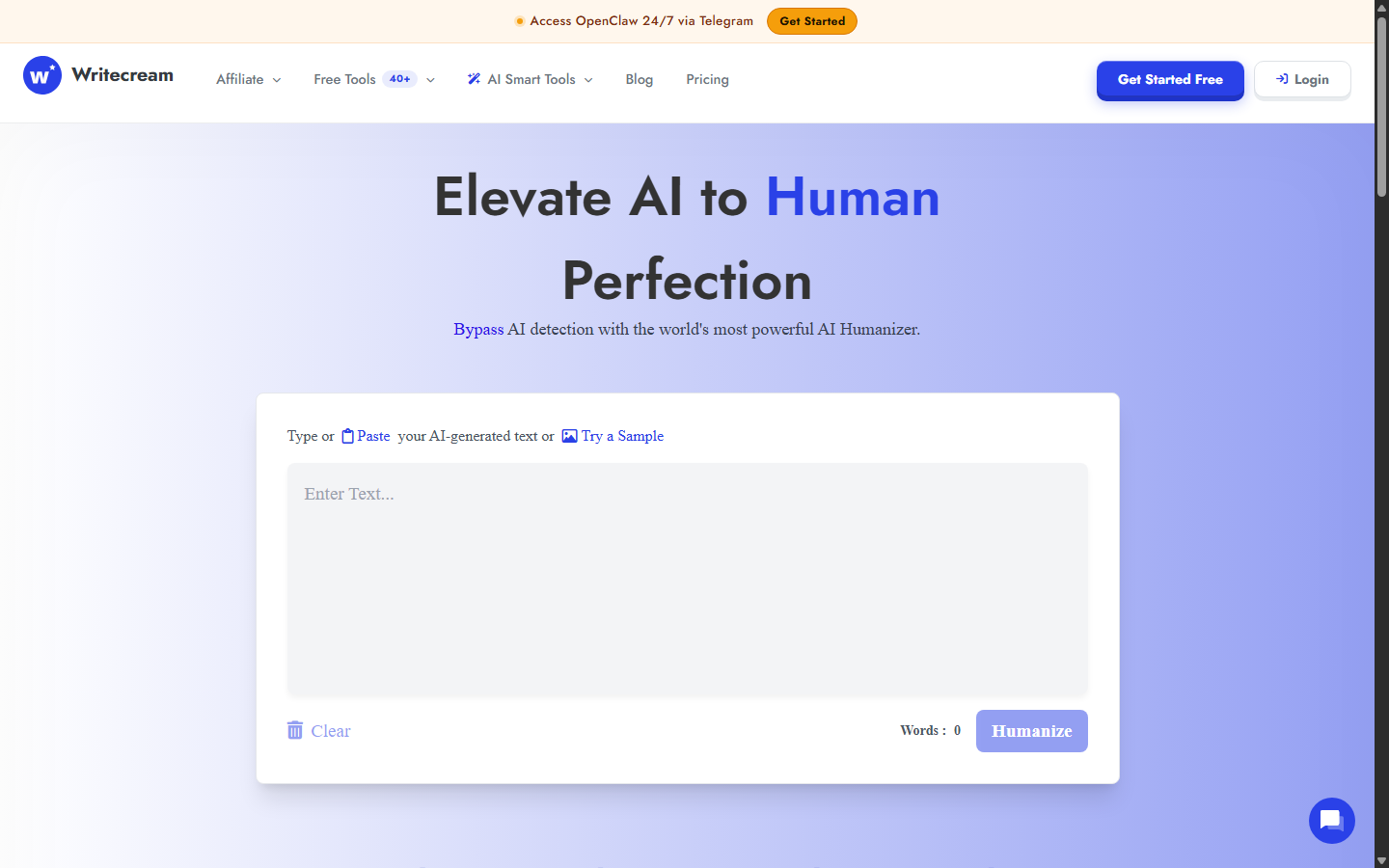
Writecream AI Humanizer is a rewriting interface for changing the tone and phrasing of AI-generated text. The dedicated page calls it an AI-to-human tool and describes a three-action flow: enter AI content, click Humanize, and copy the revised text.
The page says the tool can make writing more conversational, readable, engaging, and relatable. Those goals are reasonable editing criteria because a reviewer can compare the input and output. The same page also says the result can bypass AI detection. That claim is different. A detector result depends on the detector, model version, text length, language, genre, and later edits. Writecream does not publish evidence that supports a universal bypass promise.
The most defensible way to use the tool is therefore:
- Treat the input as a draft, not finished copy.
- Use Humanizer to generate an alternate phrasing pass.
- Compare the revision against the source text.
- Restore lost facts and precise terminology.
- Add original analysis, examples, and decisions.
- Publish only after human review and policy checks.
This makes Humanizer part of an editorial workflow rather than a camouflage layer.
What can the Humanizer change?
The visible product page supports a narrow factual claim: Writecream accepts text and returns rewritten text. The vendor describes the intended changes as conversational tone, readability, relatability, and engagement.
A rewrite may alter several observable attributes:
- Sentence length and rhythm
- Word choice
- Transitions
- Formality
- Repetition
- Active versus passive construction
- Paragraph flow
- Perceived warmth or directness
These attributes can improve a draft, but each change creates a preservation risk. A synonym can weaken a technical distinction. A shorter sentence can remove a condition. A more confident tone can turn a possibility into a promise. A sales-focused rewrite can add urgency that the evidence does not support.
What the public page does not establish
The public Humanizer page does not establish that its output is:
- Written by a human
- Undetectable by every detector
- Factually correct
- Free from plagiarism
- Legally compliant
- Copyrightable in the United States
- Original enough for a client or publication
- Helpful enough to rank in Google
- Consistent with an employer, school, or platform AI policy
A low detector score cannot fill those evidence gaps. It measures a model's classification of text, not the truth, provenance, or value of the work.
How do you use Writecream AI Humanizer responsibly?
The vendor workflow is simple, but a reliable editorial workflow needs more controls around it.
Step 1: define what must not change
Before pasting text, mark protected elements:
- Names, dates, prices, and measurements
- Product specifications
- Quotations and citations
- Legal or compliance language
- Technical terminology
- Brand claims
- Offer terms
- Required calls to action
Create a short fact sheet beside the draft. The Humanizer output should be checked against that sheet, not only against how natural it sounds.
Step 2: remove sensitive material
Do not submit secrets merely because the page says the tool is free or does not require login. Remove or replace:
- Customer names and email addresses
- Private URLs
- Credentials and API keys
- Unpublished financial data
- Protected health information
- Contract terms
- Confidential campaign strategy
- Prospect records that your organization has not approved for AI processing
Writecream's general privacy policy describes account, contact, usage, cookie, and log information. It does not clearly state the retention period, training treatment, model providers, subprocessors, or deletion schedule for text submitted to the main Humanizer.
Step 3: paste one controlled section
Start with 150 to 300 words rather than an entire article. A smaller test makes semantic drift easier to find. Remove citations from the rewrite input if the tool tends to alter URLs, then restore and verify them afterward.
Step 4: select Humanize and preserve both versions
Use the public interface's Humanize control. Save the original and revised text in separate columns or document versions. Do not overwrite the source before comparison.
Step 5: compare meaning sentence by sentence
Check each revision for four failure types:
- Deletion: a condition, limitation, or source disappears.
- Addition: a new claim appears without evidence.
- Strengthening: “may help” becomes “will improve.”
- Substitution: a precise entity, number, or technical term changes.
Reject any sentence that reads better but communicates a different fact.
Step 6: add real editorial value
The strongest human contribution is not random sentence variation. It is judgment. Add information that a generic rewrite cannot supply:
- A verified example
- A calculation
- A buyer decision rule
- A counterexample
- A limitation
- A source-backed comparison
- A workflow tested by your team
- A clear explanation of why the claim matters
Step 7: run the final quality gate
Review the result in its destination. A blog post, sales email, landing page, and academic assignment have different standards. Check factuality, citations, originality, accessibility, disclosure, brand voice, and applicable policies before publication or submission.
If you want a wider source-to-publication process, the Writecream tutorial covers briefing, drafting, SEO review, WordPress transfer, and rendered QA.
How should you evaluate humanized output?
Evaluate the revision against meaning, evidence, audience, and policy, not only against a detector score. The following scorecard turns a subjective “sounds human” reaction into a repeatable review.
| Review dimension | Pass condition | Common failure | Required action |
|---|---|---|---|
| Meaning preservation | Every material claim retains its original scope | Conditions or caveats disappear | Restore exact meaning from the source |
| Factual integrity | Names, dates, prices, and specifications match current evidence | Fluent but invented detail appears | Verify or delete the claim |
| Source integrity | Quotations, citations, and links support nearby statements | Citation is moved or detached | Reconnect each claim to its source |
| Brand voice | Tone matches documented brand examples | Generic enthusiasm replaces brand language | Rewrite with approved vocabulary |
| Readability | Sentences are clear without removing needed detail | Choppy variation or excessive informality | Edit for the intended reader |
| Original contribution | Draft adds analysis, examples, or decisions | Surface paraphrase is the only change | Add substantive human work |
| Policy compliance | Use follows client, school, employer, and platform rules | Humanizer is used to conceal prohibited assistance | Stop and follow the controlling policy |
| Conversion accuracy | CTA and offer language match actual terms | Rewrite adds urgency or a guarantee | Restore approved commercial language |
A useful acceptance test is to ask a second reviewer to identify the article's central decision, supporting evidence, and limitations without seeing the original prompt. If the reviewer can only describe the tone, the edit probably added too little value.
Can Writecream AI Humanizer bypass AI detectors?
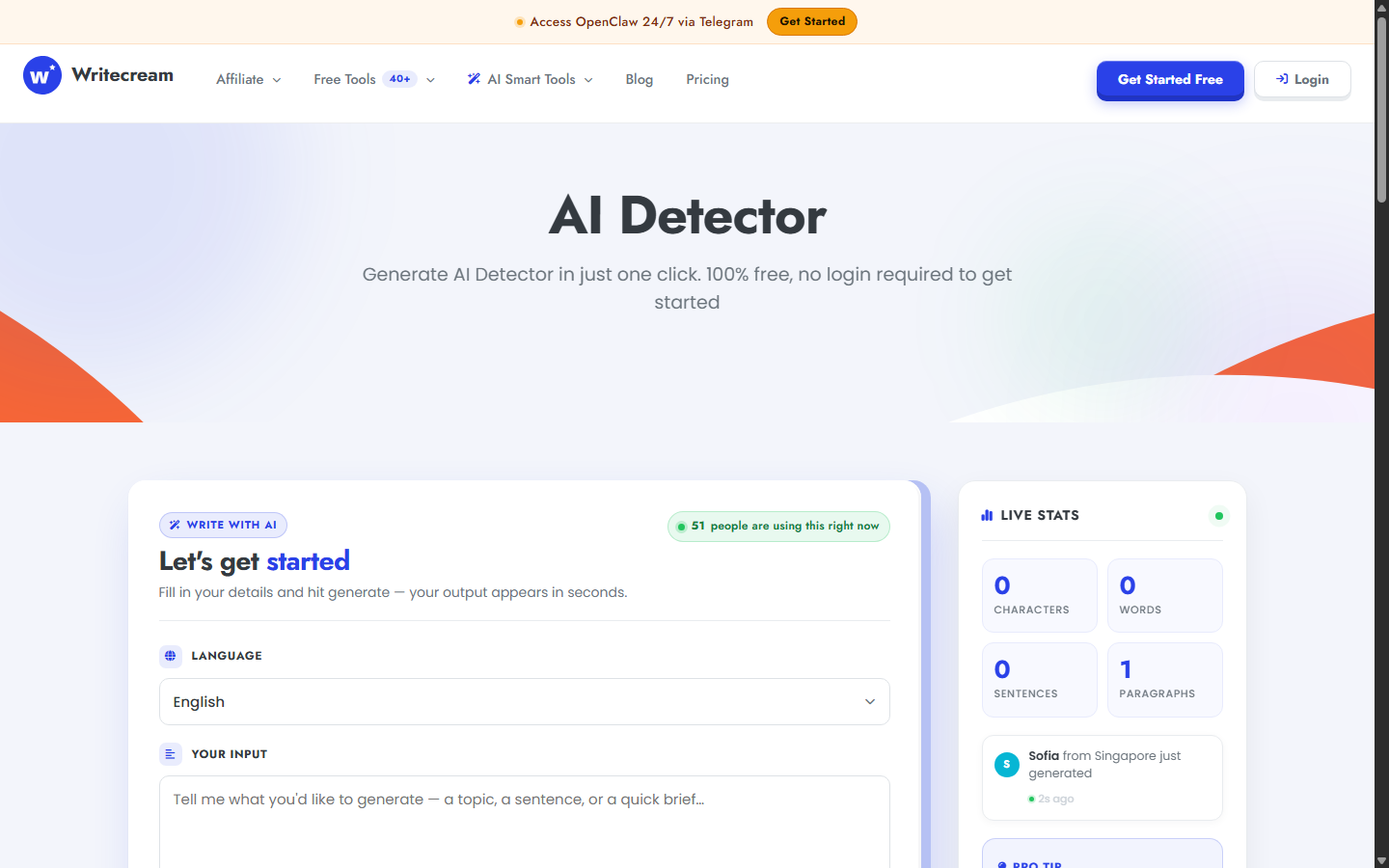
No universal bypass result can be responsibly promised. Writecream uses bypass language, but the public Humanizer and AI Detector pages do not publish a methodology, benchmark corpus, accuracy range, or cross-detector validation.
Writecream also offers a public AI Detector page that describes pattern analysis and a probability score. Its page does not provide enough technical evidence to treat the score as proof.
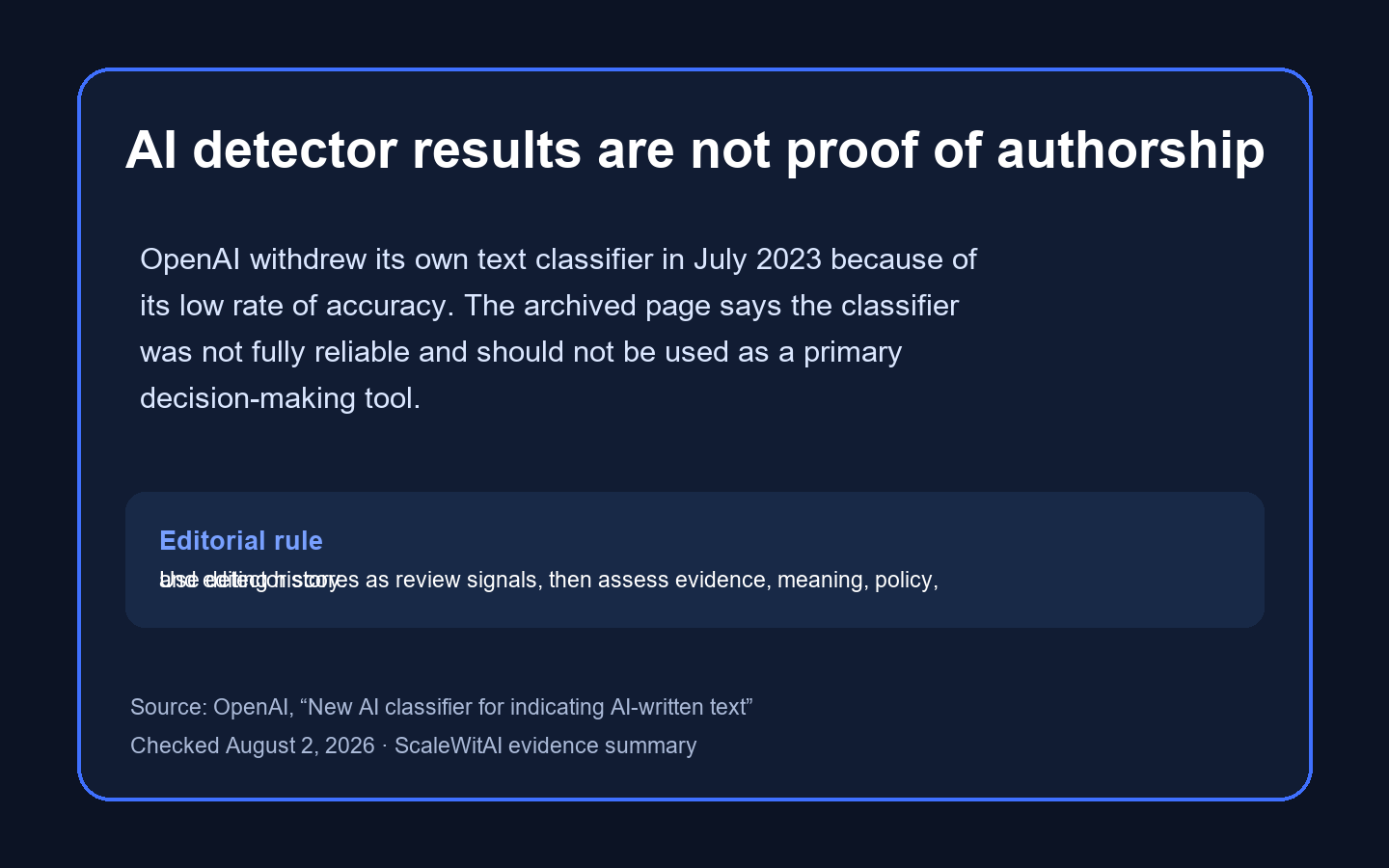
The broader detector market provides a strong reason for caution. OpenAI retired its own text classifier in July 2023 because of a low rate of accuracy. Its archived announcement says the classifier was not fully reliable and should not be a primary decision-making tool. Turnitin likewise warns that its AI writing model may misidentify human, AI-generated, and AI-paraphrased text and should not be the sole basis for adverse action.
A detector can still serve a limited editorial function. Flagged passages may reveal generic wording, repeated transitions, or predictable structure. Review the passage, but solve the writing problem directly. Do not optimize the text merely to make a score change.
Why chasing detector scores can damage content
Repeated detector-driven rewrites can:
- Replace precise terms with awkward synonyms
- Break citations and quotations
- Remove useful structure
- Add factual errors
- Create inconsistent voice
- Reduce accessibility
- Waste editing time
- Encourage concealment instead of disclosure
The correct target is a useful, accurate, policy-compliant document with a clear human contribution.
Does humanizing AI content help SEO?
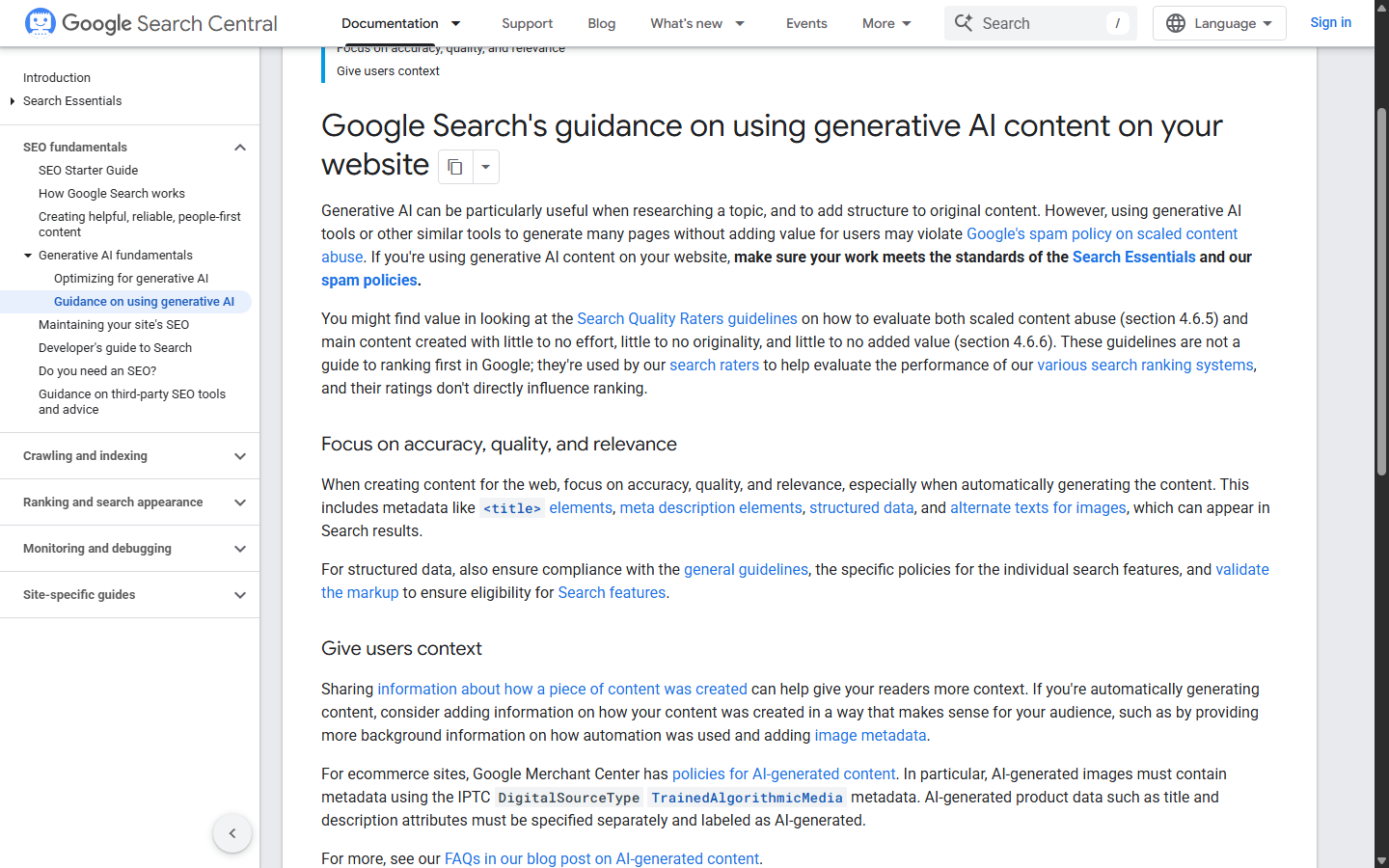
Humanizing is not a ranking factor, and a detector score is not an SEO score. Google states that generative AI can help with research and structure. It also warns that generating many pages without adding value may violate its policy on scaled content abuse.
For search content, use Humanizer only when the rewrite improves attributes that readers actually experience:
- Clear answers immediately after headings
- Accurate entity and product names
- Specific values and conditions
- Logical section order
- Useful examples
- Original comparison or analysis
- Readable sentences
- Transparent sourcing
Do not humanize vendor copy and publish it as an affiliate article with minimal added value. Google's spam policies describe thin affiliation as merchant material republished without meaningful additional value. ScaleWitAI should add decision support, source conflicts, practical safeguards, and editorial conclusions.
How should different teams use the Humanizer?
The same tool should have different acceptance criteria for different jobs.
Content creators
Use it to create a tone alternative for a completed, source-backed section. Preserve quotes, examples, and the writer's core argument. Reject generic transitions that make every article sound alike.
SEO professionals
Use it after search intent, entities, headings, and evidence are settled. Recheck title terminology, internal-link anchors, structured facts, and answer passages after the rewrite. Do not trade topical precision for random variation.
Digital marketers
Use it to adapt a message across audience segments, but maintain approved product claims, offer conditions, and disclosure language. A friendlier voice must not become a stronger promise.
Sales teams
Use it to revise a draft first line or follow-up for clarity. Verify every personalization detail against the prospect's public source. The tool does not manage consent, suppression lists, sender identity, domain reputation, or CAN-SPAM compliance.
Agencies and regulated teams
Use only content categories approved by legal, security, and procurement. Ask the vendor for retention, training, subprocessors, access controls, incident handling, deletion, and contractual commitments before submitting client-confidential or regulated material.
What are the most common Humanizer failure modes?
The text sounds different but says less
Variation is not improvement. Compare the revised section's decisions and evidence with the original. Restore missing conditions and examples.
The rewrite strengthens claims
Watch modal verbs and absolute terms. “Can support,” “may improve,” and “is designed to” should not become “guarantees,” “will,” or “always.”
The output keeps a generic AI structure
A humanizer may change wording while preserving a predictable introduction, repeated benefit blocks, and generic ending. Fix the information architecture manually.
Citations no longer support nearby claims
Sentence movement can detach a source from the statement it supports. Rebuild claim-to-source proximity after every substantial rewrite.
The result conflicts with brand voice
Human-like is not a single style. A technical buyer guide, creator newsletter, and sales email require different vocabulary and levels of formality. Use real brand samples as the standard.
A detector still flags the text
Do not start an endless rewrite loop. Review the passage for quality, document the creation process where appropriate, and follow the controlling policy. A classification disagreement is not proof of misconduct or proof of authorship.
Is Writecream AI Humanizer worth using?
It can be useful as a fast alternate-phrasing tool for low-risk drafts, provided every revision receives substantive human review. It is a poor fit when the primary objective is to evade a rule, guarantee detector results, or process confidential material without adequate vendor documentation.
A short benchmark will show whether it saves time:
- Select three representative sections.
- Record manual editing time and defects.
- Run the same sections through Humanizer.
- Record comparison, correction, and final editing time.
- Count meaning changes, unsupported additions, and accepted sentences.
- Keep the tool only if total time falls without reducing quality.
For a broader evaluation of product fit, workflow depth, pricing, and limitations, read the complete Writecream review. This is the only Review pillar link in this guide.
Try Writecream with a controlled, non-sensitive sample
Writecream AI Humanizer FAQ
Is Writecream AI Humanizer free?
The public Humanizer page says it is 100% free and requires no login. Standalone-tool access can differ from the authenticated app and may change, so verify the current interface before planning a production workflow.
Does Writecream AI Humanizer guarantee undetectable text?
No. Writecream markets detector bypass, but no public methodology or cross-detector guarantee was found. Detector vendors themselves acknowledge false positives and other limitations.
Can humanized content rank in Google?
It can rank only if it earns visibility through relevance and quality like other content. Google does not say that a humanizer or low AI score improves rankings. Scaled low-value content can violate spam policies regardless of how it was created.
Does the Humanizer check facts?
The public workflow describes rewriting, not independent fact verification. Recheck every name, number, quotation, product claim, and source after revision.
Is humanized text automatically original?
No. Different wording does not prove original authorship, non-infringement, or meaningful information gain. Run appropriate similarity checks and add human analysis, examples, and structure.
Can I use it for client-confidential content?
Do not submit confidential material without approval and sufficient contractual documentation. The main public privacy policy does not clearly explain prompt retention, model training, subprocessors, data residency, or enterprise controls.
Should I disclose that AI helped create content?
Follow the controlling client, employer, school, platform, and legal policies. Google says context about how automated content was created can help readers when that information is appropriate.
Can sales teams humanize cold emails with Writecream?
Yes, as an editing step. Teams still need to verify personalization, use accurate sender information, honor opt-outs, manage suppression lists, and follow applicable outreach rules.