Verdict: Agility Writer is the better buy for teams that need to research, generate, and publish many long-form articles. Surfer is the stronger choice for teams that already have writers and want a more mature optimization, collaboration, audit, and AI-visibility system. Agility Writer wins this comparison for production-first affiliate operators and lean agencies because its $28 monthly Basic plan includes 40 credits, Bulk Mode, research with citations, and rollover credits. Surfer wins for optimization-first SEO departments because Content Editor gives real-time SEO and AI Search scoring, while higher plans add deeper content operations.
| At a glance | Agility Writer | Surfer |
|---|---|---|
| Best overall use | Production-first research, drafting, and publishing | Optimization-first writing, refreshing, and governance |
| Starting monthly price | $28 list price for Basic, 40 credits | $49 for Discovery, 120 documents |
| AI generation | Core product, with multiple modes and templates | Available inside the Content Editor workflow through Surfer AI |
| Optimization model | Live SERP research, Optimize Mode, G-Smart, GSC tools | Content Editor guidelines, Content Score, Auto-Optimize, Content Audit |
| Topical planning | Topical Map Helper and Topical Authority Audit | Topical Map, Sites, GSC coverage gaps, Content Ideas |
| Factual workflow | In-depth research, citations, Fact Sheets, Custom Knowledge | Facts Coverage, custom instructions, Brand Knowledge, up to five source URLs |
| Scale | Up to 200 articles per Bulk run; API on Pro and yearly plans | Bulk editor creation; unlimited documents and API on Peace of Mind |
| Integrations | WordPress, Zapier, REST API, NeuronWriter, GSC | WordPress, Google Docs, Contentful, Zapier, GSC; API at top self-serve tier |
| Detector and rewriting | Anti-AI Detection style and tools to remove AI-like phrasing | AI Detector and Humanizer |
| Our winner | Agility Writer for output and unit economics | Surfer for controlled optimization and content operations |
Quick Verdict: Which Tool Should You Choose?
Choose Agility Writer when your bottleneck is producing enough researched content at an acceptable cost per article. Its product is organized around complete article generation, from topical planning and SERP research through long-form drafts, citations, internal links, and WordPress publishing. The credit model is comparatively easy to connect to output, although one article can consume one to three credits depending on mode.
Choose Surfer when your bottleneck is making writers, editors, and existing pages follow a repeatable optimization system. Content Editor is the center of gravity. It provides competitor-informed structure, terms, facts, and continuously updating scores. Surfer can generate copy, but its strongest differentiation is the feedback and governance layer around content, not bargain-priced bulk article production.
| Buyer situation | Winner | Why |
|---|---|---|
| Solo affiliate publisher | Agility Writer | Lower starting price, purpose-built review templates, citations, and bulk production |
| Agency producing many first drafts | Agility Writer | Up to 200 articles per Bulk run, API and Zapier on Pro, multi-site WordPress workflow |
| In-house SEO team with writers | Surfer | Strong editor, collaboration, scoring, auditing, and page monitoring |
| Team refreshing an established library | Surfer | GSC-connected Content Audit, rank-drop alerts, URL imports, and optimization workflow |
| Programmatic content operation | Agility Writer | Better production orientation and more direct article-credit economics |
| Multi-brand SEO governance | Surfer | Brand Workspaces, activity history, custom voices, collaboration, and higher-tier controls |
For a full view of Agility Writer outside this head-to-head, see our Agility Writer review. The recommended trial route is Agility Writer’s $1 trial, but that ScaleWitAI redirect returned 404 during our August 1, 2026 check. This article must remain in Draft until the route is repaired.
The Core Difference: Production-First vs Optimization-First

Calling both products “AI SEO writers” hides the buying decision. Agility Writer starts with an output goal: turn a topic, keyword list, CSV, location list, video, or product brief into finished long-form pages. Its modes determine how much control, research, optimization, and length a job receives. The workflow naturally ends at a publishing queue.
Surfer starts with a document and an optimization target. A user creates a Content Editor for a query, reviews competitors, adjusts guidelines, writes manually or selects AI generation, watches the score, checks quality, and exports or publishes. The product extends backward into topical research and forward into audits and AI visibility, but the editor remains the operational center.
This distinction affects ROI. Agility Writer can reduce the cost of generating a large editorial backlog, but it also makes it easy to create more pages than a team can responsibly review. Surfer can make a writer’s optimization process clearer and more consistent, but its subscription cost is harder to justify if the business only wants inexpensive AI drafts.
Neither workflow removes editorial accountability. Search intent can be misread, selected SERP competitors can be poor models, cited sources can be weak, and generated details can still be wrong. A tool can reduce research and production time. It cannot supply genuine experience, proprietary data, expert judgment, or legal responsibility.
Topical Planning and Content Strategy
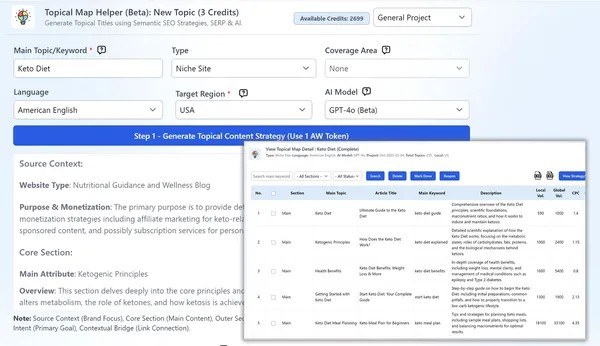
Agility Writer: maps designed to feed production
Agility Writer’s Topical Map Helper builds semantic clusters, identifies entity gaps, and supports internal-link planning. Its separate Topical Authority Audit can crawl the publisher’s site or a competitor, reconstruct coverage as a hub-and-spoke map, and recommend whether pages should be created, optimized, merged, or redirected. That makes the planning layer useful for both new builds and content consolidation.
The advantage is operational continuity. A team can move from cluster planning into article modes and Bulk Generation without leaving the production system. Auto silo links can be enabled in bulk workflows, which is valuable when the team already has a reviewed URL architecture.
The risk is treating generated clusters as a publishing command. A topical map does not prove commercial value, achievable difficulty, or editorial distinctiveness. Before committing credits, validate demand, conversion intent, overlap, and whether the business has something useful to add.
Surfer: maps connected to site performance
Surfer’s Topical Map focuses on relevant topics, competitor coverage, and content gaps. When connected to Google Search Console through Sites, it can use the domain’s existing performance context, visualize coverage, and turn opportunities into outlines. Official materials say the map refreshes every 14 days.
Surfer is more compelling for established domains because planning sits beside Content Audit and performance monitoring. Teams can use actual impressions, rankings, and coverage gaps to decide what to refresh or create. On Pro, Content Ideas and Coverage Gap strengthen this loop, while cannibalization reporting helps prevent new pages from competing with existing ones.
Planning winner: Surfer for established sites with meaningful GSC data; Agility Writer for turning a validated plan into a high-volume production queue. New sites without performance data may get more immediate value from Agility Writer’s production-oriented map, but neither tool should replace manual market and business analysis.
Content Editor, Optimization, and Content Score

Why Surfer’s editor is the stronger optimization environment
Surfer’s Content Editor analyzes top-ranking pages and supplies guidelines for relevant terms, structure, topics, questions, images, and word count. Users can select competitors rather than blindly accepting the default set. That control matters when a SERP mixes ecommerce pages, forums, definitions, and long-form guides.
The current Content Score runs from 0 to 100 and combines two components:
- SEO Score evaluates keyword use, topical coverage, structure, and alignment with top-performing pages.
- AI Search Score evaluates Facts Coverage and Upfront Intent Alignment, meaning whether the document covers relevant facts and answers the primary question clearly near the beginning.
Surfer says scores above 66 are ready to compete and advises users not to chase 100. Its documentation instead recommends landing roughly 10 to 20 points above competitors. That caveat is important. A higher proprietary score is not a Google ranking guarantee, and over-optimization can reduce clarity.
Auto-Optimize can add relevant terms and improvements after a draft is nearly complete. Editors can inspect each change, compare it with the original, approve it, discard it, or restore earlier copy. Automated internal linking uses a connected GSC property to find candidate pages and anchor placements. The pre-publish workflow also includes readability, plagiarism, and AI-readability checks.
How Agility Writer approaches optimization
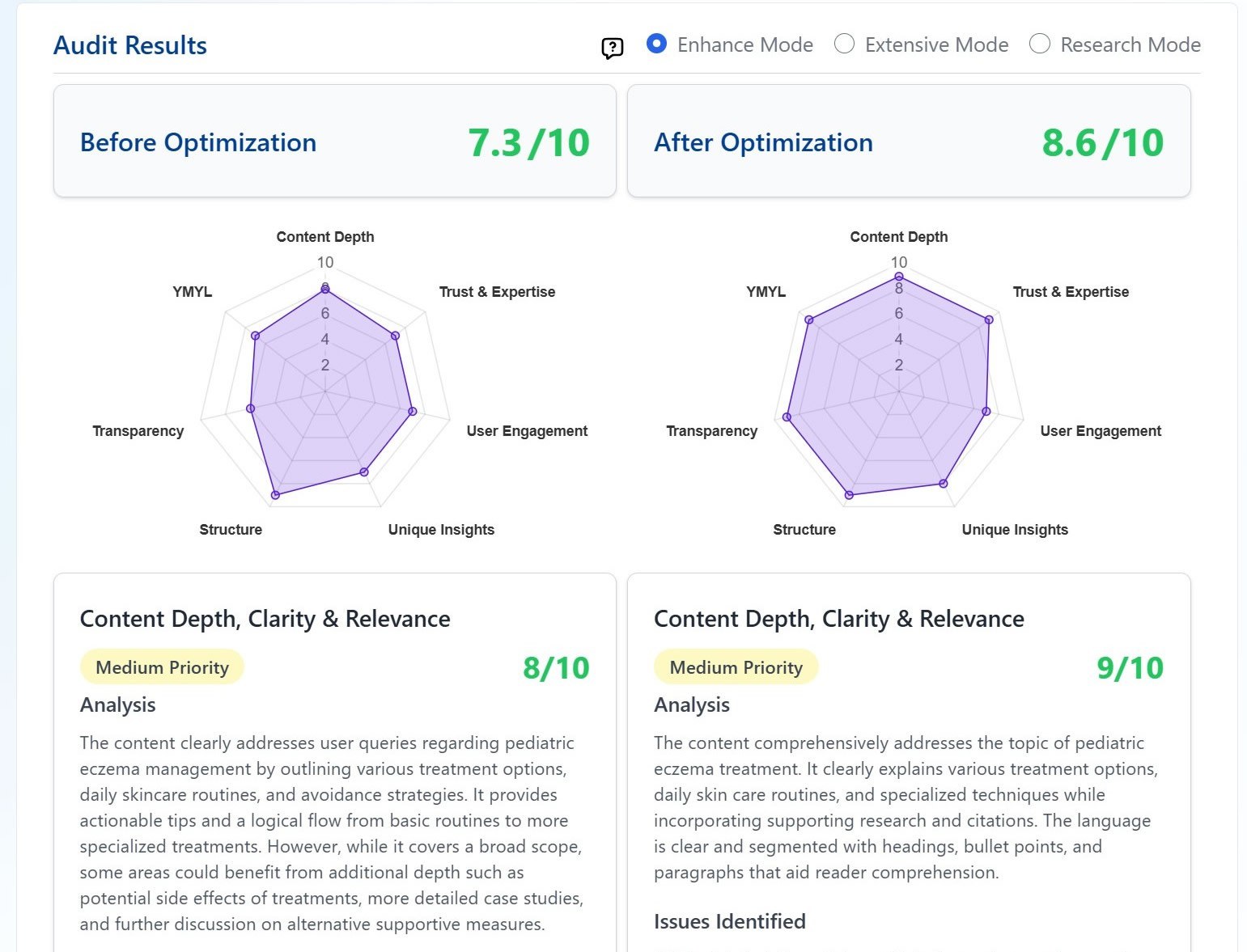
Agility Writer distributes optimization across generation modes, live SERP research, entity coverage, NeuronWriter support, Smart Editor, G-Smart Optimizer, and GSC Action Center. Optimize Mode uses three credits and supports articles up to a stated 5,000-word ceiling. Advanced Mode supports up to 7,000 words for two credits, while 1-Click has a 3,000-word ceiling for one credit.
G-Smart Optimizer audits copy against checks that Agility Writer describes as aligned with Google’s Helpful Content guidance and Search Quality Rater Guidelines. Enhance mode aims for lighter changes, Extensive performs a deeper rewrite, and Research can expand the page with new material and optional references. The before-and-after review is useful because editors can see what the system changed.
GSC Action Center adds another practical layer by finding queries a page ranks for but has not clearly covered, then turning those gaps into sections, FAQs, or internal-link actions. This is a sensible refresh workflow, but the “Google-aligned” framing must not be interpreted as certification. Google does not approve third-party content scores or guarantee rankings based on them.
Optimization winner: Surfer. Agility Writer has meaningful optimization tools, especially for generated content, but Surfer offers the clearer live editing model, score transparency, competitor controls, and team-friendly feedback loop.
Factual Research, Citations, and Brand Knowledge
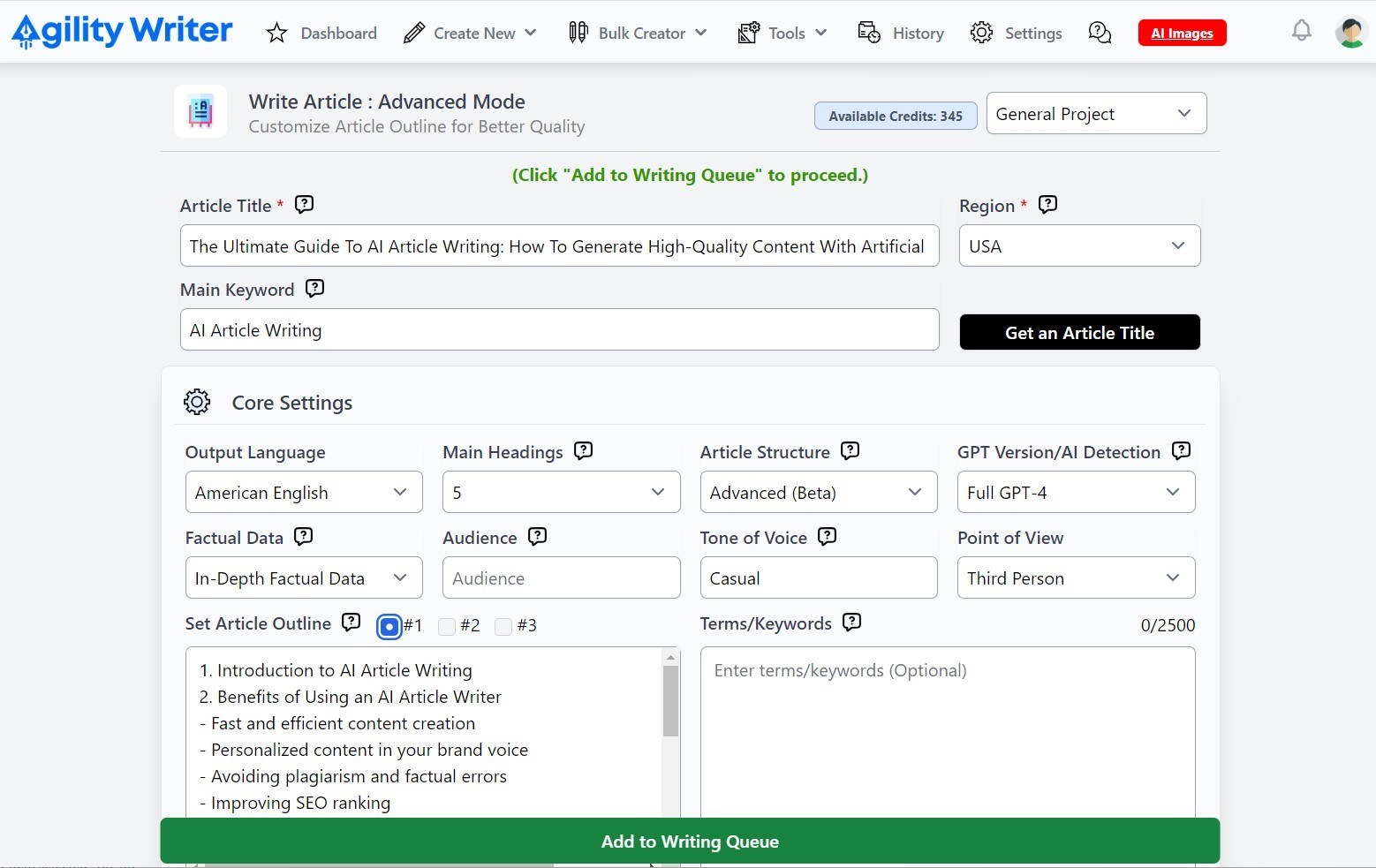
Agility Writer makes factual research a visible production feature. Basic includes in-depth research and citations. Fact Sheets can be created through AI research or manual input, reviewed with citations, and reused across related articles. Custom Knowledge lets a team carry approved brand, product, or service information into future jobs. Research mode in G-Smart can add depth and optional references.
This design is attractive for affiliate comparisons, service-area pages, and product libraries where the same approved facts recur. Build the Fact Sheet once, then use it to reduce inconsistency across a batch. Agility Writer itself still recommends fact-checking and a grammar pass, especially for YMYL topics and numerical claims.
Surfer has moved beyond keyword-only guidance. Content Editor’s AI Search Score includes Facts Coverage, and its workflow can surface missing facts. Users can add context and instructions, Brand Knowledge, a custom voice, and up to five source URLs before Surfer AI generates the outline and article. The outline stage is also a place to insert proprietary facts, examples, anecdotes, and calls to action.
The difference is emphasis. Agility Writer is stronger when citations and reusable fact profiles are requirements of initial generation. Surfer is stronger when an editor needs to measure and improve factual coverage inside a controlled document workflow. Neither proves that a source is authoritative or that a citation supports the exact sentence attached to it. Editors should open every source, verify dates, prefer primary evidence, and remove unsupported claims.
AI Article Generation and Bulk Output
Agility Writer offers distinct modes and content templates instead of one generic generate button. Official pricing lists 1-Click, Advanced, Optimize, Product Review, Roundup Review, and YouTube to Article. The feature library also supports long-form guides, listicles, service pages, and press releases. Teams can choose styles, readability, audience, angle, model, Fact Sheets, citations, and section-level controls.
Bulk Generation accepts CSVs, keywords, or location lists and can run up to 200 articles in one batch. The official pricing FAQ separately states up to 50 in a 1-Click batch. That capacity makes Agility Writer the obvious production winner, especially for carefully templated programmatic pages. However, “up to 200” describes queue capacity, not reviewed publication quality.
Surfer’s Content Editor lets users either write manually or generate with Surfer AI. The setup can include selected ranking pages, Brand Knowledge, voice, word-count guidance, instructions, and source URLs. Users can review and edit the outline before generation. Content Editor also supports bulk editor creation, which helps agencies distribute optimized briefs even when humans do the writing.
Surfer’s current self-serve pricing counts documents rather than separately advertising a small bundle of AI articles. Discovery includes 120 documents, Standard and Pro list 360, and Peace of Mind lists unlimited documents subject to fair use. Buyers should confirm in checkout exactly how their intended AI generation workflow consumes current allowances because packaging can change.
Generation winner: Agility Writer. It offers more explicit article modes, clearer credit costs per format, deeper bulk orientation, and a lower entry price. Surfer AI is better viewed as one option inside Surfer’s optimization environment.
If you are comparing production engines rather than optimization suites, our Agility Writer vs Koala comparison focuses on speed, research, and publishing tradeoffs. Our Agility Writer vs SEO Writing AI breakdown is more relevant to high-volume operators, while Agility Writer vs Writesonic covers the difference between a long-form specialist and a broader marketing platform.
Content Audits and Refresh Workflows
Surfer has the stronger ongoing content-operations system. Sites can connect to GSC, scan the domain, identify underperforming pages, recommend refresh opportunities, and monitor priority content. Content Audit combines SERP and GSC signals such as position, CTR, and traffic with optimization data. Rank-drop notifications flag pages that lose position over a sustained period, and existing URLs can be imported into Content Editor for direct re-optimization.
This creates a useful cycle: detect a decline, inspect the page and its SERP, import it, adjust competitor selection, improve factual and topical coverage, review internal links, republish, and monitor. Pro adds cannibalization reporting, which is valuable for sites with years of overlapping content.
Agility Writer covers audits through Topical Authority Audit, G-Smart Optimizer, and GSC Action Center. It can identify pages to create, optimize, merge, or redirect, audit draft quality, and mine missing queries or internal-link opportunities. The tooling is broader than a pure AI writer, but it feels designed to route findings back into rewriting and production.
Audit winner: Surfer for portfolio monitoring and ongoing SEO operations. Agility Writer remains competitive for teams that want an audit-to-rewrite path inside the same generation platform. In both cases, correlation-based suggestions need editorial review. A ranking decline can come from intent shifts, competition, links, technical problems, seasonality, or sitewide quality, not just missing terms.
API, Publishing, and Integrations
Agility Writer’s WordPress plugin supports posts or pages, categories, tags, slugs, images, draft or publish status, scheduled batches, and updates to existing posts. It can populate metadata for Yoast, Rank Math, and AIOSEO. Multi-site support is particularly useful for agencies. Zapier can start and route jobs without code.
The REST API creates asynchronous generation jobs, tracks status, and retrieves finished articles for custom systems. Agility Writer says the API uses the same engine and plan-credit pool as the app. Monthly API access begins on Pro at a $98 list price, while all current yearly plans include API and Zapier according to the pricing page. One official integration page refers to “Standard plans,” but the current pricing table names Pro as the first monthly API tier, so buyers should follow checkout entitlements.
Surfer integrates with WordPress, Google Docs, Contentful, and Zapier depending on plan. Its Google Docs extension places Content Editor guidance next to the document, which is valuable for teams that do not want writers in another editor. The WordPress integration supports content movement and optimization inside the CMS. GSC underpins Sites, Content Audit, Topical Map enrichment, and automated internal links.
Surfer’s API can create Content Editors, retrieve content, terms, and scores, and support audits and SERP analysis. Current documentation recommends v2 for new Content Editor integrations, while Audit, SERP Analyzer, AI Detector, and Humanizer remain on v1. The $299 Peace of Mind plan explicitly includes API access; Enterprise starts at $999 with tailored controls.
Automation winner: Agility Writer for article-generation pipelines and multi-site publishing. Surfer wins when integrations need to preserve its optimization experience across Google Docs, WordPress, Contentful, and custom analytics.
AI Detector and Humanizer Claims

There is no guarantee that either platform will bypass an AI detector, improve rankings, or meet Google's quality expectations. Detector scores are not quality scores, and generated work still requires human review, source verification, and original first-party value.
Agility Writer markets an Anti-AI Detection writing-style preset, structural controls, and Smart Editor actions that remove AI-like phrasing. Its public site says content can pass AI detection tools and reduce flags. Those are vendor claims, not an independent guarantee, and detector outputs can change when vendors update models.
Surfer offers an AI Detector that estimates the probability text was AI-generated and a Humanizer that rewrites text to sound more natural while preserving meaning. Its API documentation exposes both functions and identifies endpoint constraints. A probability score is still only a model estimate, not proof of authorship or quality.
Do not select either product primarily to “beat” detectors. False positives and false negatives are possible. More importantly, Google’s official guidance focuses on value, originality, accuracy, and purpose, not whether text passes a third-party detector. Humanizing weak content can vary sentence patterns without adding experience, evidence, or usefulness.
The safer workflow is to improve substance first: add original examples, expert review, proprietary data, precise sourcing, clear recommendations, and honest limitations. Then edit for voice and readability. Detector or humanizer tools can be a final diagnostic, but they should not define editorial quality.
Google Helpful Content Risk
Google says appropriate AI use is not automatically against its guidelines. The risk arises when automation is used to create many pages without added user value or primarily to manipulate rankings. Google’s current guidance emphasizes accuracy, quality, relevance, original people-first content, and E-E-A-T regardless of how content was produced.
That means Agility Writer’s 200-article bulk capacity is neither safe nor unsafe by itself. The outcome depends on the inputs, editorial controls, information gain, site purpose, and published pages. A well-researched set of genuinely useful location pages may serve users. Two hundred lightly varied pages built to occupy keyword permutations may create scaled-content-abuse risk.
Surfer’s scores are also not a safety certificate. A page can exceed a suggested score and still be derivative, commercially biased, factually wrong, or unhelpful. Competitor-based guidelines describe patterns in a SERP. They do not establish originality or expertise.
Use either tool inside a documented quality gate:
- Confirm that the page answers a real audience need and supports the site’s focus.
- Add first-party knowledge, examples, methodology, or expert review.
- Verify every factual statement, number, quote, and citation.
- Remove generic sections included only because competitors have them.
- Check overlap with existing pages and consolidate when appropriate.
- Review titles, structured data, images, and metadata for accuracy.
- Publish at a pace the team can monitor and improve.
The practical risk is not “AI content.” It is commodity content produced faster than the organization can validate or differentiate it.
Pricing Compared as of August 1, 2026
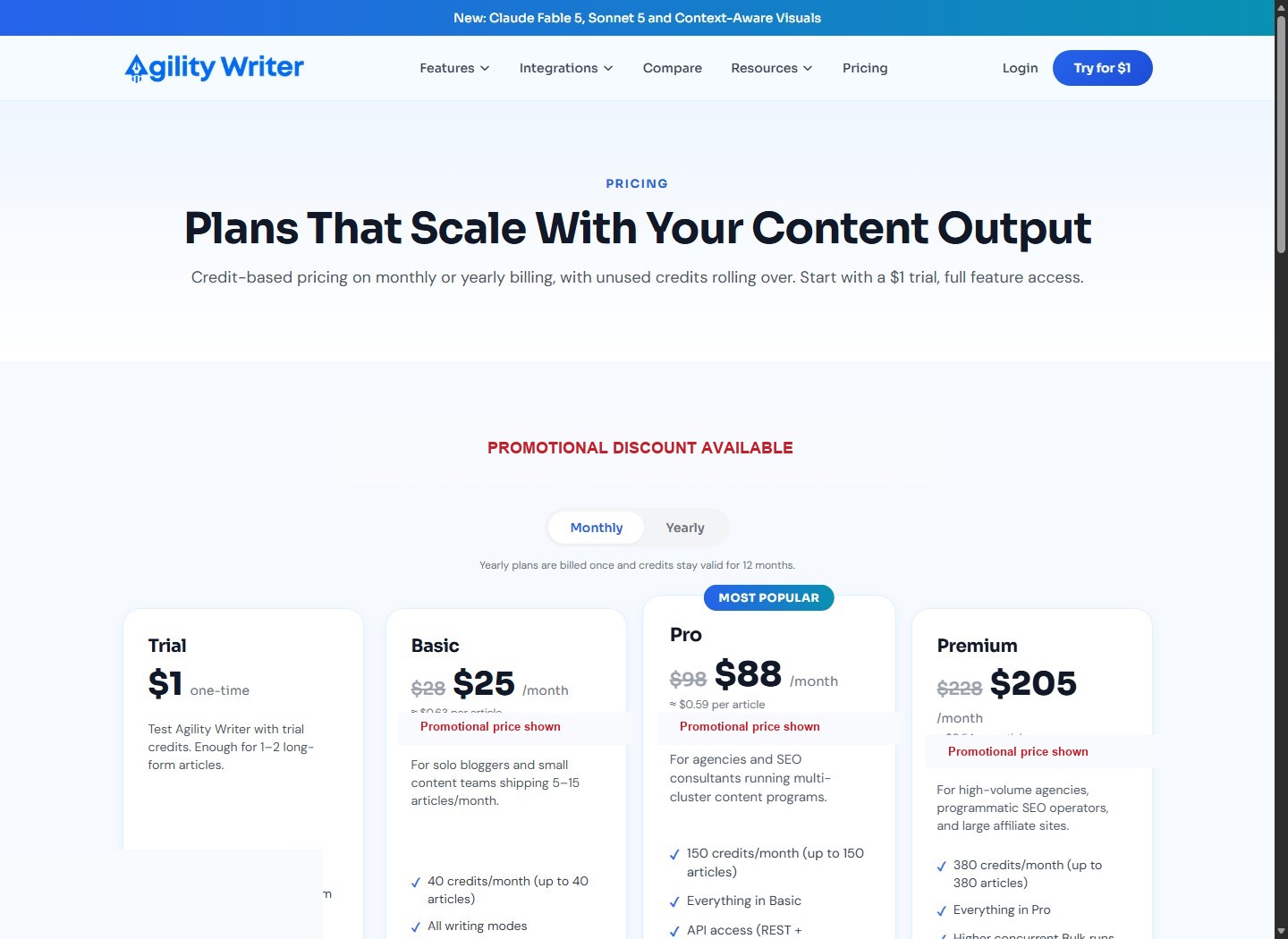
Agility Writer pricing
| Plan | Public price | Included capacity and notable limits |
|---|---|---|
| Trial | $1 one time | Five credits according to the pricing FAQ, roughly one to two long-form articles, all writing modes |
| Basic | $28/month | 40 credits, all modes, Bulk Mode, maps, research and citations; no monthly API listing |
| Pro | $98/month | 150 credits, API, webhooks, Zapier, authorship and E-E-A-T features |
| Premium | $228/month | 380 credits, higher concurrent Bulk runs, API and Zapier |
| Yearly Starter | $240/year | 300 credits, API and Zapier |
| Yearly Growth | $980/year | 1,400 credits, priority support |
| Yearly Scale | $2,480/year | 3,700 credits, dedicated account contact |
Agility Writer displayed a temporary 10% promotional discount during our check, including $25 Basic, $88 Pro, and $205 Premium. We use list prices for comparison because promotions can change. Credits roll over while the subscription remains active. “Up to one article per credit” applies only to one-credit modes. Advanced and product reviews use two credits; Optimize and roundups use three.
Surfer pricing
| Plan | Public monthly price | Included capacity and positioning |
|---|---|---|
| Discovery | $49 | 120 documents, one seat, 10 tracked pages, guidelines, Surfy, Humanizer |
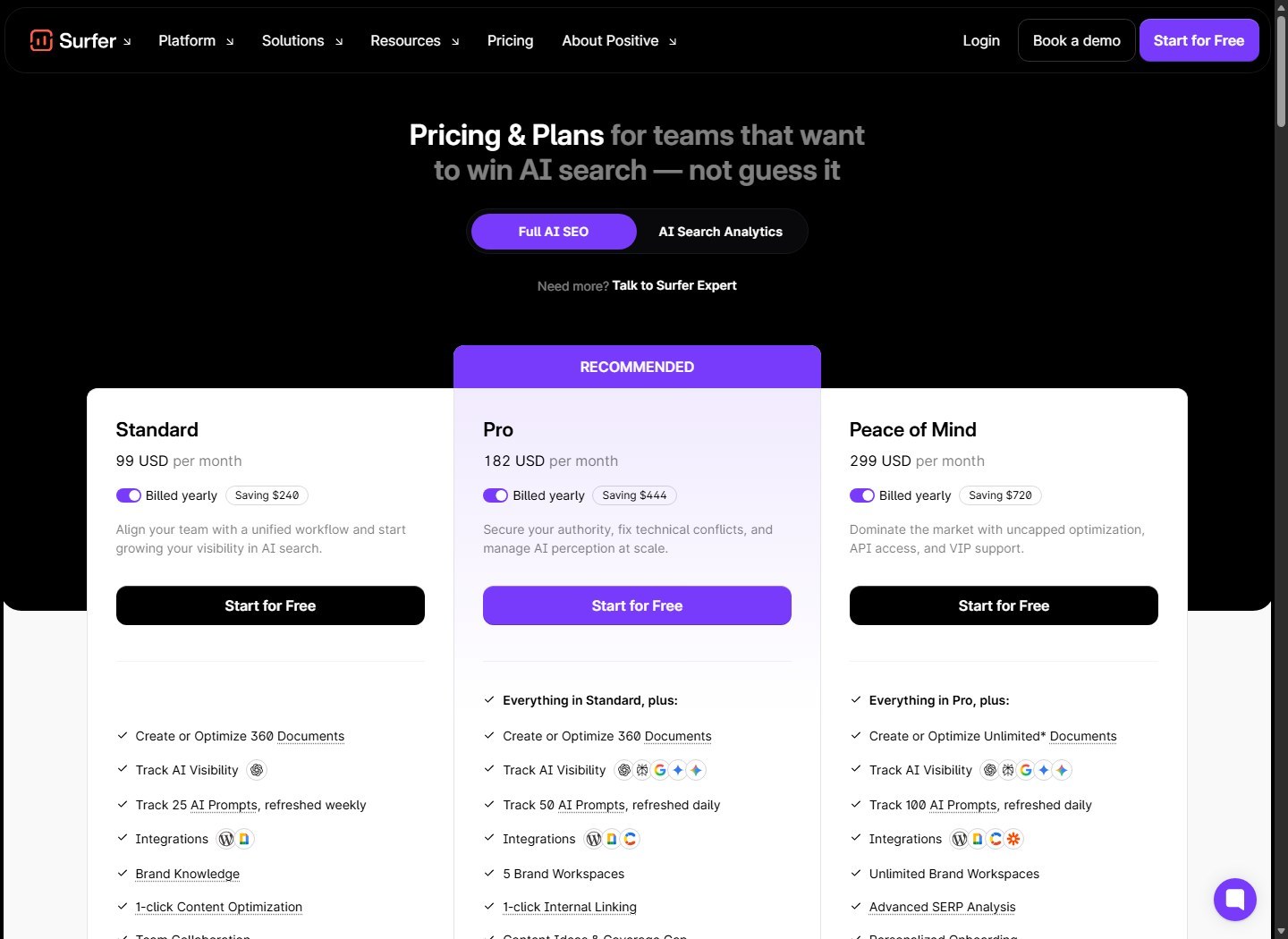
| Standard | $99 | 360 documents, three seats, 25 AI prompts refreshed weekly, integrations, Brand Knowledge, plagiarism, rank-drop detection |
| Pro | $182 | 360 documents, five seats, 50 AI prompts refreshed daily, five Brand Workspaces, Contentful, internal linking, ideas, coverage gaps, cannibalization |
| Peace of Mind | $299 | Unlimited documents subject to fair use, 10 seats, 100 daily AI prompts, unlimited Brand Workspaces, Zapier, advanced SERP analysis, API |
| AI Search Analytics | $158 | Separate AI visibility offer with 100 daily prompts and five workspaces |
| Enterprise | From $999 | Tailored limits, SSO, security, onboarding, white-label, priority support |
Surfer’s page also says annual plans can save up to 17% and are billed upfront. “Start for Free” appears on paid plan cards, but the public page does not clearly describe a permanent free plan in the extracted pricing details, so confirm checkout terms before relying on a free trial.
Value winner: Agility Writer for net-new article output. Surfer can justify its higher price when several writers use scoring, collaboration, auditing, integrations, and AI visibility across an existing content portfolio. Comparing only monthly prices understates Surfer’s operational breadth and overstates the value of unused Agility Writer production capacity.
Strengths and Weaknesses
Agility Writer strengths
- Strong long-form production workflow with format-specific modes.
- Low starting price and transparent credit consumption by article type.
- In-depth research, citations, Fact Sheets, and Custom Knowledge.
- Up to 200 articles per Bulk run and direct WordPress scheduling.
- API, webhooks, Zapier, multi-site publishing, and rollover credits.
- Topical maps, site authority audits, GSC actions, and G-Smart rewriting.
Agility Writer weaknesses
- High output increases editorial and scaled-content risk if governance is weak.
- Vendor claims about detection, Helpful Content alignment, and ranking are not guarantees.
- Credits do not map one-to-one to every article because richer modes cost more.
- Its optimization feedback is less central and standardized than Surfer’s editor.
- Public documentation contains a small plan-naming inconsistency around API eligibility.
Surfer strengths
- Mature Content Editor with live, explainable SEO and AI Search components.
- Competitor selection and guideline customization support experienced editors.
- Strong GSC-connected audits, rank alerts, maps, and refresh workflows.
- Collaboration, Brand Workspaces, history, custom voices, and CMS integrations.
- AI generation, Auto-Optimize, internal links, plagiarism, detector, and humanizer in one environment.
- API supports editor, score, audit, SERP, detector, and humanizer use cases.
Surfer weaknesses
- Higher monthly cost, especially for API access and multi-brand operations.
- Proprietary scores can encourage mechanical optimization or score chasing.
- SERP-derived recommendations inherit weaknesses from selected competitors.
- Factual coverage features do not replace primary-source verification.
- Current plan packaging is broad enough that buyers should confirm how their exact AI-generation usage is counted.
Buyer-Specific Winners
For affiliate operators, Agility Writer wins. Product Review and Roundup modes, citations, Fact Sheets, lower entry pricing, and bulk production align directly with the workflow. Require manual product verification and do not imply first-hand use that did not occur.
For content agencies selling article volume, Agility Writer wins. Pro combines 150 credits with API, Zapier, and authorship tools, while WordPress multi-site scheduling reduces handoff work. Build client-specific Fact Sheets and approval queues before scaling.
For in-house SEO teams, Surfer wins. Standard or Pro gives writers a consistent brief-and-score environment while content leaders get audits, collaboration, brand controls, and performance feedback.
For established publishers refreshing hundreds of URLs, Surfer wins. Content Audit, rank-drop detection, URL import, GSC data, internal links, and cannibalization reporting address portfolio maintenance better than a generation-first tool.
For programmatic SEO teams, Agility Writer wins on production, but only with strict controls. API jobs, webhooks, bulk generation, and direct publishing are strong. Add database validation, deduplication, source checks, human review, and staged indexing.
For teams pursuing AI-search visibility, Surfer wins on measurement. Its current plans explicitly track prompts and AI visibility, while the Content Score includes Facts Coverage and Upfront Intent Alignment. Measurement does not guarantee citations, but it gives teams a repeatable monitoring layer.
For a solo subject-matter expert publishing a few careful pieces, the choice is closer. Agility Writer is cheaper and can assemble researched drafts. Surfer is worth the premium if the expert writes manually and values live optimization more than generation volume.
FAQ
Is Agility Writer better than Surfer AI?
Agility Writer is better for research-led long-form generation, bulk production, and lower-cost article output. Surfer is better for live optimization, collaborative editing, content audits, and monitoring. The right winner depends on whether production or optimization is the primary bottleneck.
Does Surfer replace an AI writer?
Surfer can generate articles through Surfer AI, and Surfy can assist inside Content Editor. It can therefore replace a separate writer in some workflows. Its strongest value, however, remains the guidelines, scoring, optimization, audit, and governance system around the document.
Can Agility Writer optimize existing content?
Yes. Official materials list Optimize Mode, G-Smart Optimizer, Topical Authority Audit, Smart Editor, and GSC Action Center. Together they can audit, expand, rewrite, and route internal-link or missing-query improvements into existing pages.
Which tool has the better Content Score?
Surfer has the clearer native scoring system. Its 0-to-100 Content Score combines SEO Score and AI Search Score, and updates as the document changes. Agility Writer offers optimization and third-party NeuronWriter integration, but its product is less centered on one universal live score.
Which is cheaper, Agility Writer or Surfer?
Agility Writer starts at a $28 monthly list price for 40 credits. Surfer Discovery starts at $49 monthly for 120 documents. Those units are not equivalent: Agility credits are consumed by generation modes, while Surfer documents cover creation or optimization workflows. Compare cost against your actual process, not the headline unit count.
Do either tool’s AI detector claims guarantee Google rankings?
No. Detector outcomes do not guarantee authorship, quality, or rankings. Google says it focuses on helpfulness and quality rather than banning content simply because AI helped create it. Original value, accuracy, expertise, and user satisfaction matter more than a third-party detector result.
Can I publish generated articles without editing?
You can technically publish from both workflows, but you should not treat generated output as approved. Verify facts and citations, add original experience or expert input, check intent and overlap, review links and metadata, and apply stricter controls to YMYL topics.
Which tool is best for agencies?
Agility Writer is better for agencies selling high-volume creation and managing several WordPress destinations. Surfer is better for agencies selling strategy, optimization, editorial collaboration, audits, and ongoing performance improvement. Larger agencies may use Agility Writer upstream and Surfer downstream rather than forcing one platform to do both jobs.
