Agility Writer is the better buy for production-first long-form SEO publishing; Writesonic is the stronger choice when one budget must cover article creation, site audits, and AI-search visibility tracking. Agility Writer starts at $28 per month and centers its product on researched articles, topical clusters, bulk generation, and WordPress delivery. Writesonic starts at $79 per month when billed annually and now positions itself as an AI Search Visibility platform with an AI Article Writer inside a wider SEO and GEO system.
| Decision factor | Agility Writer | Writesonic | Winner |
|---|---|---|---|
| Product category | Production-first long-form SEO generator | Broader SEO + GEO growth platform | Depends on scope |
| Entry price checked August 1, 2026 | $28/month for Basic, 40 credits | $79/month billed annually for Starter | Agility Writer |
| Long-form workflow | Multiple writing modes, outlines, research, citations, optimization | Agentic article pipeline with research, citations, review, humanizer, and CMS export | Tie by different workflow |
| Topical planning | Dedicated Topical Map Helper with clusters, intent, and starter links | Content Strategy plus SEO & Content AI Agent | Agility Writer for a direct map-to-bulk handoff |
| Traditional SEO operations | G-Smart Optimizer and GSC Action Center | Content strategy, site audits, AI agent, GSC integration | Writesonic for suite breadth |
| GEO and AI visibility | No comparable public AI-answer monitoring suite found | Tracks mentions, citations, sentiment, prompts, and competitors | Writesonic |
| Bulk production | Up to 200 articles per Bulk Advanced run | CSV/Excel bulk generation documented | Agility Writer for published batch limits and silo controls |
| WordPress | Plugin, scheduling, metadata, images, multisite, updates | One-click CMS export and WordPress integration | Agility Writer for WordPress-specific operations |
| API and automation | REST API, Zapier, WordPress plugin | Open API, MCP, Zapier, multiple CMS destinations | Writesonic for ecosystem breadth |
| Best for | Publishers, affiliates, niche-site operators, production agencies | Growth teams, brands, SEO/GEO teams, enterprises | Buyer-specific |
This comparison is based on official public product pages, help documentation, and pricing pages reviewed on August 1, 2026. Feature descriptions and performance claims attributed to a vendor are therefore not independent test results.
Quick Verdict: Which Tool Should You Choose?
Choose Agility Writer if the recurring job is turning validated topics into researched, structured, publishable long-form articles at a predictable per-article cost. Its $28 Basic plan, rollover credits, dedicated Topical Map Helper, batch limits of up to 200 articles, and detailed WordPress publishing controls create a coherent production line. The product is narrower than Writesonic, but that focus is its advantage for publishers who already have analytics and SEO tools.
Choose Writesonic if the recurring job extends beyond writing into measuring and improving brand visibility across traditional and AI search. Its public pricing includes AI visibility tracking, content strategy, an SEO & Content AI Agent, AI Article Writer, site audits, Google Search Console, and WordPress. Growth and Enterprise tiers add more advanced GEO analysis or platform coverage. That breadth is useful, but buyers who only need articles may pay for a wider operating system than they need.
| Buyer situation | Better fit | Why |
|---|---|---|
| Solo publisher producing SEO articles | Agility Writer | Lower entry price and article-centered credits |
| Affiliate team building review clusters | Agility Writer | Review templates, topical maps, research, silo links, and WordPress flow |
| Brand measuring ChatGPT and Gemini visibility | Writesonic | AI-answer mentions, citations, prompts, competitors, and trends |
| SEO team replacing several point tools | Writesonic | Content, audits, AI search tracking, and agents in one subscription |
| Agency managing many WordPress sites | Agility Writer | Multisite destinations, scheduling, metadata, media, and batch publishing |
| Enterprise requiring governance and broad integrations | Writesonic | Enterprise controls, custom integrations, SSO/SAML, and wider platform scope |
For a deeper product-level view before choosing the focused option, see our Agility Writer review and buyer guide. The rest of this page explains where the category boundary matters, rather than treating both products as interchangeable “AI writers.”
What Is the Real Difference Between Agility Writer and Writesonic?
The real difference is production specialization versus growth-platform breadth. Agility Writer is designed around the unit of output: a long-form article. Writesonic is designed around the marketing system: research demand, create or optimize content, audit a site, monitor AI answers, and act on visibility gaps.
Agility Writer’s public workflow moves from a topical map or keyword list into 1-Click, Advanced, Optimize, Rewrite, or Bulk modes. It then offers the Smart Editor, G-Smart Optimizer, integrations, and publishing. That makes the product easy to evaluate through questions such as “How many articles can we produce?” and “How much control does an editor have before WordPress?”
Writesonic’s current homepage and pricing language emphasize AI Search Visibility. Its AI Article Writer remains substantial, but it now sits beside GEO tracking, site auditing, an SEO & Content AI Agent, and an Action Center. Writesonic is evaluated through broader questions: “Where is our brand absent from AI answers?”, “Which citations influence the category?”, and “Can the same platform identify and execute the fix?”
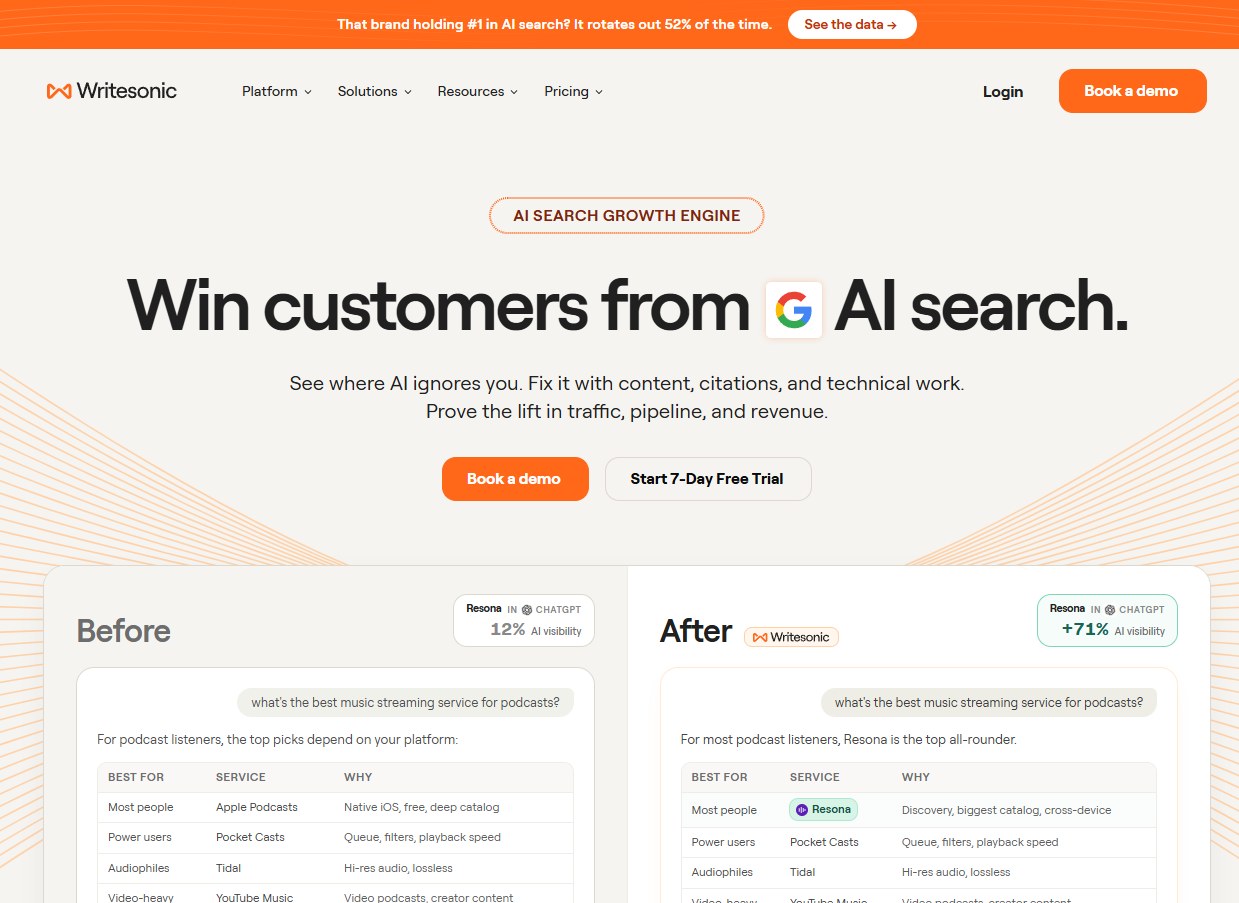
This boundary prevents a misleading feature-count contest. Writesonic wins categories that Agility Writer does not attempt to match, especially prompt-level AI visibility. Agility Writer can still win the purchase when those categories are irrelevant and the real constraint is cost-efficient, controlled article production.
How Do Their Topical Planning Workflows Compare?
Agility Writer has the more explicit topic-map-to-production workflow, while Writesonic connects planning to a broader SEO and demand system. Both can help teams decide what to publish, but the center of gravity differs.
Agility Writer Topical Map Helper
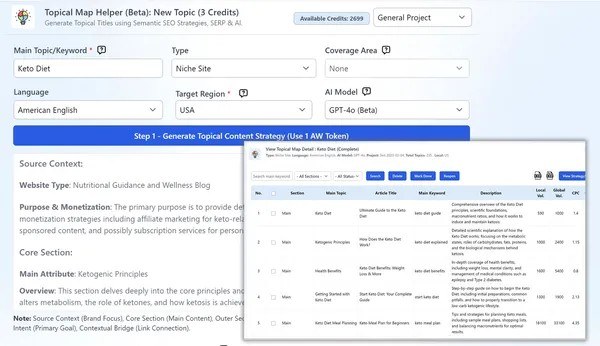
Agility Writer’s official Topical Map Helper page says the tool creates prioritized clusters with core and supporting pages, entity hints, supplementary questions, search-intent tags, and a starter internal-link blueprint. Users can export to CSV or open an item in Advanced Mode. Its FAQ says a map costs three credits and is not included in the trial, while the official pricing page says the trial includes Topical Map Helper access. Because these vendor pages conflict, buyers should confirm the current trial entitlement in checkout or with support.
The strongest operational detail is the handoff. A publisher can review the map, remove duplicates, assign unique page intent, and pass selected rows into Advanced or Bulk mode. Agility Writer also warns that no tool builds a perfect topical map and instructs users to review and filter the output. That caveat is more useful than a promise of fully automatic topical authority.
Writesonic content strategy and demand inputs
Writesonic includes Content Strategy and an SEO & Content AI Agent on its public pricing comparison. Its AI Article Writer page describes topic selection, audience research, Business Potential Scoring, keyword demand, SERP analysis, prompt and query fan-out, and competitor-gap extraction. The workflow combines traditional search inputs with questions people ask AI engines.
Writesonic’s planning advantage is not simply a bigger topic map. It can place topics inside a system that also observes AI-search prompts, brand mentions, citations, and site issues. A brand may choose a topic because it has search demand, fills a SERP gap, answers an AI prompt, or addresses a citation opportunity. That is a broader planning lens than a publisher-focused cluster generator.
Agility Writer wins when the objective is a clean cluster architecture followed by batch drafting. Writesonic wins when topic selection must connect to brand demand and measured AI visibility. In either product, an editor still needs to validate search intent, consolidate overlap, check commercial relevance, and decide which pages deserve first-party evidence.
Which Long-Form Article Workflow Is Better?
Agility Writer offers more visible mode-level controls, while Writesonic presents a more expansive agentic review pipeline. Neither official public description proves that one produces better prose or higher rankings because output quality depends on the brief, sources, model behavior, editing, and niche.
Agility Writer modes, outlines, and research
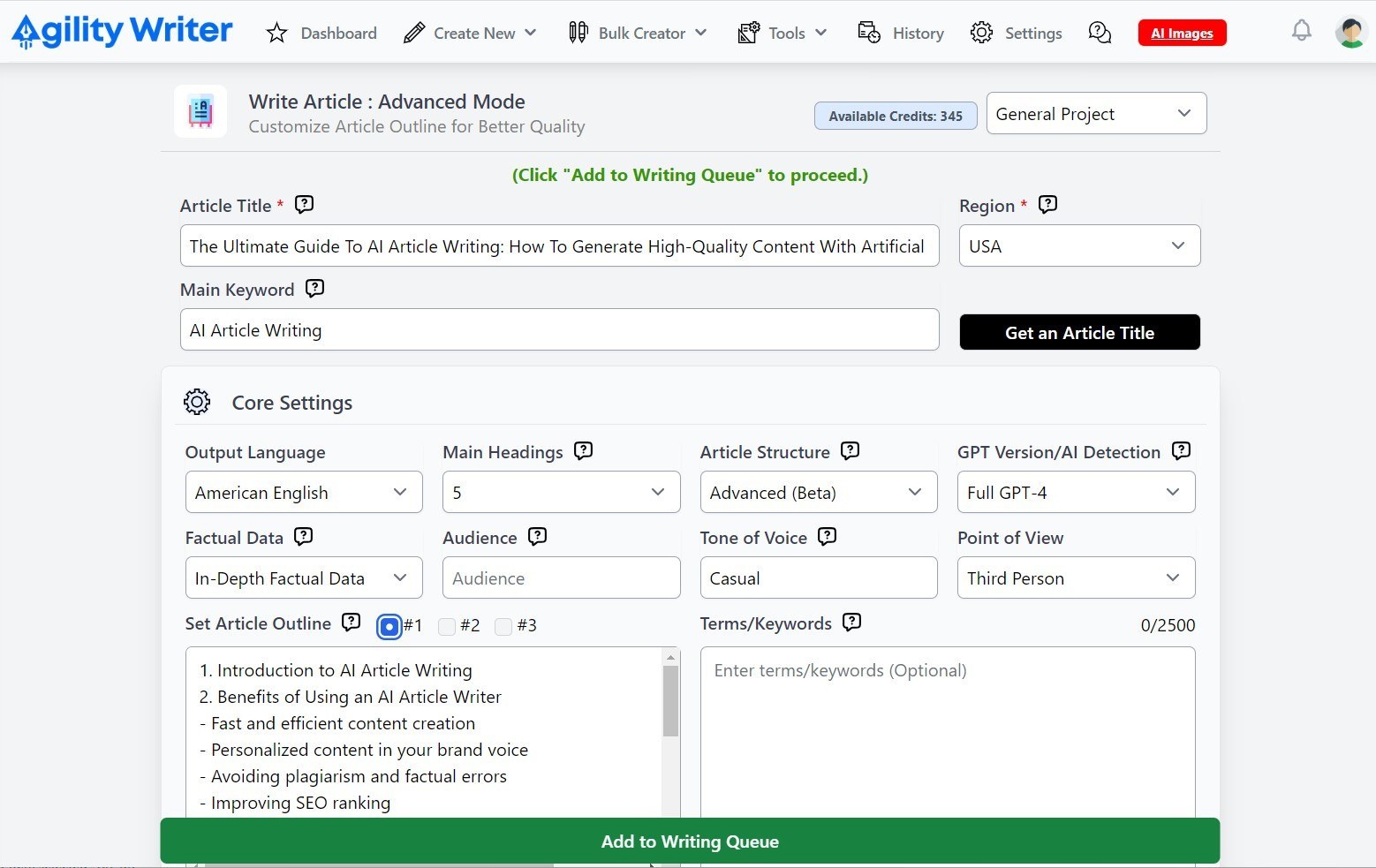
Agility Writer documents six modes: 1-Click, Advanced, Optimize, Bulk, Rewrite, and YouTube to Article. Its writing modes page lists Advanced output up to 7,000 words and Optimize output up to 5,000 words. Controls include target keyword, audience, angle, writing style, section-level Power-Up tags, Custom Knowledge, Fact Sheets, real-time data, and citations.
This setup favors editors who want to decide how much research and control each article deserves. A low-risk supporting article can use 1-Click. A pillar guide can use Advanced with a custom outline. A competitive query can use Optimize. Product Review and Roundup Review templates add structures for affiliate publishers, while Fact Sheets can supply reviewed product or brand details.
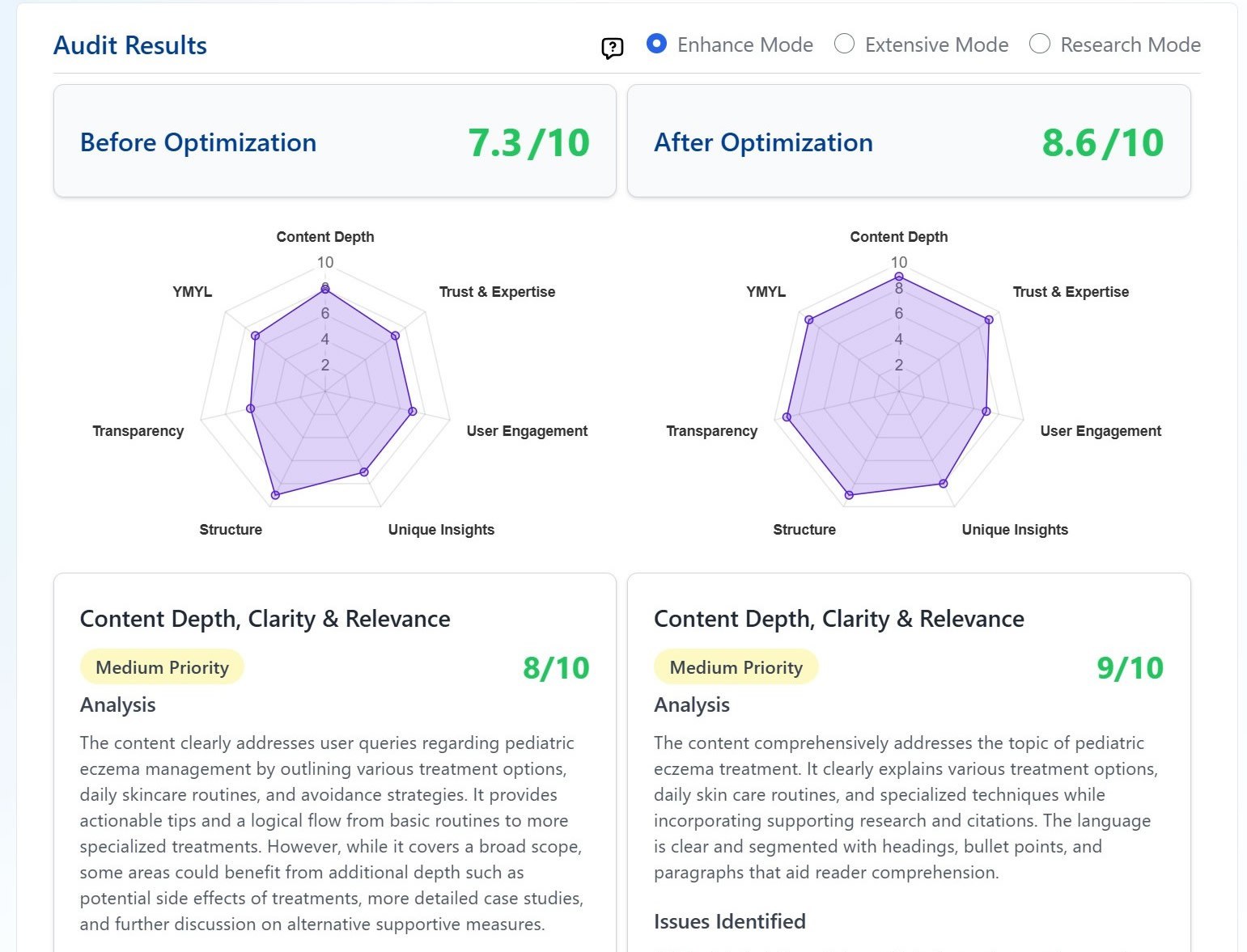
Agility Writer’s G-Smart Optimizer audits a draft, then offers Enhance, Extensive, or Research modes. The vendor says Research can add sections and citations, and revisions can be compared or rolled back. Treat “aligned with Google’s guidance” as product positioning, not proof that Google endorses an output or that a page will rank.
Writesonic AI Article Writer
Writesonic describes its current AI Article Writer as a ten-phase, 100-plus-step pipeline. Publicly listed phases include audience and demand research, SERP and competitor analysis, positioning, outline creation, section-by-section writing, multi-expert review, humanization, citation verification, internal linking, images, schema, and CMS export. It supports knowledge-grounded research, deep web research, or a combination where uploaded knowledge takes precedence.
The page says output can range from 3,000 to 8,000 words and cover listicles, comparisons, category guides, and thought leadership. It also describes brand and author voice profiles, first-party citation preferences, FAQs, and Article, FAQPage, and Author schema. These are vendor-described capabilities, not findings from this comparison.

Writesonic’s advantage is workflow consolidation. A larger team can connect research, governance, style, review, schema, and export under one system. Its weakness is that a complex automated pipeline can create confidence before an editor verifies the facts. A named “expert framework” is still software logic; it does not become subject-matter expertise by label alone.
Agility Writer is the more legible choice for teams that want to tune each article’s production mode and credit cost. Writesonic is the more ambitious choice for teams that want an article pipeline embedded in a larger search program.
How Do SEO and GEO Workflows Differ?
Agility Writer is stronger as a focused SEO publishing workflow; Writesonic is decisively stronger for dedicated GEO measurement. This is the largest functional separation in the comparison.
Agility Writer’s SEO loop
Agility Writer combines topical maps, live SERP research, entity coverage, optimization, internal links, and Google Search Console data. Its GSC Action Center reports clicks, impressions, CTR, and position changes, identifies queries a page ranks for but does not cover, and recommends internal links through PowerLinker. The connection uses read-only OAuth scopes, and each added site costs five credits once, according to the official page.
That loop is editorial: identify a query or page opportunity, revise content, route internal links, and monitor traditional search performance. It is useful for publishers who want GSC data close to the writing environment. It is not presented as a substitute for rank tracking, a full technical crawler, or cross-platform AI-answer monitoring.
Writesonic’s AI Search Visibility and Action Center
Writesonic’s GEO product page describes tracking brand visibility, citations, sentiment, competitors, prompts, markets, languages, and share of voice across AI platforms. Its public pricing shows Starter, Basic, and Growth tracking ChatGPT, Gemini, and Google AI Overviews, while Enterprise lists ten platforms. The vendor says it crawls public AI interfaces rather than relying only on APIs.
Writesonic can show which prompts mention a brand, which pages receive citations, which competitors appear instead, and how visibility changes. Growth adds sentiment analysis and Action Center access in the current pricing matrix. The Action Center groups on-page, off-page, and technical actions, turning observation into a prioritized queue.
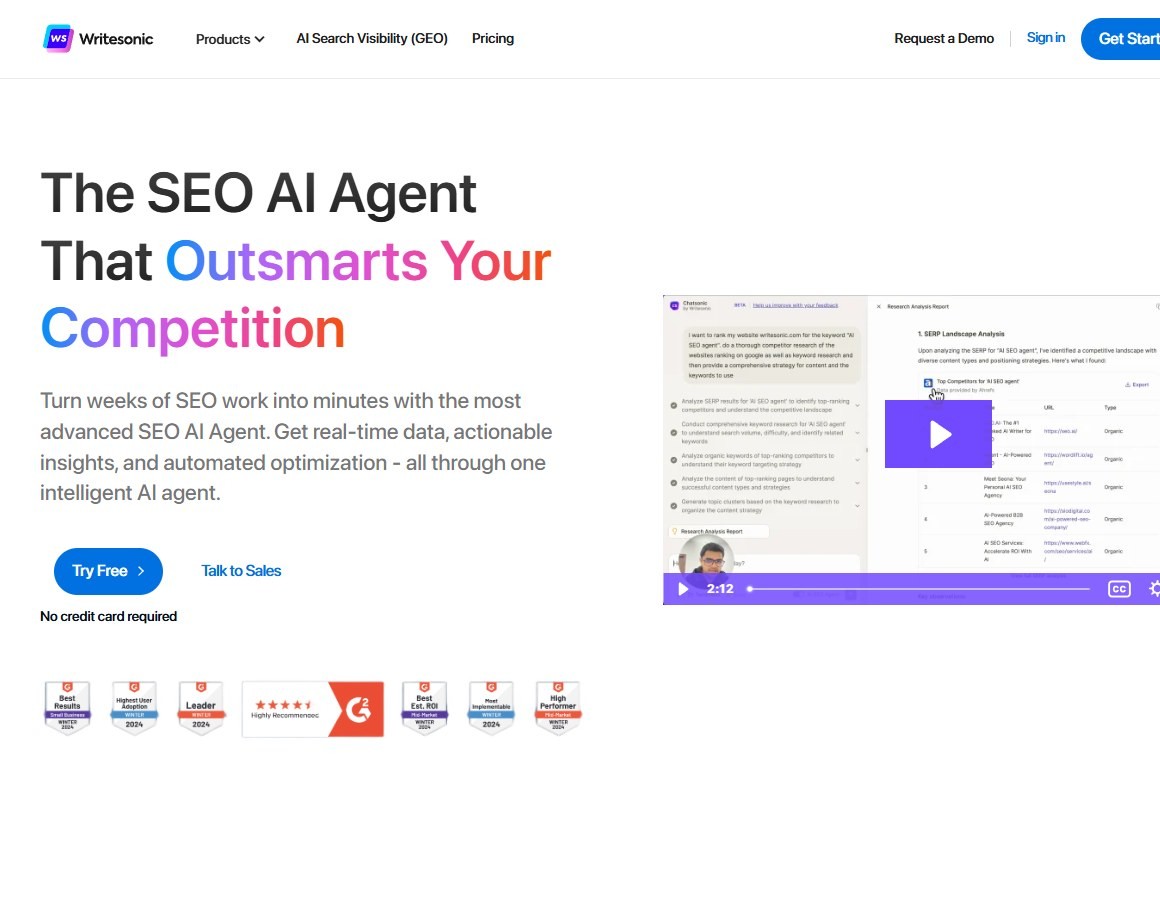
This does not mean GEO metrics guarantee revenue or citations. AI answers vary by platform, location, personalization, model changes, and sampling method. Visibility scores are vendor-defined measurements over configured prompts, not universal market share. Buyers should inspect prompt coverage, tracking frequency, geography, and exportability before using a dashboard as an executive KPI.
Google’s own AI optimization guidance says foundational SEO remains relevant for its generative features and emphasizes valuable, non-commodity content and clear technical structure. That supports a practical view: GEO monitoring can expose opportunities, but it does not replace helpful content, crawlability, brand authority, or editorial judgment.
Which Tool Handles Scale and Bulk Production Better?
Agility Writer provides the clearer public specification for article batches; Writesonic provides bulk generation inside a wider enterprise-ready ecosystem. Agility Writer’s official bulk page states up to 200 articles per Bulk Advanced run and up to 50 per Bulk 1-Click batch. Inputs can include titles, keywords, URLs, YouTube videos, CSV files, or location lists, although silo links apply to selected input paths.
Bulk Advanced can include internal silo links, entity enrichment, authority links, in-depth research, citations, images, and a NeuronWriter Query ID per CSV row. Credits are charged per article and mode, with no stated bulk surcharge. The page gives a concrete example: 100 Advanced articles cost 200 credits. This transparency helps production teams estimate campaign capacity, although premium models and other options can add credits.
Writesonic’s official bulk-generation guide documents a CSV or Excel process for AI Article Writer 6. Teams select the content type and language, download a template, add topic, country, and quality fields, upload the file, wait for processing, and download completed articles. Its broader platform also offers an open API and agentic workflows.
Agility Writer wins for a WordPress publisher building clusters or location-page campaigns because the public controls cover batch size, internal silos, research, and direct publishing. Writesonic may fit an organization that needs bulk generation to coexist with audits, GEO, multiple CMSs, and governance. For both, “bulk” should describe processing capacity, not permission to publish without review.
If programmatic volume is the decisive requirement, our Agility Writer vs Koala comparison covers another production-oriented alternative and its workflow tradeoffs.
How Do API, Integrations, and WordPress Compare?
Writesonic supports the broader integration environment, but Agility Writer offers the more detailed WordPress production controls. The right winner depends on whether WordPress is the center of the stack or one destination among several.
Agility Writer documents three automation paths: a WordPress plugin, Zapier, and a REST API. Its WordPress integration page lists bulk scheduling by date or publishing cadence, metadata for Yoast, Rank Math, and AIOSEO, automatic image storage in the Media Library, existing-post updates, multisite destinations, draft or published status, and a legacy REST route. Those controls are unusually relevant to agencies operating several content sites.
Agility Writer’s API page positions the REST API for custom job creation, status tracking, and article retrieval. Zapier is the no-code path. Public pages indicate API access, but buyers should confirm plan entitlements, rate limits, endpoints, failure handling, and credit consumption inside current documentation before designing a production dependency.
Writesonic’s AI Article Writer page lists WordPress, Sanity, Contentful, Contentstack, Notion, Drupal, Google Docs, and Slack, plus an open API and MCP. It also advertises one-click export to WordPress, Sanity, Contentful, Webflow, or Ghost. Official Zapier documentation describes workflows involving Google Docs, WordPress, Google Sheets, and Gmail.
Writesonic wins when content must move through a composable marketing stack or multiple headless CMSs. Agility Writer wins when the desired endpoint is WordPress and the operator cares about scheduled batch delivery, SEO-plugin metadata, Media Library assets, multisite routing, and updating existing posts.
Neither integration list removes operational risk. Teams should test authentication renewal, HTML and schema rendering, image ownership, internal-link resolution, draft status, taxonomy assignment, retries, and duplicate prevention before enabling automatic publishing. Keep a human approval stage for commercial, medical, legal, financial, or reputation-sensitive content.
What Do Their Humanizer and AI-Detection Claims Mean?
Both vendors market humanization, but no AI-detection score can certify quality, originality, or Google safety. Agility Writer offers Humanize, Anti-AI Detection, and SEO-NLP Friendly styles. Its public help changelog has included detector-oriented score claims, while current feature copy says its style changes sentence structure and word distribution to reduce flags.
Writesonic says its Humanizer removes recurring AI patterns such as filler, monotonous rhythm, and formulaic constructions. The AI Article Writer page places that step beside E-E-A-T additions and citation verification. This is a more editorial framing, although the vendor also uses strong language about stripping “every AI tell.”
The responsible buying interpretation is limited: a humanizer can be useful as a style-cleanup pass. It cannot prove authorship, factual accuracy, originality, expertise, or compliance. Third-party detectors can disagree on the same passage, change models without notice, and misclassify human writing. A high “human” score is not an SEO metric.
More importantly, optimizing to evade detection can distract from the work readers value: original experience, accurate sourcing, clear decisions, updated facts, useful examples, and accountable authorship. Run plagiarism checks where appropriate, verify every consequential claim, and edit for the audience rather than for a detector.
For teams that want more control over structure and section-level prompting before any style pass, the Agility Writer Power-Up guide explains the product’s instruction-oriented workflow.
Does Either Tool Reduce Google Risk?
Neither tool can remove Google risk or guarantee rankings. Google’s guidance on generative AI content says generative AI can help with research and structure, but generating many pages without adding value may violate its scaled content abuse policy. Google asks publishers to focus on accuracy, quality, relevance, Search Essentials, and spam policies.
The relevant risk is not “AI text detected.” Google defines scaled content abuse as generating many pages primarily to manipulate rankings rather than help users, regardless of how the pages are created. It also warns about thin affiliate pages that repeat merchant descriptions without meaningful additional value.
Agility Writer can support safer operations through source-based research, citations, Fact Sheets, controlled outlines, revisions, and a review step before WordPress. Writesonic can support them through knowledge grounding, citations, multi-stage review, site audits, brand governance, and visibility analysis. Those are controls, not immunity.
A defensible workflow uses either product as a production assistant:
- Validate the query and page purpose before generation.
- Add first-party knowledge, expert input, or original analysis.
- Verify names, dates, prices, statistics, quotations, and links against primary sources.
- Remove duplicated, generic, or unsupported sections.
- Disclose automation when it gives readers useful context.
- Assign an accountable author or reviewer.
- Publish only pages that add distinct value to the site.
- Monitor indexing, engagement, conversions, corrections, and search performance.
The tool with more “Google-aligned” labels is not automatically safer. The safer team is the one with stronger editorial gates, evidence standards, and deletion discipline.
How Much Do Agility Writer and Writesonic Cost?
Agility Writer is substantially cheaper to enter; Writesonic bundles a much broader platform. Prices below were checked against official public pages on August 1, 2026. Taxes, overages, add-ons, negotiated terms, and later changes may apply.
Agility Writer pricing
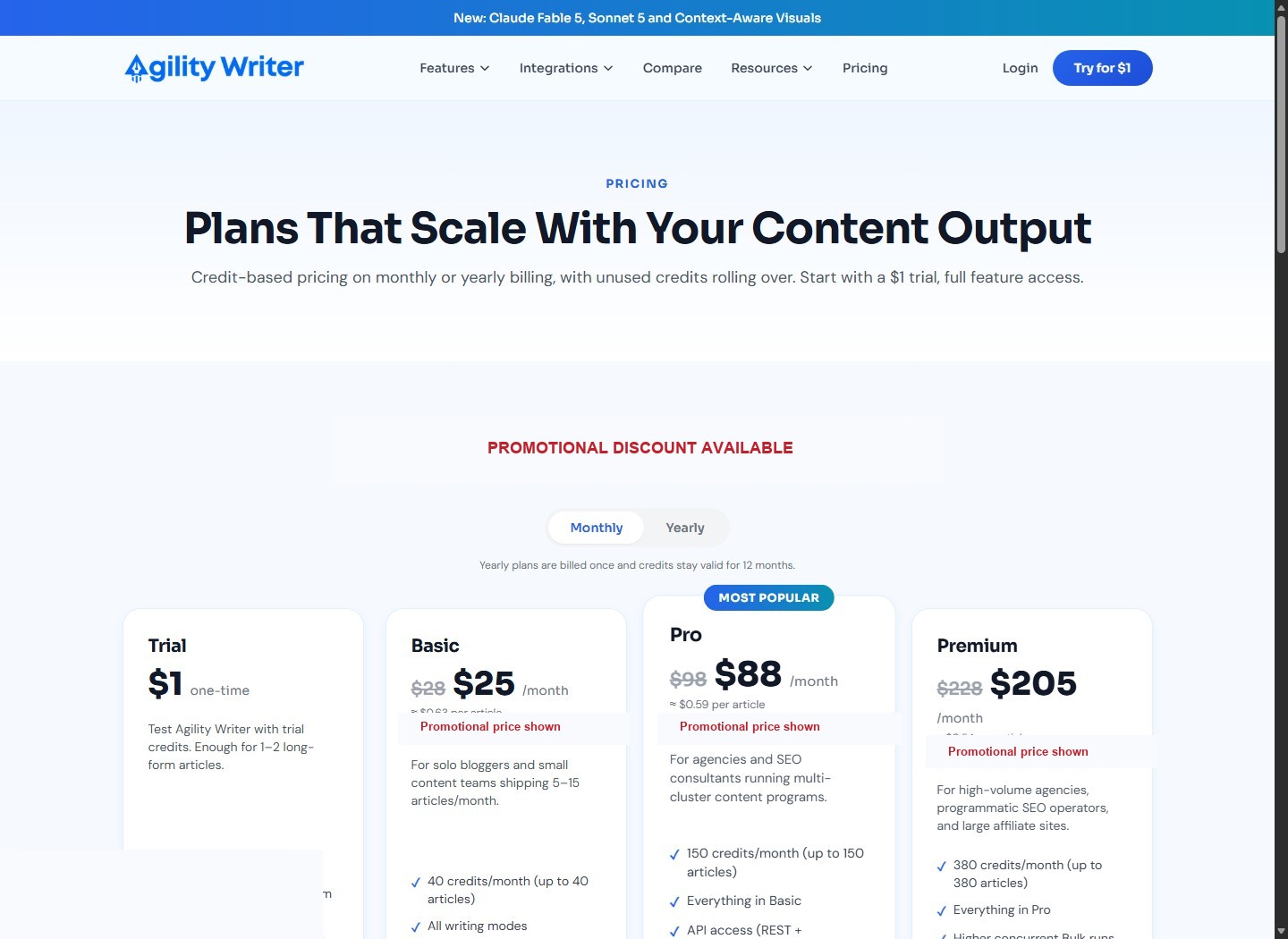
| Plan | Public price | Included monthly credits or annual pool | Public positioning |
|---|---|---|---|
| $1 Trial | $1 | 4 credits on the registration pricing page | Limited evaluation with full-feature wording |
| Basic | $28/month | 40 credits | Solo and niche blogger |
| Standard | $55/month | 80 credits | Solo and niche blogger |
| Pro | $98/month | 150 credits | Multi-site blogger |
| Premium | $228/month | 380 credits | Agency and SEO content marketer |
| Elite | $528/month | 960 credits | Content providers |
| Ultimate | $988/month | 1,800 credits | Content providers |
| Yearly Y1 | $240/year | 300 credits/year | Flexible annual pool |
| Yearly Y2 | $980/year | 1,400 credits/year | Flexible annual pool |
| Yearly Y3 | $2,480/year | 3,700 credits/year | Flexible annual pool |
Agility Writer charges by credits rather than words. “Up to” article counts assume one-credit work; Advanced, Optimize, maps, premium models, and extra operations can consume more. The registration page says unused credits roll over, but its annual and homepage wording should be reconfirmed at checkout. We intentionally do not reproduce the public coupon code in this package.
The approved ScaleWitAI route for Agility Writer is currently blocked for public release because it returned HTTP 404 during our August 1, 2026 check. The link is retained exactly as supplied for Draft workflow only: <a href="https://scalewitai.com/go/agility-writer" target="_blank" rel="nofollow sponsored noopener">check Agility Writer availability and current terms</a>. Do not publish until this route resolves correctly.
Writesonic pricing
| Plan | Annual-billing price shown publicly | Monthly price in current official help table | Key scope |
|---|---|---|---|
| Starter | $79/month billed annually | Not shown in the cited help table | AI visibility, AI articles, site audits, GSC, WordPress |
| Basic | $199/month billed annually | $249/month | 100 articles, 40 audits, two users, two projects, API access in help docs |
| Growth | $399/month billed annually | $499/month | 200 articles, 60 audits, five users, advanced GEO analysis |
| Enterprise | Custom | Custom | Broader AI-platform coverage, governance, strategy, custom integrations |
The live pricing page now displays Starter, Basic, Growth, and Enterprise. Writesonic’s official help page supplies more numeric allowances for Basic, Growth, and Enterprise, but public pages can lag each other during packaging changes. Confirm the checkout screen, article allowance, tracked prompts, projects, agent runs, add-ons, and monthly option before purchase.

A direct price comparison is incomplete because the units differ. Agility Writer mainly sells article-production capacity. Writesonic sells production plus SEO, audits, AI visibility, and agentic workflows. Compare the cost of the stack each product replaces, then compare the editorial labor that remains.
What Are Each Tool’s Main Strengths and Weaknesses?
Agility Writer’s strength is focused production economics; its weakness is limited platform breadth. Writesonic’s strength is connected SEO and GEO operations; its weakness is cost and complexity for article-only buyers.
Agility Writer strengths
- Low $28 monthly entry point.
- Clear article-centered credit model with rollover language.
- Multiple modes for speed, control, optimization, rewriting, and bulk work.
- Dedicated topical maps and map-to-bulk handoff.
- Public batch limits up to 200 articles in Bulk Advanced.
- Research, citations, Fact Sheets, Custom Knowledge, and section controls.
- Detailed WordPress scheduling, multisite, metadata, image, and update features.
- GSC-based editorial opportunities and internal-link recommendations.
Agility Writer weaknesses
- No comparable public suite for cross-platform AI-answer visibility.
- Credits make “up to X articles” dependent on the chosen mode and extras.
- Product breadth is smaller for technical SEO, enterprise reporting, and non-WordPress CMS workflows.
- Anti-detection positioning can encourage the wrong quality target.
- Public pages contain changing model and trial details that require checkout confirmation.
Writesonic strengths
- AI Article Writer includes research, citations, voice, review, internal linking, and CMS export.
- SEO, content strategy, site audits, GSC, GEO, and agents live in one platform.
- AI visibility covers mentions, citations, prompts, competitors, sentiment, and trends by tier.
- Broader CMS and workflow integrations, plus API and MCP.
- Enterprise governance, support, and custom integration options.
- Planning can connect traditional search demand with AI-search prompts and citation gaps.
Writesonic weaknesses
- $79 annual-billing entry price is much higher than Agility Writer’s $28 monthly entry.
- Teams needing only long-form generation may underuse the suite.
- Important GEO features and broader platform coverage depend on higher tiers.
- Vendor-defined visibility metrics require careful prompt and methodology review.
- A large feature set increases setup, governance, and training demands.
- Official pricing surfaces may differ in how allowances and plan details are displayed.
Buyers comparing an optimizer-led workflow with automated production can also use our Agility Writer vs Surfer AI comparison to see how a third category boundary changes the decision.
Who Wins for Each Buyer Type?
Agility Writer wins for publishers whose bottleneck is producing controlled long-form content; Writesonic wins for teams whose bottleneck is seeing and acting on search visibility across channels.
Solo bloggers and niche publishers: Agility Writer
The lower entry price, rollover credits, topical maps, article modes, and WordPress path align with a small operation. Budget for fact-checking and editing. A one-person publisher rarely needs an enterprise GEO dashboard before a reliable content process exists.
Affiliate content teams: Agility Writer
Review and roundup templates, Fact Sheets, long-form controls, and batch production fit affiliate workflows. The team must add original comparisons and buyer guidance to avoid thin affiliation. A generated product summary is not a review based on authenticated use.
SEO and content agencies: Conditional
Choose Agility Writer when the agency sells article production across WordPress properties and values multisite routing and predictable batch economics. Choose Writesonic when engagements include site audits, AI-search reporting, content strategy, citation opportunities, and executive dashboards.
In-house growth teams: Writesonic
Writesonic’s connected planning, content, audit, GSC, and GEO system can reduce handoffs across point tools. The platform becomes more defensible when several team members will use multiple modules, not when one writer needs ten articles.
Brand and communications teams: Writesonic
AI visibility, sentiment, competitor descriptions, and citation sources are closer to brand intelligence than an article generator. Writesonic is the clearer fit when the primary question is how AI systems represent the company across tracked prompts.
Programmatic SEO operators: Agility Writer, with strict controls
The 200-article Bulk Advanced limit, location inputs, CSV flow, and silo links are directly relevant. However, programmatic capacity magnifies quality risk. Require unique data, useful page-level differences, crawl controls, QA sampling, and a rollback plan before indexing a large batch.
Enterprises with security and governance requirements: Writesonic
Writesonic publicly lists enterprise support for SSO/SAML, custom integrations, governance, and a dedicated strategy team. Procurement should still review security documentation, data retention, subprocessors, model providers, permissions, and contractual terms.
If Agility Writer is the better fit for your production model, check its current plans and trial before committing. The supplied affiliate route returned HTTP 404 during our August 1, 2026 release check, so this comparison must remain a Draft until that route is repaired.
FAQ
Is Agility Writer better than Writesonic?
Agility Writer is better for cost-conscious, production-first long-form SEO workflows. Writesonic is better when the purchase also needs site audits, AI-search visibility, GEO analysis, and broader enterprise integrations.
Is Writesonic still an AI writer?
Yes, but AI writing is now one component of a broader platform. Writesonic’s AI Article Writer supports researched long-form content, while its current positioning also emphasizes SEO, GEO, site audits, AI visibility tracking, and agentic workflows.
Which is cheaper, Agility Writer or Writesonic?
Agility Writer has the lower entry price. Its Basic plan was $28 per month on August 1, 2026. Writesonic’s Starter plan was displayed at $79 per month billed annually. The subscriptions include different scopes, so compare replacement value, limits, and remaining editorial labor.
Which tool is better for WordPress?
Agility Writer has the more detailed WordPress-specific workflow. It documents scheduling, multisite destinations, SEO-plugin metadata, Media Library images, existing-post updates, and batch publishing. Writesonic supports one-click WordPress export and a broader CMS ecosystem.
Does either platform guarantee content will rank?
No. Neither product can guarantee rankings, traffic, AI citations, or immunity from updates. Search performance depends on usefulness, evidence, competition, site quality, technical accessibility, links, brand signals, and ongoing maintenance.
Can humanized AI content bypass detection?
No detector outcome is guaranteed or equivalent to quality. Both vendors offer humanization-oriented features, but detection systems can disagree and change. Edit for readers, verify sources, add original information, and use accountable human review.
Which tool is better for bulk articles?
Agility Writer provides the clearer public batch specification. It states up to 200 articles in Bulk Advanced and up to 50 in Bulk 1-Click, with CSV inputs and optional silo links. Writesonic also documents CSV or Excel bulk generation through AI Article Writer 6.
Does Writesonic’s GEO replace traditional SEO?
No. GEO tracking adds prompt, mention, citation, sentiment, and competitor data, but Google says foundational SEO remains relevant to generative search. Useful content, crawlability, technical structure, and search quality still matter.
