Agility Writer is the better overall choice for SEO teams that need defensible research, reusable source material, topical planning, and controllable long-form production. SEOWriting.ai wins for lower-cost volume, Amazon affiliate assembly, and a simpler path from keyword to WordPress. The key tradeoff is editorial control versus throughput economics, not which tool can generate more text.
| At a glance | Agility Writer | SEOWriting.ai |
|---|---|---|
| Our verdict | Best overall for research-led SEO operations | Best value for high-volume and Amazon-focused production |
| Monthly starting price | $28 for 40 credits | $19 for up to 50 articles |
| Free access | $1 trial with 5 credits | 3 free articles, no card required |
| Long-form ceiling | Up to 7,000 words in Advanced Mode | Up to 5,000 words per article |
| Bulk workflow | Up to 200 Bulk Advanced articles per run | Up to 100 generation tasks per batch |
| Research controls | Live research, Standard or In-Depth depth, optional citations, Fact Sheets, Custom Knowledge | Real-Time SERP/news, 1 to 3 reference URLs in 1-Click, external-link controls |
| Topical planning | Dedicated Topical Map Helper with entities, intent, clusters, and starter link plan | No comparable dedicated topical-map workspace documented in current product materials |
| Publishing | WordPress, scheduling, Zapier, REST API | WordPress, Shopify, WordPress MCP Server |
| Best affiliate fit | Researched single reviews and multi-product comparisons | Fast Amazon product blocks from URL or ASIN |
This comparison is based on official public product pages and documentation checked August 1, 2026. For a deeper single-product assessment before buying, read our Agility Writer review.
Quick Verdict: Agility Writer Wins on Control, SEOWriting.ai Wins on Cost
Choose Agility Writer if your content operation starts with a topic cluster, requires source review, or needs a reusable knowledge layer across many articles. Its official workflow connects a Topical Map Helper, live research, citations, Fact Sheets, long-form modes, bulk silo linking, optimization, and multi-site publishing. That combination gives agencies and serious SEO teams more places to apply editorial policy before a draft reaches WordPress.
Choose SEOWriting.ai if the economic goal is producing many conventional SEO posts or affiliate pages at the lowest listed entry price. Its $19 monthly Starter plan covers up to 50 articles, while its product workflow can add Amazon items from a URL or ASIN and send completed posts to WordPress. It also supports Shopify and a WordPress MCP Server, making it unusually practical for store and CMS workflows at this price.
| Buy Agility Writer when... | Buy SEOWriting.ai when... |
|---|---|
| Editors need visible research-depth and citation controls | Article allowance per dollar is the first constraint |
| A topical map must feed a cluster and internal-link plan | Keywords or spreadsheets already define the plan |
| Brand and product facts must be reused consistently | Amazon product roundups dominate the calendar |
| You need a native generation REST API or Zapier | You want WordPress, Shopify, or Claude-to-WordPress MCP |
| Pillar content may require up to 7,000 words | Most posts fit within a 5,000-word ceiling |
The practical ROI question is how much expensive human time the platform removes without creating a larger review burden later. Agility Writer costs more but can reduce research reconciliation, planning, and citation work. SEOWriting.ai can lower generation cost and setup time, but a team may need stronger external processes for source approval, cluster architecture, and final factual verification.
What Are Agility Writer and SEOWriting.ai?

Agility Writer is a long-form AI SEO production platform. Its current official positioning spans planning, live SERP research, drafting, optimization, internal linking, and publishing. It offers 1-Click, Advanced, Optimize, Bulk, Rewrite, and YouTube-to-Article modes, plus templates for product reviews, roundups, service pages, press releases, and guides.
Its defining difference is not the model list. It is the workflow around the model: a topical map can generate the editorial plan, Fact Sheets can hold reusable evidence, Advanced Mode can produce up to 7,000 words, and G-Smart Optimizer can audit and revise a finished article. Teams deciding how deeply that system goes should also see the Agility Writer Power-Up guide, which addresses the control layer rather than treating generation as a single button.
SEOWriting.ai is a one-click and bulk SEO article generator built around speed, affordability, and direct publishing. The official homepage emphasizes long-form posts, product reviews, product roundups, how-to guides, AI images, an SEO Checker, 48 languages, and WordPress automation. Its current documentation adds Real-Time SERP analysis, Connect to Web, brand voices, link automation, spreadsheet imports, Shopify publishing, and a WordPress MCP Server for Claude.
Both products cover the same broad outcome, turning keywords into search-focused pages, but they organize work differently. Agility Writer behaves more like an editorial production system. SEOWriting.ai behaves more like a high-throughput generation and CMS delivery layer.
Research and Citation Controls
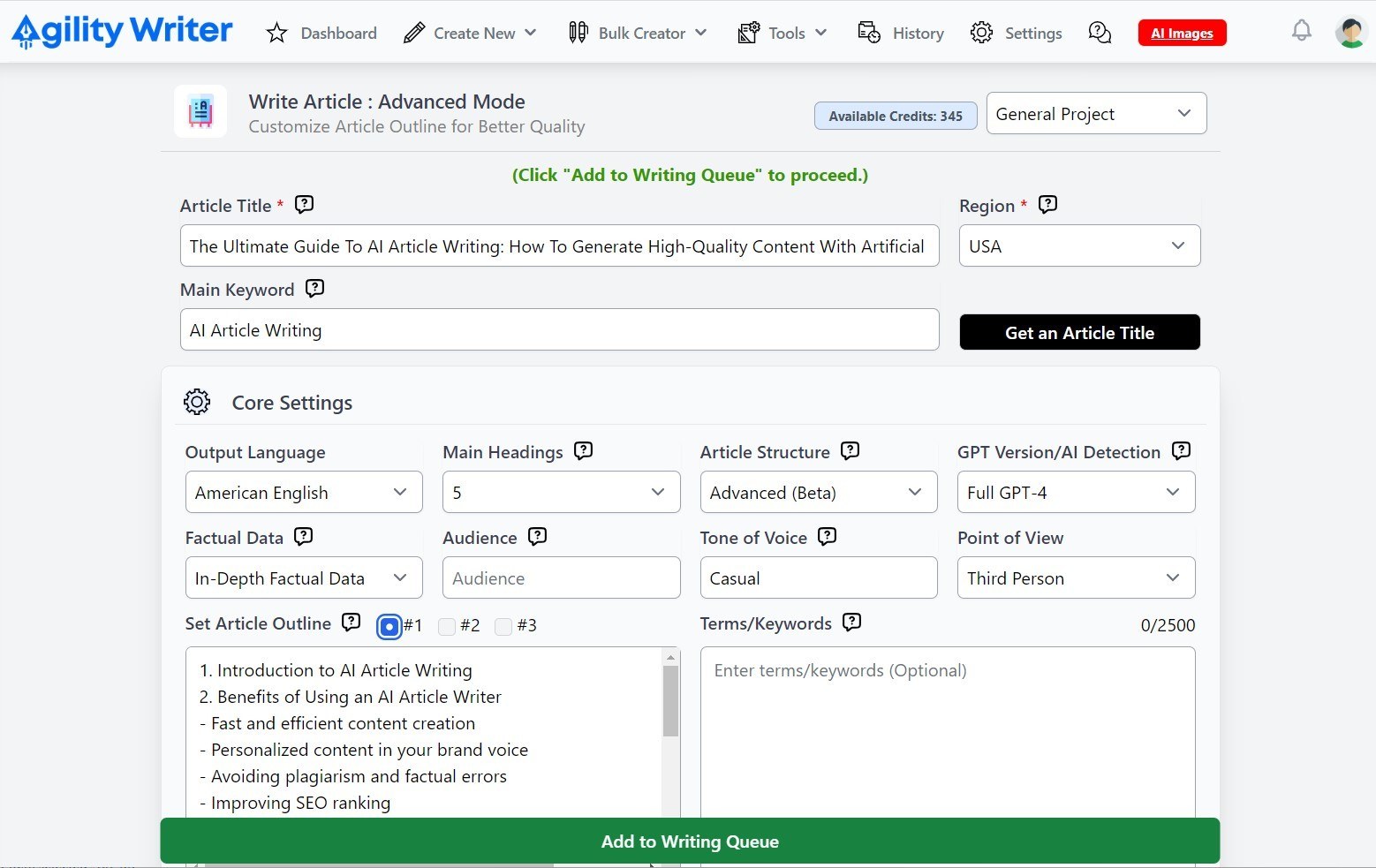
Agility Writer has the stronger documented research governance. Its writing controls let users enable real-time data and citations, add Custom Knowledge, and attach Fact Sheets. Bulk Mode exposes factual-data depth from Standard to In-Depth and optional in-text citations. G-Smart Research mode can add new sections with optional references. These controls help an editor distinguish the source-gathering phase from the writing phase.
Fact Sheets are especially valuable for recurring commercial content. An agency can create a research-backed profile for a brand, product, or service, review its citations, edit the facts, and attach the approved sheet to future articles. The current help documentation sets a 12,000-character maximum and recommends roughly 1,500 to 3,000 characters. That is enough to standardize pricing, positioning, features, audience, and differentiators without pasting the same brief into every job.
SEOWriting.ai still has useful research controls. Connect to Web can use real-time search results, news results, or supplied URLs. The URL Reference option accepts one to three links in the 1-Click Blog Post workflow, while date range, target country, language, and excluded URLs can constrain search. Its external-linking module allows automatic sources or up to 10 custom URLs, placement controls, exclusions, and dofollow or nofollow attributes.
The difference is evidence management. SEOWriting.ai documents web retrieval and link insertion, but its public materials do not show a Fact Sheet equivalent that stores a reviewed, citation-backed product dossier for reuse. Nor do they document research-depth tiers comparable to Agility Writer's Standard and In-Depth options. SEOWriting.ai can ground a draft, but Agility Writer gives an editorial team a clearer place to curate evidence before scaling it.
Neither workflow removes the need to open the cited pages. A link can be relevant while failing to support the sentence beside it. Pricing, legal, health, financial, and product-specification claims need line-by-line verification against current primary sources.
Topical Planning and Internal Linking
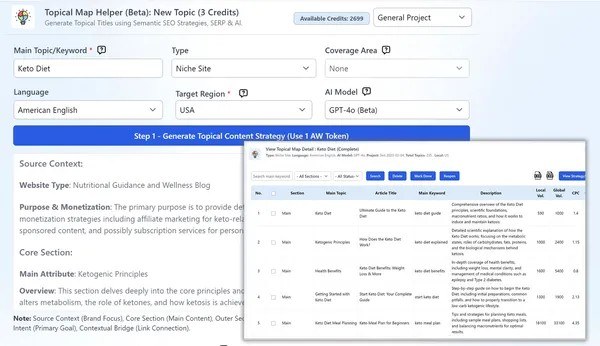
Agility Writer wins topical planning by a wide margin. Its Topical Map Helper accepts a site type, language, region, seed topic, and central entity. It produces core and supporting topics, intent labels, entity hints, supplementary questions, and a starter internal-link blueprint. Users can export the map or move an item into Advanced or Bulk Mode.
Agility Writer also states the right limitation: no tool creates a perfect topical map. Editors must merge duplicates, check the intended entity, separate overlapping intent, and prioritize pages according to business value. That caveat makes the feature more credible than an automatic-authority promise. Each map currently costs three credits and is limited to paid plans.
SEOWriting.ai publishes educational material about topical maps and its tools can generate titles, NLP terms, and outlines. Bulk Autocomplete can expand a keyword into additional jobs. Internal Linking can index a connected WordPress site, choose relevant existing pages, and insert a selected number of links at the top, bottom, or throughout an article. Contextual Enrichment can read linked pages and use their information in the new article.
Those are production aids, not a documented end-to-end cluster planner. If a strategist already has a keyword map in a spreadsheet, SEOWriting.ai can execute it efficiently. If the software must help design the cluster, find entity gaps, and propose a link architecture first, Agility Writer is the better fit.
For teams evaluating adjacent planning philosophies, our Agility Writer vs Surfer AI comparison explains the difference between a generation-led workflow and a content-optimization workflow.
Long-Form Workflows and Editorial Control
Agility Writer offers the more differentiated long-form stack. 1-Click Mode targets fast drafts up to 3,000 words. Advanced Mode raises the ceiling to 7,000 words and provides granular structure, research, knowledge, style, and section instructions. Optimize Mode targets SERP-aligned drafts up to 5,000 words. Dedicated Product Review, Roundup Review, and YouTube-to-Article paths use purpose-built structures rather than one universal template.
This mode separation matters because a $5,000 service page, a supporting blog post, and a 7,000-word pillar should not consume the same research or review budget. Agility Writer lets operators spend more credits and setup time where the page has greater revenue or ranking potential.
SEOWriting.ai simplifies the decision. A user can provide a main keyword, generate a title, choose language, article size, tone, point of view, AI model, images, NLP terms, and structure, then run the job. Current official materials say it can generate articles up to 5,000 words. Brand Voice can be created from pasted text, a URL, or an uploaded file and then applied in 1-Click or Bulk generation.
Its SEO Checker and Content Score add a post-draft optimization layer, while the AI Editor and Rewriter support revision. The lower learning curve is an advantage for solo publishers. The tradeoff is less visible separation between strategic research, reusable evidence, and article generation.
Agility Writer therefore fits teams that assign different quality tiers to content. SEOWriting.ai fits teams that value repeatable defaults and need most articles to follow one efficient operating model.
Bulk Generation and Programmatic SEO
Both tools are serious bulk platforms, but their batch logic differs.
Agility Writer supports up to 200 articles in a Bulk Advanced run and up to 50 in a Bulk 1-Click batch. Inputs can include titles, keywords, URLs, YouTube videos, CSV files, or location lists. For cluster generation, it can add up to 2,000 internal silo links per batch, use custom outlines and NeuronWriter query IDs by row, enrich entities, and add optional citations. Failed articles are reportedly flagged, credited back, and rerunnable without restarting the batch.
SEOWriting.ai accepts up to 100 article-generation tasks in its Bulk tool. Teams can paste rows, upload an Excel file, or use Autocomplete. Supported fields include main keyword, title, keywords, and outline. The current documentation permits one H1, up to 18 H2s, and up to four H3s under each H2 when importing an outline. It can apply Real-Time SERP analysis, Humanize Text, brand voice, media, internal and external links, Connect to Web, syndication, and WordPress publishing across the batch.
SEOWriting.ai markets the ability to create 1,000 or more articles in hours, but its documented input screen says up to 100 tasks at once. Buyers should interpret 1,000 as throughput across multiple batches, not a 1,000-row single-run allowance.
Winner for cluster-aware programmatic SEO: Agility Writer. Winner for inexpensive spreadsheet-to-CMS throughput: SEOWriting.ai. Before scaling either, generate a representative sample, define rejection criteria, and measure editor minutes per accepted page. The cheapest generation allowance is irrelevant if corrections overwhelm the savings.
Auto-Publishing and CMS Operations
Agility Writer's WordPress plugin can connect multiple sites, create posts or pages, select categories, tags, slug style, and status, save images into the Media Library, and populate metadata for Yoast, Rank Math, and AIOSEO. Scheduling supports one-time batches, ranges, or a fixed number per day, week, or month. It can also update existing posts. Zapier and a legacy WordPress REST route expand delivery options.
SEOWriting.ai's WordPress plugin can publish or schedule 1-Click and Bulk articles as posts, pages, or custom post types. Users can select parent pages, categories, tags, authors, URL format, featured images, and whether to send the meta description to the excerpt. Its documentation lists compatibility with Yoast, All in One SEO, Rank Math, The SEO Framework, and SEOPress for metadata, subject to WordPress and PHP requirements.
SEOWriting.ai also documents Shopify publishing with draft, published, and scheduled states. Its WordPress MCP Server connects Claude to a WordPress site for creating, rewriting, optimizing, and publishing content. That is a notable integration, but it should not be confused with a general article-generation REST API for embedding SEOWriting.ai in any custom application.
For risk control, default every automated destination to Draft, limit roles and tokens, and require an editorial approval step. Auto-publishing is operational leverage, not quality assurance.
Amazon and Affiliate Content

SEOWriting.ai is the stronger choice for Amazon-first affiliate operators. Its homepage documents a dedicated product-list workflow: enter an Amazon URL and ASIN, then generate a short name, specifications, features, pros, cons, and a review block. It also advertises more than 20 pretrained affiliate-content models for titles, descriptions, outlines, specifications, and related tasks.
Agility Writer offers Product Roundup and Single Product Review templates. Its current writing-mode page says roundups work with Amazon and non-Amazon products, with pros and cons, comparison tables, and calls to action. This makes it more flexible for SaaS, direct retailer, and mixed-program comparisons. Its research and Fact Sheet system may also be preferable when a review must reconcile official specifications across several vendors.
The buyer split is clear. Choose SEOWriting.ai to reduce the mechanical work of assembling Amazon products. Choose Agility Writer when affiliate content is research-led, crosses multiple programs, or sits inside a broader topical cluster.
Neither product can supply genuine first-hand product experience. Editors should add original photos, measurements, test conditions, ownership context, return-policy checks, and clearly supported comparisons where relevant. For a view of another affiliate-focused alternative, see Agility Writer vs Koala.
API and Integration Options
Agility Writer has the more conventional automation stack. Its native REST API supports API-key authentication, asynchronous article jobs, status tracking, and result retrieval. Official pricing limits native API access to Pro, Premium, and yearly plans. Zapier covers no-code workflows, while WordPress handles direct publishing.
SEOWriting.ai supports WordPress, Shopify, and WordPress MCP. It also lets users connect their own OpenAI or Anthropic API keys for eligible model usage. A customer-supplied model key is not the same as a public SEOWriting.ai generation API. Based on the official public sources reviewed, we found no equivalent general REST interface for creating SEOWriting.ai article jobs from a custom app.
That distinction determines the winner. A developer building an internal queue, SaaS feature, or custom approval pipeline should choose Agility Writer. A nontechnical team centered on WordPress or Shopify may find SEOWriting.ai's native publishing routes sufficient and cheaper.
Humanizer and AI-Detector Claims

There is no guarantee that either tool will bypass an AI detector, improve rankings, or meet Google's quality expectations. Detector scores do not measure usefulness, so every generated draft requires human review, fact checking, and original first-party value.
Both vendors make detector-oriented claims, and both require caution.
Agility Writer offers an Anti-AI Detection style and says its sentence structure and word distribution can lower flags from services such as Originality.ai and GPTZero. SEOWriting.ai describes Humanize Text as improving readability and bypassing AI detection. Its pricing table lists unlimited Humanizer access from the Professional tier upward, while current docs note that some readability and cleaning options are unavailable with certain models.
Treat these as vendor claims, not durable guarantees. AI detectors can change, disagree, and falsely label human writing. A passing score does not prove authorship, originality, factual accuracy, usefulness, or compliance with a publisher's policy.
A better production goal is recognizable editorial value: original examples, expert judgment, specific evidence, clean attribution, accurate entities, and prose revised for the intended reader. Humanization can improve cadence, but it cannot manufacture expertise.
Google Helpful Content and Scaled Content Risk
Google's current guidance on generative AI content does not ban AI-assisted writing. It says generative AI can help with research and structure, while generating many pages without adding value may violate the scaled content abuse policy. Google emphasizes accuracy, quality, relevance, Search Essentials, and spam-policy compliance.
Agility Writer's G-Smart Optimizer audits against criteria it maps to Google's quality and helpful-content guidance. That can be a useful editorial checklist, especially when comparing revisions or adding research. It is not a Google certification and cannot predict rankings or recovery. SEOWriting.ai's Real-Time SERP, Content Score, linking, and web research can improve a draft's baseline, but a score is not proof that a page adds information gain.
The largest risk in both products is the same: scaling before validating value. Prevent it with a documented workflow:
- Approve one search intent and audience problem per URL.
- Prefer official and primary sources, then verify every material claim.
- Add first-hand or expert information competitors do not provide.
- Remove repetitive sections created only to reach a word count.
- Review links, schema, images, metadata, and affiliate claims.
- Publish as Draft first and sample every batch for factual and structural errors.
- Track helpful outcomes such as conversions, qualified engagement, links, and support reduction, not just page count.
The safer tool is the one your team can govern consistently. Agility Writer provides more built-in governance controls. SEOWriting.ai can still be used responsibly, but low cost and high throughput make strict sampling and approval even more important.
Pricing Compared: Checked August 1, 2026
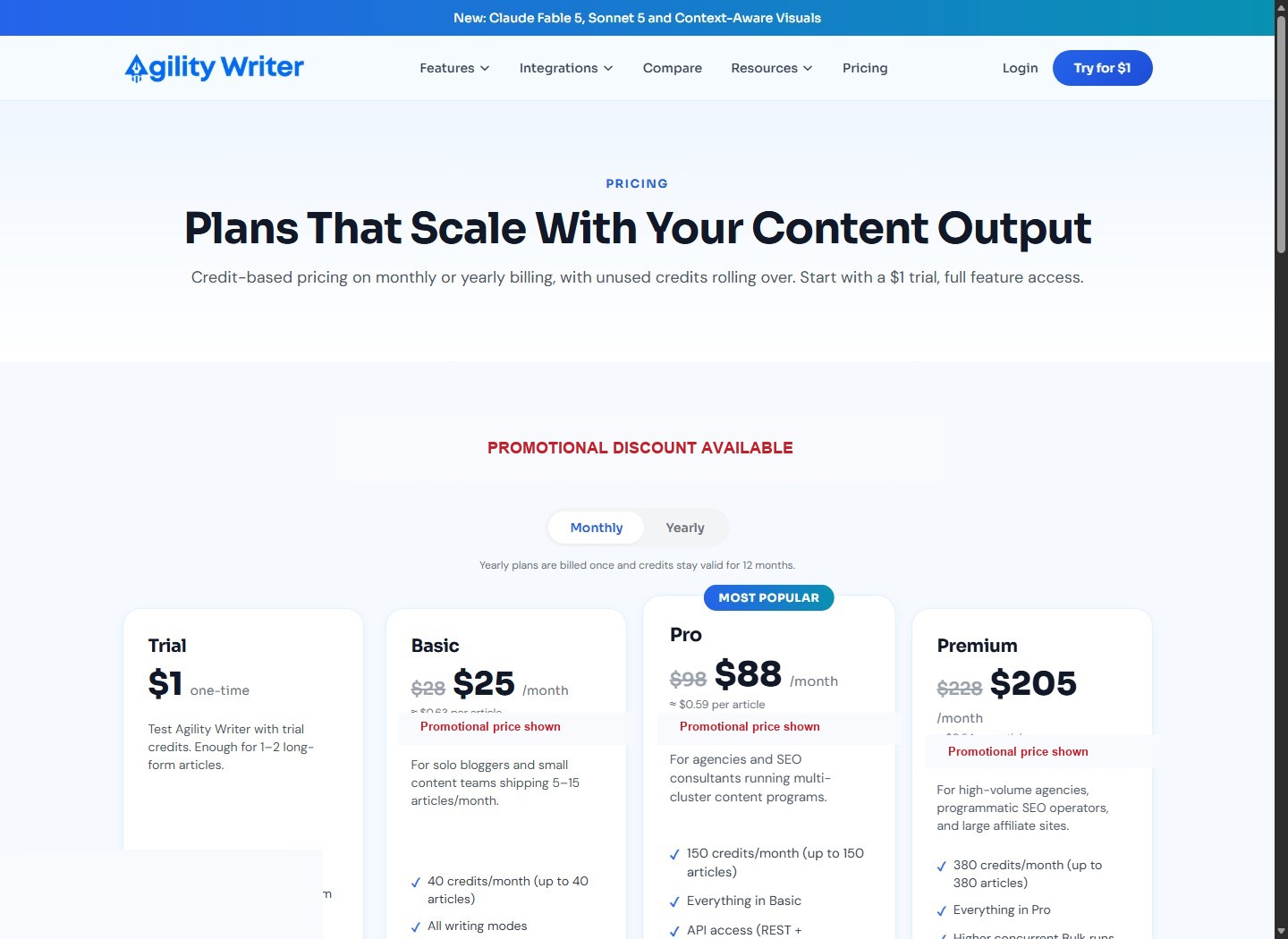
Agility Writer uses credits, and modes consume different amounts. The undiscounted monthly plans are Basic at $28 for 40 credits, Pro at $98 for 150 credits, and Premium at $228 for 380 credits. A one-time $1 trial includes five credits. Current yearly pricing is $240 for 300 credits, $980 for 1,400 credits, and $2,480 for 3,700 credits before the displayed 10% promo code. Credits roll over while an eligible subscription remains active.
Credit allowance is not identical to finished-article allowance. One-Click uses one credit, Advanced and Product Review use two, while Optimize and Roundup Review use three before possible premium-model costs. A Basic plan could therefore produce up to 40 one-credit articles, 20 Advanced articles, or roughly 13 three-credit articles.
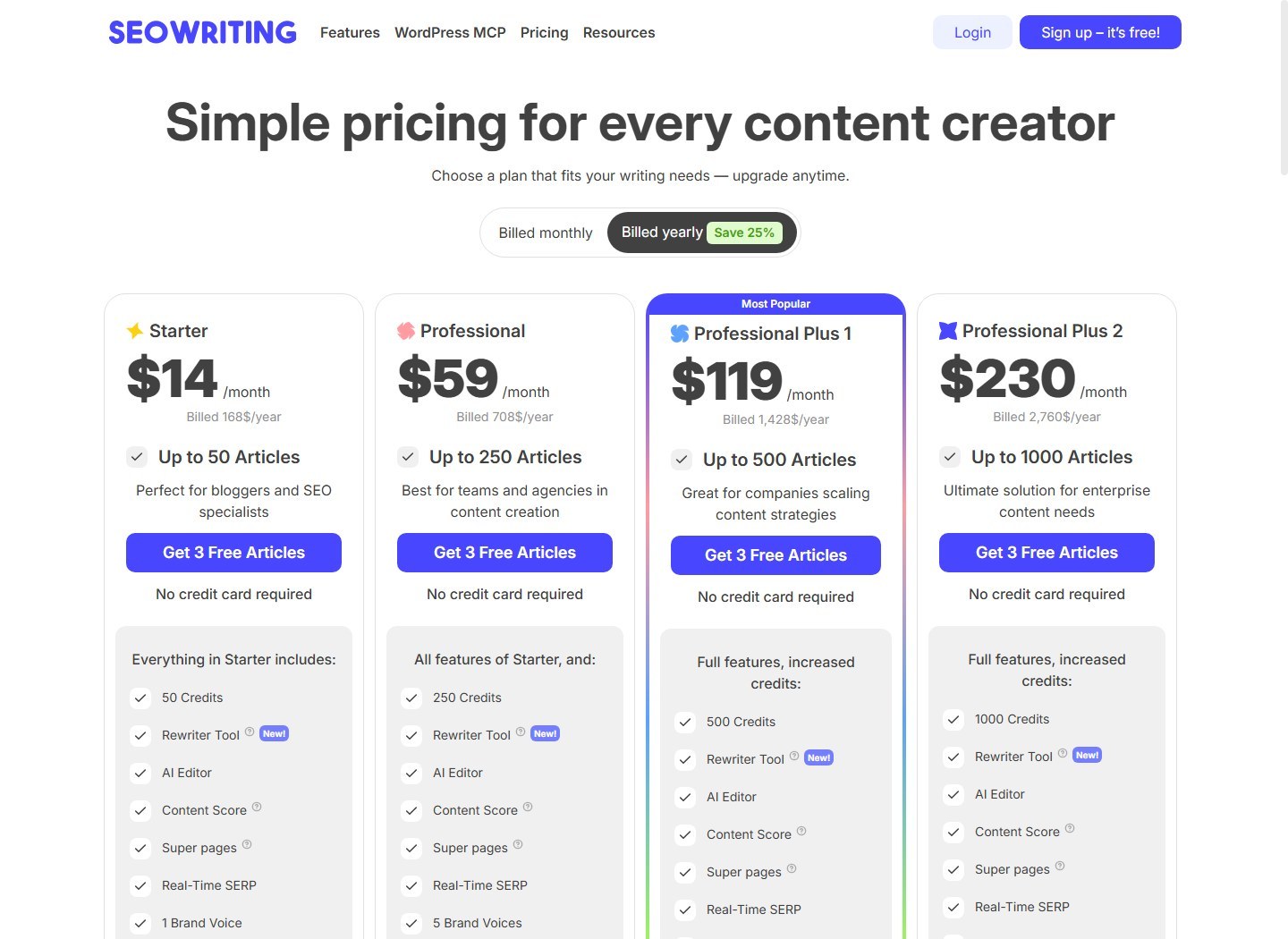
SEOWriting.ai's monthly pricing is Starter at $19 for up to 50 articles, Professional at $79 for up to 250, Professional Plus 1 at $159 for up to 500, and Professional Plus 2 at $307 for up to 1,000. Paid plans list unlimited words, but article or credit allowances still apply. The free plan currently offers three articles and 25,000 words without a credit card.
Annual billing advertises a 25% saving: $14 per month equivalent for Starter, $59 for Professional, $119 for Professional Plus 1, and $230 for Professional Plus 2, billed as $168, $708, $1,428, and $2,760 per year respectively.
| Pricing question | Agility Writer | SEOWriting.ai |
|---|---|---|
| Lowest paid monthly entry | $28 | $19 |
| Low-cost test | $1, 5 credits | 3 free articles |
| Allowance model | Credits vary by mode | Article credits by plan |
| Unused capacity | Credits roll over while subscription remains active | No rollover promise found on the current public pricing page |
| Native REST API | Pro, Premium, and yearly plans | No comparable public generation API documented |
| Best economic fit | Variable-depth editorial production | High article volume at predictable plan limits |
Pricing can change without notice, and taxes, promotions, overages, model choices, image credits, and failed generations can affect effective cost. Calculate cost per approved article, not cost per generated article.
Strengths and Weaknesses
Agility Writer strengths
- Strong research-depth, citation, Custom Knowledge, and reusable Fact Sheet controls
- Dedicated topical mapping with entity, intent, and starter internal-link planning
- Clear long-form modes for fast posts, optimized pages, pillars, reviews, and roundups
- Cluster-aware bulk generation with silo links and up to 200 Advanced jobs
- Native REST API, Zapier, multi-site WordPress scheduling, and post updates
- More suitable for agencies that need reviewable workflow stages
Agility Writer weaknesses
- Higher entry price than SEOWriting.ai
- Credit consumption varies by mode, so headline article counts can overstate practical output
- Advanced features create a larger setup and training burden
- Topical maps and AI audits still require expert review
- Detector and helpful-content claims are not ranking guarantees
SEOWriting.ai strengths
- Lower starting price and generous listed article allowances
- Fast one-click and 100-task bulk workflows
- Purpose-built Amazon URL and ASIN product assembly
- WordPress, Shopify, and Claude-to-WordPress MCP options
- Real-Time SERP, news, reference URL, link, brand voice, and content-score controls
- Accessible free plan with no payment details required
SEOWriting.ai weaknesses
- No dedicated topical-map workspace comparable to Agility Writer's documented system
- Less robust reusable evidence governance in current public documentation
- No equivalent public native article-generation REST API found
- Some advanced linking and unlimited Humanizer access require higher tiers
- High output allowances increase the temptation to publish insufficiently differentiated pages
Which Tool Should Each Buyer Choose?
SEO professionals and in-house content strategists
Winner: Agility Writer. The Topical Map Helper, GSC-oriented workflow, research settings, citations, and differentiated modes support planning and optimization, not only drafting. It is the better fit when one strategist owns a cluster from architecture through refresh.
Content marketers and solo bloggers
Winner: SEOWriting.ai for budget, Agility Writer for editorial depth. A solo publisher with a validated calendar can get strong economic value from SEOWriting.ai Starter. A subject-matter publisher managing complex claims will benefit more from Agility Writer's Fact Sheets and research controls.
SEO and content agencies
Winner: Agility Writer. Multi-client teams gain more from reusable fact layers, mode-based quality tiers, native API access, multi-site WordPress support, and cluster-level bulk workflows. The extra subscription cost can be justified if it reduces senior-editor hours.
Amazon affiliate operators
Winner: SEOWriting.ai. URL and ASIN ingestion, product blocks, affiliate models, and low-cost bulk production directly address the job. Add manual product verification and original experience before publishing.
Multi-program affiliate publishers
Winner: Agility Writer. Its Amazon and non-Amazon roundup support, citations, Fact Sheets, and deeper comparison workflow are better suited to mixed SaaS, retailer, and direct affiliate programs.
Programmatic SEO teams
Winner: Agility Writer when clusters and custom pipelines matter; SEOWriting.ai when a clean spreadsheet and WordPress are enough. Developers should value Agility Writer's asynchronous REST API. Operators with a fixed template may prefer SEOWriting.ai's lower cost.
Ecommerce teams
Winner: SEOWriting.ai for Shopify and Amazon convenience. Agility Writer remains competitive for researched buying guides and has a bulk product-description tool, but SEOWriting.ai presents the more direct commerce publishing route.
Final Recommendation: Buy the Workflow, Not the Article Quota
Agility Writer is our overall winner because its research, citations, Fact Sheets, topical planning, long-form controls, bulk linking, and API form a more governable SEO content system. It is the stronger investment for agencies, strategists, and publishers whose bottleneck is maintaining evidence and editorial consistency across a cluster.
SEOWriting.ai is the smarter value purchase when the plan already exists and the job is execution. It offers more listed article capacity per dollar, strong WordPress automation, Shopify support, and a better Amazon product workflow. Teams that choose it should invest part of the subscription savings in source verification, differentiation, and batch QA.
The ScaleWitAI Agility Writer affiliate route is preserved at check Agility Writer availability, but it returned 404 when checked August 1, 2026. This package must remain Draft until that redirect works. No alternate affiliate route should replace it.
FAQ
Is Agility Writer better than SEOWriting.ai?
Agility Writer is better for research-led SEO teams because it combines citations, Fact Sheets, topical mapping, differentiated long-form modes, cluster linking, and a native REST API. SEOWriting.ai is better for low-cost volume, Amazon affiliate assembly, and straightforward WordPress or Shopify publishing.
Which tool is cheaper?
SEOWriting.ai is cheaper at entry level. Its Starter plan is $19 monthly for up to 50 articles, compared with Agility Writer Basic at $28 monthly for 40 credits. Agility Writer's actual article count depends on the mode because modes consume one to three credits before some optional costs.
Which tool has better research and citations?
Agility Writer has stronger documented controls. It offers real-time research, Standard and In-Depth depth settings, optional citations, Custom Knowledge, reusable Fact Sheets, and a research mode in G-Smart Optimizer. SEOWriting.ai supports real-time web and news search, one to three reference URLs in 1-Click, and configurable external links.
Which is better for bulk content?
Agility Writer is better for cluster-aware bulk production, with up to 200 Bulk Advanced jobs and automated silo links. SEOWriting.ai is better for inexpensive spreadsheet-driven output, with up to 100 tasks per batch and direct WordPress scheduling.
Which is better for Amazon affiliate articles?
SEOWriting.ai is the more direct Amazon tool. It can accept product URLs and ASINs and create structured product blocks. Agility Writer supports Amazon and non-Amazon roundups, making it stronger for broader multi-program comparison content.
Does either AI writer guarantee Google rankings?
No. Neither research controls, content scores, detector settings, nor a Google-guideline audit can guarantee rankings. Google requires useful, accurate, relevant content and warns that scaled AI pages without added value can violate its spam policies.
Can either tool guarantee that content passes AI detectors?
No durable guarantee is credible. Both vendors offer detector-oriented humanization or style controls, but detectors change and can produce false positives. This comparison did not independently test detector outcomes.
Does SEOWriting.ai have an API?
SEOWriting.ai documents WordPress and Shopify integrations, a WordPress MCP Server, and the ability to connect customer OpenAI or Anthropic keys. We did not find a current official public generation REST API equivalent to Agility Writer's asynchronous article-job API.
Should generated articles be auto-published?
Use Draft status by default. Review factual claims, sources, originality, search intent, images, metadata, links, and affiliate statements before publication. Auto-publishing should automate delivery to an editorial queue, not bypass editorial approval.
