Your Coupon Code
The affiliate offer has opened in a new tab. Copy this code and apply it at checkout.

$10 Content Harmony Trial — 10 Workflow Credits
Pay $10 for 10 Content Workflow credits. Full product access, no automatic billing, no time limit, and trial credits valid for one year. No code is required. Checked July 31, 2026. Confirm the offer on the destination page because terms can change.
More Than One Month Free on Annual Plans
Annual billing includes more than one month free. Content Harmony issues the full year's credits upfront. This is plan pricing, not a public coupon code. Checked July 31, 2026. Verify the exact annual total, taxes, credit term, and renewal price before payment.
Content Harmony does not currently publish a general coupon code on its official pricing or sign-up pages. The verified entry offer is 10 Content Workflow credits for $10, with full product access, no automatic billing, no time limit, and credits valid for one year. Annual subscriptions also include more than one month free, but Content Harmony does not advertise a universal percentage code for that saving.
| At a glance | Verified details |
|---|---|
| Public coupon code | None verified on official pages |
| Trial offer | $10 for 10 Content Workflow credits |
| Trial credit validity | One year |
| Automatic renewal after trial | No |
| Standard pricing | From $50/month for five workflows |
| Annual saving | More than one month free |
| Code required | No code published for the trial or annual billing |
| Last checked | July 31, 2026 |
This guide separates first-party offers from unverified coupon-directory claims, explains how to claim the trial, calculates potential annual savings from the displayed monthly equivalents, and shows what to verify before paying. For a complete feature and workflow evaluation, read our Content Harmony review.
Quick Answer: Is There a Working Content Harmony Coupon?
No general public Content Harmony coupon code is verified on the provider's current pricing or sign-up pages. The strongest official deal is the $10 trial, which provides 10 Content Workflow credits and does not convert automatically into a subscription.
Content Harmony also advertises annual subscriptions with more than one month free. The pricing interface shows lower approximate monthly equivalents for annual billing, but those figures should be treated as plan pricing rather than a promo code. No code is required based on the official wording.
Third-party coupon directories list codes such as WCA25OFF and 10OFF, but ScaleWitAI could not confirm those codes through Content Harmony's current first-party pages. A directory's “verified” badge, recent-use counter, or percentage claim is not proof that checkout will reduce the amount due.
Which Content Harmony Offers Are Verified Now?
Two offers have current first-party support: the $10 trial and annual-plan savings. Neither requires a public coupon code.
$10 for 10 Content Workflow Credits
Content Harmony's sign-up page states that buyers can pay $10 for their first 10 Content Workflow credits. The credits remain valid for an entire year, provide full access to the product, and have no automatic billing or time limit.
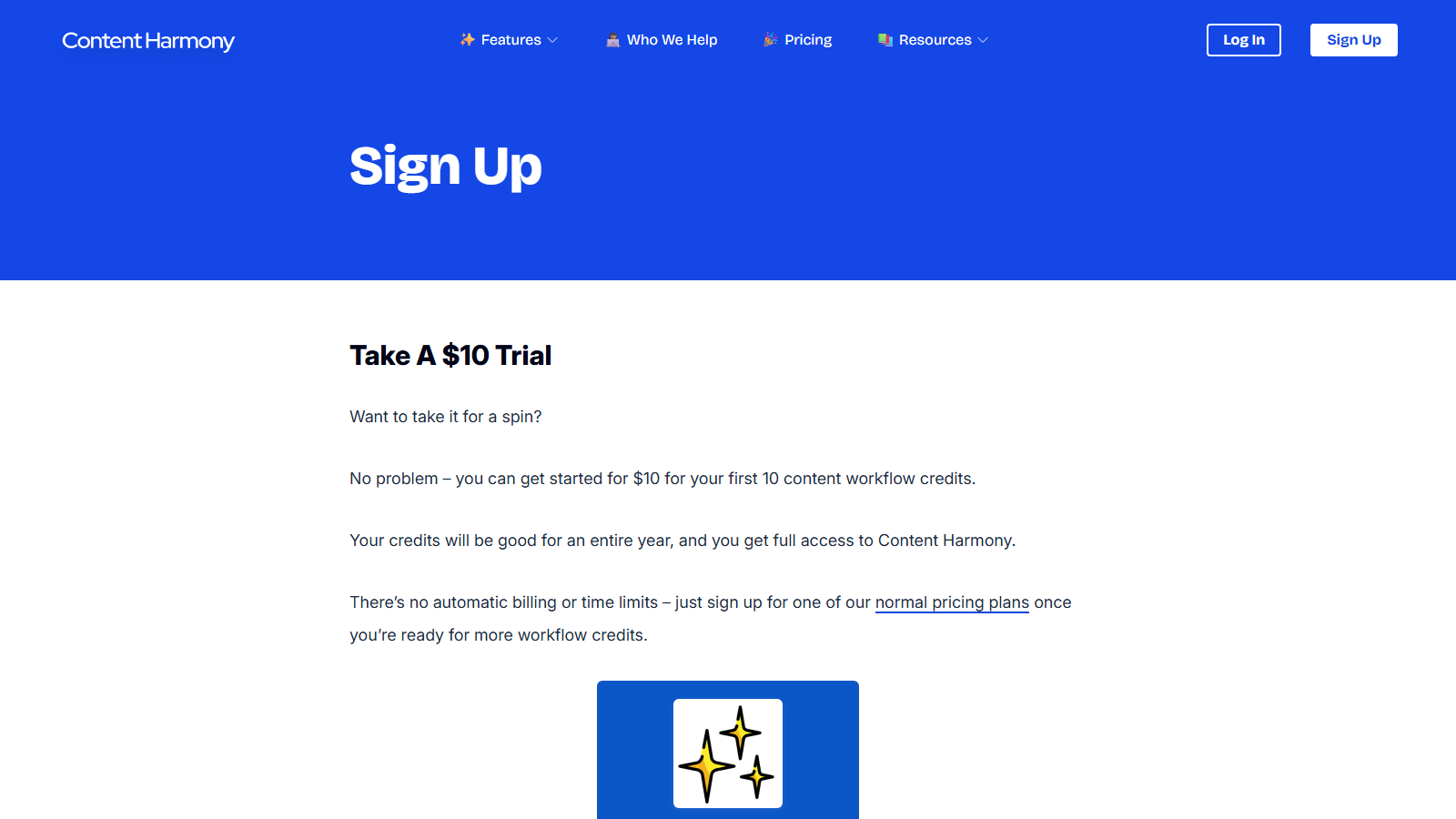
The offer is useful because one Content Workflow includes a Keyword Report, customizable Content Brief, and Content Grader for one target page. Ten credits let a team test more than a single demo query and compare the workflow across content types.
The trial should not be described as free. It costs $10. It should also not be described as a subscription discount because buyers do not have to activate a recurring plan after using the credits.
More Than One Month Free With Annual Billing
Content Harmony's pricing page states that annual subscribers receive more than one month free and receive the full year's workflow credits upfront on day one. This is an annual billing benefit, not a coupon code.
The public pricing interface displays approximate annual monthly equivalents beside standard monthly prices. Those displayed figures allow a buyer to estimate potential savings, but the final annual invoice controls the actual amount charged. Taxes, pricing changes, custom terms, and enterprise agreements can alter the total.
Rollover Value for Monthly Credits
Monthly subscription credits remain valid for 90 days rather than disappearing at the end of each billing month. This is not a discount, but it can reduce waste for teams with uneven publishing schedules.
Completed workflows remain in the account, so users can continue editing their Content Brief and Content Grader after the workflow is created. Annual subscribers receive the year's credits upfront, which offers more timing flexibility but also requires a larger commitment.
How to Claim the Content Harmony $10 Trial
Use the official sign-up path and verify each term before entering payment information.
Step 1: Open the Official Content Harmony Offer
Start from the Content Harmony trial offer. The ScaleWitAI Pretty Link should redirect to the provider's current signup or landing page when the production site is available.
Check that the destination domain is contentharmony.com before entering payment details. Do not continue if a coupon page redirects to an unrelated product, asks for software installation, or requests account credentials outside the official provider flow.
Step 2: Confirm the Trial Terms
The official page should state:
- $10 due for the trial;
- 10 Content Workflow credits;
- full product access;
- credits valid for one year;
- no automatic billing;
- no time limit requiring immediate use;
- upgrade only when more workflow credits are needed.
Save a screenshot or PDF of the offer if the terms matter to procurement or expense approval. SaaS pricing can change, and a dated copy establishes what was visible when you purchased.
Step 3: Use Representative Queries
Do not spend all 10 credits on variations of one easy keyword. Test the workflow on assignments that represent your actual production:
- a new informational article;
- a commercial comparison;
- an existing page that needs a refresh;
- a mixed-intent SERP;
- a query requiring authoritative sources;
- a topic where visuals or video matter;
- a client brief with strict brand requirements;
- a page requiring internal links;
- a freelancer handoff;
- a final draft for Content Grader review.
This sample reveals whether Content Harmony saves strategist time, produces briefs writers understand, and finds meaningful coverage gaps. A trial is inexpensive only if it answers the buying question.
Step 4: Measure Workflow Value
Record the time required to research, assemble, explain, and revise each brief. Also track:
- writer questions after handoff;
- missing requirements found during editing;
- number of revision rounds;
- time spent copying research between tools;
- grader suggestions accepted or rejected;
- pages that never reach production;
- cost per completed brief.
Content Harmony says its software can reduce a manual one-to-two-hour briefing process to roughly 10–20 minutes. Treat that as a vendor claim to test against your own workflow, not a guaranteed result.
Step 5: Upgrade Only When the Economics Work
After several representative workflows, compare time saved and rework avoided with the recurring plan cost. The Standard 5 plan starts at $50 per month. An occasional publisher may be better served by using the trial carefully and delaying a subscription until output becomes predictable.
How Much Does Content Harmony Cost After the Trial?
Content Harmony prices subscriptions by monthly Content Workflow volume while including unlimited users and projects.
| Plan | Monthly price | Monthly workflows | Approximate annual monthly equivalent shown | Approximate price per monthly-plan workflow |
|---|---|---|---|---|
| Standard 5 | $50 | 5 | ~$42 | $10.00 |
| Standard 12 | $99 | 12 | ~$89 | $8.25 |
| Standard 25 | $199 | 25 | ~$179 | $7.96 |
| Standard 50 | $299 | 50 | ~$269 | $5.98 |
| Standard 100 | $599 | 100 | ~$539 | $5.99 |
| Standard 150 | $799 | 150 | ~$719 | $5.33 |
| Enterprise | From $1,000/month | 200+ | Custom | Confirm by quote |
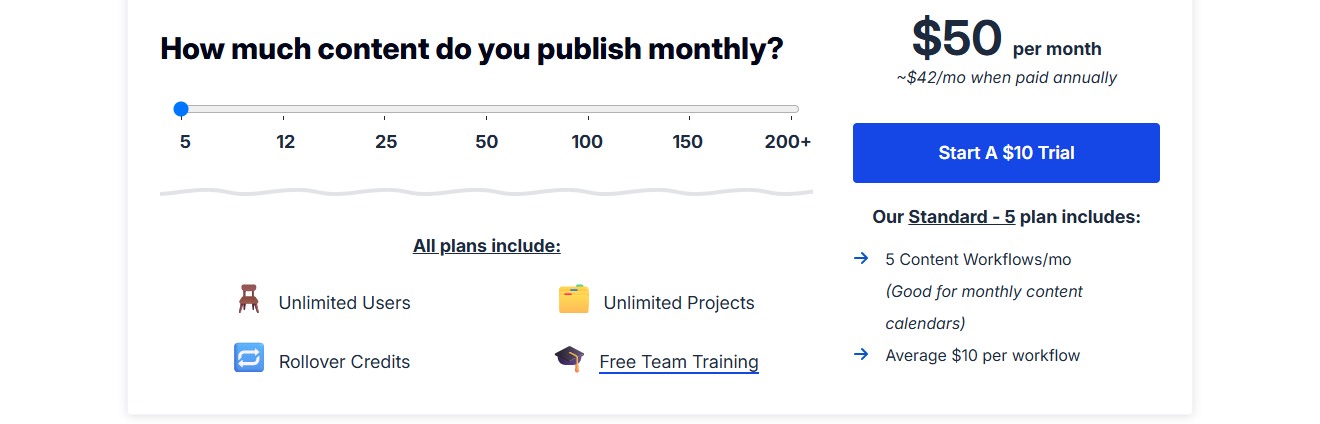
The per-workflow figure above divides the public monthly price by the monthly allowance. It does not include taxes, unused credits, staff time, or annual-plan savings. Agencies should forecast attempted reports, not only published pages, because exploratory and abandoned workflows still consume capacity.
Every standard plan includes unlimited users, unlimited projects, rollover credits, and team training according to the official product page. This can make Content Harmony economical for a distributed agency even when a lower-priced competitor restricts seats.
How Much Can Annual Billing Save?
The following estimates use the approximate annual monthly equivalents displayed by Content Harmony. They are ScaleWitAI calculations, not official percentage coupons or binding invoices.
| Plan | Twelve monthly payments | Estimated annual total from displayed equivalent | Calculated saving | Approximate reduction |
|---|---|---|---|---|
| Standard 5 | $600 | $504 | $96 | 16.0% |
| Standard 12 | $1,188 | $1,068 | $120 | 10.1% |
| Standard 25 | $2,388 | $2,148 | $240 | 10.1% |
| Standard 50 | $3,588 | $3,228 | $360 | 10.0% |
| Standard 100 | $7,188 | $6,468 | $720 | 10.0% |
| Standard 150 | $9,588 | $8,628 | $960 | 10.0% |
The calculation multiplies each monthly price and displayed annual equivalent by 12, then subtracts the estimated annual total from 12 monthly payments. Because the annual equivalents are displayed with approximation symbols, confirm the exact annual charge at checkout.
Standard 5 appears to produce a larger percentage reduction because the displayed annual equivalent rounds from $50 to about $42. Do not advertise that estimate as an official “16% coupon.” Content Harmony's first-party promise is more than one month free, not a fixed percentage across every plan.
Annual billing is most defensible when the team has tested the workflow, produces content consistently, and expects to use the credits throughout the year. Monthly billing can reduce commitment risk when output depends on seasonal campaigns, uncertain clients, or a content program that is still being validated.
Monthly vs Annual Content Harmony Billing
Choose the billing term based on utilization and flexibility, not the largest displayed saving.
| Decision factor | Monthly billing | Annual billing |
|---|---|---|
| Upfront commitment | Lower | Higher |
| Published benefit | No annual saving | More than one month free |
| Credit delivery | Issued monthly | Full year issued upfront |
| Credit timing | Valid for 90 days | Use annual allocation during the subscription year |
| Best for | Uncertain or changing output | Stable recurring production |
| Budget risk | Higher effective monthly cost | More cash committed before long-term validation |
| Renewal check | Monthly plan can be changed sooner | Confirm annual renewal price and date |
An agency with a stable client roster may benefit from annual credits upfront because production varies between months. A freelancer publishing a few pages may prefer the $10 trial or Standard 5 monthly plan until recurring demand is proven.
Unlimited users do not eliminate utilization risk. A team can invite many contributors and still waste credits if strategists run reports before approving topics, generate multiple variants without a decision rule, or abandon briefs after client priorities change.
Are Third-Party Content Harmony Coupon Codes Legitimate?
Third-party codes are unverified until the official checkout applies a real reduction. Current search results include claims of 10%, 25%, 30%, and even 70% discounts. Content Harmony's official pricing and sign-up pages do not confirm those general codes.
Use this evidence hierarchy:
- a current promotion on
contentharmony.com; - a Content Harmony email or account-specific quote;
- an authorized marketplace with explicit eligibility and dates;
- a third-party coupon directory only as a lead to test.
Reject a coupon claim when it does not identify the eligible plan, new-versus-existing-customer status, billing term, expiration, geographic restrictions, or comparison price. A countdown timer or reported success rate can be generated by the coupon site and does not prove vendor authorization.
A real saving appears in the final total before payment. A browser extension saying “code applied” without lowering the amount due is not evidence of a discount.
What Should You Do If a Content Harmony Coupon Code Fails?
A failed code usually means the promotion is expired, restricted, mistyped, account-specific, or never authorized by Content Harmony.
Follow this troubleshooting sequence:
- confirm the code came from Content Harmony or an authorized promotion;
- check capitalization and remove accidental spaces;
- verify the eligible plan and billing term;
- check whether the offer applies only to new customers;
- review country, currency, and expiration restrictions;
- remove conflicting promotions if stacking is not allowed;
- compare the final charge before and after applying the code;
- contact Content Harmony with the promotion source and a screenshot that excludes payment details.
Do not send a coupon directory your password, card number, API credentials, or client data. Billing questions should go through Content Harmony's official support or sales channel.
If no code works, the $10 trial remains the lowest verified way to test the full workflow. Annual pricing is the verified recurring-plan saving once the tool has proven useful.
Does Content Harmony Offer Agency, Nonprofit, Student, or Lifetime Discounts?
Content Harmony's current public pricing pages do not advertise a general student coupon, nonprofit discount, lifetime deal, public agency code, or seasonal discount calendar.
Agencies already benefit from unlimited users and projects on standard plans. High-volume buyers can request Enterprise pricing, procurement support, invoicing, and custom datasets. Search-intent-only plans are also available for large-scale analysis starting around 5,000 keywords per month.
A custom quote is not a public coupon. If Content Harmony gives your organization negotiated terms, document the eligible accounts, duration, renewal price, credit volume, and confidentiality requirements before describing the offer externally.
Treat lifetime-deal claims with particular caution. Content Harmony's ongoing costs include SERP data collection and analysis for each workflow, which makes an unsupported “lifetime unlimited” promise economically different from the provider's current credit-based model.
What Do Content Harmony Credits Include?
One Content Workflow combines three connected components for one target page:
- Keyword Report: search intent, topics, competitor outlines, questions, authoritative sources, visuals, video, difficulty, and related research modules;
- Content Brief: a customizable handoff built from selected research plus brand and editorial instructions;
- Content Grader: topic-coverage guidance for a draft or existing page.
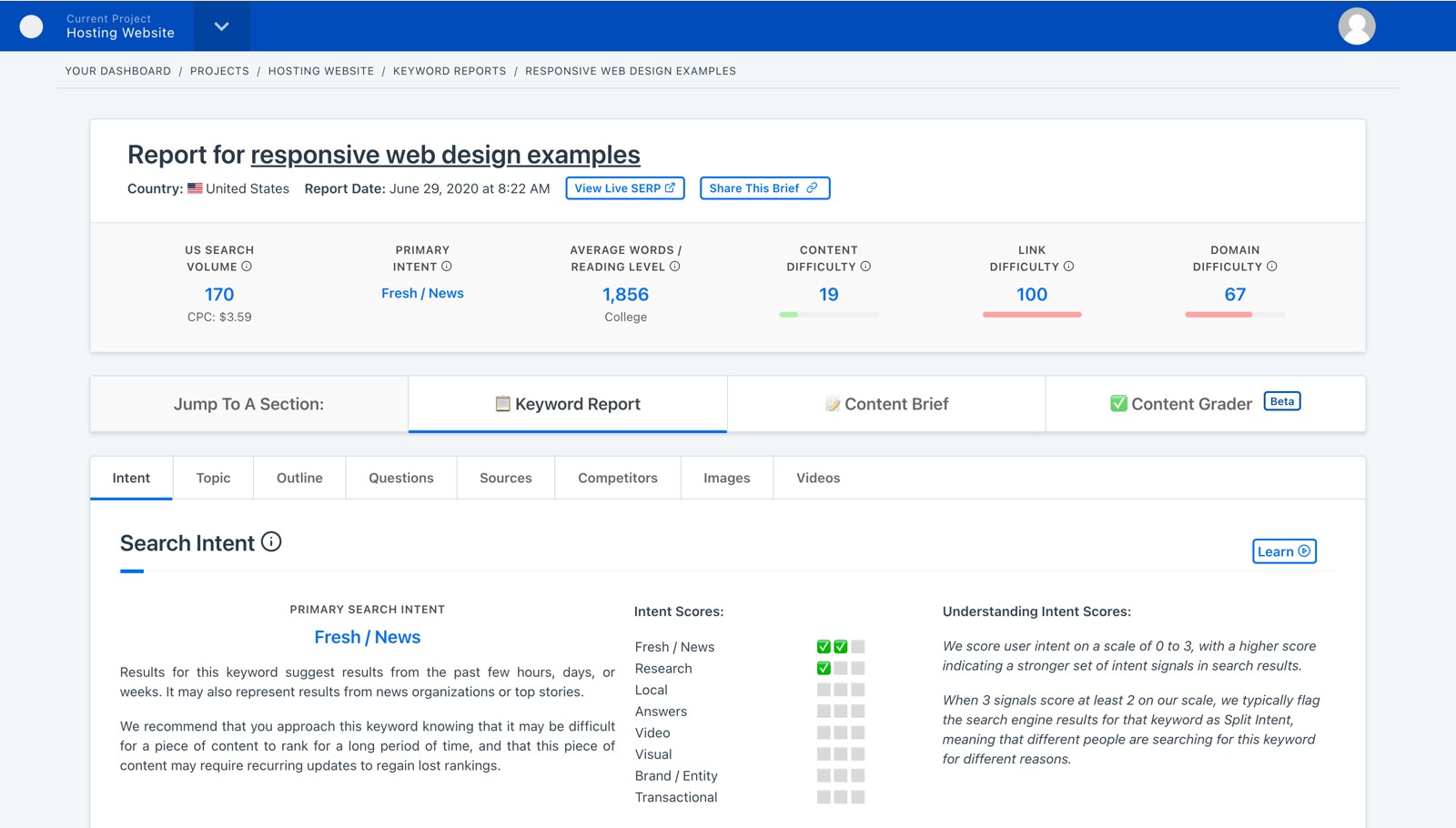
This scope matters when comparing a coupon or price. A lower-cost content score is not equivalent if your team still purchases separate research, brief, collaboration, and training tools. The opposite is also true: Content Harmony can be unnecessary when the only need is a simple editor score.
Completed workflows remain available after creation. Monthly credits are valid for 90 days, while the $10 trial credits remain valid for one year according to the sign-up page.
What Should You Verify Before Buying an Annual Plan?
Use a procurement checklist instead of treating the annual saving as the only decision factor.
- Exact annual total: confirm the amount due today rather than multiplying rounded monthly equivalents.
- Renewal price: ask whether renewal keeps the same pricing or uses the then-current rate.
- Credit allocation: verify when annual credits are issued and when they expire.
- Plan capacity: count attempted workflows, refreshes, variants, and abandoned reports.
- Data access: confirm what remains available after cancellation or downgrade.
- User governance: test project separation, guest permissions, and client access.
- API requirements: confirm plan eligibility, endpoints, limits, and implementation support.
- Refund terms: obtain written clarification before committing because the public Terms do not state a broad satisfaction guarantee.
- Cancellation process: record the deadline and responsible subscription owner.
- Taxes and currency: verify the final invoice for your US entity or billing location.
Content Harmony's Terms allow the company to change offerings and prices and to correct errors or inaccuracies. That makes checkout verification and saved purchase records more reliable than a third-party coupon page.
Is the Content Harmony Trial Worth Claiming?
The $10 trial is worth considering when your team builds recurring SEO briefs and wants a low-risk test across multiple assignments. Ten credits are enough to evaluate different intents, writers, and content types without accepting a monthly subscription.
The trial is less useful when you have not selected target queries, publish rarely, or need broad keyword discovery, technical audits, rank tracking, or automatic long-form publishing. Content Harmony starts after a topic is chosen and focuses on research, briefing, and grading.
Use the trial if you can measure time saved, writer questions, revision rounds, and brief consistency. Skip annual billing until those gains repeat. If the product boundary does not match your operation, compare the closest Content Harmony alternatives before committing.
When the fit is clear, claim the Content Harmony $10 trial and verify the official terms on the destination page before payment.
Frequently Asked Questions
What is the current Content Harmony coupon code?
No general public coupon code is verified on Content Harmony's current official pricing or sign-up pages. The verified offers are $10 for 10 trial workflows and more than one month free with annual billing, neither of which publishes a required code.
Is the Content Harmony trial free?
No. The trial costs $10 and includes 10 Content Workflow credits. The credits are valid for one year, provide full product access, and do not trigger automatic subscription billing.
Does Content Harmony require a credit card for the trial?
The official sign-up page describes a paid $10 trial, so buyers should expect to provide a payment method to complete the purchase. The page explicitly states that there is no automatic billing after the trial.
How long do Content Harmony trial credits last?
Trial credits remain valid for an entire year according to the official sign-up page. Monthly subscription credits follow a different rule and remain valid for 90 days.
How much does Content Harmony cost after the trial?
Standard plans start at $50 per month for five workflows. Other public tiers include $99 for 12, $199 for 25, $299 for 50, $599 for 100, and $799 for 150 monthly workflows. Enterprise plans start from $1,000 per month.
Does Content Harmony offer an annual discount?
Yes. The official pricing page says annual plans include more than one month free and provide the full year's credits upfront. The exact annual charge should be confirmed at checkout because displayed monthly equivalents are approximate.
Can Content Harmony coupon codes be stacked?
No public stacking policy is stated on the official pages reviewed. Do not assume that a third-party code can be combined with the $10 trial, annual pricing, or a custom quote unless Content Harmony confirms it.
Does Content Harmony offer refunds?
The public Terms do not present a broad satisfaction-based refund guarantee. Confirm refund, cancellation, unused-credit, and renewal terms in writing before purchasing an annual or enterprise plan.
Is there a Content Harmony lifetime deal?
No current lifetime deal is advertised on Content Harmony's official pricing or sign-up pages. Treat third-party lifetime claims as unverified unless the provider confirms the offer directly.