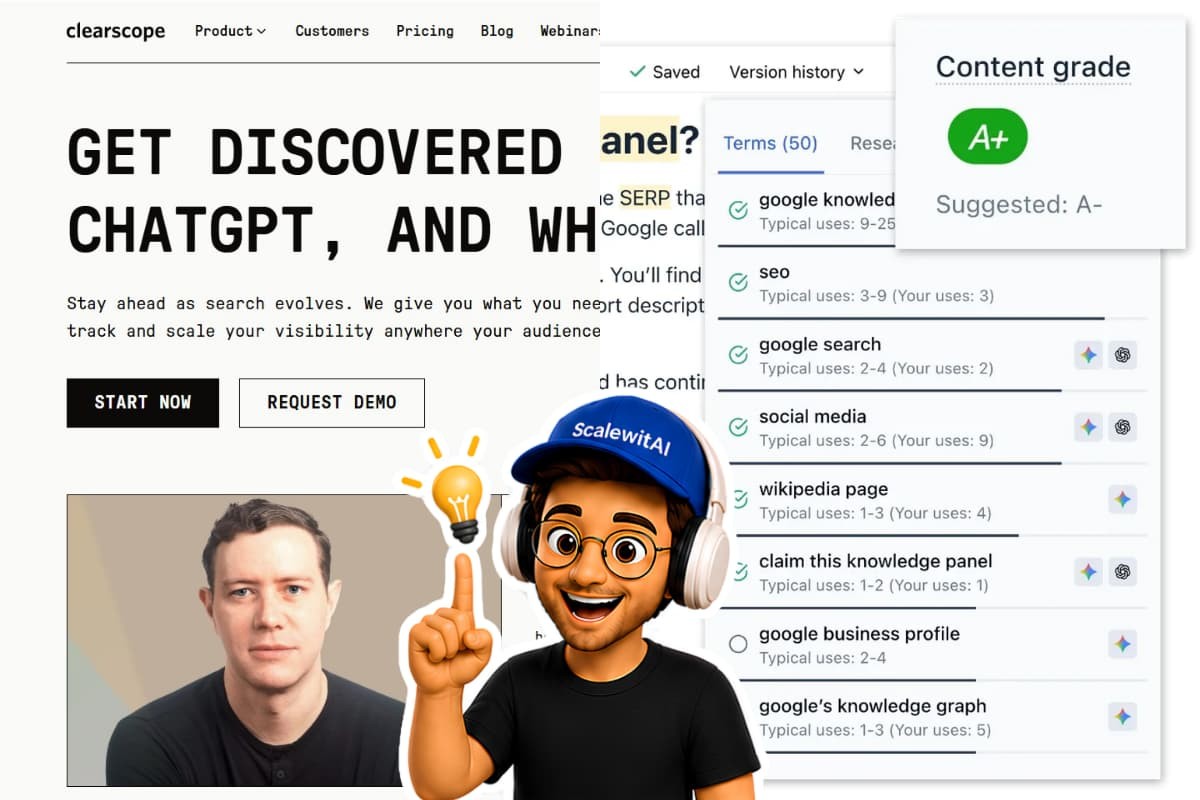
Clearscope and Writesonic both support Google and AI-search visibility, but they solve different operating problems. Clearscope gives content teams a focused research, grading, optimization, and monitoring system with unlimited users and projects. Writesonic is a broader AI Search Growth platform that combines visibility tracking, AI article production, site audits, prioritized actions, and agentic execution.
| At-a-glance | Clearscope | Writesonic |
|---|---|---|
| Best for | Editorial teams that want consistent optimization and simple quality control | Growth teams that want AI content production plus SEO and GEO execution |
| Starting public price | Essentials at $129/month | Starter at $79/month, billed annually |
| Evaluation path | 14-day free trial | Start free with no credit card stated on pricing page |
| Core workflow | Discover, write, grade, optimize, monitor, and track prompts | Track, prioritize, act, measure, and repeat |
| Google optimization | SERP-informed term guidance, intent analysis, grading, and page monitoring | Content strategy, AI articles, site audits, and SEO agents |
| AI-search layer | Prompt tracking, brand mentions, citations, and query fan-out for ChatGPT and Gemini | Visibility tracking on ChatGPT, Gemini, and Google AI Overviews on lower tiers; broader coverage on Enterprise |
| Official buying path | Try Clearscope | Writesonic official pricing and demo path |
The short answer is that Clearscope is better when expert humans already own the content process and need dependable guidance. Writesonic is better when production and execution are the bottlenecks and the team wants software to create, audit, prioritize, and help implement fixes. This comparison evaluates optimization quality, AI writing, GEO monitoring, integrations, pricing, governance, and buyer risk for solo creators, agencies, content teams, and enterprise brands.
Quick Verdict: Should You Choose Clearscope or Writesonic?
Choose Clearscope for a focused editorial optimization workflow; choose Writesonic for a broader AI-search execution system. Clearscope is the safer fit when writers need a clear Content Grade, managers need consistent briefs, and many contributors must collaborate without seat-by-seat friction. Writesonic is the stronger fit when a growth team wants AI articles, site audits, visibility tracking, prioritized actions, and agentic workflows in one platform.
The biggest purchasing mistake is treating the products as interchangeable AI writers. Clearscope now includes AI drafting and AI visibility, but its center of gravity remains content quality and discoverability. Writesonic includes content and SEO tools, but its current positioning centers on finding AI visibility gaps and acting on them through content, citations, and technical work.
| Buyer situation | Better choice | Why |
|---|---|---|
| Mixed-skill writers need one understandable standard | Clearscope | Letter grades and guided term coverage are easier to operationalize |
| Growth team wants one SEO and GEO execution platform | Writesonic | Articles, audits, tracking, actions, and agents share one system |
| Many writers, editors, and reviewers need access | Clearscope | Current plans list unlimited users and projects |
| Team needs high-volume AI-assisted production | Writesonic | AI Article Writer and content agents are central capabilities |
| Content optimizer must remain the primary job | Clearscope | Optimization is included as the product’s core workflow |
| AI visibility findings must become assigned fixes | Writesonic | Action Center and agentic workflows emphasize prioritization and execution |
If editorial consistency is your bottleneck, evaluate Clearscope with the 14-day trial. If execution speed is the bottleneck, evaluate which Writesonic tier includes the article, audit, tracking, and action capacity your team will actually use.
What Is Clearscope?
Clearscope is an SEO and AI-search content optimization platform built around topic research, editorial guidance, content grading, page monitoring, and prompt tracking. Its current product covers the content lifecycle from identifying a topic to improving a draft and watching how published pages perform across Google, ChatGPT, and Gemini.
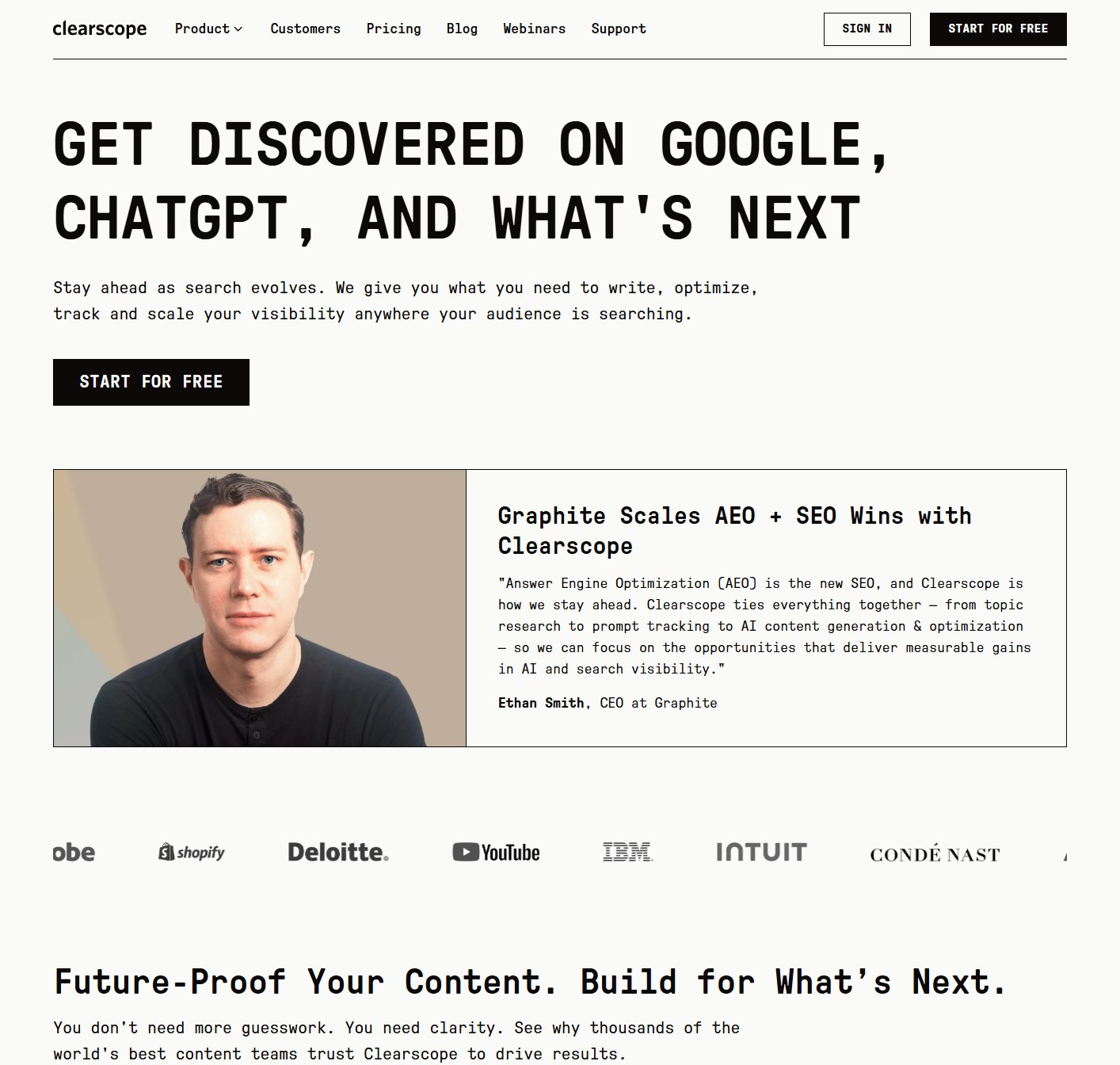
A typical team creates a Topic Exploration or Draft, reviews search intent and competitive evidence, writes in Clearscope or a connected editor, and uses the Content Grade and term recommendations as an editorial checkpoint. Published URLs can be added as Pages for ongoing monitoring. Tracked Prompts add a separate view of brand mentions, citations, share of voice, and the web searches AI systems use when constructing answers.
Clearscope is strongest when the organization already has writers, editors, subject experts, and publishing systems. It does not need to automate every step because its value is reducing ambiguity: what the audience expects, which concepts deserve coverage, how complete the draft is, and when a published page needs attention.
For the complete product baseline, read the Clearscope review. If your writers work in Workspace, the Clearscope Google Docs workflow explains how shared Draft links carry recommendations into the document editor.
What Is Writesonic?
Writesonic is an AI Search Growth platform that combines AI visibility tracking, content production, SEO audits, prioritized recommendations, and agentic workflows. The current platform is broader than its earlier identity as an AI writing tool. Its homepage describes an AI Search Loop: track visibility, prioritize gaps, act through content and technical work, measure the result, and repeat.
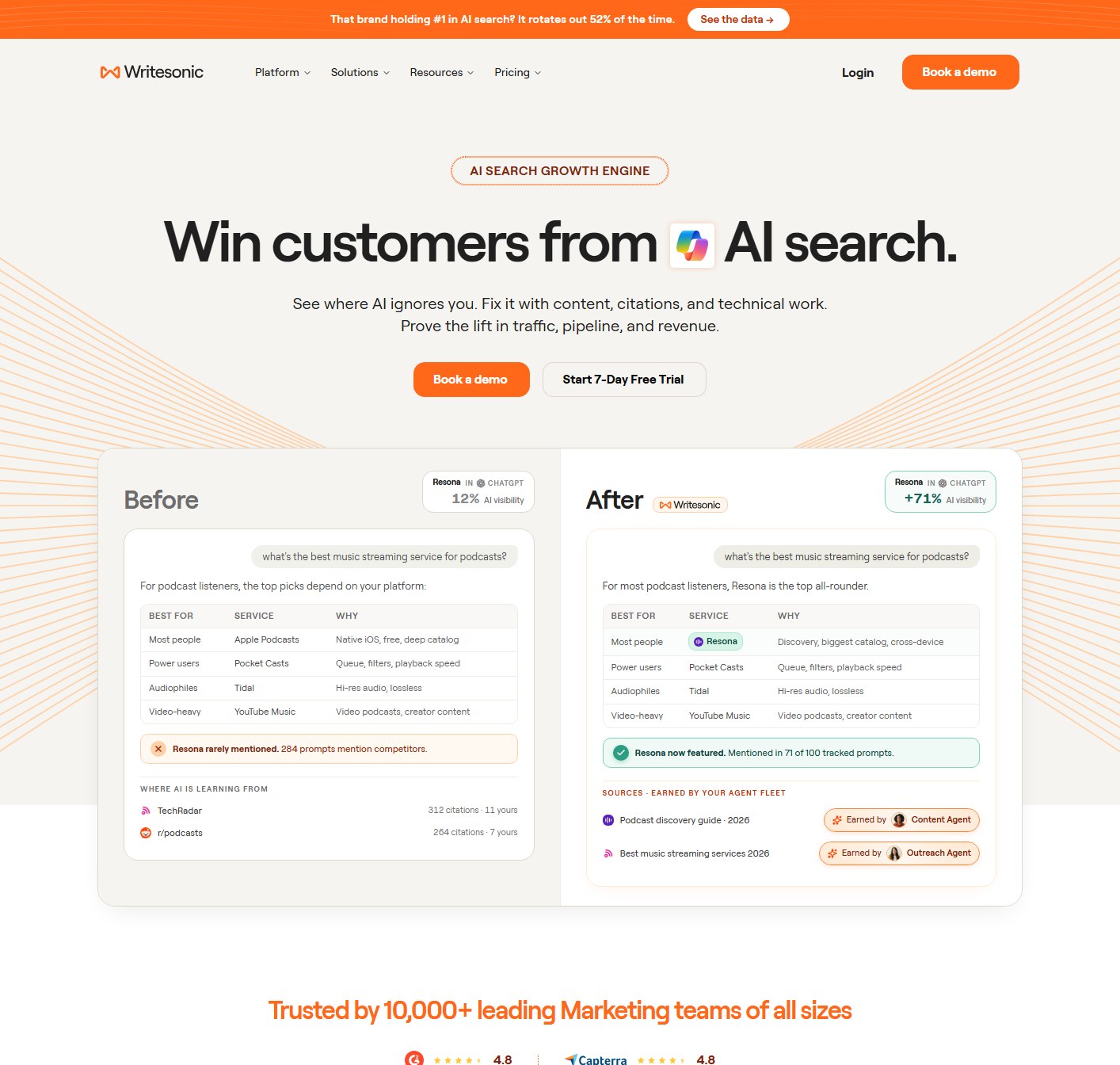
The content layer includes Content Strategy, an SEO and Content AI Agent, AI Article Writer, support for custom data, brand voice, and WordPress or Google Search Console connections. The visibility layer tracks prompts and brand presence across named AI platforms. Higher tiers add deeper analysis and Action Center access, while Enterprise expands engine coverage and governance.
Writesonic therefore aims to replace more point solutions than Clearscope. That breadth can shorten handoffs for a growth team, but it also creates a more complex buying decision. The buyer must check plan-level limits for articles, audits, prompts, tracked answers, users, projects, agent runs, integrations, and action features. A long feature list has little value if the required capability sits above the selected tier.
Clearscope vs Writesonic: What Is the Core Difference?
Clearscope is an editorial optimization system with visibility monitoring; Writesonic is an AI-search operations system with content creation and execution. The overlap is real, but the products begin from opposite process assumptions.
Clearscope assumes skilled people will make the final content decisions. It organizes SERP evidence, intent, relevant terms, draft quality, page performance, and AI citations so those people can work consistently. Writesonic assumes the team needs more work performed inside the platform. It connects visibility gaps to articles, audits, technical actions, off-page opportunities, and agents.
| Attribute | Clearscope | Writesonic | Buyer meaning |
|---|---|---|---|
| Primary category | Content optimization and search visibility | AI Search Growth and execution | Choose by operating model, not shared buzzwords |
| Main quality signal | Content Grade with term, readability, and competitor context | Content and SEO tools plus action-oriented workflows | Clearscope is easier to use as an editorial gate |
| Creation model | AI-assisted drafting inside an evidence-led workflow | AI Article Writer, content agents, research, and brand voice | Writesonic is better suited to production scale |
| Monitoring model | Pages, Tracked Prompts, citations, mentions, and Google data | Prompt tracking, brand research, sentiment, actions, and measured fixes | Writesonic extends further into execution |
| Collaboration economics | Unlimited users and projects on public plans | Capacity and controls vary by tier | Contributor-heavy teams should model total access |
| Governance | Training, support, sharing, Business account manager, Enterprise SSO | Enterprise controls, SSO/SAML, dedicated strategy support | Both can serve enterprises through different workflows |
This category boundary should guide every feature comparison. Clearscope should not be rejected because it has fewer automation surfaces if the team wants human editorial control. Writesonic should not be reduced to a generic AI writer when its current product includes visibility data, audits, agents, and action tracking.
Which Tool Has the Better Content Optimization Workflow?
Clearscope has the better focused optimization workflow, while Writesonic has the better connected creation-to-action workflow. Clearscope’s advantage is the clarity of the feedback. Writesonic’s advantage is the number of adjacent tasks that can happen without leaving the platform.
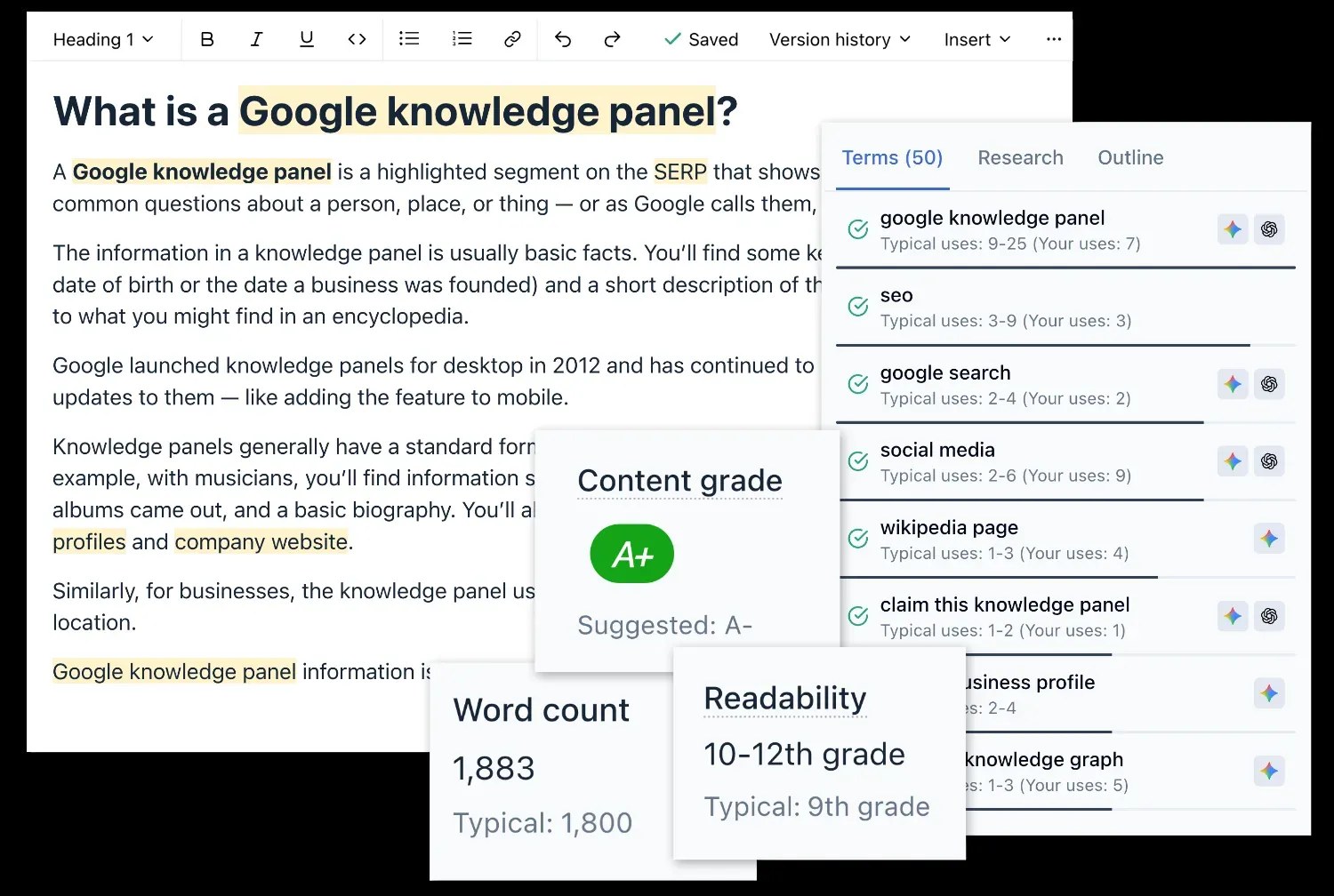
Clearscope grades topic coverage in real time and combines the letter grade with relevant terms, word count, readability, competitor evidence, citations, and common questions. A manager can define a quality checkpoint that writers understand while still requiring accuracy, original evidence, and brand standards. The Clearscope grading system guide explains why an A-level target is a coverage signal, not proof that a page deserves to rank.
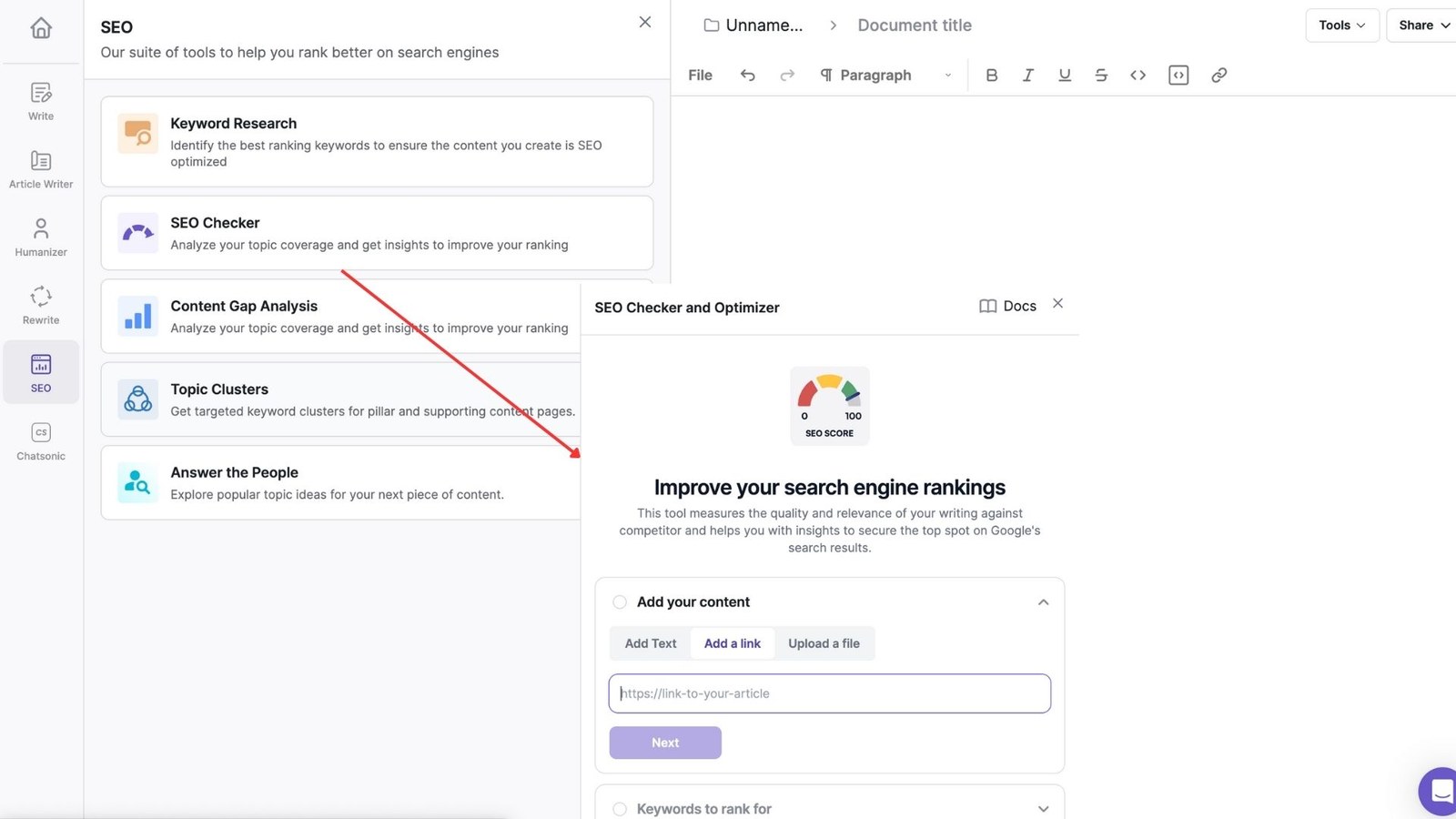
Writesonic’s official documentation describes an SEO Checker and Optimizer that analyzes competitors, calculates keyword ranges, scores content, and can rewrite copy to integrate recommendations. Its SEO Suite also includes keyword research, a Content Gap Analyzer, and keyword clustering. However, the current public pricing comparison marks “Content Optimization” as unavailable on Starter, Basic, and Growth and available on Enterprise. Buyers should verify the exact entitlement during a trial or sales call instead of assuming every documented SEO tool is included in every plan.
| Optimization task | Clearscope | Writesonic |
|---|---|---|
| Build a focused brief from SERP evidence | Strong | Available through strategy and SEO tools |
| Give writers live topical feedback | Core product strength | Verify plan access to current Content Optimization feature |
| Use one simple editorial standard | Stronger | Broader workflow creates more variables |
| Generate and rewrite content automatically | Available, but not the primary differentiator | Stronger and more central to the platform |
| Connect optimization to site and AI-search actions | Guided through research, Pages, and Tracked Prompts | Stronger through audits, Action Center, and agents |
| Risk | Chasing a grade without adding new value | Accepting automated fixes without sufficient review |
For teams buying a content optimizer first, Clearscope is the more predictable choice. For teams buying an execution stack first, Writesonic may create more total value, but only after confirming tier access and capacity.
Which Tool Is Better for AI Writing and Content Production?
Writesonic is better for AI-first content production; Clearscope is better for AI-assisted editorial control. Writesonic’s AI Article Writer is designed to research, structure, draft, cite, apply brand voice, and support different article formats. Clearscope’s AI assistant is designed to accelerate the first pass while keeping research, intent, grading, and human editing connected.
Writesonic’s documentation shows a structured article workflow with topic and location selection, article type, web research or custom sources, competitor references, keywords, title, outline, citations, internal links, and FAQs. That breadth matters to agencies and brands trying to standardize production across many briefs. It also increases the need for factual review, source verification, brand editing, and controls against generic output.
Clearscope’s workflow is more restrained. Topic Explorations identify opportunities, intent analysis clarifies the required answer, Drafts combine AI assistance with term guidance, and the Content Grade shows whether the draft covers expected concepts. This is a better fit when a subject expert or writer should remain the author and AI should remove blank-page friction rather than run the entire process.
| Production need | Better fit | Reason |
|---|---|---|
| Produce researched first drafts at scale | Writesonic | Article Writer and content agents cover more production steps |
| Preserve a human-led editorial process | Clearscope | AI assistance remains subordinate to brief, evidence, and grading |
| Create comparison, listicle, and technical formats | Writesonic | Article workflow includes explicit format and research choices |
| Standardize output across external writers | Clearscope | Simple guidance and unlimited collaboration reduce onboarding friction |
| Use proprietary files or links as sources | Writesonic | Custom Sources are documented in the Article Writer workflow |
| Minimize hallucination and generic phrasing | Neither automatically | Both require source checking and expert editing |
Writesonic wins when draft volume is the economic constraint. Clearscope wins when editing consistency and subject-matter control are the economic constraints. Neither platform turns unverified AI text into trustworthy content without human review.
Which Tool Is Better for AI Search Visibility and GEO?
Writesonic offers the broader action-oriented GEO system, while Clearscope offers the cleaner connection between content optimization and AI citation monitoring. Both can track AI-search visibility, but they differ in engine scope, data presentation, and what happens after a gap is found.
Clearscope’s pricing includes Prompt Tracking on every plan. Essentials includes 50 Tracked Prompts and 50 Pages; Business includes 300 of each. Public copy names ChatGPT and Gemini, brand visibility, citations, share of voice, and query fan-out. The practical value is seeing which prompts mention the brand, which pages earn citations, and which supporting web searches could become content opportunities.
Writesonic Starter, Basic, and Growth name ChatGPT, Gemini, and Google AI Overviews. Enterprise lists ten AI experiences, including Perplexity, Claude, Grok, DeepSeek, Microsoft Copilot, Meta AI, Google AI Mode, and Google AI Overviews. Growth adds sentiment and Action Center capabilities, while Enterprise extends action, governance, and strategy support.
| GEO requirement | Clearscope | Writesonic |
|---|---|---|
| Track prompts on entry plan | 50 Tracked Prompts on Essentials | Available on Starter; verify current prompt and answer allowances |
| Named lower-tier engines | ChatGPT and Gemini | ChatGPT, Gemini, and Google AI Overviews |
| Broader enterprise engine coverage | Public core copy is narrower | Ten AI platforms listed on Enterprise |
| Connect citations to content guidance | Strong | Strong through content, site audits, and action workflows |
| Prioritize and execute fixes | Human-led research and optimization workflow | Action Center and agents provide a more explicit execution layer |
| Measure Google and AI together | Google data plus AI mentions and citations | SEO, AI visibility, bot analytics, and integrations |
No platform can guarantee a citation in ChatGPT, Gemini, or AI Overviews. Tracking identifies patterns and opportunities. Results still depend on crawlability, factual quality, source authority, third-party corroboration, freshness, structured data, and whether the engine retrieves the page for a specific prompt.
Which Tool Is Better for Teams, Agencies, and Integrations?
Clearscope is better for low-friction editorial collaboration; Writesonic is better for teams that need a wider operational integration layer. Clearscope includes unlimited users, unlimited projects, unlimited sharing, and exporting on its public plans. Writesonic connects more execution surfaces, but limits and governance differ by tier.
Clearscope officially supports Google Docs, Microsoft Word, WordPress, and Google Search Console workflows. Business adds a dedicated account manager. Enterprise adds custom credits, custom agreements, crawler whitelisting, and single sign-on. This structure fits brands where writers, editors, legal reviewers, subject experts, and agencies need the same brief and quality signal.
Writesonic lists WordPress and Google Search Console across its pricing comparison, with Google Analytics 4 and Looker Studio on Enterprise. Its site also names APIs and MCP among integrations. Enterprise includes access controls, SSO/SAML, broad AI-platform coverage, and dedicated strategy support. Agencies should check multi-client management, user allowances, workspaces, reporting, and agent-run economics before choosing a plan.
| Team requirement | Better choice | Why |
|---|---|---|
| Unlimited contributors and projects | Clearscope | Public plans explicitly include both |
| Google Docs and Microsoft Word editing | Clearscope | Guidance can follow established editorial tools |
| WordPress and GSC publishing workflow | Tie | Both document these connections |
| GA4, Looker Studio, API, or MCP operations | Writesonic, especially Enterprise | Broader operational integrations are listed |
| Simple writer onboarding | Clearscope | The focused interface creates fewer decisions |
| Agentic SEO and GEO workflows | Writesonic | Agents and Action Center are central product layers |
| SSO and enterprise controls | Tie at enterprise level | Both publish enterprise governance capabilities |
The hidden cost is operator time. Clearscope may look expensive but reduce training and access administration. Writesonic may replace multiple subscriptions but require more setup, governance, and review. Calculate the cost of the complete workflow, not only the monthly plan.
Clearscope vs Writesonic Pricing: Which Offers Better Value?
Writesonic has the lower public entry price, while Clearscope provides the more transparent content-optimization allowance and unlimited collaboration. Pricing was checked on the official vendor pages on July 30, 2026. Annual billing, promotions, add-ons, usage limits, and enterprise contracts can change the effective cost.
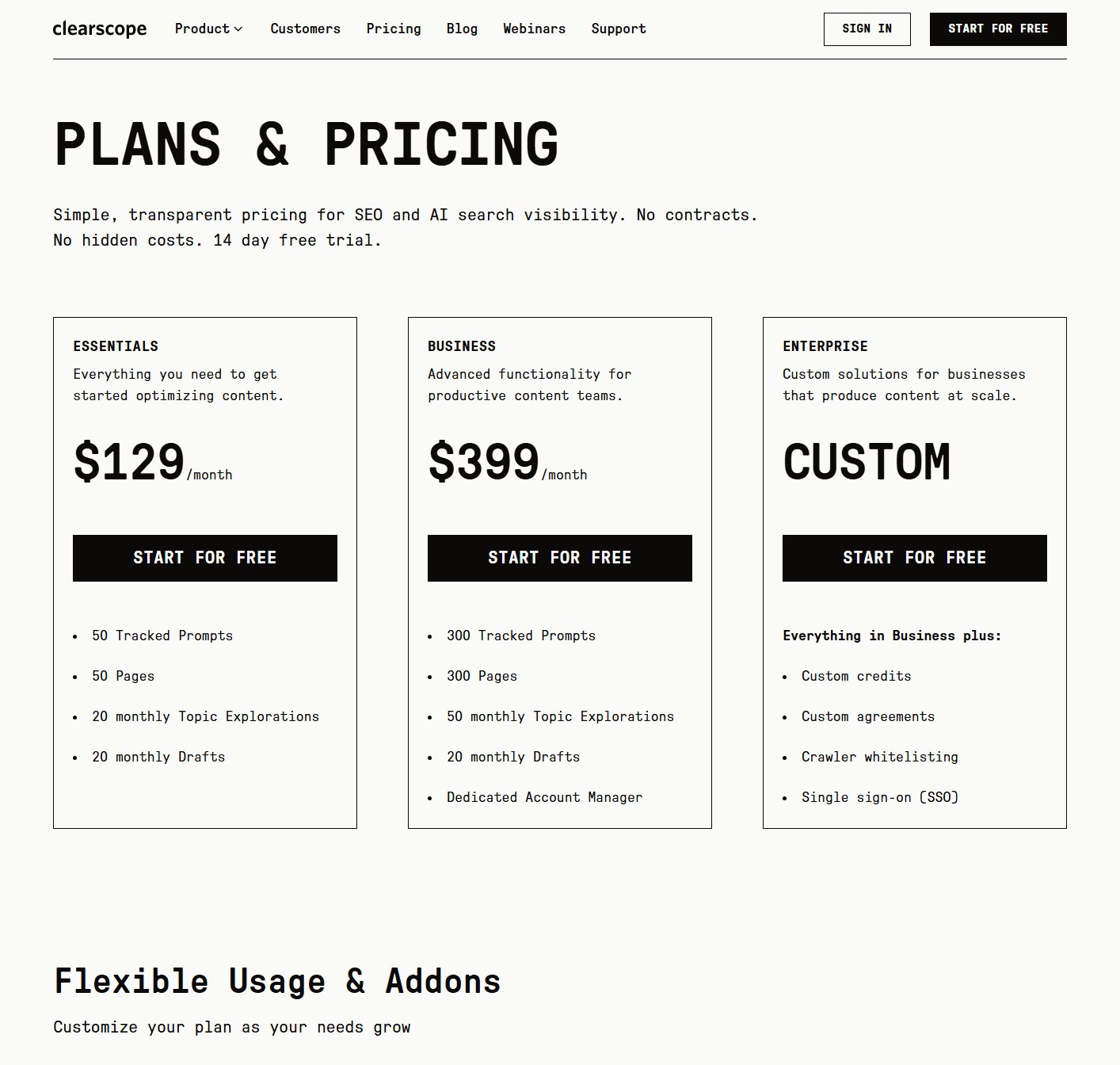
Clearscope Essentials costs $129 per month and includes 50 Tracked Prompts, 50 Pages, 20 monthly Topic Explorations, and 20 monthly Drafts. Business costs $399 per month and includes 300 Tracked Prompts, 300 Pages, 50 monthly Topic Explorations, 20 monthly Drafts, and a dedicated account manager. Enterprise is custom. Every plan lists unlimited users and projects, and the pricing page advertises a 14-day trial.
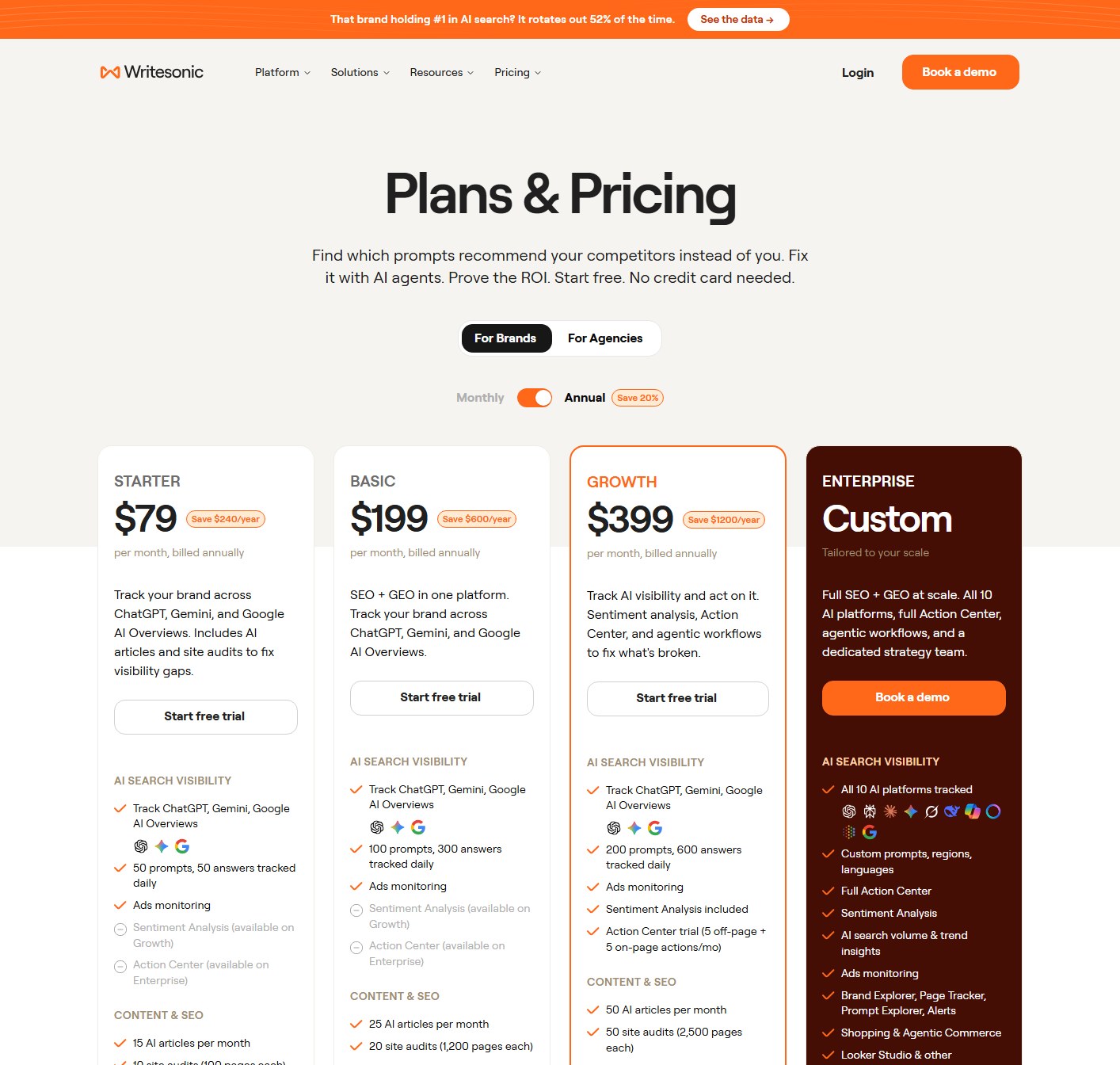
Writesonic Starter costs $79 per month billed annually. Basic costs $199, Growth costs $399, and Enterprise is custom. Starter includes AI visibility for ChatGPT, Gemini, and Google AI Overviews plus AI articles and site audits. Growth adds deeper visibility analysis and Action Center functionality. Enterprise adds all ten named AI platforms, full Action Center, agentic workflows, and tailored support. The page says users can start free without a credit card, but buyers should verify trial duration and every usage allowance shown inside the account.
| Pricing attribute | Clearscope | Writesonic |
|---|---|---|
| Entry plan | Essentials, $129/month | Starter, $79/month billed annually |
| Mid-tier example | Business, $399/month | Basic, $199/month billed annually |
| Action-oriented tier | Business improves capacity and support | Growth, $399/month billed annually |
| Trial or free start | 14-day free trial | Start free, no credit card stated |
| Collaboration | Unlimited users and projects | Included users and access controls vary by tier |
| Main limits to model | Drafts, Topic Explorations, Pages, and Tracked Prompts | Articles, audits, prompts, answers, agents, users, projects, and action features |
| Content optimization entitlement | Core capability across the platform | Current pricing table marks dedicated Content Optimization as Enterprise-only |
A solo creator who mainly needs AI-generated articles may receive more immediate output from Writesonic Starter. A content team with ten or more contributors may find Clearscope’s unlimited access and clearer optimization allowances easier to budget. Before paying, run one new article, one content refresh, and one AI visibility investigation through the intended tier.
What Are the Pros and Cons of Each Tool?
Clearscope’s strengths are editorial clarity, collaboration, and dependable optimization; Writesonic’s strengths are production breadth, GEO execution, and automation. Each product’s weakness is closely related to its advantage.
| Tool | Main pros | Main cons |
|---|---|---|
| Clearscope | Clean Content Grade; SERP and intent guidance; unlimited users and projects; Google Docs, WordPress, and Word integrations; Pages and Prompt Tracking; transparent allowances; 14-day trial | $129 entry price; Draft and research limits; fewer execution surfaces; teams can misuse grades as quotas |
| Writesonic | AI Article Writer; content strategy; site audits; AI visibility tracking; broad Enterprise engine coverage; Action Center; agentic workflows; WordPress, GSC, API, and enterprise integrations | More complex plan evaluation; key actions and dedicated optimization may require higher tiers; more automated output requires stronger factual and brand QA |
Clearscope is easier to govern because the product asks fewer people to make fewer types of decisions. Writesonic can eliminate more handoffs because the product performs more kinds of work. Buyers must decide whether their organization benefits more from simplicity or consolidation.
Both tools share a deeper limitation: neither score, agent, or AI draft proves truth, originality, experience, or authority. A high-scoring article can still repeat competitors, misstate a product, omit primary evidence, or fail to help the reader. Editorial standards must remain independent of the software.
Who Should Choose Clearscope?
Choose Clearscope when content quality control and contributor adoption matter more than maximum automation. The ideal buyer already has capable writers or experts and wants a dependable layer for research, briefs, optimization, monitoring, and AI visibility.
Choose Clearscope when:
- editors need a simple, explainable Content Grade;
- many writers and reviewers need access without additional seats;
- Google Docs, Microsoft Word, or WordPress is already the writing environment;
- content refresh decisions should connect page performance with topical relevance;
- ChatGPT and Gemini prompts, mentions, citations, and source queries are sufficient for the current GEO program;
- the team values onboarding and direct support;
- $129 per month is justified by lower editing and coordination cost.
Skip Clearscope when the organization mainly needs automated article volume, technical SEO actions, off-page citation workflows, or broad monitoring across many AI engines. The Clearscope alternatives guide provides other optimizer and GEO options, while the Clearscope vs NeuronWriter comparison covers the premium-versus-value optimizer decision.
Who Should Choose Writesonic?
Choose Writesonic when the team needs one system to research, create, audit, track, prioritize, and act on SEO and AI-search opportunities. It fits growth teams, agencies, enterprise brands, and content operations that view production capacity as a strategic constraint.
Choose Writesonic when:
- AI Article Writer can remove a measurable drafting bottleneck;
- the team needs ChatGPT, Gemini, and Google AI Overviews tracking on a lower tier;
- site audits and automatic fixes belong in the same workflow as content;
- Action Center can turn visibility gaps into assigned priorities;
- enterprise buyers need broader AI-engine coverage, governance, and strategy support;
- WordPress, GSC, GA4, Looker Studio, API, or MCP connections can replace manual handoffs;
- editors have enough capacity to verify sources, facts, voice, and automated changes.
Skip Writesonic when writers only need a focused optimizer and the selected plan does not include the required optimization feature. If a broader GEO production platform is the real requirement, compare the automation model in the Clearscope vs Scalenut guide before committing.
Final Verdict: Clearscope or Writesonic?
Clearscope is the better content optimizer; Writesonic is the better AI-search execution platform. Clearscope wins when the organization wants a clean editorial standard, unlimited collaboration, transparent optimization allowances, and a direct connection between content quality and Google or AI visibility. Writesonic wins when the organization wants AI production, audits, broad tracking, prioritized actions, and agents in one operating system.
For SEO specialists, the decision depends on whether analysis or execution is missing. For content managers, it depends on whether writer adoption or production throughput is the larger constraint. For agencies, it depends on whether unlimited collaboration or multi-client automation creates more margin. For enterprise brands, it depends on governance, engine coverage, integration requirements, and how much work the platform must perform after detecting a gap.
Run a controlled pilot instead of comparing checklists. Use the same target query, source set, draft, published URL, and AI prompts. Measure research time, first-draft quality, factual corrections, writer comprehension, useful recommendation rate, publishing friction, visibility insight, action completion, and total monthly capacity. If the focused editorial model wins, start with Clearscope’s 14-day trial and validate the workflow before subscribing.
FAQ
Is Clearscope better than Writesonic?
Clearscope is better for focused content optimization, editorial consistency, and unlimited collaboration. Writesonic is better when a team needs AI article production, site audits, AI visibility tracking, prioritized actions, and agentic execution in one platform.
Is Writesonic a real Clearscope alternative?
Yes, but Writesonic is a broader alternative rather than a direct editor-for-editor replacement. It overlaps in research, SEO guidance, content creation, and AI visibility. Buyers should verify whether the selected Writesonic tier includes the dedicated Content Optimization capability they expect.
Which tool is better for content optimization?
Clearscope is the more predictable choice for content optimization because grading and term guidance are core capabilities on its public plans. Writesonic documents an SEO Checker and Optimizer, but its current pricing table marks Content Optimization as an Enterprise feature.
Which tool is better for AI writing?
Writesonic is better for AI-first article production. Its workflow supports web research, custom sources, competitor references, article types, brand voice, citations, internal links, and structured generation. Clearscope is better when AI should assist a human-led research and editing process.
Which tool is better for ChatGPT and Gemini visibility?
Both track ChatGPT and Gemini, but Writesonic offers a broader action layer and wider Enterprise engine coverage. Clearscope provides a focused connection between prompts, citations, source queries, content optimization, and Google performance.
Is Writesonic cheaper than Clearscope?
Writesonic has a lower public starting price at $79 per month billed annually, compared with Clearscope Essentials at $129 per month. Effective cost depends on articles, audits, prompts, agents, users, projects, feature gates, and whether either platform replaces another subscription.
Can Clearscope or Writesonic guarantee Google rankings or AI citations?
No. Both platforms provide data, recommendations, monitoring, and workflow support. Rankings and citations still depend on intent satisfaction, technical accessibility, authority, source quality, originality, links, freshness, and competition.
Can a team use Clearscope and Writesonic together?
Yes, a large team could use Writesonic for research and production, then Clearscope for editorial grading and ongoing monitoring. The stack only makes financial sense when Clearscope catches meaningful quality gaps that Writesonic does not and the duplicated monitoring cost remains acceptable.