Clearscope’s grading system measures how relevant and comprehensive a draft is for one target query. It compares the draft with top-ranking search results, identifies important terms and concepts, and updates a letter grade as coverage improves. The scale runs from F to A++, but the grade is an editorial benchmark, not a Google ranking guarantee.
| At-a-glance | Details |
|---|---|
| Tool | clearscope.io |
| Grade range | F to A++, with A++ as the highest grade |
| What it measures | Topic relevance and comprehensiveness for a target query |
| Main inputs | Top-ranking pages, recommended terms, term importance, and typical usage |
| Separate metrics | Word count and Flesch-Kincaid readability |
| Best use | A quality-control signal inside a human-led SEO content workflow |
| Key limitation | A high grade does not guarantee rankings, traffic, or AI citations |
For SEO specialists, content managers, and writers, the useful question is not simply how to reach A++. It is how to turn the score into better coverage without producing repetitive, derivative copy. This guide explains the calculation signals Clearscope discloses, what the letter grade does and does not represent, and how to set a practical quality gate. For broader product context, see the Clearscope review.
Quick Answer: How Does Clearscope Grade Content?
Clearscope grades a draft by measuring its coverage of important terms found across top-ranking pages for the target query. When a writer uses a recommended term, the Editor highlights it, marks it as used, and recalculates the Content Grade in real time. Terms receive an importance score from 1 to 10, where 10 indicates a must-include concept according to Clearscope’s analysis.
The platform’s Content Grade documentation describes the score as a measure of relevance and comprehensiveness. Word count and readability appear beside the grade, but they are separate guidance signals. Clearscope does not publicly disclose a simple formula that maps a fixed number of terms to each letter grade, so teams should not invent universal thresholds such as “20 terms equals B+.”
What Does the Clearscope Grade Scale Mean?
The Clearscope scale runs from F at the low end to A++ at the high end. A higher grade means the draft includes more of the terms Clearscope considers important for explaining the target topic comprehensively.
| Grade band | Practical interpretation | Editorial response |
|---|---|---|
| F to D range | The draft has limited coverage of expected topic language | Recheck search intent, missing sections, and core entities before polishing sentences |
| C range | The draft covers part of the topic but still has visible semantic gaps | Add necessary explanations, examples, and high-importance concepts |
| B range | The draft has competitive coverage with some remaining opportunities | Review unused high-importance terms and compare the outline with relevant competitors |
| A range | The draft has strong topic coverage relative to analyzed pages | Protect clarity, originality, accuracy, and conversion intent during final edits |
| A++ | The highest available Clearscope grade | Stop adding material unless each addition improves the reader’s answer |
These bands are workflow interpretations, not official ranking probabilities. Clearscope’s public documentation confirms the F-to-A++ range and describes higher grades as stronger relevance and comprehensiveness, but it does not publish a universal boundary table for every query. The required coverage changes because each Draft uses a different SERP, locale, language, and target query.
How Does Clearscope Calculate a Content Grade?
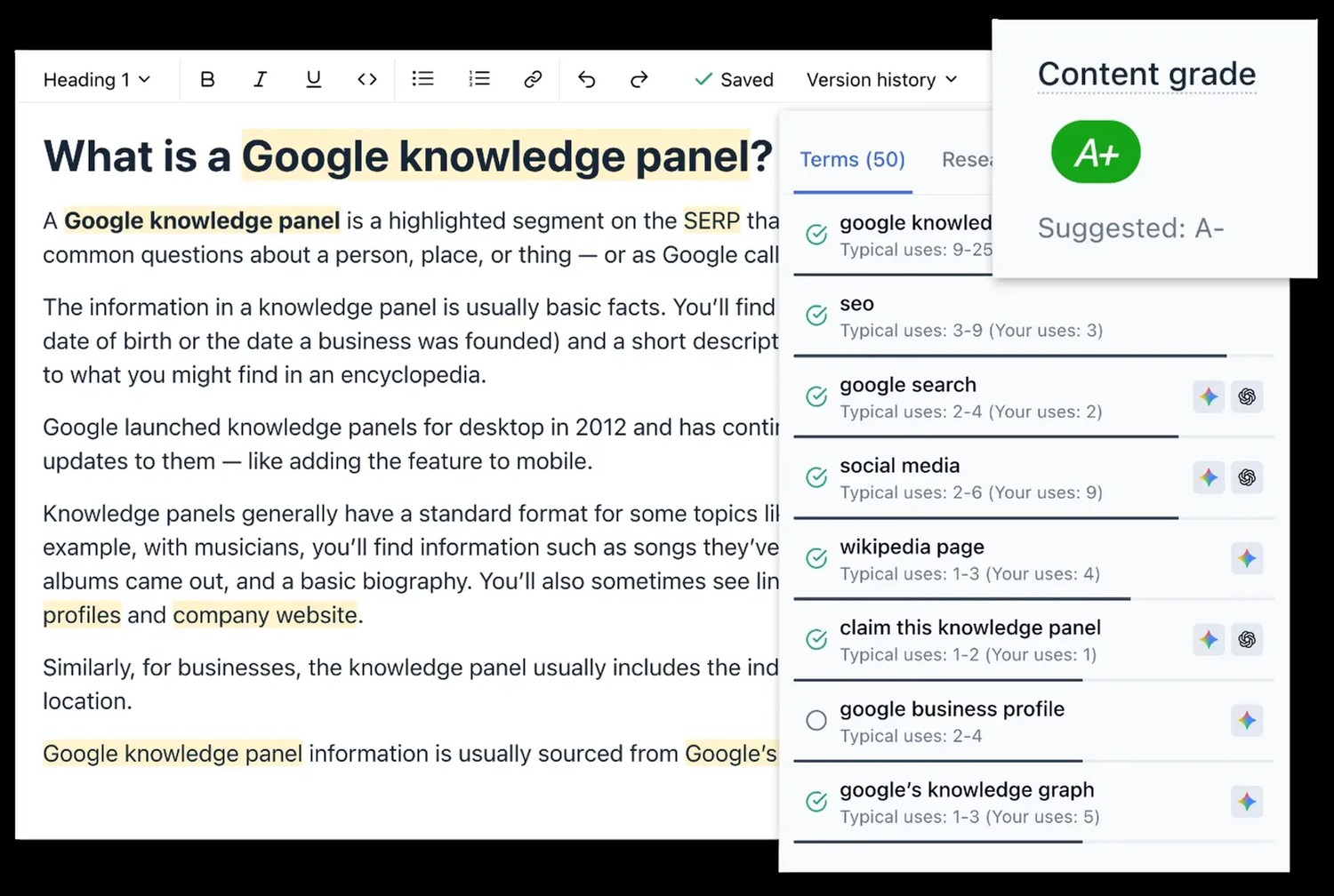
Clearscope builds the grade from query-specific SERP evidence rather than a static keyword checklist. Its disclosed process has four main stages: analyze ranking pages, identify important terms, estimate typical usage, and score the working draft as it changes.
Clearscope analyzes top-ranking search results
When a user creates a Draft analysis, Clearscope examines top-ranking content on the search engine results page for the selected query. This creates a competitive reference set for that specific topic.
The reference set matters. If the SERP mixes definitions, product pages, videos, local results, and long-form guides, one numerical target may not represent every valid content format. An SEO specialist should inspect search intent and competing page types before treating the resulting recommendations as a complete brief.
Clearscope identifies important terms and concepts
Clearscope calculates term importance based on how prominently terms appear across competing articles. The Editor displays importance on a 1-to-10 scale. A score of 10 indicates a must-include term in Clearscope’s model, while a score of 1 indicates lower importance.
The useful editorial move is to translate a term into the concept a reader needs. If “Flesch-Kincaid” is unused, the solution may be a short explanation of readability rather than inserting the phrase into an unrelated sentence. This preserves semantic relevance and avoids keyword stuffing.
Clearscope estimates typical usage
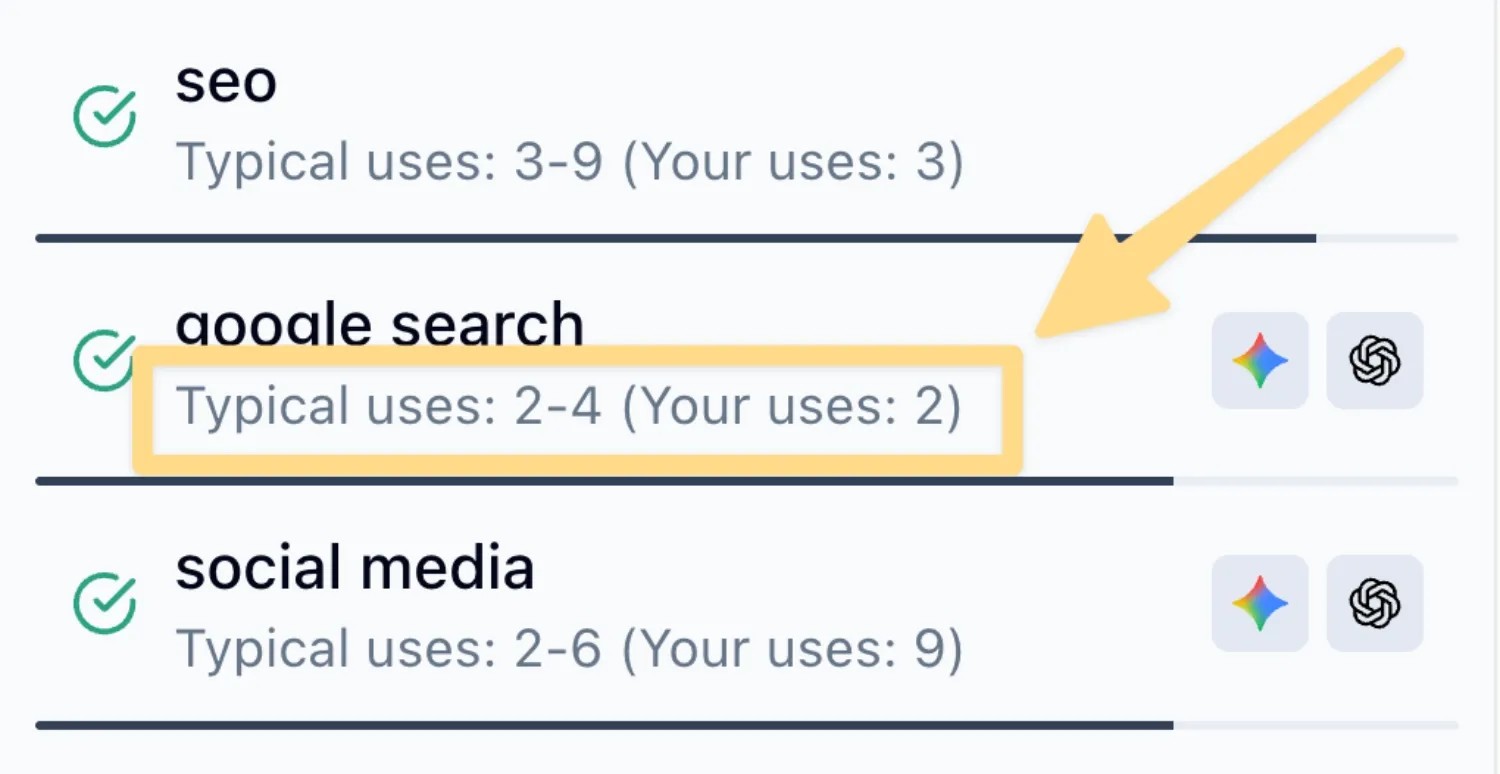
For each term, Clearscope shows a typical usage range based on top results and displays how many times the current draft uses it. The company explicitly frames that range as a guide rather than a rule.
Typical usage helps detect two opposite problems. A count of zero may reveal a missing subtopic. A count far above the competitive range may reveal repetition, awkward phrasing, or an over-optimized passage. Neither condition should be fixed mechanically without reading the surrounding section.
The Editor updates the grade in real time
As the writer adds relevant terms, Clearscope highlights them, adds a green check mark in the Terms list, and updates the Content Grade. The live feedback makes the score useful during drafting, editing, and content refreshes.
A real-time score can also change writer behavior in the wrong direction. Teams should require every grade-driven edit to pass a second question: does this sentence add a fact, relationship, example, definition, condition, or decision aid that the reader needs?
Do Word Count and Readability Affect the Content Grade?
Clearscope displays word count and readability beside Content Grade, but its Editor guide treats them as separate metrics. Word count compares the current draft with the average length of analyzed competitors. Readability uses the Flesch-Kincaid test to estimate the education level needed to understand the text.
| Metric | What it reports | How to use it |
|---|---|---|
| Content Grade | Relevance and comprehensiveness for the target query | Find semantic gaps and verify topic coverage |
| Word count | Current length versus a competitive reference range | Detect an underdeveloped draft or unnecessary expansion |
| Readability | Approximate Flesch-Kincaid grade level | Match sentence complexity to the intended audience |
| Term importance | Relative priority from 1 to 10 | Investigate high-value missing concepts first |
| Typical uses | Competitive usage range and current count | Avoid both omission and excessive repetition |
A longer article does not automatically receive a better grade, and a simpler reading level is not always better for a specialist audience. A concise technical guide can be complete at a higher reading level, while a long beginner article can still miss the central entity relationships behind the query.
How Can You Improve a Clearscope Content Grade Safely?
Improve the grade by closing meaningful topic gaps in importance order, then stop when additional text no longer improves the answer. The safest workflow separates diagnosis from editing.
Step 1: Confirm the target query and search intent
Open the SERP and identify the dominant page type, audience, and task. Exclude irrelevant competitors when the topic is ambiguous. A content grade built around the wrong intent can make an article more comprehensive in the wrong direction.
Step 2: Review unused terms by importance
Start with unused terms that carry the highest importance. Group related terms into concepts instead of treating every variation as a separate requirement. One accurate paragraph can often cover several related entities naturally.
Step 3: Map each missing concept to a section
Decide where the reader expects the answer. Add a definition near the first mention, a process detail in the workflow, a limitation near the recommendation, or a comparison in a decision table. Do not place a term wherever it happens to fit grammatically.
Step 4: Add information, not just vocabulary
For every added term, include a useful value or relationship. Instead of writing “Clearscope uses typical uses,” explain that Typical Uses compares a top-result range with the current count and should be treated as guidance. This creates entity-attribute-value coverage that helps both readers and retrieval systems understand the passage.
Step 5: Check typical usage and repetition
Review terms that exceed their normal range, repeated sentence openings, duplicate definitions, and near-identical headings. Remove forced mentions even if the displayed grade falls slightly. Content quality is the final constraint.
Step 6: Run human editorial QA
Verify facts, citations, originality, search intent, internal links, conversion path, accessibility, and brand voice. A content optimizer cannot confirm every claim or judge whether an example reflects first-hand expertise.
Step 7: Set a query-specific stopping rule
Use the competitive grade shown in the Draft, editorial requirements, and risk level to define acceptance. A reasonable rule is: meet the brief, resolve high-importance gaps, achieve a competitive grade, pass factual review, and reject edits that exist only to move the letter upward.
If you want to optimize inside a shared document, the Clearscope Google Docs guide explains how the add-on carries the grade, terms, word count, and readability into the writing environment.
What Is AI Term Presence in Clearscope?
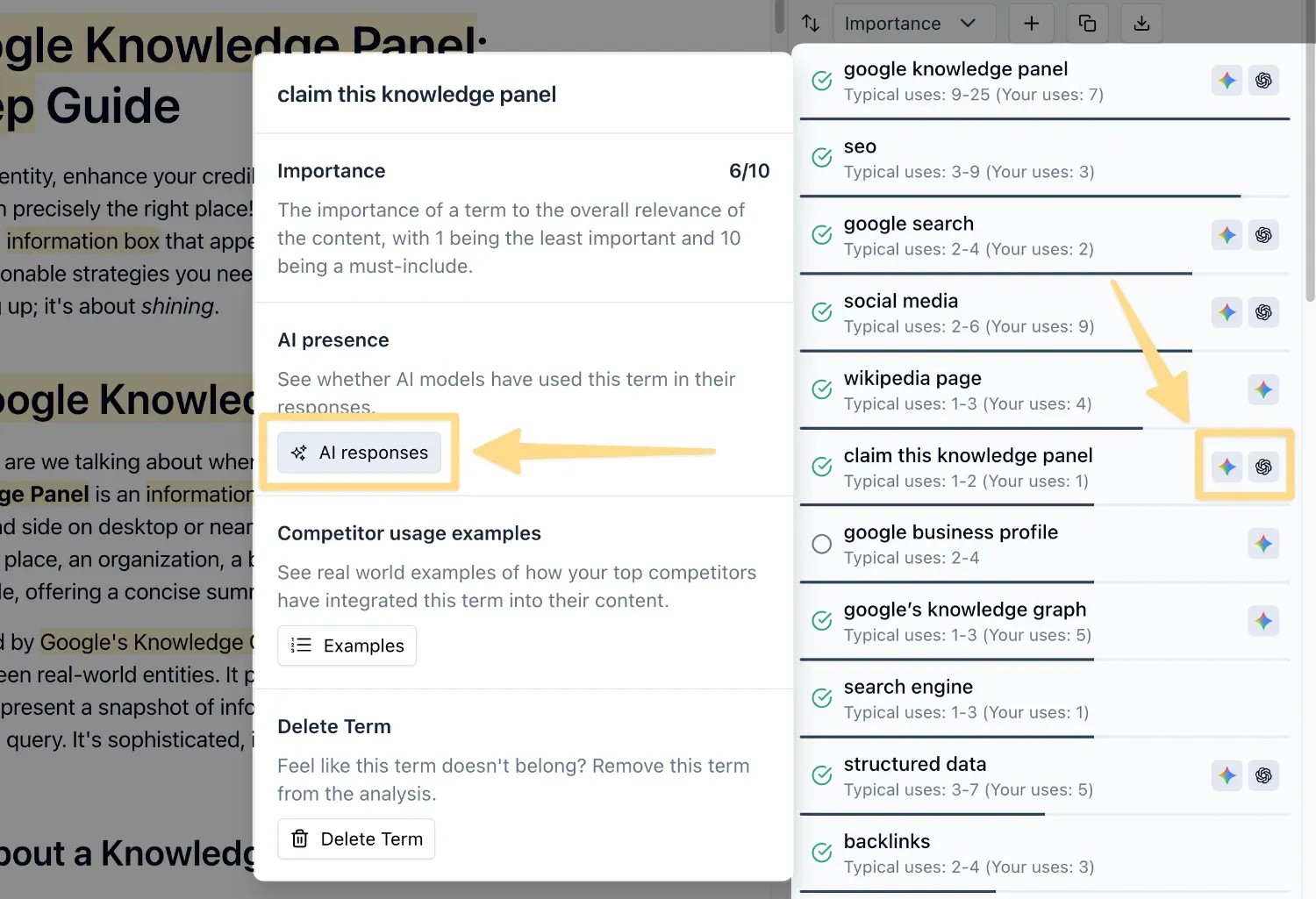
AI Term Presence shows which recommended terms appear in AI-generated responses for the Draft’s target query. Clearscope marks those terms with Gemini and GPT icons. Users can open a term to inspect the AI response and see how the concept is used in context.
AI Term Presence and Content Grade answer different questions:
| Signal | Primary question |
|---|---|
| Content Grade | Does this draft cover the important terms associated with top-ranking web content? |
| AI Term Presence | Do ChatGPT or Gemini responses use this term for the target query? |
| Prompt or visibility tracking | Does the brand appear, receive mentions, or earn citations for tracked prompts? |
A term appearing in an AI response does not prove that adding it will cause a citation. AI systems select sources and generate answers through processes outside Clearscope’s control. Use the icons to understand topic language and possible answer-engine context, then support important claims with clear definitions, evidence, and original value.
Does an A++ Grade Guarantee Higher Google Rankings?
No. An A++ grade does not guarantee higher rankings, organic traffic, featured snippets, AI Overviews, or citations in ChatGPT and Gemini. The grade measures one layer of on-page relevance and comprehensiveness relative to analyzed content.
Google rankings can also depend on search intent, information quality, originality, backlinks, internal linking, technical accessibility, page experience, site reputation, freshness, and competitive change. AI citations introduce additional uncertainty because answer engines may retrieve different sources for different prompt wording, locations, and sessions.
Use the grade as a controllable quality signal. It can show that a draft omitted important concepts, but it cannot prove that the page deserves the top position. Clearscope’s own SEO content writing guide warns that a high content grade alone does not automatically produce rankings.
What Content Grade Should Your Team Target?
Target a competitive grade that preserves usefulness, not A++ by default. Clearscope can show suggested targets and competitor grades for a query, which is more meaningful than applying one global letter to every content type.
| Content situation | Sensible quality gate |
|---|---|
| New informational guide | Match intent, cover high-importance concepts, and reach a competitive grade before editorial QA |
| Product or landing page | Preserve conversion focus; do not add informational sections that weaken the commercial task |
| Technical or regulated content | Prioritize accuracy, source quality, expert review, and necessary caveats over the highest grade |
| Content refresh | Fix changed intent and missing information before adding terms to an outdated structure |
| Agency deliverable | Define the target grade, exclusions, factual standard, and revision owner in the brief |
| Enterprise workflow | Use the grade as one auditable gate alongside legal, brand, accessibility, and governance checks |
For many teams, the strongest standard is “competitive and complete” rather than “maximum.” If the draft answers the query, explains the central entities, includes unique evidence, and passes human QA, chasing one extra plus sign may reduce efficiency without improving performance.
What Are the Most Common Clearscope Grading Mistakes?
The most common mistake is treating the grade as the objective instead of a diagnostic. That error creates several predictable failure modes.
- Forcing every unused term: Some terms may belong to another intent, a weak competitor, or a section the page does not need.
- Confusing term use with topic coverage: Mentioning a phrase once is not the same as explaining the entity, attribute, value, and relationship behind it.
- Writing to average word count: Competitive length is a reference, not a quota. Extra paragraphs can reduce clarity.
- Ignoring the competitor set: Mixed-intent SERPs can produce recommendations that combine incompatible page types.
- Removing original information: A rewrite that resembles every top result may raise the grade while lowering information gain.
- Skipping factual review: Clearscope measures coverage, not the truth of every claim.
- Using one target for every page: A product page, glossary entry, comparison, and technical guide should not share an identical editorial threshold.
If these constraints make the workflow too rigid or expensive for your operation, compare purpose-built Clearscope alternatives rather than replacing content optimization with an unrelated rank tracker or generic AI writer.
How Should Agencies and Enterprise Teams Operationalize the Grade?
Agencies and enterprise brands should define who owns the grade, when it is checked, and which higher-priority standards can override it. Without governance, writers may chase the score while editors silently apply different expectations.
A practical workflow uses four checkpoints:
- Brief approval: The strategist validates the query, intent, competitor set, outline, and required evidence.
- Draft acceptance: The writer reaches the agreed coverage level and documents excluded recommendations.
- Editorial review: The editor checks accuracy, originality, clarity, brand voice, and conversion purpose.
- Post-publication review: The SEO owner monitors rankings, clicks, impressions, content decay, and AI visibility, then refreshes only when evidence supports a change.
Record exceptions. A medical editor may reject a high-scoring sentence because it lacks the necessary condition. A product marketer may omit a related topic because it distracts from the requested action. These are valid decisions when they are explicit and reader-centered.
Teams comparing different scoring methods can also review Clearscope vs NeuronWriter or Clearscope vs Scalenut to see how workflow scope, AI generation, and optimization guidance differ.
When Should You Regrade Existing Content?
Regrade a published page when search intent, competitors, product facts, or performance signals change. A grade is tied to the analyzed query and SERP, so it can become less useful as the result set evolves.
Useful triggers include declining clicks or impressions, a material ranking loss, a new search-result format, outdated product information, changed audience questions, weak AI visibility, a major competitor update, or an annual factual review. Do not refresh solely because a calendar reminder fired.
When regrading, compare the old and new SERP before editing. Determine whether the page needs a factual update, a new section, a format change, consolidation, stronger internal links, or no action. Then use the new grade to find coverage gaps inside that larger diagnosis.
If Clearscope fits your quality-control process, try it with one new draft and one declining page. Comparing both use cases reveals whether the grading workflow improves creation and refresh decisions.
FAQ
Is A++ the highest Clearscope Content Grade?
Yes. A++ is the highest Content Grade shown in Clearscope’s current Editor documentation. The scale extends down to F, and higher grades indicate stronger relevance and comprehensiveness for the analyzed query.
What is a good Clearscope score?
A good Clearscope score is competitive for the specific query while preserving accuracy, intent, originality, and readability. Do not use one universal grade for every page. Review the suggested target and relevant competitor grades inside the Draft.
Does Clearscope use keyword density?
Clearscope shows typical usage ranges, but its grade is presented as a relevance and comprehensiveness measure rather than a simple keyword-density score. Term importance, related concepts, competitive coverage, and natural variations make the workflow broader than repeating an exact phrase.
Can Clearscope detect keyword variations?
Yes. Clearscope states that its natural language processing can recognize variations of recommended terms. Writers should still review the highlighted text and ensure each use carries the intended meaning.
How often does the Clearscope grade update?
The grade updates in real time as the draft changes in the Editor or supported writing integrations. A new Draft analysis may also produce different recommendations when the SERP or target settings change.
Is readability part of the Clearscope grade?
Readability is displayed as a separate Flesch-Kincaid metric. It helps teams match writing complexity to the audience, while Content Grade focuses on relevance and comprehensiveness.
Does AI Term Presence improve the Content Grade?
AI Term Presence adds context about terms used in ChatGPT and Gemini responses, but Clearscope presents it as a separate signal. It helps writers inspect AI topic language without proving that a term will improve rankings or earn citations.
Can Clearscope guarantee ChatGPT or Gemini citations?
No. Clearscope can surface AI Term Presence and track AI visibility signals, but it cannot guarantee citations. Retrieval, source selection, and answer generation remain controlled by each AI platform.