Search Atlas is an agentic marketing platform that connects SEO research, technical fixes, content production, paid search, local visibility, and AI-answer monitoring. Its clearest advantage is execution: OTTO SEO and Atlas Agent can move approved work from recommendation to deployment. It is not a substitute for accountable strategy, technical validation, editorial review, or paid-media governance.
| At-a-glance | Details |
|---|---|
| Homepage | Try Search Atlas |
| ScaleWitAI rating | 4.4/5 |
| Starting price | $99/month for Starter |
| Free trial | 7 days; limited AI quota; converts to paid unless canceled |
| Core automation | Atlas Agent, OTTO SEO, Content Genius, Smart Ads, LLM Visibility |
| Integrations | GSC, GA4, Google Ads, GBP, Cloudflare, WordPress, Shopify, Webflow, HubSpot, Contentful, Duda, GitHub, Vercel, and Netlify |
| Best for | Agencies, SEO professionals, freelancers, and multi-site marketing teams that can govern automation |
The buying decision is not whether Search Atlas has more features than a point tool. It is whether your team can replace disconnected research and ticket queues with one governed execution system. This Search Atlas review evaluates current pricing, workflow depth, automation risk, content and ad capabilities, and the operational controls buyers should test during the trial.
Quick Verdict: Should You Use Search Atlas?
Use Search Atlas when implementation capacity is your bottleneck and you manage enough websites, campaigns, or content to benefit from repeatable automation. Starter is unusually broad for $99 per month, while Growth and Pro add more projects, quotas, seats, AI visibility, and agency controls. The strongest use case is an experienced operator who can decide which changes should run automatically and which need approval.
Skip it if you mainly need the deepest backlink index, a lightweight content editor, one simple rank tracker, or software that requires almost no onboarding. Search Atlas is a suite, and breadth creates configuration work. Teams must validate OTTO recommendations, protect conversion-critical pages, review AI content, control ad budgets, and understand quotas before allowing autonomous changes.
| Choose Search Atlas when... | Consider another tool when... |
|---|---|
| SEO recommendations routinely wait in developer queues | You only need research and do not want software deploying changes |
| An agency manages several sites, reports, content plans, and campaigns | One specialist database, such as backlinks, matters more than suite breadth |
| You want technical SEO, content, local, AI visibility, and PPC in one workspace | Your team has no owner for approvals, rollback, QA, and change logs |
| White-label reporting and multi-client workflows justify a larger plan | A $99 starting price is too high for occasional use |
The seven-day trial is the correct way to evaluate the platform, but do not treat it as casual browsing. Connect one representative site, keep approval mode on, and run a controlled workflow. Start a Search Atlas trial only when someone has time to test setup, outputs, quotas, cancellation, and the first real deployment.
What Is Search Atlas?
Search Atlas is an all-in-one agentic marketing and SEO platform built to research, recommend, execute, publish, and report from one environment. Its product boundary is wider than a traditional SEO suite. Alongside keyword research, rank tracking, site auditing, backlink analysis, and reporting, it includes autonomous technical and on-page deployment, AI content workflows, Google Ads automation, local SEO, and LLM visibility tracking.
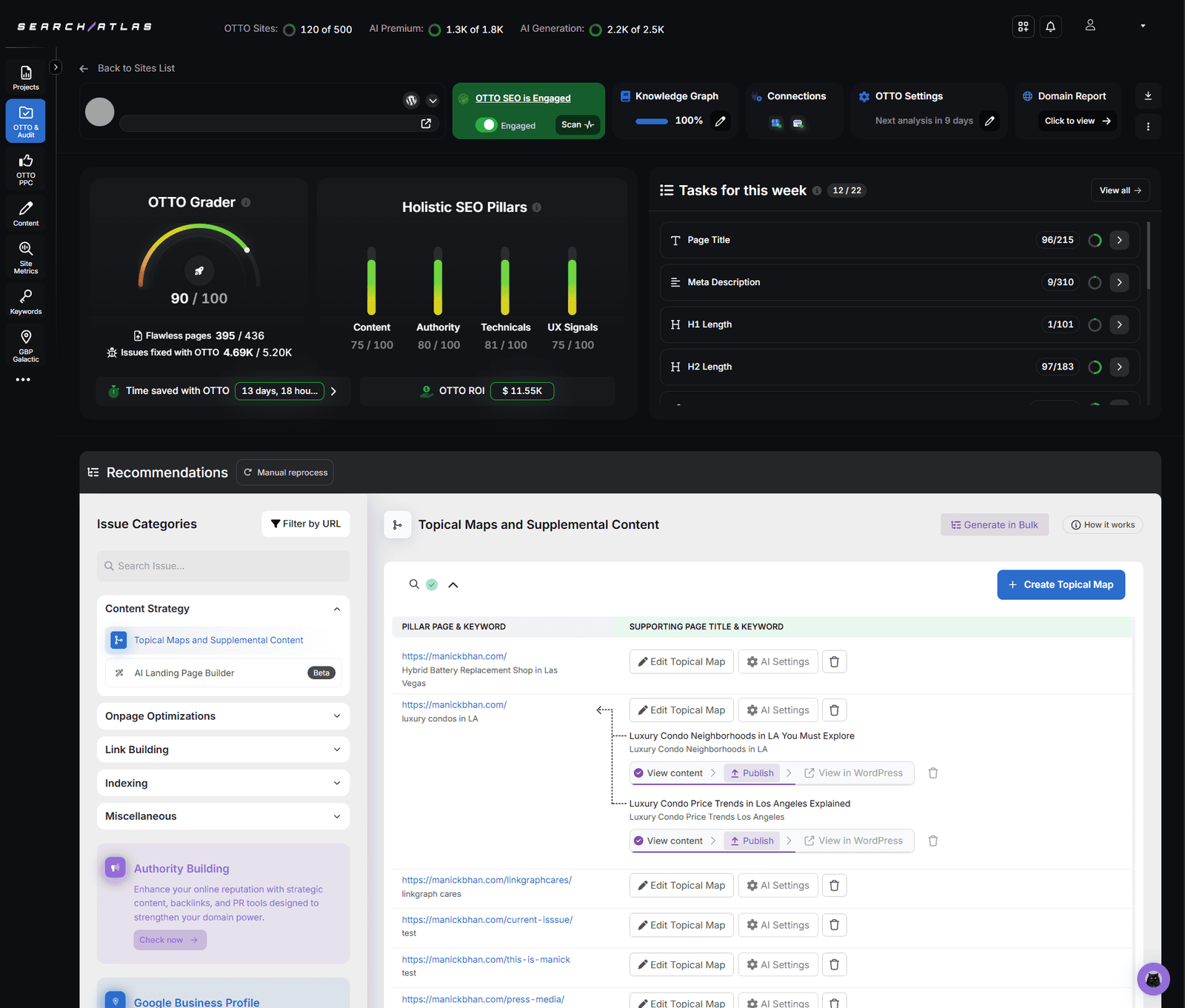
The distinction between insight and execution matters. Traditional platforms usually identify a problem and leave implementation to an SEO, writer, developer, or media buyer. Search Atlas tries to close that gap through OTTO SEO, Atlas Agent, CMS connections, and approval workflows. A recommendation can become a live change without being copied into a separate ticket.
That does not make every deployment correct. Search engines, websites, brands, and ad accounts contain business constraints that software cannot fully infer. Automation increases both speed and blast radius. Search Atlas is most valuable when a team combines machine execution with named owners, approval thresholds, backups, and measurable rollback criteria.
Who Is Search Atlas Best For?
Search Atlas fits buyers who have recurring execution work and enough process maturity to govern it.
Digital marketing agencies managing multiple client systems
Agencies can combine SEO projects, content plans, local visibility, Google Ads, reporting, and white-label delivery in one workspace. This can reduce tool switching and manual status work. The economic case improves when the agency maps each client to project, seat, content, AI, rank-tracking, and LLM quotas before choosing a plan.
The risk is governance. Client sites differ in CMS, risk tolerance, approval authority, conversion templates, and compliance rules. An agency should not apply one automation policy to every account. Define client-specific approval modes, protected URLs, escalation rules, and evidence requirements.
SEO professionals blocked by implementation queues
OTTO SEO is most compelling for strategists who repeatedly find fixable titles, schema, canonicals, internal links, redirects, indexing problems, and content gaps but cannot get changes deployed. Edge, CMS, and code connectors can shorten the path from audit to action.
Experienced SEOs still need to prioritize by impact. An automation queue full of minor metadata edits can distract from crawl architecture, indexation, product-market fit, or content quality. The platform should accelerate a strategy, not determine the strategy solely from detected issues.
Freelancers consolidating research, content, and reporting
A freelancer can use Starter for one OTTO project, content production, site research, auditing, rank tracking, Atlas Agent, and Smart Ads. The $99 fee can be efficient if it replaces several subscriptions and supports billable work every month.
It is less attractive for a freelancer who manages one small site and only needs occasional keyword research. Quotas, onboarding, and a seven-day trial create more pressure than a narrow tool with a lower entry price or free tier.
Enterprise and in-house teams with formal controls
Large teams can use Search Atlas for multi-site execution, standardized playbooks, white-label or stakeholder reporting, AI visibility, and higher quotas. Enterprise value depends on more than feature count. Procurement should validate role-based access, data handling, change history, approvals, support commitments, API and connector behavior, billing, and incident response.
Paid-media teams expanding an organic search platform
Smart Ads adds Google Ads campaign creation, audits, negative-keyword cleanup, budget movement, retargeting, pacing, and reports. This is useful when a team wants organic and paid execution connected. It does not remove the need for conversion tracking, offer strategy, creative testing, landing-page quality, margin data, and a human accountable for spend.
What Are Search Atlas’s Key Features?
Search Atlas has dozens of modules, but five clusters determine whether the platform changes a team’s operation.
Atlas Agent for strategy, playbooks, and cross-channel execution
Atlas Agent is the conversational control layer. A user selects a project, describes a goal or runs a Playbook, reviews the planned workflows, approves actions, and monitors results. Official product documentation positions it across SEO, content, authority, local, PPC, reporting, and AI search visibility.
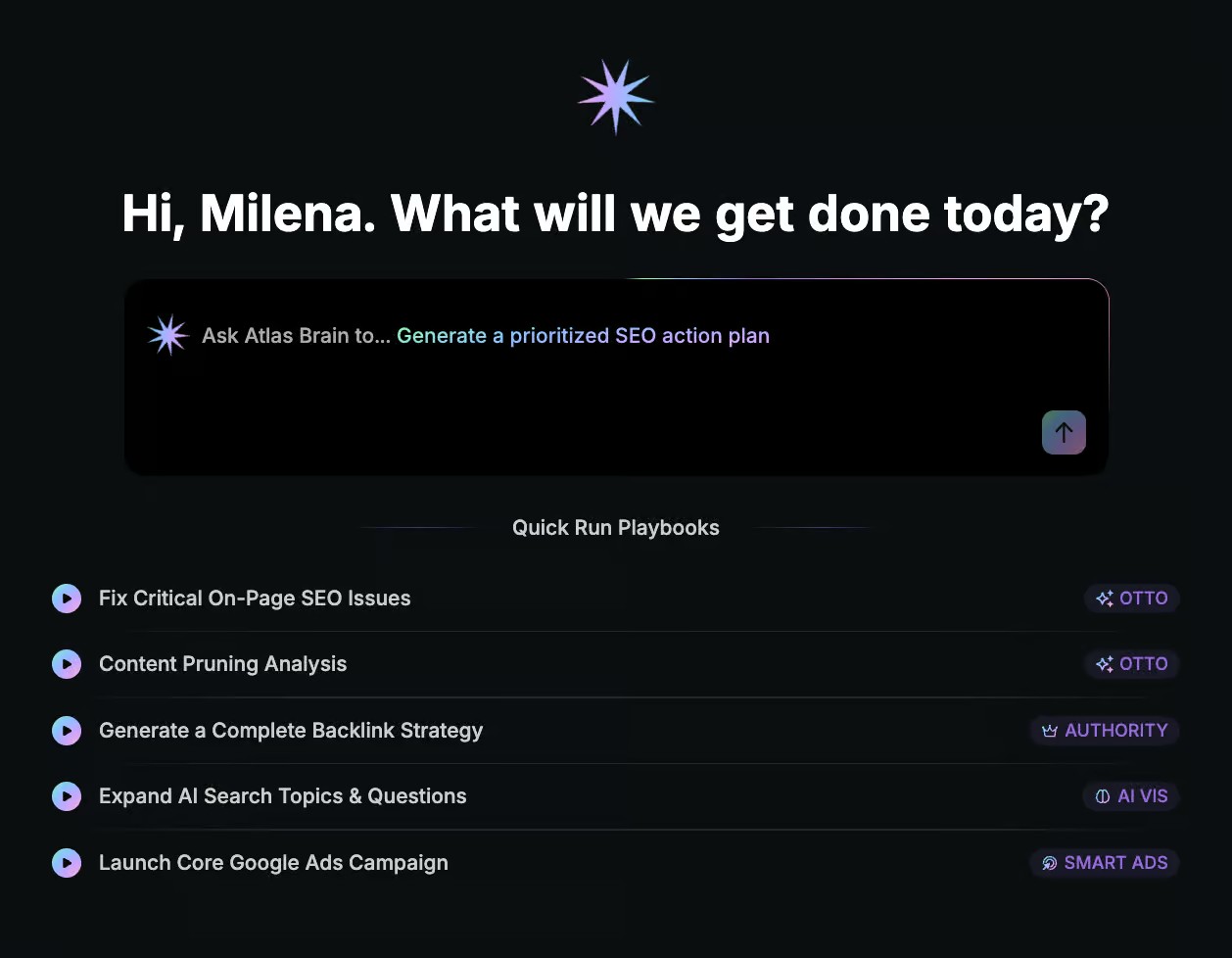
The value is not chat by itself. General AI assistants can suggest a plan, but Atlas Agent can connect the plan to Search Atlas data and execution tools. Repeatable Playbooks can package a process that would otherwise require several dashboards and handoffs.
Buyers should test the boundary between conversational convenience and reproducibility. Ask whether actions are logged, whether prompts and Playbooks can be reviewed, how approvals work, which changes can run unattended, and how the team recreates a successful workflow across clients. Natural language is easier to start, but operational control still requires explicit rules.
OTTO SEO for technical, on-page, content, local, and authority work
OTTO SEO connects to a site through the OTTO Pixel, Cloudflare, a CMS connector, or a code workflow. It can scan, recommend, and deploy work involving titles, headings, schema, canonicals, redirects, broken links, alt text, internal links, indexing, content, local profiles, and authority-building tasks. Approval mode lets teams review changes, while autopilot can apply allowed work.
The operational advantage is speed. A fix does not have to wait for a spreadsheet export, ticket, sprint, release, and recrawl. Search Atlas also says Deep Freeze keeps OTTO optimizations active after cancellation or a project pause, which addresses a common concern about overlay-based changes disappearing.
The control question is more important than the feature list. Test OTTO on a staging site or a low-risk production segment first. Protect checkout, lead-generation, legal, multilingual, faceted-navigation, and programmatic pages until the team understands how changes are applied. Keep a baseline crawl and analytics snapshot so impact can be attributed and rolled back.
Content Genius for research, briefs, drafting, refinement, and publishing
Content Genius turns a keyword or URL into live SERP research, a topical structure, brief, draft, semantic grading, visuals, schema suggestions, and a publishing workflow. Microagent actions can revise clarity, point of view, lists, formatting, and other passage-level elements without rebuilding a long prompt chain.
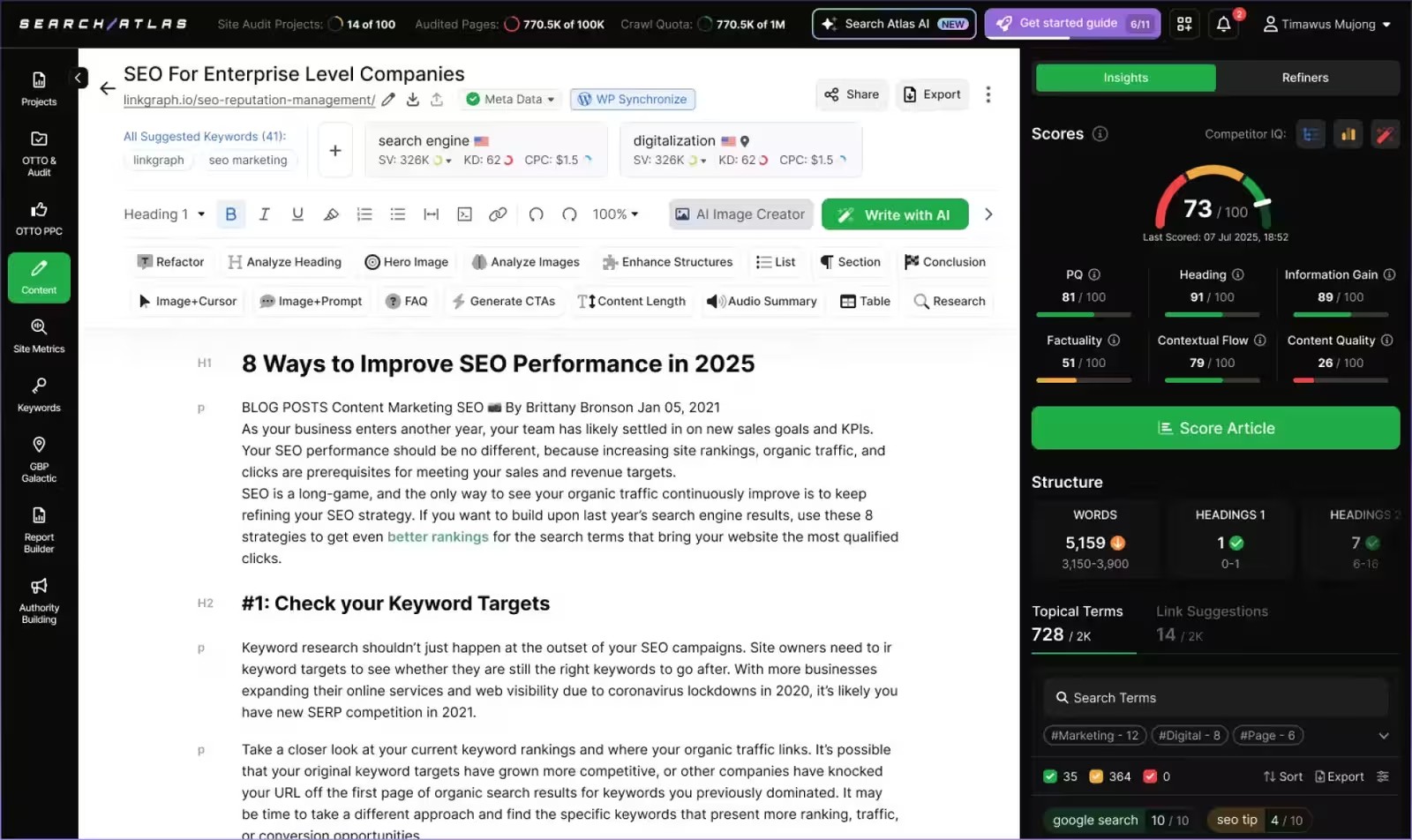
This can reduce production time, especially for agencies that repeatedly create briefs, first drafts, refreshes, and topical plans. Universal and automatic CMS publishing can remove another manual handoff. The pricing table currently allocates content pages, AI article credits, content plans, on-page audits, target keywords, and SCHOLAR semantic-grader usage by plan.
Automation does not create first-hand experience, proprietary data, accurate product knowledge, or a defensible opinion. Treat AI output as a structured draft. Require source verification, subject-matter review, brand editing, visual rights checks, internal-link validation, schema review, and a final human publishing gate. Search-ready is not the same as useful, original, or conversion-ready.
Smart Ads for Google Ads creation and optimization
Smart Ads connects to Google Ads, creates search or retargeting campaigns, proposes ad groups, keywords, match types, and copy, then monitors performance. Its workflows include account health checks, negative-keyword cleanup, budget reallocation, pacing, retargeting, performance visualization, and stakeholder reporting.
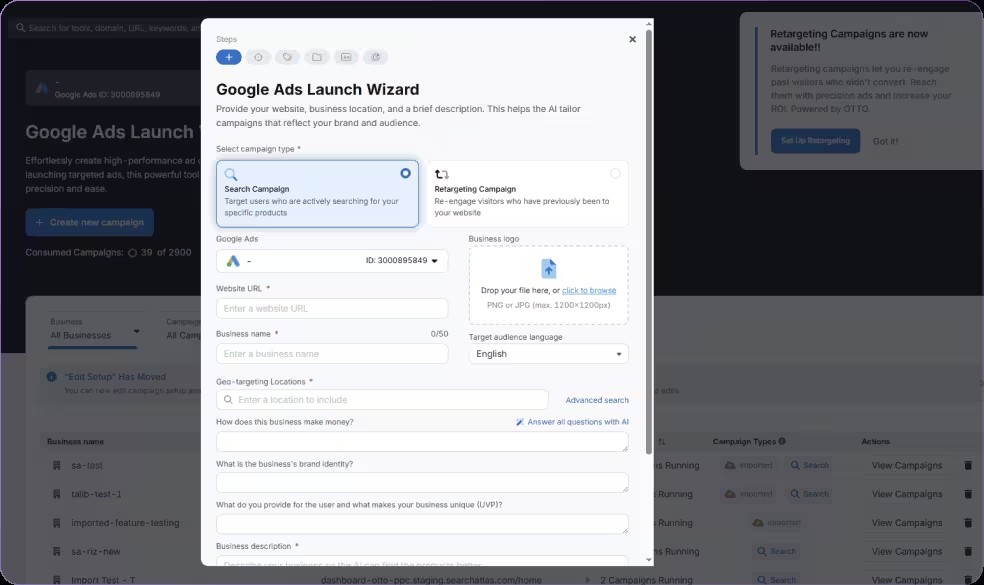
The launch wizard and approval steps make the tool more than a report. Agencies can move from a plain-language goal to a campaign structure and then keep optimization inside the same suite. That can be useful for small teams that cannot maintain a separate PPC automation stack.
Paid automation deserves stricter controls than content suggestions. Confirm conversion tracking before allowing budget decisions. Set campaign and account caps, preserve brand exclusions, audit negative keywords, inspect search terms, and verify that ROAS uses reliable conversion values. Smart Ads operates on top of Google Ads; it does not replace Google Ads, business economics, or a skilled media buyer.
LLM Visibility for mentions, placement, sentiment, and share of voice
LLM Visibility tracks whether a brand appears in AI answers, where it is placed, how it is described, and how its share of voice compares with competitors. Official pages reference ChatGPT, Gemini, Perplexity, Claude, and other AI experiences, while available models and quotas vary by plan.
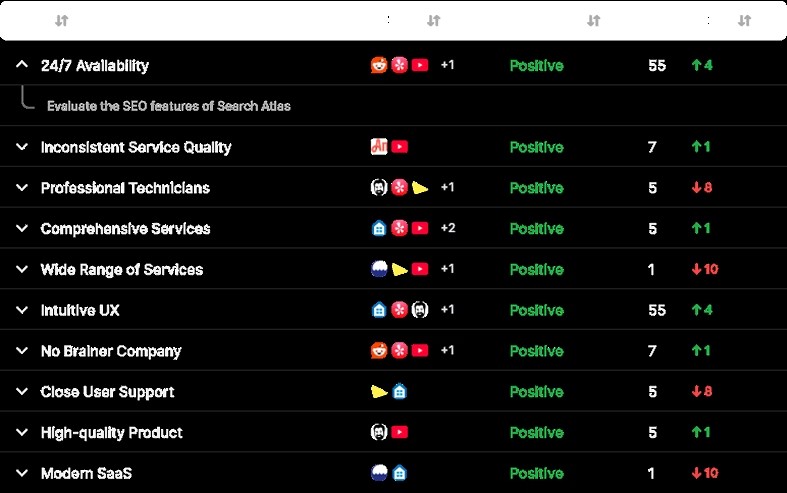
This extends reporting beyond traditional rankings. An enterprise brand or agency can monitor AI-answer themes, citations, sentiment, competitor coverage, and historical movement. The platform also connects visibility findings to actions through its broader agent and content workflows.
LLM tracking is inherently sampled. Results can vary by model, prompt, location, account context, and refresh time. Buyers should examine the query set, model coverage, refresh frequency, credit formula, citation versus mention logic, and export options. A visibility score is useful only when the tracked prompts represent real buyer journeys.
Core SEO, local, authority, and reporting tools
Search Atlas also includes Site Explorer, Site Auditor, on-page audits, keyword research, rank tracking, backlink analysis, report building, GBP automation, local citations, heatmaps, outreach, press releases, and authority tools. These modules matter because they provide data and delivery channels for Atlas Agent and OTTO.
The suite can replace several subscriptions, but replacement should be proven module by module. Compare the data freshness, country coverage, keyword limits, backlink depth, local-grid needs, report templates, white-label controls, and export requirements your team actually uses. A broad checklist does not guarantee equivalent depth to a specialist platform.
How Does Search Atlas Work?
A controlled Search Atlas rollout has eight steps:
- Choose one representative project. Start with a site that reflects your normal CMS and workflow but is not the highest-risk revenue property.
- Connect first-party data. Link Google Search Console, Google Analytics, Google Business Profile, Google Ads, or other relevant sources. Verify permissions and data ownership.
- Install the deployment connection. Use the OTTO Pixel, Cloudflare, a native CMS connector, or an approved code path. Record the existing site state before activation.
- Run baseline audits. Capture crawl, indexation, ranking, traffic, conversion, content, and AI-visibility baselines before approving changes.
- Keep approval mode on. Review proposed technical, on-page, content, local, and paid actions. Label protected pages and changes that require a specialist.
- Execute one bounded Playbook. Choose a task with a measurable outcome, such as missing metadata on a noncritical content set or an underperforming article refresh.
- Verify the deployment. Inspect source code, rendered HTML, crawlability, schema, analytics, conversions, and search behavior. Confirm that rollback works.
- Expand by evidence. Automate only tasks that pass QA repeatedly. Document owners, approvals, exception handling, quotas, and monthly ROI.
Our future Search Atlas tutorial will break this rollout into a detailed implementation checklist. The broader AI SEO writing tools hub explains where content automation fits beside specialized editors and research platforms.
What Is Search Atlas Like in Real Use?
This review is based on current product documentation, pricing, terms, official interface assets, independent reviews, and live-account testing. That combination matters because Search Atlas changes quickly and plan details can move faster than third-party tutorials.
The public workflow shows a platform built for action, not quiet analysis. Atlas Agent, OTTO, Content Genius, Smart Ads, and CMS connections all push users toward execution. For experienced marketers, this can remove repetitive work. For beginners, it can create false confidence because a prepared action looks more authoritative than it is.
Independent reviewers generally identify the same trade-off. They praise the breadth, automation, local SEO, reporting, and value relative to buying several tools. Recurring criticisms include a learning curve, crowded navigation, occasional bugs or slow reports, and the need to review OTTO changes. One 2026 reviewer who used the Growth plan reported crashes and slower reports while still describing the platform as ambitious and feature-rich. A sponsored hands-on review also noted confusing interface placement, occasional bugs, and the trust required for direct site changes.
Onboarding support can reduce setup friction. The official pricing page currently includes a free 30-minute one-on-one onboarding session even during the trial. Use it to configure one project and clarify quotas, not as a generic product tour. Bring a written test plan and ask the specialist to show where approvals, logs, rollback, cancellation, and data exports live.
The suite will feel expensive if you use one module. It can feel economical when it replaces research, content optimization, rank tracking, local reporting, AI visibility, and deployment tools. Calculate replacement value conservatively. Do not count a feature as a saving until it matches the depth and reliability of the subscription you plan to cancel.
How Much Does Search Atlas Cost?
Search Atlas currently lists four monthly plans plus custom enterprise options. Every public plan advertises a seven-day free trial, and the pricing page says trial users can book a 30-minute onboarding session.
| Plan | Monthly price | AI SEO projects | User seats | Positioning |
|---|---|---|---|---|
| Starter | $99 | 1 | 1 | Solo marketers, freelancers, and one-person agencies |
| Growth | $199 | 2 | 3 | Scaling agencies and mid-sized businesses with multiple sites |
| Pro | $399 | 4 | 5 | High-volume agencies and advanced SEO teams |
| Agency | $999 | 10 | 10 | Larger client portfolios, higher quotas, priority support, and white label |
| Enterprise | Custom | Tailored | Tailored | Large organizations needing custom quotas, onboarding, and support |
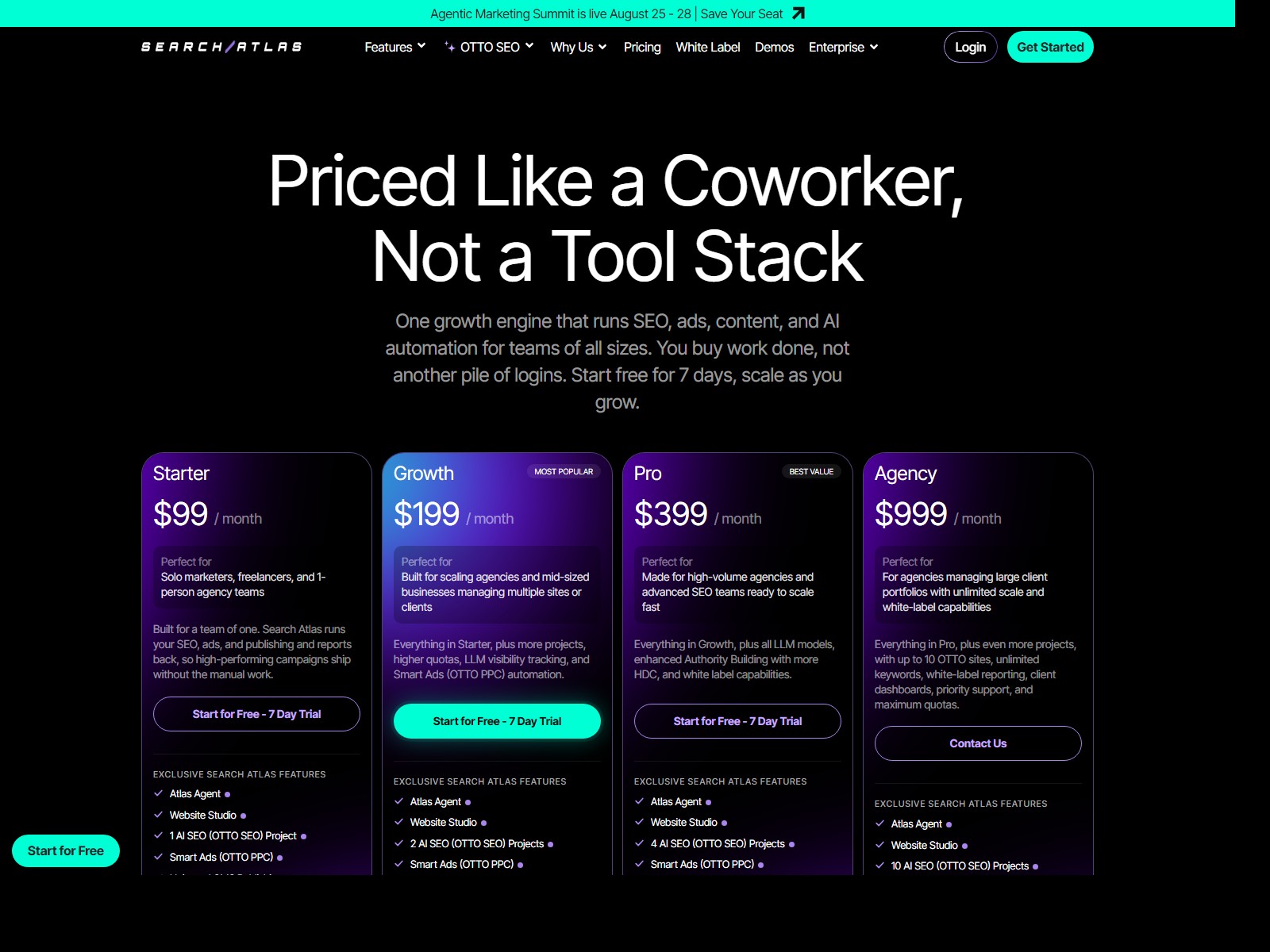
The headline prices do not show total capacity. Current pricing tables also vary AI quota, content pages, AI article credits, content plans, on-page audits, target keywords, semantic-grader usage, rank-tracking projects and refreshes, LLM Visibility projects and credits, Google Business Profile projects, and authority-building allowances. Top-ups may add cost.
Starter currently includes 500 monthly AI credits, 40 content pages, 30 AI article credits, 40 content plans, and one OTTO project according to the public comparison table. Growth, Pro, and Agency increase these allowances. Verify every quota at checkout because official pages and older reviews can disagree as the product evolves.
The free trial requires active management. The official FAQ says access moves to a paid plan after seven days unless canceled and notes that trial AI quota is limited. Set a cancellation reminder before starting.
Refund terms are strict. Search Atlas states that most cases follow a no-refund policy. Its published criteria require monthly refund requests through live chat within 48 hours of billing and less than 10% usage of every tool quota. Annual requests have a 72-hour window, may qualify for a 50% refund, and also apply the usage rule. Promotional subscriptions, add-ons, and upgrades are excluded unless stated otherwise. Confirm the current policy before payment.
For updated offers, use our future Search Atlas coupon and trial verification instead of relying on unverified coupon directories. If the platform fits your rollout plan, compare the current Search Atlas plans and capture the checkout terms before submitting payment.
What Are the Pros and Cons of Search Atlas?
Search Atlas trades simplicity and specialist depth for breadth, connected execution, and agency-scale automation.
| Pros | Cons |
|---|---|
| Executes approved SEO work instead of only reporting issues | Broad interface and quotas create a real learning curve |
| Combines SEO, content, local, PPC, AI visibility, and reporting | Automation can scale a bad recommendation or configuration |
| Starts at $99 with one OTTO project and a seven-day trial | Trial converts to paid unless canceled |
| Atlas Agent and Playbooks connect strategy to repeatable workflows | Natural-language actions still need logs, approvals, and QA |
| Content Genius links research, drafting, optimization, and publishing | AI drafts still require sourcing, expertise, editing, and brand control |
| Smart Ads adds campaign creation and ongoing optimization | Paid automation needs reliable tracking, caps, and media-buyer oversight |
| Native CMS, Cloudflare, and code connectors reduce ticket queues | Connector behavior and rollback should be tested before broad deployment |
| Agency, reporting, local, and white-label capabilities support scale | Independent reviewers report occasional bugs, slow reports, or navigation friction |
| LLM Visibility connects AI-search measurement to action | LLM data is sampled and credit-based; prompt coverage must be audited |
| Free one-on-one onboarding is available during the trial | Published refund conditions are narrow and time-sensitive |
What Are the Best Search Atlas Alternatives?
The right alternative depends on which part of Search Atlas you value and which complexity you want to avoid.
| Alternative | Better fit when... | Trade-off versus Search Atlas |
|---|---|---|
| Semrush | You want a mature all-in-one research, competitive intelligence, advertising, and reporting ecosystem | More modules or add-ons may be needed, and implementation is less unified |
| Ahrefs | Backlink research, web crawling, and competitive content data are the highest priorities | Less focused on autonomous on-site deployment, local operations, and paid execution |
| SE Ranking | Agencies want approachable rank tracking, audits, reporting, and client workflows at a lower entry point | Agentic deployment and suite breadth are more limited |
| Surfer SEO | The central job is content briefs, on-page optimization, and AI-assisted writing | It is not a replacement for technical, local, backlink, PPC, or agency operations |
| Alli AI | Automated on-page and technical deployment is the primary requirement | Search Atlas covers a wider research, content, local, reporting, and ads stack |
| AgencyAnalytics | White-label client dashboards and reports matter more than execution | Reporting is the product; SEO, content, and PPC work still happens elsewhere |
Search Atlas is the execution-first choice. Semrush and Ahrefs remain stronger reference points for mature data ecosystems, Surfer is narrower for content, Alli AI is narrower for deployment, and AgencyAnalytics centers reporting. Our future Search Atlas alternatives comparison will evaluate these options by automation, data depth, agency controls, implementation burden, and total subscription cost.
Where Does Search Atlas Fall Short?
The suite is difficult to evaluate quickly. Seven days is enough for one controlled workflow, not every toolkit. Buyers who click through modules without a test plan may reach billing without understanding deployment, quotas, or replacement value.
Breadth can reduce interface clarity. Independent reviewers report crowded navigation, tools placed in unexpected locations, slower reports, or occasional instability. Rapid feature releases are valuable, but agencies need predictable behavior more than novelty.
Automation raises governance risk. OTTO and Atlas Agent can change a site faster than a manual team. That is useful when the rules are right and expensive when they are wrong. Approval mode, protected URLs, backups, logs, staged rollout, and rollback tests are requirements, not optional enterprise polish.
Quota economics are complex. A monthly price includes projects, seats, AI credits, content credits, tracking, LLM queries, GBP projects, and authority allowances. The first capacity limit can force an upgrade even when the rest of the plan is underused.
Specialist data depth must be proven. A tool can contain backlink, keyword, audit, local, and rank-tracking modules without matching the index size, update speed, geographic coverage, exports, and historical depth of every specialist competitor.
AI content needs human evidence. Content Genius can accelerate research and drafting, but search visibility depends on factual accuracy, experience, originality, useful media, brand trust, and conversion design. Publishing speed is not a quality metric.
Smart Ads does not remove financial accountability. Budget movement and negative-keyword automation can save time, but poor conversion tracking or strategy can turn automation into faster waste.
Refund flexibility is limited. Short request windows and low usage thresholds make trial cancellation and billing documentation essential.
Which Search Atlas Attributes Should Buyers Check?
Use this buyer checklist before choosing a plan:
- Execution bottleneck: Identify which recommendations currently wait for developers, writers, local specialists, or media buyers.
- Project count: Map every site and client to the required OTTO, audit, rank-tracking, LLM, content, GBP, and ads projects.
- Quota forecast: Estimate AI credits, articles, content plans, audits, keywords, LLM refreshes, and likely top-ups.
- Deployment route: Test the exact Pixel, Cloudflare, CMS, or code connector used in production.
- Approval policy: Separate safe bulk work from changes requiring SEO, developer, legal, editorial, or media-buyer sign-off.
- Protected assets: List checkout, lead, pricing, legal, international, programmatic, and high-traffic URLs that should not change automatically.
- Rollback proof: Verify how each change is logged, reversed, preserved, or removed after cancellation.
- Data quality: Compare keyword, backlink, rank, local, and audit outputs against current tools and first-party data.
- Content QA: Require sources, SME review, originality, brand checks, visual rights, internal links, schema, and final approval.
- Paid-media controls: Confirm conversion values, budget caps, exclusions, search-term review, pacing, and account ownership.
- Agency governance: Test seats, roles, client separation, white labels, reports, exports, and support escalation.
- Commercial terms: Save the checkout price, renewal, trial conversion, refund window, usage rule, add-ons, and cancellation evidence.
- ROI measurement: Track hours saved, tickets removed, deployment cycle time, content revision rate, ad waste, ranking movement, qualified traffic, and conversions.
Is Search Atlas Worth It?
Search Atlas is worth considering when your team already knows what good SEO and campaign governance look like but needs faster execution across several workflows. At $99, Starter can offer strong value to a freelancer or small operator using OTTO, content, auditing, rank tracking, and reporting. Growth and Pro make more sense when multiple sites, seats, LLM visibility, white labels, and larger quotas support revenue-producing work.
It is not automatically cheaper than a tool stack. The suite only saves money when its modules replace software and labor without reducing data quality, control, or reliability. A team that uses one feature, exceeds one quota, or keeps all old subscriptions may pay more while adding complexity.
Use the trial as an operational test. Measure one deployment from baseline to verified result, inspect one AI content workflow, audit one Smart Ads recommendation set without risking budget, and calculate capacity for the next three months. If the outputs pass review and the saved labor exceeds the fee, start with the appropriate Search Atlas plan. If not, choose the specialist alternative that matches the actual bottleneck.
How We Test and Score
ScaleWitAI funds every account used in this review with its own capital. We subscribe to all paid tiers with self-funded plans and never use sponsored, gifted, or vendor-provisioned accounts, so our evaluation reflects the same product a paying customer receives and stays 100% independent of vendor influence.
Evaluation combines standardized test suites with hands-on workflow testing. We use HumanEval-style tasks to probe logic and code reasoning, BLEU/ROUGE-style metrics to measure natural-language quality, and internal stress-test scenarios to map context-window limits and long-input behavior. We run more than 10,000 prompts per AI platform every year, across varied access conditions, and log results against a transparent scoring rubric.
The dataset for this review was collected over 12 months (from August 2025 to August 2026). Historical comparisons track AI model development since 2024, and this report tests and compares 12+ leading AI models and providers on the market.
Frequently Asked Questions
Is Search Atlas a legitimate SEO platform?
Yes. Search Atlas is an established SEO and marketing software platform with public product documentation, pricing, integrations, case studies, independent reviews, and third-party review listings. Buyers should still verify individual feature claims and commercial terms during the trial.
How much does Search Atlas cost?
Search Atlas currently lists Starter at $99 per month, Growth at $199, Pro at $399, and Agency at $999. Enterprise pricing is custom. Projects, seats, AI credits, content allowances, tracking, local features, and LLM Visibility capacity differ by plan.
Does Search Atlas offer a free trial?
Yes. Public pricing pages advertise a seven-day free trial and a 30-minute onboarding session. The official FAQ says the trial has limited AI quota and moves to a paid plan unless canceled, so record the billing date and cancellation process before starting.
What is OTTO SEO?
OTTO SEO is Search Atlas’s execution engine for technical, on-page, content, local, indexing, and authority tasks. It can connect through a Pixel, Cloudflare, CMS, or code workflow and run in approval or autopilot mode. Teams should test changes and rollback on a limited scope first.
Can Search Atlas replace Semrush or Ahrefs?
It can replace parts of those workflows for teams that value execution, content, local SEO, AI visibility, and connected reporting. It may not replace every specialist database or historical workflow. Compare the exact keyword, backlink, rank, audit, export, and geographic requirements before canceling another platform.
Does Search Atlas create and publish content?
Yes. Content Genius can research a topic, build a brief, draft and refine content, suggest schema and visuals, and publish through supported CMS workflows. Human sourcing, subject expertise, editorial QA, and final approval remain necessary.
Can Search Atlas manage Google Ads?
Smart Ads can create and audit Google Ads campaigns, propose keywords and copy, clean negative keywords, track pacing, reallocate budget, support retargeting, and generate reports. It works on top of Google Ads and still requires correct conversion tracking, budget controls, and accountable paid-media oversight.
What CMS platforms work with OTTO SEO?
Current official pages list WordPress, Shopify, HubSpot, Webflow, Contentful, and Duda among native CMS connections, plus Cloudflare, GitHub, Vercel, and Netlify deployment routes. Confirm the exact connector behavior, permissions, and rollback process for your stack.
Is Search Atlas good for agencies?
Yes, especially for agencies that can use multi-site SEO, content, local tools, Smart Ads, reporting, white labels, and automation. The agency must still map quotas to clients, separate permissions, define approval policies, and validate reliability before scaling across the portfolio.
What is the Search Atlas refund policy?
The published policy is restrictive. Monthly requests generally must be made through live chat within 48 hours of billing with less than 10% usage of every tool quota. Annual requests have a 72-hour window and may receive a 50% refund under the usage condition. Verify the current policy before purchase.
