Clearscope and Scalenut both help teams optimize content for Google and AI search, but they solve the job from opposite directions. Clearscope is a focused, editorial-first optimizer with polished recommendations. Scalenut is a broader production platform that combines planning, AI drafting, optimization, audits, and visibility tracking.
| At a glance | Clearscope | Scalenut |
|---|---|---|
| Best for | Editorial teams prioritizing reliable optimization | Teams wanting an all-in-one creation and GEO workflow |
| Entry price checked July 30, 2026 | $129/month | $59/month regular monthly price |
| Free trial | 14 days | 7 days |
| Main advantage | Focused optimization and easy adoption | Broader automation at a lower entry price |
| Main trade-off | Higher starting price and fewer production tools | More moving parts and less focused editing experience |
| Visit | Try Clearscope | Visit Scalenut |
The practical choice is not simply which platform has more features. It is whether your bottleneck is improving content quality inside an established editorial process or producing and managing more SEO content from one system. If you want deeper context on Clearscope before comparing it, read our full Clearscope review.
Quick Verdict: Clearscope or Scalenut?
Choose Clearscope if your team already has writers, briefs, and publishing systems but wants a fast, dependable optimization layer. Its strongest qualities are the focused editor, clear Content Grade, term recommendations, intent analysis, and integrations with Google Docs, Microsoft Word, and WordPress. Unlimited users and projects on current plans also make its account structure easier for agencies and larger editorial groups.
Choose Scalenut if you want a lower-cost platform that can plan, draft, optimize, audit, and publish content. Cruise Mode, keyword clustering, GEO scoring, AI visibility monitoring, WordPress and Shopify publishing, and site-level audits reduce the need for separate tools. It is the more feature-dense option for solo operators and teams that need content throughput.
Our overall winner for content optimization quality is Clearscope. Our value and automation winner is Scalenut. Neither guarantees rankings or AI citations. The better purchase depends on whether workflow focus or platform breadth creates more value for your team.
Clearscope vs Scalenut at a Glance
| Comparison area | Clearscope | Scalenut | Winner |
|---|---|---|---|
| Content optimization | Focused term, intent, readability, and grade feedback | GEO Score across terms, structure, prompts, and other checks | Clearscope for editorial focus |
| AI long-form writing | AI drafting and editing assistance | Guided Cruise Mode from keyword to draft | Scalenut |
| Keyword planning | Topic Explorations and intent analysis | Keyword Planner with clusters and gaps | Scalenut for breadth |
| AI search visibility | Prompt tracking, brand visibility, citations, fan-out awareness | Prompt tracking, mentions, sentiment, citations, recommendations | Tie, with different workflow strengths |
| Content audits | Page monitoring and content analytics | Site audits, optimizer routing, GSC analysis, and technical modules | Scalenut |
| Collaboration | Unlimited users, sharing, exporting, and common editor integrations | Plan-based team limits, workspaces, comments, and publishing integrations | Depends on team structure |
| Ease of adoption | More focused and easier to standardize | Broader platform with more modules to learn | Clearscope |
| Starting price | $129/month | $59/month regular monthly billing | Scalenut |
The feature count favors Scalenut, but the comparison is closer when a team only needs one dependable optimizer. Paying for unused modules does not create value. Conversely, a cheaper optimizer can become expensive if you still need separate tools for drafting, keyword clustering, auditing, and publishing.
What Is the Core Difference Between Clearscope and Scalenut?
Clearscope is primarily an optimization and content intelligence platform. It analyzes search results and language patterns, then gives editors a focused workspace for improving relevance, coverage, readability, and intent alignment. Its newer product set also covers topic discovery, AI-assisted writing, content monitoring, internal linking, and AI search visibility, but the editorial optimization experience remains its center of gravity.
Scalenut is an all-in-one SEO and generative engine optimization platform. It tries to move a user from research to execution without leaving the product. The workflow includes keyword clusters, Cruise Mode drafting, a GEO AI Editor, existing-content optimization, audits, traffic analysis, internal linking, AI visibility, and direct publishing.

This distinction affects who benefits most. Clearscope helps a content team make a strong draft more complete without dictating the whole production process. Scalenut is more willing to generate the draft, structure the process, apply changes automatically, and connect optimization to site-level actions.
Clearscope vs Scalenut Feature-by-Feature
| Capability | Clearscope approach | Scalenut approach |
|---|---|---|
| SERP analysis | Builds reports from ranking pages and language relevance | Benchmarks content and outlines against ranking competitors |
| Optimization score | Letter-based Content Grade | Numeric GEO Score and optimization parameters |
| Term guidance | Important terms with target usage ranges | NLP key terms with usage guidance |
| Intent support | Search intent insights and audience questions | Intent-led clusters, prompts, competitor outlines, and questions |
| Draft generation | AI-assisted drafting within the content workflow | Guided full-draft generation through Cruise Mode |
| Existing content | Optimization reports, page monitoring, and protective views | URL import, content optimizer, audits, gaps, and auto fixes |
| AI visibility | Tracks prompts, mentions, citations, and fan-out behavior | Tracks visibility, sentiment, prompts, citations, and competitors |
| Publishing | WordPress integration plus editor exports and sharing | WordPress and Shopify auto-publishing on eligible plans |
Research and briefing
Clearscope emphasizes the information an editor needs before or during drafting. Topic Explorations help teams understand a subject beyond one keyword, while search intent analysis, questions, citations, and competitor signals can support a useful brief. The output is particularly suitable when strategists create briefs and writers work elsewhere.
Scalenut connects research more tightly to production. Its Keyword Planner groups terms into clusters, shows competing domains, and gives the user an intent-oriented prompt. Cruise Mode then uses SERP information and selected references to generate titles, outlines, and a draft. This is helpful when one operator owns research and writing or when an agency needs a repeatable production lane.
Winner: Scalenut for an integrated brief-to-draft workflow. Clearscope for a lighter intelligence layer that fits an existing content operation.
Content optimization and scoring
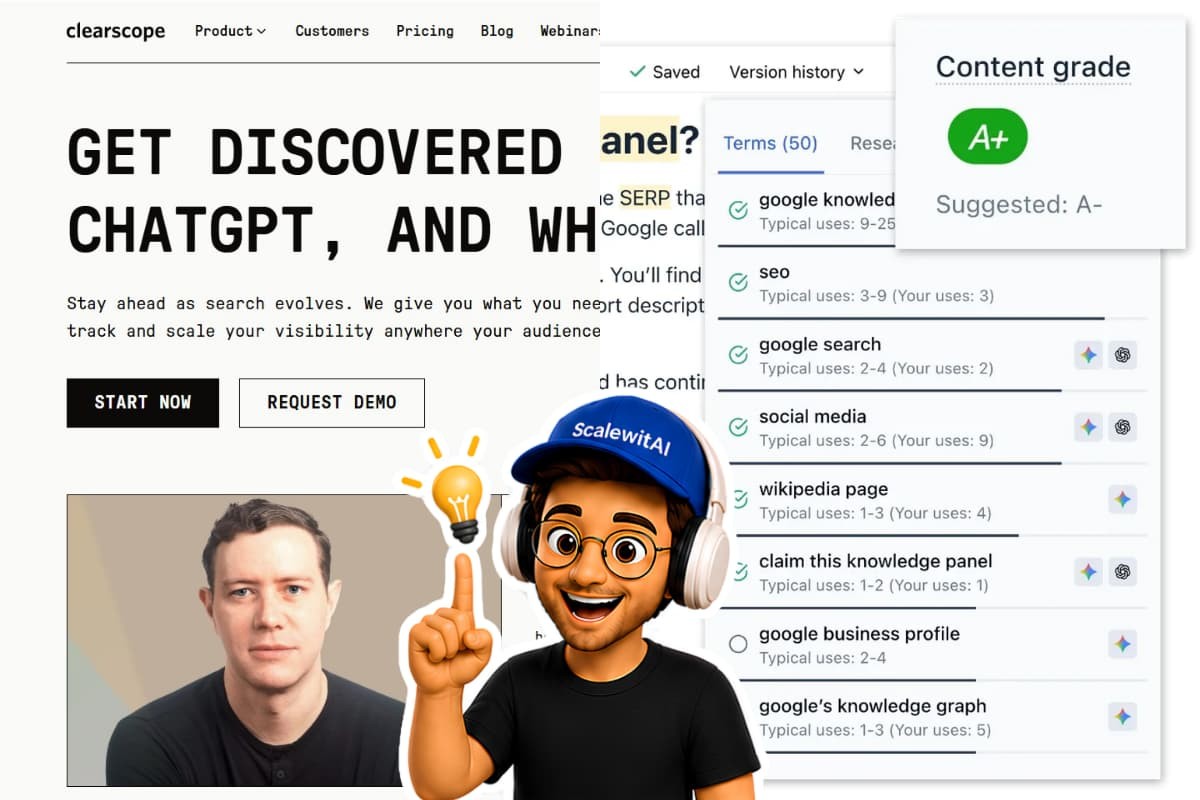
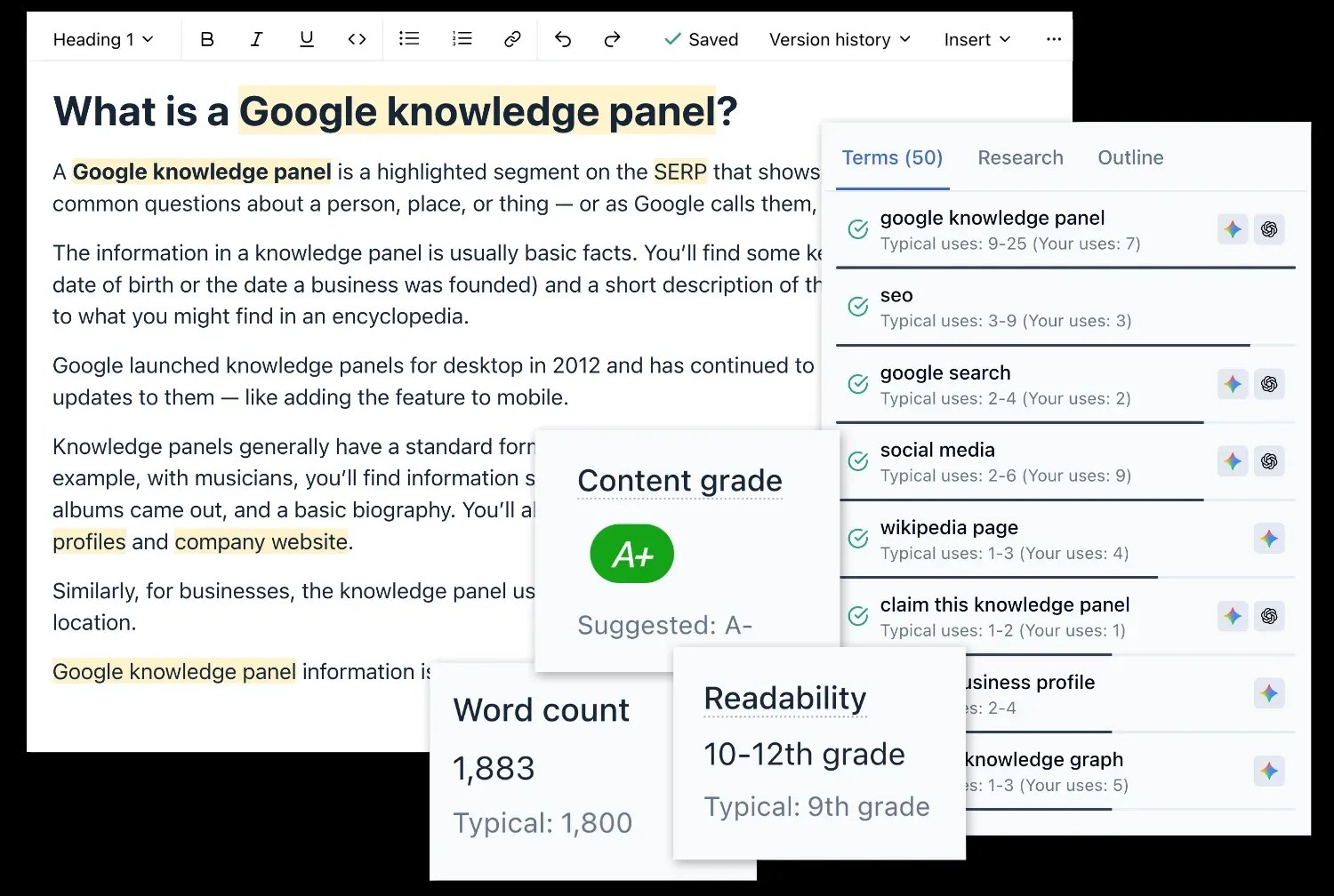
Clearscope’s Content Grade measures how well a draft covers the important terms associated with a target query. The grade runs from F to A++ and updates as the text changes. Word count and readability remain separate metrics, which helps editors see whether a draft has topical gaps without treating length or sentence complexity as the same signal. Our guide to the Clearscope grading system explains this calculation in more detail.
The interface is intentionally restrained. A writer can focus on the draft, relevant terms, questions, and competitor context without navigating a large suite. That simplicity matters when many freelancers or subject-matter experts must follow the same quality standard.
Scalenut uses a numeric GEO Score and evaluates a wider set of factors. Its current documentation describes real-time feedback across content structure, term coverage, prompt coverage, word count, readability, and image use. The editor also includes Fix It and Auto Optimizer capabilities for users who want software to apply changes rather than only flag opportunities.
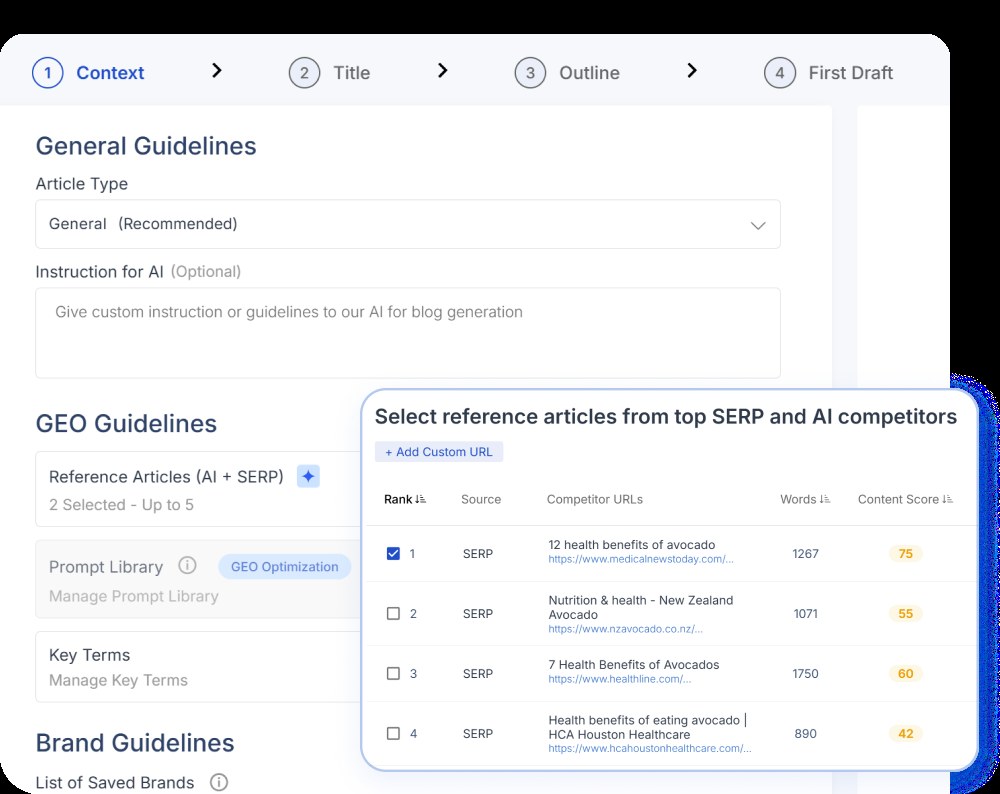
The trade-off is control. Automated changes can accelerate an early optimization pass, but an editor must still verify facts, tone, intent, and whether each added term contributes meaning. Clearscope’s more manual approach can be slower, yet it encourages deliberate editing and is easier to audit sentence by sentence.
Winner: Clearscope for focused, human-led optimization. Scalenut for broader checks and faster automated fixes.
AI writing and content production
Scalenut has the clearer advantage for generating complete long-form drafts. Cruise Mode guides users through keyword and location selection, context, title, outline, and draft creation. It can incorporate competitor outlines, prompts, references, images, and a chosen article type. That structure reduces the blank-page problem and makes the process teachable across a production team.
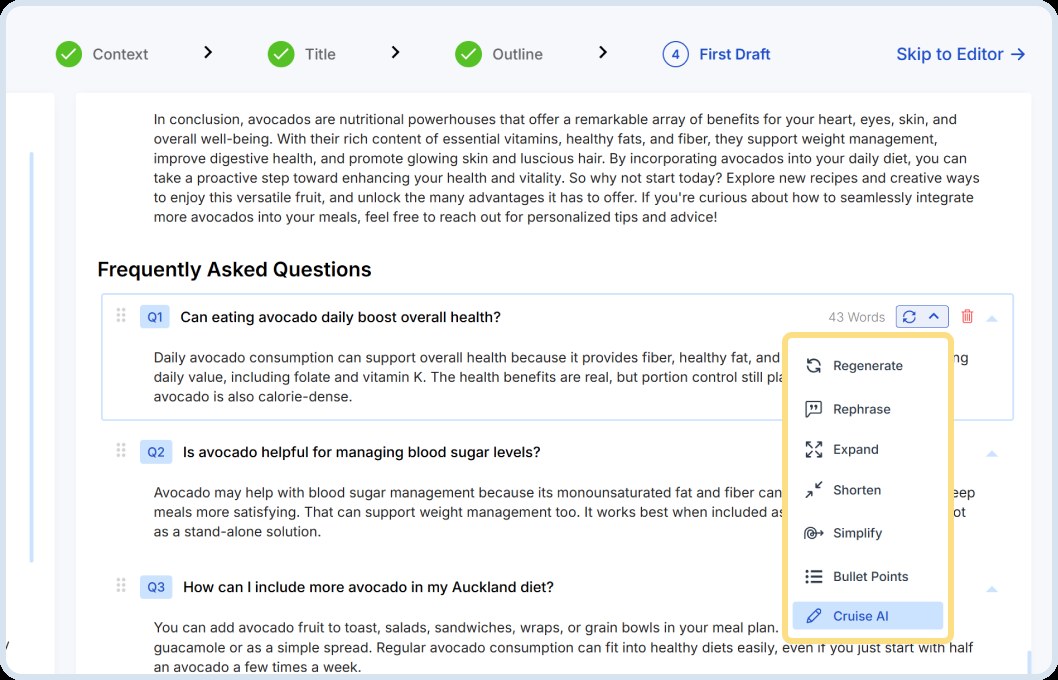
Clearscope includes AI-assisted writing and editing, but it is better viewed as an addition to its optimization workflow than as the primary reason to buy the platform. It is useful for first-pass drafting, expanding an idea, or overcoming a stalled section. Teams that already use a preferred writer or human specialists may see this lighter role as an advantage because optimization remains independent from generation.
Scalenut’s wider automation also introduces a larger review burden. A complete generated draft can look finished before its claims have been sourced or its examples have been made original. A high GEO Score is not a substitute for expert review, first-party evidence, or a clear editorial point of view.
Winner: Scalenut for end-to-end AI content creation. Clearscope for teams that want AI assistance without making generation the center of the workflow.
Content planning and topical authority
Both platforms have moved beyond single-keyword optimization. Clearscope’s Topic Explorations help strategists map connected ideas and search intent. Scalenut’s Keyword Planner generates clusters, highlights competitor coverage, and moves selected opportunities into its writing workflow.
Scalenut is more operational when a team needs to turn keyword research into a calendar and draft queue. Clearscope is more useful when strategists want to investigate a topic, then decide independently how the content system should be structured.
Neither tool replaces strategic judgment. Automated clusters can group terms that share vocabulary but require different page types. Before approving a cluster, check whether the same page can satisfy each query, whether the SERP formats match, and whether the topic supports the site’s entity and commercial goals.
Winner: Scalenut for built-in clustering and execution. Clearscope for focused topic and intent exploration.
Content refreshes, audits, and internal linking
Clearscope supports optimizing live pages, monitoring content performance, and identifying pages that may need attention. Its Protect and internal-linking capabilities can help editorial teams maintain content after publication rather than treating optimization as a one-time task.
Scalenut offers a broader maintenance stack. Content Audit categorizes pages for action, the Content Optimizer imports live URLs, Traffic Analyzer uses Google Search Console data, and Link Manager surfaces internal-link opportunities. Higher plans also include functions such as cannibalization analysis, larger audit limits, and advanced planning.
Scalenut therefore has the edge for teams trying to manage an entire content inventory from one product. Clearscope remains attractive when the maintenance process already lives in an analytics platform, crawler, or project-management system and the team mainly needs dependable page-level recommendations.
Winner: Scalenut for site-wide execution. Clearscope for simpler page-level optimization inside an existing audit stack.
AI Search Visibility: Which Platform Is Better for GEO?
Both products now address visibility beyond traditional Google results. That makes older comparisons that describe them only as SEO content editors incomplete.
| AI visibility capability | Clearscope | Scalenut |
|---|---|---|
| Prompt tracking | Included on current plans | Included with plan-based limits |
| Core engines on entry plan | ChatGPT and Gemini stated on pricing page | ChatGPT and Google AI Overviews stated on pricing page |
| Additional engine access | Product coverage can evolve | Perplexity listed on Professional |
| Brand mentions and citations | Yes | Yes |
| Competitor visibility | Yes | Yes |
| Query fan-out insight | Explicitly included | Prompt and recommendation workflow |
| Sentiment analysis | Not the central published differentiator | Included in AI Visibility documentation |
| Action workflow | Recommendations, intent, topic, writing, and optimization tools | Recommendations linked to content, links, communities, and publishing |
Clearscope’s current pricing includes prompt tracking, brand visibility tracking, and query fan-out awareness. Query fan-out data is valuable because AI systems may run related web searches before composing an answer. A team can use those subqueries to identify missing supporting pages or sections.
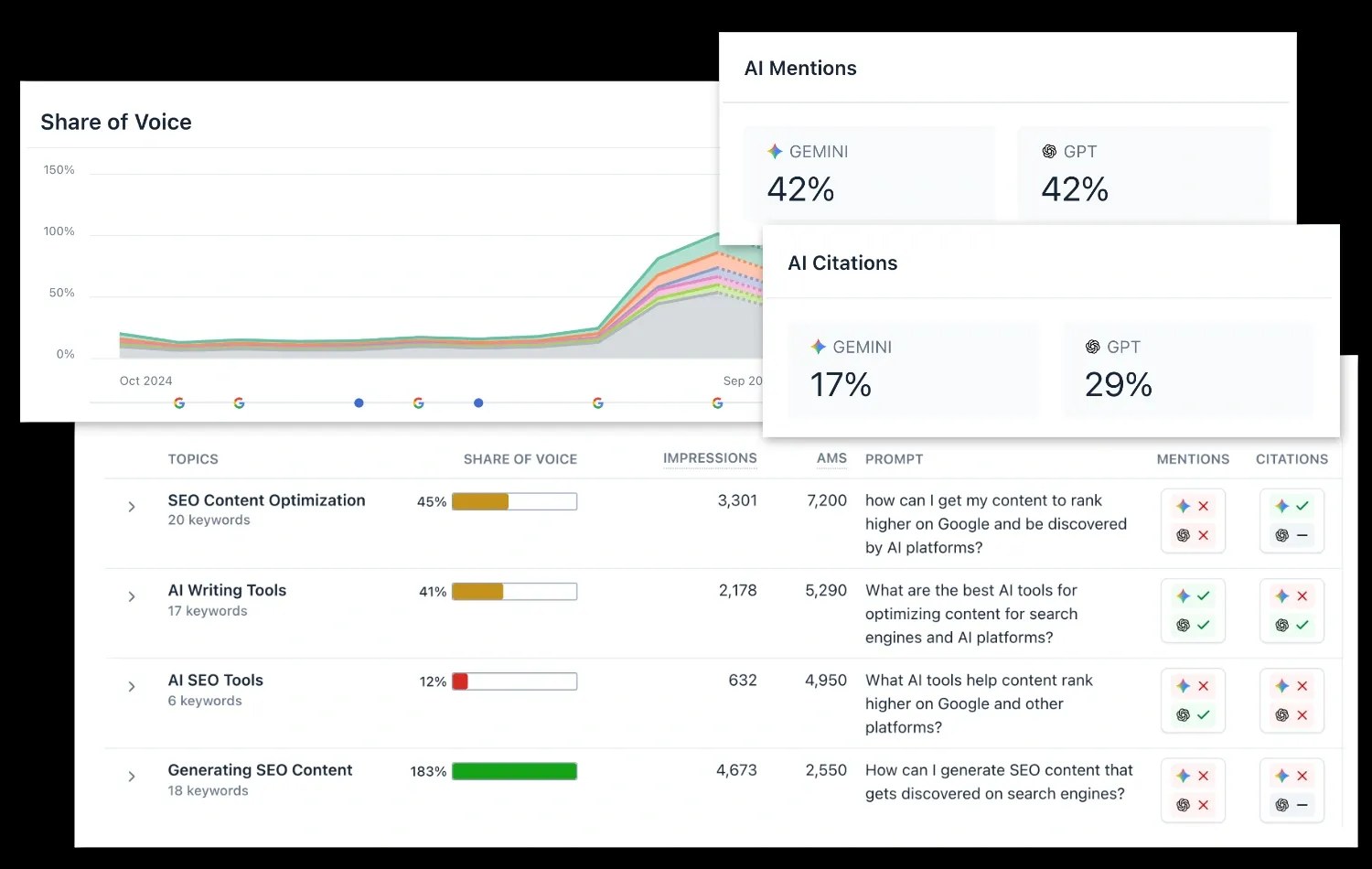
Scalenut’s AI Visibility module emphasizes visibility score, share of voice, mentions, citations, sentiment, prompt context, and competitive comparison. Its strongest distinction is the connection between monitoring and execution. Identified gaps can feed content creation, optimization, internal linking, community research, or backlink actions within the wider platform.
The right GEO tool is still the one that produces decisions your team can execute. Prompt counts alone are not enough. Compare engine coverage, geography, refresh frequency, historical data, citation inspection, competitor controls, and export options during a trial.
Winner: Tie. Clearscope offers a cleaner visibility and content-intelligence experience. Scalenut offers a broader action ecosystem and more explicit sentiment and execution paths.
Integrations, Collaboration, and Publishing
Clearscope integrates with Google Docs, Microsoft Word, and WordPress, which lets writers optimize in familiar environments. Shared report links and exports help teams collaborate without giving every contributor a complex setup. If Google Docs is central to your workflow, our Clearscope Google Docs guide covers the practical setup.
Scalenut integrates with WordPress, Shopify, Semrush, Copyscape, Google Search Console, and other services depending on the module and plan. Its Plus plan advertises auto-publishing to WordPress and Shopify. This is useful for high-volume workflows, but direct publishing should still include an approval gate so generated text, metadata, links, and formatting are reviewed before going live.
| Team workflow | Clearscope | Scalenut |
|---|---|---|
| User model | Unlimited users on current plans | Team limits vary by plan |
| Project model | Unlimited projects | Workspaces tied to domains and plans |
| External editors | Google Docs and Microsoft Word | Primarily platform workflow plus exports and integrations |
| CMS | WordPress | WordPress and Shopify auto-publishing on eligible plans |
| Collaboration | Sharing, exporting, comments, common editor access | Comments, version history, workspaces, team collaboration |
| Best fit | Distributed editorial teams and agencies with existing systems | Teams consolidating creation and publishing inside one platform |
Clearscope’s unlimited-user approach is especially attractive when an agency regularly adds clients, contractors, and reviewers. Scalenut’s workspace and seat model can be better when domains need clearer operational separation, but buyers should map the exact plan limits before committing.
Winner: Clearscope for low-friction editorial adoption. Scalenut for integrated creation-to-publishing automation.
Clearscope vs Scalenut Pricing
Pricing below reflects public US-facing pages checked on July 30, 2026. Promotional annual prices, double-limit offers, and plan entitlements can change, so verify the checkout page before purchasing.
| Plan level | Clearscope | Scalenut |
|---|---|---|
| Entry | Essentials: $129/month | Starter: $59/month regular monthly price |
| Mid-tier | Business: $399/month | Plus: $89/month regular monthly price |
| Advanced | Enterprise: custom | Professional: $199/month regular monthly price |
| Managed service | Custom services available separately | VIP Service: custom |
| Trial | 14 days | 7 days |
| Entry visibility allowance | 50 tracked prompts | 10 prompts, weekly refresh |
| Entry content allowance | 20 monthly Topic Explorations and 20 monthly Drafts | 5 articles, 5 optimizations, and 5 clusters per month at regular limits |
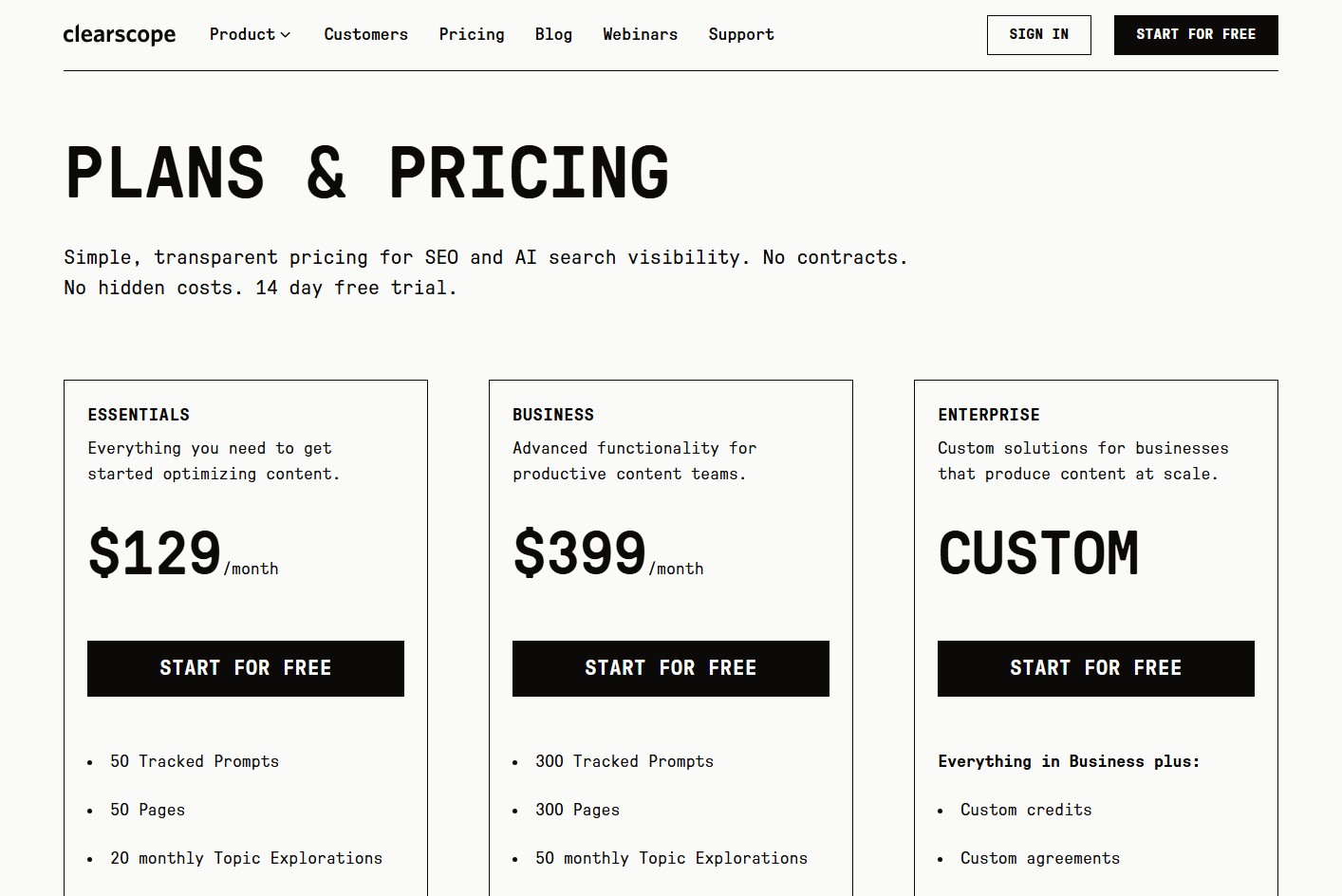
Clearscope’s Essentials plan includes 50 tracked prompts, 50 pages, 20 monthly Topic Explorations, and 20 monthly Drafts. Business raises tracked prompts and pages to 300 and Topic Explorations to 50 while retaining 20 monthly Drafts, according to the public pricing page. Current plans state unlimited users and projects.
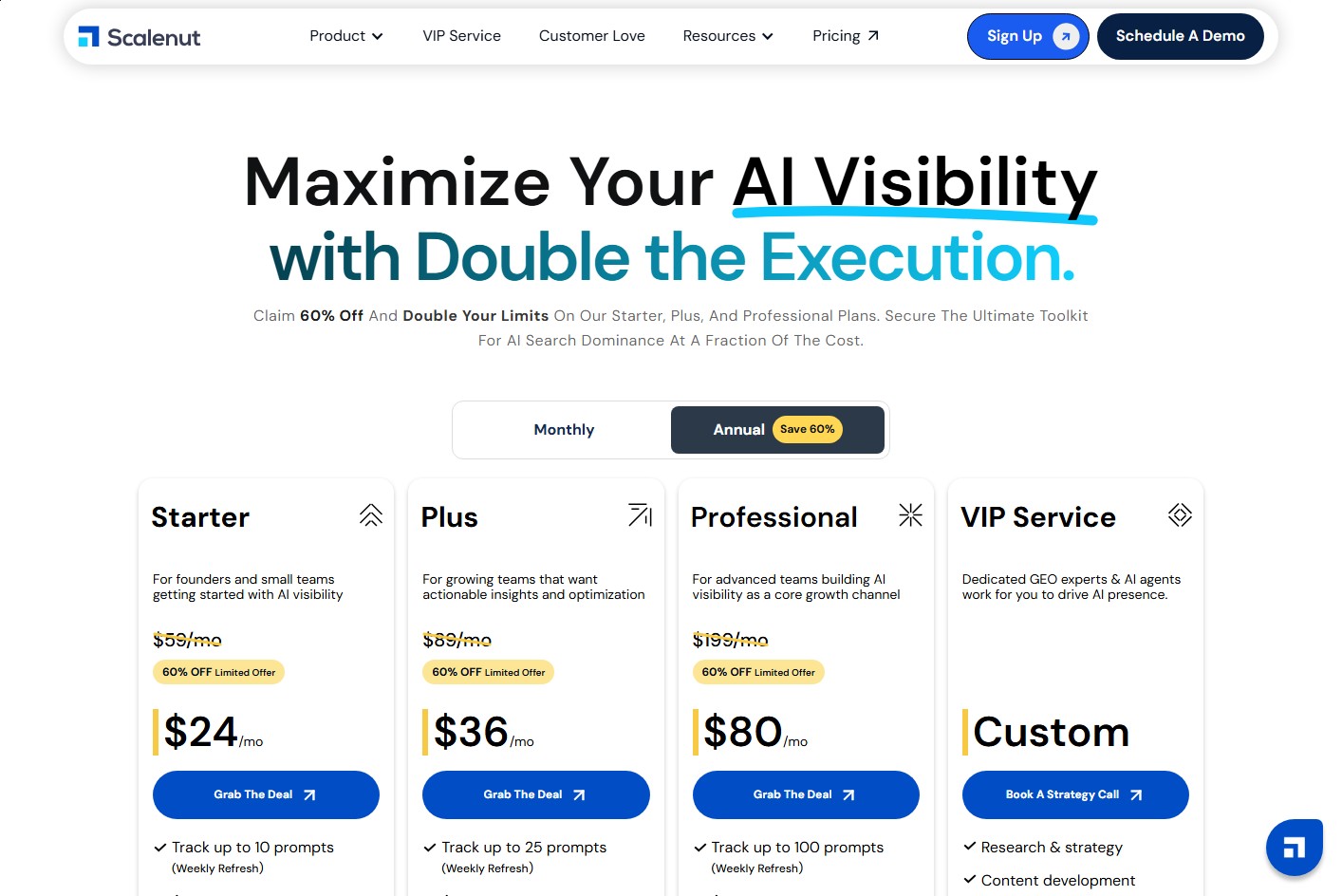
Scalenut’s regular monthly prices start lower. Starter lists 10 tracked prompts, one workspace, and five each of articles, optimizations, and clusters per month. Plus raises production allowances and adds audits, internal linking, topic gaps, auto-publishing, and up to four team members. Professional expands prompts, workspaces, team access, audits, and advanced planning. The pricing page displayed temporary annual discounts and doubled limits during our check; those promotional numbers should not be treated as permanent base pricing.
Which offers better value?
Scalenut offers more functional breadth per dollar when a buyer will use AI drafting, clustering, audits, internal linking, and publishing. It can replace several point solutions for a solo creator or a small content team.
Clearscope can offer better operational value despite the higher price when reliable optimization is the only missing layer. Unlimited users reduce seat friction, the editor requires less training, and the tool fits workflows that already use dedicated systems for planning, writing, analytics, and publishing.
Winner: Scalenut on entry price and feature breadth. Clearscope can still win on total workflow value for established editorial teams.
Clearscope Pros and Cons
Clearscope pros
- Focused optimization experience that is easy to teach and audit
- Clear separation between Content Grade, readability, and word count
- Strong term recommendations, intent context, and editor usability
- Google Docs, Microsoft Word, and WordPress integrations
- Unlimited users and projects on the current pricing structure
- Prompt tracking and AI search visibility included in current plans
- Suitable for agencies and enterprise editorial governance
Clearscope cons
- $129 monthly starting price is high for many solo creators
- Fewer end-to-end production and site-audit functions than Scalenut
- Limited draft allowances can matter for high-volume AI production
- Teams may still need separate keyword, audit, analytics, and publishing tools
- Editors must interpret recommendations rather than rely on one-click optimization
Scalenut Pros and Cons
Scalenut pros
- Lower regular monthly starting price
- Cruise Mode supports research, outline, draft, and optimization in one flow
- Keyword clusters, audits, content optimization, and publishing are connected
- GEO Score combines SEO and AI-search-oriented checks
- AI visibility includes prompts, sentiment, mentions, citations, and competitors
- WordPress and Shopify publishing available on eligible plans
- Professional plan supports unlimited workspaces and team members
Scalenut cons
- The larger feature set creates more interface and process complexity
- Important capabilities and higher limits are gated by plan
- Automated drafts and fixes still require factual and editorial review
- Promotional pricing can make the stable cost harder to interpret
- A numeric score may encourage checklist editing if teams lack content standards
- Teams that already own specialized tools may pay for overlapping functions
Which Tool Is Better for Your Team?
| Buyer profile | Better choice | Why |
|---|---|---|
| Solo creator on a limited budget | Scalenut | Lower entry price and more built-in production tools |
| SEO specialist optimizing expert-written drafts | Clearscope | Focused editor and transparent topical feedback |
| Agency with many writers and client projects | Clearscope or Scalenut Professional | Clearscope minimizes user friction; Scalenut adds domain workspaces and production breadth |
| Content manager with an established stack | Clearscope | Fits existing briefing, writing, and publishing systems |
| Small team replacing several tools | Scalenut | Planning, drafting, optimization, audits, links, and publishing in one platform |
| Enterprise editorial brand | Clearscope | Easier governance, adoption, sharing, and editorial consistency |
| High-volume AI content operation | Scalenut | Cruise Mode and automated execution support throughput |
| GEO team connecting visibility to actions | Scalenut | Monitoring links directly to content, audit, community, and link workflows |
Choose Clearscope if editorial quality is the bottleneck
Clearscope is the safer choice when your team already knows what to publish and can produce credible drafts but needs a consistent optimization standard. It is particularly suitable for subject-matter-expert content, regulated review processes, and distributed writing teams where software should guide rather than rewrite.
Choose Scalenut if throughput and consolidation are the bottlenecks
Scalenut is the stronger choice when research, outlining, first drafts, optimization, auditing, and publishing are fragmented across tools. Its broader system can reduce handoffs and subscription overlap, provided your team has a mandatory human review stage.
Run a practical trial before choosing
Use the same target query, source packet, and existing article in both trials. Then compare:
- How quickly each platform produces an actionable brief.
- Whether recommendations match the real search intent.
- The amount of manual cleanup required after AI drafting or auto-optimization.
- How well each editor preserves facts, brand voice, and information gain.
- Whether visibility tracking covers the engines, prompts, and markets you need.
- The time required to move an approved article into your CMS.
- The actual monthly cost at your expected content and prompt volume.
A controlled test is more useful than comparing feature checkmarks because it measures the work your team will actually perform.
Clearscope and Scalenut Alternatives
If neither workflow fits, compare products based on the same bottleneck rather than searching for a universally best SEO tool. Our guide to Clearscope alternatives maps the broader category.
For a lower-cost content optimization editor with detailed SERP and entity recommendations, see Clearscope vs NeuronWriter. For a comparison involving a platform with broader AI writing and marketing functions, see Clearscope vs Writesonic.
The key distinction is whether you need a specialist editor, an AI production platform, or a complete search visibility system. Many disappointing software purchases come from buying the broadest tool rather than the tool that removes the current constraint.
Frequently Asked Questions
Is Clearscope better than Scalenut?
Clearscope is better for teams that prioritize focused content optimization, easy editorial adoption, and a clean workflow across Google Docs, Microsoft Word, and WordPress. Scalenut is better for teams that want lower-cost, end-to-end planning, AI writing, optimization, auditing, and publishing. The better tool depends on which workflow problem matters most.
Is Scalenut cheaper than Clearscope?
Yes. At the time of our July 30, 2026 check, Scalenut’s regular monthly Starter plan was $59, while Clearscope Essentials was $129 per month. Scalenut also displayed temporary annual promotional pricing. Compare regular prices, allowances, seats, and renewal terms rather than judging the purchase from a temporary discount alone.
Which is better for AI writing?
Scalenut is better for generating complete long-form drafts. Cruise Mode guides users from a keyword through research, title, outline, and draft creation. Clearscope includes AI-assisted writing, but its main strength remains optimization and editorial guidance rather than automated production.
Which is better for content optimization?
Clearscope has the stronger focused optimization experience. Its Content Grade, term guidance, readability metric, questions, and intent context are easy for writers and editors to apply. Scalenut offers broader GEO scoring and automated fixes, which may be preferable when speed and automation matter more than a minimalist editor.
Do Clearscope and Scalenut track AI search visibility?
Yes. Both now track aspects of brand visibility in AI-generated results. Clearscope includes prompt tracking, brand visibility, citations, and query fan-out awareness. Scalenut includes prompt tracking, visibility scores, mentions, citations, sentiment, competitive analysis, and action recommendations. Engine coverage and limits vary by plan.
Which tool is better for ChatGPT and Gemini visibility?
Both support workflows for AI visibility, but neither can guarantee a mention or citation. Clearscope’s current pricing explicitly mentions prompt tracking across ChatGPT and Gemini. Scalenut’s entry plans list ChatGPT and Google AI Overviews, while higher-level coverage includes additional engines. Test the exact engines, countries, and prompt sets your team uses.
Which is better for agencies?
Clearscope is attractive to agencies that need unlimited users and projects with a simple optimizer that external writers can learn quickly. Scalenut can be better for agencies that want multiple domain workspaces, integrated production, audits, and publishing. Model your expected clients, seats, articles, optimizations, and prompts before comparing plan costs.
Can either tool guarantee higher Google rankings?
No. Both platforms can help a team improve relevance, coverage, structure, and workflow efficiency, but ranking also depends on intent satisfaction, originality, authority, links, technical quality, competition, and user response. A content score is a diagnostic signal, not a forecast or guarantee.
Can I use Clearscope and Scalenut together?
Yes, but the overlap may be difficult to justify. A team could use Scalenut for clustering and first drafts, then Clearscope for final optimization. Test whether the second editor produces meaningful improvements beyond Scalenut’s own optimizer before paying for both.
Does Scalenut have a free trial?
Scalenut’s public pricing page offered a seven-day trial during our check. Clearscope offered a 14-day trial. Trial terms can change, so confirm billing requirements and cancellation rules on the vendor’s checkout page.
What should I test during the free trials?
Use one new article and one declining published page. Compare brief quality, term recommendations, intent alignment, draft cleanup time, collaboration, CMS transfer, AI visibility data, and total monthly limits. Include writers and editors in the test because usability problems often appear during handoffs rather than in the initial demo.