NeuronWriter and Writesonic both help marketing teams produce search-focused content, but they solve different buyer problems. NeuronWriter is a focused AI SEO content optimizer for SERP analysis, semantic recommendations, content scoring, briefs, and pre-publish article improvement. Writesonic is now positioned as an AI Search Growth Engine for AI visibility tracking, SEO agents, content execution, citations, and brand discovery across AI answer platforms.
| At-a-glance | NeuronWriter | Writesonic |
|---|---|---|
| Primary category | AI SEO content optimizer | AI search growth and generative marketing platform |
| Best fit | SEO writers, copywriters, content editors, affiliate teams, SMB content teams | SEO specialists, marketers, agencies, content teams, GEO teams, brands tracking AI search visibility |
| Core workflow | Analyze SERPs, build briefs, improve terms, raise content score, publish stronger pages | Track AI visibility, find prompts and citation gaps, use AI agents, generate content, measure lift |
| Official trial | 7-day Gold trial, 3 analyses, no credit card required | 7-day free trial, no credit card required |
| Pricing signal | Subscription and lifetime buying paths are the main ScaleWitAI buyer routes | Starter from $79/mo, Basic from $199/mo, Growth from $399/mo, Enterprise custom when billed annually |
| Best decision | Choose when article quality is the bottleneck | Choose when AI search visibility, content execution, and generative workflows are the bottleneck |
This comparison is for US SEO specialists, marketers, copywriters, content creators, agencies, content teams, SMBs, and website owners. It explains where the tools overlap in SEO writing, where Writesonic expands into AI search visibility, and when a team should use NeuronWriter as a focused optimizer instead of treating Writesonic as a direct one-for-one replacement.
Quick Verdict: Should You Choose NeuronWriter or Writesonic?
Choose NeuronWriter if your main problem is improving SEO articles before publication. It is the cleaner tool for SERP competitor structure, semantic terms, briefs, scoring, editorial checks, AI-assisted writing, WordPress context, Google Search Console context, and repeatable content quality control.
Choose Writesonic if your main problem is AI search growth across a broader marketing workflow. Writesonic is stronger when the buyer wants AI visibility tracking, prompt monitoring, citation and content fixes, SEO agents, generative content production, traffic or pipeline attribution, and a platform that reaches beyond one article editor.
| Buyer situation | Better choice | Why |
|---|---|---|
| You need to optimize articles before they go live | NeuronWriter | The workspace is built around briefs, terms, scoring, and draft improvement |
| You need AI visibility tracking across answer platforms | Writesonic | The official site focuses on ChatGPT, Claude, Gemini, Google AI Overviews, Copilot, Grok, and similar discovery channels |
| You are a copywriter or SEO editor | NeuronWriter | The daily work happens inside outlines, recommendations, and content scoring |
| You are a GEO or brand visibility marketer | Writesonic | The platform tracks where AI systems mention, ignore, or misrepresent a brand |
| You want a simpler content optimization buying path | NeuronWriter | The scope is narrower and easier to adopt for article production |
| You want AI agents plus SEO execution | Writesonic | The product message includes agents that track, prioritize, act, measure, and repeat |
If NeuronWriter is the content optimizer you want to evaluate first, compare the NeuronWriter subscription option and the NeuronWriter lifetime option. If your team needs a broader AI search growth system, evaluate Writesonic by tracked AI platforms, prompts, content agent workflow, integrations, attribution, and plan limits.
What Is NeuronWriter?
NeuronWriter is an AI SEO content optimization platform for planning, writing, scoring, and improving search-focused content. The official site positions it around ranking on Google, getting cited by AI, competitor analysis, semantic SEO, content optimization, AI writing, internal link suggestions, WordPress, Google Search Console, and API workflows.

NeuronWriter fits the pre-publish content stage. A user can enter a target query, inspect competing SERP pages, create an outline, review recommended terms, draft or improve an article, raise the content score, and prepare the page for publication. That makes it useful for copywriters, SEO editors, affiliate publishers, niche site owners, agencies, and SMB teams that need a repeatable article quality gate.
For deeper product context, read the full NeuronWriter review. If your decision is mainly commercial, the NeuronWriter subscription and lifetime deal options page is the better next step.
What Is Writesonic?
Writesonic is an AI search growth and generative content platform for tracking, fixing, and measuring brand visibility in AI search. Its official homepage says buyers now find answers through AI systems and that brands need to make sure AI platforms find, cite, and describe them correctly.
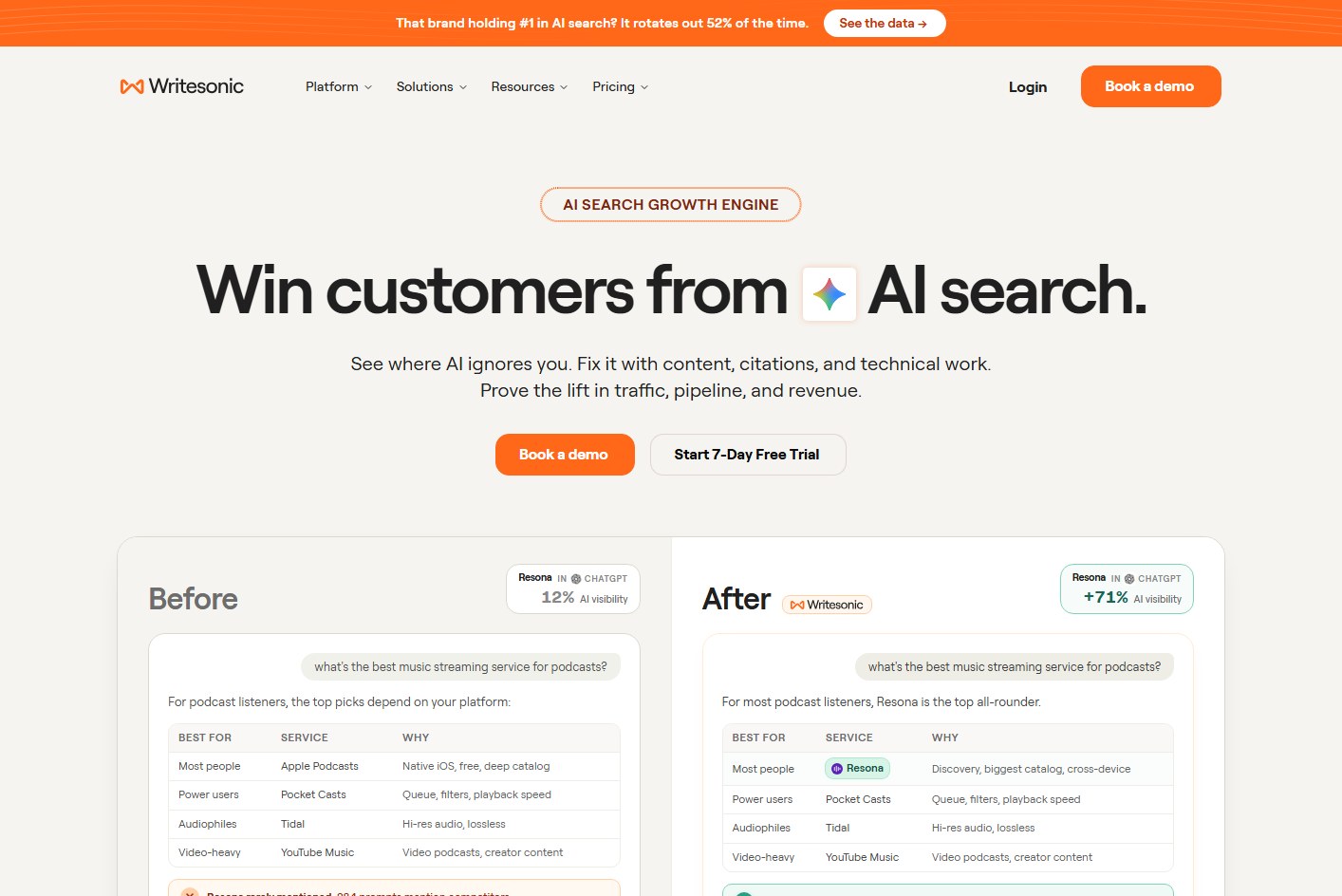
The current Writesonic positioning is not only generic AI writing. The homepage describes an AI Search Loop that tracks visibility, prioritizes gaps, acts through content, citation, and technical workflows, measures lift, and repeats the process. The official pricing page frames Writesonic as an AI Search Visibility Platform for SEO plus GEO, with paid plans for tracking brand visibility across AI platforms and using AI agents to fix visibility gaps.
That makes Writesonic broader than a focused article optimizer. It can help content teams generate and improve assets, but the larger value proposition is brand visibility across AI answer engines. Current self-serve plans focus on ChatGPT, Gemini, and Google AI Overviews; the broader 10-platform coverage listed by Writesonic requires Enterprise.
NeuronWriter vs Writesonic: Core Difference
The core difference is focused article optimization versus broader AI search growth. NeuronWriter helps content teams make a specific page stronger before it goes live. Writesonic helps marketing teams understand where AI search systems mention competitors, find visibility gaps, create or fix content, and measure whether brand visibility improves.
| Attribute | NeuronWriter | Writesonic | Buyer meaning |
|---|---|---|---|
| Main job | Content optimization | AI search growth and generative marketing execution | Different workflow depth |
| Daily user | Writer, editor, content SEO, affiliate publisher | SEO specialist, GEO marketer, agency strategist, brand visibility lead | Different owner |
| Primary proof | Content score, term coverage, SERP content patterns | AI visibility, prompt coverage, citations, sentiment, traffic, pipeline, revenue signals | Different evidence type |
| AI search angle | Create content that can rank and get cited | Track, fix, and measure visibility across AI search platforms | Creation versus growth loop |
| Complexity | Narrower adoption path | Broader platform onboarding | Different training burden |
A small content-led site may start with NeuronWriter because article quality is the first bottleneck. A larger marketing or agency team may choose Writesonic because AI search visibility, citation gaps, and agentic execution need to be managed as an operating loop.
Which Tool Is Better for SEO Content Optimization?
NeuronWriter is usually better when the comparison is limited to focused SEO content optimization. Its public positioning is built around content briefs, SERP analysis, semantic terms, content scoring, AI writing help, content planning, and optimization guidance before publication.
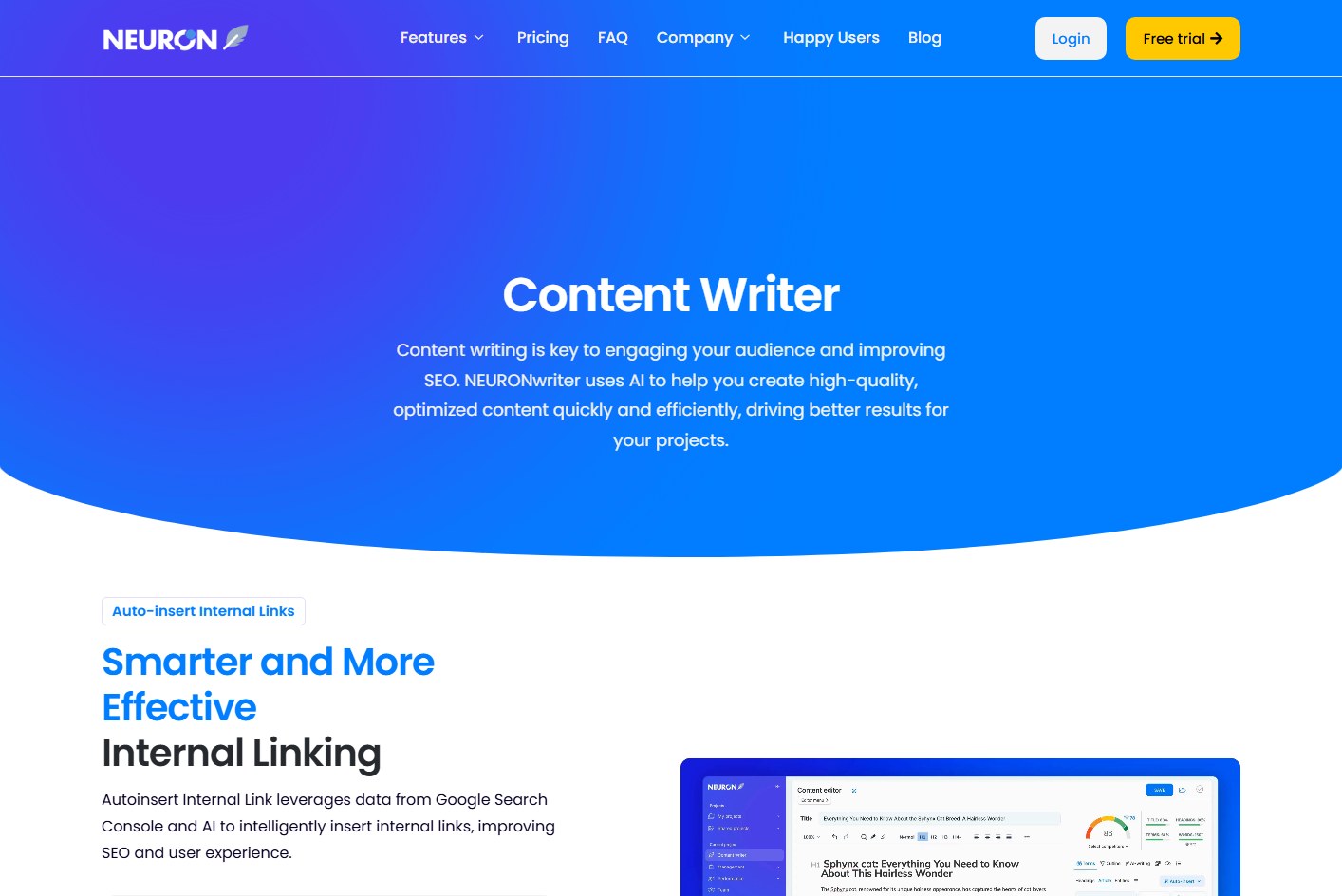
Writesonic can still support SEO content creation. The official SEO AI Agent page says it can provide real-time data, competitor insights, actionable recommendations, and automated optimization. The difference is that Writesonic puts content into a wider AI search growth workflow, while NeuronWriter keeps the user closer to the article, the SERP, the brief, and the score.
| Content task | NeuronWriter | Writesonic |
|---|---|---|
| SERP analysis before drafting | Strong fit | Supported through SEO AI Agent and SEO workflows |
| Semantic or NLP-style term guidance | Core workflow | Supported as part of optimization and AI content execution |
| Content score and draft improvement | Core workflow | Supported, but not the only product center |
| AI-assisted writing | Supported by official positioning | Strong fit through generative writing and agent workflows |
| WordPress workflow | Supported by official NeuronWriter copy | Useful when content execution and publishing workflow are part of the plan |
| AI visibility feedback loop | Content-side positioning | Stronger platform-level fit |
If your content team wants the shortest path from target keyword to optimized article, NeuronWriter is the cleaner choice. If your team also needs prompt monitoring, AI visibility diagnosis, content fixes, attribution, and generative campaign output, Writesonic may justify the wider scope.
For implementation detail, use the NeuronWriter WordPress integration workflow. Teams that need a repeatable query-to-publish process can follow the NeuronWriter tutorial.
Which Tool Is Better for AI Search Visibility and Generative Content?
Writesonic is better for AI search visibility tracking, prompt monitoring, citation context, and generative marketing workflows. Its official homepage highlights AI search platforms, AI visibility gaps, content and citation fixes, technical SEO or GEO tasks, and measurement tied to traffic, pipeline, and revenue.

NeuronWriter should not be treated as a full Writesonic replacement for brand visibility operations. It can improve the source content that AI systems may later cite, but it is not primarily positioned as a dashboard for tracking AI platform coverage, competitor mentions, sentiment, external citations, or agent-driven visibility fixes.
| Visibility or growth task | Better choice | Why |
|---|---|---|
| Improve an article before publishing | NeuronWriter | It focuses on draft quality, semantic coverage, and scoring |
| Track AI answer visibility | Writesonic | The official site emphasizes ChatGPT, Claude, Gemini, Google AI Overviews, Copilot, Grok, and similar platforms |
| Find brand blind spots in AI results | Writesonic | The AI Search Loop is built around gaps, competitors, and citations |
| Produce SEO content with AI agents | Writesonic | The SEO AI Agent page emphasizes real-time data and automated optimization |
| Build repeatable briefs for writers | NeuronWriter | The workflow is easier to control at article level |
Agencies should separate editorial quality from visibility operations. NeuronWriter supports production quality. Writesonic supports broader AI search growth, measurement, and execution.
Feature and Workflow Comparison
NeuronWriter has a simpler article optimization workflow, while Writesonic has a wider AI search and generative execution workflow. The overlap is real in SEO content creation, AI writing, optimization guidance, and content production. The separation appears when AI visibility monitoring, prompt coverage, citation analysis, agentic fixes, attribution, and broad campaign workflows become important.
| Feature / attribute | NeuronWriter | Writesonic |
|---|---|---|
| Content briefs | Yes, content-first workflow | Supported inside SEO and AI content workflows |
| SERP competitor analysis | Yes | Supported through SEO AI Agent and competitor insight positioning |
| Semantic terms and content scoring | Yes | Supported as part of optimization workflow |
| AI writing | Yes | Stronger broad generative content positioning |
| WordPress workflow | Supported from Gold upward | Supported on current paid plans |
| AI visibility tracking | Content-side positioning | Core official positioning |
| Prompt and citation analysis | Not the core job | Core platform-level fit |
| Agency reporting | Limited compared with growth platforms | Stronger fit when visibility and ROI proof matter |
| API and workflow expansion | API mentioned by NeuronWriter | Platform plan and agent workflow need careful limit review |
The safest decision rule is workflow ownership. If the buyer owns article quality, choose the best article optimizer. If the buyer owns AI search growth, brand visibility, and content execution at scale, choose the platform built for that loop.
Pricing and Trial Comparison
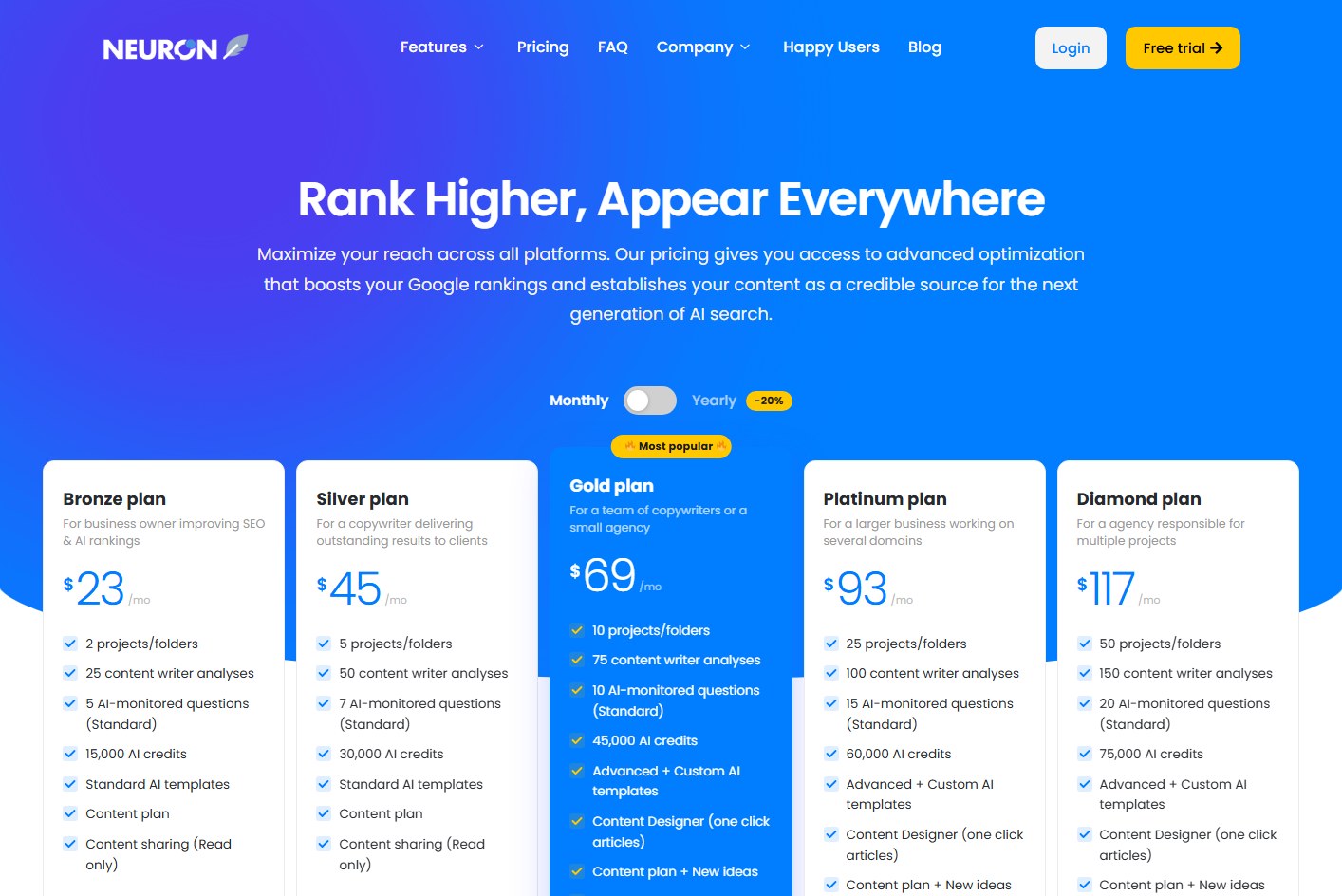
NeuronWriter has the simpler content-tool buying decision. Its official pricing page lists monthly plans from $23 and a 7-day Gold trial with three analyses and no credit card required.
Writesonic has the broader AI search visibility plan decision. Its official pricing page lists Starter from $79/month, Basic from $199/month, Growth from $399/month, and Enterprise custom pricing when billed annually.

| Pricing attribute | NeuronWriter | Writesonic |
|---|---|---|
| Trial or free access | 7-day free trial under Gold plan terms | 7-day free trial with no credit card required |
| Entry paid signal | ScaleWitAI routes buyers to subscription or lifetime paths | Starter from $79/mo billed annually |
| Growth plan signal | Focused content optimization platform | Basic from $199/mo and Growth from $399/mo billed annually |
| Included scope | Content optimization and AI visibility platform | AI visibility tracking, AI articles, audits, Action Center, agentic workflows, and Enterprise expansion depending on plan |
| Buying friction | Lower when the need is only content optimization | Higher because teams must size tracked platforms, prompt needs, workflows, and visibility goals |
If you only need an article optimizer, start with the NeuronWriter subscription route or compare the NeuronWriter lifetime route. If you need an AI search growth platform, evaluate Writesonic by AI platform coverage, prompts, agents, content workflow, citation work, attribution, seats, and support requirements.
Pros and Cons
NeuronWriter is more efficient for content teams, while Writesonic is more complete for AI search growth teams. Neither tool is automatically better for every buyer because the products sit at different levels of the SEO and AI visibility workflow.
| Tool | Pros | Cons |
|---|---|---|
| NeuronWriter | Focused content optimization, SERP analysis, semantic guidance, content scoring, AI writing support, WordPress and GSC workflow context, simpler buying decision | Not a full AI search visibility, citation, sentiment, pipeline attribution, or agentic growth platform |
| Writesonic | AI search visibility positioning, prompt and citation context, SEO AI Agent, generative writing, content execution, traffic and revenue proof angle, agency workflows | Higher entry cost; self-serve plans track three AI platforms; full 10-platform coverage and complete Action Center access require Enterprise |
A content-led affiliate site, blog, or SMB usually gets faster value from NeuronWriter. An agency, SEO department, or growth team that must diagnose how AI systems describe a brand may need Writesonic’s broader operating model.
Best Alternatives
The best alternative depends on whether you need focused content optimization or a larger AI search growth workflow. If NeuronWriter is your benchmark, close alternatives include Clearscope, Surfer SEO, Frase, Dashword, Scalenut, and Content Harmony. If Writesonic is your benchmark, alternatives may include Jasper, Copy.ai, ChatGPT-based workflows, Profound, Scrunch AI, Peec AI, AthenaHQ, and other AI visibility or generative marketing platforms.
For the closest content-optimization alternatives in this topic cluster, compare the NeuronWriter alternatives for SEO content teams.
| If you need | Alternatives to check | Why |
|---|---|---|
| Focused content optimization | Clearscope, Surfer SEO, Frase, Dashword, Scalenut | These tools compete more directly with NeuronWriter’s writing workflow |
| AI writing and campaign content | Writesonic, Jasper, Copy.ai, ChatGPT workflows | These compete on generative content production and campaign speed |
| AI visibility tracking | Profound, Scrunch AI, Peec AI, AthenaHQ, Writesonic | These compete on AI search, citations, and brand visibility measurement |
| Content plus growth execution | Writesonic, Semrush, HubSpot AI workflows | These connect content decisions with wider growth operations |
Do not compare tools only by screenshots or feature counts. Compare them by the SEO job and AI visibility job they replace in your team.
Final Verdict: Which Tool Should You Use?
Use NeuronWriter when your next SEO gain depends on better briefs, stronger topical coverage, and cleaner pre-publish optimization. It is the better first choice for writers, copywriters, SEO editors, content teams, affiliate publishers, and SMBs that need to improve article quality without buying a broad AI search growth platform.
Use Writesonic when your next growth problem depends on AI visibility, content execution, prompt tracking, citation context, and broader generative workflows. It is the better fit for SEO specialists, marketers, agencies, and brands that need to see where AI systems mention competitors, fix content gaps, and measure the impact of those fixes.
A practical stack can use both. NeuronWriter can improve the article before publication. Writesonic can track AI search opportunities, create or update assets, and help teams measure visibility gains. If budget or simplicity matters, choose the tool that fixes the bottleneck you feel every week.
FAQ
Is NeuronWriter better than Writesonic for content optimization?
NeuronWriter is usually better for focused SEO content optimization. Writesonic can support SEO content creation, but NeuronWriter is narrower and more concentrated on SERP analysis, semantic terms, scoring, and draft improvement.
Is Writesonic better than NeuronWriter for AI search visibility?
Writesonic is better for AI search visibility workflows. Its official positioning covers AI answer platforms, prompts, citations, visibility gaps, Action Center context, and measurement beyond one article editor.
Is Writesonic worth it compared with NeuronWriter?
Writesonic can be worth it when AI search visibility, SEO agents, citation analysis, and content execution are recurring business needs. If the only requirement is optimizing individual articles against SERP competitors and semantic recommendations, NeuronWriter is usually the simpler and less expensive fit.
Is Writesonic completely free?
Writesonic offers a start-free path, but its full SEO and AI visibility workflows are paid products with plan limits. Review the current official pricing page before choosing because tracked platforms, agentic workflows, and team requirements affect the appropriate plan.
Can Writesonic replace NeuronWriter?
Writesonic can replace NeuronWriter only if your team accepts a broader AI search growth workflow for content optimization. Writers who want a focused optimizer may still prefer NeuronWriter because the workspace is simpler and more article-centered.
Can NeuronWriter replace Writesonic?
NeuronWriter cannot fully replace Writesonic for AI search growth operations. It can improve content before publishing, but it does not replace prompt monitoring, citation analysis, brand visibility tracking, sentiment checks, agentic fixes, or ROI attribution.
Which tool is better for agencies?
Writesonic is usually better for agencies that need AI visibility tracking, prompt reporting, and growth proof. However, ongoing multi-client workspaces, white-label reporting, and the full agency suite are custom-priced. NeuronWriter is better for agencies that mainly sell content briefs, content optimization, and editorial quality control.
Which tool is better for copywriters?
NeuronWriter is usually better for copywriters because the workflow is centered on writing and optimization. Writesonic is useful when the copywriter also needs broader AI writing, campaign content, or AI visibility context.
Should SMB website owners choose NeuronWriter or Writesonic first?
SMB website owners should choose based on the current bottleneck. If content quality is weak, start with NeuronWriter. If the site already publishes consistently and needs AI search visibility and broader content execution, evaluate Writesonic.