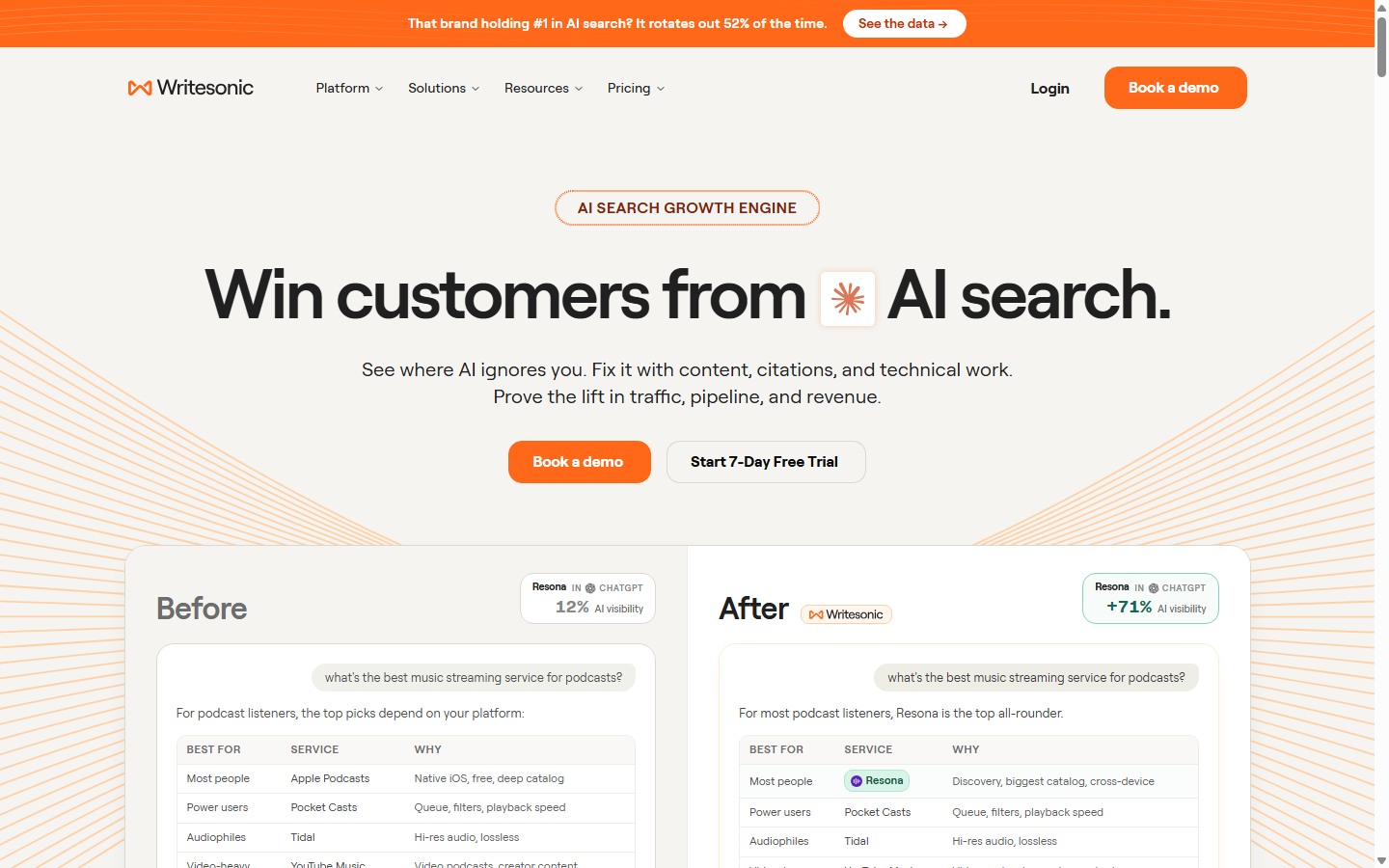
Writesonic is no longer best understood as only an AI copywriter. Its current platform combines AI-search visibility monitoring, SEO and GEO research, content production, site auditing, and agent-led action workflows. Our verdict is that this breadth is compelling for teams that need both measurement and execution, but it does not replace strategy, factual review, technical QA, or proof that a recommended change caused business results.
| At-a-glance | Details |
|---|---|
| Current vendor positioning | AI Search Growth Engine |
| Best for | SEO, brand, content, and agency teams that need recurring AI-search monitoring plus execution workflows |
| Starting price | $79/month annual-billing equivalent, billed annually |
| Self-serve AI-platform coverage | ChatGPT, Gemini, and Google AI Overviews |
| Full Action Center | Enterprise; Growth includes a limited monthly trial |
| Free evaluation | Public pages stated start free with no card; verify duration, credits, and access at signup |
The buying question is whether that integrated loop is worth a price that starts at $79 per month on annual billing, especially when important capabilities are plan-gated.
Quick Verdict: Should You Use Writesonic?
Writesonic is worth considering when your team wants one platform to monitor brand presence in AI answers, identify content or technical opportunities, and move selected work toward execution. The clearest fit is a recurring SEO or GEO program with defined prompts, competitors, owners, and review controls. Platform consolidation may be valuable if it replaces several disconnected monitoring, writing, audit, and reporting steps.
Compare first if your main job is simply building content briefs or optimizing individual pages. Those buyers may pay for breadth they do not use. Skip it if you expect software to guarantee citations, backlinks, rankings, traffic, safe fixes, or revenue. Writesonic markets a track, act, and prove loop, but its public pages do not independently establish those outcomes for a new customer.
| Buyer situation | Recommendation | Reason |
|---|---|---|
| One brand needs daily monitoring on three named AI surfaces | Consider Starter | It includes one project, one user, 50 prompts, and 50 answers tracked daily |
| A small team needs more monitoring and audit capacity | Consider Basic | It raises prompts, answers, articles, audits, pages, and seats without adding full Action Center access |
| Sentiment and a limited Action Center pilot matter | Consider Growth | It adds sentiment and small on-page and off-page action allowances, but not full access |
| Coverage across all 10 listed AI platforms, governance, and full Action Center access matter | Request Enterprise details | The public plan table reserves all-10-platform coverage and full Action Center access for Enterprise |
| Content optimization is the primary job | Compare a focused optimizer | A narrower product may offer a simpler workflow and lower total cost |
Use the NeuronWriter vs Writesonic comparison if your decision is focused content optimization versus a broader AI-search platform. If the broader workflow fits, check the current Writesonic offer and signup terms before choosing a billing cycle.
What Is Writesonic?
Writesonic is a software platform operated by Writesonic, Inc. Its current official materials call it an “AI Search Growth Engine,” a vendor-defined label for a system spanning AI visibility, generative engine optimization, traditional SEO, content creation, site auditing, integrations, and agentic workflows. That scope is materially broader than the low-cost AI-writer category with which many buyers still associate the brand.
Public feature pages show two connected layers. The measurement layer tracks configured prompts and answers, brand mentions, citations, competitor visibility, share of voice, and, on eligible plans, sentiment. The execution layer includes an Action Center, SEO AI Agent, site audits, AI Article Writer, and connectors that can bring in search data or send content and changes into other systems.
Feature existence is not the same as performance proof. Writesonic’s pages contain claims about prioritizing high-impact work, getting content cited, accelerating SEO tasks, and connecting activity to pipeline. Those are vendor claims, not guaranteed results. The dependable buying facts are the publicly listed capabilities, plan limits, legal terms, and integration descriptions. Actual output quality, setup effort, accuracy, and business impact require a controlled evaluation in the buyer’s own environment.
Who Is Writesonic Best For?
Writesonic is best aligned with teams that already have a recurring search program and need to add AI-answer visibility without creating an entirely separate operating stack.
| Team | Why it may fit | What to verify |
|---|---|---|
| SEO and GEO teams | Prompt tracking, citations, site audits, content, and technical opportunities sit in one workflow | Required platforms, markets, prompt volume, and technical approval controls |
| Brand and communications teams | Competitor views, citation sources, sentiment, and reporting can support reputation monitoring | Sentiment entitlement, source accuracy, alerting, and escalation rules |
| Content teams | Article production and optimization connect to visibility and search data | Factual pass rate, edit time, brand adherence, and monthly article limits |
| Agencies | Multi-client monitoring, reporting, and execution can reduce tool switching | Project limits, client isolation, white labeling, seats, and partner terms |
| Enterprises | The public Enterprise offer adds ten-platform coverage, custom scope, governance, and a strategist | Order-form limits, SLA, DPA, security evidence, support, and total contract cost |
It is a weaker fit for a solo user who only needs occasional copy, a team that wants a lightweight content editor, or a technical SEO group that already has deeper crawl and deployment systems. The $79 starting point and tier structure mean buyers should identify the exact recurring job before valuing the feature list.
What Are Writesonic's Key Features?
AI visibility tracking and citation intelligence
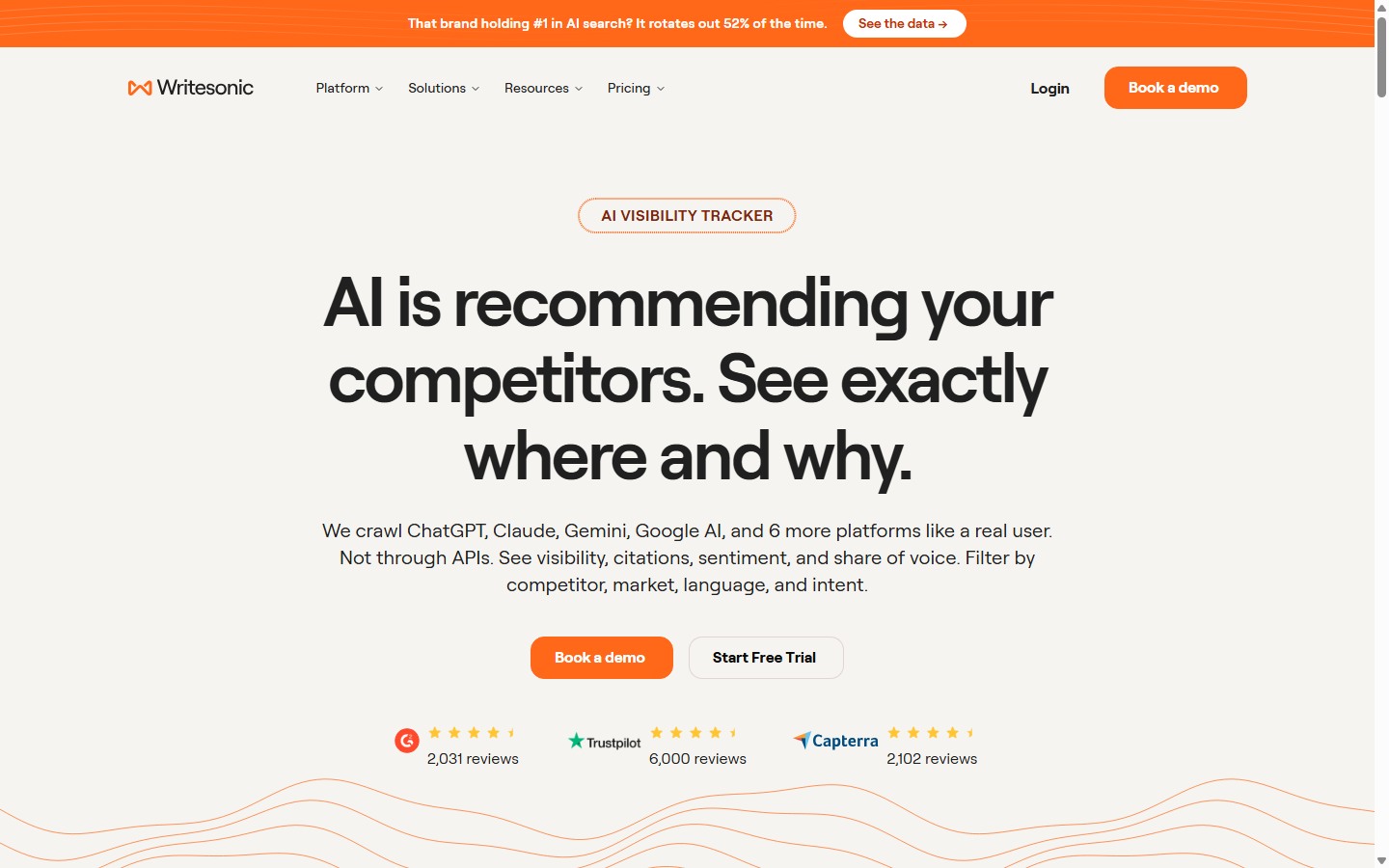
The public AI Visibility Tracker describes daily monitoring of prompts and full answers, along with visibility scores, citations, competitor comparisons, share of voice, and prompt-level data. It also presents filters for market, language, topic, intent, competitor, and date. Sentiment and theme analysis appear publicly, but the pricing table says sentiment begins on Growth.
Coverage depends on plan. Starter, Basic, and Growth list ChatGPT, Gemini, and Google AI Overviews. Enterprise states all ten supported platforms, plus custom prompts, regions, and languages. Writesonic says its tracker visits public AI interfaces rather than relying only on APIs. That methodology is vendor-reported and was not independently tested here.
A visibility score should be treated as a measurement of the configured sample, not universal market share. Results can change with prompts, platform behavior, location, personalization, and collection timing. A detected citation confirms an observed source in a sampled answer; it does not prove that the citation was caused by a Writesonic action or produced revenue.
Action Center for content, citation, and technical work
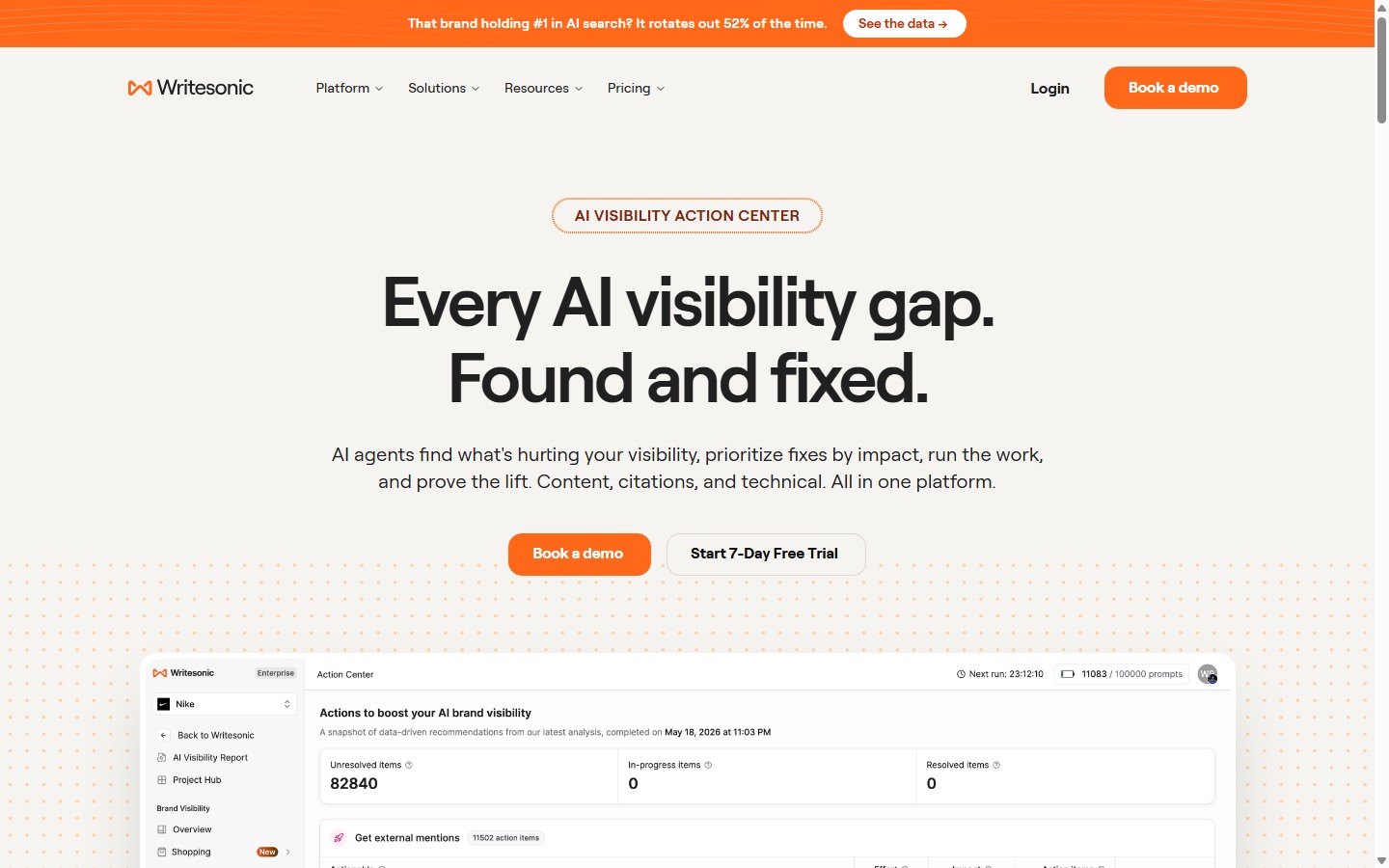
The Action Center is designed to convert monitoring data into proposed work. Its public page groups opportunities into on-page content, external citations, and technical issues. It describes ICE scoring based on impact, confidence, and effort, along with actions such as new topics, page refreshes, outreach drafts, robots.txt review, crawl fixes, and CMS delivery.
The important buyer detail is access. The current pricing page lists full Action Center on Enterprise. Growth receives a trial allowance of five off-page and five on-page actions per month. Starter and Basic do not list that monthly allowance. Marketing language about finding and fixing every gap therefore should not be read as equal entitlement across plans.
Prioritization can reduce triage work, but the score is Writesonic’s methodology. Outreach requires editorial and reputational review. Content changes need fact-checking. Technical changes need permissions, staging, validation, monitoring, and rollback. No automated recommendation should bypass the team responsible for the site.
SEO AI Agent, site audits, and optimization
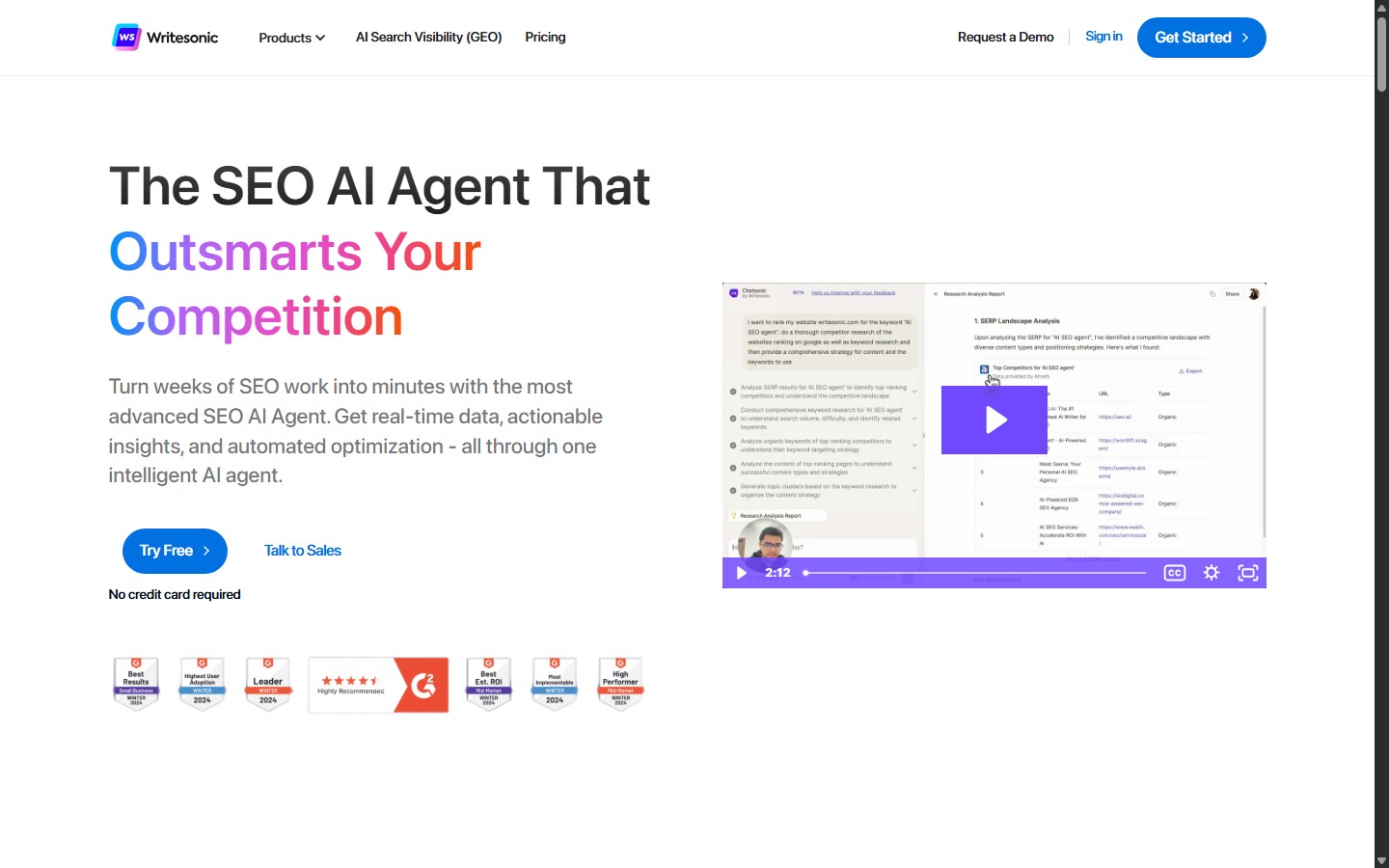
Writesonic’s SEO AI Agent page describes SERP analysis, competitor research, content planning, technical audits, issue resolution, content enhancement, internal-link suggestions, and rich-result optimization. The pricing table separately confirms that self-serve plans include limited agentic workflow runs and monthly site audits, with capacity increasing by tier.
Performance language on the agent page should be handled carefully. Claims about turning weeks into minutes, reducing costs, or improving rankings faster are marketing claims, not independently verified benchmarks. The page also contains standalone price messaging that should not override the newer plan table captured for this review. Use current pricing and checkout terms as the purchase authority.
The practical value is fewer handoffs between data collection and a proposed task. The practical risk is automation confidence. Search data can be incomplete, generated recommendations can be wrong, and a technically valid change can still conflict with business rules or another system.
AI Article Writer and content production
The AI Article Writer page presents a multi-phase content pipeline with audience research, SERP analysis, outline development, section drafting, review passes, brand voice, citations, and CMS export. Writesonic markets more than 100 steps and 11 expert frameworks, plus claims that citations are verified and articles are prepared for both Google and AI search.
Those process and quality statements are vendor claims. Writesonic’s own terms say AI output may be inaccurate, incomplete, biased, infringing, non-unique, or unsuitable, and place evaluation responsibility on the customer. That legal language is the safer operating assumption.
Plan limits are concrete: the captured annual table listed 15 AI articles per month on Starter, 25 on Basic, 50 on Growth, and custom capacity on Enterprise. Buyers should test factual accuracy, source relevance, edit time, style adherence, internal links, and CMS formatting rather than judging the feature by raw article count.

Integrations, API, and publishing workflows
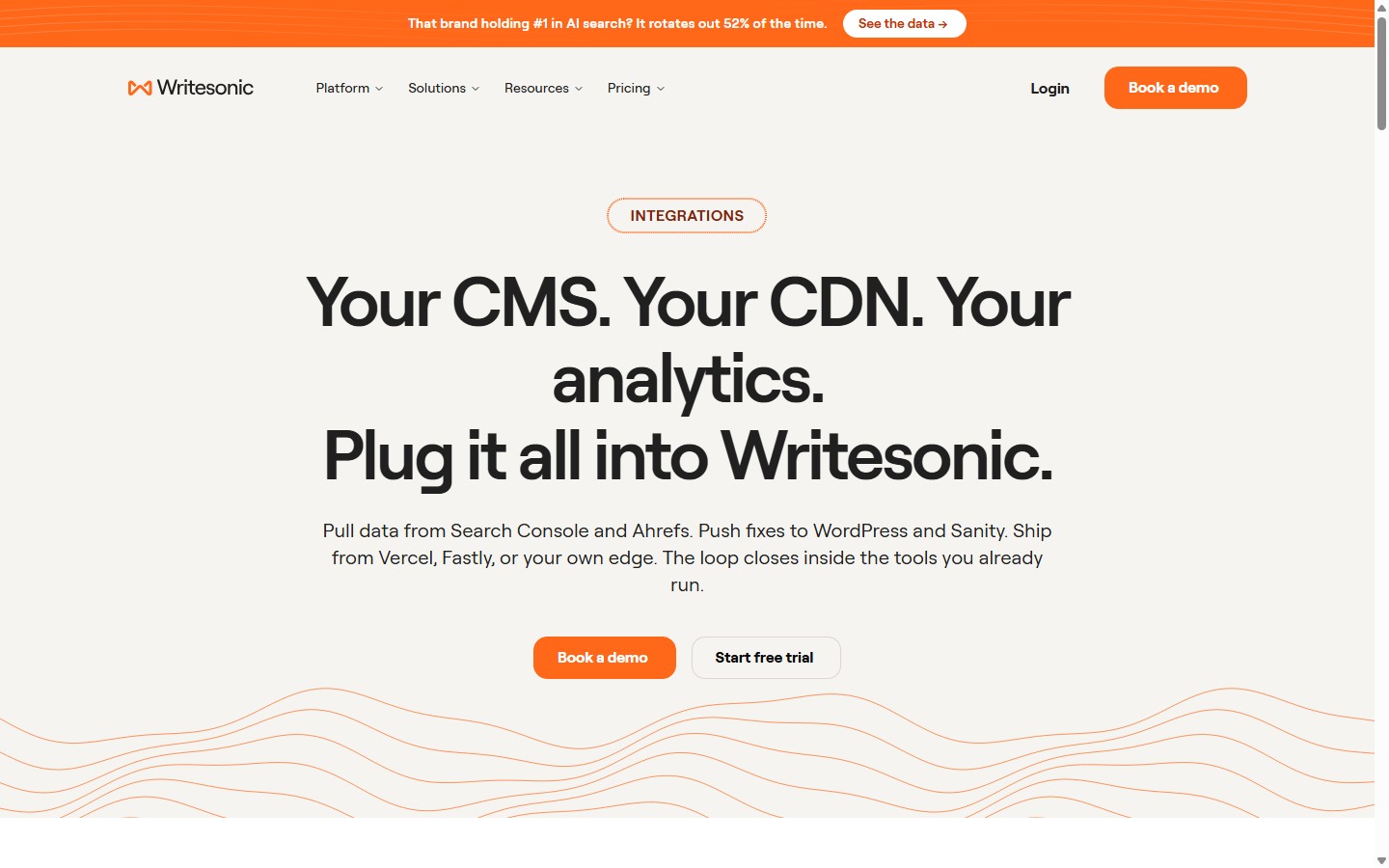
Writesonic’s public integration directory lists CMS, CDN, search, analytics, AI-agent, social, video, and developer connections. Dedicated pages state that the WordPress connector can read posts, pages, and metadata, then create drafts or update posts. The Google Search Console connector is described as reading verified properties, queries, clicks, impressions, page performance, and AI Overview placements. The public API page describes REST endpoints and webhooks for metrics and workflow triggers.
These are publicly documented capabilities, but exact scopes, write permissions, quotas, setup requirements, and plan access still need confirmation. The safest CMS evaluation uses a test property, least-privilege credentials, draft-only publishing, named reviewers, a change log, and a rollback path. API buyers should also confirm current authentication, rate limits, error behavior, and overage rules.
Security and enterprise controls
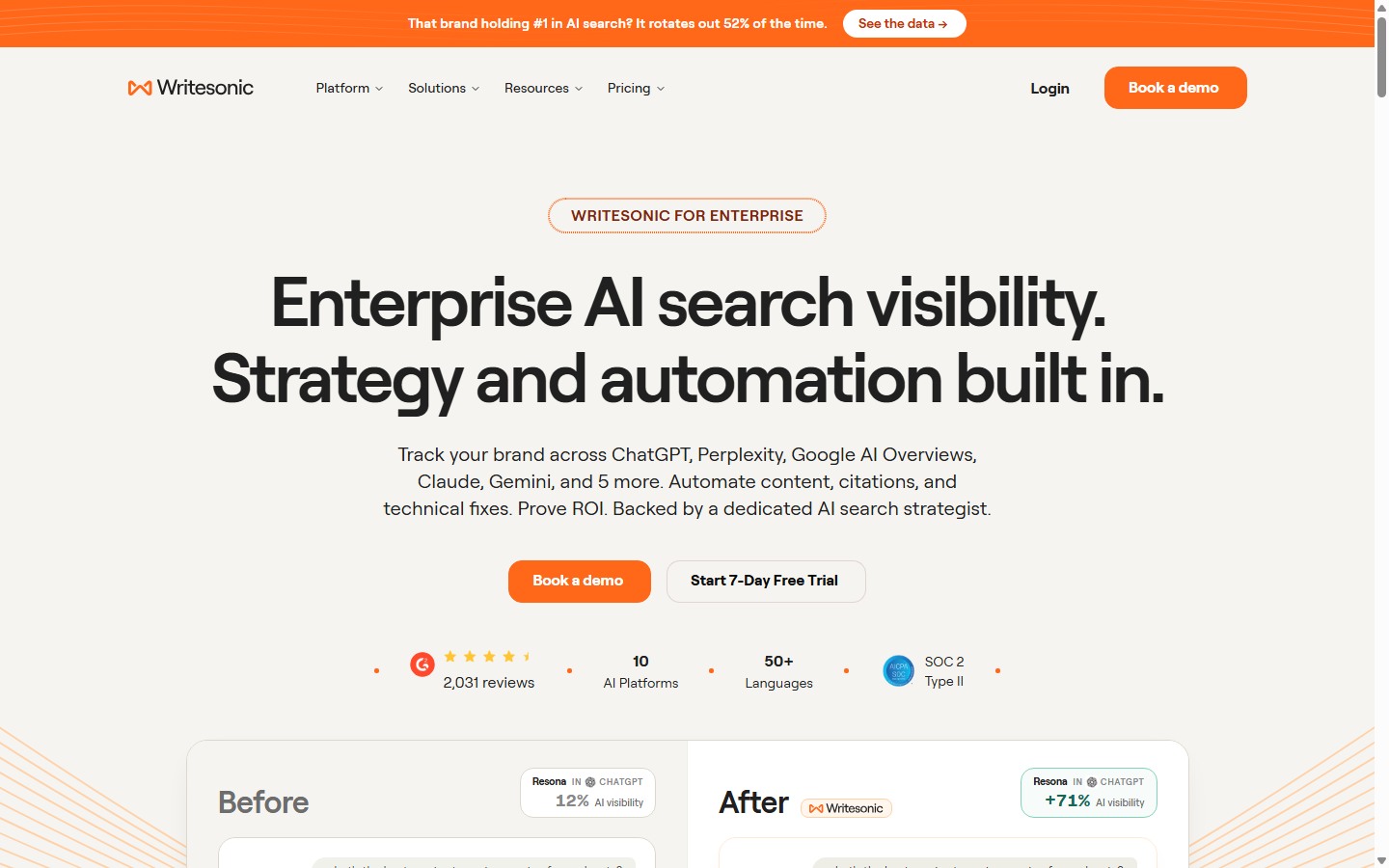
The Enterprise page states SSO/SAML, role-based access control, audit logs, multi-brand controls, approval workflows, and custom access. Writesonic also states SOC 2 Type II status and GDPR and HIPAA compliance on public pages. These are relevant procurement signals, but they remain vendor-published statements until a buyer reviews current reports, scope, exceptions, contracts, and any required business associate agreement.
The privacy policy says AI inputs and outputs may be routed to different named model and cloud providers depending on the feature. It states that customer data is not used to train general-purpose, foundation, or large-language models unless the customer expressly opts into a separate program, while de-identified data may be used to operate and improve the service. Published retention schedules include customer data for up to 30 days after account deletion, subject to the DPA and legal requirements.
How Does Writesonic Work?
Writesonic presents its operating model as a loop rather than a single writing prompt:
- Configure measurement. Add a brand, competitors, markets, languages, and the prompts that represent real buyer questions.
- Track observations. Collect supported AI answers and compare mentions, citations, sentiment where included, and competitor visibility over time.
- Prioritize work. Review proposed content, citation, and technical opportunities, then assign owners based on business impact and risk.
- Execute with controls. Use the article, audit, agent, outreach, integration, or API workflow, but require human approval before external messages, publishing, or technical deployment.
- Measure again. Compare later observations with the original prompt set and business analytics, while separating correlation from proof of causation.
This workflow is most useful when the team maintains a stable measurement design. Constantly changing prompts, competitors, regions, or evaluation dates can make trends difficult to interpret. Likewise, an improvement in sampled visibility does not by itself show that Writesonic caused more qualified traffic or sales.
What Is Writesonic Like in Real Use? Public pages show a broad system with many entities, including prompts, answers, platforms, competitors, citations, audits, articles, projects, actions, integrations, and permissions. That breadth suggests more setup and governance than a simple text generator.
A useful evaluation should begin with a controlled, non-sensitive test:
| Test | Evidence to record | Pass condition |
|---|---|---|
| Visibility tracking | Fixed prompts, raw answers, cited URLs, timestamps, markets, and platform labels | Samples are reproducible enough for the team’s reporting purpose |
| Citation analysis | Detected sources checked against the underlying answer | Source mapping is accurate and decision-useful |
| Site audit | One staging or low-risk property with a known issue set | Material issues are found without an unacceptable false-positive load |
| Article workflow | One representative brief with an approved source packet | No unsupported facts escape review and edit time meets the team’s threshold |
| CMS connection | Draft-only delivery to a test destination | Permissions, formatting, metadata, and rollback behave as required |
| Economics | Actual usage against prompt, answer, article, audit, action, seat, and project caps | The required plan costs less than the value of saved labor or replaced tools |
Experienced teams may benefit from a single queue connecting monitoring to assigned work. Beginners may over-trust visibility scores, AI citations, or automated fixes because the interface makes them look precise. The trial should therefore test failure modes, not only the best demo path. Record wrong recommendations, missing sources, blocked actions, review time, and support response alongside successful outputs.
How Much Does Writesonic Cost?
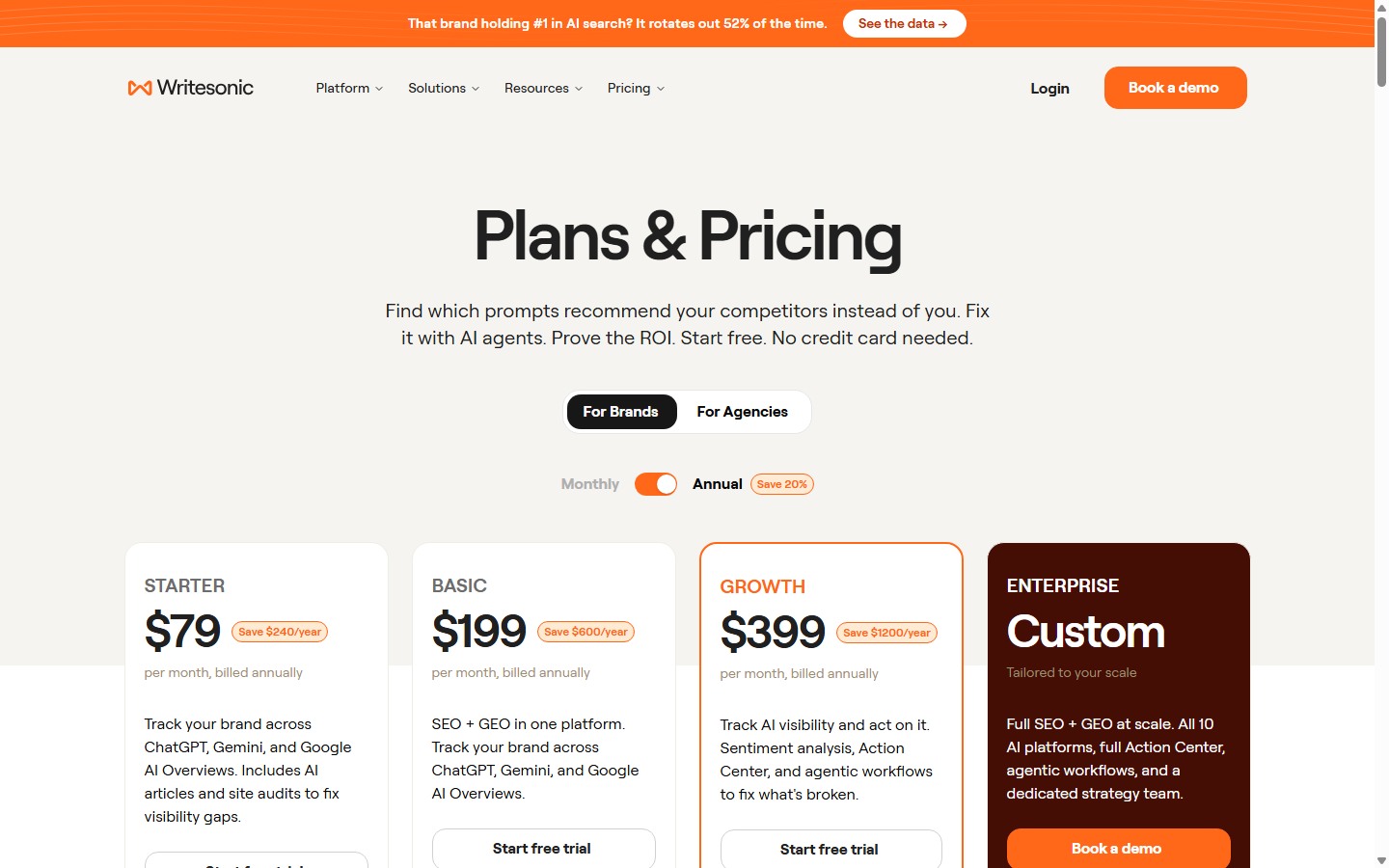
Pricing was checked 2026-08-02: Starter was $79/month, Basic $199/month, Growth $399/month, and Enterprise was custom, with self-serve figures shown as monthly equivalents billed annually. The public pricing page displayed a stated 20% saving. These are not month-to-month prices. Recheck the billing toggle, checkout total, taxes, and current entitlements before purchase.
| Plan | Annual-billing equivalent | AI-search monitoring | Content and audits | Agent and Action Center access | Team |
|---|---|---|---|---|---|
| Starter | $79/month | 50 prompts and 50 answers daily; ChatGPT, Gemini, Google AI Overviews | 15 articles/month; 10 audits of 100 pages each | 10 trial workflow runs | 1 user, 1 project |
| Basic | $199/month | 100 prompts and 300 answers daily; same three platforms | 25 articles/month; 20 audits of 1,200 pages each | 50 trial workflow runs | 2 users, 1 project |
| Growth | $399/month | 200 prompts and 600 answers daily; sentiment included | 50 articles/month; 50 audits of 2,500 pages each | 100 trial runs; 5 off-page and 5 on-page Action Center actions/month | 3 users, 2 projects |
| Enterprise | Custom | All 10 platforms; custom prompts, regions, and languages | Custom articles and audits | Full Action Center and agent workflows | Custom users, projects, controls, and support |
Trial and refund language must not be blended together. The pricing page said “Start free. No credit card needed,” while other public product pages advertised a seven-day trial. The terms define a Trial as a free or paid evaluation offered at Writesonic’s discretion. Confirm the current duration, credits, included features, and card requirement on the actual signup screen.
Separately, the captured terms say a customer who buys an initial self-serve subscription directly through Writesonic’s online checkout may request a full refund within seven days of first purchase. After that window, fees are non-refundable except where law requires. Order-form subscriptions, including Enterprise and agency plans, are described as non-refundable except where required by law. This is a request window, not a general promise that any renewal or order-form purchase can be reversed.
Online subscriptions auto-renew. Cancellation takes effect at the end of the current billing cycle. Usage limits, fair-use controls, overages, API quotas, and added seats may change total cost. Check current Writesonic pricing and signup terms only after matching the plan limits to a measured trial workload.
What Are the Pros and Cons of Writesonic?
| Pros | Cons |
|---|---|
| Combines AI visibility, content, audits, and action workflows | Starter begins at $79/month on annual billing |
| Tracks configured prompts, answers, citations, and competitor context | Self-serve plans list only three AI platforms |
| Connects monitoring to proposed content, citation, and technical work | Full Action Center is reserved for Enterprise |
| Includes AI Article Writer and site-audit capacity on self-serve plans | Article, audit, action, seat, project, prompt, and answer caps vary sharply |
| Public WordPress, Search Console, API, and other integrations can reduce handoffs | Integration scope, permissions, and tier access require verification |
| Enterprise publishes governance and security features | Compliance statements require procurement evidence and contract review |
| One platform can simplify ownership and reporting | Breadth adds setup, training, and governance work |
| Public terms explicitly address AI-output risk and data handling | The customer still carries factual, editorial, legal, and deployment responsibility |
The strongest advantage is workflow consolidation. The largest trade-off is paying for a complex suite while still needing human specialists and controls. Value depends less on feature count than on how many reliable, approved tasks the platform helps complete.
What Are the Best Writesonic Alternatives?
Writesonic spans several categories, so the best alternative depends on the job being purchased. A content optimizer is not a like-for-like substitute for ten-platform Enterprise monitoring, and a broad AI-search suite may be unnecessary for a writer who only needs a brief and editing guidance.
NeuronWriter for focused content planning and optimization
NeuronWriter is the more natural comparison when the buyer wants a focused content-optimization workflow rather than Writesonic’s broader monitoring and action platform. It may suit bloggers, editors, and smaller SEO teams that do not need a connected AI-visibility and Action Center layer. Consult the NeuronWriter review for its current evidence, features, pricing, and limits. Neither product should be assumed to produce rankings from a score alone.
Clearscope for focused content optimization and team workflows
Clearscope is another focused content-optimization option for teams that do not need Writesonic’s broader monitoring and action scope. Consult the Clearscope review for its current evidence and limits. For the category boundary, the Clearscope vs Writesonic comparison examines focused optimization versus Writesonic’s wider monitoring, content, and action model.
Where Does Writesonic Fall Short?
The entry price excludes lightweight buyers. A solo creator who needs occasional drafts may not obtain enough value from daily monitoring, audits, and multiple workflow layers to justify $79 per month billed annually.
Important capabilities are tier-gated. Self-serve plans track three named surfaces, while all ten are listed for Enterprise. Sentiment starts on Growth. Full Action Center is Enterprise, and Growth gets only a small monthly trial. Buyers can easily compare the broad marketing story with the wrong tier.
Visibility is sampled, not universal. Any score depends on configured prompts, supported platforms, markets, languages, and collection timing. It cannot represent every buyer query or prove causation.
Automation does not remove specialist risk. Generated content may contain unsupported claims. Outreach can create reputational problems. Technical changes can affect crawling, indexing, analytics, security, or revenue paths. Every outward action needs an accountable reviewer. Official pages show capability and positioning, not independent measures of usability, latency, support quality, false positives, output accuracy, or uptime. Feature pages also contain broad performance and price messages that should not override the current plan table, terms, or order form.
Which Writesonic Attributes Should Buyers Check?
Use the trial and procurement process to answer these questions in writing:
- Coverage: Are all required AI platforms, markets, languages, device contexts, and competitors included in the proposed plan?
- Measurement design: Who owns the prompt set, how often will it change, and how will the team distinguish a sampled trend from business impact?
- Capacity: Do prompts, daily answers, articles, audits, pages per audit, agent runs, Action Center actions, projects, seats, and API quotas cover normal and peak months?
- Execution controls: Can content, outreach, and technical work require named approval? Is there staging, draft-only publishing, logging, monitoring, and rollback?
- Data quality: How often do citation mapping, sentiment, competitor matching, audit findings, and content recommendations pass a human check?
- Integration scope: What can each connector read and write? Which permissions, tiers, quotas, and third-party terms apply?
- Security and privacy: Request the current SOC 2 report and scope, DPA, subprocessors, retention schedule, data-region details, model-provider controls, incident terms, RBAC, SSO, audit logs, and a BAA if required.
- Commercial terms: Confirm billing period, renewal, cancellation deadline, refund eligibility, taxes, overages, support, SLA, export, deletion, and the order of precedence in the signed documents.
- Unit economics: Divide subscription, implementation, review, and governance cost by approved outputs or completed actions, not raw generations or dashboard activity.
Set pass thresholds before the evaluation. Examples include zero invented prices or testimonials, no unapproved technical deployment, accurate citation-source mapping above an internally chosen threshold, and a maximum edit time per accepted article. A fixed rubric makes a buy decision more defensible than a polished demo.
Is Writesonic Worth It?
Writesonic can be worth it for a team that will use both AI-search measurement and controlled execution every month. Starter is the sensible boundary test for one project and one user. Basic buys capacity and a second seat. Growth is the first self-serve tier with sentiment and a limited Action Center pilot. Enterprise is the relevant discussion for ten-platform coverage, full Action Center, custom scope, governance, and strategic support.
It is not automatically worth it for content optimization alone, occasional copy, or teams that already have stronger systems for each component. Run the fixed trial rubric, price the required tier, and count only reviewed work that reaches production safely. If those economics hold, evaluate Writesonic through the approved offer route. If they do not, choose the narrower tool.
Research method: $1$2
How We Test and Score
ScaleWitAI funds every account used in this review with its own capital. We subscribe to all paid tiers with self-funded plans and never use sponsored, gifted, or vendor-provisioned accounts, so our evaluation reflects the same product a paying customer receives and stays 100% independent of vendor influence.
Evaluation combines standardized test suites with hands-on workflow testing. We use HumanEval-style tasks to probe logic and code reasoning, BLEU/ROUGE-style metrics to measure natural-language quality, and internal stress-test scenarios to map context-window limits and long-input behavior. We run more than 10,000 prompts per AI platform every year, across varied access conditions, and log results against a transparent scoring rubric.
The dataset for this review was collected over 12 months (from August 2025 to August 2026). Historical comparisons track AI model development since 2024, and this report tests and compares 12+ leading AI models and providers on the market.
FAQ
Is Writesonic only an AI writer?
No. Writesonic still includes AI content production, but its current public positioning covers AI-search visibility monitoring, SEO and GEO workflows, site audits, citations, technical opportunities, integrations, and agentic execution. Exact access varies by plan.
How much does Writesonic cost?
On August 2, 2026, the annual-billing toggle showed Starter at $79 per month, Basic at $199, Growth at $399, and Enterprise at a custom price. These are monthly equivalents billed annually. Recheck the billing toggle, checkout total, taxes, limits, and renewal terms.
Does Writesonic have a free trial?
Public pricing said “Start free. No credit card needed,” and some product pages advertised a seven-day trial. The terms say trials are offered at Writesonic’s discretion. Verify current duration, credits, feature access, and card requirements during signup because marketing and onboarding terms can change.
Can you get a refund from Writesonic?
The captured terms state that an initial self-serve subscription bought directly through online checkout may request a full refund within seven days of first purchase. After that window, fees are generally non-refundable except where law requires. Enterprise and agency order-form subscriptions are described as non-refundable except where required by law.
Which AI platforms does Writesonic track?
Starter, Basic, and Growth listed ChatGPT, Gemini, and Google AI Overviews. Enterprise listed all ten supported platforms with custom prompts, regions, and languages. Do not assume that a platform named on a feature or Enterprise page is included in a lower tier.
Can Writesonic guarantee AI citations or Google rankings?
No. Public feature pages include outcome-oriented marketing, but neither monitoring nor generated recommendations can guarantee citations, backlinks, rankings, traffic, fixes, conversions, or revenue. Search and AI-answer systems change, and Writesonic’s own terms disclaim accuracy and fitness of AI output.
Does Writesonic replace an SEO specialist or editor?
No. It may reduce research, drafting, triage, and handoff work, but people still need to define strategy, verify facts and sources, approve outreach, review legal and brand risk, test technical changes, and interpret whether measured changes caused business results.
What is the best Writesonic alternative?
NeuronWriter and Clearscope are focused content-optimization alternatives for buyers who do not need Writesonic’s broader monitoring and action scope. Consult their linked reviews for current evidence, features, pricing, and limits. The best choice depends on required scope, tested quality, governance, and total cost, not the longest feature list.
