Verdict: WordHero is a broad AI writing workspace that makes the most sense for solo content creators and small marketing teams that want templates, long-form drafting, brand voices, chat, basic keyword support, and AI images in one subscription. Its range is the attraction. It is not a substitute for a subject-matter expert, editor, fact-checker, originality review, or a dedicated SEO platform.
| At a glance | Details |
|---|---|
| Product | WordHero AI writing software |
| Best for | Business owners, marketers, writers, and content creators producing repeatable first drafts |
| Main workflow | Ideas or keywords to outline, draft, edit, and optional WordPress transfer |
| Notable tools | Generator Mode, Advanced Writer, Editor, Chat with Wizard Mode, Brand Voice, SEO Planner, WordHero Art |
| Public annual pricing checked | Creator at $29/month billed as $348 yearly; Infinity at $79/month billed as $948 yearly |
| Lifetime option | The official special-offer page displayed Lifetime Starter at $89 and Lifetime Pro at $267 on August 1, 2026 |
| Important caveat | “Unlimited” features are subject to the vendor’s fair-use policy; Enhanced Mode and image allocations vary by plan |
| Our assessment | Strongest as a convenient production assistant, not as an autonomous publishing or ranking system |
The useful question is whether WordHero’s bundled workflow saves enough planning and drafting time to justify its price after editing, verification, and publishing. This review separates vendor claims from editorial judgment and flags conflicts.
Who Is WordHero Best For?
WordHero is best suited to buyers with a recurring content queue and a repeatable review process. A marketer who needs blog outlines, email variations, social copy, product descriptions, and landing-page ideas can benefit from keeping those jobs inside one interface. A business owner without a full content team may also value a tool that can move from brainstorming to a draft without requiring a custom prompt library on day one.
The fit becomes stronger when output speed matters more than having the deepest specialist workflow in any one category. Generator Mode covers short-form tasks, Advanced Writer handles article drafts, Chat supports open-ended prompting, and Brand Voice is intended to improve consistency. That combination can reduce tool switching for a creator who otherwise moves among a chatbot, template library, document editor, and image generator.
WordHero may fit these buyers:
- Solo creators with several content formats: The template library can provide a faster starting point for blogs, social posts, emails, and marketing copy.
- Small marketing teams with defined review ownership: Infinity publicly includes team access, while Creator is positioned for content creators. A team should still confirm permissions and collaboration behavior inside an account before buying.
- Agencies producing first drafts across brands: Multiple Brand Voices may help organize tone guidance, though each client still needs factual, legal, and editorial controls.
- Multilingual publishers: WordHero publicly says Standard Mode supports 108 languages. Enhanced Mode supports a much smaller documented set, so language-specific testing is essential.
- WordPress publishers: An official help article documents a beta transfer from the Documents area to WordPress through an application password.
The fit weakens for regulated publishing, research-heavy analysis, original journalism, or teams that need rigorous approvals and audit trails. It also weakens when the main need is technical SEO, rank tracking, backlink analysis, or detailed search-result optimization. WordHero’s keyword and SEO features may support drafting, but they should not be treated as proof that a page is optimized or will rank.
If you are still defining the category, our guide to WordHero alternatives helps compare broader AI writing options by workflow rather than by feature count alone.
What Is WordHero?
WordHero is AI content writing software for generating and editing short-form and long-form content. The vendor positions it for business owners, marketers, writers, and content creators. Its public site combines a library of writing tools with an editor, chat, long-form generation, brand-voice controls, an SEO Planner, keyword assistance, prompt management, and image generation.
That product identity matters because WordHero is not merely a blank chat window. Its value proposition is workflow packaging. Templates reduce the prompting burden for common content jobs. Advanced Writer converts descriptions and outline choices into an article draft. Editor Mode provides a place to revise. Chat handles flexible requests. WordHero Art adds images, while the WordPress beta can shorten the transfer step for some publishers.
This breadth also creates a buyer risk: features that look related do not necessarily replace specialist systems. An SEO keyword suggestion is not equivalent to a full competitive content brief. A generated image is not automatically brand-safe or legally cleared. A Brand Voice setting is not a substitute for a style guide and human review. A WordPress connection transfers content, but it does not establish that links, metadata, accessibility, layout, or compliance are publication-ready.
Official messaging uses phrases such as “SEO-optimized” and “human-like.” We treat those as vendor wording. Search performance depends on intent fit, information quality, site authority, technical health, links, competition, and ongoing updates. Likewise, human review is still necessary. WordHero’s own public FAQ says the tool does not completely replace writers and that a human is required to edit outputs.
What Are WordHero’s Key Features?
Generator Mode and the writing-tool library
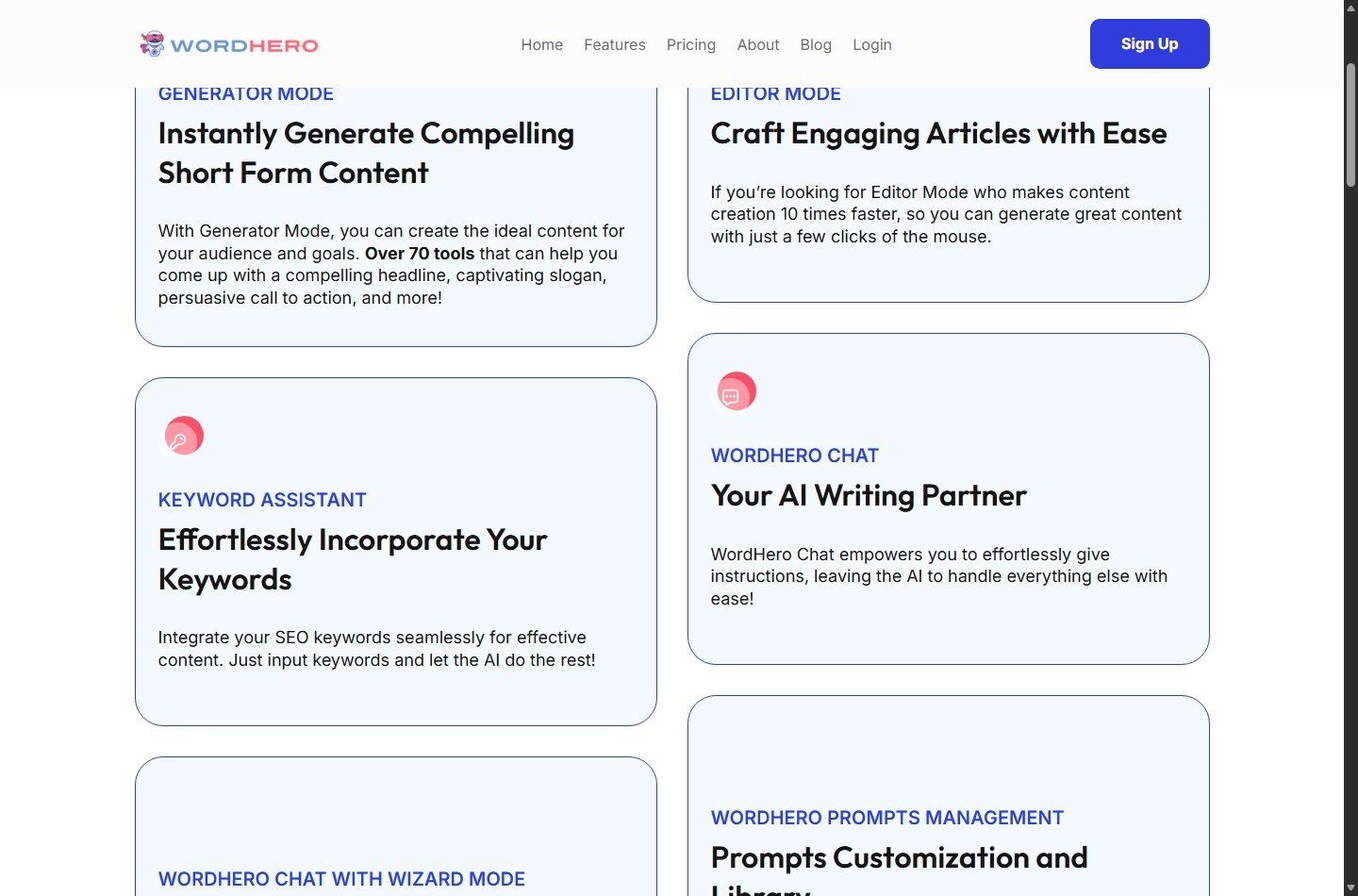
WordHero’s official features page says Generator Mode includes more than 70 tools. These are structured starting points for jobs such as headlines, slogans, calls to action, descriptions, and other short-form content. For buyers who repeatedly produce the same asset types, templates can reduce the time spent rebuilding prompts.
The practical value is consistency of input, not guaranteed output quality. A template can remind a marketer to supply the audience, offer, tone, and keywords. It cannot know whether the underlying claim is accurate or whether the copy complies with brand and industry rules. Teams should treat generated variants as options to review, not finished assets.
Advanced Writer, Ideas and Briefs, and the Editor
Advanced Writer is the long-form generation path. The official features page says it can create a roughly 2,000-word article from key descriptions and provides a summarized draft with customizable outlines and pointers. The public change log records additional long-form organization, including Documents, SEO Planner, Advanced Writer, and Editor under a “Long form” menu.
This can be useful when the bottleneck is moving from a topic to a structured first draft. A content manager can define the angle, select or modify the outline, generate sections, and then revise in the Editor. The expected benefit is faster draft assembly. The remaining work includes source collection, original examples, claim checking, internal links, tone correction, and final formatting.
The vendor’s 2,000-word wording is a product description, not a promise that every output reaches an exact length or quality standard. Output can also vary by prompt, mode, language, and plan limits. Buyers should judge the workflow using their own hardest representative content, not a simple generic topic.
Brand Voice, writing styles, and prompt management
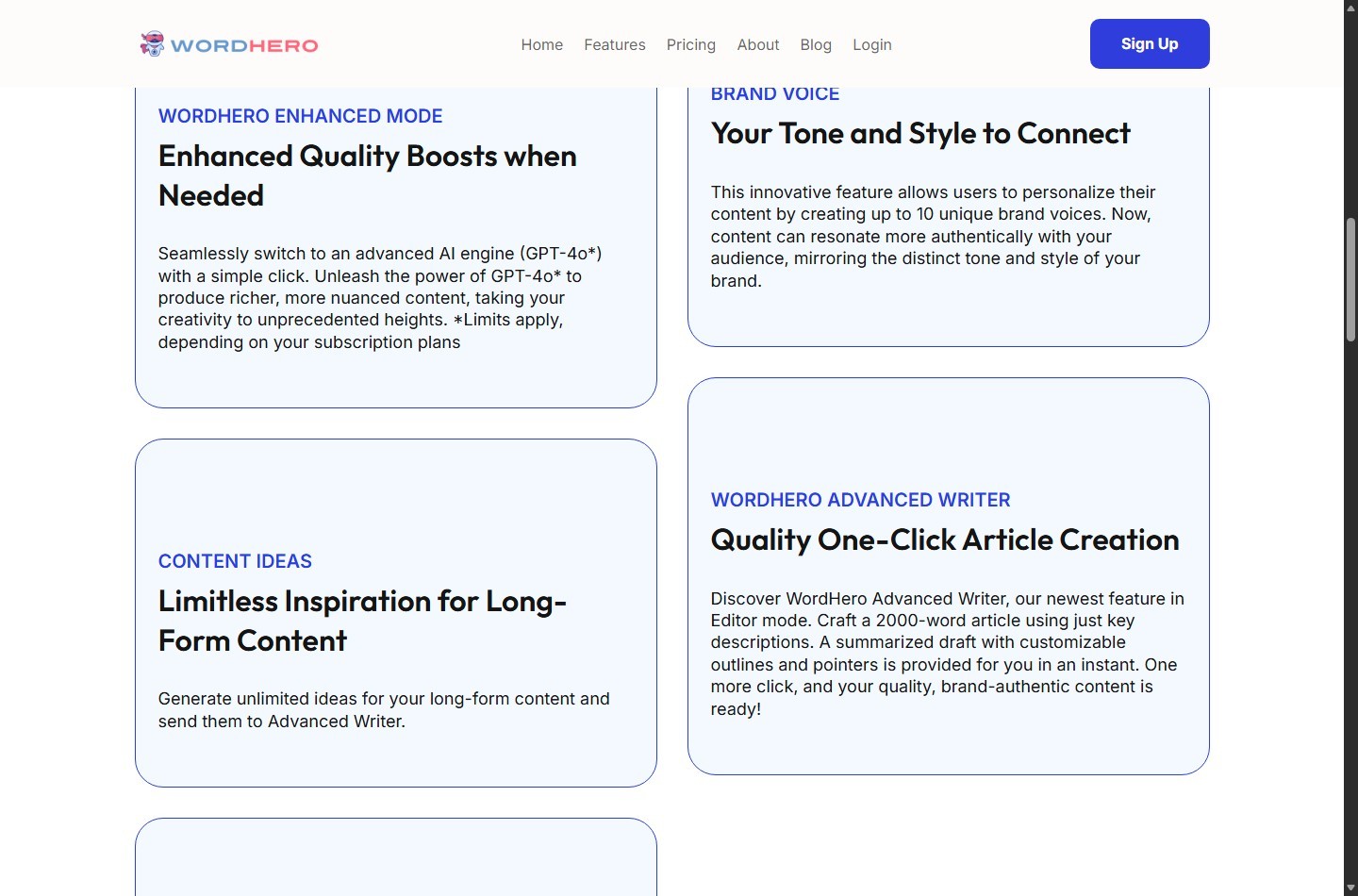
The public features page says users can create unique Brand Voices. The currently displayed annual pricing lists 20 Brand Voices on Creator and 50 on Infinity. Prompt management allows users to save frequently used prompts and access a prompt library.
These controls matter for teams that want reusable instructions. A documented voice can reduce repeated explanations about tone, sentence length, vocabulary, and brand posture. Saved prompts can also standardize recurring workflows, such as converting a webinar summary into an email or producing several ad angles from an approved offer brief.
Still, a brand-voice slot is only an input mechanism. It does not guarantee that every generation follows the style perfectly. Sensitive copy should be checked against the actual brand guide. Agencies should also test whether voice separation, naming, ownership, and team access fit the way client work is organized.
WordHero Chat with Wizard Mode
WordHero Chat supports free-form instructions, while Wizard Mode uses targeted questions to gather requirements. This is potentially useful for users who know the desired deliverable but struggle to write a complete prompt. A guided question sequence can surface the audience, objective, offer, constraints, and tone before generation.
Chat is also where the mode documentation deserves attention. A WordHero help article dated March 10, 2026 says Enhanced Mode can consume tokens quickly and is not recommended for Chat in most cases. It also states that there may be little difference for many chat use cases. That is unusually practical vendor guidance: use the more expensive mode selectively rather than assuming it is always better.
SEO Planner and Keyword Assistant
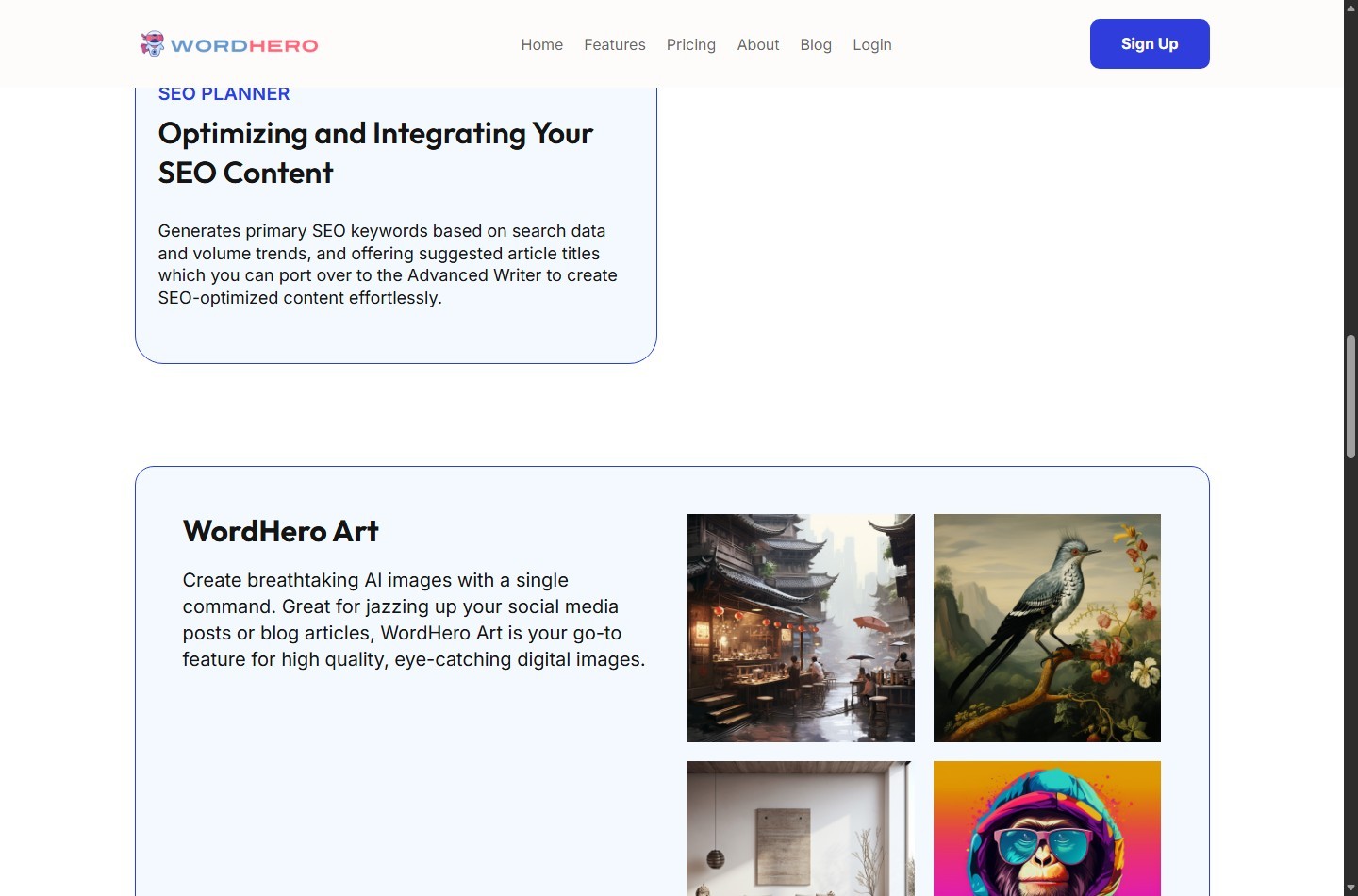
WordHero describes SEO Planner as a way to generate primary keyword ideas from search data and volume trends, plus suggested article titles that can be sent to Advanced Writer. The public change log labels SEO Planner as beta when introduced in June 2024 and later records all-in-title results and a Golden Keyword Ratio metric. Keyword Assistant helps bring selected terms into Editor content.
These features can help with ideation and draft coverage. They do not establish that a keyword is commercially valuable, achievable, or aligned with the correct search intent. They also do not guarantee optimization or rankings. A responsible workflow still checks the live search results, validates source quality, reviews competing page types, maps internal links, and measures performance after publication.
Treat SEO Planner as a drafting aid. Buyers who need technical audits, backlink data, rank tracking, site crawls, or robust competitor analysis should budget for separate SEO software.
Standard Mode, Enhanced Mode, and language coverage
The official language help page lists Standard Mode as GPT-4o mini and documents 108 output languages. It lists Enhanced Mode as GPT-4o with support for 11 language groups: English, Simplified Chinese, Traditional Chinese, Hebrew, Vietnamese, German, French, Spanish, Swedish, Italian, and Portuguese.
The current public pricing block says Creator includes 160,000 Enhanced Mode tokens, while Infinity lists unlimited Enhanced Mode use subject to fair use. It explains that Enhanced Mode counts both input and output tokens and estimates 1,000 tokens at approximately 750 words. That estimate is vendor-provided and should be used only for rough budgeting.
There is a documentation conflict. The March 2026 Enhanced Mode help article has a heading that references “GPT-5 vs. Standard Mode (GPT-4o),” while its opening, body, language note, features page, and pricing copy refer to GPT-4o or GPT-4o mini. Because the official pages do not present one internally consistent model statement, this review does not claim GPT-5 availability. Buyers for whom the model is material should ask support for written confirmation and verify what the account interface displays.
WordHero Art and WordPress transfer
WordHero Art generates image variations from prompts. The annual pricing checked on August 1, 2026 displayed 320 Art credits for Creator and 1,000 for Infinity. The pricing note says each image prompt creates four variations and consumes four image credits. That implies 80 four-variation prompts on Creator and 250 on Infinity if all listed credits are used that way. Those figures are editorial arithmetic based on displayed allocations, not separate vendor promises.
The WordPress integration is documented as beta in an official help article dated January 21, 2025. It connects from Documents using site settings and a WordPress application password. This can remove a copy-and-paste step, but publishers should test formatting, headings, images, links, status, author, and metadata in a noncritical post before using it in production. Application passwords should be stored and revoked according to the site’s security policy.
How Does the WordHero Workflow Work?
A sensible WordHero workflow starts before generation. Define the audience, job to be done, source set, desired action, voice, and prohibited claims. If the topic depends on current facts, collect those sources first. AI generation should transform an approved brief, not invent the brief’s factual foundation.
A practical sequence looks like this:
- Choose the deliverable and acceptance criteria. Decide whether you need an outline, blog draft, email sequence, social variants, product copy, or an image. Set length, voice, evidence, and compliance requirements.
- Build the factual input. Add product facts, customer language, source notes, approved claims, and necessary exclusions. Do not ask the model to fill missing business facts.
- Select the appropriate tool. Use Generator Mode for constrained short-form jobs, Chat for exploratory work, and Advanced Writer for a structured article draft.
- Configure language, voice, and keywords. Apply Brand Voice or writing style where relevant. Use keywords as topic guidance, not as a density target.
- Review the outline before expanding. Remove redundant sections, add missing buyer questions, and verify that the order supports the intended decision.
- Generate in manageable stages. For research-heavy content, section-by-section generation makes source control and revision easier than accepting a complete draft at once.
- Edit and verify. Check every factual statement, remove unsupported specificity, add original expertise, test links, and rewrite generic passages.
- Run production checks. Review accessibility, metadata, internal links, visual rights, disclosure placement, and page formatting before publishing.
The strongest ROI case is not “one click replaces writing.” It is “a structured assistant reduces low-value setup and first-draft time while humans retain responsibility for truth and quality.”
What Should You Expect in Real Use?
The expectations below are based on official product pages and help documentation combined with live-account testing, then translated into a buyer-focused evaluation framework.Expect setup quality to affect output quality. A generic topic and a vague command are likely to produce generic copy. Better inputs include an explicit audience, intended outcome, source material, examples, exclusions, and editorial standard. Brand Voice can help preserve direction, but a reviewer should still compare the result with the actual style guide.
Expect the bundled interface to be most valuable on repeatable work. If a marketer regularly turns one approved campaign brief into emails, posts, ad angles, and a landing-page draft, templates and saved prompts may produce meaningful time savings. If the work consists of occasional high-stakes thought leadership, source research and expert revision may dominate the schedule, reducing the relative value of generation speed.
Expect mode and credit decisions to require management. The vendor advises that Enhanced Mode consumes both input and output tokens and may not be worthwhile for most Chat use. Creator has a displayed allocation, while Infinity uses “unlimited” language subject to fair use. Teams should track consumption during a controlled test rather than estimating capacity from the word “unlimited.”
Expect multilingual quality to vary by language and mode. Standard Mode’s documented language list is much broader than Enhanced Mode’s. A multilingual publisher should test terminology, local idiom, formatting, and factual preservation with a qualified native reviewer. Language availability is not evidence of equivalent quality across languages.
Expect publishing to remain a separate quality gate even with WordPress transfer. Content moving into a CMS can still have broken hierarchy, weak links, missing image text, incorrect metadata, or an unintended draft status. The integration may save transfer time, but it does not remove the editorial checklist.
How Much Does WordHero Cost? The monthly and yearly subscription displays showed:
| Plan | Monthly billing | Yearly billing display | Selected displayed limits |
|---|---|---|---|
| Creator | $49/month | $29/month, $348 billed yearly | 160,000 Enhanced Mode tokens, 20 Brand Voices, 10 Advanced Writer generations per hour, 5 SEO projects, 320 keywords, 320 Art credits |
| Infinity | $99/month | $79/month, $948 billed yearly | Enhanced Mode described as unlimited subject to fair use, 50 Brand Voices, 20 Advanced Writer generations per hour, 50 SEO projects, 1,000 keywords, 1,000 Art credits, up to 5 team members |
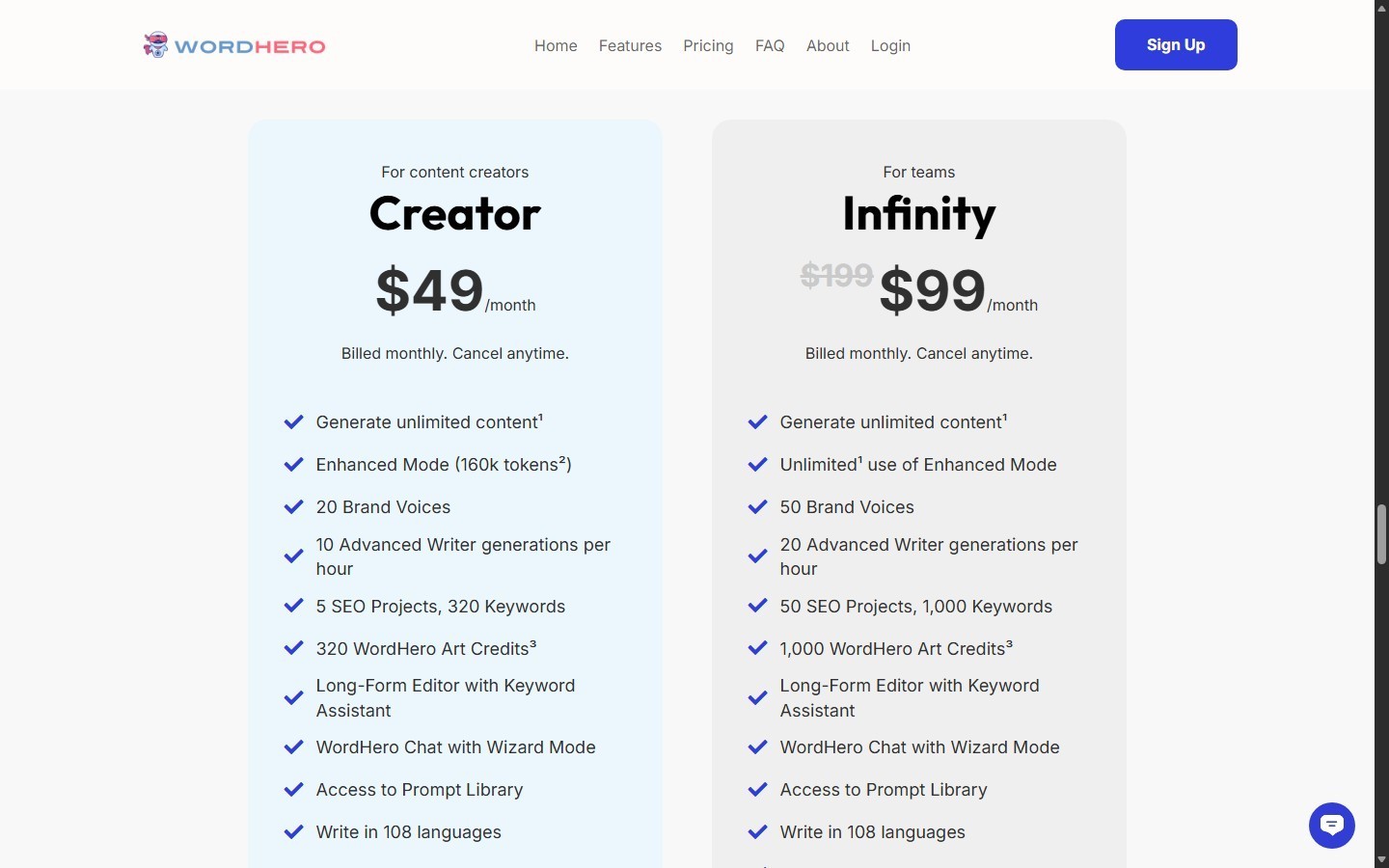
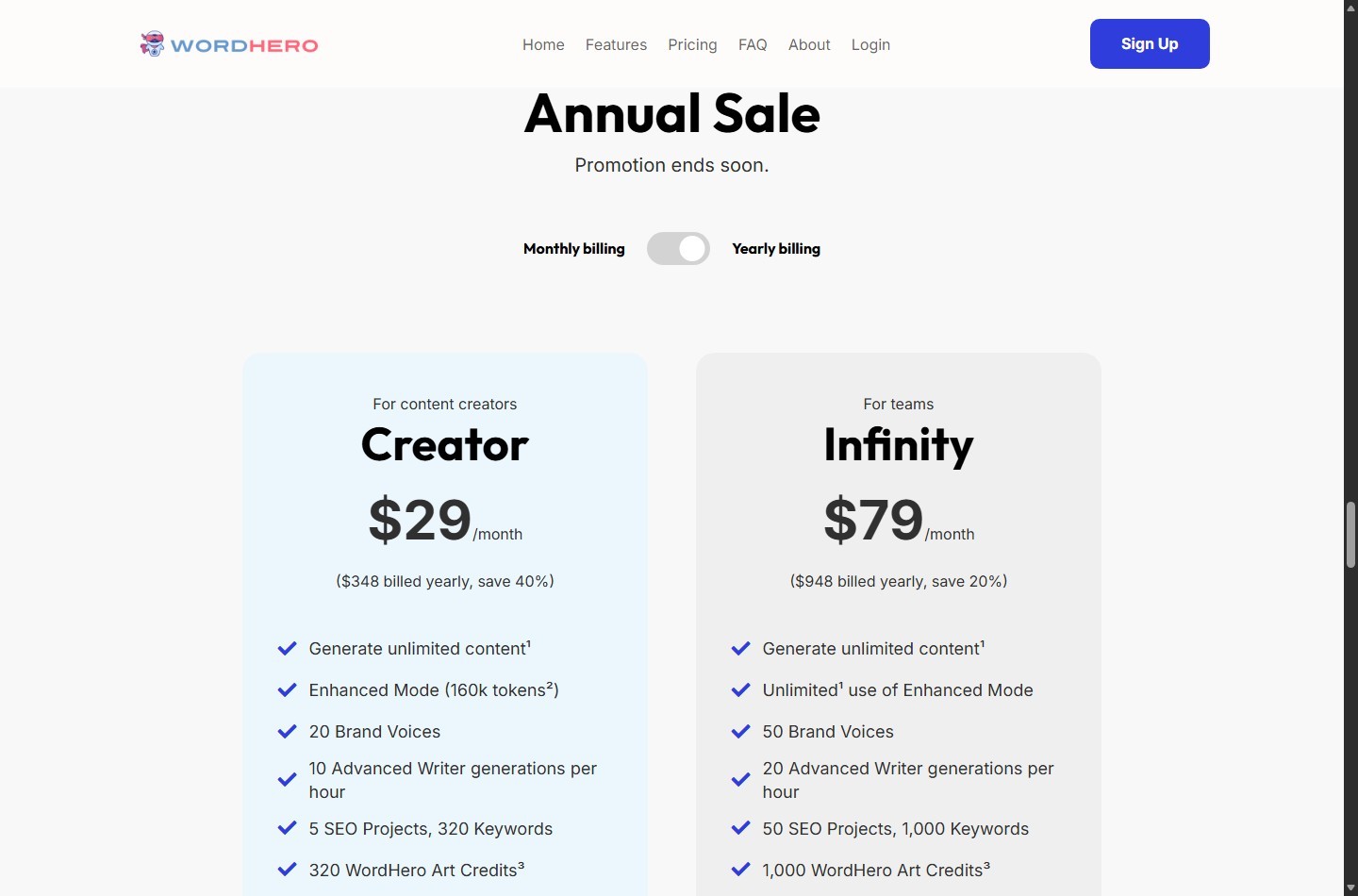
These are dated vendor displays, not permanent quotes. Taxes, currency treatment, eligibility, renewal pricing, and checkout terms can affect the amount paid. The annual totals above were shown directly by WordHero; they are not our arithmetic. Buyers should verify the final checkout and governing terms rather than relying on a promotional banner.
Creator is the more plausible starting point for one operator who needs the long-form workflow, brand voices, and a defined Enhanced Mode allowance. Infinity only makes economic sense when the higher limits or included team access solve measured constraints. “Unlimited” does not mean ungoverned use because the vendor applies its fair-use policy.
Draft publication blocker: Check WordHero subscription options. This required ScaleWitAI route returned HTTP 404 with no redirect when checked. Keep the Page in Draft until an authorized destination is configured and verified. The route is a CTA, not product evidence.
What about the WordHero lifetime deal?
WordHero’s official special-offer page displayed two one-time options on August 1, 2026:
| Lifetime plan | Displayed one-time price | Selected displayed limits |
|---|---|---|
| Lifetime Starter | $89 | Generator Mode, 30,000 Standard Mode tokens per month, 1 Brand Voice, 1 SEO project with 20 keywords, 20 Art credits, current and future writing tools, and 108 languages |
| Lifetime Pro | $267 | Generator and long-form access, Standard Mode described as unlimited subject to fair use, 10,000 Enhanced Mode tokens, 5 Brand Voices, 4 Advanced Writer generations per hour, 3 SEO projects with 80 keywords, and 80 Art credits |
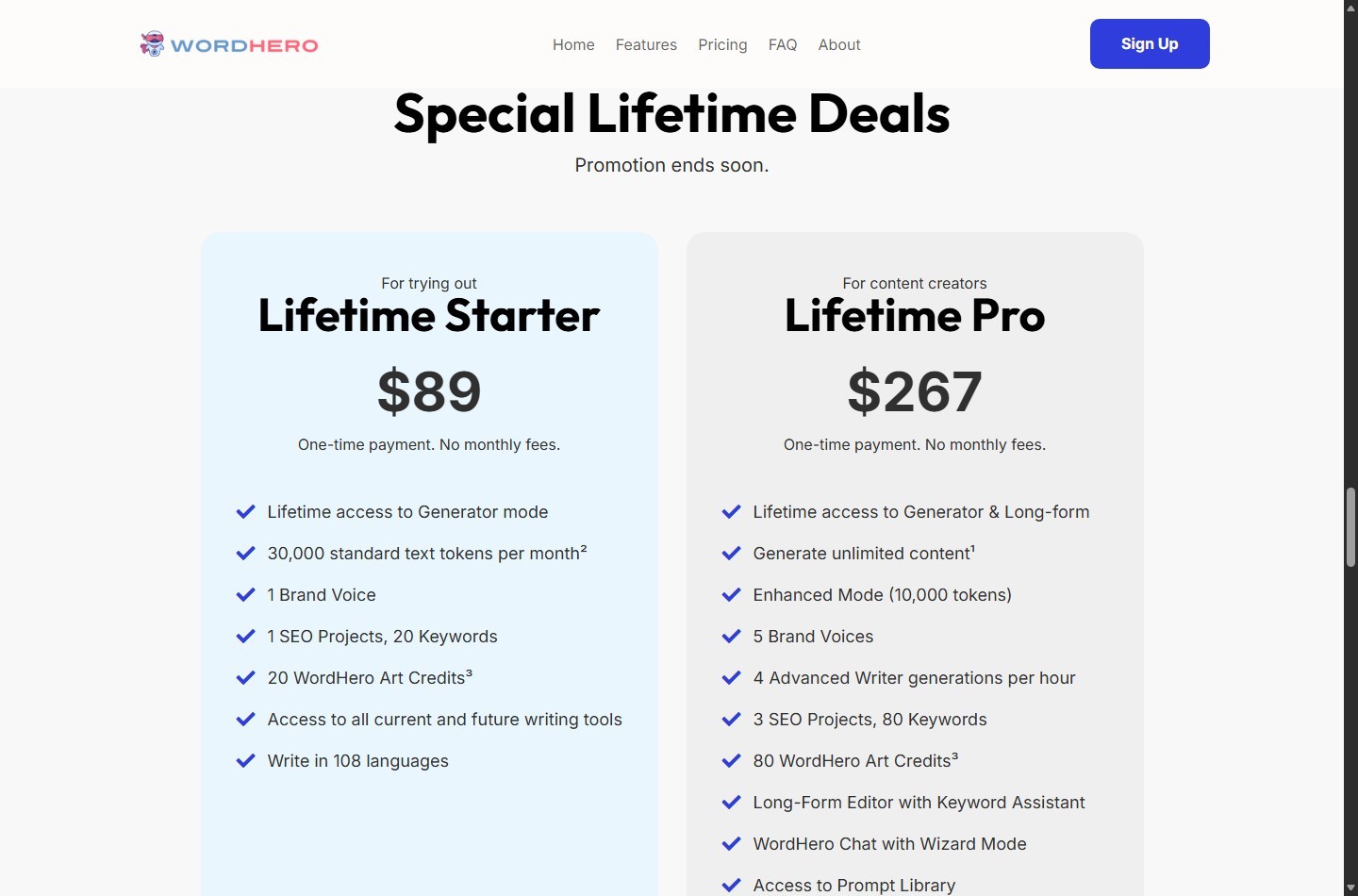
The one-time price is attractive only if the included limits match the workload. Lifetime Starter is not a substitute for the subscription workflow when long-form generation or higher allocations are essential. Lifetime Pro provides more capability, but its Enhanced Mode, Art, Brand Voice, Advanced Writer, and SEO allocations remain materially below the recurring Infinity display.
Treat “lifetime” as the vendor’s offer label, not a prediction about how long the service or every feature will exist. Before paying, save the dated checkout terms and verify fair use, refunds, support entitlement, future-feature treatment, account restrictions, and the exact resources included. The public page also displayed guarantee and promotion language, but eligibility is governed by current terms.
For a focused breakdown, see our WordHero deal analysis.
Draft publication blocker: Review the WordHero lifetime option. This required route also returned HTTP 404 with no redirect. Do not public-publish the CTA until its destination is authorized and verified.
What Are WordHero’s Pros and Cons?
| Pros | Cons |
|---|---|
| Broad set of short-form, long-form, chat, voice, keyword, and image tools | Breadth does not replace specialist SEO, research, or editorial systems |
| Structured templates can reduce prompt setup for recurring jobs | Generated facts and claims still require source-level verification |
| Advanced Writer and Editor support a topic-to-draft workflow | Vendor length and quality wording should not be treated as guaranteed output |
| Standard Mode documents 108 languages | Enhanced Mode documents a much smaller language set |
| Brand Voices and saved prompts can support repeatability | Style consistency still requires human review |
| WordPress beta may reduce transfer work | CMS transfer still requires security, formatting, metadata, and status checks |
| Subscription and lifetime pages publicly list plan-level allocations | “Unlimited” remains subject to fair use, and checkout terms can change |
The main advantage is operational convenience. WordHero assembles many common content tasks in one product and exposes explicit limits for several annual-plan resources. For a creator with a steady queue, that can be easier to budget and train than a loose set of disconnected tools.
The main disadvantage is the gap between generation and publication. The software can create a draft quickly, but buyers still own the costly parts of trustworthy content: research, differentiation, expert input, factual review, brand approval, legal review where needed, and performance measurement.
Where Does WordHero Fall Short?
First, the official documentation is not fully consistent. The Enhanced Mode help article’s heading references models differently from its own body and from the language page, features page, and pricing copy. This does not prove that any particular model is or is not available. It means buyers should verify model access in writing if it affects procurement.
Second, WordHero’s public SEO wording can be interpreted too broadly. Keyword insertion and planning may support an SEO workflow, but no tool can guarantee optimization or rankings from generation alone. Search outcomes depend on many factors outside the writing interface. A team should demand intent alignment, source quality, original value, internal linking, technical quality, and post-publication measurement.
Third, “unlimited” is qualified by fair use. The public pricing note clearly applies a fair-use policy to unlimited features, but the visible pricing block does not quantify every operational threshold. High-volume buyers should request specifics and run a workload test before committing.
Fourth, the lifetime offer has lower allocations than the recurring plans. Buyers can compare displayed prices and core limits, but they still need the live checkout and governing terms before treating the offer as a durable procurement decision.
Fifth, AI output carries familiar governance risks. It can be inaccurate, generic, repetitive, biased, or too confident. WordHero’s prohibited-content help page also documents restricted topics and uses. Businesses need an escalation process when a prompt or output intersects with safety, regulated claims, customer data, or sensitive subjects.
Finally, an all-in-one interface may be less valuable for teams that already have mature specialist systems. If your editors already work in a preferred CMS, your SEO team uses dedicated data, and your writers have controlled prompt workflows, WordHero must save measurable time without creating extra migration or review work.
What Are the Best WordHero Alternatives?
The best alternative depends on what you want to improve.
Rytr is a relevant comparison for buyers prioritizing lightweight AI writing and a simpler purchasing decision. WordHero presents a wider content workspace with Advanced Writer, SEO Planner, Art, and multi-brand allocations. The better fit depends on volume, long-form needs, and how much bundled functionality you will actually use. Our detailed WordHero vs Rytr comparison maps the choice to buyer workflow.
A general-purpose AI assistant may be better for flexible analysis, coding, document work, and custom instructions beyond marketing templates. The tradeoff is that you may need to design your own prompts, workflows, and controls instead of using WordHero’s packaged tools.
A dedicated SEO content platform may be better when the priority is competitive SERP analysis, content briefs, optimization guidance, team workflows, and measurable search performance. WordHero’s SEO Planner and Keyword Assistant can support drafting, but they do not obviously replace a full SEO stack.
A human writer or specialist agency remains the stronger choice for original reporting, expert interviews, regulated topics, distinctive thought leadership, and high-stakes conversion assets. AI can still assist with outlines and variants, but accountability and original insight remain human responsibilities.
A CMS-first workflow may be better if collaboration, approvals, structured content, and publishing governance are the primary bottlenecks. WordHero’s WordPress beta can help with transfer, but it is not a complete content operations system.
Do not select an alternative from a generic feature checklist. Compare the whole production cost: subscription, setup, prompting, source research, editing, approvals, transfer, rework, and performance monitoring.
How Should You Evaluate WordHero Before Buying?
Use a controlled evaluation instead of judging one impressive output. Choose five to ten tasks that reflect real work, including at least one difficult task. Keep the inputs and scoring method consistent across WordHero and any alternative.
Build a representative test set
Include a short-form template task, a long-form article section, a revision task, a brand-voice task, and a factual task grounded in supplied sources. Multilingual teams should add one task per priority language. SEO teams should add a brief-to-draft task but score intent coverage separately from keyword inclusion.
Define a scorecard before generating
Score factual accuracy, source fidelity, instruction following, brand fit, structural quality, useful originality, edit time, and publish readiness. Record critical errors separately because one fabricated claim can matter more than several elegant sentences. Do not use output length as a quality proxy.
Track total labor and resource use
Measure minutes spent briefing, generating, waiting, editing, verifying, formatting, and transferring. Record Enhanced Mode tokens, Art credits, failed generations, and retries. The relevant metric is approved output per total hour and dollar, not raw words generated.
A simple ROI equation is:
`monthly value = approved hours saved × loaded hourly cost – software cost – added review or rework cost`
This is an evaluation model, not a claim that WordHero will produce savings. Use actual team data. If saved drafting time simply becomes extra correction time, the tool has not improved the process.
Test governance and publishing
Check account roles, brand separation, prompt handling, data policy, export options, and support response before introducing client or confidential material. If testing WordPress transfer, use a staging or noncritical draft and confirm headings, links, images, author, status, and metadata. Revoke test credentials when no longer needed.
Set a decision threshold
For example, require a material reduction in approved-draft time with no increase in critical factual errors. Set different thresholds for low-risk social variants and high-risk product or legal copy. A tool can pass one workflow and fail another.
Is WordHero Worth It?
WordHero is worth considering if you produce content frequently, can use several parts of the bundle, and already have a disciplined human review process. Creator is the logical public annual plan for a solo operator or small production workflow. Infinity becomes relevant when five seats, larger brand and SEO project allocations, higher Advanced Writer throughput, and a much larger resource pool solve real constraints.
It is less compelling if you need only occasional drafts, rely primarily on specialist SEO analysis, or expect the software to publish accurate content without review. The lifetime options can reduce recurring software cost, but only for workloads that fit their lower documented allocations.
Our decision rule: buy only when a controlled test shows lower total cost per approved asset, not merely faster raw generation. Choose the recurring plan only after confirming checkout terms and realistic usage. Consider Lifetime Pro only after receiving dated, complete terms and comparing its actual limits with your workload. Until the two ScaleWitAI affiliate redirects are fixed, both commercial CTAs remain publication blockers.
How We Test and Score
ScaleWitAI funds every account used in this review with its own capital. We subscribe to all paid tiers with self-funded plans and never use sponsored, gifted, or vendor-provisioned accounts, so our evaluation reflects the same product a paying customer receives and stays 100% independent of vendor influence.
Evaluation combines standardized test suites with hands-on workflow testing. We use HumanEval-style tasks to probe logic and code reasoning, BLEU/ROUGE-style metrics to measure natural-language quality, and internal stress-test scenarios to map context-window limits and long-input behavior. We run more than 10,000 prompts per AI platform every year, across varied access conditions, and log results against a transparent scoring rubric.
The dataset for this review was collected over 12 months (from August 2025 to August 2026). Historical comparisons track AI model development since 2024, and this report tests and compares 12+ leading AI models and providers on the market.
FAQ
Is WordHero a good AI writer?
WordHero appears well equipped for structured first drafts, content variants, long-form assembly, and reusable brand instructions. Whether it is good for your operation depends on factual accuracy, edit time, brand fit, and approved-output cost on your own tasks.
Does WordHero replace human writers?
No. WordHero’s own FAQ says it does not completely replace writers and that a human is still required to edit outputs. Human oversight is also needed for research, originality, fact-checking, compliance, and strategic judgment.
Does WordHero guarantee plagiarism-free content?
No such guarantee is made in this review. Generated text should go through an originality and source review appropriate to the publication. Do not treat AI generation as proof of originality or permission to reuse third-party expression.
Does WordHero guarantee SEO rankings?
No. WordHero offers SEO Planner and Keyword Assistant features, and the vendor uses SEO-focused marketing language. Those tools do not guarantee optimization or rankings. Search performance depends on content quality, intent fit, competition, site authority, technical factors, links, and maintenance.
How much does WordHero cost?
On August 1, 2026, WordHero’s public homepage with yearly billing displayed showed Creator at $29 per month billed as $348 yearly and Infinity at $79 per month billed as $948 yearly. Pricing can change, so verify the checkout total, taxes, renewal terms, and plan limits before buying.
Is there a WordHero lifetime deal?
The official special-offer page displayed Lifetime Starter at $89 and Lifetime Pro at $267 on August 1, 2026. Verify the live checkout, included limits, fair-use rules, refund eligibility, and governing terms before purchase.
What is the difference between Standard and Enhanced Mode?
Official documentation identifies Standard Mode as the broad-language mode and describes Enhanced Mode as a more resource-intensive option with narrower documented language support. The official pages contain conflicting model wording, so model-specific access should be confirmed with WordHero support and in the account interface.
How many languages does WordHero support?
WordHero documents 108 languages for Standard Mode. Its official help page lists a much smaller set for Enhanced Mode. Availability does not guarantee equal output quality, so use qualified native reviewers for important multilingual content.
Can WordHero publish to WordPress?
An official help article dated January 21, 2025 documents a beta connection from Documents to WordPress using an application password. Test it on a noncritical draft and verify formatting, links, images, metadata, author, and status before production use.
Which WordHero plan is best for teams?
Infinity is publicly positioned for teams and displayed up to five team members in the annual pricing block checked. Confirm collaboration permissions, fair-use terms, account ownership, and the current checkout details before purchase.
