Clearscope is a premium content optimization platform for researching topics, building briefs, improving drafts, monitoring published pages, and tracking visibility across Google, ChatGPT, and Gemini. It is best for teams that value dependable editorial guidance and simple collaboration more than low entry pricing or an all-in-one technical SEO suite.
| At-a-glance | Clearscope |
|---|---|
| Primary category | SEO content optimization and AI search visibility |
| Official site | clearscope.io ↗ |
| Best for | SEO specialists, content managers, writers, agencies, and enterprise content teams |
| Starting price | Essentials at $129 per month |
| Free access | 14-day free trial; no permanent free plan listed |
| Core workflow | Discover topics, create drafts, grade content, publish, monitor decay, track AI visibility |
| Integrations | Google Docs, WordPress, Microsoft Word, Google Search Console, and Google Analytics |
| AI visibility | Prompt and brand visibility tracking across ChatGPT and Gemini |
| Main limitation | Premium pricing and no full technical SEO, backlink, or rank-tracking suite |
This Clearscope review evaluates the current product and US pricing for solo creators, agencies, content operations teams, and enterprise brands. It explains how the grading system works, where AI search tracking adds value, what the platform does not replace, and whether the workflow justifies paying more than many focused content optimizer alternatives.
Quick Verdict: Is Clearscope Worth Using?
Clearscope is worth considering when content quality control, writer adoption, and ongoing visibility monitoring matter more than the lowest monthly price. Its strongest advantage is a connected workflow: research a topic, create a shareable draft, optimize against current search results, monitor the published page, and track brand mentions or citations in ChatGPT and Gemini.
Skip Clearscope if you mainly need technical crawling, backlink analysis, daily keyword rank tracking, high-volume AI article generation, or a budget tool for occasional articles. Those jobs require another platform or a less expensive content optimizer.
| Buyer situation | Verdict | Why |
|---|---|---|
| Content team needs consistent briefs and quality gates | Strong fit | Real-time grades, term recommendations, readability, competitor context, and shared drafts create a repeatable editorial standard |
| Brand wants Google and AI visibility in one content workflow | Strong fit | Prompt tracking, citations, share of voice, content optimization, and monitoring connect SEO with AEO/GEO decisions |
| Solo creator publishes only a few articles | Conditional | The workflow is accessible, but $129 per month may exceed the value of light usage |
| Agency coordinates external writers | Strong fit | Unlimited users and projects, guest-mode draft sharing, integrations, and centralized monitoring reduce handoff friction |
| Team needs a complete SEO suite | Weak fit by itself | Clearscope does not replace a crawler, backlink database, local SEO platform, or full rank tracker |
If the workflow matches your operation, you can start the 14-day Clearscope trial and test it with one new article plus one declining page before committing.
What Is Clearscope?
Clearscope is an SEO content optimization and AI search visibility platform built around the full content lifecycle. The current product covers topic discovery, search-intent analysis, drafting, content grading, AI-assisted writing, internal-link recommendations, published-content monitoring, and visibility measurement across Google and AI answer engines.
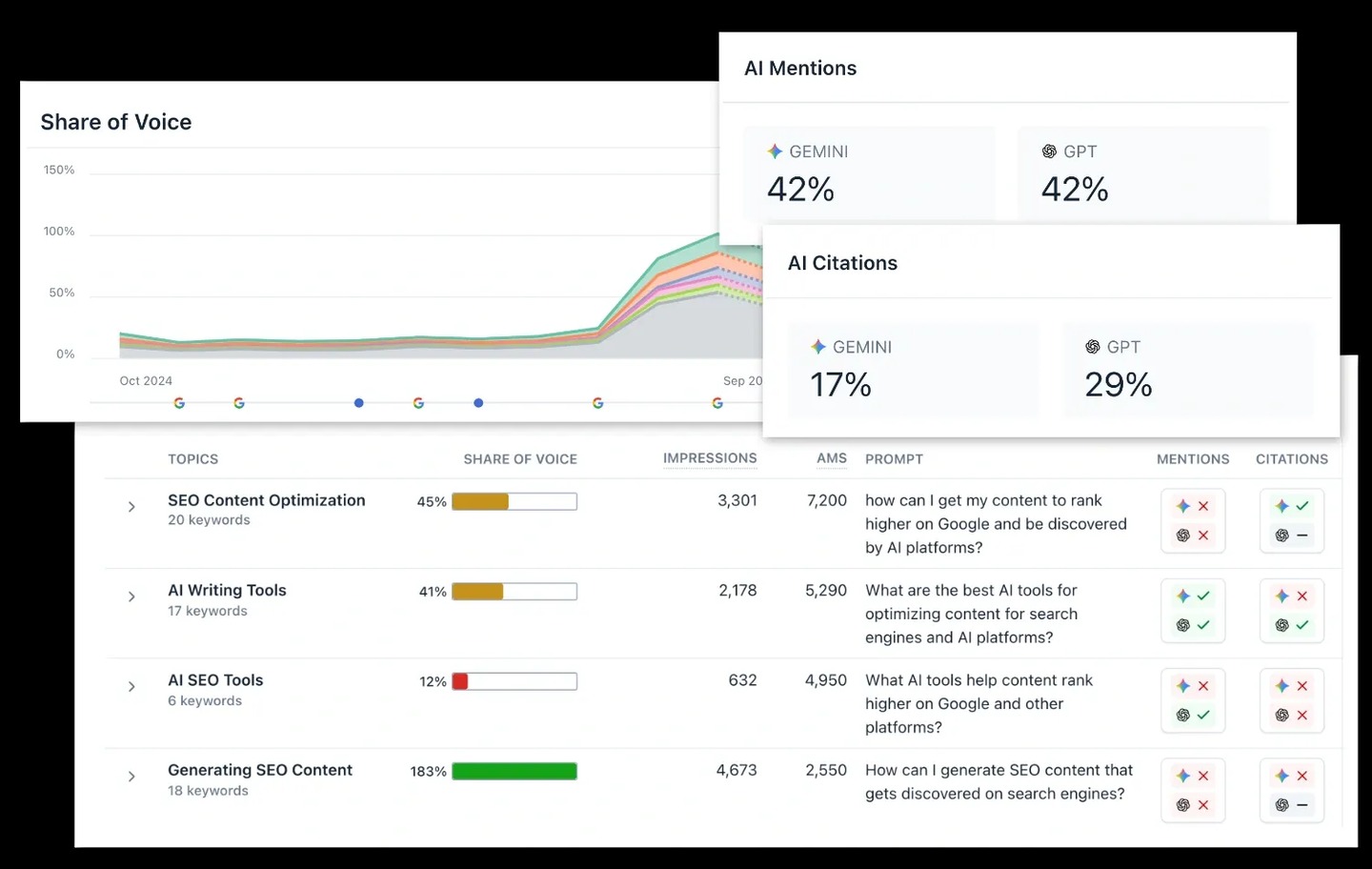
The platform is not simply a keyword density checker. It analyzes current search results, surfaces topics and terms that help explain an entity comprehensively, compares a draft with competitive pages, and updates its recommendations as search intent changes. Its Content Inventory then keeps the optimization process active after publication.
Clearscope now also goes beyond traditional Google rankings. Current plans include prompt tracking, brand visibility tracking, and query fan-out awareness for ChatGPT and Gemini. A newer official Prompt Tracking announcement also names Claude, but the pricing page and most support documentation still name only ChatGPT and Gemini. Buyers who require Claude coverage should confirm availability and sampling during the trial.
Who Is Clearscope Best For?
Clearscope fits organizations that treat content as an ongoing operating system rather than a one-time writing task. The platform can serve a solo specialist, but its pricing and workflow become easier to justify when several writers, editors, subject-matter experts, or clients share the same quality standard.
SEO specialists
SEO specialists can turn SERP evidence into a practical brief instead of sending writers a raw keyword export. Competitor views, suggested terms, questions, content grades, word-count targets, and readability indicators make recommendations easier to explain and audit.
Content managers and editorial teams
Content managers benefit from standardized drafts, shared links, live scoring, version history, and monitoring. The grade becomes a quality-control signal, while the manager still decides whether the article satisfies search intent, brand voice, and factual standards.
Content creators and subject-matter experts
Writers receive guidance inside Clearscope, Google Docs, WordPress, or Microsoft Word. This reduces tool switching and lets the creator focus on useful explanations instead of manually checking a spreadsheet of required terms.
Agencies
Agencies can use unlimited users and projects, guest sharing, and a repeatable briefing process across clients. Business adds a dedicated account manager, while Enterprise adds custom agreements, crawler whitelisting, and single sign-on.
Enterprise brands
Enterprise teams gain the most when content governance, security, account support, large inventories, and AI visibility reporting must work together. Clearscope is less compelling when the organization only wants inexpensive AI drafts without a broader editorial process.
What Are Clearscope’s Key Features?
Clearscope’s main features connect discovery, production, optimization, distribution, and monitoring. The value comes from using them as one lifecycle rather than judging the editor alone.
Topic Explorations and search-intent research
Topic Explorations help teams move from a broad subject to related topics, keywords, questions, search volume, competitive signals, and content-cluster opportunities. The workflow supports content planning before a writer opens a draft.
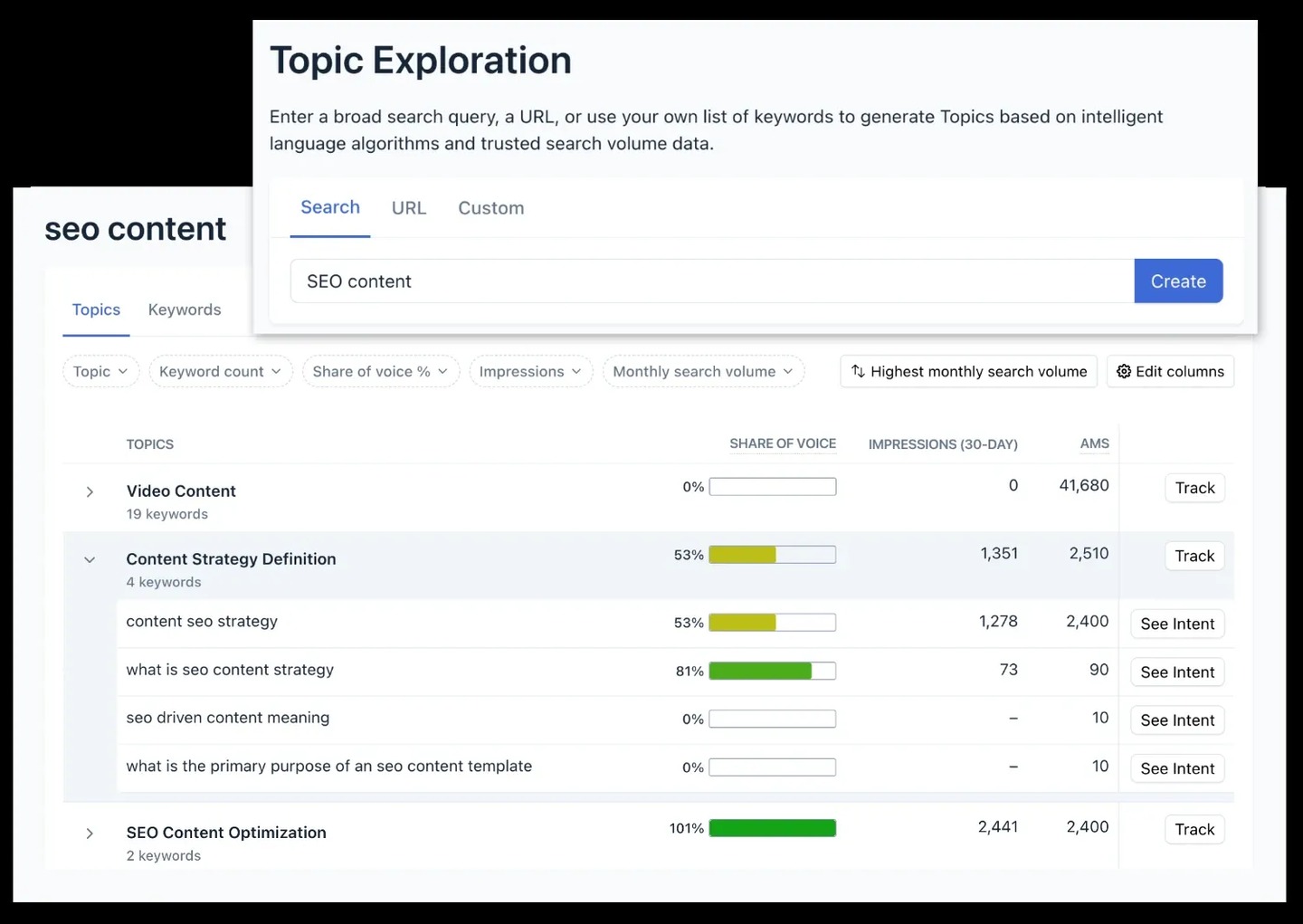
This feature is useful for content managers who need to decide what to create, not just how to optimize an assigned keyword. Essentials includes 20 monthly Topic Explorations, Business includes 50, and Enterprise uses custom credits. Current Draft documentation lists English, German, French, Spanish, and Italian, with optional city, state, or regional targeting. Teams publishing in other languages should validate support before subscribing.
Content Editor and real-time grading
The Content Editor grades topical coverage from A++ to F while tracking term usage, word count, headings, and readability. The grade reflects how comprehensively and relevantly the draft covers a subject relative to analyzed top-ranking content. It is not a guarantee of ranking.
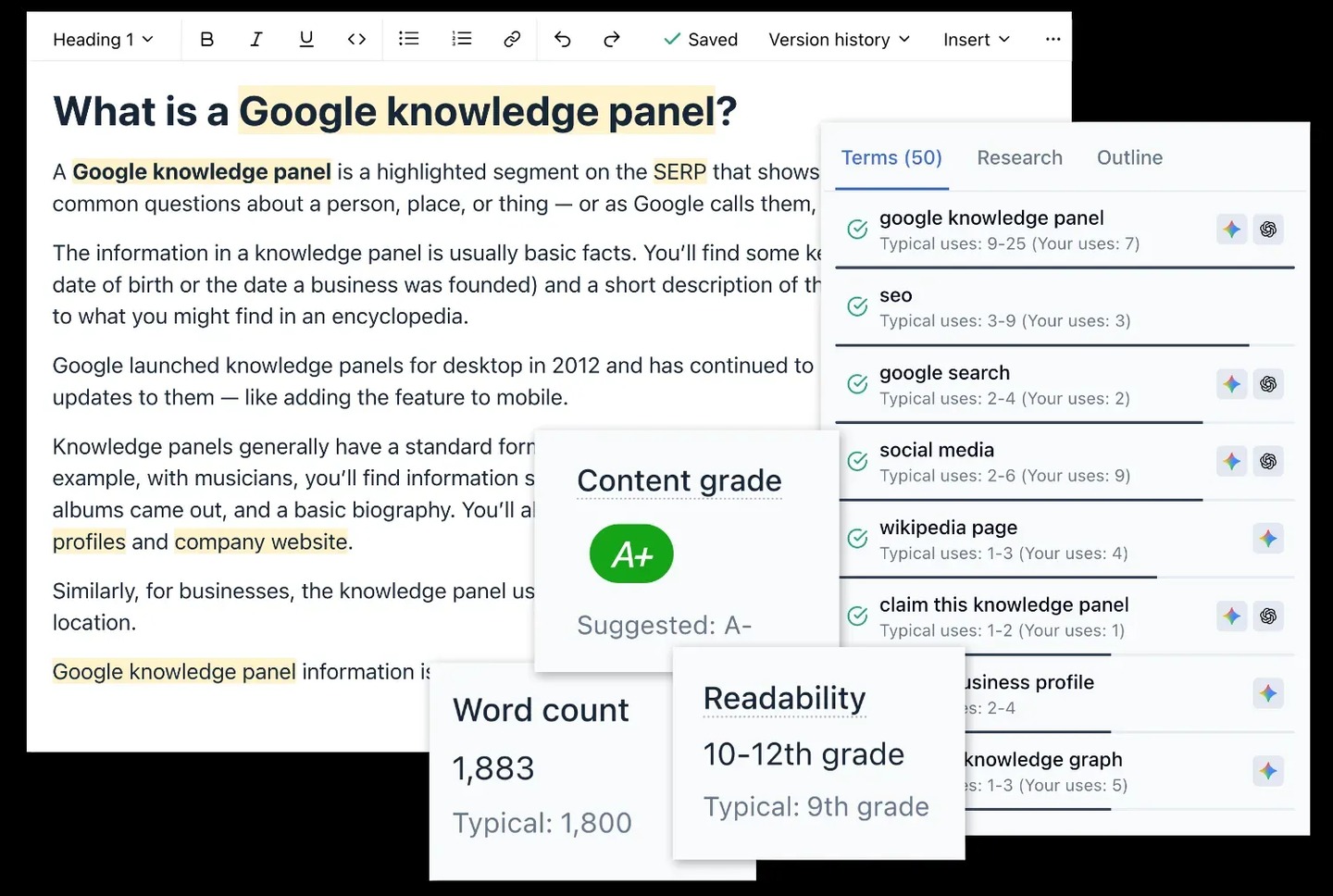
Clearscope uses Flesch-Kincaid readability tests to estimate the reading level. The research and competitor views add term usage, outlines, page positions, word counts, and competing content grades. For a deeper explanation of what raises or lowers a score, use the Clearscope grading system guide.
The safe way to use the grade is as a diagnostic. An A-grade draft can still be inaccurate, repetitive, unoriginal, or poorly matched to the conversion goal. Editors should treat unused terms and competitor patterns as evidence to investigate, not instructions to force every phrase into the page.
AI-assisted outlining, drafting, and editing
Clearscope includes AI-assisted workflows for outlines, first drafts, editing, and overcoming writer’s block. The product still centers the human editor: AI can accelerate a first pass, but subject knowledge, source verification, brand voice, examples, and information gain remain editorial responsibilities.
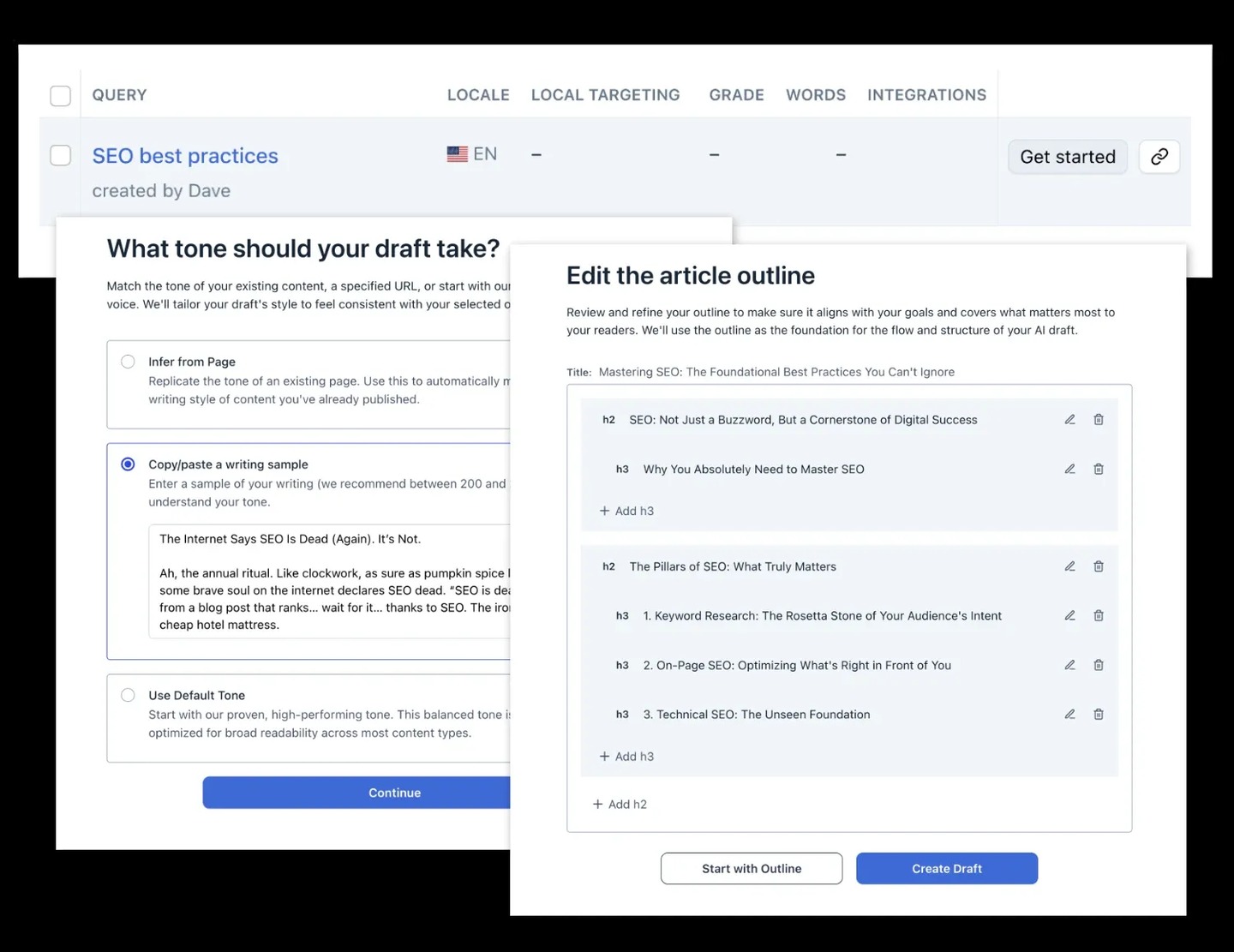
Current pricing expresses usage as monthly Drafts rather than unlimited AI output. Both Essentials and Business list 20 monthly Drafts, while Enterprise uses custom credits. Teams planning high-volume generation should calculate the cost per finished article before treating Clearscope as their primary AI writer.
Prompt tracking and AI search visibility
Prompt Tracking monitors specific prompts to show when and how a brand appears. Current pricing and most support pages describe ChatGPT and Gemini, while a newer official feature announcement also names Claude and competitor comparison across up to five domains. The broader visibility workflow combines AI mentions, citations, Google performance, share of voice, and query fan-out awareness.
This feature matters because AI engines can use web searches and external sources to construct answers. Clearscope helps a team identify which pages earn citations, where competitors appear, and which source queries may require better content. It does not guarantee that ChatGPT or Gemini will cite a page, because answer generation remains controlled by each platform.
Content Inventory and content-decay monitoring
Content Inventory connects published pages with Google Search Console data, content grades, clicks, impressions, position, and optimization opportunities. Clearscope currently describes monthly content reevaluation plus weekly Monday alerts. Pre-built or custom views can surface decaying pages, striking-distance opportunities, indexing issues, broken links, and pages that need refreshing.
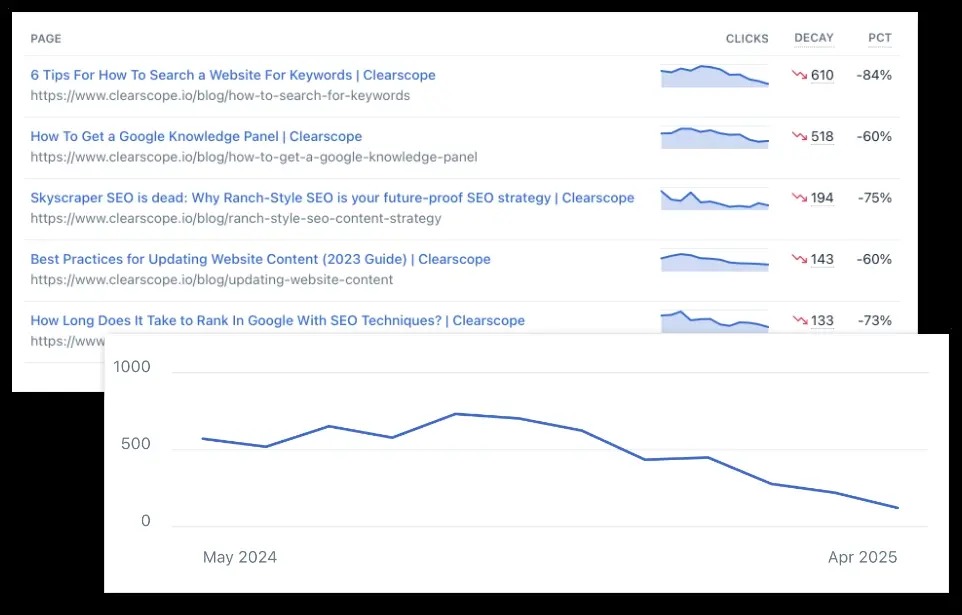
The operational value is prioritization. The Content Decay view compares clicks in the latest 90 days with the equivalent period one year earlier, alongside seasonal change and a 12-month trend. That signal helps identify refresh candidates, but it does not prove content quality caused the decline. Demand, seasonality, technical problems, and SERP changes still require investigation.
Google Docs, WordPress, Microsoft Word, and analytics integrations
Clearscope integrates its editor experience with Google Docs, WordPress, and Microsoft Word. Writers can view term recommendations and live scoring where they already draft, while shareable links let external contributors use Guest Mode without a full login.
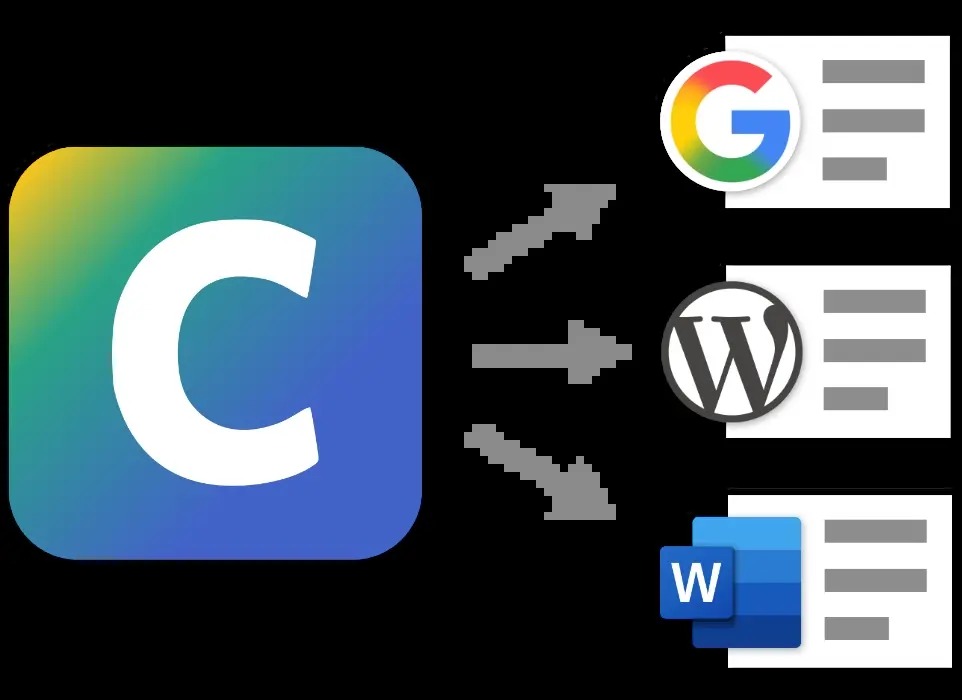
Teams using Google Docs can follow the Clearscope Google Docs workflow for installation, linking a draft, collaboration, and score verification. Google Search Console and Google Analytics support published-content monitoring; internal-link recommendations help connect related pages and distribute link equity.
How Does Clearscope Work?
Clearscope works by converting a target topic into research, draft guidance, measurable editorial checks, and post-publication monitoring. A practical workflow has six stages.
- Explore the topic. Use Topic Explorations to identify queries, questions, search demand, and related subject areas.
- Create a Draft. Choose the target query, language, locale, and optional local area. Clearscope says the analysis usually takes one to two minutes and evaluates the top 30 desktop and mobile Google results.
- Build the brief. Review competing pages, common headings, questions, citations, terms, word counts, and intent before defining the outline.
- Write and optimize. Draft in Clearscope or a supported editor while monitoring the content grade, readability, structure, and term coverage.
- Publish and connect the URL. Move the approved content into WordPress or another CMS and add the page to Content Inventory.
- Monitor and refresh. Use Google and AI visibility signals to find decay, citation gaps, indexing issues, and update opportunities.
| Stage | Primary Clearscope signal | Human decision still required |
|---|---|---|
| Discovery | Topic opportunities, search volume, questions, competitor activity | Which topic supports business goals and topical authority |
| Briefing | SERP patterns, terms, outlines, questions, word-count ranges | Search intent, angle, evidence, audience, and conversion goal |
| Drafting | Grade, readability, term coverage, AI assistance | Accuracy, voice, originality, examples, and information gain |
| Publishing | CMS integration and shared workflow | Final QA, legal review, formatting, and conversion elements |
| Monitoring | GSC metrics, content health, decay, prompts, citations | Whether to update, consolidate, redirect, or leave the page unchanged |
The workflow is strongest when a team defines an acceptance rule such as “meet the brief, address the intent, pass factual review, and reach an appropriate grade.” Requiring A++ for every article can encourage unnecessary additions and erase useful differences between content formats.
What Is Clearscope Like in Real Use?
Clearscope’s practical strength is reducing ambiguity between the SEO strategist, editor, and writer. The interface presents a manageable set of signals instead of asking every contributor to interpret raw SERP exports or master a large SEO suite.
Setup begins with a project, topic, and draft. The first important judgment is competitor selection: if the ranking pages represent mixed intent, a content grade can optimize the wrong format. Experienced teams review the SERP and exclude irrelevant page types before accepting word-count or term targets.
During drafting, the live grade gives fast feedback, but the best improvements usually come from adding missing explanations rather than repeating words. A writer should ask why a term appears, what entity relationship it represents, and whether the reader needs that information. This produces a more natural article than chasing the score mechanically.
The post-publication workflow adds durable value. Content Inventory and AI visibility tracking turn a single optimization session into an update loop. The trade-off is operational discipline: someone must review alerts, prioritize pages, and approve changes. Buying the platform does not create the strategy automatically.
How Much Does Clearscope Cost?
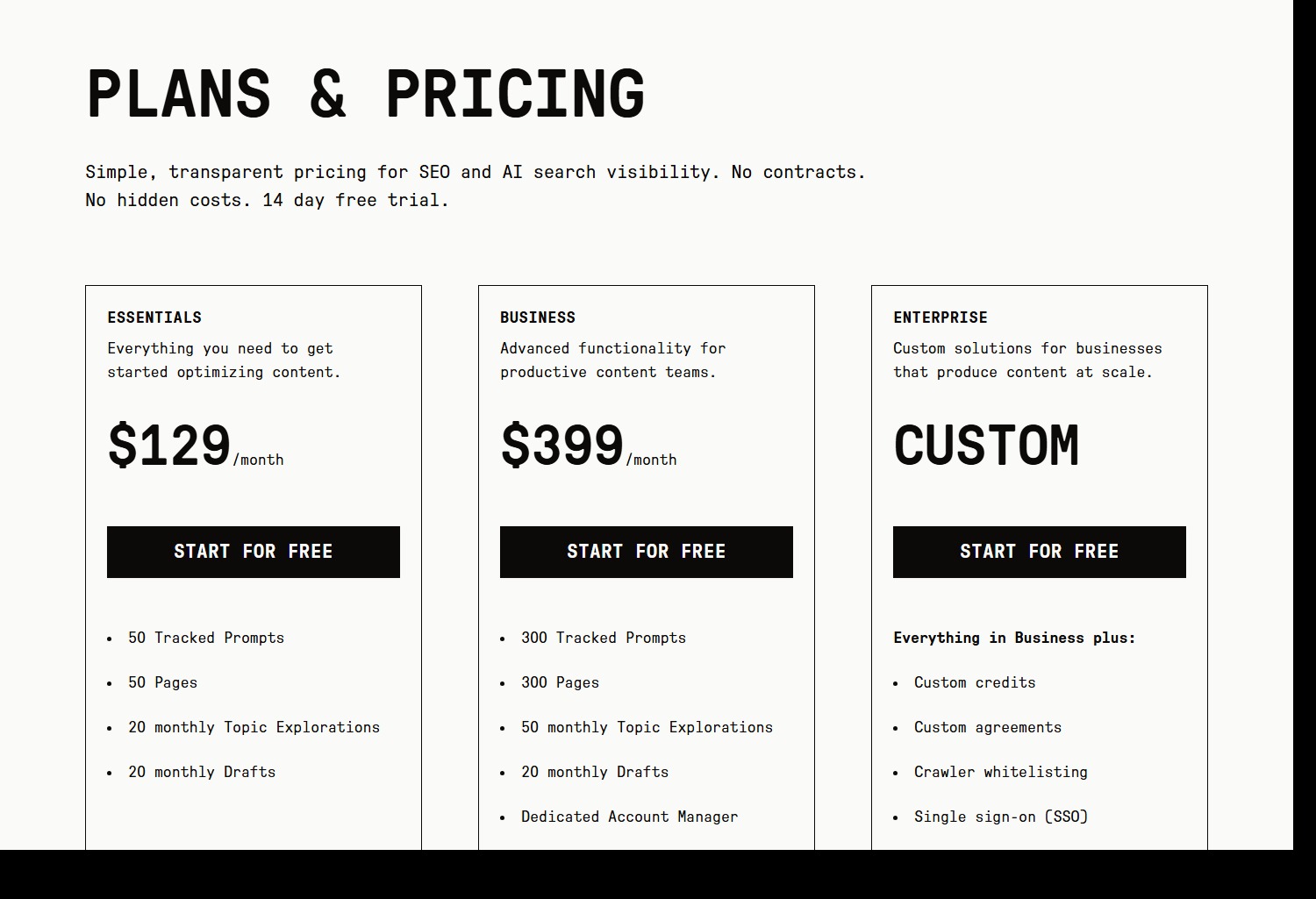
Clearscope starts at $129 per month and offers a 14-day free trial with no permanent free plan listed. The current US pricing page presents monthly Essentials, Business, and custom Enterprise options with no minimum contract for monthly plans.
| Plan | Monthly price | Included usage | Best fit |
|---|---|---|---|
| Essentials | $129 | 50 tracked prompts, 50 pages, 20 monthly Topic Explorations, 20 monthly Drafts | Solo specialists and small content teams with controlled volume |
| Business | $399 | 300 tracked prompts, 300 pages, 50 monthly Topic Explorations, 20 monthly Drafts, dedicated account manager | Agencies and established content operations needing more monitoring capacity |
| Enterprise | Custom | Custom credits, custom agreements, crawler whitelisting, SSO | Large brands with security, procurement, governance, and scale requirements |
Every plan currently lists unlimited users and projects, prompt tracking, brand visibility tracking, query fan-out awareness, search-intent recommendations, training and onboarding, priority support, sharing and exporting, and flexible plan changes. Usage limits still matter because pages, prompts, explorations, and drafts determine whether the advertised price fits the operation.
The live pricing configurator currently lists 100 additional Pages at $25 per month on Essentials or $15 on Business, plus 10 additional Drafts at $50 on Essentials or $20 on Business. Monthly Draft and Topic Exploration credits do not roll over. Official add-on documentation also says over-limit add-ons can be billed automatically, so buyers should monitor usage rather than treating the listed subscription as a fixed ceiling.
Before subscribing, estimate monthly new drafts, tracked pages, tracked AI prompts, and Topic Explorations. A five-person team can find Essentials economical if usage stays inside its limits; a solo creator publishing two articles per month may find the same $129 difficult to justify.
What Are Clearscope’s Pros and Cons?
Clearscope prioritizes editorial usability and connected content intelligence, but premium pricing and focused scope create clear trade-offs.
| Pros | Cons |
|---|---|
| Clear real-time content grading and term recommendations | $129 entry price is high for light or occasional use |
| Topic, draft, optimization, monitoring, and AI visibility in one lifecycle | No permanent free plan listed |
| Unlimited users and projects on current plans | Draft, page, prompt, and Topic Exploration limits still apply; monthly Draft and Exploration credits do not roll over |
| Google Docs, WordPress, Microsoft Word, GSC, and analytics workflows | Does not replace technical crawlers, backlink tools, or full rank trackers |
| Guest sharing supports freelancers and external writers | A high grade can encourage formulaic writing when used without editorial judgment |
| Content Inventory helps prioritize refreshes and content decay | AI citations and rankings remain outcomes the platform cannot guarantee |
| Training, onboarding, support, and Enterprise governance | High-volume AI generation may be cheaper in broader AI writing platforms |
Where Does Clearscope Fall Short?
Clearscope falls short when buyers expect one subscription to handle every SEO, AI writing, and analytics task. Its recommendations are valuable for content decisions, but they do not replace a complete technical and off-page SEO stack.
First, Clearscope does not provide the depth of a dedicated site crawler, backlink intelligence platform, local SEO suite, or daily rank tracker. Teams may still need tools for log analysis, Core Web Vitals, link prospecting, local listings, or granular rank monitoring.
Second, the grading system can be misused. Top-ranking pages provide useful evidence, but copying their terms and structure can produce derivative content. Original data, first-hand examples, expert review, proprietary frameworks, and a distinct answer remain necessary for information gain.
Third, official AI visibility documentation is in transition. Pricing and most support pages name ChatGPT and Gemini, while a newer Prompt Tracking announcement also names Claude. Buyers who need broad monitoring should verify model access, geography, sampling, refresh frequency, and prompt capacity during the trial.
Finally, usage economics vary sharply. Unlimited users sound generous, but the real constraints are monthly Drafts, Topic Explorations, tracked Pages, and tracked Prompts. Unused monthly Draft and Exploration credits expire, while official documentation says plan add-ons can be billed automatically when limits are exceeded. A buyer should model those units and set an internal usage review instead of comparing only seat counts.
What Are the Best Clearscope Alternatives?
The best Clearscope alternative depends on whether the buyer prioritizes lower-cost optimization, broader AI SEO execution, a full SEO suite, or AI search growth. The dedicated Clearscope alternatives guide provides the broader shortlist.
| Alternative | Better when | Main trade-off versus Clearscope | Detailed comparison |
|---|---|---|---|
| NeuronWriter | You want a lower-cost semantic optimizer with SERP analysis, scoring, AI writing, WordPress, and GSC context | Less premium editorial positioning and a different monitoring/governance model | Clearscope vs NeuronWriter |
| Scalenut | You want content planning, generation, optimization, and GEO workflows in a broader AI SEO platform | More platform complexity and a less focused editorial experience | Clearscope vs Scalenut |
| SE Ranking Content Editor | You want content optimization inside an all-in-one SEO suite with rank tracking and site auditing | Content optimization is one module rather than the product’s sole center | Clearscope vs SE Ranking |
| Writesonic | You want AI article generation, SEO agents, citations, and wider AI search growth execution | Broader automation can add complexity and higher plan-gating for advanced visibility workflows | Clearscope vs Writesonic |
Do not compare Clearscope with unrelated rank trackers or technical audit tools simply because all of them carry an SEO label. The closest alternatives share the content-brief, editor, semantic recommendation, scoring, and existing-content optimization workflow.
Is Clearscope Worth the Price?
Clearscope is worth the price when a team can spread the subscription across enough drafts, tracked pages, contributors, and refresh decisions. It is harder to justify for a low-volume solo site that needs only occasional term suggestions.
Use the 14-day trial as a controlled evaluation rather than a product tour. Create one new brief, optimize one draft, connect one published page, test the Google Docs or WordPress workflow, add representative AI prompts, and invite a writer or editor. Then measure briefing time, revision cycles, usability, and whether the monitoring signals lead to actionable decisions.
A practical buying threshold is operational, not numerical: if Clearscope replaces manual SERP analysis, reduces writer rework, and helps the team refresh pages before traffic declines materially, the workflow can justify the premium. If the team ignores Content Inventory and prompt tracking, a cheaper editor may deliver most of the value.
Evaluate Clearscope with a 14-day trial, then compare the actual usage against Essentials limits before choosing a paid plan.
FAQ
What does Clearscope do?
Clearscope helps teams research topics, create and optimize content, monitor published pages, and track visibility across Google, ChatGPT, and Gemini. Its editor provides real-time grading, term recommendations, readability, competitor context, and workflow integrations.
How does the Clearscope grading system work?
Clearscope grades content from A++ to F based on topical comprehensiveness and relevance compared with analyzed top-ranking pages. The grade changes as a draft uses relevant terms and addresses the subject, while separate metrics track readability and word count. A high grade does not guarantee rankings or AI citations.
Does Clearscope offer a free trial?
Yes. Clearscope currently advertises a 14-day free trial. Its pricing page does not list a permanent free plan, so continued access requires Essentials, Business, or a custom Enterprise agreement.
How much does Clearscope cost?
Clearscope Essentials costs $129 per month, Business costs $399 per month, and Enterprise uses custom pricing. Buyers should also compare limits for Drafts, Topic Explorations, Pages, and tracked Prompts.
Does Clearscope work with Google Docs and WordPress?
Yes. Clearscope integrates with Google Docs, WordPress, and Microsoft Word. It also uses Google Search Console and Google Analytics data for published-content monitoring and performance context.
Can Clearscope help content appear in ChatGPT or Gemini?
Clearscope can track prompts, brand mentions, citations, and source-query opportunities across ChatGPT and Gemini, then guide content improvements. It cannot guarantee inclusion because each AI platform controls retrieval, source selection, and answer generation.
Is Clearscope an AI writer?
Clearscope includes AI-assisted outlining, drafting, and editing, but it is primarily a content optimization and visibility platform. Teams that mainly want bulk AI article generation may prefer a broader AI writing product.
Is Clearscope good for agencies?
Clearscope can fit agencies that need repeatable briefs, unlimited users and projects, guest sharing, integrations, client monitoring, and centralized content standards. Agencies should compare tracked-page and draft limits with their client volume.
Does Clearscope replace Ahrefs, Semrush, or a technical SEO tool?
No. Clearscope does not replace full backlink databases, technical crawlers, local SEO systems, or comprehensive rank trackers. It works best as the content research, optimization, monitoring, and AI visibility layer inside a broader SEO stack.
What languages does Clearscope support?
Current Draft documentation lists English, German, French, Spanish, and Italian. Clearscope also supports optional city, state, or regional targeting. Publishers working in other languages should test a representative query during the trial rather than assume universal coverage.
What is the best way to test Clearscope?
Test one new article and one declining published page during the 14-day trial. Include topic research, a shared draft, an integration, Content Inventory, and representative AI prompts so the evaluation covers the full workflow instead of only the editor.